Showing posts with label black. Show all posts

Tuesday, October 7, 2025

Gettysburg will have the first museum dedicated to its Black history

Not long ago, the Hopkins House in Gettysburg - the last remaining Civil War-era log cabin that had been owned by Black citizens - was scheduled for demolition. Instead, thanks to community activists, historians and fundraisers, the nearly 200-year-old building is being preserved as a museum. It will become the first museum in Gettysburg devoted to the area’s Black history. – PennLive article

Tuesday, June 18, 2024

This Black regiment fought at Fort Fisher and protected Washington, D.C. A new sign at a fort in Arlington will remember the 107th UCT's campaign for equality

107th USCT troops at Fort Corcoran in Northern Virginia (Library of Congress)
and John McNair of Arlington parks and Drew Gruber of Civil War Trails with sign at Fort Ethan Allen
National Park Service ranger Steve T. Phan likes to refer to the 68 enclosed fortifications that defended Washington, D.C., during the Civil War as “Freedom’s Forts.”

Thousands of enslaved people attempted to self-emancipate at U.S.  Army lines around the capital and the forts and Union soldiers were often their first contact.

“African-Americans labored in army camps and at the forts, and perhaps fitting, were later stationed in the defenses as USCT soldiers,” Phan told the Picket. “The soldiers not only helped secure the capital, they participated in the destruction of slavery and the restoration of the Union.”

Phan, chief of interpretation at Camp Nelson National Monument in Kentucky, served from 2017-2021 with the NPS’ unit telling the story of the Civil War Defenses of Washington. His expertise was called upon for a new marker remembering the service of a USCT regiment at Fort Ethan Allen, now a park in Arlington, Va.

Arlington’s parks and recreation team and community leaders on Thursday morning – a day after Juneteenth -- will unveil a Civil War Trails sign at the park remembering the 107th U.S. Colored Troops, one of at least three African-American regiments that helped man the 68 forts.

The regiment, which was organized in Louisville, Ky., in spring 1864, took part in fighting in North Carolina, including the assault on Fort Fisher. It later sent two companies (C and H), about 200 men, to Fort Ethan Allen, one of the strongest and heavily armed of the DC sites, in October 1865, while other troops were stationed nearby

They drilled and manned Fort Ethan Allen’s ramparts in case trouble ever began. While the war had been over in the region for several months, Phan said the Army kept about 20 forts open into 1866. “A lot of the USCT had to fulfill their three years of service,” having enlisted in 1863 and 1864. (At left, Sgt. Maj. Charles Singer of Company A, 10th USCT, NPS photo)

“Congress did not want to pay for the maintenance and garrisoning. The chief engineer made the point, ‘Remember where we were at in 1861, when there was no defense of the capital, and we had to rush to build these forts,’” says Phan.

The forts were such a powerful deterrent against the Confederacy that just a few saw action, and only for a couple days in July 1864. Rebel units nearing the capital put the city into panic, but their foray ended when they were rebuffed at Fort Stevens in Maryland.

Fort Ethan Allen, near Key Bridge, was not among the outposts that opened artillery fire on Confederates approaching Fort Stevens.

Earthwork remnants in nearby 19-acre Fort C.F. Smith Park are considered the best preserved of the 22 Arlington-area forts. While most traces are gone, the ruins of the lunette fort include a bomb proof, the fort well, the north magazine and 11 of the 22 gun emplacements.

The forts on the Arlington Line, plus Ethan Allen, were built to complement each other. “One fort doesn’t need to protect everything. It can rely on other forts,” said John McNair, historian for Fort C.F. Smith Park. McNair led the two-effort to put the new marker at Fort Ethan Allen Park.

Fort Ethan Allen (top left) and other Civil War forts near the Potomac (Library of Congress)
That’s why most of the guns in the lunette at C.F. Smith are trained to the northwest, to cover the gap between it and Ethan Allen, instead of to the south, where Confederates attackers would likely emerge. Fort Strong took care of that sector, McNair told the Picket in 2018.

By autumn 1865, the defeated Confederate army was gone. But that did not mean the 107th USCT companies at Fort Ethan Allen relaxed.

They protected government property and ordnance that was to be sold to pay off the war debt.

Many white Virginians, ardent secessionists and pro-slavery citizens in Maryland were likely hostile to the troops, said Phan (right).

For the soldiers in the 107th – along with the 4th USCT and 28th USCT – deployment in and around Washington must have been especially poignant.

“The majority of these men are enslaved and they are going to end their war service in the view of the Capitol. That is pretty incredible,” said Phan.

Black troops were fighting for the rights of citizenship after many had freed themselves by leaving the South. “They want to be able to move, to purchase property, to marry who they want. They want to vote.”

Seven months before war’s end, Sgt. Maj. Charles Singer of the 107th wrote a letter published in The Christian Monitor about his motivation. Singer was born free, a rarity among USCT soldiers.

Pvt. Creed Miller, a former slave, fought with Company E of the 107th UST.
He died of disease in 1866 (National Museum of African American History and Culture)
“I wish for nothing but to breathe … the air of liberty…. I have no ambition, unless it to be to break the chain and exclaim: ‘Freedom to all!” Singer wrote. “I never will be satisfied so long as the meanest slave in the South has a link of chain clinging to his leg.

Phan emphasized that freedom doesn’t ensure equality.

About 23,000 Black troops enlisted in Kentucky and those who returned to the state after the Civil War endured stiff discrimination and the codification of Jim Crow laws. Kentucky, a Southern border state during the conflict, did not officially ratify the 13th Amendment – which abolished slavery – until 1876.

Remaining earthworks at Fort Ethan Allen Park (Farragutful, Wikipedia)
USCT veterans formed communities across the state while others joined the Army and became
the first Buffalo Soldiers, serving for another 20 years.

“It is a practical way to take care of themselves and their families,” said Phan.

Others moved to Ohio or other Midwestern states. About 5,000 Kentuckians went to Kansas, many joining the Black colony in Nicodemus in the 1870s.

In a news release about the sign, Rita McClenny, president and CEO of the Virginia Tourism Corporation, said the park offers travelers an opportunity to stand in the footsteps of warriors.

Plan for Fort Ethan Allen in Virginia, near Key Bridge (Library of Congress)
"These men did not sit idly by as the war progressed and this new sign commemorates those who fearlessly fought for emancipation and equality,” she said.

NPS ranger Bryan Cheeseboro, an expert on the African-American troops in the war and a speaker at the event, has said USCT troops were stationed at Fort Runyon. At least 20 members of the 45th USCT are buried at Arlington National Cemetery, he said.

The Picket has reached out to Arlington County’s John McNair for comment.

The Civil War Trails sign unveiling will take place at 9:30 a.m. Thursday at Fort Ethan Allen Park, 3829 N. Stafford St., Arlington, Va. Call 703-228-1865 for more information on the unveiling.

Thursday, June 6, 2024

William Johnson was born enslaved, died a Civil War veteran. A Jacksonville consortium will revitalize a campus cemetery and restore his headstone amid larger effort to honor area USCT soldiers

New headstone, exterior of cemetery and old marker before it was stolen (Jacksonville University)'
Sketch of Black soldiers in Florida (State Library and Archives of Florida)
Perhaps they rest under a live oak or Sabal palm in an overgrown and forgotten plot, tucked away in what is now forest.
 A few may be beneath unmarked graves along a busy thoroughfare.

Regardless of the setting, a nonprofit in Jacksonville, Fla., is attempting to track down the graves of African-American soldiers – many of them formerly enslaved -- who served in a United States Colored Troops regiment during the Civil War.

The idea is to place government-approved headstones marking their service to country and, when possible, to rehabilitate abandoned USCT gravesites, “bringing these soldiers and their descendants the redemption they have so deserved.”

That initiative got some attention recently after Jacksonville University and the nonprofit, Local Initiatives Support Coalition (LISC) Jacksonville, announced plans to improve a fenced cemetery on campus that holds the remains of Cpl. William Johnson, Company F, 33rd USCT.  A new VA-approved headstone, expected to be erected by Veterans Day, will replace one stolen after a university staffer rediscovered the neglected cemetery in the late 1980s.

In a larger effort, LISC Jacksonville, in partnership with the Digital Humanities Institute at the University of North Florida, will use pension and other records to apply for grave markers for other USCT members in the area. (At right, soldiers believed to the be in the 1st South Carolina Volunteers, later the 33rd USCT)

“After the Civil War, Black veterans and their families fought a completely different battle; however, this one was a true logomachy, a war of words,” says the introduction to a UNF page about the pensioners. “From pleading with Army officials that they were who they said they were to widows who wouldn’t quit, these pension records tell the stories of resilience in the face of institutionalized discrimination and racism.”

Jacksonville University emeritus professor of history Craig Buettinger notified LISC about the unmarked Johnson grave in 2022 when the organization launched its Operation Final Hours initiative. The aim is to help Duval County families receive and install headstones from the Department of Veteran Affairs for an unmarked burial site. About 25 families have been helped thus far, LISC says.

Kristopher Smith, community development program officer at LISC Jacksonville, told the Civil War Picket in an email there could be other African-American soldiers buried in the former Chaseville Cemetery, which predates Jacksonville University. Buettinger said “fragments suggest another USCT veteran.”

Smith (left) said in the coming weeks, LISC will try to track down the locations of other members of  Johnson’s Company F of the 33rd USCT.

“I won't have a total number until after we complete our preliminary review in mid-June,” Smith said.

James Beasley, director of the UNF institute, told the Picket he is honored to help preserve the memory of the USCT pensioners and help students “engage in research that impacts the community. Students were able to take the skills that we teach in our classes and have it affect social change.”

From enslavement to serving the United States

Buettinger said Cpl. Johnson's “life is also mostly hidden from us, especially before his enlistment.”  

The soldier was likely born enslaved in Duval County and was believed to be a field hand. He traveled to the Union lines at Fernandina, enlisting at Fort Clinch with one of the first Black regiments to be raised after the 1863 Emancipation Proclamation. (Confederate and Union forces battled over Jacksonville throughout the war.)

The 1st South Carolina before it became the 33rd USCT (Library of Congress)
Johnson was believed to be about 21 when he and two friends enlisted with the 1st South Carolina Colored Infantry in January 1863.

The 33rd USCT was later formed from the 1st South Carolina, according to the National Park Service. It served in South Carolina and took part in several expeditions. The regiment was in occupied Charleston at war’s end and was stationed there several months.

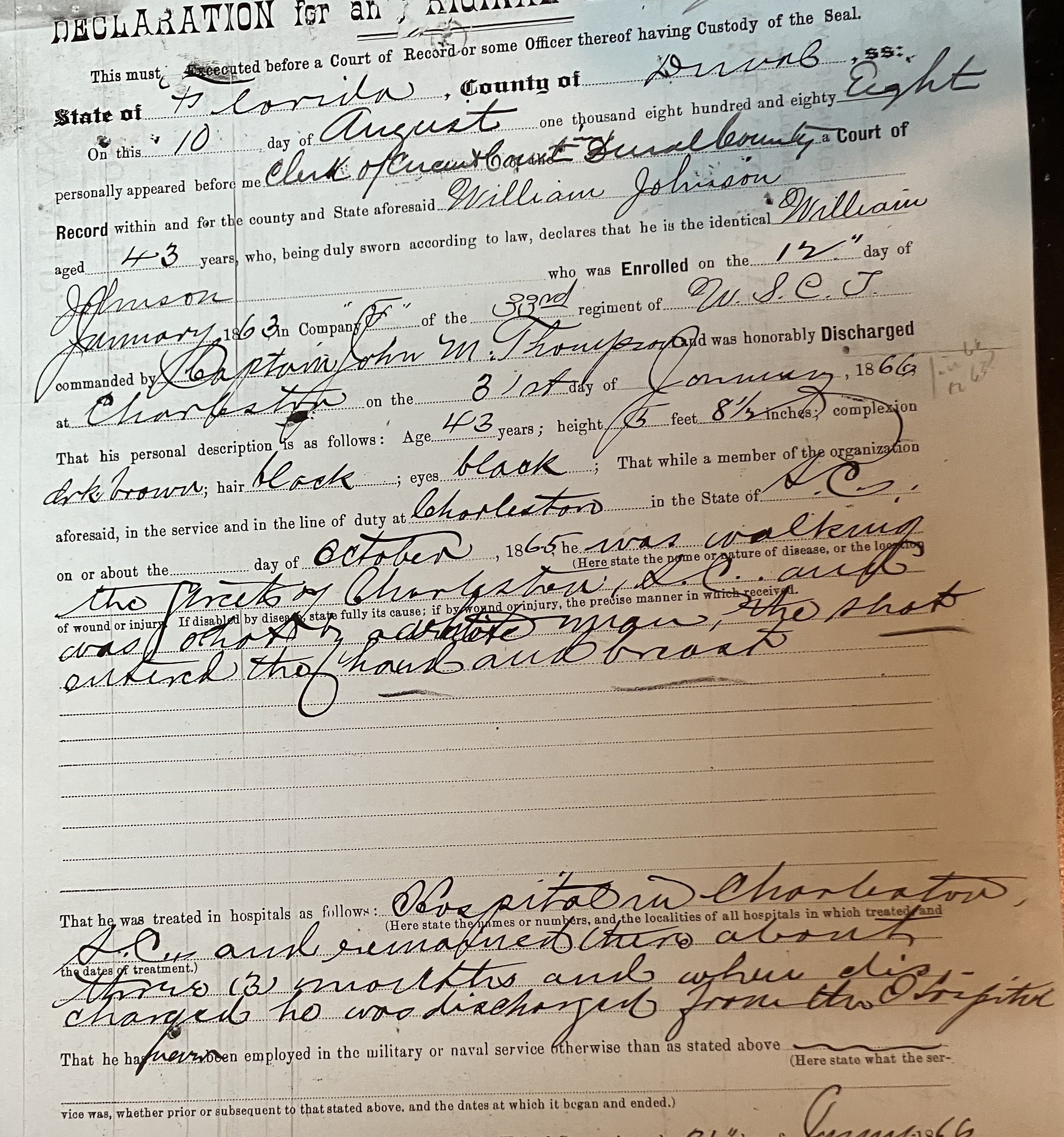
Pension records (below) show Johnson was shot in the hand and chest by a bushwhacker in October 1865, leaving him partially disabled. He was discharged the following year.

William Johnson's pension request details wounding (click to enlarge)
Johnson later lived in the Arlington neighborhood of Jacksonville and attended a church that was once located on Jacksonville University land. He married Fanny Jackson, who survived him by more than a decade after his 1892 passing. He was believed to be 51 when he died, Buettinger says.

“Because of his wounds, he could only do light gardening and he said he could only earn half of what an able-bodied worker earned,” said the professor.

Johnson has no living survivors. The exact location of his grave in the cemetery is not known.

Now is the time to replace a stone headstone

Established in 1934, Jacksonville University has five colleges, 11 schools and four institutes. Its 235-acre riverfront campus is “minutes from downtown and from beautiful area beaches.”

Dr. Craig Buettinger provides details about cemetery (Jacksonville University)
The last known burial at what was called Chaseville Cemetery was in about 1932. The burial ground served two African-American churches in Chaseville, a largely Black community on the northern end of Arlington. It’s possible Black Jacksonville police officers are interred there as well.

By 1962, the cemetery had fallen into neglect. There are no records, so officials don’t know how many graves are on the site and few, if any, remain marked.

“When it was rediscovered by JU staff member Jim Golden in 1989, only Johnson’s marble veteran’s headstone remained. Golden, himself a veteran, cleared up the grounds and held a ceremony for Johnson. Regrettably, that military headstone was later stolen,” Buettinger wrote in a summary about Johnson and the cemetery.

Buettinger and Ray Oldakowski, professor of geography, led the university effort to replace the headstone.

Artifacts recovered from the cemetery parcel (Jacksonville University)
The wooded site is on the edge of the campus, east of the Jacksonville University warehouse, near the Green Street gate, along University Boulevard. The cemetery is maintained by Jacksonville University.

Smith, with LISC Jacksonville, said it is too early to place cost estimates on the cemetery revitalization and the organization is working on funding sources.

The Haskell Company, which does design, engineering and construction work, is providing pro bono help to LISC and Jacksonville University through design and scoping documents. A company spokesman told the Picket it’s possible Haskell will eventually become involved in contracted work.

“Haskell will continue its pro bono work leading up to Nov 2024 when we anticipate having funding commitments and (a) final design in place for the cemetery,” said Smith. (At left, the current rendering for the overhaul of the campus cemetery, courtesy Jacksonville University)

JU President Tim Cost says the school is committed to honoring veterans. “It’s not only important to us, but especially to the Arlington community, to honor those who occupied this beautiful piece of land before us.”

Beasley, of UNF, said, “It’s been extremely inspiring to see how looking for information and conducting research has led to the physical manifestation of the headstone being created. No matter how small what you’re doing in the classroom is, it might have a large effect in the community,” Beasley added.

Buettinger believes the community and university have an opportunity to honor those buried on the campus.

“We must make sure that this cemetery is not again forgotten,” he said.

Tuesday, December 13, 2022

Unveiling of marker in Nashville will be the latest in the area to honor service of black Union troops (USCT) during the Civil War

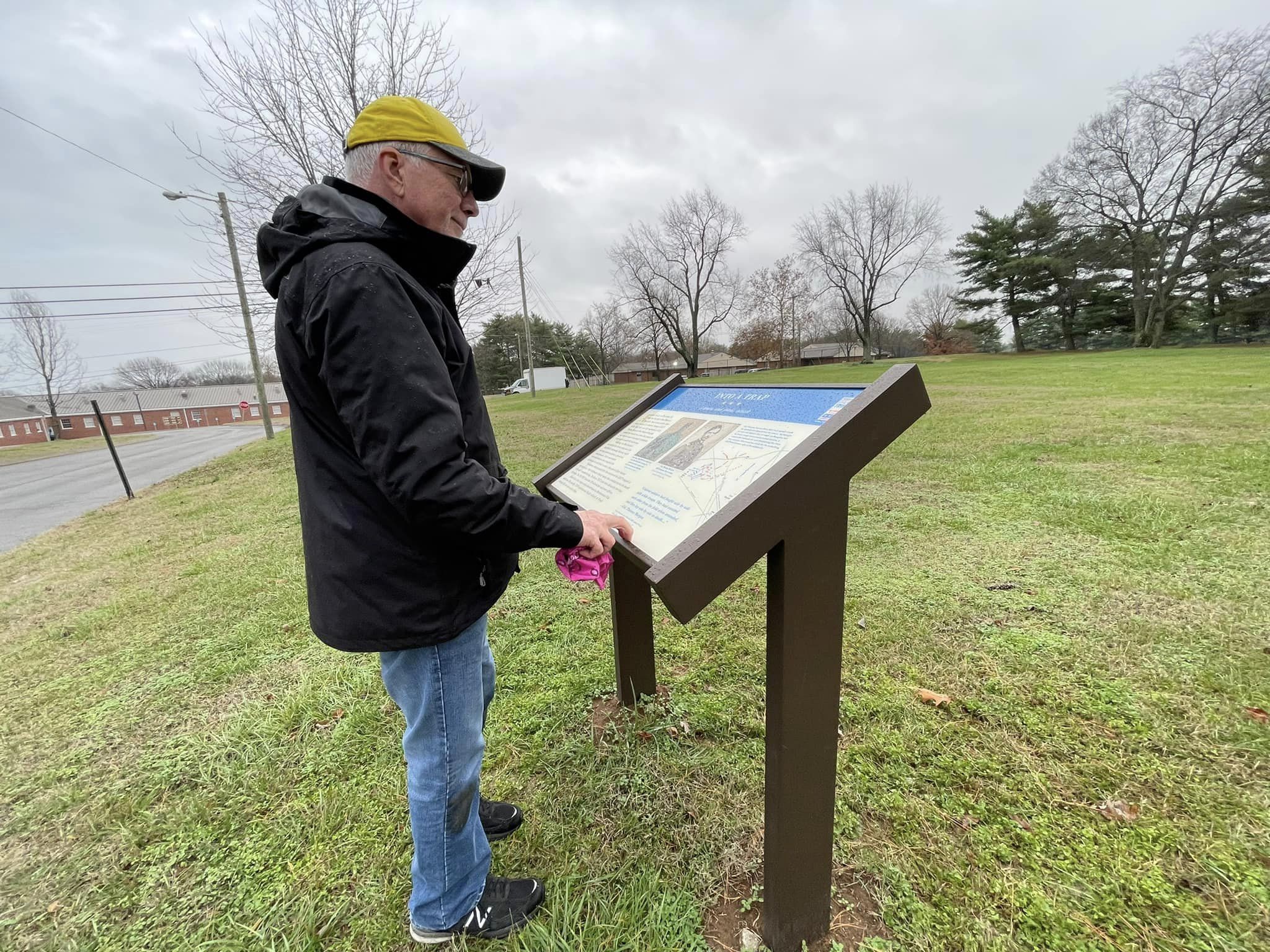
Jack Richards checks out the new Civil War Trails sign (Courtesy of John Banks)
African-American troops --- many former slaves seeing combat for the first time – will be remembered this week in Nashville with the dedication of the latest sign in the region to honor their valor during the Civil War.

The Battle of Nashville Trust, local officials and STEM Prep Academy backed the Civil WarTrails marker focusing on U.S. Colored Troops (USCT).

“The fact that this small sliver of battlefield survives and is the place where this monumental event occurred is amazing.” Drew Gruber, executive director of Civil Trails, said in a press release. “It’s not hard to stand at the new sign and imagine the United States flags being unfurled as these men charged forward charting a new course for our nation.” 

The event is scheduled for 10 a.m. Thursday (Dec. 15) at the school.

A fanciful depiction of Nashville includes Black troops (Library of Congress)
Three USCT regiments (14th, 17th and 44th) took part in a futile attack on fortifications on Dec. 15, 1864, the first day of the battle. The sign, on school property, is placed where troops advanced that morning.

Their object was the so-called Granbury’s Lunette, named for a Southern general who died two weeks earlier at fighting in nearby Franklin. A deep railroad cut, stronger than expected forces and artillery doomed the USCT assault. A maneuver by seasoned troops trapped them, and the USCT regiments and white Union troops were forced to retreat within 10 minutes.

The 17th had nearly 120 casualties in the fighting.

Other USCT troops had a bit more success the next day in fighting at Peach Orchard Hill, which led to a Confederate retreat after intense combat. The 13th USCT suffered crushing casualties.

Granbury's crescent lunette was strongly defended (Battle of Nashville Trust)
The Tennessee Wars Commission provided grants for the new marker and one planned for Peach Orchard Hill. In 2021, the Tennessee Historical Commission erected a sign about a half mile from Granbury’s Lunette, emphasizing the role of African-American troops.

Also in 2021, the Battle of Franklin Trust and local officials unveiled a statue honoring former slaves who fought for the Union.

USCT units were relatively new when the Battle of Nashville took place and there were questions of whether they would make an effective fighting force.

Federal Maj. Gen. George Thomas inspected the battlefield and said to his staff, “Gentlemen, the question is settled; Negroes will fight.”

About 180,000 black men served in Union forces during the conflict.

Dedication of a related marker in October 2021 (Battle of Nashville Trust)

Friday, October 7, 2022

More than a century after his death, research leads to a black Civil War naval veteran finally receives a headstone in Tacoma, Wash.

Wreaths were placed near new headstone Saturday (Oakwood Hill Cemetery)
Updated Oct. 10

In life, David Franklin and David Phillips may have rubbed elbows at a Tacoma, Wash., post of the Grand Army of the Republic in which they were members. Custer Post No. 6 was a home away from home for those who served the Union during the Civil War -- a place where veterans shared food and drink and accounts of their harrowing experiences while they were younger.

Sketch of David Franklin (Alan Archambault)
In the hereafter, Franklin and Phillips lie within steps of each other. But while Phillips, a white man who served in the 4th Minnesota, has a marked grave, the final resting spot of Franklin, Tacoma’s only black Civil War naval veteran, was topped only by grass.

That unfortunate situation was rectified this week with the installation of a marble Veterans Administration-approved headstone.

A dedication ceremony Saturday morning (Oct. 8) at Oakwood Hill Cemetery in Tacoma finally brought Franklin an honor he has long deserved.

The effort to recognize Franklin, who died in 1920 at age 79, was led by Loran Bures, Phillips’ second great-grandson. Bures, a member of the Sons of Union Veterans of the Civil War, the successor to the GAR, came across Franklin in 2017 while conducting research on veterans who lived in Pierce County, home to Tacoma.

The SUVCW’s mission includes researching GAR records, the registration of graves and Civil War memorials and monuments.

Bures (pronounced Burruss) came across a biographical card produced in 1939 during research by the Works Progress Administration into Civil War veterans in the area.

“It speaks volumes the information it doesn’t have,” Bures told the Civil War Picket this week.

The card does indicate Franklin died of heart disease on March 16, 1920, and was buried in the GAR section at Oakwood Hill.

But it had no information on any marker, the veteran’s military service and the fact that Franklin was black. While the GAR was open to all ethnicities, there were only three black sailors among the 2,000-5,000 Civil War veterans living in Washington, according to Bures, a 69-year-old retired librarian, archivist and researcher.

Bures came across Franklin’s death certificate and a National Park Service database that showed the man served as officers’ steward and cook on the USS Dawn. The steam-powered vessel took part in Federal blockades and captured several ships. Much of its service was on the James River in Virginia.

The USS Dawn’s most famous action came in May 1864 in the defense of Wilson’s Wharf in Virginia. The vessel’s guns and the Federal garrison made up of U.S. Colored Troops drove back the Confederate assault.

As a cook and steward, Franklin’s primary role would not have been combat, but it was common practice for a crew member to have a second duty station.

The USS Dawn was built in 1857. (Wikipedia)
At Wilson’s Wharf, “he most likely was helping bring powder and ammunition below deck to the three guns on the deck,” said Bures, adding there is no way to verify that.

Franklin is listed as an ordinary seaman in the NPS file.

Group does not know of living relatives

There are gaps in what’s known about Franklin, including when he moved to Washington and whether he ever married. His death certificate says he was widowed, but Bures said he has found no information about a spouse. The local SUVCW is asking any possible descendants or relatives to contact the organization.

It is known that Franklin was born in 1840. “He was born free in New York City to parents who were free people of color,” said Bures.

Franklin joined the Navy at age 23 in November 1863, midway through the Civil War. The NPS database lists him as being 5 foot 5 inches tall and working as a cook. He served on USS Dawn until near war’s end, mustering out in March 1865.

Bures believes the veteran came to Pierce County between 1885 and 1888. He is listed in a GAR roster for the latter year and a 1907 volume includes Franklin among 752 members (comrades) in the Custer post.

Records show that Franklin joined the Washington National Guard infantry as a cook in 1906.

Ensuring proper honors for veteran

Bures traveled to Oakwood Hill Cemetery several months ago to inspect Franklin’s grave.

He suspected it might be unmarked because of the WPA card and a Findagrave profile that had no photo of a headstone. (Researchers have been unable to find a photograph of Franklin. Bures' second great-grandfather, 1st Sgt. David Phillips, is buried at Tacoma Mausoleum, which adjoins the cemetery.)

Oakwood Hill verified the seaman was buried there and had not been exhumed, officials told the Picket .

Franklin’s resting place was a gap in a row of headstones for other GAR members. Bures and others put together verification information for the VA, including evidence of a Navy pension.

Franklin's graves was marked only by a flag (Loran Bures)
Bures would speculate on why Franklin’s grave received no marker. “There could be a lot of reasons for it.” Oakwood Hill Cemetery co-owner Corey Gaffney told the Picket he, too, did not know why a headstone was not set in 1920.

Gaffney, who purchased the business with his wife, Jennifer, in 2021, told theTacoma News-Tribune the cemetery was providing resources to ensure Franklin received proper honors.

The grave is among weathered headstones that appear not to have been cleaned in recent years. The businessman told the Picket that the couple is working to make improvements at the cemetery and funeral home and restore the site to "its former glory."

"We believe that in 3-5 years this property will be completely viable and unrecognizable to some. That’s our hope and our goal."

Gaffney told the Picket in an email after the ceremony that "the definition of integrity is doing the right thing when no one is looking. While we did have coverage of this event and dedication, there are countless other actions we’ve took for the benefit of this cemetery that have gone unnoticed.  We do not do things for accolades; more for knowing at the end of the day that we acted appropriately on behalf of those in our care that cannot do so anymore themselves."

Bures said there are other unmarked graves of Civil War veterans across the state.

“It is important they receive recognition for their service to the Union, as any veteran deserves proper recognition.”

The SUVC's Gov. Isaac Stevens Camp No. 1, in which Bures is an officer, led Saturday's headstone dedication. The ceremony included a wreath laying, remarks, a biography of Franklin and funeral honors performed by re-enactors.

Loran Bures stands on Franklin's grave before marker was placed; behind is a mausoleum. 

Friday, September 2, 2022

Rally to the sound of the guns: Fort Pulaski near Savannah is looking for cannon crew volunteers. Here's what you need to know before enlisting

Crew fires a Parrott gun and trains on a howitzer; Doherty in foreground (NPS photos)
WANTED: Able-bodied men and women. No experience required. Applicants will undergo training and must pass a test. Requirements include working well with others and following orders. Job includes wearing a woolen uniform in hot weather. The position is a lot of fun, but safety comes first -- always. You’ll be firing cannons.

Fort Pulaski National Monument outside Savannah, Ga., recently took to social media to find folks for its cannon crew, with a special focus on Saturdays. While the Facebook post was not written quite like the Picket’s mock ad above, the job does entail those requirements.

Shannon L. Doherty, a park guide at Pulaski and its historic weapons supervisor, says it’s been tough to always field a crew because core volunteers sometimes can’t attend every event and staffers can’t always work extra days.

That’s where you might come in.

The cannon crew has typically been made up of older volunteers, many military veterans. But Doherty welcomes all those who can qualify.

“No experience is fine, because you have to be trained either way,” she says. “Firing a historic cannon is exhilarating. It’s loud and there’s the sulfur smell. The visitors come up and talk about how much they enjoyed it.”

The Fort Pulaski cannon crew portrays Union artillerymen.

They fire a reproduction 30-pounder Parrott rifle -- which recoils a bit -- and a 12-pounder smoothbore field howitzer, both made by Steen. The latter was not used in the Pulaski siege, but was a common anti-infantry weapon during the war.

National Park Service cannon and rifle crews do not fire period weapons. Chief Ranger George Elmore of Fort Larned National Historic Site in Kansas told the Picket in 2014 the agency does not want to risk destroying an historic artifact.

Various stages of the making of artillery rounds, not in sequence.
Doherty, trained in black powder, supervises  the work. (NPS photos)
Fort Pulaski has about two dozen cannons, several of which date to the Civil War. The Confederate masonry fortification surrendered in April 1862 after withering fire from Federal rifled guns destroyed parts of the wall and threatened its magazine. The innovative rifled weapons brought an end to that type of fort construction.

NPS venues that fire reproduction 18th and 19th century small arms and artillery must have an employee certified in their use and safety. Of course, actual rounds are not fired. Doherty, who underwent required NPS black-powder training in March, must be present at all cannon firings and she trains and supervises the crew.

Crew members must have awareness and aptitude

Both of Fort Pulaski’s demonstration weapons are in the parade ground. Each is fired during a typical 25-minute program. “We are trying to connect it to the theme of the park,” says Doherty. One example is the freedom story – how the Federal army helped the emancipation process.

National parks that fire cannons must follow a lengthy safety manual that is remarkably close to standards during the Civil War. “We try to be historically accurate and as safe as possible,” says Doherty.

Cannoneers sponge the Parrott barrel at Pulaski (NPS photo)
Accidents are exceedingly rare, but the work does come with danger. In 2014, the breech of a gun fired at Fort McHenry National Monument failed, leaving one member of the cannon crew slightly injured.

Fort Pulaski requires volunteers to read the rules and take a 24-question test on safety. A couple questions are, “If the cannon fails to fire, what command is given?” and “The minimum waiting time before the piece is reprimed after a misfire is:”

The NPS manual of instruction begins with a sobering reminder for crews to be well-trained and prepared. It lists the four primary causes of accidents in historic weapons demonstrations using artillery:

1. Rapid firing

2. Poorly maintained or improper equipment

3. Improper drill

4. Improper ammunition

Cannon crew members march in for a demonstration at Pulaski (NPS photo)
During the Civil War, guns typically had a crew of eight. Crews firing replica weapons typically have six members, with one member fulfilling three spots, involving retrieving a charge and moving it up to the cannon.

Doherty makes sure they go over equipment and members understand all positions. Unlike, the Civil War, when all those in a battery needed to be interchangeable because of death or injury, volunteers don’t have to serve at every position.

For example, the No. 1 position involves sponging the barrel and ramming the round down the tube. “That can freak some people out.” 

The crew drills the morning of any cannon firings.

“(It’s) being comfortable into whether it was in one position or others, feeling confident. Not being shaky on anything,” Doherty says. “I am watching to see proficiency, if someone isn’t doing too well.” (At right, Parrott sponger, rammer and wormer at Fort Pulaski, NPS photo)

Another view of the howitzer training (NPS photo)
Elmore, who has conducted safety courses for NPS staffers, said each park is required to have its own magazine, meet ATF (Bureau of Alcohol, Tobacco, Firearms and Explosives) requirements and to have a loading area.

Doherty says the crew routinely goes over equipment, for example ensuring there are no holes in hand gloves are splinters in the sponge rammer. They are equipped with hearing protection.

The cannon cannot be fired more than once every 10 minutes. Visitors are 50 feet away and no one can be downrange of the barrel.

“This is not a race. We do need to be deliberate in the steps and not a rush. That’s when errors happen.”

Making the rounds safely is exacting work

Doherty – following ATF and NPS rules -- works with a mold to make the replica rounds, which contain aluminum foil, black powder and peat moss; the latter adds length and volume to the shell. On the day of firing, a friction primer causes ignition, setting off the black powder.

Black powder, finished rounds are kept in powder magazine
The black powder and finished rounds are stored in a World War II-era magazine.

The powder comes in a plastic bottle. The larger Parrott gun requires all 16 ounces while the howitzer uses about half of that.

Doherty takes the powder from the magazine, places it in a locked non-sparking box and works in another room after park hours.

While Doherty solely can do a few of the steps, others can help certain parts of the preparation – but only under her supervision.

To prevent a fire or explosion, Doherty works with a wooden table that has no exposed nails. It takes about 30-45 minutes to prepare six rounds, enough for three firings a day.

The rounds, weighing about a pound, are returned to the magazine for future use.

When the Picket wrote about NPS black-powder training in 2014, powder cost about $15 a pound. Like everything else, it’s gotten a lot more expensive.

A recent order of 50 pounds cost about $1,200 with shipping, Doherty says.

Fort Pulaski has helped other parks, including Fort Sumter National Monument, with supply.

More crew members, more cannon firings

The venue hopes the addition of a few more volunteers might ensure Saturday firings throughout the year.

Interestingly, the park did artillery demonstrations on Wednesdays during June and July because of higher staffing that day and the fact that visitors tended to travel on the weekends.

A crew moves the limber in the Fort Pulaski parade ground (NPS photo)
Fort Pulaski is particularly busy in November and December for holidays, thus the push to recruit more crew members. Doherty has three core members, all area retirees, to depend on, but she needs a bigger pool of recruits.

Sometimes, re-enactors come in with different standards. Doherty stresses people need to be open to learning and follow NPS rules.

For all the safety concerns, serving on a crew has its rewards.

“We can provide unrivaled weekend entertainment and outstanding camaraderie,” the park’s callout said.

Recruits can enlist with the Fort Pulaski cannon crew by emailing Historic Weapons Supervisor Shannon Doherty at shannon_Doherty@nps.gov. Applicants will also speak with the park's volunteer coordinator.