Showing posts with label cannon. Show all posts

Saturday, July 4, 2026

Savannah dredging operations brought up numerous Civil War and Revolutionary War cannons and artifacts. How did the projects and weapons compare?

CSS Georgia Dahlgren pulled up from river in 2015; one of the Revolutionary War cannons in 2021 and this week's unveiling of conserved artillery pieces at the Savannah History Museum (U.S. Army Corps of Engineers photos)
A stunning collection of Revolutionary War cannon recovered off Old Fort Jackson in Savannah, Ga., is now on public display, the culmination of an extensive archaeological and conservation effort.

A contractor dredging the Savannah River in 2021 came across the first of the 19 artillery pieces, which some thought might belong to CSS Georgia, a Confederate ironclad that was scuttled nearby by its crew in December 1864. But it soon became apparent they dated to the American Revolution and the British siege of the city in 1779. They were on ships scuttled by the British to prevent French support of the colonists.

The surprise discovery of the Revolutionary War weapons came following the 2015-2017 recovery of items associated with the Civil War ironclad.

That U.S. Army Corps of Engineers harbor deepening project, which involved contractors and U.S. Navy divers, recovered more than 30,000 CSS Georgia artifacts, including 241 pieces of ordnance, five cannons and two large casemate sections. The latter were documented and left in the water.

A section of the CSS Georgia's casemate in 2017 (U.S. Army Corps of Engineers)
The Corps of Engineers worked with Texas A&M University to conserve the CSS Georgia material and then 17 of the cannons associated with the Revolutionary War. The Savannah History Museum this week openedLoyalists and Liberty: Savannah in the American Revolution.”

Chris Dostal, director of the conservation lab at Texas A&M, told the Civil War Picket:

From a conservation standpoint, both projects involved large, concreted iron artillery from a marine or riverine environment, but the Savannah River cannon presented a particularly unusual opportunity because so many guns were recovered together, several with associated bore contents preserved.”

Some CSS Georgia artifacts are on display at the National Civil War Naval Museum in Columbus, Ga. (At left, one of its propellers, Picket photo).

That venue "is the only institution with CSS Georgia artifacts on loan from our office," said Kate Morrand, a conservator with the Naval History and Heritage Command. "The remainder of the CSS Georgia collection includes over 5,100 artifacts and is curated by the NHHC Underwater Archaeology Branch, based at the Washington Navy Yard."

The command was involved in the CSS Georgia project but the Revolutionary War cannons were not under its purview.

The Picket recently asked Corps officials to provide some context to how both archaeological projects dovetailed or differed.

The following responses came from Francis “Franky” Stankiewicz with Chronical Heritage, Andrea Farmer, archaeologist with the Savannah district of the Army Corps, and Cheri Pritchard, media relations chief with that office. The responses have been edited for brevity and context.

Q1: Are you any closer to knowing precisely which British ships these Revolutionary War cannon belonged to? I know the HMS Rose was ruled out.

A: We have learned a great deal since the cannon were conserved, but I would not say we can assign individual guns to specific vessels with certainty. The strongest current interpretation is that the assemblage most likely originated from the armed ship Savannah, formerly the American privateer General Arnold, and the British transport Venus, both of which were associated with the 1779 Siege of Savannah. Current research suggests that domestic colonial production is the most likely origin for the guns attributed to the General Arnold/Savannah. However, manufacture in Britain, France (particularly Bordeaux), or Spain (particularly Bilbao) cannot be ruled out. Within the realm of domestic production, Rhode Island and Pennsylvania presently appear to be the most probable manufacturing centers.

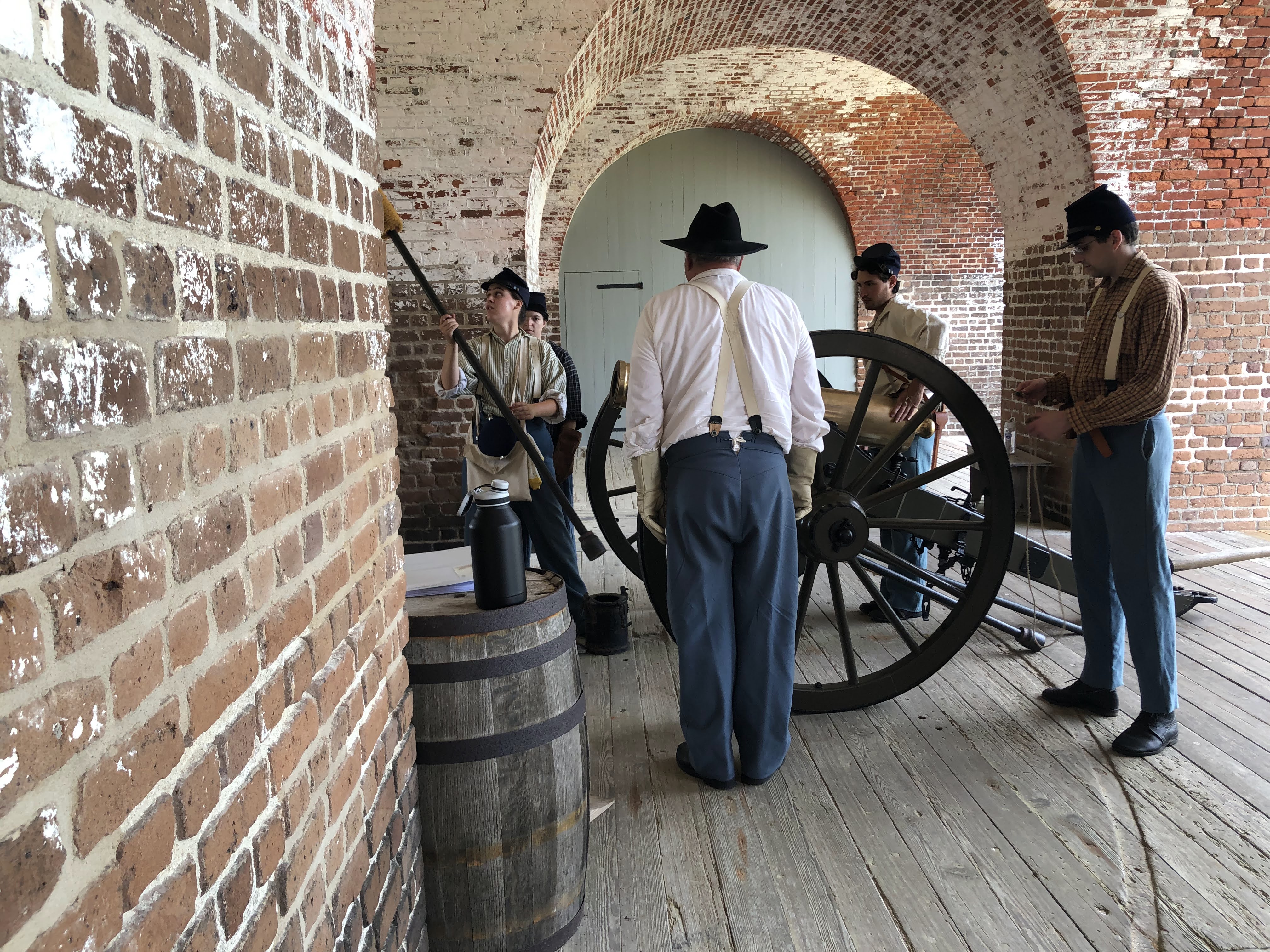
Andrea Farmer with two reenactors at the Savannah History Museum (USACE photos)
Q: There was early speculation these 19 cannons might date to the Revolutionary War era but might have been placed on the CSS Georgia or fortifications. What led you to determine they dated to the Revolution?

A: The Revolutionary War interpretation rests on several lines of evidence. Typologically, the guns are mid-to-late 18th-century 6-pounders, including examples exhibiting Armstrong-pattern characteristics as well as related short-gun variants. Historically, British and French accounts document the burning and scuttling of armed vessels in this section of the Savannah River during the 1779 Siege of Savannah, consistent with the location of the recovery area. Archaeologically, many of the cannon were recovered in a loaded condition, containing tampions, wadding, shot, powder cartridges, fuse remains, and powder residue, indicating that they were likely prepared for immediate use rather than discarded at a later date. Taken together, the age, location, and loaded condition of the guns strongly support their association with the Revolutionary War-era scuttling events in the Savannah River.

Q: From an archaeological and conservation viewpoint, how different are these cannons vs. those found at CSS Georgia site?

A: From a conservation standpoint, these cannons were unusually rich in sealed contexts. Most were heavily concreted and contaminated cast iron, but many still held preserved bore contents. That meant conservation was also excavation: tampions, hemp junk wads, shot, cartridges, and residues had to be removed and documented in sequence. CSS Georgia material, by contrast, is Civil War ironclad wreckage and ordnance context: later, more industrial, and tied to an armored floating battery. The Savannah cannon assemblage is earlier, Revolutionary War-era muzzle-loading artillery, and its research value comes heavily from the combination of gun form, loading evidence (i.e., material within), and scuttling context. (See link for more photos)

Q. I know the investigation into CSS Georgia concluded a few years back. Have you learned anything more about the site or vessel since then?

A: The CSS Georgia investigation itself concluded earlier, and the current investigations do not indicate a major new interpretation of the vessel since that work. What they do add is a broader landscape context: the cannon cluster site lies near, but is not part of, the CSS Georgia site, and prior mapping work around CSS Georgia actually helped identify the Revolutionary War cannon concentration.

Q: Do you have a schematic/map or illustration showing their precise location in the Savannah River? And do you have anything similar showing the CSS Georgia cannon location -- or both put together?

A: To help preserve and protect these cultural resources long-term, we are not publicly disclosing their precise locations. While the locations are known to a limited number of researchers and resource managers, there is broad agreement that this information should remain restricted for now. Limiting access helps protect the sites from disturbance while supporting future research and analysis that may provide additional insights. Researchers continue to use a variety of mapping products, including sonar and multi-beam imagery of the Cannon Cluster Site near Fort Jackson. Specific details about the exact locations of these resources and their relationship to one another are also being withheld to support ongoing stewardship and future study. In addition, the Savannah Harbor shipping channel is heavily trafficked by large commercial vessels. Restricting site locations helps discourage unauthorized diving activity and reduces potential safety risks. (At left, anchor from one of the 18th century vessels, USACE)

Q: Finally, what is your long-term perspective on both CSS Georgia and these 19 cannons -- What do they tell us about their chapters in American history?

A: Although separated by nearly a century, CSS Georgia and the Revolutionary War cannon cluster represent two distinct chapters in Savannah's long history as a strategically important river port. CSS Georgia represents the Civil War effort to hold the river with improvised Confederate naval technology, including an ironclad that functioned more as a floating battery than an effective maneuvering warship. The cannon cluster reaches back to the Revolution when British forces deliberately used vessels and their armament to obstruct the river and help stop the French fleet during the Siege of Savannah. Together, they show that control of the Savannah River was repeatedly central to military strategy, commerce and the fate of the city.

------

Postscript: Gordon Watts' perspective on the RevWar cannons

Archaeologist Gordon Watts, who dived and studied the CSS Georgia wreck site for decades, was present for the recovery of artifacts and helped write a final report on the project. I asked him for his perspective on the Revolutionary War cannons.

Gordon Watts studies CSS Georgia casemate section in 2017 (Civil War Picket photos)
Q. Were you surprised that British cannons were found near Old Fort Jackson?
A.  No surprise. If familiar with the Revolutionary War in Savannah, Fort Jackson did not even exist at that time. Construction on that fortification did not begin until 1808.


Q. Any reaction to their discovery? Also, what do you think of the combination of Civil War and RevWar artillery in the same area?
A. Initial reaction was with the lack of associated Revolutionary War vessel remains with the ordnance.  Savannah was the site of considerable Revolutionary War military and naval activity. Likewise, Savannah was the site of considerable military and naval activity during the War Between the Confederate States and the United States. The presence of sunken vessel remains and artifacts in the Savannah River in the proximity of the city is not unusual.

Q. Have you learned anything more about the site or vessel since then?
A: 
Conservation and analysis of the ordnance, casemate structure and cultural material from the CSS Georgia has shed considerable light on one of the earliest Confederate Ironclads. The CSS Georgia underwater archaeological investigations was, and remains, one of the most comprehensive undertaken to date and has resulted in extensive historical research and publication.

The archaeological investigation has produced an extensive collection of ordnance, vessel structure and cultural material that supports informative displays.

Q. Anything else?
A.  Very pleased to see the levels of interest in and support for documentation and exhibition of material associated with both of the Savannah River underwater archaeological sites. Hopefully, that level of interest will inspire similar investigation of other underwater archaeological sites in the Savannah and back rivers and other sites in waterways farther away but closely associated with Savannah and Georgia's history.

Tuesday, June 30, 2026

'Faithful Unto Death': Gettysburg hero Alonzo Cushing's Medal of Honor will be displayed at park visitor center for this week's 163rd anniversary

1st Lt. Alonzo Cushing (center, back) and other artillery officers at Antietam in 1862 (Library of Congress)
The Medal of Honor awarded to artillery 1st Lt. Alonzo H. Cushing will be displayed at Gettysburg National Military Park on the anniversary of his death during Pickett’s Charge.

The medal and display box will be on exhibit July 1-5 at the park’s museum and visitor center.

This rare display coincides with the anniversary of the Battle of Gettysburg, offers visitors a unique opportunity to reflect on Cushing's sacrifice where it occurred and provides them with the opportunity to view the nation’s highest military decoration awarded to one of Gettysburg’s most recognized Union officers,” the Gettysburg Foundation said.

Cushing's Medal of Honor has been displayed at various sites (Gettysburg Foundation)
The Delafield, Wisc., native was raised in Fredonia, N.Y. Cushing, one of three brothers who had distinguished military service, was only 22 when he fell leading his battery.

At Gettysburg, Cushing and his battery of six 3-inch ordnance rifles took position with Brig. Gen. Alexander S. Webb's brigade on July 2, 1863. They were engaged throughout the day and again on July 3 as Confederate forces opened a two-hour artillery bombardment that preceded the assault known as Pickett's Charge, the foundation said.

Battery A, 4th U.S. Artillery was at a spot dubbed "The Angle."

Cushing suffered two grievous wounds and directed the operation of a field piece during the massive Rebel advance. He refused to leave the field. A bullet to the head killed him instantly.

In 2014, the young officer received the Medal of Honor from President Barack Obama for demonstrating conspicuous gallantry, inflicting severe casualties on the enemy and helping to turn back the charge. A descendant living in California accepted it on Cushing's behalf.

"This medal is a reminder that no matter how long it takes it's never too late to do the right thing," Obama said during the brief ceremony at the White House Roosevelt Room.

It was rare for a Federal officer during the war to receive a Medal of Honor and historians acknowledge efforts to recognize Cushing at the time probably were sidetracked because others survived the momentous July 1863 battle in Pennsylvania and wrote about their service.

It was largely up to the descendants of Cushing, who like his three brothers had no children or direct descendants, to keep alive his legacy, saving his letters, traveling to Gettysburg and sharing stories around the Thanksgiving table.

Among those joining the Cushing and Loring families in Washington, D.C. for the White House and U.S. Army ceremonies was Margaret E. Zerwekh, then 94, of Delafield.

Zerwekh, who died in 2018, lived on property once owned by the Cushing family. She performed research on him and petitioned a congressman years ago to support the honor. Efforts involved additional politicians and military experts who studied records of the young artilleryman's stand at Gettysburg.

Cushing's citation reflects the same devotion expressed in the words inscribed on his headstone (left, click to enlarge) at West Point: "Faithful unto Death." 

Cushing's medal is now part of the collection at Gettysburg National Military Park.

Monday, December 4, 2023

Was this wagon wheel shattered in explosion as Sherman's troops took S.C. capital? Experts hope to learn more when they conserve hundreds of artifacts

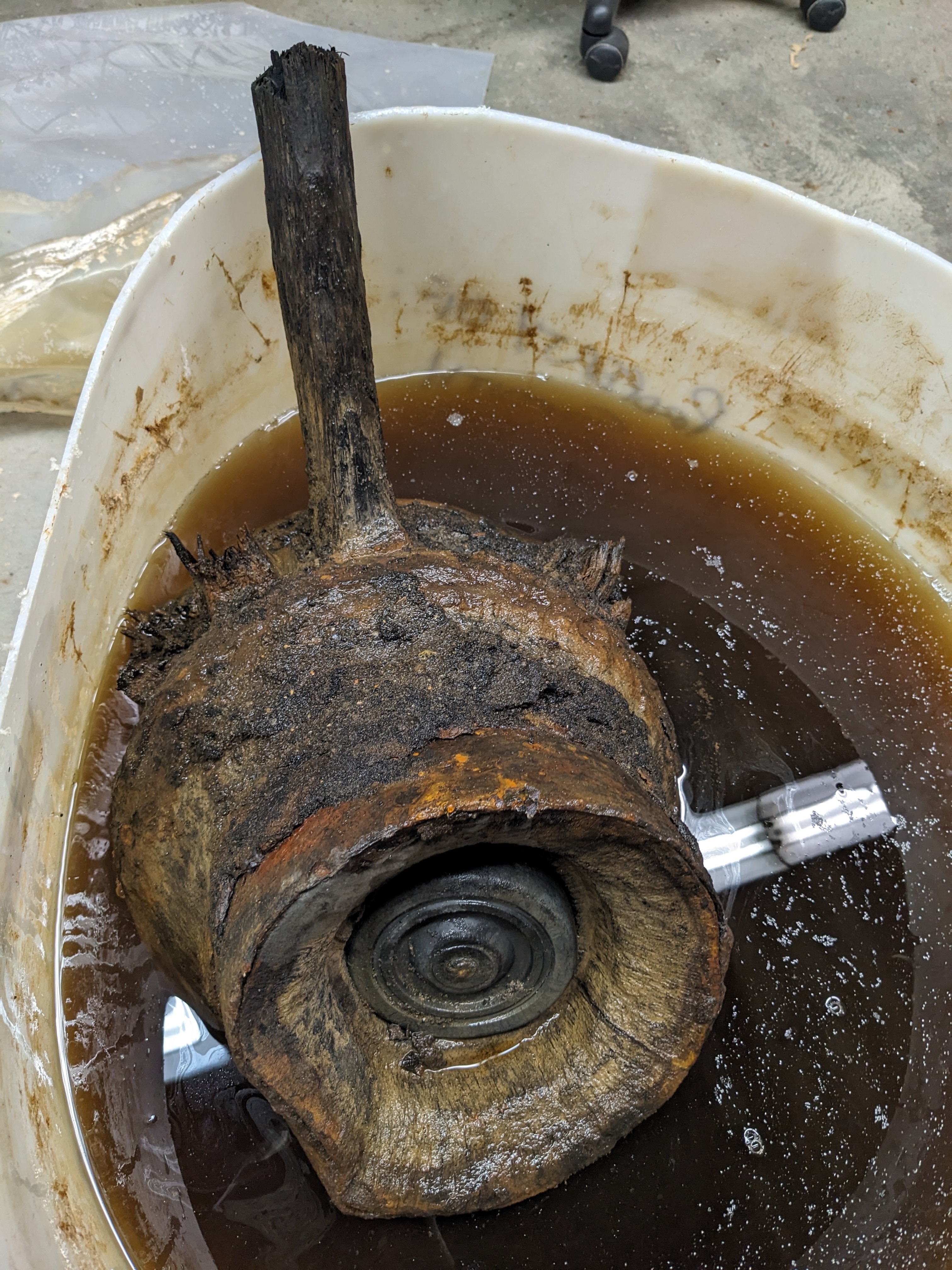
The wheel hub recovered from the Congaree River (Courtesy of Sean Norris, TRC Companies)
A metal detector first noticed the round object buried in the bed of the Congaree River in Columbia, S.C. Archaeologists surmised it was a just another rubber tire -- one of many found during an extensive river cleanup.

After all, some 2.5 tons of debris – including trash, tires and scrap metal – were carted off during the removal of toxic, century-old coal tar along the shoreline, Dominion Energy announced last month.

Crews decided to dig out the object by hand, expecting an item made well past the Civil War-era.

“Once it was exposed, we knew we had something much more interesting than that,” said Sean Norris, program archaeologist for TRC Companies, a subcontractor for Dominion Energy.

The item was the shattered hub of a wagon wheel, and it’s possible it was damaged in an explosion when Union troops who took the city in February 1865 dumped tons of captured Confederate ordnance into the Congaree. (Photo below, courtesy of South Carolina Confederate Relic Room and Military Museum)

The artifact was found an area where numerous rounds of Civil War ammunition were recovered.

“We had a few folks from the (South Carolina Confederate Relic Room and Military Museum) take a preliminary look and our consensus was that this wheel fit the time frame for a Civil War-era wagon. The location in association with other artifacts of that time period lead us to believe that this wheel was deposited around the same time the other ordnance was dumped in the river,” Norris said in an email.

“The official records mention the explosion and the destruction of a wagon and a team of mules in a couple correspondences. It seems possible that what was left of the wagon after it was destroyed was thrown in the river along with everything else that was being dumped. There would be no specific reason for the wagon parts to be discarded elsewhere.”

Wartime reports indicated three Federal soldiers, including Capt. Williamson M. Davis, died in the explosion. Another 20 or so troops were injured.

The wheel, which shows signs of charring, currently rests in a plastic vat at the Relic Room in Columbia as it awaits conservation.

The museum typically has it covered with a wet towel and plastic bag to keep in moisture. Exposed wood -- if left to dry before conservation -- can disintegrate, experts said.

Archaeologists recovered about 500 Civil War artifacts during the project. Most of those will go to the Relic Room after treatment, which could take up to 18 months, said Chelsea Sigourney, curator of exhibits and collections.

Exhibit on burning of Columbia (Courtesy South Carolina Confederate Relic Room and Military Museum)
“Some artifacts will be stabilized in distilled water and later go through electrolysis” at the South Carolina Institute for Archaeology and Anthropology (SCIAA), Sigourney told the Picket.

“I’d like to be able to have a small exhibit about what is collected from the dig, but that is a project for the future. I wouldn’t even attempt to set a date for that until we hear conservation is complete,” the curator said.

The Relic Room has exhibits that mention Sherman’s occupation and the burning of the capital.

Remnants of Rebel sword, canister and iron spike points (James Legg, SCIAA)
James Legg, public archaeologist for SCIAA, said the agency will handle the bulk of the conservation work. 

“I think I currently have about 200 Civil War artifacts and an assortment of other metal artifacts. This is essentially what the EOD (explosive ordnance disposal) teams recovered during excavation, and it was convenient to bring it on over here to SCIAA in anticipation of the TRC contract,” Legg told the Picket.

“TRC still has a collection of similar or somewhat smaller size that was recovered during the off-site screening process. They may conserve some or all of that group,” he said.

Numerous cannonballs were recovered (James Legg, SCIAA)
The Civil War-related artifacts found during the project include some 6-pounder, 12-pounder and 10-inch projectiles, a large number of canister and grape shot balls, canister plates, small arms ammunition and a Confederate sword blade. Only the lead bullets will not require conservation

“The entire collection (or the half or more that I do) will take about a year to complete, once we begin. I will use electrolytic reduction, manual cleaning and other neutralization techniques before sealing each piece,” Legg wrote in an email.

He said it was unclear who would do the work on the wagon wheel. 

Allen Roberson, executive director of the Relic Room, said he has submitted a proposal for funding of an exhibit room on the discoveries.

Details of Sherman's campaign (Courtesy South Carolina Confederate Relic Room and Military Museum)
“Some of that dig is fascinating,” Roberson told the Carolina News and Reporter. “I think the archaeological recovery is almost as insane as what you pull out of the river.”

He told the news outlet that the exhibit may open in a year and a half to two years.

Norris said most of the river artifacts are at a TRC Companies laboratory, awaiting conservation and curation. He expects analysis of the wheel to begin in the new year.

Archaeologists did not find any other wheels, metal hubs or large pieces of wood near the wheel.

Friday, September 2, 2022

Rally to the sound of the guns: Fort Pulaski near Savannah is looking for cannon crew volunteers. Here's what you need to know before enlisting

Crew fires a Parrott gun and trains on a howitzer; Doherty in foreground (NPS photos)
WANTED: Able-bodied men and women. No experience required. Applicants will undergo training and must pass a test. Requirements include working well with others and following orders. Job includes wearing a woolen uniform in hot weather. The position is a lot of fun, but safety comes first -- always. You’ll be firing cannons.

Fort Pulaski National Monument outside Savannah, Ga., recently took to social media to find folks for its cannon crew, with a special focus on Saturdays. While the Facebook post was not written quite like the Picket’s mock ad above, the job does entail those requirements.

Shannon L. Doherty, a park guide at Pulaski and its historic weapons supervisor, says it’s been tough to always field a crew because core volunteers sometimes can’t attend every event and staffers can’t always work extra days.

That’s where you might come in.

The cannon crew has typically been made up of older volunteers, many military veterans. But Doherty welcomes all those who can qualify.

“No experience is fine, because you have to be trained either way,” she says. “Firing a historic cannon is exhilarating. It’s loud and there’s the sulfur smell. The visitors come up and talk about how much they enjoyed it.”

The Fort Pulaski cannon crew portrays Union artillerymen.

They fire a reproduction 30-pounder Parrott rifle -- which recoils a bit -- and a 12-pounder smoothbore field howitzer, both made by Steen. The latter was not used in the Pulaski siege, but was a common anti-infantry weapon during the war.

National Park Service cannon and rifle crews do not fire period weapons. Chief Ranger George Elmore of Fort Larned National Historic Site in Kansas told the Picket in 2014 the agency does not want to risk destroying an historic artifact.

Various stages of the making of artillery rounds, not in sequence.
Doherty, trained in black powder, supervises  the work. (NPS photos)
Fort Pulaski has about two dozen cannons, several of which date to the Civil War. The Confederate masonry fortification surrendered in April 1862 after withering fire from Federal rifled guns destroyed parts of the wall and threatened its magazine. The innovative rifled weapons brought an end to that type of fort construction.

NPS venues that fire reproduction 18th and 19th century small arms and artillery must have an employee certified in their use and safety. Of course, actual rounds are not fired. Doherty, who underwent required NPS black-powder training in March, must be present at all cannon firings and she trains and supervises the crew.

Crew members must have awareness and aptitude

Both of Fort Pulaski’s demonstration weapons are in the parade ground. Each is fired during a typical 25-minute program. “We are trying to connect it to the theme of the park,” says Doherty. One example is the freedom story – how the Federal army helped the emancipation process.

National parks that fire cannons must follow a lengthy safety manual that is remarkably close to standards during the Civil War. “We try to be historically accurate and as safe as possible,” says Doherty.

Cannoneers sponge the Parrott barrel at Pulaski (NPS photo)
Accidents are exceedingly rare, but the work does come with danger. In 2014, the breech of a gun fired at Fort McHenry National Monument failed, leaving one member of the cannon crew slightly injured.

Fort Pulaski requires volunteers to read the rules and take a 24-question test on safety. A couple questions are, “If the cannon fails to fire, what command is given?” and “The minimum waiting time before the piece is reprimed after a misfire is:”

The NPS manual of instruction begins with a sobering reminder for crews to be well-trained and prepared. It lists the four primary causes of accidents in historic weapons demonstrations using artillery:

1. Rapid firing

2. Poorly maintained or improper equipment

3. Improper drill

4. Improper ammunition

Cannon crew members march in for a demonstration at Pulaski (NPS photo)
During the Civil War, guns typically had a crew of eight. Crews firing replica weapons typically have six members, with one member fulfilling three spots, involving retrieving a charge and moving it up to the cannon.

Doherty makes sure they go over equipment and members understand all positions. Unlike, the Civil War, when all those in a battery needed to be interchangeable because of death or injury, volunteers don’t have to serve at every position.

For example, the No. 1 position involves sponging the barrel and ramming the round down the tube. “That can freak some people out.” 

The crew drills the morning of any cannon firings.

“(It’s) being comfortable into whether it was in one position or others, feeling confident. Not being shaky on anything,” Doherty says. “I am watching to see proficiency, if someone isn’t doing too well.” (At right, Parrott sponger, rammer and wormer at Fort Pulaski, NPS photo)

Another view of the howitzer training (NPS photo)
Elmore, who has conducted safety courses for NPS staffers, said each park is required to have its own magazine, meet ATF (Bureau of Alcohol, Tobacco, Firearms and Explosives) requirements and to have a loading area.

Doherty says the crew routinely goes over equipment, for example ensuring there are no holes in hand gloves are splinters in the sponge rammer. They are equipped with hearing protection.

The cannon cannot be fired more than once every 10 minutes. Visitors are 50 feet away and no one can be downrange of the barrel.

“This is not a race. We do need to be deliberate in the steps and not a rush. That’s when errors happen.”

Making the rounds safely is exacting work

Doherty – following ATF and NPS rules -- works with a mold to make the replica rounds, which contain aluminum foil, black powder and peat moss; the latter adds length and volume to the shell. On the day of firing, a friction primer causes ignition, setting off the black powder.

Black powder, finished rounds are kept in powder magazine
The black powder and finished rounds are stored in a World War II-era magazine.

The powder comes in a plastic bottle. The larger Parrott gun requires all 16 ounces while the howitzer uses about half of that.

Doherty takes the powder from the magazine, places it in a locked non-sparking box and works in another room after park hours.

While Doherty solely can do a few of the steps, others can help certain parts of the preparation – but only under her supervision.

To prevent a fire or explosion, Doherty works with a wooden table that has no exposed nails. It takes about 30-45 minutes to prepare six rounds, enough for three firings a day.

The rounds, weighing about a pound, are returned to the magazine for future use.

When the Picket wrote about NPS black-powder training in 2014, powder cost about $15 a pound. Like everything else, it’s gotten a lot more expensive.

A recent order of 50 pounds cost about $1,200 with shipping, Doherty says.

Fort Pulaski has helped other parks, including Fort Sumter National Monument, with supply.

More crew members, more cannon firings

The venue hopes the addition of a few more volunteers might ensure Saturday firings throughout the year.

Interestingly, the park did artillery demonstrations on Wednesdays during June and July because of higher staffing that day and the fact that visitors tended to travel on the weekends.

A crew moves the limber in the Fort Pulaski parade ground (NPS photo)
Fort Pulaski is particularly busy in November and December for holidays, thus the push to recruit more crew members. Doherty has three core members, all area retirees, to depend on, but she needs a bigger pool of recruits.

Sometimes, re-enactors come in with different standards. Doherty stresses people need to be open to learning and follow NPS rules.

For all the safety concerns, serving on a crew has its rewards.

“We can provide unrivaled weekend entertainment and outstanding camaraderie,” the park’s callout said.

Recruits can enlist with the Fort Pulaski cannon crew by emailing Historic Weapons Supervisor Shannon Doherty at shannon_Doherty@nps.gov. Applicants will also speak with the park's volunteer coordinator.

Friday, August 5, 2022

Twenty years ago today, a giant 'Spider' lifted the USS Monitor turret from the ocean floor. It's still cause for celebration, including this weekend

Cheers erupted when the USS Monitor turret was brought up in 2002 (NOAA)
At 5:47 p.m. on Aug 5, 2002, the turret of the USS Monitor broke the surface of the Atlantic Ocean off the North Carolina coast, the crowning achievement in the recovery of much of the legendary Civil War ironclad.

The operation utilized an eight-legged contraption dubbed the "Spider," which locked around the upside-down turret and lifted it from the ocean floor, 140 years after the USS Monitor sank during a storm off Cape Hatteras.

The National Oceanic and Atmospheric Administration (NOAA), the U.S. Navy and the Mariners’ Museum and Park in Newport News, Va., where the giant artifact has been in a conservation tank since its recovery, this week have been recalling the momentous turret recovery.

A webinar about recovery of the ironclad’s principal components was held Tuesday.

The museum on Saturday will mark the 20th anniversary (NOAA image left), with programs set from 10 a.m.-3 p.m. ET. Speakers include Will Hoffman, chief conservator of the Monitor, and John Broadwater, who was part of recovery operations. You can find more details about the events here.

The Mariners’ Museum has been conserving the vessel’s two large Dahlgren guns. Responding to a Facebook question this week about the turret’s orientation, officials said:

“The turret will be flipped right side up in the next year or two to continue conservation work, so we should definitely be able to display it correctly. The guns will most likely be displayed separately since we will want to do everything we can to preserve all of the artifacts.”

While much of the USS Monitor’s wreckage has remained on the ocean floor since Dec. 31, 1862, the turret, guns, anchor, engine components and thousands of artifacts are housed at the Mariners’ Museum.

Researchers found the wreckage of the USS Monitor in 1973 and subsequent trips included the recovery of a famous lantern and anchor. Between 1998 and 2001, most of the engine room was excavated and brought ashore.

Hoffman, in a blog post this week, wrote about the unique and meticulous recovery involving divers and crews in a barge above.

The turret carried two Dahlgren guns (Mariners' Museum and Park)
“Due to the turret being upside-down, the weight of all artifacts and marine debris within it rested on its roof, which was not designed to handle it all. Therefore, once in the spider, the iconic object would be picked up slightly off the seafloor and set onto a lower support pad which would then be affixed to the spider, creating an ‘artifact Oreo.’ This would ensure no objects would be lost as the turret was brought up.”

The turret popped to the surface with much fanfare on Aug. 5, 2002. The artifact was brought to Newport News a few days later, greeted by pleasure boats and a 21-gun salute. The turret was then trucked to the museum in an informal parade.

The USS Monitor revolutionized naval warfare.

A specially built "spider" lifted the turret from 230 feet (NOAA)
On March 6, 1862, the new Union ironclad – its radical design dubbed “Ericsson’s folly” by its doubters -- steamed down New York City’s East River for the short journey to Virginia. There were doubts about whether the Monitor could withstand the seas and intense enemy firepower; it fired only two cannons from the revolving turret.

But the small ship quickly challenged the heavily armored CSS Virginia upon arrival and ended the latter’s rampage against Federal ships. The stalemate foreshadowed the end of wooden warships.

An expedition in May, utilizing an underwater robot, visited the USS Monitor and other shipwrecks in the Monitor National Marine Sanctuary. According to media reports, officials said the ironclad was in better shape than expected, probably because of its superior construction.

NOAA schematic shows a portion of the turret under the ship's armor belt
"During those (2002) projects, it was necessary to cut into the ironclad's armor belt, hull, and deck to gain access to the turret since the shipwreck was on top of it,” said Tane Casserly, resource protection and permit coordinator at the sanctuary. “The question for us at NOAA was, did those cuts into the shipwreck cause further deterioration? Would we see significant changes caused by these actions today?"

The answer to those questions "was a resounding 'No'," Casserley told McClatchy News.

The Monitor turret before its recovery in summer 2022 (NOAA)

Tuesday, July 19, 2022

Restored gun carriage will be featured at Georgia battlefield

Civil War history is being preserved in Clinton, Ms., as artists put the finishing touches on battlefield weaponry. For more than two years, two men have been working tirelessly to restore a cannon carriage that weathered the elements and will now find a new home on a Georgia battlefield. -- Article here

Saturday, March 13, 2021

Virginia kids using metal detector come across Civil War shell

A small group of children found a Civil War-era cannonball in southeastern Virginia that might contain explosive black powder. Officers from the York-Poquoson Sheriff’s Office responded to the Seaford area of York County after children with a metal detector found a round metal object about two feet underground, the department said. The children brought the object inside, and parents called 911. -- Article

Tuesday, June 30, 2020

Removed Raleigh cannons are now perched at Fort Fisher

Two Civil War cannons that flanked a Confederate monument on the Union Square grounds in Raleigh, NC, since 1902 now have a new home at Fort Fisher, according to the Wilmington Star. The naval cannons, which were removed with the 1895 monument on the orders of Gov. Roy Cooper last week after they were vandalized, were delivered to the Fort Fisher State Historic Site on Sunday. • Article

Wednesday, April 1, 2020

Colt revolving rifle bullets fired by Illinois troops among hundreds of artifacts recovered at Arkansas' Prairie Grove battlefield park

Recovered round from Colt revolving rifle (Prairie Grove Battlefield State Park)
Colt revolving rifle (center) -- Hmagg, Wikipedia
Removal of underbrush at the epicenter of a ferocious battle in northwest Arkansas has allowed archaeologists to recover about 400 Civil War artifacts, including spent bullets fired from innovative Colt revolving rifles.

The Colt Model 1855 was used by two flanking companies of the 37th Illinois Infantry at the Battle of Prairie Grove on Dec. 7, 1862. The design was similar to Colt revolvers – with a rotating cylinder – and the weapon became a repeating rifle by adding a stock and barrel. 

While it had mixed success during the war, the rare rifle was largely effective at Prairie Grove and two other prominent battles.

Experts said the location of seven recently recovered Colt bullets may alter maps of the precise position where the regiment fought during a Federal charge on Confederate artillery and infantry at the Archibald Borden house. Its commander, Lt. Col. John Black, would receive a Medal of Honor for his leadership during the battle.

(Arkansas Archeological Survey)
Staff with the Fayetteville office of the Arkansas Archeological Survey conducted the survey at Prairie Grove Battlefield State Park in late February and the first two weeks of March. The coronavirus pandemic has halted the work and analysis of the artifacts. (June 7 update: Work recently resumed)

The four acres being studied in front of the Borden house are believed to never have been touched by metal detectors before. Mike Evans, station assistant with the survey, said he has worked many sites, but never with this many concentrated artifacts. “This area was wooded and fairly inaccessible. We wanted to take a look at the heart of the battle.”

“This is as central to that battle as you can get,” he told the Picket this week. The slope in front of the house, an orchard and other parts of the farm were the scene of two assaults each by Federal and Confederate troops.

The survey found numerous bullets, artillery shell fragments, friction primers, casings and canister. Interestingly, few personal items, such as buttons or insignia, were recovered.

“It is rich. It looks pretty thick,” Evans said of the artifacts, which he expects to number 1,000 when the crew eventually can return to the park to complete the survey. “And you are seeing little clusters. You are seeing a hot spot down the hill.”

(Note: Officials with the park and survey, which are partnering in the survey, emphasize that metal detecting and removal of artifacts from Prairie Grove by the public is prohibited.)

Confederate troops under Maj. Gen. Thomas Hindman squared off against the men of Union Brig. Gens. James Blunt and Francis Herron at Prairie Grove. While the fighting ended in somewhat of a draw, the Rebels withdrew from the field, giving the Union a strategic victory. Northwest Arkansas and Missouri would remain under Federal control for the rest of the conflict.

Casualties totaled about 2,700.

Park wanted terrain to look like 1862

Sampling of items from Prairie Grove (Arkansas Archeological Survey/AAS)
Bormann fuse for artillery (Prairie Grove Battlefield State Park)

The clearing of underbrush and thinning of trees below the Borden hill and along a foot trail was the impetus for the archaeological work, said Matt Mulheran, park interpreter at Prairie Grove since autumn 2018.

The growth “had not allowed anyone to get in there with a metal detector. All of those artifacts were there in pristine condition waiting to tell a story,” he said. The park for years had wanted to do the clearing project, and the interpreter got the ball rolling last year.

Official reports and soldier accounts showed the modern terrain was not accurate to the battle.

“That hillside was very open and the Borden family had taken a lot of time clearing the underbrush,” said Mulheran. “We wanted to get back to that landscape.”

Minie ball with impact damage, dropped.58-caliber and Enfield round (Prairie Grove BSP)
The Bordens lived on a large farm and were not aware of what was to come on the morning of Dec. 7, 1862. "A Confederate officer knocks on their door and tells them they have to flee.”

They rushed to a neighbor’s resident, where the families huddled in a cellar. The Bordens emerged after the fighting to find their home burned by Federal troops. Caldonia Borden Brandenburg years later spoke of the loss of livestock and stored food.

“All of the kinfolks and neighbors gave us food, clothing and bedding and household goods that they could spare, to help us get started again,” she said. “As soon as it was safe for us kids to go on the battle fields, we went and picked up clothes, canteens, blankets and anything we found to use. We had to put everything in boiling water to kill the “grey backs” [body lice] …”

Around 1870, the Borden family rebuilt the distinctive yellow home on the same site. They eventually moved west, Mulheran said, and others farmed the land until the 1940s or 1950s. The house eventually fell into disrepair. “There were trees growing out of the porch.”

Borden house in 1976 (Prairie Grove Battlefield State Park)
The property was acquired by the state in 1979 and rehabilitated.

Volunteers and a Bobcat with a mulching attachment have removed the undergrowth and the park will continue tree thinning and grooming this summer.

“It has come a long way in the time I have been here,” said Mulheran. “People can (now) see it just as the soldiers saw it.”

Some items came from filming of miniseries

Complicating the archaeological dig has been the presence of artillery and long gun components associated with Civil War reenactors who took part in events at the state park over the years.

Officials believe some of the recovered items date back to the filming of the 1982 television miniseries, “The Blue and the Gray,” which starred Stacy Keach and Gregory Peck and was based on Bruce Catton’s book.

Co-producer Harry Thomason spoke with The New York Times about why filming was done in the region.

''We are being extremely accurate in the spirit of this production,'' he told the newspaper. ''If purists want to say we should have filmed this picture exactly where the actual events happened, they have not visited many of those places lately. Some don't even exist anymore, and many have been overrun with commercialism. Most of the actual battlefields are covered with monuments and statues. We had 21 critical location scenes for this picture. We looked all over the country, and this 90-mile strip of western Arkansas met our requirements better than anywhere else.''

Evans, with the Arkansas Archeological Survey, says some of the artillery friction primers may be associated with reenactors.

But numerous items come from the period: Minie balls, grapeshot, Bormann fuses, exploded artillery, .69-caliber round balls, the tip of a bayonet scabbard and a piece of brass sash buckle, among them.

Much of the recovered debris is from Union guns fired from the valley toward Confederate artillery. “The hill was catching all that stuff,” Evans told the Picket.

Reenactors advance upon Borden home (Arkansas State Parks)
37th Illinois locked in fierce fighting

The ridge where the Borden home sat was the highest terrain on the battle and was an obvious place for the Confederates to place a large part of their artillery, as was done by Capt. William Blocher’s Arkansas battery. It provided a good view of a wide valley and Fayetteville-Cane Hill Road below. Gunners trained their weapons on a ford on the Illinois River.

Federal guns opened up below the Borden house, allowing for the Federal assaults. The 37th Illinois – the only veteran unit in the assaults -- took part in the second wave.

Lt. Col. John Black
Commanding them was Lt. Col. Black, who was still recovering from a wound he suffered in the right arm at the Battle of Pea Ridge (about 40 miles north, ninth months before). Black rode in to battle on horseback, his disabled arm in a sling, and led his men up the slope to the orchard. Gunfire wounded his left arm during the pitched struggle.

Although the regiment became surrounded, Mulheran told the Picket, their experience and the five-shot Colt revolving rifle somewhat evened the circumstances. Eventually, they were forced to withdraw to the valley, where they fought off a determined Confederate counterattack and protected artillery.

Decades later, Black received the Medal Honor for extraordinary heroism: “Lieutenant Colonel Black gallantly charged the position of the enemy at the head of his regiment, after two other regiments had been repulsed and driven down the hill, and captured a battery; was severely wounded,” read the citation.

Black and his brother, Capt. William Black (for heroism at Pea Ridge), were among the few siblings to receive the Medal of Honor.

The 37th had about 15% of its men killed or wounded at Prairie Grove.

A flawed weapon had its moments

The Colt revolving rifles did find success, and when used by experienced troops, they could result in a higher rate of fire.

Enfield bullet, blank from miniseries, fired Minie ball (AAS)
“They were a superior weapon but they did have a lot of trouble with them,” said Evans.

Carl Drexler, assistant research professor and station archeologist with the Arkansas Archeological Survey, said the 37th Illinois was issued about 200 of the revolving rifles prior to Pea Ridge (about 18,000 were manufactured until 1862).

Companies A and K had them, as did several Confederate regiments. But those Southern units went east of the Mississippi River before Prairie Grove.

Drexler provided this summary of the weapon by email:

As far as their efficacy and importance, it was a bit of a mixed bag. The idea behind them was to increase the individual firepower of a common soldier. The .56-caliber version (most often carried in the West) used a 5-shot cylinder that could be swapped out when empty, which made any unit armed with them a formidable opponent. Also, unlike other multi-shot weapons of the period, they did not use metallic cartridges, meaning they were usable by Confederates or anyone with a bullet mold. That was the good.

Jessica Kowalski at work (Ark. Archeological Survey)
“The bad was, well, pretty crippling to the use of the weapon. If you’ve ever fired a cap-and-ball revolver you know that you have to seal the chambers very well to prevent loose powder being exposed, because flash and hot gasses from one chamber firing can ignite exposed powder in other cylinders, causing what is called ‘chain fire.’ Given the orientation of the cylinder to the barrel, this means you’re basically shooting bullets into the frame of the gun, which usually destroys it. It also means that you have bits of lead and gun frame flying sideways. That’s startling if you’re holding a pistol out in front of you, but if you’re firing a long arm, you’re expected to be aiming with your left hand resting on the fore stock… in front of the cylinder. You now have lead, iron, brass, and flame flying at your left forearm and hand, and many soldiers wound up maimed for life as a result.

“I think around 5,000 such weapons were ordered by the U.S. Army for the war, and the above flaws kept them from being ordered in larger numbers and made them very unpopular with the troops. They are known to have been crucial in several situations, though. The 37th Illinois used them to good effect at Pea Ridge, and the 21st Ohio defended Horseshoe Ridge at the Battle of Chickamauga, Georgia, with them in the early fall of 1864. They were an interesting and fairly logical idea (turn a functioning pistol design into a shoulder arm), but I would prefer to have had a Spencer.”

More work and research lie ahead

Mulheran and Evans say the discovery of the Colt rounds may put the regiment in a slightly different position than believed, perhaps a couple hundred yards away.

“By tracing where these bullets landed we can document the movement of this regiment,” Mulheran said.

Borden house is at right center (Arkansas State Parks)
Finds during the survey indicate a possible location for a Confederate battery.

More excavations and analysis are required for any new conclusions to be made.

A Facebook post from Prairie Grove Battlefield State Park summarizes what can be gleaned by such research.

Battlefield archaeology is an important science that allows researchers to gain a better understanding of what happened during the Battle of Prairie Grove. The evidence can provide new details on how we interpret the battle and completely change the current perception of events. We look forward to seeing the results of this survey.”
Before and after of hillside (Prairie Grove Battlefield State Park