Showing posts with label explosion. Show all posts

Monday, October 5, 2026

Descendants of Sultana disaster victims and survivors were early champions of a large museum. They will be in Arkansas next month to celebrate a day long coming

Descendant Robert Burke of Marion, Ind., places wreath remembering ancestor in Mississippi River in 2015; Doug Schneider of the association has created a medallion for this year's reunion in Marion.
With the grand opening of the reimagined Sultana Disaster Museum in Marion, Ark., just a few weeks away, organizers credit a meeting nearly 40 years ago for getting the ball rolling for an enduring tribute to victims and survivors of the maritime disaster.

The first gathering of the Sultana Association of Descendants and Friends occurred in Knoxville, Tenn., bringing together researchers Jerry Potter and Gene Salecker.

“Gene and Jerry had been researching the Sultana story for several years separately when they met for the first time at our first formal Sultana reunion in Knoxville in 1988,” said association founder Norman Shaw. “They became friends and started sharing research, resulting in Jerry's book coming out in 1992 followed by Gene's in 1996.”

The little-known story of the steamboat Sultana was finally being told.

Potter, Salecker and retired banker Louis Intres eventually championed a combination of artifacts, memorabilia and stories of those involved in the Sultana to build a first iteration of the museum in 2015, the same year the descendants group last met in Marion. (Interestingly, none neither they nor Shaw are descendants.)

Marion – across the Mississippi River from Memphis, Tenn., is near where the Sultana caught fire and exploded in late April 1865, killing about 1,200 people, including hundreds of Union soldier who had just been released from Confederate prisons and were heading home.

This year's meeting of the descendants group Nov. 12-14 will be a prominent part of the celebration in Marion, which worked for years to raise the millions needed for a larger location a few blocks from the first venue.

Salecker told the Picket no one envisioned a museum during that first meeting of descendants.

A few years later, Intres learned Salecker had been collecting artifacts and memorabilia and had put them on display a few times at the Ohio Civil War Show in Mansfield and at Sultana Association of Descendants and Friends reunions.

“I think after seeing what I was bringing to our reunions for display, and after seeing some of the photos from the Kenosha (Wis.) display, Louis asked me if I would loan him all of my artifacts for a display that he wanted to put up at Arkansas State University, where he was working as an adjunct professor. The display was put up in February 2012,” said Salecker, who lives in the Chicago area.

“In June 2013, Louis, working with the Marion Chamber of Commerce and Mayor Frank Fogleman, arranged for a display of my artifacts and some items from Jerry Potter and a few descendants … in a shopping complex. After that, in consultation with Frank and others in Marion, it was decided to look for an interim museum site, while we all looked for a permanent site for a museum,” Salecker added. (Louis Intres, photo below)

Officials say it’s important that the little-known story of greed, fraud, valor and sacrifice be told in a bigger way than what’s covered in a tiny museum that opened in 2015 and closed this past May.

The Sultana disaster was little known at the time, not helped by the fact that it got lost in headlines about the assassination of President Abraham Lincoln and the end of the Civil War.

John Fogleman, president of the Sultana Historical Preservation Society, which is leading the museum effort, told the Picket the authors and descendants were responsible for conceiving the idea of the museum. Fogleman's ancestors helped rescue those thrown into the river by the catastrophe, and that aspect of the story will be featured in the exhibits.

Officials hope the larger venue – in the town’s old high school gymnasium -- will boost learning and tourism in the area.

Descendants attending this 38th annual reunion will wear a yellow ribbon similar to those worn by survivors of the disaster. Member Doug Schneider is producing a medallion showing an historic photograph of the Sultana and the exterior of the new site. 

Schneider's great-great grandfather, Peter Rosselot, Company E, 50th Ohio Volunteer Infantry, survived the tragedy. He had been captured at Franklin and imprisoned at Cahaba in Alabama.

Rosselot (left, with wife Louise) wrote about the calamity in a chapter of Chester Berry's famous book about the Sultana. 

"There were seven of our company on the boat, and five of them perished. If it has not been for the grace of God we too would have perished. After I had got down on the lower deck I waited for a favorable opportunity to save myself. After a large number of the men had made their escape or were drowned I watched for a clear space in the river, for I was afraid some one would catch hold of me and I would share the fate of the others. I jumped off into the river, and swam away as fast as I could ..."

Schneider, who lives in Massachusetts, has been on four trips with the association. "Norm has done an amazing job of finding various places to visit that are related to the men who were on the Sultana."

Other meeting locations have included Knoxville, Cincinnati, Vicksburg, Ms., Memphis, Americus, Ga., and Athens, Ala. -- all have ties to POW camps, the boat itself or the disaster.

Shaw said he is hopeful 200 members of the group will come to Marion. He has booked rooms in four hotels. About 115 people had signed up by Oct. 9.

Descendants at their 2015 reunion in Marion and Memphis (Norman Shaw)
Here is the schedule for the descendants association gathering:

Wednesday, Nov. 11, Veterans Day: The city will have a 1 p.m. public ceremony at the museum’s flag plaza (114 Military Road). Sixth-grade students will sing and there will be a few remarks.

Thursday, Nov. 12: An afternoon meet-and-greet of descendants at the Best Western motel in Marion.

Friday, Nov. 13: A 10 a.m. tour of the new museum. John Fogleman and museum executive director Jeff Kollath will provide an introductory presentation.

The association will have a banquet from 6 p.m.-9 p.m. at The Crossings Church gym across from the museum. Tacker’s Shake Shack will provide the meal. The program includes recognitions, singing, book giveaways and a candlelight ceremony. Cost is $37.

Speakers include Potter, Salecker (at right, with model of Sultana) and Shaw.

“I expect that I will share how I first came to learn about the Sultana and became captivated by her remarkable story,” Potter said. “On a hot day in July 1978, I took a shortcut through the lobby of the National Bank of Commerce in Memphis and noticed a painting depicting the burning of the Sultana on April 27, 1865. The painting was displayed among several others in an alcove of the bank. That brief encounter sparked what has become nearly five decades of research, preservation and storytelling. My talk will focus on that journey and on the enduring mission of ensuring that the stories of the men aboard the Sultana, so often overlooked by history, are remembered and shared with future generations.”

Salecker will talk about early efforts of displaying the memorabilia and artifacts around the Midwest and finally in Marion. The author and collector said the effort moved from "Are there any interested descendants out there?" to "Look what we have accomplished."

Saturday, Nov. 14: 10 a.m. grand opening of the museum to the public.

In 2015, Norman Shaw (right) and reenactor prepare to place flag in Mississippi River in memory of soldiers
Robert Burke, 82, of Marion, Ind., is among the descendants traveling to Marion next month.

In 2015, Burke dropped a custom wreath and white rose into the Mississippi River in honor of his ancestor, Enoch Nation, 9th Indiana Cavalry, who was a Cahaba prisoner near Selma, Ala. Many other released prisoners had been at Andersonville (Camp Sumter) in Georgia

“They never found his body,” Burke told the Picket then. “My only hope is he’s in an unknown soldier’s marked grave.”

Shaw recalls stumbling across the Sultana story as founder and later president of the Knoxville Civil War Roundtable in 1987. He learned about three local children of Sultana survivors and then about six more over the next few years. “All are gone now, of course.”

He recently sent an email to members of the descendants association, updating them on logistics for the gathering.

“In just 1.5 months, our long, sought-after dream of a new Sultana museum will become a reality,” Shaw wrote. “I'm sure your Sultana ancestors would be proud.”

Thursday, July 30, 2026

Battle of the Crater: Park historian Emmanuel Dabney thinks you should know about these 5 men, three of whom fought with the USCT and two who wore gray

John Elder's painting of the Crater emphasizes the Confederate perspective 
The Battle of the Crater, which occurred 162 years ago today, wasn’t just a significant defeat for Union forces trying to break Confederate siege lines at Petersburg, Va. The debacle is remembered as much for the massacre of scores of U.S. Colored Troops who were surrendering.

Federal soldiers set off a mine on July 30, 1864, under a position held by South Carolinians. Troops rushed into the giant breach but became targets when they massed in an area with little room to maneuver. 

Among them were USCT units who had been encouraged by their white officers to use "Fort Pillow! No Quarter!" as their battle cry. Instead, they received “no quarter” from Rebels.

Petersburg National Battlefield this summer offers daily ranger programming that includes an 11 a.m. tour of the Crater.

I asked Emmanuel Dabney (right), chief of resource management at the park, to name a few soldiers whose actions or memories stand out from fighting at the Crater. He mentioned these five men:

Pvt. Peter Churchwell, 23rd USCT

Churchwell had the unfortunate distinction of being returned to slavery after his capture at the Crater. He had escaped from Orange County, Va., in 1862. He worked in Washington, D.C., before he enlisted in the 23rd US Colored Troops.

After his capture at the Crater, Churchwell was put to work for several days burying the dead before he was sent to Danville, Va., according to the National Park Service. (At left, USCT soldier in action, Library of Congress)

Churchwell testified later in his life, “I was kept there until Major Reuben Gordon, my old Master, heard I was in prison, and he came there and claimed me as his slave [and] sold me to a Mr. Shedrick Lee, a slave dealer at Richmond, Va., and he sold me to Luke Powell a slave dealer who took me to Wilmington N.C. [and] I was there 8 days working in a shoe shop of Geo. French’s store, [and] then sold to Patrick Murphy who took me on his farm near Raleigh N.C., and worked at making boot [and] shoes for him, [and] he sold them.”

Churchwell escaped in early 1865 and fled to Wilmington, N.C., which had fallen to the Union troops. He lived in Washington, D.C., in his later years, according to the park.

Capt. Robert K. Beecham, 23rd USCT

Like many other officers, Beecham served in white units early in the Civil War before they were assigned to lead USCT regiments.

Dabney describes the officer’s 1902 memoirs, “As If It Were Glory: Robert Beecham's Civil War from the Iron Brigade to the Black Regiments,” as “amazing.” (Photo, courtesy Wisconsin Historical Society, Unique ID W0139K4) 

Beecham was captured at Gettysburg and then exchanged before joining the 23rd USCT. He was wounded and captured at the Crater and served eight months in captivity before he escaped and found his way to freedom just before war’s end.

The soldier wrote in this recollections: “The Afro-American came forward cheerfully and volunteered his strength, his brawn, his heart’s blood to save the honor of the flag that to him and his race had been the symbol of every dishonor.”

Pvt. Abraham Tuckson, 23rd USCT

Abraham Tuckson, who escaped from slavery in Virginia in 1862, was killed at the Crater. His remains were never identified, said Dabney. Hester Tuckson, his widow and mother of their children, was left to remember her departed husband.

In 2011, Eric Mink with the NPS wrote about the couple, who were enslaved in Spotsylvania County.

Abraham, after he fled from enslaver Dr. John R. Taylor, returned to the plantation to retrieve what he felt was rightfully his, including clothing.

“Abraham’s confrontation with Dr. Taylor is an example of a former slave embracing his freedom and sense of independence,” Mink wrote. ”We also learn about a woman whose husband left to fight to maintain his freedom and secure hers, but she remained on the plantation and managed to keep the rest of her family together.”


Col. John Cheves Haskell, Confederate artillery battalion

Dabney said the officer commanded an artillery battalion and has a vivid account of stopping at least some of the massacre of surrendered USCTs at the Crater. (Photo: Library of Congress)

Haskell and several other Confederate officers tried to stem the slaughter, but they had little success.

“Our men, who were always made wild by having negroes sent against them … were utterly frenzied with rage. Nothing in the war could have exceeded the horrors that followed. No quarter was given, and for what seemed a long time, fearful butchery was carried on,” Haskell wrote years later in his memoirs.

William A. Day, 49th North Carolina Infantry

Like Col. Haskell, Day recalled the fury Confederate defenders heaped on the USCT troops, Dabney says. The Black soldiers brought their own anger into the battle, seeking retribution for the massacre at Fort Pillow of African-American troops.

“(Confederates) dashed up to the brink of the ditch, halted a moment as if mapping out their work, fired a rolling volley into the ditch filled with Yankees, the most of them being negroes, at this feet; then turning the butts of their guns, they sprang into the ditch among them,” Day wrote in “Confederate Veteran” magazine.

“The slaughter was terrible. The soldiers were excited, they were reckless; they burst the negroes’ skulls with the butts of their guns like eggshells. The officers tried to prevent it, but they were powerless. It was ‘No quarter for the Rebels’ that morning, and it is no quarter for them now. The fight was soon ended.”

Sunday, September 7, 2025

Artifacts in the round: Archaeologists provide fascinating conservation update on shattered wagon wheel, Confederate munitions found in S.C. river cleanup

Wheel before treatment began and in shower stall more recently for cleaning, 6-pounder and 12-pounder shells (SCIAA); George Barnard photo of damage in Columbia after the Civil War (Library of Congress)
Maybe it’s just me (it probably is), but an unusual Civil War artifact undergoing conservation in Columbia, S.C., looks like a king crab or spider with a few of its legs missing.

There, I said it.

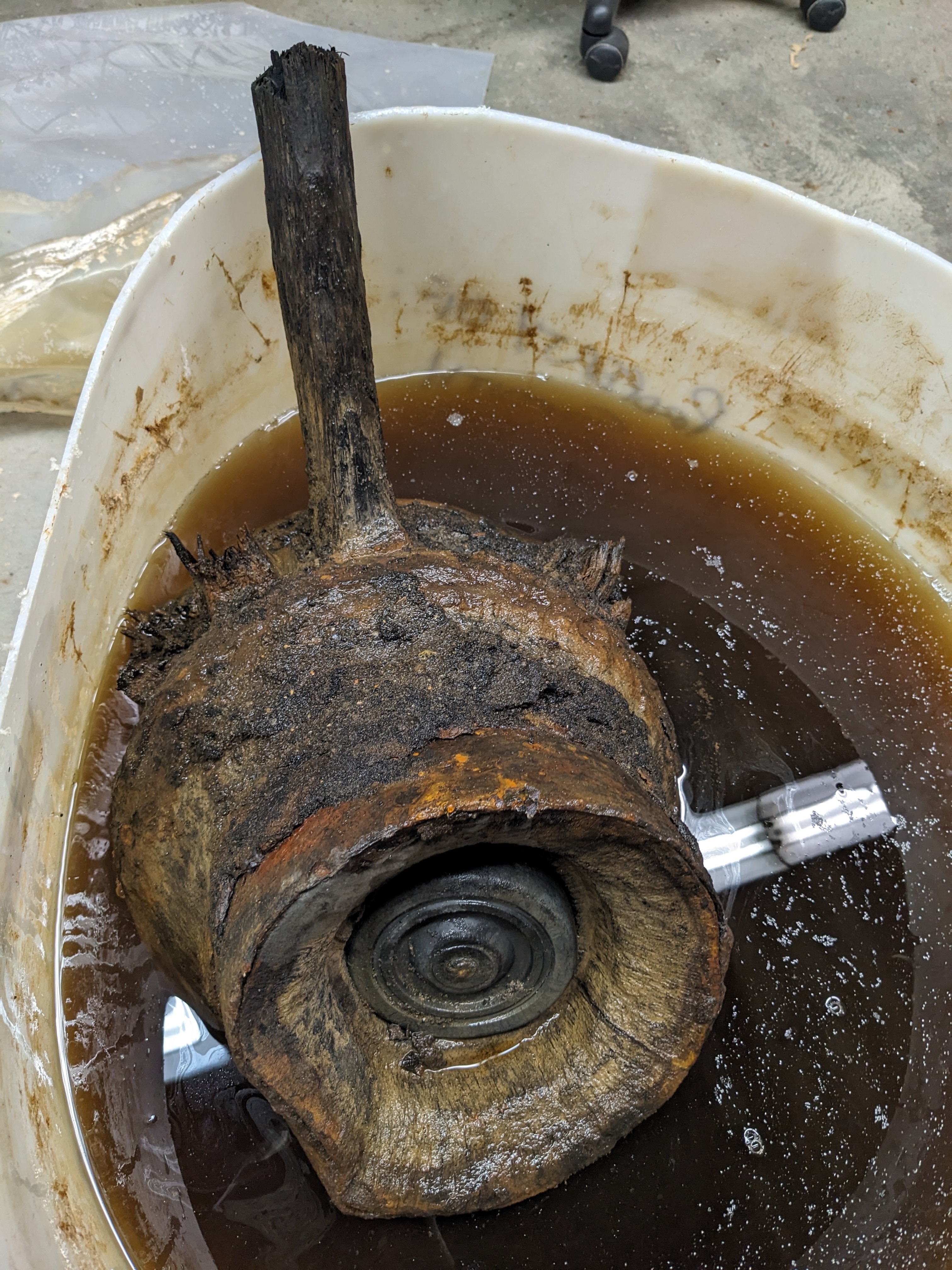
I have been fascinated by the remnants of a wagon wheel believed destroyed on Feb. 19, 1865, when Federal forces sacked the South Carolina capital and dumped captured Confederate ammunition and materiel into the Congaree River.

A metal detector first noticed the round object buried in the bed of the Congaree. Archaeologists surmised it was a just another rubber tire -- one of many found during an extensive river cleanup a few years back. More than 500 Civil War-related artifacts were recovered during the project, and this is among the most unexpected.

Jim Legg, public archaeologist for the 
South Carolina Institute for Archaeology and Anthropology (SCIAA), this month provided an update to the Picket on the conservation of the artifact and other pieces, none of which were believed to be fired. (At right, a sample of grapeshot and canister, SCIAA photo)

Hundreds of items emerged in 2022 and 2023 as crews removed century-old coal tar along the Congaree shoreline. Since then, Legg’s office and TRC Companies, a subcontractor for Dominion Energy, have been working to conserve items with a wide range of dates.

The completed military part of the collection will go to South Carolina Confederate Relic Room and Military Museum in Columbia for eventual exhibit.

The wheel hub, which has evidence of charring, will take at least another year to preserve. Archaeologists did not find any other wheels, metal hubs or large pieces of wood near the artifact.

“I have always thought the wheel was from (an) explosion. One thing that threw it off was that black rubber disk in the middle of the hub (left, TRC companies photo),” Legg wrote in an email.

"I finally just took it out to see what it was, and found that it was the rubber wheel from a 20th century kid's wagon. Either it floated into that location, or maybe one of the EOD (explosive ordnance disposal) guys picked it out of the junk pile and dropped it in there. It was a perfect fit.”

Even with that oddity, Legg is comfortable calling the fragment a casualty of Maj. Gen. William T. Sherman’s troops.

The features are consistent with a 1860s wagon wheel and it was found where at least one heavy wagon was blown to pieces.

“There is no record of any guns or gun carriages being destroyed/dumped in the river,” he added.

Something blowed up real good at river

Federal troops threw Confederate war materiel into the river after they took what they wanted before marching to North Carolina. Much of the state capital went up in flames, from a variety of sources, after its surrender.

Sean Norris, program archaeologist for TRC Companies, previously said of the wheel:

William Waud depiction of the burning of Columbia in 1865 (Library of Congress)
“The official records mention the explosion and the destruction of a wagon and a team of mules in a couple correspondences. It seems possible that what was left of the wagon after it was destroyed was thrown in the river along with everything else that was being dumped. There would be no specific reason for the wagon parts to be discarded elsewhere.”

The wheel at first was treated in a basic solution at the Relic Room before Legg moved it to his laboratory. Most of the recovered iron items considered the most important have been conserved.

The wheel has presented some challenges

Legg keep the wheel fragment in a shower stall for about a month during rinsing and hand cleaning. The artifact then went into a small tank, where it is undergoing polyethylene glycol (PEG) treatment for about another year.

“For size comparison this thing appears to be the same size as those seen on the NPS field artillery carriages -- fairly massive,” Legg wrote. In any case, they are the same basic design as a heavy wagon wheel hub.” (A gun carriage wheel at Chickamauga, Jim Legg photo)

I asked Legg whether the wheel has presented a conservation challenge.

“Yes, the fact that it is heavily encased in wrought iron hardware. Ideally, it would be cut apart, and the iron bands would be treated with electrolysis while the wood underwent the PEG process, then reassembled.” He said the cost for that would be enormous.

“I did a lot of manual cleaning of the iron before I started the PEG, but the bands are still fairly crusty. The iron will pretty much have to fend for itself, and I can only hope that it is not too unstable after the process is done. I can probably do some hand cleaning at that stage, perhaps with air abrader (a tool used to reduce corrosion), which will at least make it look better.”

A few items are distinctively modern

Norris said the project encountered Native American ceramics and projectile points and typical historic glass and ceramics that you would expect to find in river a flowing through a city.

The Relic Room exhibit on the Congaree finds will include a few non-Civil War items. Legg provided a photo (above) with a range: A brass hose nozzle, an iron sash weight, a Waterbury Clock Company winding key, an iron fork with wood handle (possibly Civil War), a silver plate fork from the Seaboard Coast Line Railroad, two .50-caliber BMG cartridges dated 1944, a pocket knife and a fire department button from the 1890s. 

Legg will produce a report on 1865 ordnance dump and a exhibit, possibly to open in 2027, at the Relic Room in Columbia.

“I have recently had some preliminary discussions with the museum about the exhibit, and the permanent curation of the collection there,” he said.

A group of 24-pounder and 12-pounder Confederate canister plates (SCIAA photo)
I asked Legg, who has helped produce three exhibits at the museum, how it might interpret the hundreds of historic artifacts found in the Congaree River cleanup.

“My thinking right now is to put the ordnance dump in the more general context of the Federal destruction of military resources in and around Columbia. I will also want to cover the pollution mitigation project itself, which was an amazing thing to see, even aside from the archaeology component.”

The Picket has reached out to the Relic Room for comment.

Recent view of the wagon wheel hub undergoing conservation in Columbia (SCIAA photo)

Wednesday, August 20, 2025

Riding the choppy waves: Opening of Sultana Disaster Museum in Arkansas delayed again as another $1.5 million must be raised to offset higher costs

A Harper's Weekly depiction of the April 1865 disaster in the Mississippi River (Library of Congress)
The availability and price of materials needed to create dynamic exhibits will further delay the opening of the new Sultana Disaster Museum in Marion, Ark., and require more fund-raising, backers said this week.

“The escalation in cost of exhibit fabrication is the major issue. There have also been change orders that were required but were unanticipated due to working on a building as old as the gym was,” said John Fogleman, president of the Sultana Historical Preservation Society.

Crews are building a more robust Sultana Disaster Museum than the current small location a few blocks away. It will be housed in the gymnasium of an old high school, with a couple additions.

Officials originally hoped the new site would open in April 2025, in conjunction with the 160th anniversary of the Civil War maritime tragedy. That was not feasible and the timeline shifted to April 2026. Now the board of society has decided to push back the opening several months, into the fall, though no new date has been set.

Acclaimed Sultana historian and author Jerry Potter, a member of the board, said construction cost overruns also were cited in a July meeting. “We are seeking additional funding,” said Potter, adding he is “very confident” in the project’s outlook.

“We need to raise about $1 (million) to1.5 million. We will use every tool available to us to try and achieve our goal, including fundraising events, grants and direct donation requests,” Fogleman wrote the Picket on Aug. 20.

The museum is currently housed in small building a couple blocks away
Marion, close to where the side-wheeler Sultana exploded and caught fire in the Mississippi River, will honor soldiers who died in the disaster and residents who helped save others who were plunged into the river in late April 1865.

About 1,200 passengers and crew perished. Hundreds of Federal soldiers, many recently freed from Confederate prisons, including Andersonville and Cahaba, were on their way home.

In mid-2024, the Sultana Historical Preservation Society brought on Jeff Kollath, former longtime executive director of the Stax Museum of American Soul Music in nearb y Memphis, Tenn., as executive director.

Kollath sent an email recently to the founder of the Sultana Association of Descendants and Friends, explaining the new outlook.

“We have had some additional delays in getting the building completed, yes, but also we've had a funding opportunity come along that we will not know about until later this year,” wrote Kollath, according to a post on the group’s Facebook page. “If received, it would provide a significant influx of resources into the project and allow us to build the museum we all want with the bells, whistles and whatnot. While we are dismayed that we will not open on schedule, it gives us time to acquire the funding we need.”

The attraction will be housed in the town's old high school gym (Sultana Disaster Museum)
The Picket reached out to Fogleman and Kollath about this funding opportunity but had not received details as of this writing.

Norman Shaw of the descendants group told the Picket he predicted between 200 and 250 people would have come to Marion in April 2026 for their annual meeting.

“We were making plans for a special two-day 2026 Sultana reunion to be held the same weekend in Marion as the museum's opening in April 2026, but not to conflict with any plans being made by the museum's staff. The 2026 Sultana reunion has now been postponed to coincide with the weekend of the opening of the new museum in the fall of 2026, whenever that date is decided,” Shaw wrote.

He said he believes most members of the group are disappointed by the additional delay. But they likely believe they “can certainly wait another six months.”

The soft opening of the museum for public programming and regional events is still planned by the end of this year, officials say.

Monday, December 4, 2023

Was this wagon wheel shattered in explosion as Sherman's troops took S.C. capital? Experts hope to learn more when they conserve hundreds of artifacts

The wheel hub recovered from the Congaree River (Courtesy of Sean Norris, TRC Companies)
A metal detector first noticed the round object buried in the bed of the Congaree River in Columbia, S.C. Archaeologists surmised it was a just another rubber tire -- one of many found during an extensive river cleanup.

After all, some 2.5 tons of debris – including trash, tires and scrap metal – were carted off during the removal of toxic, century-old coal tar along the shoreline, Dominion Energy announced last month.

Crews decided to dig out the object by hand, expecting an item made well past the Civil War-era.

“Once it was exposed, we knew we had something much more interesting than that,” said Sean Norris, program archaeologist for TRC Companies, a subcontractor for Dominion Energy.

The item was the shattered hub of a wagon wheel, and it’s possible it was damaged in an explosion when Union troops who took the city in February 1865 dumped tons of captured Confederate ordnance into the Congaree. (Photo below, courtesy of South Carolina Confederate Relic Room and Military Museum)

The artifact was found an area where numerous rounds of Civil War ammunition were recovered.

“We had a few folks from the (South Carolina Confederate Relic Room and Military Museum) take a preliminary look and our consensus was that this wheel fit the time frame for a Civil War-era wagon. The location in association with other artifacts of that time period lead us to believe that this wheel was deposited around the same time the other ordnance was dumped in the river,” Norris said in an email.

“The official records mention the explosion and the destruction of a wagon and a team of mules in a couple correspondences. It seems possible that what was left of the wagon after it was destroyed was thrown in the river along with everything else that was being dumped. There would be no specific reason for the wagon parts to be discarded elsewhere.”

Wartime reports indicated three Federal soldiers, including Capt. Williamson M. Davis, died in the explosion. Another 20 or so troops were injured.

The wheel, which shows signs of charring, currently rests in a plastic vat at the Relic Room in Columbia as it awaits conservation.

The museum typically has it covered with a wet towel and plastic bag to keep in moisture. Exposed wood -- if left to dry before conservation -- can disintegrate, experts said.

Archaeologists recovered about 500 Civil War artifacts during the project. Most of those will go to the Relic Room after treatment, which could take up to 18 months, said Chelsea Sigourney, curator of exhibits and collections.

Exhibit on burning of Columbia (Courtesy South Carolina Confederate Relic Room and Military Museum)
“Some artifacts will be stabilized in distilled water and later go through electrolysis” at the South Carolina Institute for Archaeology and Anthropology (SCIAA), Sigourney told the Picket.

“I’d like to be able to have a small exhibit about what is collected from the dig, but that is a project for the future. I wouldn’t even attempt to set a date for that until we hear conservation is complete,” the curator said.

The Relic Room has exhibits that mention Sherman’s occupation and the burning of the capital.

Remnants of Rebel sword, canister and iron spike points (James Legg, SCIAA)
James Legg, public archaeologist for SCIAA, said the agency will handle the bulk of the conservation work. 

“I think I currently have about 200 Civil War artifacts and an assortment of other metal artifacts. This is essentially what the EOD (explosive ordnance disposal) teams recovered during excavation, and it was convenient to bring it on over here to SCIAA in anticipation of the TRC contract,” Legg told the Picket.

“TRC still has a collection of similar or somewhat smaller size that was recovered during the off-site screening process. They may conserve some or all of that group,” he said.

Numerous cannonballs were recovered (James Legg, SCIAA)
The Civil War-related artifacts found during the project include some 6-pounder, 12-pounder and 10-inch projectiles, a large number of canister and grape shot balls, canister plates, small arms ammunition and a Confederate sword blade. Only the lead bullets will not require conservation

“The entire collection (or the half or more that I do) will take about a year to complete, once we begin. I will use electrolytic reduction, manual cleaning and other neutralization techniques before sealing each piece,” Legg wrote in an email.

He said it was unclear who would do the work on the wagon wheel. 

Allen Roberson, executive director of the Relic Room, said he has submitted a proposal for funding of an exhibit room on the discoveries.

Details of Sherman's campaign (Courtesy South Carolina Confederate Relic Room and Military Museum)
“Some of that dig is fascinating,” Roberson told the Carolina News and Reporter. “I think the archaeological recovery is almost as insane as what you pull out of the river.”

He told the news outlet that the exhibit may open in a year and a half to two years.

Norris said most of the river artifacts are at a TRC Companies laboratory, awaiting conservation and curation. He expects analysis of the wheel to begin in the new year.

Archaeologists did not find any other wheels, metal hubs or large pieces of wood near the wheel.

Friday, November 11, 2022

Survivor artifacts and memories: A detailed look at current plans for the new Sultana Disaster Museum in Arkansas, gallery by gallery

Banners for survivor reunions in the late 19th century (Sultana Disaster Museum)
A new museum remembering the steamboat Sultana maritime disaster will feature artifacts from the current two-room venue, recently collected items and professionally produced exhibits that will tell all facets of the Civil War story.

Gene Salecker (below), a Sultana author and lecturer, said renovated and expanded space in the old high school in Marion, Ark., will be much larger and in a more prominent spot in town. Groundbreaking was held Friday, on Veterans Day.

The Sultana exploded and caught fire in the Mississippi Rover not far from Marion on April 27, 1865. About 1,200 passengers and crew perished. Hundreds of Federal soldiers, many recently freed from Confederate prisons, including Andersonville and Cahaba, were on their way home, a cruel fate after enduring months or years of privation.

The school’s gymnasium-auditorium will be largely gutted, though crews will try to preserve as much of the original floor as possible. “In addition to the renovations of the existing structure, a new addition will be built onto the south side of the building, which will house the main entrance, ticketing station, museum store and … the auditorium and orientation theater,” said Wyley Bigger, director of special operations and projects for the Sultana Disaster Museum. (The groundbreaking was held in the old gym)

Section-by-section look at museum experience

The Picket asked Salecker, who has donated many items to the museum, to provide details on the experience for visitors once the new location opens. Some responses have been edited for brevity.

Q. I need a big picture description, please, of what all will be in the museum, how the visitor flow will go and the principal themes. What should be the takeaway when someone leaves? 

Current floor plan for new museum in Marion (Sultana Disaster Museum, click to enlarge)

A
. Our initial concept, and it may vary once we get heavily into the actual layout of the museum, is to have people enter the museum and see a short video explaining what the Sultana disaster is and how it impacted so many people -- survivors, families of the slain, rescuers, descendants and etc.

We plan on having people then walk through a section that will cover an overview of the Civil War and the importance of steamboating on the Mississippi River. Next, a person will enter a display on the building of the Sultana and on her first two years of service. The next section will be devoted to Civil War battle, capture and prisons. (Read about one former prisoner who kept memory of disaster alive to dying day.)

John H. Simpson was a passenger (photos courtesy of Gene Salecker)
Next will come a section devoted to Camp Fisk, the neutral exchange camp outside of Vicksburg where the prisoners gathered in hopes of being exchanged and sent home. Our next section will discuss the bribery and the greed and corruption that surrounded the three steamboats that carried the ex-prisoners northward. Emphasis will center on the Sultana.

From there we are hoping to immerse people into the loading of the Sultana by having a scale mock-up of the steamboat that people can board and see the boilers, the engines, perhaps the staterooms. Here will be stories of the loading and the overcrowding, and of the two day trip upriver.

The next section will explain the explosion, the fights for survival and the activities of the many rescuers. This section will include information on the hospitals, the rescue boats, the activities at Fort Pickering (the fort guarding the southern waterway approach to Memphis).

Our next section will include information on the aftermath of the disaster -- the (Capt.) Speed trial, the establishment of the Hartford Steam Boiler Inspection and Insurance Company, and the laws passed to prevent such a disaster from happening again.

The visitor to the museum will then step into an area showing our Wall of Honor, which will list every person on board the Sultana between April 24-27, 1865 as she made her way upriver from Vicksburg - ex-prisoners, guards, crew and civilian passengers. Where possible, we will have actual photos of the person. 

Photos of some on board Sultana are currently on exhibit (Sultana Disaster Museum)
The last two sections will feature the information on the reunions of the Sultana survivors, the current Sultana Association reunions, and on the various monuments and markers that have been put up to memorialize the greatest maritime disaster in American history.

The permanent museum will also contain a temporary exhibit area which will feature rotating exhibits on loan from other museums. These exhibits will not only be Civil War-related, but any and all American wars, as well as other interesting American displays. We will also have an auditorium that can be used for Sultana Disaster Museum seminars, events, and more.

Q. What will be the "signature" artifacts or constructed objects that will most grab a visitor's attention?

A. The signature artifacts, of course, will be that actual pieces of the Sultana that have been collected over the years or were carried by many of the survivors on board the Sultana. These pieces include:

Fire bricks (top) and shaker places from the furnace (G. Salecker)
-- Several pieces of fire brick and heavy metal shaker plates from the furnaces of the Sultana
-- Pieces of wood taken from the wreck years afterwards and given to survivors as cherished mementos
-- Wooden mallet made from the wood of the Sultana
-- Couple of buttons from the frock coat saved during the disaster by the captain of the guard unit
-- Couple of hand-made wooden combs (one below) carved by the prisoners while they were in a Confederate prison and carried aboard the Sultana

Carved comb made in a Confederate prison (Gene Salecker)
-- Cartridge box sling found along the shore of the Mississippi River shortly after the disaster
-- Cane made from the wood of the Sultana
-- Display board made from wood from the Sultana containing several small metal artifacts taken from the wreck
-- Knife made from a file and carried by one of the ex-prisoners aboard the Sultana
-- Steamboat engineer's wrench said to be from the Sultana
-- Cotton bale hook salvaged from the wreck of the Sultana

Additionally, our museum features dozens of items that were used at the many reunions of the Sultana Survivors’ Association -- reunion ribbons, numerous flags, a welcoming banner, an embroidered eagle banner, metal adjutant collection box, journals, minutes, envelopes with Association letterhead, lap desk from the association secretary, and a few wall plaques.

Curios crafted by survivor William Lugenbeal (Sultana Disaster Museum)
One of the most remembered survivors was Pvt. William Lugenbeal, who survived by slaying the Sultana's pet alligator and floating to safety in its sturdy wooden crate.

Our museum has two canes from Lugenbeal, one pipe, one napkin ring, and a curio box all decorated with the image of an alligator and inscribed to the man who was "saved by a alligator." 

And, since we will also be a museum that discusses the importance of steamboats on the Mississippi River, we also have many 1850-1860 steamboat memorabilia -- an 1857 first class steamboat ticket, an 1858 second-class deck passage ticket, a main saloon meal ticket from the 1860s, a hand-written menu from an 1860s steamboat (exceedingly rare, at left), an 1858 steamboat pilot's license and an 1854 steamboat engineer's certificate.

After the disaster, not only were the pilots and engineers required to be licensed but also the captain and first mate. We, therefore, have an 1881 steamboat captain (master) license and an 1889 first mate's license.

And, I would be remiss if I forgot to state that we have an actual 1840 engine from the steamboat LeRoy.

Q. Are all items/artifacts in the current museum going to be displayed on Military Road? Are there some in storage that will debut at the new site? If so, what are they?

A. Hopefully, we have room for all of the items currently on display in our interim museum -- and in the back room -- to go on display in our permanent museum. Any item that we do not have space for will be rotated with items on display so that all of the items will eventually have their moment to shine! We have a couple of pieces that are not on current display in the interim museum because of space limitations. One is the actual 1840 steamboat engine from the steamboat LeRoy and the other is another 14-foot model of the Sultana, this one depicting that moment after the disaster with the hole blown in the middle of the boat, the smokestacks down, the pilothouse gone, the decks collapsed on top of one another, and tons of steam escaping through the blast hole.

The current museum has only two rooms; it is off a side street
All of the artifacts that I owned in 2020 were donated to the museum at that time. I am imagining that all of them will be put on display in the permanent museum if space allows. If not, then they will be rotated with other items a few times a year. About 85-90 percent of the pieces in the museum come from my collection.

There are some items that I picked up in 2021 and 2022 that have not been donated to the museum. I am hoping that they will have their debut when the permanent museum opens.

Gym site provides nostalgia for local residents

Wyly Bigger, the director of projects for the Sultana Disaster Museum, said “that while constructing a brand-new building (as first envisioned) may have allowed for more freedom in architecture and exhibit design, I believe having the museum in this historic space adds a new element to the museum that can enhance the experience for history lovers.”

Photo by Mark Hilton, HMdb.org
The building (above)
was completed in 1938-1939 during the New Deal era by the Federal Emergency Administration of Public Works (later known as the Public Works Administration). It hosted exhibition basketball games by the University of Arkansas and Louisiana State University.

“In addition to the history, it is a place of fond memories for a lot of locals who attended school and played ball there. By preserving this building and giving it a use where it had none, we’re combining its history with that of the Sultana and creating a rich collective of histories in one place,” Bigger said.

Retired John Fogleman, head of the Sultana Historical Preservation Society, told the audience at the groundbreaking of the role of the disaster survivors.

“This museum idea did not begin with us. The seed for the idea of a museum was planted by the actual survivors. Not for a museum. All they wanted was a monument" along the Mississippi River. That effort never came to fruition. Now is the time to rectify that, Fogleman said.

Former US Transportation Secretary Rodney Slater discussed the assassination of President Abraham Lincoln nearly two weeks before the Sultana exploded. Slater said Lincoln stressed that no soldiers died in vain during the war and all men were created equal. He asked the crowd to bless the memory of the disaster's victims

Haizlip Studio rendering of exterior includes mock smokestacks (Sultana Disaster Museum)