Showing posts with label steamboat. Show all posts

Friday, July 24, 2026

Remembering the Sultana disaster: This 14-foot model greeted Arkansas museum visitors for years. It was one of two made for a film about Civil War tragedy

The old Sultana museum (Picket photo), Gene Salecker with model and a still from film abouit the disaster
About 25 years ago, an Ohio documentary maker who was passionate about the steamboat Sultana tragedy put his dreams into production, filming scenes in a river, swimming pool and a recreated ship’s cabin, among other locations.

The late Tom Koba’s production apparently never enjoyed widespread distribution, but he did leave behind two models of the Sultana. The actual vessel exploded and caught fire in April 1865, killing about 1,200 peopleHundreds of Federal soldiers, many recently freed from Confederate prisons, including Andersonville and Cahaba, were on their way home.

Sultana author Gene Salecker worked from the remains of those boats to create new models, one of which was the star at the Sultana Disaster Museum in Marion, Ark., before the museum closed two months ago as a larger, permanent venue is built a few blocks away.

A giant version of the doomed vessel will be the centerpiece of the new museum. “People will be able to actually walk up onto the recreated deck and see our actual 1842 steamboat engine (right) and a display on the fateful boilers, as well as other featured displays,” said Salecker, who has purchased numerous artifacts for the museum over the years.

Museum executive director Jeff Kollath said Salecker’s model, which was disassembled recently, will be placed in the main area, too. Salecker will put it back together in October, a month ahead of the museum’s grand opening.

“People can see pictures or drawings of the Sultana, but can only imagine what it really looked like,” said Norman Shaw, a founder of the Sultana Association of Descendants and Friends. “With Gene's large model, they can examine one up close. Also get an idea (of) how it operated.”

History is fortunate a photograph of the overloaded Sultana, taken shortly before the disaster, survives.

Blue tape in the gym shows shape of new Sultana model (Gene Salecker)
Sultana author Jerry Potter said Salecker’s model “is an incredible tool to give people an understanding of the layout of the Sultana. Gene has done an amazing job of restoring it. Now, it is going to its final home.”

I asked Salecker to talk about the Sultana models and how they have been used. His responses have been edited and ordered for brevity and context.

Q. Did you build the model? If so, when did you build it and why?

I built the existing model during the summers of 2013 and 2014 while I was still teaching and had the summers off. However, the foundation of the model came from someone else.

The 14-foot model (actually, two of them) were the brainchild of Tom Koba, of Berlin Heights, Ohio. Tom was an independent filmmaker who had worked with the state of Ohio on a couple of Civil War documentaries

I met Tom at the Ohio Civil War Show in Mansfield after my 1996 book was published. Tom bought a copy and was instantly hooked on the story. He would come to the show each year and pick my brain, hoping one day to make a documentary on the Sultana.

Scenes from filming in 2000, of survivors and fiery water (Courtesy Gene Salecker)
I believe Tom began his film in about 2000. He lived on a large farm and actually built a full-scale main saloon, boiler and coal bin area, some of the decking, etc. At one point, he rented out a public pool and at night, he put up some fake deck pieces, lit them on fire and had people rushing from the burning "boat" and jumping into the water. He hired professional stunt people to set themselves on fire and jump into the water, and a professional makeup person to put "burns" and "scalds" on many of the people. He also used local re-enactors as some of the ex-POWs.

Tom hired a couple of retired gentlemen to build him the two 14-foot models. One was to be detailed and the paddlewheels could move by radio control. He planned to run this on a river near his farm and take shots of the crowded boat going up the river. The second boat was not as well detailed and was meant to be exploded and burned.

Original Sultana model several years after film production (Gene Salecker)
At one of the Sultana Association reunions, Tom came and showed a few of us the finished "rushes." He was getting ready to edit the scenes when he unexpectedly died in 2007 at age 61.

In about 2012, I got a phone call from (his companion and business partner) asking me if I wanted the two 14-foot models. They had sat on her mother's front lawn, covered by a blue tarp .. . near Lake Erie. I rented a U-Haul truck and went and brought the two models back to my house in River Grove, Ill.

(The Picket contacted the business partner and will update this if she responds to questions about the project.)


In the summer of 2013, I moved the best model into my shed and began stripping off the old paint and mold and preparing it the way the Sultana had actually looked. It took me two summers and a lot of work but I completed the first model and brought it down to Marion for the grand opening of the interim museum in April 2015 (photo above).

Q. What materials are primarily used? How much of the original models were used?

A. I primarily used cedar and balsa wood. I also used chairs, spittoons, door handles, buckets, barrels, etc. from scale dollhouses.

Model that greeted museum visitors for 11 years awaits reassembly in new venue (Gene Salecker)
As for how much of Tom's original models I used, (it was) the hulls (Tom had them painted black and I had to strip, sand and paint them white.) I used the decking. I used all the slats in the railings and the upright railing posts. I used much of the paddlewheel housings but had to cut and redesign them. I used all of the stairs leading into the Texas cabins. I used his stage planks. In other words, to honor Tom, I used as much of the original model as I could but much of it needed a lot of modification. I would say I used about 60% of what was not too damaged by the elements.

Q. How did you/the builder come up with the specs and design?

A. All of the information about the Sultana (size, number of boilers, etc.) came from the January and February 1863 Cincinnati newspapers, which were reporting on the building of the SultanaIn 1979, I was working as a draftsman and drew up blueprints of the boat. No steamboat was built by blueprints so there were no existing prints for the Sultana. When someone wanted a new boat built, he went to the boat builder, gave him the measurements he wanted and etc., and the boat builder went to work. Steamboats were pretty standard.

Click on this 1865 panorama of St. Louise to see Sultana at center-right (credit below)
I used the information on the Sultana for specifics, and for the genera overall design of a steamboat, I referred to “The Western Rivers Steamboat Cyclopoedium” by Alan L. Bates, a retired steamboat engineer. Bates wrote his book, which is almost entirely of line drawings of parts of the steamboat, with "a nod to the modeler." When I was finished with my blueprints, I sent them to Alan L. Bates himself to check them over and he returned them with some comments and corrections. Those were what I used and referred to in building the 14-foot model.

(Photo above: Courtesy Herman T. Pott National Inland Waterways Library at the University of Missouri-St. Louis)

Q. Tell me about the second model you built.

A. I used the best of the two (Koba) models to build the one that was displayed in the Interim museum. A few years later, I used the second model to build an "after the explosion" model which has only been put on display once -- at the 2021 kickoff of the fundraising for the new museum. I had to make an exact duplicate of the first model and then strategically wreck it.


I tried to use as much of Tom's original model in the second one (above, courtesy Gene Salecker), also. However, since I had picked the best pieces from both models when I made the first one, there weren’t much undamaged pieces left. Of course, I used the hull and some of the decking but most of it had to be handmade to an exact match of the first model. That was the hard part -- being exactly like the first model except for the ruptured middle of the boat. The stern, the bow, the paddlewheel boxes, everything had to be exactly the same.

Fortunately, I took hundreds of photos as I worked on the first model so I used those as reference for the second model... and I made sure that I kept my measurements of everything.

(Editor's note: There is no room in the gallery for the  "after the explosion" version, which is in storage in Marion, Kollath told the Picket.)

Q. How has the model added to the story of the Sultana?

A. Melody Walker of the interim Sultana Disaster Museum used to say that the two things everybody photographs when they come to the museum is the many names on the Memorial Wall and the 14-foot steamboat model. People like to look at the model to get a better understanding of what the Sultana looked like. They can see how difficult it would have been for a soldier to leap from the top hurricane deck into the crowded water 25 feet below.

Photograph of the Sultana near Helen, Ark., a day before tragedy on the Mississippi (Library of Congress)
The model has added to the understanding of where the explosion came from (top, back end of the boilers in the center of the boat), and how the blast traveled upward at about a 45-degree angle, tearing everything before it, including the pilothouse. The model adds to the understanding of just what the ex-POWs and the others had to go through to reach the supposed safety of the water.

 As they say, a picture (or in this case, a model) is worth a thousand words. It is a great educational aide in helping to explain the tragedy of the Sultana.

Previous Sultana coverage:

Thursday, May 7, 2026

The current Sultana Disaster Museum in Marion, Ark., will close May 16; a larger, more dynamic venue at old high school is expected to open in November

The Sultana Disaster Museum during a visit in late January (Civil War Picket photo)
A small Arkansas museum that tells the story of the steamboat Sultana disaster near the end of the Civil War will close after May 16 as a larger venue is completed a few blocks away -- the culmination of a long journey for the community.

The Sultana Disaster Museum in Marion made the announcement Thursday morning on social media.

“After years of welcoming visitors to 104 Washington St. on the Marion Courthouse Square, the current Sultana Disaster Museum will officially close its doors on May 16 as we begin the big move into our new museum home opening in November!," the post said.

“This move marks an important new chapter in preserving and sharing the story of the Sultana and the lives forever impacted by the disaster. We are incredibly grateful to everyone who has visited, supported, donated, volunteered and helped keep this history alive through the years.”

John Fogleman, president of the Sultana Historical Preservation Society, told the Picket officials anticipate opening the new museum with several days of activities beginning on Veterans Day (Nov. 11) and culminating with a grand opening on Saturday, Nov. 14.

Gene Salecker made this model several years ago (Picket photo)
The new venue will be in a former high school gymnasium-auditorium that was built near the end of the Great Depression.

Officials originally hoped the new site would open in April 2025, in conjunction with the 160th anniversary of the maritime tragedy. But there have been delays and officials with the Sultana Historical Preservation Society had the continuous work of raising funds.

Marion, close to where the side-wheeler Sultana exploded and caught fire in the Mississippi River, will honor soldiers who died in the disaster and residents who helped save others who were plunged into the river in late April 1865. Among those residents were ancestors of Fogleman.

Marion is across the river from Memphis, Tenn.

About 1,200 passengers and crew perished. Hundreds of Federal soldiers, many recently freed from Confederate prisons, including Andersonville and Cahaba, were on their way home when fire broke out following a boiler explosion. The tragedy has been remembered at the museum and in books by Gene Salecker, Jerry Potter and others. (Picket photo, left)

Remaining days and times for visitors to visit the current museum -- which opened in April 2015 -- are 10 a.m.-4 p.m. May 7-9 and 10 a.m.-4 p.m. May 14-16.

Now the focus of the project will be looking forward.

"We can’t wait to welcome you into the new space this fall with expanded exhibits, new experiences and even more opportunities to honor and remember this important piece of history," the museum said.

Officials have been largely mum about specific exhibits, although the Picket got a rough idea during a visit to Marion in January. A large mockup of the Sultana will be the focal point.

The idea is to provide a more high-tech, interactive presentation than the old site. That will be especially important since very few surviving items from the vessel were located.

John Fogleman of the Sultana Historical Preservation Society shows mockup in gym (Picket photo)
The new venue will feature the main items in the former gymnasium. There are adjoining rooms for special exhibits and community meetings and events. Officials hope to draw on area schools for field trips.

Museum officials say the exhibits will build off the full story of the Sultana with information about the importance of the river, the Confederate prisoner of war camps at Cahaba and Andersonville, the bribery and corruption that led to the overcrowding of the side-wheel steamboat, the explosion and fire, and the creation of the Sultana Survivors Association.

Salecker, a Sultana collector, author and historian, has purchased many of the artifacts housed in the current museum.

The rooms include a 14-foot model of the Sultana, photographs of survivors and victims, reunion items and a few pieces believed to belong to the steamboat. (Not much survived, and the wreck is said to lie below a bean field east of Marion.)

John Fogleman shows board at new venue detailing donors and sponsors (Picket photo)
"As for the collection, I know that everything 
will be going over to the new museum but I do not know how much will actually be put on display," Salecker said in an email Thursday. "We have a lot of reunion and GAR items connected with survivors, but we only have limited space for the display of those items. I would hope that we will be rotating items from time-to-time to keep our displays fresh."

Salecker recalls the ceremony when the interim museum opened.

"We had a slight, drizzly rain that day during outside ceremonies. Perhaps the rain was appropriate since we were commemorating a disaster. The Heavens were crying for the 1,164 people that died on the Sultana."

Norman Shaw, a founder of the Sultana Association of Descendants and Friends, recalled the group's meeting in 2015 in Marion to mark the museum's opening. The weekend included descendants dropping roses into the Mississippi River to remember the dead and survivors.

"Even though in a temporary space, we hoped the new museum was only the initial step toward an eventual permanent museum," Shaw said. "Everyone involved worked hard and diligently in raising the $10 million dollars needed to build the new museum, followed by the many hours it took to plan and to oversee the building process."

Gene Salecker and his father Roy, who passed away in early 2025 (Special to the Picket)
Shaw said the survivors of the incident were committed to have the story told for generations.

"They would be most pleased if they could be present to see the doors open for the new Sultana Disaster Museum, but, no doubt, will be with us in spirit."

Potter said his memories of the small museum center around people who have come from all over the world to learn about the overlooked moment in U.S. history.

"I can still recall how many of them stood in amazement as this tragic chapter of American history was unfolded before them. Most said it was incredible -- almost unbelievable -- that they had never heard the story before. Being able to meet such people, to tell the story, and to witness their reactions is what I remember most," he wrote in an email. "This small museum has been the avenue through which the memories of those aboard the Sultana have been kept alive."

Thursday, May 30, 2024

Sultana Disaster Museum picks director to lead an expanded venue that will add 'wow factor' to story of 1865 steamboat explosion on the Mississippi

The longtime executive director of the Stax Museum of American Soul Music in Memphis is leaving to oversee the expansion of a museum in Marion, Ark., dedicated to the story of the Sultana maritime disaster that occurred near the end of the Civil War.

The Sultana Historical Preservation Society announced Thursday the hiring of Jeff Kollath, who had been at the Stax museum for nine years and previously worked at historical, veterans and humanities sites in his native Wisconsin.

Kollath (left), who is in his mid-40s, officially starts work as executive director at the Sultana Disaster Museum on July 1, a day after he leaves his current job.

An enticement was an opportunity to build something fresh. Kollath will be deeply involved in devising exhibits for the new location of the Sultana museum.

"As a museum professional, one of my greatest joys has been uncovering, interpreting and telling the stories of everyday people and their extraordinary lives,” Kollath said in a news release. “There are thousands of stories to be told in this new museum. The Sultana disaster is something that still reverberates generations later, and I look forward to working with the board and others in making this important story come alive in our museum for guests of all ages."

The society touted Kollath’s experience in grant writing, budget development, facilities management, public speaking and exhibit development and design. The Memphis museum where he has worked provides a deep look at Stax records, which was instrumental in the development of soul music.

“Jeff expressed to the Board of Directors his passion for making history come alive through high quality exhibitions, immersive educational experiences, and free, accessible programming, and we could not be more excited,” the Sultana board said. Marion is across the Mississippi River from Memphis. 

The society earlier this year awarded a construction contract for a larger, more dynamic museum than the current small one a few blocks away. The venue will be housed in the gymnasium of an old high school, with a couple additions.

Museum acquired this Grand Army of the Republic item remembering brothers who died on boat (SPHS)
Marion, close to where the side-wheeler Sultana exploded and caught fire in the Mississippi River, broke ground in 2022 for the venue, which will honor soldiers who died in the disaster and local residents who helped save others who were plunged into the river in late April 1865. About 1,200 passengers and crew perished. Hundreds of Federal soldiers, many recently freed from Confederate prisons, including Andersonville and Cahaba, were on their way home.

John Fogleman, president of the Sultana Historical Preservation Society, told the Picket in an email Thursday, "Especially valuable is Jeff's ability to tell compelling stories in a compelling way. Our museum is all about telling the story of the individual soldiers and that is one of Jeff's strengths."

Kollath has been in the museum business for 20 years and has experience in telling the stories of soldiers through his work at the Wisconsin Veterans Museum.

Pat Mitchell Worley, CEO of the Soulsville Foundation, which overseas the Stax museum, said the museum professional is “a lover of great stories at heart, and Stax and the Sultana, the greatest maritime disaster in America, are both that. He’s getting the chance to create a museum from the ground up, and draw on his passion for research and storytelling with this new opportunity."

Design for the front of larger museum in Marion (Courtesy Sultana Disaster Museum)
Worley said Kollath oversaw a major renovation of the Memphis museum last year for its 20th anniversary, created a program offering free field trips for all Title One schools in Tennessee and “has been a tireless supporter of free educational programming, curating more than just exhibits, but also having conversations surrounding the story of Stax, how history shaped it then, and continues to do so today.”

Most recently, Kollah was instrumental with the research required to tell the Stax story as part of a recently released HBO docuseries

Gene Salecker, Sultana author, collector and museum supporter, previously said he believes the big attraction at the new museum will be a mock-up of the forward part of the Sultana, which will include the steamboat’s boilers.

“Since the boilers were the main cause of the destruction of the Sultana, we are hoping to have a display on how the boilers worked and what went wrong,” he said, describing the overall museum experience as immersive. “We have tons of information and a great number of artifacts to put into each display.”

Museum officials say the exhibits will build off the full story of the Sultana with information about the importance of the river, the Confederate prisoner of war camps at Cahaba and Andersonville, the bribery and corruption that led to the overcrowding of the boat, the explosion and fire, and the creation of the Sultana Survivors Association. (At left, photo of 1891 reunion banner, courtesy of SHPS)

Fogleman said construction at the gymnasium-auditorium has slowed somewhat after the discovery of issues related to water leaks in the roof and elsewhere.

"Before interior work can continue a new roof will be required. Some of this was anticipated but some was not. Since federal grants are involved, it slows the process."

Previous Sultana coverage:

Wednesday, January 31, 2024

Moving forward: Sultana Disaster Museum in Marion, Ark., signs construction contract for a larger venue about 1865 Mississippi River tragedy

Current design for front of museum (Courtesy Sultana Disaster Museum)
Backers of a larger and more dynamic museum about the Sultana maritime disaster at the end of the Civil War have taken a major step, signing a $6.389 million contract this week for construction of the Marion, Ark., venue.

The contract with Zellner Construction of nearby Memphis, Tenn., involves renovating the 1939 high school gymnasium to repurpose it as a museum and to build an addition to the front of the museum for an auditorium and entry.

“We are elated we have finally signed a construction contract,” said John Fogleman, president of the Sultana Historical Preservation Society, which is leading the effort. “There were many who doubted that a new Sultana Disaster Museum would ever be built.”

Fogleman said he expects construction to perhaps begin in March, after anticipated approval by government agencies. Officials hope the new site will open in mid-2025, ideally around the time of the 160th anniversary of the tragedy.

“We selected Zellner because of their excellent reputation, their course of work in the past with our architects and the fact they were the low bidder (of five),” he wrote in an email on Wednesday.

The exhibits will be bid separately. None have been as yet designed.

The overcrowded Sultana just hours before the explosion  (Library of Congress)
Gene Salecker, Sultana author, collector and museum supporter, said he believes the big attraction will be a mock-up of the forward part of the Sultana, which will include the boilers.

“Since the boilers were the main cause of the destruction of the Sultana, we are hoping to have a display on how the boilers worked and what went wrong,” he said, describing the overall museum experience as immersive. “We have tons of information and a great number of artifacts to put into each display

“We are hoping to walk people through the entire war/experience of the Sultana. People will walk through a section about the importance of the Mississippi in American history and the Civil War. We will have a display on soldiers in the war, on prisoners and on the prisoner exchange. The history of the Sultana will cover its construction, it's early life, it's importance of spreading the word of Lincoln's assassination, and then the overcrowding, the explosion, the rescues and the reunions.”

The disaster is currently remembered at a small museum a few blocks from the future site. Dreams for a larger facility germinated many years ago.

The city, close to where the side-wheeler Sultana exploded and caught fire in the Mississippi River, broke ground in 2022 for a museum that will honor soldiers who died in the disaster and residents who helped save others who were plunged into the river in late April 1865.

Carved comb made by Union POW in a Confederate prison (Gene Salecker)
About 1,200 passengers and crew perished. Hundreds of Federal soldiers, many recently freed from Confederate prisons, including Andersonville and Cahaba, were on their way home.

Museum officials say the exhibits will build off the full story of the Sultana with information about the importance of the river, the Confederate prisoner of war camps at Cahaba and Andersonville, the bribery and corruption that led to the overcrowding of the side-wheel steamboat, the explosion and fire, and the creation of the Sultana Survivors Association.

Fogleman and others have raised thus far donations, grants and pledges totaling $10.369 million. “We are still seeking money,” he said. The city of Marion has helped with fund-raising, including revenue from the Advertising and Promotion Committee to fund operating costs.

The society’s board added three new members, according to Fogleman, with the aim of having younger representatives and more women. They bring social media, marketing, banking and other skills, he said.

The story of the Sultana runs deep in the blood of two members of the Sultana society.

Fogleman’s great-grandfather, John Fogleman, after lashing two or three logs together, poled his way through the current of the Mississippi River and toward survivors. He plucked dozens of people -- mostly Federal soldiers -- from the chilly river. It’s possible his sons Leroy and Gustavus assisted.

Franklin Barton and LeRoy and Gustavus Fogleman (Courtesy of John Fogleman)
The present-day Fogleman’s and cousin Frank Barton share another great-great-grandfather, Franklin Hardin Barton, an officer with the 23rd Arkansas Cavalry. He used a dugout canoe to reach survivors, many of whom were burned or scalded.

Frank Barton, treasurer of the Sultana Historical Society, told the Picket on Wednesday he is glad the Sultana story will “finally have a permanent venue that is befitting of this historical event and will honor those men and women that were aboard the Sultana that fateful night in April of 1865. Part of the Sultana story is how this country forgot those individuals and this new museum will be another step in correcting that part of the Sultana disaster story.

This article will be updated

Previous Sultana coverage:

Tuesday, May 23, 2023

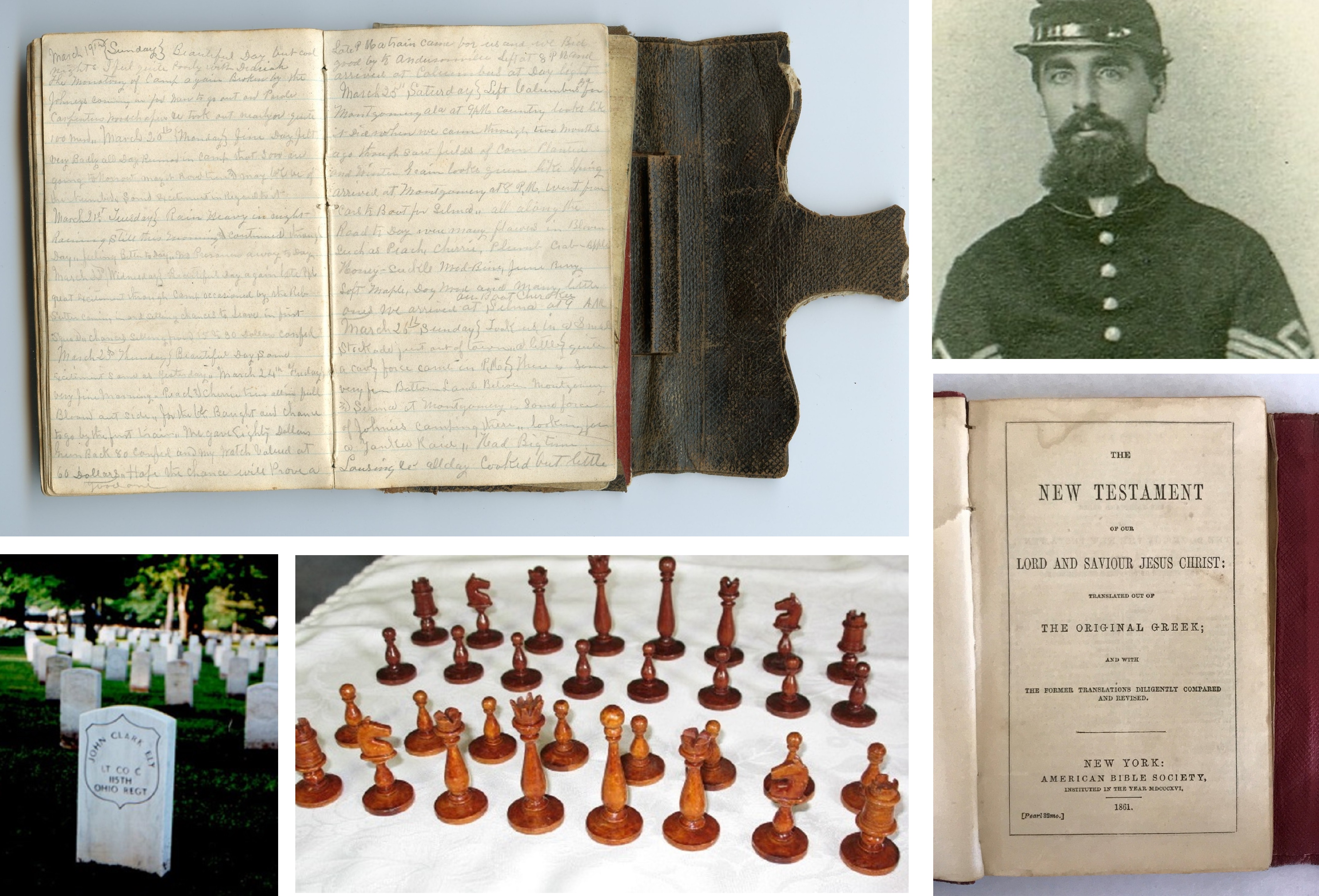
Sinking of the Sultana: Will journal and Bible belonging to Ohio soldier John Clark Ely, victim of the disaster, go to a museum?

(Clockwise from top left: Pages from journal, Sgt. John Clark Ely, his Bible, chess set pieces,
and his grave in Memphis. (Photos courtesy of John M. Ely, David C. Ely and Jerry O. Potter)
Sgt. John Clark Ely of Ohio left behind a brokenhearted family when he perished in the Sultana disaster on the Mississippi River. He is emblematic of the heartbreaking stories of former Civil War prisoners who died when they were just days away from home.

Beyond stories about Ely, there are tangible reminders of his life.

John M. Ely of the Aspen, Colo., area, has his great-great-grandfather’s two chess sets and a journal (below) that survived the sinking of the steamboat on April 27, 1865, above Memphis, claiming 1,200 lives. The journal is believed to be the only one describing the days leading up to the tragedy.

John M. Ely’s second cousin, David Clark Ely of Placerville, Calif., has a Bible bestowed upon his ancestor before he went off to war.

The two men and David’s sister, Sharon Ely Pearson, are open to the idea of the heirlooms being available to the public through an exhibit or the like.

“I wish we had those items for the museum,” says Sultana expert and author Jerry O. Potter.

By museum, Potter means the Sultana Disaster Museum across from Memphis in Marion, Ark. Supporters are raising the last of the dollars and pledges needed to build a larger and permanent venue at an old high school gymnasium.

Marion was the closest town to the disaster and residents helped rescue those thrown into the river after the fire and explosion on the Sultana.

The tiny current museum in Marion, Ark. A new location is in the works.
Officials say it’s important that the little-known story of greed, fraud, valor and sacrifice be told in a bigger way than what’s covered in a tiny museum that opened in 2015.

While the journal has been excerpted in some form for years, the whereabouts of the Bible weren’t known to Potter and Gene Salecker, another renowned Sultana author.

“I have never heard of the Ely Bible, so this is something new to me,” Salecker, author of Destruction of the Steamboat Sultana,” told the Picket in an email.

I made the story of the Bible known to the museum supporters after contacting David C. Ely, who I spoke to several years ago, and John M. Ely, who I tracked down a couple months back. The Picket has written numerous articles about the Sultana and Ely, and I wanted to update readers on all the items known to be associated with him. (David C. Ely and John M. Ely have not been in touch with each other or the Marion museum.)

Sgt. Ely, 37, of Company C, 115th Ohio Volunteer Infantry, was jammed on the overcrowded steamboat with hundreds of other recently released Union prisoners. (He is at left in the photo, next to Company C comrade Sgt. Charles W. Way, who also died on the Sultana.

The Ohio schoolteacher, who was supposed to get a promotion to lieutenant at the end of the war, had been captured by Confederate forces under Nathan Bedford Forrest on Dec. 5, 1864, near LaVergne, Tenn.

Ely (pronounced ee-lee) spent time in a few prisons, most notably Andersonville, before he was paroled at war’s end near Vicksburg, Ms.

“He is my hero,” Potter, author of The Sultana Tragedy: America’s Greatest Maritime Disaster,” told the Picket in April. “I guess I know more about Lt. Ely than just about any other soldier on the Sultana. In reading his diary, I was able to see things through his eyes and to learn of his hopes and dreams.”

Several years ago, Potter told the Picket: “While we have many accounts written later, his is the only one that we have that gives a day-to-day account leading up to the disaster. Plus, he is one of the few buried at the (Memphis) national cemetery with a headstone with his name. Finally, he became my hero who through his own words I got to know him.”

In his journal (the only one of two belonging him to survive), Ely writes about his service, family, capture and time in prison.

On Dec. 25, 1864, Ely wrote,
“Such a day for us prisoners. Hungry, dirty, sleepy and lousy. Will another Christmas find us again among friends and loved ones?”


The soldier, born in Franklinville, N.Y., moved with his family as a child to the Cleveland area. The 1850 census shows Seth and Laura Ely and their children living in Cuyahoga County. John Clark was 21.

In the 1860 count (above, click to enlarge), Ely is described as a farmer living with his wife, Julia, and two children in Stow township in the same county.

Ely married Julia Richmond (right) in 1856; after his death, she received a pension and moved to Norwalk, Ct., where she died at age 42 in August 1873.

Sharon Pearson told me in 2015 that Julia moved to Norwalk to be closer to her husband’s family and she is buried in Union Cemetery.

“She lived in Danbury, CT, with several of the other female members of the family who were widowed or ‘spinsters.’" 

The journal, chess pieces and Bible eventually went to the fathers of the cousins. John M. Ely’s father, Norman, had the journal and chess sets, while the small Bible went to Norman’s cousin, Clifford Seth Ely Jr., father of David and Sharon.

Julia Richmond Ely's application for a Federal pension (click to enlarge)
Norman Ely told the Picket in 2012 that the cousins and their wives traveled to a reunion of Sultana descendants. They visited Andersonville in Georgia. (Andersonville National Historic Site has a transcript of Ely's journal made by Norman)

Norman Ely's mother had told him about the small diary, which captures the soldier's despair, anguish, privations -- and hope. (Norman Ely, of Glenwood Springs, Colo., died in March 2013.)

Clifford Ely, a businessman in Norwalk, told the Picket in 2012 he was touched by his ancestor's time at Andersonville. "There was a lot of sickness around. Other people stole things from him. It was just a sad thing, day by day. People tried to escape, (but) he never did."

"He had all the great hopes. He couldn't wait to get home," said Clifford Ely. "When he got on the steamboat, he kept writing to her (Julia)." (Clifford died in October 2013.)

David Clark Ely, 64, and retired from the U.S. Coast Guard, says he wonders how the Bible survived.

“Did he leave this behind with his wife or did he take it into the Army? Did he carry it with him? At one point, it was it separated from him.”

New Testament given to John C. Ely in summer 1862 (David C. Ely)
Ely sent the Picket several photos of the Bible he pulled out from a box. One of the pages is missing, he said. A yellowed page (above) says the Bible was presented to John Clark Ely “upon the event of his going to the war in Aug. 1862.” David said he does not know the Bible's history.

Another line appeared to David and I to read the volume was from “the Church at Stone.” The last word was hard to decipher so I started checking around the internet. My query on a Facebook page for Andersonville descendants led me to learn it was “Stow” in Ohio, where the Elys were living.

The city of Stow has a page about its history, saying eight soldiers from the area were onboard the Sultana and four perished. The Picket reached out to a local historical society for more information but received no reply.

John M. Ely (left), the county attorney in Pitkin County, Colo., confesses he did not pay much attention to John Clark Ely’s story while growing up. “Why did I not listen?”

He saw the chess sets as a child and as he got older he began to express interest in filling in the gaps of what he knew.

Ely wonders why the soldier and others like him would leave spouses and children to go to combat. “To me it is a continual fascination and wonderment about this guy. What was he thinking?”

The attorney has visited Julia’s grave in Connecticut and a few years after his father passed, he and his children stopped by Memphis to see John Clark Ely’s grave.

Like David Ely, John M. Ely isn’t certain how the items survived being thrown into the river. It’s possible, with the exception of the journal, they were kept at the sergeant’s home in Stow. As for the diary, perhaps it was found among the debris in the Mississippi or its banks.

John M. Ely told the Picket he never played with the chess sets. “It seems fragile and I have never messed with them.”

He is mulling what will become of them and the journal.

If he does not give them to his children, Ely says he would be interested in an organization, foundation or museum having them so that they could care for the heirlooms and exhibit them.

His cousins have not discussed donating the Bible (right), but after talking with the Picket, David says they might be interested in seeing it exhibited as part of a larger narrative.

There is a story with it,” he says.

Time will tell whether the items will one day be displayed in Marion, telling one part of the Sultana’s compelling story.

No one was formally held accountable for putting too many men on the steamboat, despite documented concerns about the safety of one of the boat's boilers. Accounts of the tragedy were overshadowed by headlines about the assassination of President Abraham Lincoln.

Potter and Salecker have written about a kickback scheme between the vessel's financially strapped captain and an Army quartermaster, Lt. Col. Reuben B. Hatch. According to Potter, the transport fee was $5 for an enlisted man, $10 for an officer. Capt. J. Cass Mason agreed to take the enlisted men for $3; Hatch kept the $2.

But John Clark Ely knew nothing about that.

Three days before he died, their great-great grandfather was looking forward to being home. He wrote of a sunny day and boarding the Sultana in Vicksburg.

Mere hours before the explosion, John Clark Ely wrote simply: “Very fine day, still upward we go.”

Additional pages from the Sgt. Ely's journal (Courtesy of John M. Ely)
Previous Sultana coverage: