Showing posts with label closing. Show all posts

Thursday, May 7, 2026

The current Sultana Disaster Museum in Marion, Ark., will close May 16; a larger, more dynamic venue at old high school is expected to open in November

The Sultana Disaster Museum during a visit in late January (Civil War Picket photo)
A small Arkansas museum that tells the story of the steamboat Sultana disaster near the end of the Civil War will close after May 16 as a larger venue is completed a few blocks away -- the culmination of a long journey for the community.

The Sultana Disaster Museum in Marion made the announcement Thursday morning on social media.

“After years of welcoming visitors to 104 Washington St. on the Marion Courthouse Square, the current Sultana Disaster Museum will officially close its doors on May 16 as we begin the big move into our new museum home opening in November!," the post said.

“This move marks an important new chapter in preserving and sharing the story of the Sultana and the lives forever impacted by the disaster. We are incredibly grateful to everyone who has visited, supported, donated, volunteered and helped keep this history alive through the years.”

John Fogleman, president of the Sultana Historical Preservation Society, told the Picket officials anticipate opening the new museum with several days of activities beginning on Veterans Day (Nov. 11) and culminating with a grand opening on Saturday, Nov. 14.

Gene Salecker made this model several years ago (Picket photo)
The new venue will be in a former high school gymnasium-auditorium that was built near the end of the Great Depression.

Officials originally hoped the new site would open in April 2025, in conjunction with the 160th anniversary of the maritime tragedy. But there have been delays and officials with the Sultana Historical Preservation Society had the continuous work of raising funds.

Marion, close to where the side-wheeler Sultana exploded and caught fire in the Mississippi River, will honor soldiers who died in the disaster and residents who helped save others who were plunged into the river in late April 1865. Among those residents were ancestors of Fogleman.

Marion is across the river from Memphis, Tenn.

About 1,200 passengers and crew perished. Hundreds of Federal soldiers, many recently freed from Confederate prisons, including Andersonville and Cahaba, were on their way home when fire broke out following a boiler explosion. The tragedy has been remembered at the museum and in books by Gene Salecker, Jerry Potter and others. (Picket photo, left)

Remaining days and times for visitors to visit the current museum -- which opened in April 2015 -- are 10 a.m.-4 p.m. May 7-9 and 10 a.m.-4 p.m. May 14-16.

Now the focus of the project will be looking forward.

"We can’t wait to welcome you into the new space this fall with expanded exhibits, new experiences and even more opportunities to honor and remember this important piece of history," the museum said.

Officials have been largely mum about specific exhibits, although the Picket got a rough idea during a visit to Marion in January. A large mockup of the Sultana will be the focal point.

The idea is to provide a more high-tech, interactive presentation than the old site. That will be especially important since very few surviving items from the vessel were located.

John Fogleman of the Sultana Historical Preservation Society shows mockup in gym (Picket photo)
The new venue will feature the main items in the former gymnasium. There are adjoining rooms for special exhibits and community meetings and events. Officials hope to draw on area schools for field trips.

Museum officials say the exhibits will build off the full story of the Sultana with information about the importance of the river, the Confederate prisoner of war camps at Cahaba and Andersonville, the bribery and corruption that led to the overcrowding of the side-wheel steamboat, the explosion and fire, and the creation of the Sultana Survivors Association.

Salecker, a Sultana collector, author and historian, has purchased many of the artifacts housed in the current museum.

The rooms include a 14-foot model of the Sultana, photographs of survivors and victims, reunion items and a few pieces believed to belong to the steamboat. (Not much survived, and the wreck is said to lie below a bean field east of Marion.)

John Fogleman shows board at new venue detailing donors and sponsors (Picket photo)
"As for the collection, I know that everything 
will be going over to the new museum but I do not know how much will actually be put on display," Salecker said in an email Thursday. "We have a lot of reunion and GAR items connected with survivors, but we only have limited space for the display of those items. I would hope that we will be rotating items from time-to-time to keep our displays fresh."

Salecker recalls the ceremony when the interim museum opened.

"We had a slight, drizzly rain that day during outside ceremonies. Perhaps the rain was appropriate since we were commemorating a disaster. The Heavens were crying for the 1,164 people that died on the Sultana."

Norman Shaw, a founder of the Sultana Association of Descendants and Friends, recalled the group's meeting in 2015 in Marion to mark the museum's opening. The weekend included descendants dropping roses into the Mississippi River to remember the dead and survivors.

"Even though in a temporary space, we hoped the new museum was only the initial step toward an eventual permanent museum," Shaw said. "Everyone involved worked hard and diligently in raising the $10 million dollars needed to build the new museum, followed by the many hours it took to plan and to oversee the building process."

Gene Salecker and his father Roy, who passed away in early 2025 (Special to the Picket)
Shaw said the survivors of the incident were committed to have the story told for generations.

"They would be most pleased if they could be present to see the doors open for the new Sultana Disaster Museum, but, no doubt, will be with us in spirit."

Potter said his memories of the small museum center around people who have come from all over the world to learn about the overlooked moment in U.S. history.

"I can still recall how many of them stood in amazement as this tragic chapter of American history was unfolded before them. Most said it was incredible -- almost unbelievable -- that they had never heard the story before. Being able to meet such people, to tell the story, and to witness their reactions is what I remember most," he wrote in an email. "This small museum has been the avenue through which the memories of those aboard the Sultana have been kept alive."

Thursday, May 1, 2025

First on the Picket: Compelling artifacts and technology acquired in recent years will tell a bigger story in an Atlanta History Center exhibition opening next year. The aim is to get you to think about what the Civil War meant then -- and its impact today

The Atlanta History Center
is closing a longtime Civil War exhibit to make way for two new galleries that will feature breathtaking artifacts and a broader discussion of issues that engage the republic to this day: our belief systems, victory, defeat, reconciliation and the evolving meaning of freedom.

Atlanta, museum officials say, is ideal to tell a bigger national story about the Civil War in a striking way. Beyond being the capital of the South and a melting pot, it’s recognized by historians as a crucial battleground for saving the presidency of Abraham Lincoln and the United States itself.

For 30 years, relics collected by an Atlanta father and son formed the core of “Turning Point: The American Civil War.” The exhibit focused on the soldiers in blue and gray and how they did their deadly work, and visitors were awed by the incredible collection of uniforms, weapons, personal items -- and just about every conceivable type of artillery shell.

While “Turning Point” did address some big questions about the Civil War, there was limited discussion on technology, slavery and the home front. New, more diverse generations – distanced even more from the Civil War era – are asking deeper questions, the museum says, about why the war happened, how 4 million enslaved Americans gained their freedom, Reconstruction and what the conflict, which took at least 720,000 lives, means today.

Sheffield Hale with Union 20th Corps wagon that traveled near what is now the AHC (Picket photo)
“Thirty years ago, we (had) white, middle-class older folks,” Gordon Jones, the AHC’s senior military historian and curator, told the Picket about the exhibit’s key audience at the time. “We are a changed city. Demographics have changed. Our audience asks different questions.”

The history center is investing $15 million and more than 15,000 square feet for the new exhibition, which has not been formally named. It is expected to open in summer 2026, when the AHC marks its centennial.

“Turning Point” will close on May 25, but Civil War aficionados can still get their fix during construction with the giant Cyclorama painting of the Battle of Atlanta, related exhibits and the locomotive Texas, one half of the famous “Great Locomotive Chase” in 1862.

Jones came to the history center in early 1991 and cataloged the vast artifacts collection of Beverly M. DuBose Jr., whose name is on the current gallery. The collection became the basis for much of “Turning Point," which now has an outdated feel.

Flags and other items in the current "Turning Point" exhibit (Picket photo)
The curator could not conceive in the early 1990s what the internet and online auctions would mean for the history center, which has since purchased scores of artifacts, many of which will be displayed for the first time in the exhibition.

“More is better. It’s what gets people excited,” said Jones. “Artifacts are what speak to you emotionally, through your heart.”

Two flags and messages they sent to formerly enslaved

Make no mistake, Confederate and Union bayonets, swords, flags, rifles and revolvers will still be a big part of the presentation. To that end, Jones and AHC CEO and president Sheffield Hale are excited about plans to include two large collection of dug relics.

But they are particularly excited about the artifacts related to U.S. Colored Troops. The impetus for that came about in 2019, when the history center bought a hand-painted flag made for the 127th USCT infantry. It depicts a soldier waving farewell to Columbia, a symbol of the United States, with the words “We Will Prove Ourselves Men.”

“It’s an iconic knock-your-socks-off artifact,” Jones (At left in Picket photo) said at the time. Even an enlisted man’s USCT uniform wouldn’t be as historically significant as this flag.”

There’s another flag (top photo of this post) the curator said will be his favorite item in the new exhibit.

Most of the American flag is long gone, save for the 34 stars and upper-left canton. It flew over a camp on Craney Island near Hampton Roads, Va., that protected escaped slaves, whom Jones said were active in their liberation. The camp operated for just over a year before closing in September 1863; it was one of dozens of such camps in southeast Virginia housing an estimated 70,000 formerly enslaved people, according to the AHC. The tattered flag, which originally was 10 feet tall by 20 feet long, is undergoing conservation for display.

While the flag for the 127th USCT largely symbolized pride and duty, this one was a symbol of freedom, welcoming those who arrived safely after a dangerous journey.

 “If I get to that flag, I get my freedom, Jones said a refugee might think. “The choice to whom I can marry, to find my family.”

A closer look at the fascinating 'new' artifacts

I met Monday with Hale and Jones to talk about the new exhibition, which officials say will be heavy on “cutting-edge technology and immersive storytelling” and the benefits of newer scholarship. (Afterward, Jones showed me several artifacts in a storage area in the building’s basement)

They outlined some of what visitors will see in the galleries and other items in the center's vast collection. Below is just a smattering of what we discussed:

Patent for Morse breech-loading firearm (Atlanta History Center)
-- The downstairs Goldstein gallery, which is empty, will focus on technology and the Civil War. In part, it will feature the singular collection of the late George W. Wray Jr., showcasing some of the rarest Confederate firearms, swords, uniforms, flags and other items. Some were one of a kind. When it went on temporary display in 2015, the theme was the weapons were an attempt by a slave-based society to fight an industrial war. The South was hampered by limited manufacturing and the Union blockade of foreign goods.

-- A projection on one wall will feature a timeline of the war, key moments and maps, Hale said. The AHC will display elements of its interactive “War in Our Backyards” collaboration with The Atlanta Journal Constitution about 10 years ago.

-- Utilizing an online database about the Atlantic slave trade, the former DuBose space will feature an animated screen showing their routes, destinations and other details.

Gordon Jones with 18th century British blunderbuss (Picket photo)
Two items will show the connection of the U.S. slave trade and the practice elsewhere:

-- One is a circa 1750s short-barreled firearm, or blunderbuss, made by the John Whately family in England. The European slave cartel traded guns for enslaved persons along the West African coast. It was typical for the buyers to supply weapons, iron bars, printed cloth and other metals as part of the barter. "This one is extremely lightweight, cheaply made, and incredibly rare to find in this condition," said Jones, who believes this one may have been a sample weapon. 

“It was just rotten and evil from the start to finish,” the historian said of the slave trade.

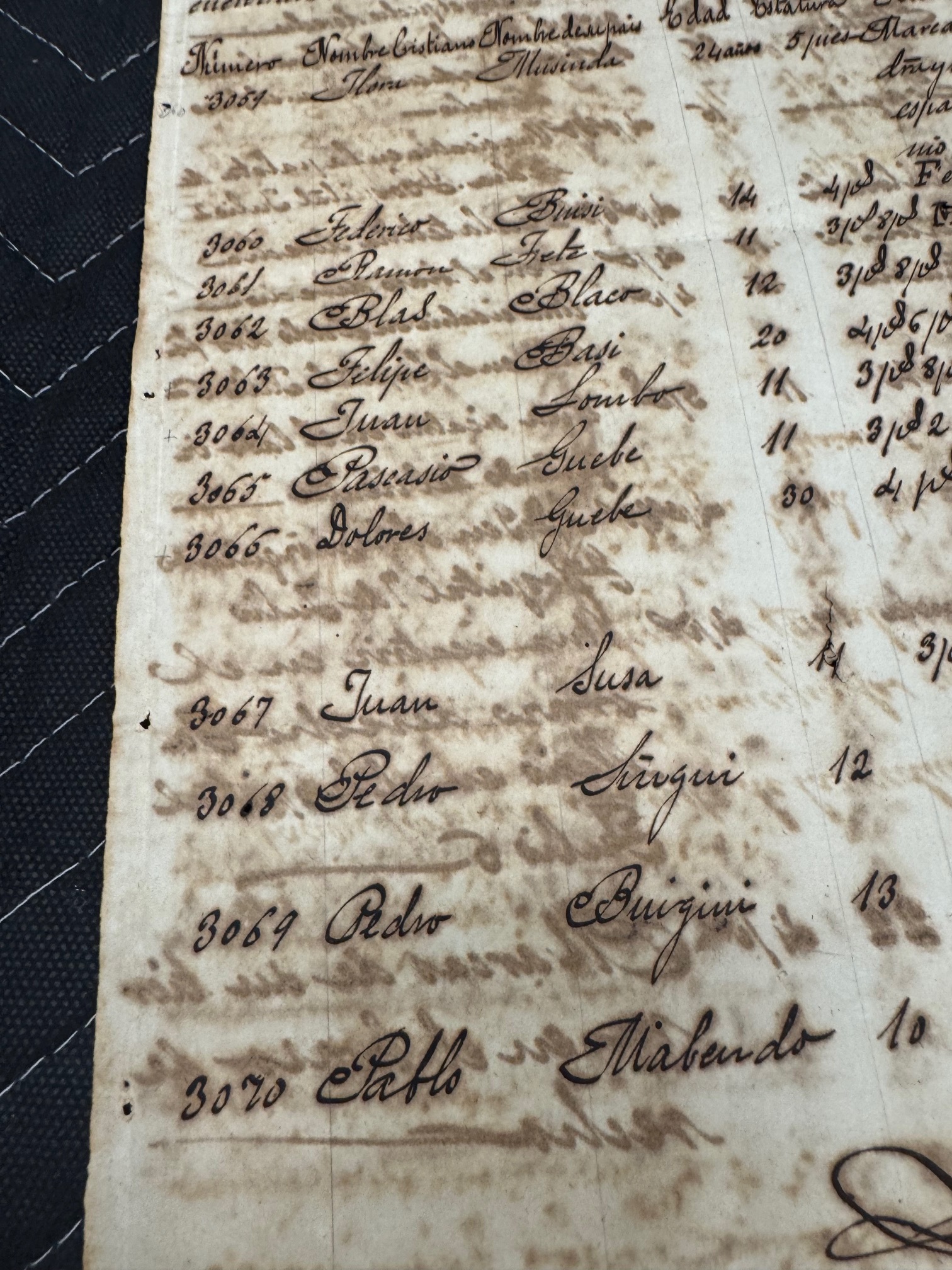
-- Documents written on parchment in 1868 detailing enslaved persons brought to Cuba five years before. The ledger includes Christian names, their age, condition and, most chillingly, the branding mark burned in their bodies. Visitors will learn the international slave trade continued until the late 1880s. (Picket photo, right)

-- A presentation on Confederate and Union monuments, including their locations.

-- Documents from the Maj. Henry Thomas Massengale collection. The Confederate States Quartermaster Bureau in Atlanta was responsible for manufacturing, procuring and transporting military supplies such as clothing, camp equipment, forage, and draft animals, to the Army of Tennessee before, during, and after the Atlanta campaign. Some of the notations are about enslaved persons, including one about a requisition for pants, drawers, shirts and hats for three. “The clothing is required for Negroes employed on the Fortifications that were confined in the Smallpox Hospital and their clothing had to be burned to prevent contagion.” The papers are available at the AHC's Kenan Research Center.

-- Personal items belonging to Capt. James Lile Lemon of the 18th Georgia. “He literally saved everything,” said Jones. Among the artifacts is a drum (photo at top of post) captured from two young Pennsylvania drummer boys on Sept. 16, 1862, the day before the Battle of Sharpsburg (Antietam). Lile later wrote about the capture of the boys by Pvt. Frank A. Boring:

"As he was driving them to the rear at point of bayonet they heaped so much abuse upon him - out of their fear or nervousness - that he had to be restrained from striking them with the clubbed musket. Of course, instantly the target of many wags among our company who joked with him about "scaring little boys" & etc. He replied that he would be d---d if he'd take such abuse from "d---d Yankee whelps." The boys were release & "beat a hasty retreat" back to their lines, with Boring giving them a rite hard look as they went."

-- A portion of the DuBose family Civil War dug relic collection is one of two never-before-exhibited relic collections to be included in the new exhibits. “These collections are comprised of approximately 50,000 artifacts recovered from the 1930s through the 1990s from Tennessee to Virginia, with special emphasis on the Atlanta area,” said the AHC. “They include Minie balls, shell fragments, bayonets, belt plates, gun parts and personal items of every description: the detritus of war left in and on the ground, often in our own backyards.” (Photo courtesy Atlanta History Center)

-- A fascinating lithograph copy of South Carolina’s ordinance of secession. Black troops with the 102nd USCT, mainly comprised of Michigan and Canadian men, seized it in March 1865 at a Charleston home. The Union troops listed four companies within the regiment.

They called the signed sheet a “scroll of treason.” (the original document is in the South Carolina archives). The AHC has a pistol that belonged to one of the White officers listed at the bottom.

Crucial to all this, Hale and Jones said, is being authentic and honest about artifacts and context. At a time of growing use of artificial intelligence and a distrust among many of museums, it’s important visitors know where items came from, said Hale.

Notation on copy of South Carolina secession document calls it a "scroll of treason" (Picket photo)

The aim is to be thought-provoking

Part of the exhibit will look at how the United States went from the Revolutionary War and subsequent conflicts to the Civil War, and what was resolved and what was not during those 80 years.

Some of the fractures continue today, said Jones, adding it is important to raise questions but let visitors make their own conclusions. “We want to change … the traditional ways we examined the Civil War.”

The AHC has utilized focus groups and feedback as it plotted the direction of the exhibit. Jones considers history professor Carolina Janney of the University of Virginia, historian and former president of the University of Richmond Ed Ayers and Cynthia Neal Spence, associate professor of sociology at Spelman College, among his mentors. Spence was featured in an AHC documentary about the legacy of Stone Mountain.

At the end of the day, compelling artifacts, context and interactive features will combine to entertain and educate, the AHC believes.

“We want them to say, ‘Dang, I never realized that,’” Jones said.

Friday, March 11, 2022

Devil's Den, a rocky focal point on the second day of Gettysburg, will close for 6 months as park addresses erosion and safety issues

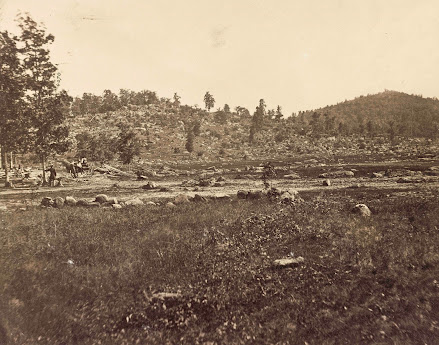
Visitors to Devil's Den a few years after the battle (Library of Congress)
A second landmark at Gettysburg National Military Park will close for several months this year for major rehabilitation.

Park officials announced Thursday that work at Devil’s Den is expected to begin on March 21. The closure will last five to six months as crews address “significant erosion and safety issues in this highly visited area of the battlefield.”

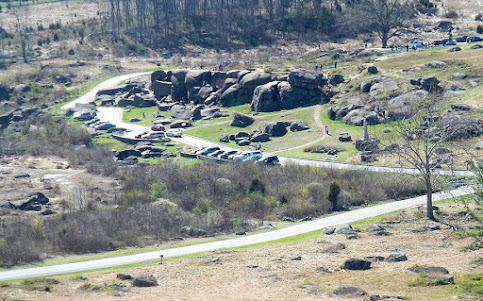
Devil’s Den was the scene of fierce fighting on July 2, 1863, during the decisive battle. The boulder-strewn hill was the object of forces under Confederate Lt. James Longstreet. The Rebels took the position and engaged in fire with Union troops on Little Round Top.

The park said the work is needed because of the erosion along existing walkways and from unauthorized social trails that have created safety hazards.

“The scope of the project will reestablish, preserve, and protect the features that make up this segment of the battlefield landscape,” it said in a statement. “These improvements will allow visitors to better immerse themselves into the historic landscape that is essential to understanding the three-day Battle of Gettysburg.

Crawford Avenue, Sickles Avenue and the Devil’s Den parking area will remain open as much as possible for visitor use. Adjacent battlefield locations, such as the Slaughter Pen, Devil’s Kitchen, and the Triangular Field, will all remain open. The construction contractor will occasionally need to close all road access around the area, but notices will be posted ahead of time, the park said.

View of Devil's Den from Little Round Top (Wikipedia, Wilson44691)
The announcement came about a month after the National Park Service detailed a rehabilitation project on Little Round Top, where Union forces fought off a furious Confederate assault, also on July 2.

Park officials said they are addressing ongoing problems at the overcrowded site. They cited erosion, overwhelmed parking areas, poor accessibility and related safety hazards, and degraded vegetation.

“This project will also enhance the visitor experience with improved interpretive signage, new accessible trail alignments, and gathering areas. These improvements will allow visitors to better immerse themselves into the historic landscape that is essential to understanding the three-day Battle of Gettysburg,” a news release said. 

An update this week said tree cutting was completed last month and the overall project is out for bid, with two contracts: one for overall construction and the second for revegetation of Little Round Top.

The closure of Little Round Top is expected to begin sometime between March 20 and June 21. The project will take up to 18 months to complete, officials previously said.

After the park announced the Devil's Den closure in a Facebook post, critics and supporters weighed in. One said the need for work at both areas has been known for years and the public will be disappointed that two landmarks will be closed at the same time. Others said people should be grateful the work is happening to perpetuate the memory of those who fought there.

Park spokesman Jason Martz told the Picket in an email that the timing of the projects is coincidence, but they are both meant to address problem areas.

Wednesday, February 2, 2022

Gettysburg's famed Little Round Top will be closed 12-18 months during project addressing erosion, parking, accessibility and more


Tree cutting this month at Little Round Top will kick off a larger rehabilitation project that will include a 12-18 month closure of the hill where Union forces fought off a furious Confederate assault, Gettysburg National Military Park announced Tuesday.

Park officials said they are addressing ongoing problems at the overcrowded site. They cited erosion, overwhelmed parking areas, poor accessibility and related safety hazards, and degraded vegetation.

Once rehabilitation efforts begin, all of Little Round Top will be closed for 12 to 18 months, the park said. Officials said Wednesday they were unable to provide details on the exact timing of the beginning of the closure, other than "later in Spring 22."

“This project will also enhance the visitor experience with improved interpretive signage, new accessible trail alignments, and gathering areas. These improvements will allow visitors to better immerse themselves into the historic landscape that is essential to understanding the three-day Battle of Gettysburg,” a news release said. 

A park page on the project says the aim is to “reestablish, preserve, and protect the features that make up this segment of the battlefield landscape.” 

Little Round Top seen from Plum Run Valley (Library of Congress)
Little Round Top and Sykes Avenue will be closed Feb. 9-11 and Feb. 14-16 for the cutting of up to 63 trees along both sides of the road. The park says the removal is necessary for the project.

The work is happening now so as not to interfere with the nesting and breeding of northern long-eared and Indiana bats that may roost in the area. “Both species of bat are on the federal endangered species list and the select tree cutting project must be completed before their anticipated arrival in early spring when nesting activities typically begin.”

Little Round Top is the location of some of the most famous fighting of the battle

Rising 164 feet above the Plum Run Valley to the west, the boulder-strewn hill became the anchor of the Union’s left flank and a focal point of Confederate attacks on the afternoon of July 2, 1863.  The 4th,15th and 47th Alabama regiments made a series of legendary assaults against the 20th Maine, led by Col. Joshua Chamberlain (right).    

“The (Maine) regiment’s sudden, desperate bayonet charge blunted the Confederate assault on Little Round Top and has been credited with saving Major General George Gordon Meade’s Army of the Potomac, winning the Battle of Gettysburg and setting the South on a long, irreversible path to defeat,” according to the American BattlefieldTrust

Thursday, November 12, 2015

Work at Petersburg's Poplar Grove cemetery will return headstones to upright position

Gravestones lie flat on the ground at Poplar Grove (NPS photos)

Ann Blumenschine recalls the day a group of Vietnam veterans stopped at the visitor station of the Five Forks unit of Petersburg National Battlefield. They had made a stop at Poplar Grove National Cemetery – resting place for 6,000 Union soldiers – and were disappointed by its condition.

Perhaps they weren’t expecting to see gravestones placed on the ground rather than standing upright. Occasional flooding from poor drainage had eaten away some of the writing on the stones. The flagpole was in rough shape, as were historical buildings on the property.

“I did not know what to say,” said Blumenschine, a Petersburg park ranger and public information officer.

Now the park has an answer. A dozen years after the push for a multimillion-dollar rehabilitation project began, proper and lasting honor will be restored to those who made the ultimate sacrifice for their country at this Virginia battlefield in 1864 and 1865.

Typical Poplar Grove grave (NPS)
This Sunday (Nov. 15) is the last day for people to visit Poplar Grove National Cemetery before it closes for an anticipated 18 months. 

Maintenance employees and contractors will repair drainage issues, put in new – and upright – marble gravestones, and repair a brick boundary wall and the buildings, including a lodge that one day may serve as a visitor stop. (The cemetery currently is not staffed.)

Officials said they are unaware of any other cemetery maintained by the National Park Service that contains flat gravestones.

Betsy Dinger, a park ranger who maintains a database of soldiers buried at Poplar Grove, told the Picket earlier this year that her heart sank when she first saw the peculiar arrangement of stones, which are of different sizes. “I thought this doesn’t look right.”

The park superintendent in the early 1930s believed that cutting off the bases of the gravestones and placing the remaining marble on the ground was a good way to save on maintenance money. 

Tombstone House off of I-85 (NPS)

Hundreds of the bottoms from the sawed-off monuments found a new, inappropriate purpose. They were sold to a man who used them on the exterior of his Petersburg house and sidewalk.

While park employees don’t second-guess the superintendent’s maintenance decision, they are well aware that the action needs to be remedied.

Dinger said that the new, familiar military gravestones with a rounded top will “make it easy for elements to roll off and protect the inscription.” Because of poor drainage, some of the current stones have become hosts to lichen.

Blumenschine said a storm once brought down trees, including one that brought up a gravestone in its exposed roots. Rumors that coffins were exposed were unfounded, she said.

Lodge at Poplar Grove National Cemetery
1932 photo shows cemetery with upright markers (NPS)

In accordance with protocol, the old gravestones will be ground up and disposed of in order to prevent their use in a dishonorable way.

Poplar Grove National Cemetery, about in the center of the sprawling battlefield, was surveyed in 1866. The Rev. Thomas Flower’s farm was chose. The War Department administered the site until turning it over to the NPS in 1933.

About 6,200 soldiers are buried there, with about 4,000 of them unknown. In some instances, multiple soldiers are buried together. A few Confederates rest at Poplar Grove.

1869 burial register
Many of them fell along the battlefield’s western front. Some died at hospitals, including at City Point. The last burial at Poplar Grove came in 2003.

Rangers said the rehabilitated cemetery will benefit from a maintenance crew up to the task.

“This project is not just important to Civil War soldiers who sacrificed and died,” said Blumenschine. “It will show the respect we have” for fallen sevicemembers today.

Visitation to Poplar Grove during the project will be very limited. Officials said requests for tours will need to be made at least 30 days in advance. Updates on the project will be posted on the park's website and on Facebook.

Thursday, October 8, 2015

Antietam's Burnside Bridge closing Saturday for repairs on walls, arches and piers

Damage to upstream wall in January 2014 (NPS)

A $1.7 million project will stabilize Antietam National Battlefield’s iconic Burnside Bridge, which lost a section of stone wall in January 2014 after the bitter “polar vortex."

Temporary repairs were made, but a deeper engineering assessment found the 12-feet wide by 125-feet-long stone has substantial deterioration of the walls and significant water infiltration, the park in western Maryland said in a Wednesday press release.

The bridge over Antietam Creek will close Saturday (Oct. 10). It was not immediately clear when the pedestrian structure is expected to reopen.

The investigation also found that the instability extended to bridge piers with voids that need to be filled, officials said.

Phase 1 of the preservation will focus on strengthening the stone piers and arches, the National Park Service said. Portable dams will be installed in the creek to divert the water. Phase II will begin in early spring with repairs that require selectively dismantling and rebuilding sections of the bridge walls.

Superintendent Susan Trail last year told the Picket that rapid freezing and thawing after weather systems likely added to the natural wear on the stones.
NPS photo

Originally known as Rohrbach's or Lower Bridge, the battlefield landmark was built in 1836 by John Weaver at a cost of $3,200 as a wagon, horse and foot crossing southeast of Sharpsburg.

On Sept. 17, 1862, America's bloodiest single day, a small force of Confederates on high ground for three hours defended the critical crossing against troops belonging to Ambrose E. Burnside's 9th Corps.

“Topography at the site heavily favored the few hundred Confederates who defended it. The road approaching the east end of the bridge swung on a course paralleling that of Antietam Creek; in the last few hundred yards before reaching the bridge, the road plunged into a funnel-like depression between the opposing bluffs of the creek,” the NPS says. 

“Confederate troops were in rifle pits on the west bluff overlooking the bridge and the approach road.

Critics say Burnside did not do adequate reconnaissance before the attack, which cost him about 500 casualties. 

"After taking the bridge at about 1 p.m., Burnside reorganized for two hours before moving forward across the arduous terrain -- a critical delay. Finally, the advance started only to be turned back by Confederate General A.P. Hill’s reinforcements that arrived in the late afternoon from Harpers Ferry," according to the NPS.

Gen. Robert E. Lee's army was saved, but he had to end his Maryland invasion and return to Virginia.

After the battle, the bridge was actively used for traffic until as recently as 1966, according to the NPS.
The last significant work occurred in the late 1980s.

Monday, June 15, 2015

Readying for restoration, move: Atlanta Cyclorama soon to close at Grant Park

(Picket and Library of Congress photos)

I was a couple minutes behind and hurried to join the rest of the audience. The large room was nearly pitch-black and my hands felt like paws as they tried to find an empty seat during the crawl up the carpeted steps. I could just make out a couple silhouetted heads and finally clutched a seat near the top of the platform. Whew! Just in time for the performance.

The lights came on. The Civil War’s Battle of Atlanta began.

The crowd of 35 at the Atlanta Cyclorama & Civil War Museum gazed at the massive painting and took in the light-and-sound presentation as the revolving platform took us around the massive mural twice. We passed the Troup-Hurt House, where the Confederates briefly broke through the Federal line on July 22, 1864. Passed Union Maj. Gen. John A. “Blackjack” Logan and his staff riding furiously toward the front. Passed fake cannon and plaster figures in the diorama, including one bearing a likeness of “Gone With the Wind” star Clark Gable, who said during a visit to the Atlanta Cyclorama that the only thing that could improve it was to add him. They did so -- but he ended up as the face of a dead soldier.

Near the end of the dated production, the recorded narration said of the Confederate loss at Atlanta: “So many dreams died that day. So perished this cause.”

The lights back on, we made our way to the edge of the giant platform, taking in details of the slightly rippled, magnificent work of art.

Rendering of painting's future home (Atlanta History Center)

I lingered a few minutes with others to speak with our guide and I walked out to take in the museum’s other exhibits, including the famed locomotive Texas.

It was a bittersweet moment last Friday. After all, it was the last time I would sit on the platform at Atlanta’s Grant Park, where the mural, painted by German artists in 1885-1886, has been housed in the same building since 1921. I first visited in 1974 and have made a few more stops since then.

The Atlanta Cyclorama’s last day in its current location is Tuesday, June 30. It will close with little fanfare.

After then, the cultural and historic landmark prepares for the next phase of its storied life. The painting is being relocated to the Atlanta History Center in the city’s Buckhead neighborhood, where an extensive restoration will be completed.

What’s to become of the old property?

New entry area for Zoo Atlanta; Cyclorama building in background
This zoo building near Cyclorama will be removed (Zoo Atlanta)

Zoo Atlanta, right next door in Grant Park, will raze its old administrative office near the entrance and place those and other functions in the old Cyclorama building. The change also will allow for an expansion of the African savanna exhibit and the addition of elephants (two currently are at the zoo).

“We are appreciative of the mayor (Kasim Reed) bestowing us taking over a treasured building that has a legacy in Atlanta,” Keisha Hines, the zoo’s senior director of communications, told the Picket.

While there is no firm opening date for the new Cyclorama building, AHC officials told the Picket last week they expect it to be sometime in early to mid-2017.

AHC officials are excited that the move will bring new interpretation opportunities for the Cyclorama, which covers 15,030 square feet and is 42 feet tall and 358 feet in circumference. The $32.2 million project, funded largely through donations and philanthropies, will include an endowment for long-term maintenance and ensure more people will see the painting, which officials refer to as an artifact.


Gordon Jones, senior military historian and curator at the Atlanta History Center, said once the restoration is done, people will see the Cyclorama as its artists envisioned – from an open platform with a 3-D effect. And the view won’t be hemmed in as it currently is at Grant Park (you only see a third or so of the painting at any given time because of the large rotating platform). Another bonus is the return of sections that were trimmed so that the mural could fit inside the current building.

Jones understands why some are nostalgic about the painting-in-the round's long tenure at Grant Park. (The painting has been in Grant Park since the 1890s; it once was in a wooden building).

“It’s the end of an era and the beginning of another. It makes you sad. It was an Atlanta icon for so long,” Jones told the Picket. “So many have taken care of it -- (Artist-historian) Wilbur Kurtz and the staff. It has been a labor of love for a lot of people.”

A 1979-1982 renovation of the building and conservation led by Gustav Berger ensured the painting’s survival. But the city’s funding limited what could be done in new forms of interpretation and long-term care of the painting, and it was never able to pay for a proper means of attachment to the walls (it hangs now like a shower curtain).

“This is the right thing to do,” Jones says of the impending move. “We are a long-term care facility.”

(Picket photo)

Squabble over famous locomotive Texas

The addition of the Cyclorama will add to the AHC’s permanent exhibits and collections relating to the Civil War.

Asked what items from the Grant Park location he is most excited about coming to the AHC, Jones mentioned four artillery pieces that stood vigil at Fort Walker in what is now Grant Park and a Robert Schade figure study (below) used as guide for the mural’s artists.


Another star of the show will be the locomotive Texas.

On April 12, 1862, the Texas took part in the famous Great Locomotive Chase, or Andrews Raid. Steaming in reverse, the locomotive pursued the fleeing General that had been commandeered by Union soldiers and civilians in disguise.

The Texas was back in the headlines a couple months ago when word came that politicians and officials in Cobb County and Kennesaw, northwest of Atlanta, indicated they would try to have the locomotive moved to the Southern Museum of Civil War and Locomotive History, which houses the General.

A state representative told the Marietta Daily Journal in April that he believes the Texas may be state property, rather than the city of Atlanta’s. “It just makes all kinds of sense in the world to be housed somewhere in Cobb. This is where the historical event actually took place, and I know that it would be well cared for by that museum for sure,” Rep. Earl Ehrhart said. He told the newspaper he may introduce legislation to make it happen if state officials don’t reach a decision.

Frieze on the Cyclorama exterior

While the chase did not take place in Atlanta, the Atlanta History Center says extensive research has uncovered a document that goes in its favor.

“We are certain it belongs to the city,” Jones said, describing a timeline in which a railroad line disposed of rolling stock and a ladies’ association bestowed the Texas to Atlanta after the state declined it.

Hillary Hardwick, vice president of marketing communications at the AHC,” said “there is nothing to discuss.” Plans are being made to have the Texas tell a wider story of the founding and growth of Atlanta transportation and there is value in having the trains in different locations to tell two stories, she said.

Officials will have to bust out a wall at the Grant Park building in order to move the locomotive by crane to a flat-bed truck for the journey north to Buckhead.

A panoramic journey way back in time

Mike Saulsberry
Sitting on the 184-seat viewing platform at Grant Park, southeast of downtown Atlanta, was like a trip back in time – to a sweltering day in July 1864. The mural, all 9,334 pounds of it, is epic in scale and focus. The focal point of the painting depicts fighting about a mile and a half from Grant Park.

Among those I joined Friday on the stage was Mike Saulsberry of Michigan.

He and his brother, who lives in the Atlanta area, had visited the site in the late 1990s and he was interested in seeing it again after delving deeper into history and genealogy in recent years.

The brothers have ancestors, James and Edward Gish, who served in the U.S. Colored Troops’ Company D, 108th Regiment, and Henson Salsbury with Company F, 122nd Regiment.

“I liked the fact that the presenter took time to answer questions,” Saulsberry said of Friday’s presentation. “He gave us an opportunity to get up and walk around.” At Gettysburg’s cyclorama, he said, the presentation was too quick. “You didn’t have a chance to linger.”

Saulsberry said he wants to learn more about African-American soldiers and their role in the Atlanta Campaign.


While programs in recent years at the current location have stressed diversity and the impact of the war on various populations, the standing exhibits at Grant Park are dated and lack such context. Two years ago, venue spokesman Yakingma Robinson told the Picket that the staff had hoped for new, interactive exhibits. That now will have to wait until the new building at the Atlanta History Center.

In 2011, Kevin Riley, editor of The Atlanta Journal-Constitution, wrote about his visit to the center: “The Cyclorama looks tired -- from the seating, to the diorama, to the painting itself."

With concerns about attendance, funding and the condition of the painting and exhibits, Mayor Reed in 2011 assembled a task force to study solutions. Last summer, Reed and the Atlanta History Center announced the Cyclorama would get a new home.

Robinson and Jones told the Picket that the painting, itself, is in decent shape. But art experts won’t know for sure until the diorama is removed so that they can get a closer look.

Zoo Atlanta's current elephants: Kelly and Tara.

Zoo Atlanta excited about the addition

Although some residents of Grant Park spoke in favor of keeping the Cyclorama, there never appeared to be much formal interaction between the venue and the surrounding neighborhood.

Zoo Atlanta has much deeper ties to residents and associations.

And it’s much more of a destination. While it saw a small attendance bump during the Civil War sesquicentennial, the Cyclorama’s current numbers are between 60,000 and 70,000 annually. Zoo Atlanta anticipates 1 million visitors this year, said Hines, the spokeswoman.

Beyond the expanded savanna exhibit, current plans call for the zoo to use the building for offices and a large special events facility that can be rented. A current Zoo Atlanta administrative building will be torn down to a build “a more rich entry area for the guests.” Hines cautioned plans are subject to change.

Already, the zoo sees weddings, parties and even sleepovers for children.

Conceptual image of expanded exhibit (Zoo Atlanta)

Zoo officials can’t do much inside of their new site until the Atlanta History Center has done some of the necessary restoration work and move the mural.

Hines said it’s not yet clear what decorative or other themes might be put in place in the old Cyclorama building.

“It will be exciting once we do know,” she said of the project. “It will be great for Zoo Atlanta, residents and partners in the neighborhood.”

COMING SOON: A closer look at the Atlanta History Center’s plans for Cyclorama and related exhibits