A March 14 walking tour shares the stories of soldiers, citizens, and self-liberated African-Americans in Civil War Alexandria, Va. It covers the military occupation, the conversion of public and private buildings into hospitals, and emancipation. -- READ ARTICLE
Showing posts with label slavery. Show all posts
Showing posts with label slavery. Show all posts
Saturday, February 14, 2026


Wednesday, September 24, 2025
Oorah! Marine Corps makes sure a recovered Schenkl artillery shell is safe, hands it over to Liberia House in Manassas, Va., ahead of its 200th birthday bash
 |
| Photos of returned shell (top) and after its discovery in April (below, City of Manassas) |
“The following ordnance items have been
certified free from bulk explosives, have been certified inert, indicated by an
accompanying inert certification.”
U.S. Marines stationed about 25 miles away
returned a Civil War Schenkl artillery shell that was found in April by contractors
using heavy equipment at a creek near Liberia House, which has a rich history.
“At my request, they did not clean the shell
up except to remove loose dirt. So it looks very much like it did when it
was discovered, except now it has a big hole in the top from being worked on,”
said Mary Helen Dellinger, curator at the city-run Manassas Museum, which
manages the historic site.
 |
| The striking Liberia House was made from bricks fashioned from red clay on site (City of Manassas) |
The Schenkl shell would have contained black
powder but the Picket was unable to determine whether it still was present 160
years later. An EOD technician at the base who answered questions Tuesday about
explosive ordnance said he did not have details on this shell.
The technician said if any black powder was
present the item would have been carefully pressure washed and cleaned with a
filtration system.
Hard to say which side had this particular round

Manassas, obviously, is associated with two major battles and numerous smaller operations and skirmishes.
The Schenkl was primarily used
by Federal artillerymen in a variety of cannons, including the Parrott.
“As far as Federal vs. Confederate shell – it’s difficult to say,” said Dellinger (left in city Instagram post) of this example.
“We do know that during the Battle
of Bull Run Bridge the 2nd New York was stationed on the
property (exact location unknown) and were firing at the Confederates at Fort
Beauregard (located about ½ mile from Liberia). Because of the history of both
sides being on the property during the war, it’s really hard to say which side
left the shell behind.”
About
400,000 Schenkl shells were made during the Civil War. They came in several
styles, including ones that contained case shot. It had a Papier-mache sabot.
Shell will make its public debut Oct. 11
The Prince William County property served as headquarters for Confederate and
Union forces early in the war. Jefferson Davis (in 1861) and Abraham Lincoln
(in 1862) came here to confer with their generals. “Proof of occupation is
displayed as faded graffiti left by Union soldiers is visible on interior
walls,” the city says.
Soldiers from both sides wrote graffiti in many
structures in the region. Those surviving at Liberia Hall are Union.
Dellinger previously told the Picket past archaeological digs at Liberia yielded numerous Civil War-related pieces, among them buttons, bullets, small bits a pieces of metal that relate to horse equipage, other accoutrements and a sword -- “the coolest thing until this shell.”
Manassas touts its extensive Black history through a trail for residents and visitors. Liberia House tells the story of the enslaved people on the land at the time of the war.
Liberia House was built for William J. and
Harriett Weir in 1825. Enslaved laborers did most of the construction on the
two-story, Federal style brick home. They are believed to have crafted much of
the stylish interior, too. Its 1,600 acres made Liberia a large working farm
and plantation.
Dellinger said the birthday party will not have a Civil War focus but there will be come wartime components, including the debut of the Schenkl round.
”After that, I plan on leaving the shell at the house so when we have it open for public events it’s on hand for people to see.”
Marines keep busy with calls about ordnance
 |
| 19th century photo of house shows men in fashionable clothing (Library of Congress) |
The Quantico EOD
technician told the Picket the team will try to render them safe if possible.
“Everybody has stockpiles they need certified, looked at, or inerted,
on top of people finding (items) in their yards in Northern Virginia.”
Liberia House is located at 8601 Portner Ave., Manassas. The
house is open for special events and tours and an annual bee
festival. The grounds are open from sunrise to sunset. For more information,
contact the Manassas Museum at 703-368-1873.
Thursday, May 1, 2025
First on the Picket: Compelling artifacts and technology acquired in recent years will tell a bigger story in an Atlanta History Center exhibition opening next year. The aim is to get you to think about what the Civil War meant then -- and its impact today
 |
Atlanta,
museum officials say, is ideal to tell a bigger national story about the Civil
War in a striking way. Beyond being the capital of the South and a melting pot,
it’s recognized by historians as a crucial battleground for saving the
presidency of Abraham Lincoln and the United States itself.
For 30 years,
relics collected by an Atlanta father and son formed the core of “Turning Point: The American Civil War.” The exhibit focused on the soldiers in blue and
gray and how they did their deadly work, and visitors were awed by the
incredible collection of uniforms, weapons, personal items -- and just about
every conceivable type of artillery shell.
While
“Turning Point” did address some big questions about the Civil War, there was
limited discussion on technology, slavery and the home front. New, more diverse
generations – distanced even more from the Civil War era – are asking deeper questions,
the museum says, about why the war happened, how 4 million enslaved Americans
gained their freedom, Reconstruction and what the conflict, which took at least
720,000 lives, means today.
 |
| Sheffield Hale with Union 20th Corps wagon that traveled near what is now the AHC (Picket photo) |
The history center is investing $15 million and more than 15,000 square feet for the new exhibition, which has not been formally named. It is expected to open in summer 2026, when the AHC marks its centennial.
“Turning Point” will close on
May 25, but Civil War aficionados can still get their fix during construction with
the giant Cyclorama painting of the Battle of Atlanta, related exhibits and the
locomotive Texas, one half of the famous “Great Locomotive Chase” in 1862.
Jones came to the history center in early 1991 and cataloged the vast artifacts collection of Beverly M. DuBose Jr., whose name is on the
current gallery. The collection became the basis for much of “Turning Point," which now has an outdated feel.
 |
| Flags and other items in the current "Turning Point" exhibit (Picket photo) |
“More is
better. It’s what gets people excited,” said Jones. “Artifacts are what speak
to you emotionally, through your heart.”
Two flags and messages they sent to formerly enslaved
Make no mistake, Confederate and Union bayonets, swords, flags, rifles and revolvers will still be a big part of the presentation. To that end, Jones and AHC CEO and president Sheffield Hale are excited about plans to include two large collection of dug relics.

“It’s an iconic knock-your-socks-off artifact,” Jones (At left in Picket photo) said at
the time. Even an enlisted man’s USCT uniform wouldn’t be as historically
significant as this flag.”
There’s another flag (top photo of this post) the curator said will be his favorite
item in the new exhibit.
Most of the American flag is long gone, save for the 34 stars
and upper-left canton. It flew over a camp on Craney Island near Hampton Roads, Va., that
protected escaped slaves, whom Jones said were active in their liberation.
While the flag for the 127th USCT largely symbolized
pride and duty, this one was a symbol of freedom, welcoming those who arrived
safely after a dangerous journey.
“If I get to that flag, I get my freedom,
Jones said a refugee might think. “The choice to whom I can marry, to find my
family.”
A closer look at the fascinating 'new' artifacts
I met Monday
with Hale and Jones to talk about the new exhibition, which officials say will be
heavy on “cutting-edge technology and immersive storytelling” and the benefits
of newer scholarship. (Afterward, Jones showed me several artifacts in a
storage area in the building’s basement)
They outlined some of what visitors will see in the galleries and other items in the center's vast collection. Below is just a smattering of what we discussed:
 |
| Patent for Morse breech-loading firearm (Atlanta History Center) |
-- A projection on one wall will feature a timeline of the
war, key moments and maps, Hale said. The AHC will display elements of its
interactive “War in Our Backyards” collaboration with The Atlanta Journal
Constitution about 10 years ago.
-- Utilizing an online database about the Atlantic slave
trade, the former DuBose space will feature an animated screen showing their
routes, destinations and other details.
 |
| Gordon Jones with 18th century British blunderbuss (Picket photo) |
-- One is a circa 1750s short-barreled firearm, or blunderbuss, made by the John Whately family in England. The European slave cartel traded guns for enslaved persons along the West African coast. It was typical for the buyers to supply weapons, iron bars, printed cloth and other metals as part of the barter. "This one is extremely lightweight, cheaply made, and incredibly rare to find in this condition," said Jones, who believes this one may have been a sample weapon.
“It was just rotten and evil from the start to finish,” the historian said of the slave trade.
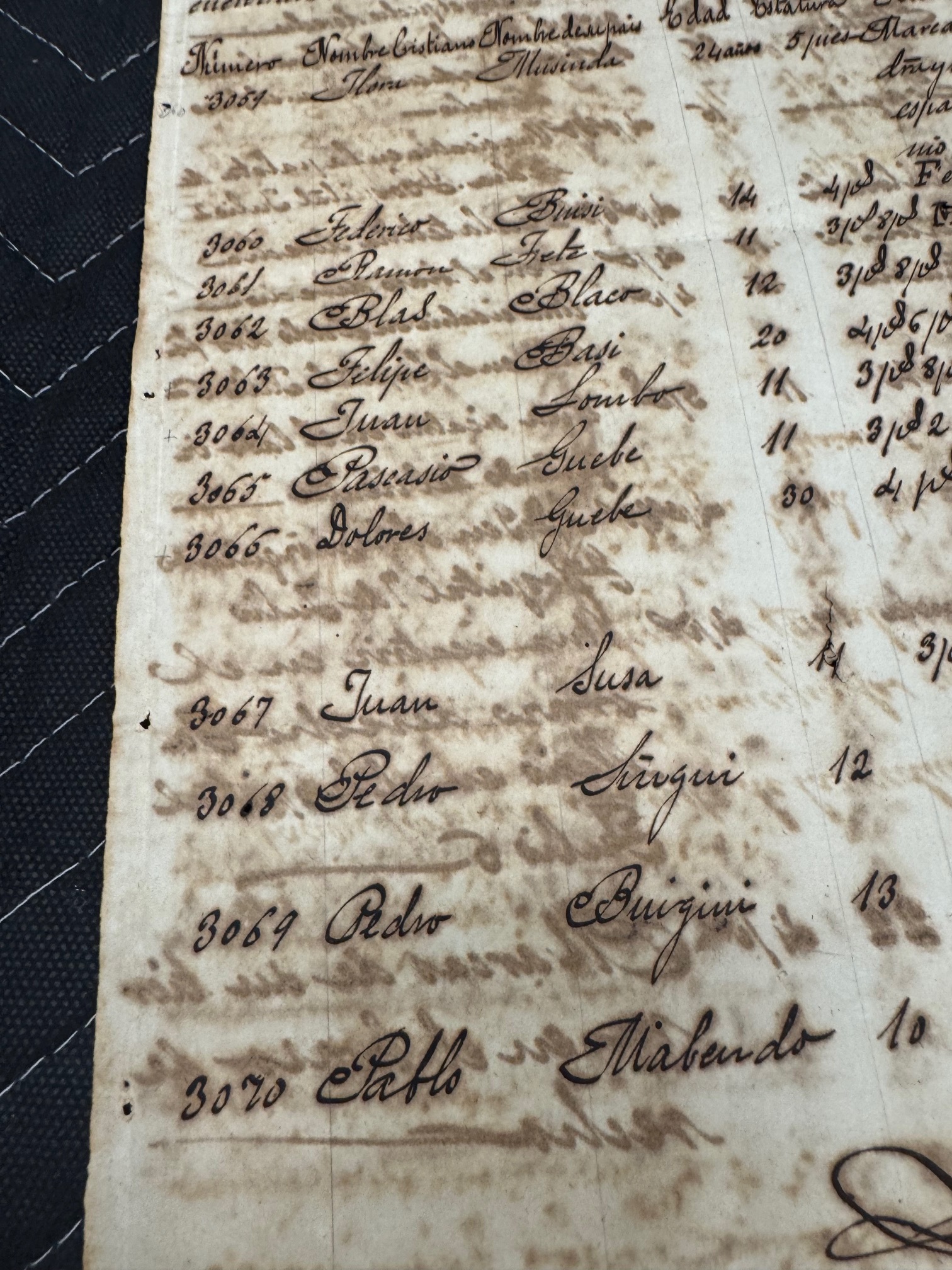
-- A presentation on Confederate and Union monuments, including their locations.
-- Documents from the Maj. Henry Thomas Massengale collection. The Confederate States Quartermaster Bureau in Atlanta was responsible for manufacturing, procuring and transporting military supplies such as clothing, camp equipment, forage, and draft animals, to the Army of Tennessee before, during, and after the Atlanta campaign. Some of the notations are about enslaved persons, including one about a requisition for pants, drawers, shirts and hats for three. “The clothing is required for Negroes employed on the Fortifications that were confined in the Smallpox Hospital and their clothing had to be burned to prevent contagion.” The papers are available at the AHC's Kenan Research Center.
-- Personal items belonging to Capt. James Lile Lemon of the 18th Georgia. “He literally saved everything,” said Jones. Among the artifacts is a drum (photo at top of post) captured from two young Pennsylvania drummer boys on Sept. 16, 1862, the day before the Battle of Sharpsburg (Antietam). Lile later wrote about the capture of the boys by Pvt. Frank A. Boring:
"As he was driving them to the rear at point of bayonet they heaped so much abuse upon him - out of their fear or nervousness - that he had to be restrained from striking them with the clubbed musket. Of course, instantly the target of many wags among our company who joked with him about "scaring little boys" & etc. He replied that he would be d---d if he'd take such abuse from "d---d Yankee whelps." The boys were release & "beat a hasty retreat" back to their lines, with Boring giving them a rite hard look as they went."

-- A fascinating lithograph copy of South Carolina’s ordinance of secession. Black troops with the 102nd USCT, mainly comprised of Michigan and Canadian men, seized it in March 1865 at a Charleston home. The Union troops listed four companies within the regiment.
They called the signed sheet a “scroll of treason.” (the original document is in the South Carolina archives). The AHC has a pistol that belonged to one of the White officers listed at the bottom.
Crucial to all this, Hale and Jones said, is being authentic and honest about artifacts and context. At a time of growing use of artificial intelligence and a distrust among many of museums, it’s important visitors know where items came from, said Hale.
 |
| Notation on copy of South Carolina secession document calls it a "scroll of treason" (Picket photo) |
The aim is to be thought-provoking
Part of the
exhibit will look at how the United States went from the Revolutionary War and
subsequent conflicts to the Civil War, and what was resolved and what was not
during those 80 years.
Some of the fractures
continue today, said Jones, adding it is important to raise questions but let
visitors make their own conclusions. “We want to change … the traditional ways
we examined the Civil War.”
The AHC has
utilized focus groups and feedback as it plotted the direction of the exhibit.
Jones considers history professor Carolina Janney of the University of
Virginia, historian and former president of the University of Richmond Ed Ayers
and Cynthia Neal Spence, associate professor of sociology at Spelman College,
among his mentors. Spence was featured in an AHC documentary about the legacy
of Stone Mountain.
At the end of
the day, compelling artifacts, context and interactive features will combine to
entertain and educate, the AHC believes.
“We want them
to say, ‘Dang, I never realized that,’” Jones said.
Friday, January 12, 2024
Tracing 'A Long Arc': These 9 Civil War-era photographs in an Atlanta exhibit drive home identity, race and trauma across the South, US
 |
| A young Union artilleryman (High Museum of Art, more information below) |
The show,
which concludes its Atlanta run on Sunday (Jan. 14), has nearly 200 black and white and
color photographs. They are presented chronologically, taking the visitor
through a series of rooms.
As the
introductory panel says, “A Long Arc” demonstrates “how
Southern photography has shaped American concepts of race, place, and history.”
I am no art critic, so I offer a New York Times essay, this article and this one for deeper looks.
While
I was struck during my October visit by compelling images from the past 100
years (some seen here), I am concentrating this post on the first gallery,
related to slavery, secession and the Civil War. (Picket photo below)

“Portrait
photography in the antebellum South was most distinctive for how it projected
and channeled racial and social identity at a moment of intense debate over
slavery. It was not unusual for Southern slaveholders to commission photographs
of their children with enslaved members of their households, a means of
reinforcing social hierarchies. Yet, significantly, the medium also offered
free Black Americans a means to declare their presence and self-possession in a
society that did not regard them as citizens.”
Wartime
studios provided portraits soldiers could send home. Photographs of battlefield
carnage and the destruction of Southern cities viewed the land as “the
repository of memory, history, and trauma,” says the High, which amassed most
of the collection.
I am sorry that I am writing this just before the Atlanta exhibit ends (life got in the way). But if you can't get there in the next couple days, the Addison Gallery of American Art in Andover, Mass., will be hosting "Long Arc" from March 2 to July 31.

SLAVE PEN IN VIRGINIA
Several
images of such markets were taken during the war, often after Federal forces
had taken a Rebel city, such as Alexandria, Va., shown here. The photographer
was A.J. Russell, a member of the 141st New York. When he took the
photo, the building had been converted into a prison holding Confederates.
According to the Metropolitan Museum of Art, between
1830 and 1836, Alexandria – across the Potomac River from Washington,
D.C. – was the seat of the slave trade. Hundreds of slaves were held in this
building.
A New York
Times essay on the High Museum exhibit said this about the “Slave Pen” label
for photograph: “Think about the cold fact of
that label for a moment. The places where enslaved people were imprisoned
before being sold weren’t called jails. They were called pens. Built to contain
livestock.”
Andrew Joseph Russell (American, 1830-1902), Slave Pen, Alexandria, Virginia,
1863, albumen silver print from glass negative, High Museum of Art,
Atlanta, purchase with funds from the Lucinda Weil Bunnen Fund and the Donald
and Marilyn Keough Family, 2021.266.
DEFIANT SECESH SHOWS HER COLORS

In South Carolina, civilian men and women, and even companies of
soldiers, wore palmetto emblems during the Civil War, according to Hinman Auctions.
“Southern cockades were generally all blue, all red, or red
and white,” according to Creative Cockades. “Once again, center emblems include
stars, military buttons and pictures, but additionally Southern products such
as palmetto fronds, pine burs, corn or cotton were used.
Unidentified photographer, woman wearing secession sash, ca. 1860, ambrotype, High Museum of Art, Atlanta, purchase with funds from the Lucinda Weil Bunnen Fund and the Donald and Marilyn Keough Family, 2021.279.
WHITE CHILD WITH ENSLAVED CHILD

This image really caught my attention: What was their relationship exactly? What became of them later in life?
The New York Times said this of such
photographs: “Even before photographs of battle fortifications and mass graves and
prison camps and cities in ruin brought home in detail the enormous scale and
human cost of the Civil War, images of the realities of enslaved people in the
South inspired widespread moral outrage and aided the abolitionist movement.
Southern politicians had been lying about both the benevolence of enslavers and
the ‘three-fifths’ nature of Black humanity since the founding of this country,
but the real truth about slavery began to come clear to most people outside the
South only when first photographs of enslaved people ermerged.”
Whitehurst Studios, Mary
Zulette Waterhouse, Richmond, Va., Age about Two, with Unidentified Enslaved
Child, 1850s, hand-tinted sixth plate daguerreotype in hinged enclosure,
3 1/2 x 3 inches, Addison Gallery of American Art, Phillips Academy, Andover,
MA, museum purchase, 2012.21

CHILLING COLLECTION OF SKULLS
This
photograph by John Reekie (1832-1885) can lead viewers to gasp at its content
and composition. It was included in a sketch book produced by legendary Civil
War photographer Alexander Gardner. The relatively unknown Reekie captured
African-American soldiers in April 1865 digging up the remains of Union troops
who died nearly a year before at Cold Harbor, Va.
The
Metropolitan Museum of Art says this of the photograph: “Reekie’s atypical low vantage point and tight
composition ensure that the foreground soldier’s head is precisely the same
size as the bleached white skulls and that the head of one of the workers rests
in the sky above the distant tree line. It is a macabre and chilling
portrait -- literally a study of black and white -- that is as memorable as any made
during the war.
A
Burial Party, Cold Harbor, Virginia, 1865, published 1866, albumen silver
print, High Museum of Art, Atlanta, purchase with funds from the Lucinda Weil
Bunnen Fund and the Donald and Marilyn Keough Family, 2021.267

GET YOUR PICTURE RIGHT HERE!
Isaac H.
Bonsall (1833–1909), according to the High Museum, was one of many enterprising
photographers who took advantage of the public’s rising interest in
photography, especially studio portraits, during the onset of the Civil War.
“These
photographs allowed sitters to strengthen bonds with their loved ones, reinvent
themselves, and construct personal histories,” the museum says. “In 1862,
the New York
Tribune published an observer’s account of the onslaught of
traveling portrait studios among the army: “A camp is hardly pitched before one
of the omnipresent artists in collodion and amber … pitches his canvas gallery
and unpacks his chemicals.”
Bonsall’s Photo Gallery, Chattanooga,
TN, 1865, albumen silver print, High Museum of Art, Atlanta, purchase with
funds from the Lucinda Weil Bunnen Fund and the Donald Marilyn Keough Family,
2021.269.

RAMMING THE ROUND HOME
The men of 2nd
Regiment, United States Colored Light Artillery, Battery A, are shown on drill
circa 1864. Organized in Nashville in 1864 and
dispatched until 1866, the unit accompanied the infantry and cavalry troops
into battle with horse-drawn cannons.
Though
many batteries were relegated to everyday garrison duty, Battery A fought in
the Battle of Nashville in December 1864, where these photographs chronicling
the loading and firing of the gun may have been taken, the High Museum says.
Unidentified photographer, albumen silver print, High Museum of Art, Atlanta, purchase with funds from the Lucinda Weil Bunnen Fund and the Donald and Marilyn Keough Family, 2021.275.
EYES OF A YOUNG ARTILLERYMAN (top photo)
More
than 25.000 black artillerymen, many of whom were freedmen from Confederate
states, served in the Union Army. Artillerymen were required to handle hundreds
of pounds of supplies, such as the gun, its limber, a traveling forge and
caissons to store the ammunition, according to the High Museum.
Unidentified photographer, Young biracial artilleryman, undated,
ambrotype, High Museum of Art, Atlanta, purchase with funds from the
Lucinda Weil Bunnen Fund and the Donald and Marilyn Keough Family,
2021.280.
.jpg)
CONFEDERATE WORKS IN GEORGIA
George N. Barnard (1819-1902) arrived in Atlanta shortly after the Confederates abandoned the city. He was intent on taking photographs of its defenses, including this image of what is now part of the Georgia Tech campus.
The Metropolitan Museum of Art says “this
view is one of the most frequently cited and reproduced of all Barnard’s war
photographs. The subject is an abandoned Confederate fort with rows of
chevaux-de-frise running through the landscape.”
Rebel Works in Front of Atlanta, Ga.,
No. 1, 1864, printed 1866, albumen silver print, High Museum of Art, Atlanta,
gift of Mrs. Everett N. McDonnell, 75.23.
Thursday, July 6, 2017
Ole Miss to recognize slave labor
The University of Mississippi said Thursday that it will post a sign
acknowledging that slaves built some structures on the main campus founded
before the Civil War. The administration has already added a plaque to provide information
about slavery and the Civil War to a Confederate soldier statue near the
Lyceum, the main administrative building on campus. • Article
Friday, August 31, 2012
Telling story of 'hard luck' Minn. regiment
 A new book looks at a historical incident I've never read about. In November 1863, a group of soldiers from the Ninth Minnesota Volunteer Infantry Regiment heard the agonized pleas of a slave, a father whose wife and children were about to be sold off and separated, and set off to rescue the family — in defiance of orders. As a result, the liberators were charged with mutiny and starred in a case that caught national attention. • Article
Thursday, April 14, 2011
A more inclusive look at the war
My whirlwind trip to Charleston, S.C., concluded around 11 a.m. yesterday in Marion Square, where young college students sunbathed, rode bikes and sipped coffee.
 Above, them South Carolina statesman John C. Calhoun, at the top of a tall statue, looked grimly toward the South.
The man who called slavery a "positive good" and defended states rights seemed a bit lost in time.
Musical programs and lectures I attended Monday and Tuesday showed me this was a very different Charleston that celebrated the war's centennial in 1961.
The buzz word for 2011 is "commemoration."
Speakers reiterated that secessionists really did think the war was about slavery and race. The states rights argument, they said, was built in support of slavery. I realize all of this can be argued -- and will be -- through 2015 and beyond.
In 1961, programs no doubt failed to mention the service of U.S. Colored Troops in the Union army and the toll of slavery on generations of African-Americans.
Monday night, a concert included several period tunes, including "Dixie" and the "Battle Hymn of the Republic."
Jay Ungar and his band performed "Ashokan Farewell," the haunting violin song that was the theme song for Ken Burns' Civil War TV series.
African-American Union re-enactors and men in Confederate gray stood together in front of the outdoor audience on a beautiful spring evening. It was a moment of real unity.
To the east across the park in the Battery, Fort Sumter glowed in red and blue.
 Today, as then, the city also remembers the destruction it suffered during the war and its loss of young men to a cause in which they believed.
I was only a few years old at the time, but I can't imagine Charleston was this introspective during the centennial.
For all this, I noticed very few African-Americans at the events, parks and bombardment re-enactments I attended around Charleston this week.
It was a reminder, that although many civil rights gains were made only a few short years after the 1961 centennial, there appears to still be a racial divide in commemorating the Civil War. It would be an understatement to point out the pain that slavery and subsequent segregation brought to the African-American community.
Going forward, I hope events over the next four years will capture at least some of Charleston's spirit of reconciliation.
 Above, them South Carolina statesman John C. Calhoun, at the top of a tall statue, looked grimly toward the South.
The man who called slavery a "positive good" and defended states rights seemed a bit lost in time.
Musical programs and lectures I attended Monday and Tuesday showed me this was a very different Charleston that celebrated the war's centennial in 1961.
The buzz word for 2011 is "commemoration."
Speakers reiterated that secessionists really did think the war was about slavery and race. The states rights argument, they said, was built in support of slavery. I realize all of this can be argued -- and will be -- through 2015 and beyond.
In 1961, programs no doubt failed to mention the service of U.S. Colored Troops in the Union army and the toll of slavery on generations of African-Americans.
Monday night, a concert included several period tunes, including "Dixie" and the "Battle Hymn of the Republic."
Jay Ungar and his band performed "Ashokan Farewell," the haunting violin song that was the theme song for Ken Burns' Civil War TV series.
African-American Union re-enactors and men in Confederate gray stood together in front of the outdoor audience on a beautiful spring evening. It was a moment of real unity.
To the east across the park in the Battery, Fort Sumter glowed in red and blue.
 Today, as then, the city also remembers the destruction it suffered during the war and its loss of young men to a cause in which they believed.
I was only a few years old at the time, but I can't imagine Charleston was this introspective during the centennial.
For all this, I noticed very few African-Americans at the events, parks and bombardment re-enactments I attended around Charleston this week.
It was a reminder, that although many civil rights gains were made only a few short years after the 1961 centennial, there appears to still be a racial divide in commemorating the Civil War. It would be an understatement to point out the pain that slavery and subsequent segregation brought to the African-American community.
Going forward, I hope events over the next four years will capture at least some of Charleston's spirit of reconciliation.
Thursday, August 26, 2010
Re-enactor sleeps in slave quarters
Joseph McGill is a program officer for the National Trust for Historic Preservation in South Carolina. But that's only his day job. On the side, McGill is a Civil War reenactor who has recently begun sleeping in former slave cabins. • Article
Tuesday, July 27, 2010
Soldier's headstone finally corrected
The headstone of a former slave and Union soldier no longer identifies him as a member of the Confederate army, after his family failed to notice the error for years. More than 100 of Samuel Brown Sr.'s surviving descendants and Civil War buffs gathered at Vallejo's Sunrise Memorial Cemetery in California for the dedication of his new headstone. • Article
Friday, June 11, 2010
Rare photo of slave children found in attic
A haunting 150-year-old photo found in a North Carolina attic shows a young black child named John, barefoot and wearing ragged clothes, perched on a barrel next to another unidentified young boy. Art historians believe it's an extremely rare Civil War-era photograph of children who were either slaves at the time or recently emancipated. • Article
Thursday, April 8, 2010
Kennesaw battlefield conducting focus groups with African-Americans
Hoping to widen the scope of its exhibits, Kennesaw Mountain National Battlefield Park is talking with African-Americans about their attitudes on the Civil War.
The park wants to know what would draw more African-Americans and what kind of exhibits or themes might better tell the black narrative on the conflict.
 “The African-American side of the Civil War has been left out” at most sites, said Kennesaw Mountain (KEMO) Superintendent Stanley C. Bond.
The park, working with the Center for the Study of the Civil War Era at nearby Kennesaw State University, will be hosting five focus groups this spring. Each group will have 8-10 participants. The groups will include officials and members of several organizations, such as the NAACP Cobb County branch.
KEMO’s recommendations and actions following the study will be shared with other federal Civil War sites later this summer. National Park Service sites are charged with discussing the causes and consequences of the war, Bond says. It’s part of the “From the Civil War to Civil Rights” initiative.
Bond says the popular suburban Atlanta battlefield does have some mention of the homefront and the African-American story during the Civil War, but needs to do more.
 “We would like to see more people here for historical purposes,” says Bond, who contends about 80 percent of park visitors come for recreational purposes, such as hiking, walking and horseback riding.
Conducting the focus groups is Hermina Glass-Avery (above), associate director of the KSU center.
Glass-Avery contends that slavery, race and emancipation got short shrift during the nation’s 1961 observation of the Civil War centennial. She hopes that changes during the sesquicentennial commemoration starting in 2011.
A controversy this week has rekindled the issue of perspective.
Virginia Gov. Bob McConnell apologized Wednesday for failing to include slavery in his proclamation declaring April as Confederate History Month. He said he wanted the month to mark the valor of Confederate soldiers, but critics said he should have first acknowledged the ties between slavery and the war.
 Bond and Glass-Avery cite the following as examples of little-known aspects of blacks in Georgia:
-- Some 250 African-Americans from the era, many federal soldiers, are buried at the National Cemetery in Marietta. One African-American, “Ten Cent” Bill Yopp, served with Confederate forces and is buried with them at the Confederate Cemetery in Marietta.
-- African-Americans, like their white owners and neighbors, suffered late in the war. “When Sherman went on the March to the Sea he took everything,” Bond said.
-- Large numbers of black women died in contraband camps because they were left without support when freed men joined the federal army.
-- Plantations symbolize the antebellum South. “You don’t hear from the silent hands that made them operate,” said Glass-Avery.
-- African-American soldiers “were present and agents of change for their freedom.” At least 200,000 served.
 Glass-Avery and Bond hope their focus group findings may bring about new interpretive approaches and exhibits that could increase the number of black visitors.
“Their [African-Americans’] story is not held with the same respect as other narratives,” said Glass-Avery, who contends the election of President Barack Obama has made the time right to discuss the war, race and civil rights. She says the Compromise of 1850, Jim Crow laws, the Dred Scott decision by the U.S. Supreme Court and the Civil War all shaped the push for civil rights in the 1950s and 1960s.
KEMO recently participated in the Center for the Study of the Civil War Era’s recent symposium, “Alternative Realities: African-Americans and the American Civil War: Freedom, Memory and Identity.”
 Glass-Avery says the “Lost Cause” touted by many Southerners after the war and at the 1961 centennial has given way to the discussion of many other issues and beliefs related to the Civil War.
In the end, Glass-Avery hopes that Americans will be open to different views of history.
“It is ethical for us to be respectful of one another.”
The park wants to know what would draw more African-Americans and what kind of exhibits or themes might better tell the black narrative on the conflict.
 “The African-American side of the Civil War has been left out” at most sites, said Kennesaw Mountain (KEMO) Superintendent Stanley C. Bond.
The park, working with the Center for the Study of the Civil War Era at nearby Kennesaw State University, will be hosting five focus groups this spring. Each group will have 8-10 participants. The groups will include officials and members of several organizations, such as the NAACP Cobb County branch.
KEMO’s recommendations and actions following the study will be shared with other federal Civil War sites later this summer. National Park Service sites are charged with discussing the causes and consequences of the war, Bond says. It’s part of the “From the Civil War to Civil Rights” initiative.
Bond says the popular suburban Atlanta battlefield does have some mention of the homefront and the African-American story during the Civil War, but needs to do more.
 “We would like to see more people here for historical purposes,” says Bond, who contends about 80 percent of park visitors come for recreational purposes, such as hiking, walking and horseback riding.
 Conducting the focus groups is Hermina Glass-Avery (above), associate director of the KSU center.
Glass-Avery contends that slavery, race and emancipation got short shrift during the nation’s 1961 observation of the Civil War centennial. She hopes that changes during the sesquicentennial commemoration starting in 2011.
A controversy this week has rekindled the issue of perspective.
Virginia Gov. Bob McConnell apologized Wednesday for failing to include slavery in his proclamation declaring April as Confederate History Month. He said he wanted the month to mark the valor of Confederate soldiers, but critics said he should have first acknowledged the ties between slavery and the war.
 Bond and Glass-Avery cite the following as examples of little-known aspects of blacks in Georgia:
-- Some 250 African-Americans from the era, many federal soldiers, are buried at the National Cemetery in Marietta. One African-American, “Ten Cent” Bill Yopp, served with Confederate forces and is buried with them at the Confederate Cemetery in Marietta.
-- African-Americans, like their white owners and neighbors, suffered late in the war. “When Sherman went on the March to the Sea he took everything,” Bond said.
-- Large numbers of black women died in contraband camps because they were left without support when freed men joined the federal army.
-- Plantations symbolize the antebellum South. “You don’t hear from the silent hands that made them operate,” said Glass-Avery.
-- African-American soldiers “were present and agents of change for their freedom.” At least 200,000 served.
 Glass-Avery and Bond hope their focus group findings may bring about new interpretive approaches and exhibits that could increase the number of black visitors.
“Their [African-Americans’] story is not held with the same respect as other narratives,” said Glass-Avery, who contends the election of President Barack Obama has made the time right to discuss the war, race and civil rights. She says the Compromise of 1850, Jim Crow laws, the Dred Scott decision by the U.S. Supreme Court and the Civil War all shaped the push for civil rights in the 1950s and 1960s.
KEMO recently participated in the Center for the Study of the Civil War Era’s recent symposium, “Alternative Realities: African-Americans and the American Civil War: Freedom, Memory and Identity.”
 Glass-Avery says the “Lost Cause” touted by many Southerners after the war and at the 1961 centennial has given way to the discussion of many other issues and beliefs related to the Civil War.
In the end, Glass-Avery hopes that Americans will be open to different views of history.
“It is ethical for us to be respectful of one another.”
Governor still in hot water over proclamation
Virginia Gov. Robert F. McDonnell (R) apologized late Wednesday for failing to include slavery in his proclamation declaring April as Confederate History Month. • Article
Subscribe to:
Comments (Atom)