Showing posts with label cannons. Show all posts

Thursday, May 1, 2025

First on the Picket: Compelling artifacts and technology acquired in recent years will tell a bigger story in an Atlanta History Center exhibition opening next year. The aim is to get you to think about what the Civil War meant then -- and its impact today

The Atlanta History Center
is closing a longtime Civil War exhibit to make way for two new galleries that will feature breathtaking artifacts and a broader discussion of issues that engage the republic to this day: our belief systems, victory, defeat, reconciliation and the evolving meaning of freedom.

Atlanta, museum officials say, is ideal to tell a bigger national story about the Civil War in a striking way. Beyond being the capital of the South and a melting pot, it’s recognized by historians as a crucial battleground for saving the presidency of Abraham Lincoln and the United States itself.

For 30 years, relics collected by an Atlanta father and son formed the core of “Turning Point: The American Civil War.” The exhibit focused on the soldiers in blue and gray and how they did their deadly work, and visitors were awed by the incredible collection of uniforms, weapons, personal items -- and just about every conceivable type of artillery shell.

While “Turning Point” did address some big questions about the Civil War, there was limited discussion on technology, slavery and the home front. New, more diverse generations – distanced even more from the Civil War era – are asking deeper questions, the museum says, about why the war happened, how 4 million enslaved Americans gained their freedom, Reconstruction and what the conflict, which took at least 720,000 lives, means today.

Sheffield Hale with Union 20th Corps wagon that traveled near what is now the AHC (Picket photo)
“Thirty years ago, we (had) white, middle-class older folks,” Gordon Jones, the AHC’s senior military historian and curator, told the Picket about the exhibit’s key audience at the time. “We are a changed city. Demographics have changed. Our audience asks different questions.”

The history center is investing $15 million and more than 15,000 square feet for the new exhibition, which has not been formally named. It is expected to open in summer 2026, when the AHC marks its centennial.

“Turning Point” will close on May 25, but Civil War aficionados can still get their fix during construction with the giant Cyclorama painting of the Battle of Atlanta, related exhibits and the locomotive Texas, one half of the famous “Great Locomotive Chase” in 1862.

Jones came to the history center in early 1991 and cataloged the vast artifacts collection of Beverly M. DuBose Jr., whose name is on the current gallery. The collection became the basis for much of “Turning Point," which now has an outdated feel.

Flags and other items in the current "Turning Point" exhibit (Picket photo)
The curator could not conceive in the early 1990s what the internet and online auctions would mean for the history center, which has since purchased scores of artifacts, many of which will be displayed for the first time in the exhibition.

“More is better. It’s what gets people excited,” said Jones. “Artifacts are what speak to you emotionally, through your heart.”

Two flags and messages they sent to formerly enslaved

Make no mistake, Confederate and Union bayonets, swords, flags, rifles and revolvers will still be a big part of the presentation. To that end, Jones and AHC CEO and president Sheffield Hale are excited about plans to include two large collection of dug relics.

But they are particularly excited about the artifacts related to U.S. Colored Troops. The impetus for that came about in 2019, when the history center bought a hand-painted flag made for the 127th USCT infantry. It depicts a soldier waving farewell to Columbia, a symbol of the United States, with the words “We Will Prove Ourselves Men.”

“It’s an iconic knock-your-socks-off artifact,” Jones (At left in Picket photo) said at the time. Even an enlisted man’s USCT uniform wouldn’t be as historically significant as this flag.”

There’s another flag (top photo of this post) the curator said will be his favorite item in the new exhibit.

Most of the American flag is long gone, save for the 34 stars and upper-left canton. It flew over a camp on Craney Island near Hampton Roads, Va., that protected escaped slaves, whom Jones said were active in their liberation. The camp operated for just over a year before closing in September 1863; it was one of dozens of such camps in southeast Virginia housing an estimated 70,000 formerly enslaved people, according to the AHC. The tattered flag, which originally was 10 feet tall by 20 feet long, is undergoing conservation for display.

While the flag for the 127th USCT largely symbolized pride and duty, this one was a symbol of freedom, welcoming those who arrived safely after a dangerous journey.

 “If I get to that flag, I get my freedom, Jones said a refugee might think. “The choice to whom I can marry, to find my family.”

A closer look at the fascinating 'new' artifacts

I met Monday with Hale and Jones to talk about the new exhibition, which officials say will be heavy on “cutting-edge technology and immersive storytelling” and the benefits of newer scholarship. (Afterward, Jones showed me several artifacts in a storage area in the building’s basement)

They outlined some of what visitors will see in the galleries and other items in the center's vast collection. Below is just a smattering of what we discussed:

Patent for Morse breech-loading firearm (Atlanta History Center)
-- The downstairs Goldstein gallery, which is empty, will focus on technology and the Civil War. In part, it will feature the singular collection of the late George W. Wray Jr., showcasing some of the rarest Confederate firearms, swords, uniforms, flags and other items. Some were one of a kind. When it went on temporary display in 2015, the theme was the weapons were an attempt by a slave-based society to fight an industrial war. The South was hampered by limited manufacturing and the Union blockade of foreign goods.

-- A projection on one wall will feature a timeline of the war, key moments and maps, Hale said. The AHC will display elements of its interactive “War in Our Backyards” collaboration with The Atlanta Journal Constitution about 10 years ago.

-- Utilizing an online database about the Atlantic slave trade, the former DuBose space will feature an animated screen showing their routes, destinations and other details.

Gordon Jones with 18th century British blunderbuss (Picket photo)
Two items will show the connection of the U.S. slave trade and the practice elsewhere:

-- One is a circa 1750s short-barreled firearm, or blunderbuss, made by the John Whately family in England. The European slave cartel traded guns for enslaved persons along the West African coast. It was typical for the buyers to supply weapons, iron bars, printed cloth and other metals as part of the barter. "This one is extremely lightweight, cheaply made, and incredibly rare to find in this condition," said Jones, who believes this one may have been a sample weapon. 

“It was just rotten and evil from the start to finish,” the historian said of the slave trade.
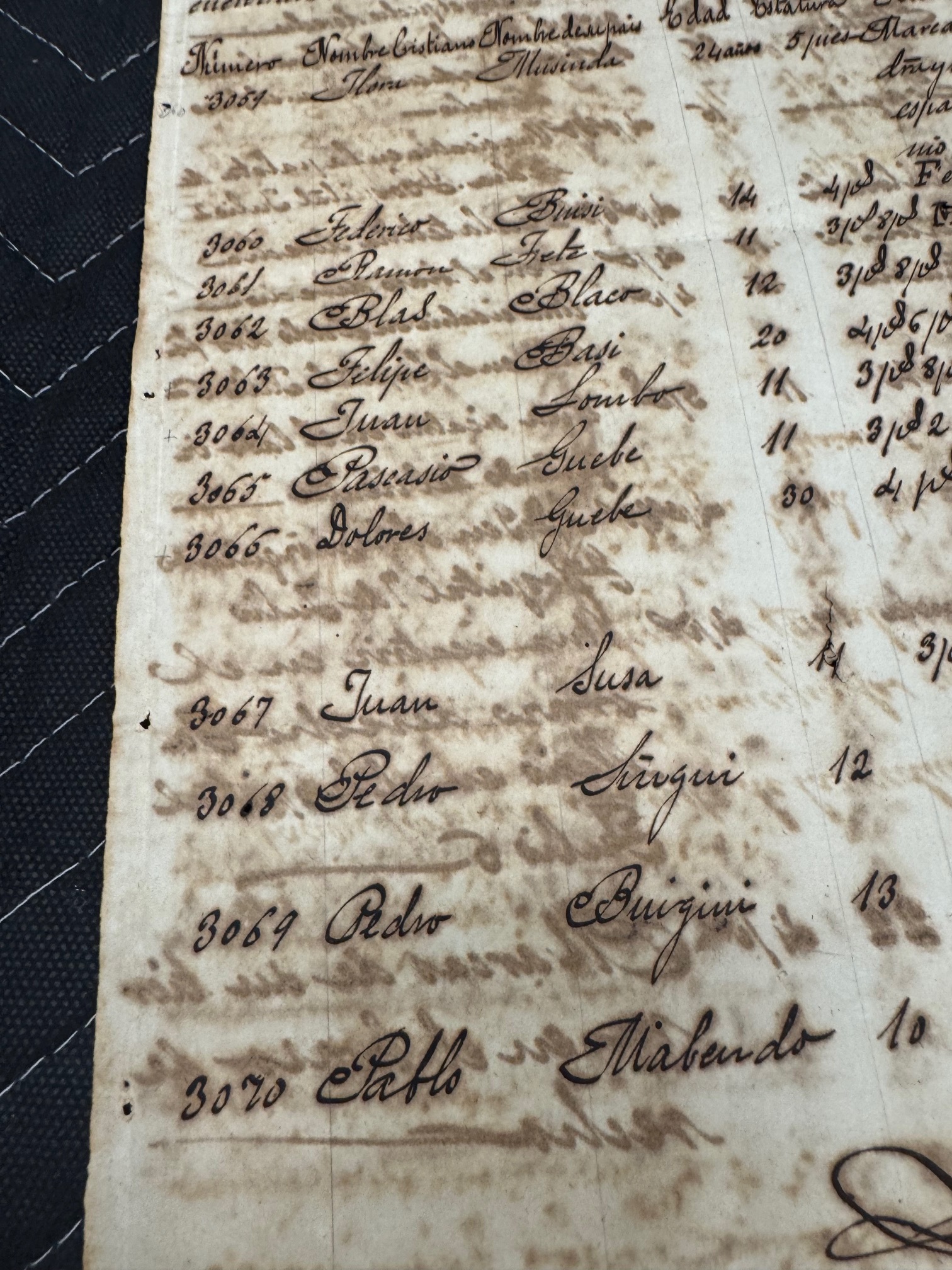
-- Documents written on parchment in 1868 detailing enslaved persons brought to Cuba five years before. The ledger includes Christian names, their age, condition and, most chillingly, the branding mark burned in their bodies. Visitors will learn the international slave trade continued until the late 1880s. (Picket photo, right)

-- A presentation on Confederate and Union monuments, including their locations.

-- Documents from the Maj. Henry Thomas Massengale collection. The Confederate States Quartermaster Bureau in Atlanta was responsible for manufacturing, procuring and transporting military supplies such as clothing, camp equipment, forage, and draft animals, to the Army of Tennessee before, during, and after the Atlanta campaign. Some of the notations are about enslaved persons, including one about a requisition for pants, drawers, shirts and hats for three. “The clothing is required for Negroes employed on the Fortifications that were confined in the Smallpox Hospital and their clothing had to be burned to prevent contagion.” The papers are available at the AHC's Kenan Research Center.

-- Personal items belonging to Capt. James Lile Lemon of the 18th Georgia. “He literally saved everything,” said Jones. Among the artifacts is a drum (photo at top of post) captured from two young Pennsylvania drummer boys on Sept. 16, 1862, the day before the Battle of Sharpsburg (Antietam). Lile later wrote about the capture of the boys by Pvt. Frank A. Boring:

"As he was driving them to the rear at point of bayonet they heaped so much abuse upon him - out of their fear or nervousness - that he had to be restrained from striking them with the clubbed musket. Of course, instantly the target of many wags among our company who joked with him about "scaring little boys" & etc. He replied that he would be d---d if he'd take such abuse from "d---d Yankee whelps." The boys were release & "beat a hasty retreat" back to their lines, with Boring giving them a rite hard look as they went."

-- A portion of the DuBose family Civil War dug relic collection is one of two never-before-exhibited relic collections to be included in the new exhibits. “These collections are comprised of approximately 50,000 artifacts recovered from the 1930s through the 1990s from Tennessee to Virginia, with special emphasis on the Atlanta area,” said the AHC. “They include Minie balls, shell fragments, bayonets, belt plates, gun parts and personal items of every description: the detritus of war left in and on the ground, often in our own backyards.” (Photo courtesy Atlanta History Center)

-- A fascinating lithograph copy of South Carolina’s ordinance of secession. Black troops with the 102nd USCT, mainly comprised of Michigan and Canadian men, seized it in March 1865 at a Charleston home. The Union troops listed four companies within the regiment.

They called the signed sheet a “scroll of treason.” (the original document is in the South Carolina archives). The AHC has a pistol that belonged to one of the White officers listed at the bottom.

Crucial to all this, Hale and Jones said, is being authentic and honest about artifacts and context. At a time of growing use of artificial intelligence and a distrust among many of museums, it’s important visitors know where items came from, said Hale.

Notation on copy of South Carolina secession document calls it a "scroll of treason" (Picket photo)

The aim is to be thought-provoking

Part of the exhibit will look at how the United States went from the Revolutionary War and subsequent conflicts to the Civil War, and what was resolved and what was not during those 80 years.

Some of the fractures continue today, said Jones, adding it is important to raise questions but let visitors make their own conclusions. “We want to change … the traditional ways we examined the Civil War.”

The AHC has utilized focus groups and feedback as it plotted the direction of the exhibit. Jones considers history professor Carolina Janney of the University of Virginia, historian and former president of the University of Richmond Ed Ayers and Cynthia Neal Spence, associate professor of sociology at Spelman College, among his mentors. Spence was featured in an AHC documentary about the legacy of Stone Mountain.

At the end of the day, compelling artifacts, context and interactive features will combine to entertain and educate, the AHC believes.

“We want them to say, ‘Dang, I never realized that,’” Jones said.

Tuesday, September 26, 2023

Rocky Face Ridge Park: Groups acquire two replica Napoleon guns to help further interpretation of clashes in northwest Georgia

These two artillery pieces are now in a park near Dalton, Ga. (Courtesy of BGES)
Two replica Napoleon cannons that for years accentuated the grounds of a hotel across from Vicksburg National Military Park have a new home at Rocky Face Ridge Park – scene of two Civil War actions -- in northwest Georgia.

The purchase and transport of the non-firing artillery pieces was a joint effort of the Blue and Gray Education Society and the nonprofit Save the Dalton Battlefields in Georgia.

“Cannons have arrived!” Bob Jenkins, head of the Dalton group, wrote in an email Thursday afternoon to supporters about the additions to the park, which formally opened in July 2022.

They will be the second and third guns on site, following the BGES donation last year of a 3-inch ordnance rifle replica.

The majority of the $30,000 purchase was covered by a donation from Bill and Linda Blackman (right), who have supported preservation efforts in Whitfield County, home to the park. Virginia-based BGES paid other costs.

“I am interested in anything that will help Whitfield County do more and draw people.” Bill Blackman told the Picket in a phone call.

The park is perhaps best known for its extensive and challenging bicycle trails. “I think (the new cannons) will bring out the Civil War aspect of it,” said Blackman, past president of the Whitfield County Historic Preservation Commission.

Model 1857 12-pounder smoothbores were the most widely used field artillery piece during the Civil War, and both sides had dozens during the 1864 Atlanta Campaign, according to the Georgia Battlefields Association, adding the price for the two pieces was a relative bargain.

Whitfield County touts its park as a wonderful history magnet -- with the remains of Federal and Confederate earthworks, trenches and 12 interpretive signs spread out over a 3-mile trail below a towering ridge.

The Napoleons after they arrived in Georgia on Sept. 21 (Courtesy of BGES)
Rocky Face Ridge Park was the site of two Civil War clashes.

Federal Maj. Gen. George Thomas probed the Confederate defenses in February 1864, ahead of the grinding march on Atlanta. The park is near Dug Gap, Mill Creek Gap and Tunnel Hill, other Civil War sites of interest.

And in early May 1864, Union troops advanced toward Dalton, which was held by forces under Confederate Gen. Joseph E. Johnston. The Yankees “were the tip of the spear” that launched the Atlanta Campaign, said Jim Ogden, chief historian at Chickamauga & Chattanooga National Military Park. Rebel troops on top of the ridge thwarted a Union victory.

'Our work is diverse, meaningful and long lasting'

Len Riedel, executive president of the Blue and Gray Education Society, said the two Napoleons were placed in front of the Mississippi hotel about 15 years ago.

“The owners wanted to fit in and the property was within the Federal siege lines and so pointed at the Confederate lines less than 1,000 yards ahead -- they blended well. As our group frequently stayed there during study tours, we were accustomed to their presence.”

Cannons when they were along hotel driveway (Courtesy of BGES)
New owners of the hotel decided to go in a different promotional direction and decided to sell the guns, Riedel said. The Picket left messages for the hotel's general manager.

The replica gun were manufactured and installed by Steen Cannon in Kentucky.  

“While reenactment groups wanted fully fireable reproductions there was also a robust market for display units such as we have acquired. The tube is only half bored and there is no firing vent hole,” Riedel wrote in an email. “The carriages are aluminum and our belief is that they are in good condition.”

The Blue and Gray Education Society recruits historians across the country to lead tours and aids preservation efforts. It has made numerous cannon purchases and has produced interpretive signs and brochures across the region.

“Our work is diverse, meaningful and long lasting,” Riedel said. “Our Dalton work will bring more awareness and interest in this early part of the Atlanta Campaign -- it is for things like that that we are in business for and have been for nearly 30 years.

Park features mountaintop and valley views

Jenkins said one of the replica Napoleons will be placed on the north end of the field at the May 1864 Confederate line, and the other will be placed on the south side, representing the location of the February 1864 Confederate line.

The reproduction 3-inch ordnance rifle (Picket photo of Jenkins, left, above)  is placed at the location of the Federal 4th US light artillery battery during the February 1864 action.

They will likely be formally dedicated in the fall.

Rocky Face Ridge Park, in Crow Valley, was 20 years in the making, following purchases of 625 acres -- in the shape of a rectangle -- on top of the mountain, and then 301 grassy acres below.

Getting to the mountaintop is not easy. It’s accessible from a bike trail, but officials are hoping a better-marked, hiking-only trail will one day be constructed. Visitors are rewarded with a great view and stone breastworks built by Confederate defenders.\

In a statement Friday, Jenkins said:

“On behalf of Save the Dalton Battlefields, we are grateful for this gift from Blue and Gray Education Society for the new Rocky Face Ridge Park and for the generous donation from Dr. and Mrs. William Blackman to help make it happen. Blue and Gray Education Society has been, and continues to be a wonderful friend and supporter of our new park and of historic preservation, education, and interpretation across the nation. We are also grateful for Whitfield County’s continued support of historic preservation efforts within our county.”

Monday, March 7, 2022

Cannons and cribs: Archaeologists provide details on Revolutionary War weapons and Confederate water obstructions found in Savannah River

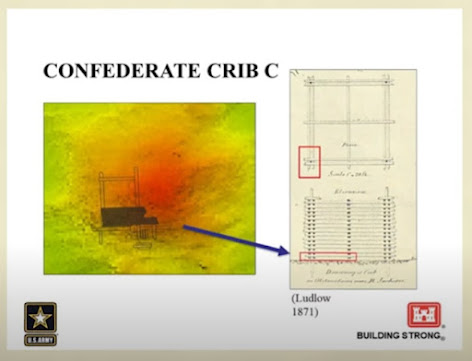
Planks at the bottom of this obstruction are shown in dark area (USACE)
Over the years, underwater archaeologists have found that amid all the junk littering the bottom of the Savannah River is a trove of treasure.

Such was the case in 2021, when they spotted 15 Revolutionary War-era cannons and explored obstructions placed in the river 85 years later during the Civil War.

Contractors working for the US Army Corps of Engineers surveyed and dived two Confederate “cribs” -- or tall wooden boxes filled mostly with brick – that discouraged the approach of Union ships to the port city. Forces towed the wooden obstructions, believed to be 40 feet by 40 feet, and put them in place near Fort Jackson and the ironclad CSS Georgia, a floating battery that was part of the Savannah River defenses.

Archaeologists last month provided details of the Revolutionary War and Civil War artifacts during a public event at the Savannah History Museum. Three cannons were recovered last year, while the other 12 were pulled up in January.

The Army Corps’ Savannah district funded the hard-hat dives as part of the busy Georgia port’s channel deepening.


About a half dozen severely degraded cribs are on the South Carolina side of the river. Crews focused on what are called cribs C and D.

Commonwealth Heritage Group divers found some planks used to build Crib C.

“On top of the planks it was tons of bricks that we dug through, and then underneath the planks it was sterile sand and Miocene clay, which is the base of the river,” said archaeologist Stephen James. “That basically told us we were at the bottom of the crib.”

They found an intact corner at Crib D. While C won’t be impacted by the deepening, the remnants of D were documented and then largely destroyed by dredging, James said. “There is very little of the cribs left.”

The Confederacy used a wide array of weapons and obstructions to deter advances on Savannah from the sea. Besides forts and warships, wooden cribs, pile dams, torpedoes (mines), snags, logs and shipwrecks were employed.

Divers located an intact corner on this obstruction (USACE)
Time and dredging have taken their toll on the cribs over the past 160 years. But that’s not all.

After the Civil War ended in 1865, the city wanted to reopen the port and it hired salvage companies to remove river obstructions, including the cribs and pieces of the scuttled CSS Georgia. 

“They had their own demolition. Surprisingly, they had divers back then, had pretty heavy-duty machinery to pull that stuff down,” said Will Wilson of Commonwealth Heritage Group. Of course, not all of the objects were removed or recovered in the 19th century.

Topographic view of four cribs from survey. Dredged channel is in blue (USACE)
The Corps is in charge of the ongoing deepening of the Savannah harbor and the dives are part of an investigation of historical resources that have been or could be affected.

Officials referred to period maps and descriptions from Union Corps of Engineers Capt. William Ludlow and a Capt. Boutelle for information on the cribs.

The CSS Georgia is on the National Register of Historic Places and the cribs are eligible for inclusion, officials say.

Monday, February 7, 2022

2 million artifacts later, Jim Jobling, conservator of CSS Georgia and other Civil War vessels, retires from Texas A&M lab

Jim Jobling, in 2017 at CSS Georgia recovery site, with 3D propeller model (Picket photo)
Jim Jobling, who was on deck when amazing artifacts from the CSS Georgia were brought to the surface in Savannah, Ga., and later tended to them during conservation, has retired from the Conservation Research Laboratory at Texas A&M University.

The South Africa native was a familiar figure during the 2015 and 2017 recovery of the scuttled Confederate floating battery from the Savannah River. Beneath a hard hat, he was usually dressed in a blue shirt and white pants, helping to bring items onto the barge, where he and others cleaned and sorted them for transport from Savannah, Ga., to College Station.

The U.S. Army Corps of Engineers’ Savannah District was in charge of removing the wreckage of the ironclad as part of a harbor deepening project. Among the contractors was Texas A&M, renowned for its nautical archaeology program.

Jobling retired on Jan. 7 after 37 years with the university. He served as lab manager.

I have done numerous posts on the CSS Georgia, and visited the recovery operations twice. Jobling, the chief conservator, was always very accessible and helpful. He and the TAMU team sent more than 18,000 artifacts to the U.S. Naval History and Heritage Command after they were conserved.

Of the CSS Georgia, Jobling said: “It was a good project, with a lot of good people putting in many hours of hard work -- over and above the call of duty.”

During Jobling's tenurethe CRL took on 203 individual projects, conserving over 2 million artifacts, officials said. "His background is pretty incredible; between his years as a soldier in South Africa to working as a technical diver in Antarctica, he's pretty much seen it all, and as such, he was always clear-eyed and steady-handed at the lab," lab director Chris Dostal told the Picket.

The archaeologist learned to scuba dive as a young man and explored shipwrecks in his native country before moving to the US. At Texas A&M he was involved in both land and nautical projects, among them the La Belle in Matagorda Bay, Texas, CSS Alabama (1864), Heroine (1838), USS Westfield (1863), and treatment of cannons from the Alamo in San Antonio, Texas, and Castillo de San Marcos in St. Augustine, Fla.

The Conservation Research Lab recently posted a Facebook tribute to “the one and only” Jobling.

Jim has been many things to everyone who works at or visits the lab. He's an endless font of information -- and stories -- with a true love of history. He's a jokester. He's a problem solver - usually solving problems by cobbling together some clever device. He's there to remind us of what's important when we're feeling down or frustrated, usually with a few ‘Jim-isms’ thrown in (‘What you need to do and that is...’). He's a friend."

Gordon Watts, an underwater archaeologist who has worked on numerous shipwrecks or debris sites, including the CSS Georgia, worked with Jobling in Savannah and said he thinks the archaeologist will keep in touch with the lab in some capacity.

“He and Dr. (Donny) Hamilton made the conservation program at TAMU the best in the US,” Watts told the Picket in an email. “No one better.”

Dostal said Jobling was a great networker and was one call away from reaching someone who could help solve a problem or answer a question.

"I have no idea how many of our former students he has helped over the years, but there are quite a few of us that are forever grateful for his mentorship and friendship. It's a hard-earned and well-deserved retirement, but he is always going to be a major part of the lab, and we already miss him."

Jobling apparently hasn't slowed down since retirement. He is assisting in the study of Revolutionary War-era cannon recently raised from the Savannah River.

Monday, January 24, 2022

While in poor shape, four Civil War river obstructions -- or cribs -- in Savannah remain intact in places, Corps officials say

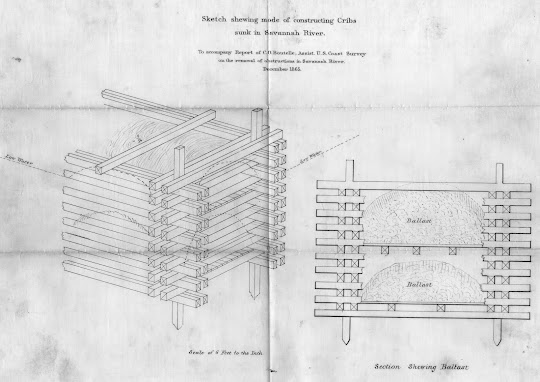
Design of cribs placed in the Savannah River -- click to enlarge (National Archives)
Divers in Savannah, Ga., recently spotted intact portions of two cribs – or tall wooden boxes filled mostly with brick – that were dropped into the river during the Civil War to discourage the approach of Union ships to the port city.

Confederate forces towed the wooden obstructions, believed to be about 40 feet by 40 feet, and put them in place near Fort Jackson and the ironclad CSS Georgia, a floating battery that was part of the Savannah River defenses.

“They were severely degraded. They were not in great shape,” U.S. Army Corps of Engineers Savannah District archaeologist Andrea Farmer said of the condition of what are termed Crib C and Crib D. But a few portions, including the corner of one crib, had remained mostly intact.


Contract divers using sonar last fall located four of the cribs on the South Carolina side of the river. Cribs A and B were previously explored and the dives in November and December concentrated mostly on C and D, Farmer told the Picket earlier this month.

The Corps is in charge of the ongoing deepening of the Savannah harbor and the dives are part of an investigation of historical resources that have been or could be affected. The Corps recently concluded the recovery of artifacts from the CSS Georgia, which was scuttled by its crew in December 1864 shortly before Federal forces took Savannah and was in the current shipping channel.

While tourists to the popular coastal destination gaze upon the supertankers coming from or to the Atlantic Ocean, they likely have no idea what lies beneath the surface: Remnants of vessels, pieces of Native American pottery that washed down stream, and other items deposited over the centuries.

View of cribs from multibeam survey. Dredged channel is in blue (USACE)
Divers in the past year have located numerous cannons in the river in this area, likely from the Revolutionary War era. They are trying to determine how they came to be in the water.

The Confederacy used a wide array of weapons and obstructions to deter advances on Savannah from the sea. Besides forts and warships, wooden cribs, pile dams, torpedoes (mines), snags, logs and shipwrecks were employed.

Unlike the cannons, the four cribs will be left in place. They are not expected to be directly affected by future channel deepening because they are on the northern edge of the project, Farmer said.

Corps officials referred to period maps and descriptions from Union Corps of Engineers Capt. William Ludlow and Capt. Charles Boutelle for information on the cribs. Boutelle, working for the U.S. Coast Survey, made a December 1865 survey of obstructions in the Savannah River.

Topographic view of four cribs from survey. Dredged channel is in blue (USACE)
“It is assumed, based on the lack wood cribbing left, that only the base or lowest portion of the cribs remain, and the extant portions differ by crib,” Farmer wrote in an email. “It looks like normal crib construction. There is nothing unusual or special about the cribs.”

She said the cribs initially would have been at or near the surface but years of deterioration have reduced them mostly to debris a few feet about the river bottom.

Crib A may be the most well preserved, as it seems to have the greatest amount of material based on the current height of the obstruction. Cribs C and D contain more material than Crib B, both in terms of extant structure and rubble/brick fill based on the areas that have been excavated.”

The Corps said it hopes to provide photos of the dives soon.

Examination of harbor from the city to Elba Island (USACE)

Friday, November 5, 2021

Archaeologists find even more old cannons in the Savannah River. They hope to solve the mystery of their origin and history

Will Wilson and Jeffrey Pardee during Oct. 12 dive (USACE Savannah)
The Savannah River is proving to be a graveyard for military cannons.

Following the February discovery in Savannah, Ga., of three artillery pieces that may date to the mid-1700s, archaeologists last month came across more artifacts.

“We were able to confirm two additional cannon that we knew about before. We found what we believe to be another cannon -- a very small cannon. We found what may be the muzzle of another cannon,” Will Wilson, an archaeologist with Commonwealth Heritage Group, said in a video posted last week by the Savannah district of the US Army Corps of Engineers.

Corps district spokesman Billy Birdwell expects the artifacts recovery near Old Fort Jackson to conclude in the next couple weeks.

“Once the recovery efforts are completed, the cannons will be analyzed to determine more information, such as type, age, and use. All cannons are believed to predate the Civil War era,” Birdwell told the Picket in an email.


The Picket recently posted
 an article about sonar survey and dives that have occurred since the February discovery.

The most recent were on the remains of Confederate “cribs,” or obstructions, placed in the river to prevent a Federal attack during the Civil War.

So what’s the story with the cannons found this year? Were they carried on warships or dumped into the water at some point?

Some theorize the three pieces found in February may have been carried by the HMS Rose, a British warship that took part in the siege of Savannah during the Revolutionary War.

The Rose was scuttled so as to block the channel from French ships that might come to the aid of colonists trying to retake the city.

That find was in the general vicinity of where the Rebel ironclad CSS Georgia was scuttled in December 1864 during the Civil War. Most of the ironclad’s wreckage was removed a few years back as part of the Corps’ deepening of the Savannah harbor.

More than a half dozen CSS Georgia artillery pieces have been pulled up over the years, but there could be a few more still in the river. And it’s possible some of the cannons were used at Fort Jacksonwhich was constructed in the early 1800s, or elsewhere and later discarded. The CSS Georgia served as a floating battery near Fort Jackson.

The Corps and contractors will try to determine the cannons’ provenance.

Asked whether the cannons explored last month could have been carried by the CSS Georgia or another period warship, Birdwell wrote, “While I understand this is technically possible, we haven’t done anywhere near enough research to say yes or no or anything more than ‘eh, maybe. Maybe not.’”

During their dives in mid-October, archaeologists also found part of an anchor and a bar shot, a type of munition designed to destroy ship rigging. They were commonly used during the Revolutionary War. (Above, James Duff with bar shot, photo: USACE Savannah)

The video briefly describes diving in the Savannah River. Crews using sonar and other technology guide divers to potential artifacts 45 to 50 feet below. Visibility near the bottom can often be nil.

A CSS Georgia Dahlgren gun found in 2015 (USACE)
“You are basically like an astronaut,” said Commonwealth archaeologist Andy Derlikowski. “You have your hard hat on … It’s a lot of just running around the sea floor until you physically encounter something on the bottom to identify.”

Birdwell said discussions are continuing on the final disposition of the cannons and other recently recovered items.

The artifacts will be placed in temporary conservation while they are being analyzed, and decisions are still pending on potential conservation efforts,” he said.

Tuesday, June 30, 2020

Removed Raleigh cannons are now perched at Fort Fisher

Two Civil War cannons that flanked a Confederate monument on the Union Square grounds in Raleigh, NC, since 1902 now have a new home at Fort Fisher, according to the Wilmington Star. The naval cannons, which were removed with the 1895 monument on the orders of Gov. Roy Cooper last week after they were vandalized, were delivered to the Fort Fisher State Historic Site on Sunday. • Article

Tuesday, December 4, 2018

CSS Georgia: Five years after the recovery of thousands of ironclad artifacts began in the Savannah River, no museum has committed to putting any on display

Uniform belt buckle recovered a few years ago (USACE)

On a summer day in 2017, representatives from museums across the South took a short boat ride to a barge not far from downtown Savannah, Ga. There, they got a first-hand look at artifacts and casemate belonging to the CSS Georgia, an ironclad floating battery on the Savannah River that kept any Union marauders away during the Civil War.

The scattered remains of the scuttled Confederate ship had been moved by the US Army Corps of Engineers as part of a massive harbor-deepening project. What might be called the modern effort to salvage the ironclad began with the symbolic raising of a piece of casemate -- protective armor made up of railroad track iron -- in November 2013.

The US Navy -- which essentially owns the vessel -- was encouraging these museums to “obtain a vision” on how they might display cannons, armor, a propeller and countless other items once they had undergone conservation.

It’s been more than 16 months since that visit, and no loan agreement has been reached with any of the institutions, which must weigh the costs of building or maintaining a structure that can securely hold the items and safeguard their condition. While conservation continues in Texas, the artifacts, at least for now, will remain out of the public view. 

The Picket recently contacted the Naval History and Heritage Command for an update on the endeavor. The emailed questions were answered by Shanna Daniel, a conservator with the command’s Underwater Archaeology Branch Conservation Lab.

Dahlgren gun in 2015 (USACE)
Q. What is the status of conservation of CSS Georgia artifacts, from Naval History and Heritage Command's perspective?
A.
Conservation is one of the most important elements of underwater archaeology as artifacts recovered from underwater require special care and can vary in condition, depending on the environments from which they're recovered. The artifacts’ material makeup, such as wood, iron, brass, ceramic, are also important considerations in the conversation process. Thus, conservation takes time to ensure overall stability of artifacts. That said, conservation continues with artifacts recovered from CSS Georgia at Texas A&M University's Conservation Research Laboratory (CRL) to ensure long-term stability for curation and display.

Q. Are all items still being held at Texas A&M, or are some in new locations, i.e. US Navy facilities? Are any currently on display, or scheduled for display?
A. Many of the CSS Georgia artifacts are currently undergoing conservation treatment at Texas A&M University CRL but some have completed the treatment process and will be shipped to the Naval History and Heritage Command (NHHC) in Washington, D.C. at the beginning of next year for curation.

Q. Has any decision been made on the disposition/display of the artifacts -- all or any portion? If so, what are the details?
A. As CSS Georgia artifacts finish conservation at Texas A&M CRL, they will be shipped to NHHC for curation and available through the NHHC Archaeological Loan Program to institutions or museums that meet the loan requirements. They'll also be made available as needed to researchers interested in viewing the collection. No official request has been made by a potential institution for a loan of CSS Georgia artifacts.

Q. What is the command's current view/goal for display of the artifacts?

A. One of NHHC's mission objectives is to share the Navy's history and heritage. In the case of archaeological artifacts, we accomplish our mission by making it possible for eligible and qualified organizations to borrow and exhibit artifacts for public display. Placing the CSS Georgia collection at a suitable location that meets the loan requirements to display and curate the artifacts would meet that objective, and provide the public a unique look into the naval history of the United States, as well as American naval ship design and employment. This collection tells an important story from our history that, until recently, was lost in the waters of the Savannah River for more than 150 years.

A portion of the armor casemate in 2017 (Picket photo)

Q. Is the command in active communications with any institutions? 
A. We did receive initial interest from various museums about the collection, but they have not corresponded with us in some time. As mentioned before, we regard our archaeological artifact loan program as one of our most important tools for sharing America's rich naval history and heritage with the public and are happy to discuss the program with qualified institutions.

Q. If so, are you at liberty to name them?
A.
It would be inappropriate to discuss an artifact loan during the predecisional phase (Click here for a list of institutions that were invited to see the artifacts in 2017).

Q. Pending any loan agreement, would the Navy likely display any artifacts on its own, or does the command believe they will stay in storage until any agreement?
A. There are no internal Navy plans to display the collection at this time. However, artifacts from NHHC's collection are frequently used by our network of 10 official Navy museums in their exhibits. For example, the National Museum of the U.S. Navy recently opened an exhibit featuring artifacts recovered from the wreck of World War I cruiser USS San Diego (ACR 6).

Tuesday, October 31, 2017

Cannons used for training back on display

A pair of rare Civil War cannons has been returned to the mansion of a wartime Rhode Island governor. Local officials and the Rhode Island National Guard are gathering Tuesday at the Sprague Mansion in Cranston to mark the return. • Article

Tuesday, September 29, 2015

Cannons pulled up near Florence, S.C.

Three Civil War cannons were raised from the muddy water of the Pee Dee River on Tuesday, remnants of Union General William Sherman’s march through the Carolinas in 1865. The cannons were thrown off of the CSS Pee Dee as Sherman's troops approached after the burning of Columbia. • Article