Showing posts with label CSS Georgia. Show all posts

Saturday, July 4, 2026

Savannah dredging operations brought up numerous Civil War and Revolutionary War cannons and artifacts. How did the projects and weapons compare?

CSS Georgia Dahlgren pulled up from river in 2015; one of the Revolutionary War cannons in 2021 and this week's unveiling of conserved artillery pieces at the Savannah History Museum (U.S. Army Corps of Engineers photos)
A stunning collection of Revolutionary War cannon recovered off Old Fort Jackson in Savannah, Ga., is now on public display, the culmination of an extensive archaeological and conservation effort.

A contractor dredging the Savannah River in 2021 came across the first of the 19 artillery pieces, which some thought might belong to CSS Georgia, a Confederate ironclad that was scuttled nearby by its crew in December 1864. But it soon became apparent they dated to the American Revolution and the British siege of the city in 1779. They were on ships scuttled by the British to prevent French support of the colonists.

The surprise discovery of the Revolutionary War weapons came following the 2015-2017 recovery of items associated with the Civil War ironclad.

That U.S. Army Corps of Engineers harbor deepening project, which involved contractors and U.S. Navy divers, recovered more than 30,000 CSS Georgia artifacts, including 241 pieces of ordnance, five cannons and two large casemate sections. The latter were documented and left in the water.

A section of the CSS Georgia's casemate in 2017 (U.S. Army Corps of Engineers)
The Corps of Engineers worked with Texas A&M University to conserve the CSS Georgia material and then 17 of the cannons associated with the Revolutionary War. The Savannah History Museum this week openedLoyalists and Liberty: Savannah in the American Revolution.”

Chris Dostal, director of the conservation lab at Texas A&M, told the Civil War Picket:

From a conservation standpoint, both projects involved large, concreted iron artillery from a marine or riverine environment, but the Savannah River cannon presented a particularly unusual opportunity because so many guns were recovered together, several with associated bore contents preserved.”

Some CSS Georgia artifacts are on display at the National Civil War Naval Museum in Columbus, Ga. (At left, one of its propellers, Picket photo).

That venue "is the only institution with CSS Georgia artifacts on loan from our office," said Kate Morrand, a conservator with the Naval History and Heritage Command. "The remainder of the CSS Georgia collection includes over 5,100 artifacts and is curated by the NHHC Underwater Archaeology Branch, based at the Washington Navy Yard."

The command was involved in the CSS Georgia project but the Revolutionary War cannons were not under its purview.

The Picket recently asked Corps officials to provide some context to how both archaeological projects dovetailed or differed.

The following responses came from Francis “Franky” Stankiewicz with Chronical Heritage, Andrea Farmer, archaeologist with the Savannah district of the Army Corps, and Cheri Pritchard, media relations chief with that office. The responses have been edited for brevity and context.

Q1: Are you any closer to knowing precisely which British ships these Revolutionary War cannon belonged to? I know the HMS Rose was ruled out.

A: We have learned a great deal since the cannon were conserved, but I would not say we can assign individual guns to specific vessels with certainty. The strongest current interpretation is that the assemblage most likely originated from the armed ship Savannah, formerly the American privateer General Arnold, and the British transport Venus, both of which were associated with the 1779 Siege of Savannah. Current research suggests that domestic colonial production is the most likely origin for the guns attributed to the General Arnold/Savannah. However, manufacture in Britain, France (particularly Bordeaux), or Spain (particularly Bilbao) cannot be ruled out. Within the realm of domestic production, Rhode Island and Pennsylvania presently appear to be the most probable manufacturing centers.

Andrea Farmer with two reenactors at the Savannah History Museum (USACE photos)
Q: There was early speculation these 19 cannons might date to the Revolutionary War era but might have been placed on the CSS Georgia or fortifications. What led you to determine they dated to the Revolution?

A: The Revolutionary War interpretation rests on several lines of evidence. Typologically, the guns are mid-to-late 18th-century 6-pounders, including examples exhibiting Armstrong-pattern characteristics as well as related short-gun variants. Historically, British and French accounts document the burning and scuttling of armed vessels in this section of the Savannah River during the 1779 Siege of Savannah, consistent with the location of the recovery area. Archaeologically, many of the cannon were recovered in a loaded condition, containing tampions, wadding, shot, powder cartridges, fuse remains, and powder residue, indicating that they were likely prepared for immediate use rather than discarded at a later date. Taken together, the age, location, and loaded condition of the guns strongly support their association with the Revolutionary War-era scuttling events in the Savannah River.

Q: From an archaeological and conservation viewpoint, how different are these cannons vs. those found at CSS Georgia site?

A: From a conservation standpoint, these cannons were unusually rich in sealed contexts. Most were heavily concreted and contaminated cast iron, but many still held preserved bore contents. That meant conservation was also excavation: tampions, hemp junk wads, shot, cartridges, and residues had to be removed and documented in sequence. CSS Georgia material, by contrast, is Civil War ironclad wreckage and ordnance context: later, more industrial, and tied to an armored floating battery. The Savannah cannon assemblage is earlier, Revolutionary War-era muzzle-loading artillery, and its research value comes heavily from the combination of gun form, loading evidence (i.e., material within), and scuttling context. (See link for more photos)

Q. I know the investigation into CSS Georgia concluded a few years back. Have you learned anything more about the site or vessel since then?

A: The CSS Georgia investigation itself concluded earlier, and the current investigations do not indicate a major new interpretation of the vessel since that work. What they do add is a broader landscape context: the cannon cluster site lies near, but is not part of, the CSS Georgia site, and prior mapping work around CSS Georgia actually helped identify the Revolutionary War cannon concentration.

Q: Do you have a schematic/map or illustration showing their precise location in the Savannah River? And do you have anything similar showing the CSS Georgia cannon location -- or both put together?

A: To help preserve and protect these cultural resources long-term, we are not publicly disclosing their precise locations. While the locations are known to a limited number of researchers and resource managers, there is broad agreement that this information should remain restricted for now. Limiting access helps protect the sites from disturbance while supporting future research and analysis that may provide additional insights. Researchers continue to use a variety of mapping products, including sonar and multi-beam imagery of the Cannon Cluster Site near Fort Jackson. Specific details about the exact locations of these resources and their relationship to one another are also being withheld to support ongoing stewardship and future study. In addition, the Savannah Harbor shipping channel is heavily trafficked by large commercial vessels. Restricting site locations helps discourage unauthorized diving activity and reduces potential safety risks. (At left, anchor from one of the 18th century vessels, USACE)

Q: Finally, what is your long-term perspective on both CSS Georgia and these 19 cannons -- What do they tell us about their chapters in American history?

A: Although separated by nearly a century, CSS Georgia and the Revolutionary War cannon cluster represent two distinct chapters in Savannah's long history as a strategically important river port. CSS Georgia represents the Civil War effort to hold the river with improvised Confederate naval technology, including an ironclad that functioned more as a floating battery than an effective maneuvering warship. The cannon cluster reaches back to the Revolution when British forces deliberately used vessels and their armament to obstruct the river and help stop the French fleet during the Siege of Savannah. Together, they show that control of the Savannah River was repeatedly central to military strategy, commerce and the fate of the city.

------

Postscript: Gordon Watts' perspective on the RevWar cannons

Archaeologist Gordon Watts, who dived and studied the CSS Georgia wreck site for decades, was present for the recovery of artifacts and helped write a final report on the project. I asked him for his perspective on the Revolutionary War cannons.

Gordon Watts studies CSS Georgia casemate section in 2017 (Civil War Picket photos)
Q. Were you surprised that British cannons were found near Old Fort Jackson?
A.  No surprise. If familiar with the Revolutionary War in Savannah, Fort Jackson did not even exist at that time. Construction on that fortification did not begin until 1808.


Q. Any reaction to their discovery? Also, what do you think of the combination of Civil War and RevWar artillery in the same area?
A. Initial reaction was with the lack of associated Revolutionary War vessel remains with the ordnance.  Savannah was the site of considerable Revolutionary War military and naval activity. Likewise, Savannah was the site of considerable military and naval activity during the War Between the Confederate States and the United States. The presence of sunken vessel remains and artifacts in the Savannah River in the proximity of the city is not unusual.

Q. Have you learned anything more about the site or vessel since then?
A: 
Conservation and analysis of the ordnance, casemate structure and cultural material from the CSS Georgia has shed considerable light on one of the earliest Confederate Ironclads. The CSS Georgia underwater archaeological investigations was, and remains, one of the most comprehensive undertaken to date and has resulted in extensive historical research and publication.

The archaeological investigation has produced an extensive collection of ordnance, vessel structure and cultural material that supports informative displays.

Q. Anything else?
A.  Very pleased to see the levels of interest in and support for documentation and exhibition of material associated with both of the Savannah River underwater archaeological sites. Hopefully, that level of interest will inspire similar investigation of other underwater archaeological sites in the Savannah and back rivers and other sites in waterways farther away but closely associated with Savannah and Georgia's history.

Tuesday, January 17, 2023

Bill Still, leader of U.S. maritime studies, including those of numerous Civil War shipwrecks, dies at age 90

William N. “Bill” Still Jr., a leading figure in the study of U.S. maritime history, including ironclads and other Civil War warships, has died at age 90.


Still died last week while in hospice care, according to Wilkerson Funeral Home and Crematory of Greenville, N.C.


The retired professor, author and lecturer co-founded the maritime history and underwater archaeology program at Eastern Carolina University, and was known for his study of USS Monitor, commerce raider CSS Alabama, ironclad CSS Georgia and the Confederate submarine Hunley.

“His impact on the history and nautical archaeology program at East Carolina University and on the legion of students that passed through that program will be a perpetual legacy,” program co-founder Gordon P. Watts Jr., wrote the Picket in an email this week. “He will be missed by all who benefited from his attention, none more than me.”


Watts, a former student of Still’s, is himself a renowned nautical archaeologist, and is among only a few people who found the remains of the USS Monitor off Cape Hatteras, N.C., in 1973.


The two men, according to ECU, led conservation work on the famed ironclad’s propeller, which was recovered in 1983. It is exhibited at Mariners’ Museum and Park in Newport News, Va.


Still, a native of Columbus, Ms., conducted research and wrote numerous works for the U.S. Navy over his career. From 1995-2005, he served as a member of the Secretary of the Navy's subcommittee on naval history. 


“He authored and co-authored dozens of books and publications focused on maritime history from the Civil War through World War II,” according to his obituary. Up until two weeks prior to his death, he was actively researching and writing the last installation of his series for the Secretary of the Navy, which began with Crisis at Sea and Victory Without Peace, focused on the U.S. naval force's withdrawal following WWI.”


John Quarstein, author and director emeritus of the USS Monitor Center, said Dr. Still “was a marvelous person, historian, lecturer, and writer. I believe his volume, ‘Iron Afloat,’ is the best book written about Confederate ironclads. He helped me with my writing, Civil War preservation efforts, and with my work about USS Monitor."


Still, known as “Doc” by graduate students, retired from ECU in 1994, a key figure in its prominence for graduate study in the field. He was considered a dynamic, caring and animated professor.


Jeff Johnston, formerly with NOAA's Monitor National Marine Sanctuary, said Still "was a true hero of ironclads and freely shared that knowledge."


The award-winning historian and author was preceded in death by Mildred Boling Still, his wife of 55 years. He is survived by four children and numerous grandchildren and great-grandchildren.

Tuesday, May 31, 2022

Picket exclusive: 20 artifacts from the CSS Georgia are now on display at the National Civil War Naval Museum. Read all about them!

6-pounder gun, partial anchor, bottle top (National Civil War Naval Museum)
Serving on the Confederate ironclad CSS Georgia wasn’t a peach of an assignment. The vessel was too underpowered to move and needed constant pumping so it wouldn’t sink. Sailors, meanwhile, drilled and labored in Savannah’s brutally hot environment. And they never saw any action – at least the combat kind.

Visitors to the National Civil War Naval Museum in Columbus, Ga., are able to view artifacts that speak of weaponry, diversions and discipline for those who served on the floating battery, which was scuttled by its crew in December 1864 when Sherman’s army neared the city.

The U.S. Navy -- via the Naval History and Heritage Command -- recently loaned and shipped more than 20 conserved artifacts to the museum. Officials expect more shipments in the years ahead. (Picket photo at left shows propeller in foreground, with shaft just beyond)

Most of the ironclad’s wreckage was removed a few years back as part of the U.S. Army Corps of Engineers’ deepening of the Savannah River to make room for larger tankers. 

Thousands of artifacts underwent treatment at Texas A&M University, which shipped them to the Navy Yard in Washington, D.C. for storage. 

The Navy has been in contact with museums over possible loans regarding the CSS Georgia, but the National Civil War Naval Museum has been the only one to sign on thus far, officials said.

A portion of a sword sheath found on the river bottom.
Because the remains of the CSS Georgia were in a river that swept all kinds of manmade items downstream, it’s impossible to know how many artifacts pulled up during the project date to the Civil War. But, ostensibly, most do.

The Civil War Picket received the following inventory from the Naval History and Heritage Command and used information from an archaeological report on the project and other sources to describe the items that are now in Columbus. 

All photos are courtesy of the National Civil War Naval Museum except where noted.


Leg irons
: 15.5" x 5.0", 1.88 pounds
A few sets of these encrusted devices were recovered from the wreck site, likely used to discipline sailors who got into trouble on or off shore.


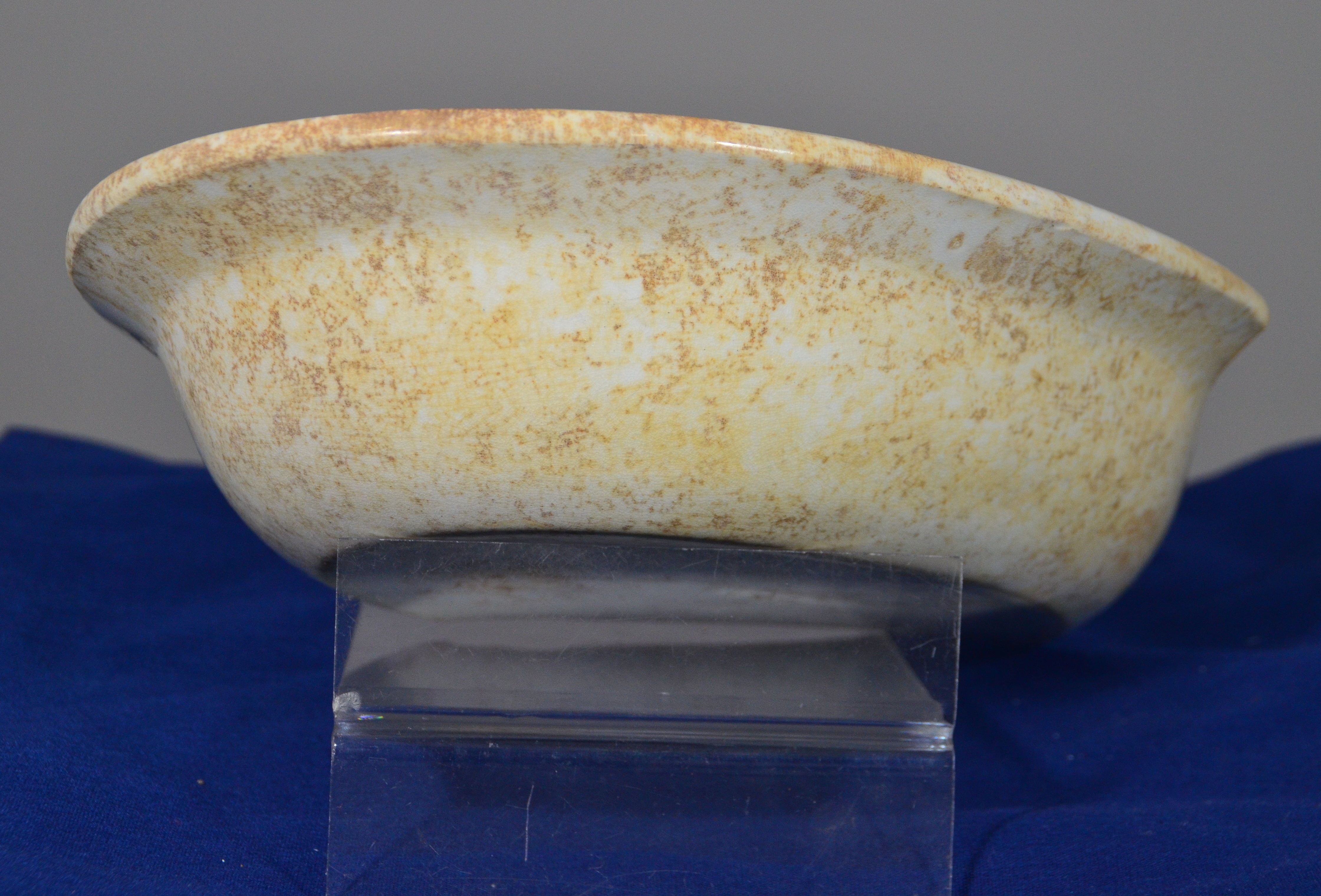
Ceramic ironstone bowl, partial, white glaze
: 9.25" x 7.0" x 2.25", 1.2 pounds
Hundreds of whole or broken pieces of ceramics were found on the river bottom, including four forged from ironstone.

Metal iron hook and eye: 11" x 7.5", 3.88 pounds

Copper alloy sabot: 6.5" (diameter) x 1.375", 7.8 pounds

The sabot, designed to ensure an artillery shell was in the proper position in the barrel, was described this way in the final report on the project:

“The shallow copper saucer, bowl or basin appearance of the aft face of a Brooke copper ratchet disc sabot. Interestingly, this is a spent or fired sabot indicated by the grooving on its exterior side. The hammer marks may have been a result of fitting the sabot onto the shell prior to firing.”


Light blue bottle
: 9.5" x 2.25" (diameter), 0.54 pounds, believed to have held wine

Colorless bottle, partial with broken neck: 6.0" x 1.75" (diameter), 0.5 pounds -- Photo of top of post
This “is a thick-walled, strangely shaped bottle with a small base of a diameter that would allow it to fit into one of the rings; glass fragments similar to this bottle were found in several units across the site. Seven glass bottle stoppers, divided into four categories, were recovered, and may belong to cruet or decanter sets.”


6-pounder iron cannon, Noble Brothers Foundry
:
125.25" (artifact length) 132" x 36" x 28" (crate), 1,240 pounds

This piece of ordnance is one of five recovered in 2015, and it was originally located on the spark deck aft. It is the only one of its type discovered in the river, and it was manufactured in Rome, Ga. It was presented to the Confederacy by the “Ladies of Rome.” The left trunnion is marked August 1862.

James Noble, an Englishman, organized the company with his six sons in 1855. By January 1862, the firm was heavily engaged in the production of cannon and battery equipment. “The Noble Brothers experienced considerable success in the casting of bronze and iron field guns. Between April 1861 and October 1862, some 58 field pieces were delivered to the Confederacy. Of these, at least 15 were cast iron 6 pounders.”

A dispute with the Confederate government in late 1862 ended all ordnance contracts with the foundry.

The Corps report says: “The Noble Brothers’ plant was destroyed when Sherman’s troops entered Rome on May 18, 1864. The large smokestacks of the foundry were blown up and the shops burned. The Union troops attempted to dismantle the lathe using sledgehammers, with little success. The hammer marks are still visible today and the fire caused minimum damage to the lathe. The massive machine stayed in production until the mid-1960s.”

Iron gun port, partial: 24.0" x 14.5" x 4.125", 192 pounds (photo above, with cannon)

(Civil War Picket photo)

Complete triple-bladed propeller
: 6' (diameter) 55" x 82" x 73" (crate), 2,700 pounds

From the final archaeological report prepared for the Army Corps:

“It is not known what kind of engine the CSS Georgia employed, but it is known that the LGA Steering Committee searched for one far and wide. In a letter written on June 11, 1862, John Elliot states that the vessel had a double engine and twin propellers. The engines were only able to make about 2 knots under full steam. All agreed they were inadequate for propelling the vessel against the swift currents or tides of the Savannah River. The engines did, however, serve a functional purpose, as one writer in 1862 stated, ‘Our iron floating battery is a splendid failure. She has been taken down between the forts and they are obliged to keep her engines at work the whole time to prevent her sinking, she leaks so badly’ It is thought that the vessel’s leaking was most likely a result of building her with unseasoned wood, a common practice in Confederate vessel construction.”


Complete propeller shaft
: 12' x 5.68" (diameter) 132" x 36" x 28" (crate), 1,510 pounds

The triple-bladed propeller is mounted on a 6-inch diameter shaft approximately 12 feet 6 inches in length. Because two of its three blades were buried, jetting was conducted to uncover the blades prior to lifting. Once lifted onto the barge deck, the shaft was cut free from the 8-foot blade with a saw for ease of transportation and conservation. A single strut indicates the vessel would have had two propellers, and historical sources indicate that the CSS Georgia was powered by “a double engine and twin propellers,” according to the Corps report.


Leather shoe sole and upper fragments
: 4 pieces, “10 5/16" x 3.5" x 0.02" (sole), 0.14 pounds

Some 68 boot or shoe fragments were recovered from the site. Most are small fragmentary pieces of leather with no complete shoe or boot, the soles of several examples being the most intact portion of recovered footwear.


Leather shoe heel with partial sole
: 4.1" x 2.6" x 0.98" (heel thickness/ 0.02" (sole thickness), 0.16 pounds

Leather fire hose, partial with small bag of leather fragments: “9.75 x 4.5 x 1.02”, 0.56 pounds

Copper alloy sword sheath: “2.52 x 1.6 x 0.6”, 0.06 pounds

Numerous small arms including a mostly complete pistol, eight Enfield bullet cartridges, 90+ bullets of varying caliber for pistol and rifle, two bullet molds, two gunflints and two sword and five bayonet hilts were recovered.


Copper alloy gun sight, forward with "N 714" (mark): “3.98" x 1.34" x 2.36", 1.16 pounds

A naval gun had to be raised to an appropriate degree of elevation to achieve the necessary range to strike a distant object at sea. This sight was placed on the front of the barrel.

Small partial iron anchor: “40.5" x 21.0" x 10.0", 180 pounds

The use of this particular anchor is unknown.

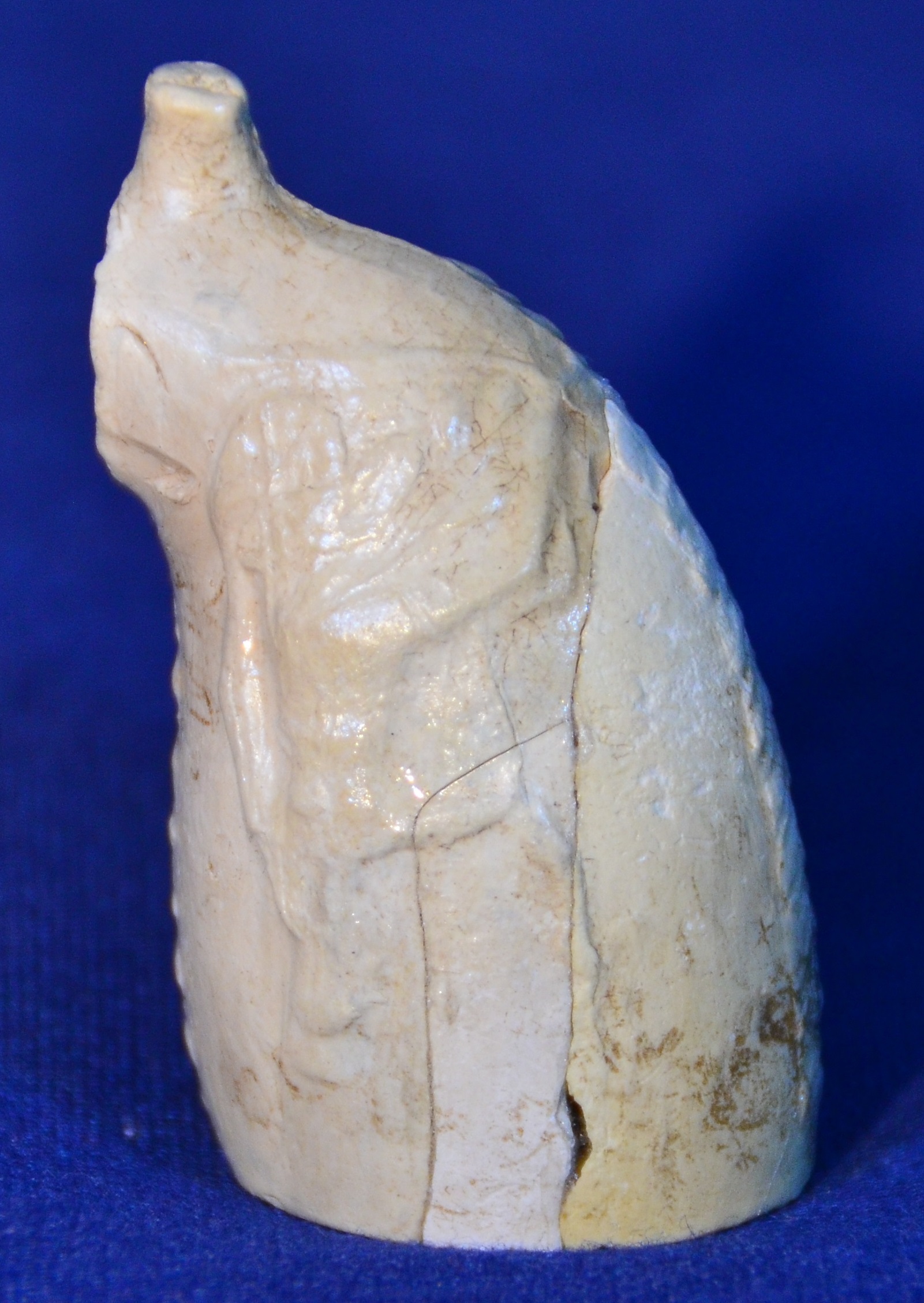
Kaolin pipe bowl, with floral decoration: “1.61" x 0.91" x 0.87", 0.02 pounds

Eight kaolin smoking pipes were recovered in the wreckage of the CSS Georgia. Similar to the prehistoric ceramics, and some percentage of the glass and historic ceramics recovered from the site, “the kaolin smoking pipe bowls are potentially intrusive (non-Civil War), although some if not all could easily have been personal property of those on board.”

Worm-eaten wood wedges: 2 pieces, “3.5" 1.54" x 0.94" (larger fragment), 0.06 pounds

Coal fragments: 2 pieces, “2.56" x 1.73" x 1.06" (larger piece) / “1.73" x 1.57" x 0.83" (smaller piece), 0.18 pounds

The CSS Georgia could have easily carried 100 tons of coal, but it’s unknown how much it carried at the time of its scuttling. Bunkers would likely have been located outboard of the boiler on both sides of the hull.
-----------------

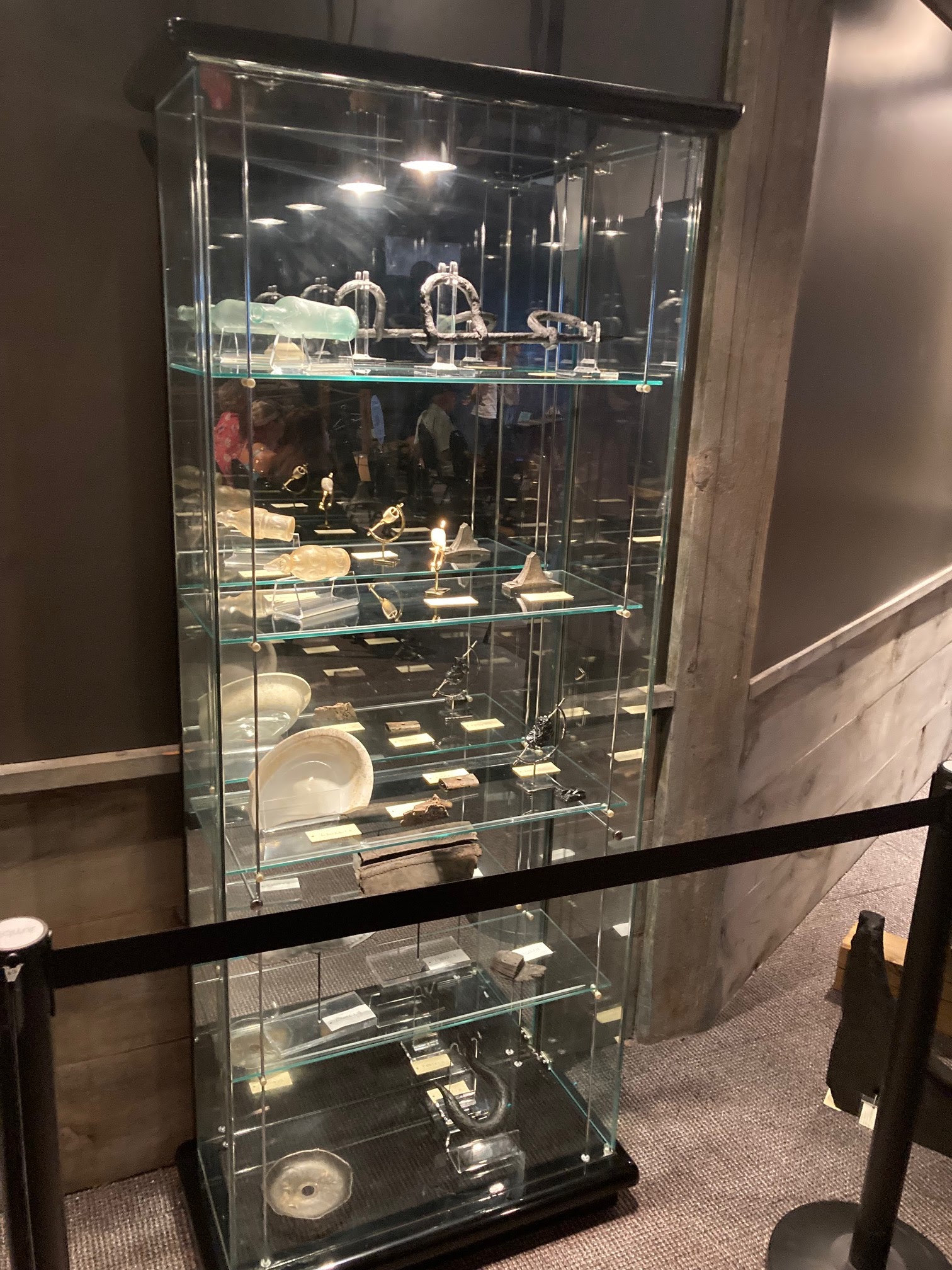
The Picket recently visited the museum, which put smaller artifacts in a large glass case. Signage and interpretation are still in the works.

Smaller CSS Georgia artifacts (Picket photo)

Sunday, May 8, 2022

CSS Georgia: Navy sends batch of ironclad artifacts pulled from Savannah River to National Civil War Naval Museum for display

CSS Georgia propeller is raised from Savannah River in 2015 (Dept. of Defense)
Updated May 18:

The National Civil War Naval Museum has received a first shipment of artifacts belonging to the CSS Georgia, the ironclad vessel that was part of Savannah’s effective river defenses.

The U.S. Navy recently lent about 20 conserved items to the Columbus, Ga., museum, which has worked for years to receive items from the Confederate floating battery. The CSS Georgia was scuttled by its crew when Union forces took Savannah in December 1864.

Museum executive director Holly Wait told the Picket that the shipment included a propeller, shaft, cannon, part of an anchor, part of a gun port, pipe stem, sword sheath, several glass bottles, an eye bolt, gun site and an elevation screw.

“It was a really big feather in our cap to get such a collection as this,” museum director of history and collections Jeff Seymour told the Ledger-Enquirer newspaper.

The Civil War Picket has written extensively about the CSS Georgia and reached out to the Naval History and Heritage Command for comment and further details.

"NHHC hopes that through display of the CSS Georgia artifacts at NCWNM, the public will benefit from a greater understanding of archaeology, conservation, Civil War history and US Navy history," said Lt. Anthony Ivester, public affairs officer for the command.

Conserved and shipped 6-pounder from CSS Georgia (Courtesy of NCWNM)
Most of the ironclad’s wreckage was removed a few years back as part of the U.S. Army Corps of Engineers’ deepening of the Savannah River to make room for larger tankers. Thousands of artifacts have undergone treatment at Texas A&M University, which shipped them to the Navy Yard in Washington, D.C. for storage.

The project, which involved contractors and U.S. Navy divers, recovered more than 30,000 artifacts, including 241 pieces of ordnance, five cannons and two large casemate sections. The latter were documented and left in the water.

In 2017, Navy officials invited several museums, including from Savannah, to the recovery site. The Columbus museum is the first to receive the artifacts from NHHC, which is the custodian of naval artifacts and history.
"We have received previous inquiries from other institutions, but there are no other active agreements for CSS Georgia artifacts," said Ivester.

The Navy and the museum reached an agreement on the loan in March and the items were shipped on May 3, officials said. For now, the CSS Georgia artifacts will be displayed in the museum's main gallery, Wait said.


When asked about long-term plans for a display, Ivester said:

"NCWNM has agreed to coordinate with NHHC as they develop the exhibit for the CSS Georgia artifacts. Archaeological artifacts are best compatible with certain materials and NHHC can provide specialized guidance on which materials are suitable for their continued preservation while on display."

Wait said the shipment was the first of a few expected over the next three to five years.

“The Navy has a standard 3-year loan agreement to confirm that items are cared for properly.  However, all our conversations with them have included our long-term plans," she wrote in an email.

The NHHC described the present loan as short-term, with the possibility of renewal.

Wait said the CSS Georgia will be the seventh Civil War vessel to be exhibited in the country. The museum has two others: the ironclad CSS Jackson and the twin-screw wooden ship CSS Chattahoochee.

Gordon Watts, who has dived on the CSS Georgia and was involved in its recovery and study of artifacts, told the Picket: "I think it is fantastic that museum personnel have been able to obtain a collection of artifacts from the Georgia. Now at least some of the numerous artifacts recovered from the wreck will be available for public access. Congratulations to the National Civil War Naval Museum on a significant addition to their already impressive exhibits."

Monday, February 7, 2022

2 million artifacts later, Jim Jobling, conservator of CSS Georgia and other Civil War vessels, retires from Texas A&M lab

Jim Jobling, in 2017 at CSS Georgia recovery site, with 3D propeller model (Picket photo)
Jim Jobling, who was on deck when amazing artifacts from the CSS Georgia were brought to the surface in Savannah, Ga., and later tended to them during conservation, has retired from the Conservation Research Laboratory at Texas A&M University.

The South Africa native was a familiar figure during the 2015 and 2017 recovery of the scuttled Confederate floating battery from the Savannah River. Beneath a hard hat, he was usually dressed in a blue shirt and white pants, helping to bring items onto the barge, where he and others cleaned and sorted them for transport from Savannah, Ga., to College Station.

The U.S. Army Corps of Engineers’ Savannah District was in charge of removing the wreckage of the ironclad as part of a harbor deepening project. Among the contractors was Texas A&M, renowned for its nautical archaeology program.

Jobling retired on Jan. 7 after 37 years with the university. He served as lab manager.

I have done numerous posts on the CSS Georgia, and visited the recovery operations twice. Jobling, the chief conservator, was always very accessible and helpful. He and the TAMU team sent more than 18,000 artifacts to the U.S. Naval History and Heritage Command after they were conserved.

Of the CSS Georgia, Jobling said: “It was a good project, with a lot of good people putting in many hours of hard work -- over and above the call of duty.”

During Jobling's tenurethe CRL took on 203 individual projects, conserving over 2 million artifacts, officials said. "His background is pretty incredible; between his years as a soldier in South Africa to working as a technical diver in Antarctica, he's pretty much seen it all, and as such, he was always clear-eyed and steady-handed at the lab," lab director Chris Dostal told the Picket.

The archaeologist learned to scuba dive as a young man and explored shipwrecks in his native country before moving to the US. At Texas A&M he was involved in both land and nautical projects, among them the La Belle in Matagorda Bay, Texas, CSS Alabama (1864), Heroine (1838), USS Westfield (1863), and treatment of cannons from the Alamo in San Antonio, Texas, and Castillo de San Marcos in St. Augustine, Fla.

The Conservation Research Lab recently posted a Facebook tribute to “the one and only” Jobling.

Jim has been many things to everyone who works at or visits the lab. He's an endless font of information -- and stories -- with a true love of history. He's a jokester. He's a problem solver - usually solving problems by cobbling together some clever device. He's there to remind us of what's important when we're feeling down or frustrated, usually with a few ‘Jim-isms’ thrown in (‘What you need to do and that is...’). He's a friend."

Gordon Watts, an underwater archaeologist who has worked on numerous shipwrecks or debris sites, including the CSS Georgia, worked with Jobling in Savannah and said he thinks the archaeologist will keep in touch with the lab in some capacity.

“He and Dr. (Donny) Hamilton made the conservation program at TAMU the best in the US,” Watts told the Picket in an email. “No one better.”

Dostal said Jobling was a great networker and was one call away from reaching someone who could help solve a problem or answer a question.

"I have no idea how many of our former students he has helped over the years, but there are quite a few of us that are forever grateful for his mentorship and friendship. It's a hard-earned and well-deserved retirement, but he is always going to be a major part of the lab, and we already miss him."

Jobling apparently hasn't slowed down since retirement. He is assisting in the study of Revolutionary War-era cannon recently raised from the Savannah River.

Thursday, December 30, 2021

2021's top 11 Picket posts: Hurricane leaves a surprise, Cockspur Lighthouse, submarine Hunley skipper, Longstreet and more

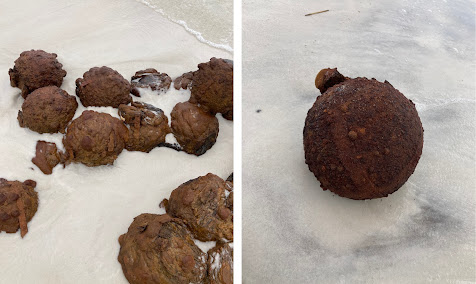
Hurricane Ida uncovered these artillery shells in Florida (Gulf Islands National Seashore)
The top 11 Civil War Picket posts -- by page views -- in 2021 covered the spectrum. Among them: a bayonet found in a yard, cannonballs uncovered by Hurricane Ida and the lingering mystery of a coffin found near Fort McAllister in Georgia.

We’ve got a few items in the works and we look forward to rolling those and others out in 2022. Thanks so much for your continued interest. Please tell a friend or two about us. Happy New Year!

11. USS MONITOR: The little ironclad that could sported two Dahlgren guns in its famous rotating turret. Conservators at the Mariners’ Museum and Park in Newport News, Va., were honored this year by the Navy for cleaning their barrels of salts and sediment, keeping them on the path for one day being put on display. -- Read more

10. JAMES LONGSTREET: The Longstreet Society in Gainesville, Ga., acquired a brief but fascinating letter from the legendary Confederate general seeking a federal pension 20 years after the Civil War’s end. Longstreet expressed guarded hope that his valiant service in the U.S. Army in the Mexican-American War would outweigh any concerns about him later donning the gray uniform. -- Read more

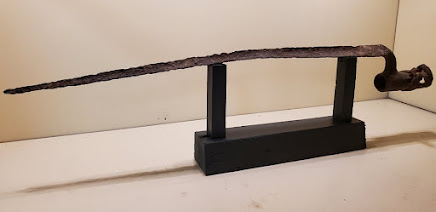
9. UNEARTHED BAYONET: An Illinois man tilling a garden came across something way the down the list of possible surprises: A rusted bayonet. Did it belong to a soldier serving in Ulysses S. Grant’s first Civil War command?  -- Read more

The bayonet in its temporary exhibit (Nick Little, Market House Antiques)
8. “FIGHTING JOE WHEELER”: A quick jaunt to the Brown’s Mill cavalry battlefield below Atlanta recalls one horrible day for Federal troopers in 1864. Riders under the command of Confederate Lt. Gen. Joseph “Fighting Joe” Wheeler raised hell and sent a Yankee general fleeing across the river into Alabama. -- Read more

7. MYSTERY COFFIN: We invited you to come read the adventure of one coffin, 20 rifles and two caretakers of Georgia history. And you did. The coffin found at Fort McAllister State Park near Savannah is being conserved and officials might use the same chemical treatment on Enfield rifles (right) that were smuggled into Charleston Harbor but were lost when the blockade runner ran aground. -- Read more

6. IRONCLAD REMOVAL CONCLUDED: The CSS Georgia, while woefully underpowered, did its job in Savannah, Ga. It was among a myriad of stationary defenses that kept Federal forces from sailing into the city during the Civil War. Federal officials have now wrapped up their removal of the gunboat’s debris as part of a harbor deepening project. -- Read more

5. CAMP LAWTON SKIRMISH: Archaeology students at a Georgia university found artifacts that might derive from a skirmish between Union and Confederate cavalry during Maj. Gen. William T. Sherman’s March to the Sea. The fighting took place near a Confederate POW camp that held Union prisoners for several weeks in autumn 1864.  -- Read more

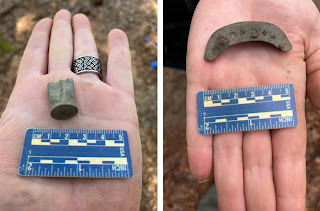
Spencer rifle casing and toe tap with nails
(Courtesy Camp Lawton Archaeological Project)
4. HURRICANE IDA: The Category 4 storms -- bringing heavy rain and wind – hit Gulf Islands National Seashore in late August, and its impact left quite a surprise: Days later and over a period of three weeks, park staff discovered 194 Civil War-era cannonballs, deposited in a couple clusters along a Florida beach. -- Read more

3. COCKSPUR LIGHTHOUSE: Fort Pulaski National Monument near Savannah, Ga completed a project aimed at protecting the small but resilient lighthouse. The 46-foot structure has endured high tides, hurricanes, waves from ever-growing container ships, vandals and – for a deafening 30 hours – the April 1862 bombardment of Fort Pulaski during the Civil War. -- Read more

2. HUNLEY’S SHARP-DRESSED SKIPPER: He was dressed more for a night on the town than for a moonlit submarine journey toward Union vessels blocking Charleston Harbor. Lt. George Dixon was decked out in a three-piece outfit, mid-calf suede boots and silver suspender buckles bearing his initials. Conservators have been analyzing the incredible array of artifacts found inside the submarine since it was raised two decades ago and are now working on a volume about the doomed crew, including personal effects such as clothing, buttons and shoes. -- Read more 

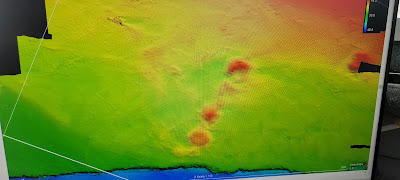
1. CONFEDERATE “CRIBS”: Archaeologists using sonar to scan the bottom of the Savannah River located the remnants of four underwater obstructions placed by Confederate defenders during the Civil War. Dubbed cribs, the wooden structures held bricks and other debris meant to thwart ships. -- Read more

Sonar image of four Confederate cribs in Savannah River (USACE, Savannah)