Showing posts with label National Civil War Naval Museum. Show all posts

Wednesday, January 14, 2026

National Civil War Naval Museum hopes to arrange and display armor from ironclad's fantail by the end of March. The complex piece -- damaged by an arson fire in 2020 -- was built to protect CSS Jackson's rudder, propellers

Fantail before arson fire, Brandon Gilland with armor, charred wood, explainer on design (Picket photos)
A fire set by Union cavalrymen in 1865 and a second lit by an arsonist in 2020 took away the dignity – and much of the wood – from a remarkable section of the Confederate ironclad CSS Jackson.

But the blazes could not erase the story of the fantail crafted for the vessel, whose remains are on display at the National Civil War Naval Museum in Columbus, Ga.

The arson fire dashed hopes of conserving the fantail, the precisely built curved rear deck that protected the vessel’s rudder and propellers. It sat for years, lying upside down, in a pole barn outside the museum. Officials had hoped to move the component inside and build a pie-shaped replica.

The arson changed all that.

Crew of the CSS Jackson (Muscogee) aboard vessel on Chattahoochee River (Wikipedia)
Museum officials moved to the idea of using the surviving armor and replacement wood for a recreation that would highlight the artifact’s complexity and contours. No dice. That option ultimately proved too costly and unfeasible.

“Each piece looked like it was almost cut to fit. There are all kinds of sizes and shapes,” museum director Brandon Gilland told the Picket. In other words, it would take big bucks and precise knowledge and skills to fashion new pieces.

Now there’s a new approach.

The fantail after it was removed from the Chattahoochee River in 1961 (NCWNM photo)
To mark its 25th year in a large building situated on Victory Drive and near the Chattahoochee River -- where the Jackson was built -- the museum will shortly begin a less ambitious project to display the 30 or so pieces of fantail armor, said Gilland.

“That fantail has been nagging at me for a while,” he said.

Volunteers, using equipment to lift the 400-pound sections, will arrange them in a half-moon shape. Beneath the armor will be cedar or some other material.

The finished product will likely end up flat on the floor next to the Jackson’s stern, though Gilland would like for the fantail to be slightly elevated, if possible.

They can't use the original wood, because the 1865 and 2020 fires basically ruined them

The goal is to have the modest display ready for the March 21 RiverBlast, an annual event that includes cannon firings, living historians, food, family events and more.

Since the surviving armor was treated about five years ago, the sections have sat in rows along the Jackson. Bolts and other fasteners are in crates, awaiting new life. Charred wood lie on pallets, also near the stern

I held a bolt and a couple fasteners and asked Gilland whether they could be reused. Perhaps some of the bolts, he said. To demonstrate, he placed a bolt in a hole in one piece of iron armor (Picket photo, above).

That momentary connection seemingly brought the project to life.

Structure proved to be more complex than thought

CSS Jackson flag captured by 4th Division, U.S. Cavalry (The American Civil War Museum, Richmond, Va.)
Remains of the Jackson and the twin-screw wooden ship CSS Chattahoochee are the star exhibits of the museum. Both were lost in April 1865 at war’s end -- the Jackson set afire by Federal captors and the Chattahoochee scuttled by its own crew.

They were recovered from the Chattahoochee River in the early 1960s. Neither saw action.

The fantail was the half-moon shaped rear deck of the CSS Jackson, which was never fully operational. The section of armor and timber is a remarkable example of design and construction prowess. 

After the 2020 fire, the upside-down fantail was the first to receive conservation attention. Each beam was documented. Using a process called photogrammetry, the archaeologists took hundreds of images of each layer in order to better understand the structure. (Gilland says the section with green labels at right may be the least damaged from the 2020 fire; Picket photo)

Jeff Seymour, director of history and collections at the museum at the time of the arson blaze, wrote about the ironclad’s fantail:

“As each level emerged, we were able to see elements of this vessel that no one has seen since 1864. As each level surfaced, several questions about how the Jackson was constructed were answered, but many more questions developed. Simply, this structure is much more complex than we thought heading into this project."

Seymour called the fantail “a very unique piece of naval architecture” that’s believed to be the only Civil War example out of the water. Because the rear deck was curved, builders had to customize the length of the armor and timber. (Seymour now works at the Erie Maritime Museum in Pennsylvania.

When I saw the fantail in 2019, before the arson fire, the artifact and the Chattahoochee’s engine components were in the pole barn outside the museum, exposed to the elements and slowly deteriorating.

I marveled at the fantail, which was charred in places from the 1865 fire. But the wood was in place and you could see how it was fashioned from layers of longleaf pine and other material.

Remnants of the pole barn after the 2020 fire; the roof is no longer there  (Columbus Fire and EMS)
The June 2020 arson, which has not been solved, charred the fantail’s timbers to their core, also destroying the piece’s shape. The Chattahoochee’s wrought iron and cast iron engines, the iron plates from the Jackson’s armor and the iron plating to the fantail survived, though they were exposed to the thermal heat.

To this day, dozens of pieces of armor belonging to one side of the Jackson are in the fenced area, poking through weeds and burned wood. Why not move them inside and conserve them? There’s no money to do that currently, said Gilland.

Video shows how the fantail was put together

The naval museum has the benefit of post-fire conservation work done several years ago by Terra Mare Conservation to serve as a guide.

The company treated and tagged the armor, digitally mapped the fantail and produced a fascinating video showing how it was designed and put together. Visitors can stand near one of the Jackson’s propeller and watch the looped production

Gilland expects the work to cost about $2,000, compared to at least $25,000 for a full recreation. Museum officials several years ago cited a much higher figure to do a full-scale recreation.

Fund-raising for the fantail work was part of a larger effort, most of which has been completed, including a few new exhibits, said Gilland.

Robert Holcombe, a naval historian and former director of the museum, previously told me besides the CSS Georgia in Savannah, the fantail may have been the only piece of wood from a Confederate ironclad with iron plating still attached.

Homemade behemoth had an inglorious end

Museum visitors can gaze at the hull of the flat-bottom ironclad from a viewing platform and on the floor (Picket photo below).

 A section is missing, but you get a good views of the vessel’s enormity – it was about 222 long and 57 feet across. Above the CSS Jackson’s hull is ghosting framework intended to show how the warship appeared above the water line. The rudder is missing.


The Jackson (originally named the Muscogee) was designed to protect Columbus – a critically important industrial center for the Confederacy -- from Union navy marauders and blockaders. 
Construction on the Jackson began in early 1863. It was built entirely in Columbus.

The Jackson’s casemate had a 35-degree slope and featured nearly two feet of wood and two layers of plating, mostly manufactured at the Scofield and Markham mill in Atlanta.

The vessel, armed with six Brooke rifles (two of which rest outside the museum), was finally launched -- after earlier unsuccessful attempts -- on Dec. 22, 1864, to local fanfare. 

Fantail bolts and fasteners were cleaned and place in boxes (Picket photo)
The two engines and four boilers – manufactured in Columbus – were not operational when the city fell, and there’s a question about how well they would have performed, anyway. At best, the Jackson would have done about 5 knots.

The ship still needed armor and was unfinished when the Federal cavalry arrived on April 16, 1865.

“The following day the nearly completed ship was set ablaze and cut loose by her captors,” a panel at the naval museum says. “After drifting downstream some 30 miles, the Jackson ground on a sandbar and burned to the waterline.”

This view shows differing lengths and widths for armor (Picket photo)

Brandon Gilland points to area to where armor will be displayed (Picket photo)

Wednesday, March 5, 2025

Holly Wait led the National Civil War Naval Museum for 10 years. Her 'transformative' leadership, grit and humor will be remembered Thursday at celebration of life

Holly Wait lifts ribbon-cutting scissors and a glass after CSS Chattahoochee work (Terra Mare Conservation)
Holly Beasley Wait’s friendliness, good cheer and distinctive laugh were her calling cards, whether when talking to a stranger or working with colleagues at the National Civil War Naval Museum in Columbus, Ga.

When challenges came along, the museum’s executive director exhibited another side of her character: determination.

Such was the case when tragedy struck in June 2020. An arson fire roared through an outside storage area, severely damaging a unique component of the CSS Jackson and scorching the engines of the CSS Chattahoochee, the other key attraction at the museum in the river city.

Former curator Jeff Seymour remembers feeling devastated. But Wait’s mettle and leadership came to the fore, he recalls.

“She brought the team together and said, ‘We are going to get through this and go to the next step.’”

Wait, who was always thinking of the next step in improving the museum’s collection and outreach to the community, died Feb. 19 at a local hospital. Her unexpected passing has jolted the institution’s staff.

The museum at 1002 Victory Drive will host a celebration of Wait’s life at 6 p.m. ET Thursday (March 6). The funeral for the public historian, who was 64, is scheduled for 2 p.m. Saturday (March 8) at Miles-Odum Funeral Home Chapel in her native Waycross, Ga.

Wait was at the helm of the National Civil War Naval Museum for nearly 10 years.

“Holly's leadership … has been transformative,” the museum says. “She successfully navigated the institution through financial challenges and expanded its national reach. The National Civil War Naval Museum survived the pandemic because of her leadership. The museum's visitation numbers have reached their highest levels under her leadership. Her innovative programming and vision have broadened the museum's appeal, welcoming diverse audiences to engage with and learn from its exhibits.”

Wait worked with the Navy to create an exhibit displaying artifacts from the CSS Georgia, a floating battery that defended Savannah during the Civil War (Propeller in photo, left). The museum acquired letters written by a Federal engineer describing the blockade of Charleston, S.C.

The executive director and staff organized countless lectures and a 2016 symposium, “Wrecks, Recovery & Conservation.” The speakers featured preeminent conservation experts who have been tasked with helping bring the stories of the CSS Georgia, USS Monitor and the submarine H.L. Hunley to the public.

Among them was renowned conservator Paul Mardikian, who has worked on numerous projects, including the Hunley and CSS Alabama.

Mardikian and Claudia Chemello, who formed Terra Mare Conservationcleaned and treated the Chattahoochee’s engines and the Jackson’s fantail after the fire.

“Claudia and I remember Holly for her wonderful spirit, great sense of humor and infectious laugh,” Mardikian wrote the Picket in an email. “She was never fazed by a challenge and was a true advocate for conservation. Both she and … Jeff Seymour showed remarkable strength and resolve after the devastating fire that destroyed much of the CSS Jackson's fantail.”

Wait (center), Paul Mardikian (second from left), Claudia Chemello and Jeff Seymour, to Wait's left, during discussion about the CSS Jackson's fantail (Terra Mare Conservation)
The engines are now on display next to the hybrid Confederate gunboat.

The giant remains of the CSS Jackson, also constructed in the Chattahoochee River, are the star attraction of the museum.

Portions of the surviving fantail wood and armor plates are stacked below, awaiting possible recreation of the section of armor plating that protected the rudder and propellers of the ironclad. An engineer created a digital record that will guide a possible reconstruction. Funding has not been procured.

Wait helped ensure the success of the annual RiverBlast Festival, which features firing of a 7-inch Brooke rifle, and a host of events -- including car shows, barbecue tastings and paranormal tours -- that broadened the museum’s mission.

In recent years, the venue expanded its support of more voices in its lecture lineup, ensuring the service of African-Americans during the Civil War received its due.

Seymour, now curator at the Erie Maritime Museum in Pennsylvania, said Wait’s deep experience in nonprofits and museum led efforts to build attendance and financial stability, especially when the local government reduced funding.

“She would work diligently to make sure the books were balanced. We looked at new ways to fund exhibits,” he said. “Anything to become more visible.”

Wait relied heavily on her staff, according to Seymour. “She did not make decisions out of the blue, and we discussed things at length before anything moved.”

Among the initiatives Wait championed are two social media fixtures: “Curator’s Corner” and another YouTube channel focusing on Navy lingo over the years.

“The museum thrived under her leadership, but Holly was so much more. Holly was the kind of person everyone instantly loved,” her obituary says.

“I don’t think the next person will be able to fill her shoes,” says Seymour.

CSS Jackson fantail (left) before the fire, which charred historic and modern vessels (Picket photos)
The museum has not announced an interim director as it navigates the days ahead.

“Her leadership has yielded many benefits already, but the greatest rewards are yet to be seen, as she has initiated numerous projects that are still developing and expanding,” it said of Wait.

Wait had degrees from Valdosta State University and Florida State University and served at institutions in Georgia and Florida for more than three decades, including the Jekyll Island Museum, the Museum of Florida History, the Heritage Museum of Northwest Florida, Okefenokee Heritage Center and Beaches Area Historical Society.

Before moving to Columbus, Wait was director of the Pearce Museum, a Civil War and Western art museum at Navarro College in Corsicana, Texas. She published four volumes of original Civil War letters.

“Notably at every museum she has dramatically improved both visitation and revenue, as well as upgrading their collections and facilities,” reads her obituary           

Wait is survived by her husband John Wait, a brother and a stepson and stepdaughter.

Holly Wait takes a chisel to the CSS Chattahoochee engines after fire (Terra Mare Conservation)
Here’s what others who knew Wait and participated in programs at the naval museum said about her contributions. Some responses have been edited for brevity:

LAURA DAVIS, assistant professor of history at Columbus (Ga.) State University

Holly Wait was a dedicated and passionate public historian who not only helped guide the National Civil War Naval Museum through COVID-19 and other trying times but was the beating heart of the institution. She helped expand the museum's collection and programming, educating visitors on the importance of naval history. My students always loved visiting with her and I will forever be grateful for the warm welcome she provided me when I first moved to Columbus and shortly thereafter joined the board. Her spirt, determination and energy will be missed.

WILL HOFFMAN, director of conservation and chief conservator at The Mariners’ Museum and Park, which houses USS Monitor

I met Holly in 2016, when she organized the “Wrecks, Recovery & Conservation” symposium at the National Civil War Naval Museum. From my interactions with her over the years, it was clear that she was passionate about her work, museum and goal of ensuring that the stories of Civil War naval sailors will continue to be told. (Picket photo at 2016 program, left)

JAMES WELLBORN, associate professor of history, Georgia College and State University

I only recently had the pleasure of meeting Holly, when she invited me to give a summer lecture in August 2024. Throughout that process and in attending several summer lectures beforehand, Holly was incredibly welcoming and gracious with her time and incredible historical insights and perspectives. Such collegiality and congeniality is the mark of a truly genuine soul. She was a true champion of public history and will be sorely missed, not only at the National Civil War Naval Museum where she did such incredible work but in the broader field of public history. 

MICHAEL K. SHAFFER, Civil War historian and author

Since she joined the museum, I had the privilege of collaborating with her on several lectures I delivered there in Columbus. As a fellow author, Holly shared several valuable resources with me, which I incorporated into my writing. I will deeply miss her. Rest in peace, my dear friend!

The museum has established the Holly B. Wait Endowment Fund to support its mission. You can learn more here.

Tuesday, May 31, 2022

Picket exclusive: 20 artifacts from the CSS Georgia are now on display at the National Civil War Naval Museum. Read all about them!

6-pounder gun, partial anchor, bottle top (National Civil War Naval Museum)
Serving on the Confederate ironclad CSS Georgia wasn’t a peach of an assignment. The vessel was too underpowered to move and needed constant pumping so it wouldn’t sink. Sailors, meanwhile, drilled and labored in Savannah’s brutally hot environment. And they never saw any action – at least the combat kind.

Visitors to the National Civil War Naval Museum in Columbus, Ga., are able to view artifacts that speak of weaponry, diversions and discipline for those who served on the floating battery, which was scuttled by its crew in December 1864 when Sherman’s army neared the city.

The U.S. Navy -- via the Naval History and Heritage Command -- recently loaned and shipped more than 20 conserved artifacts to the museum. Officials expect more shipments in the years ahead. (Picket photo at left shows propeller in foreground, with shaft just beyond)

Most of the ironclad’s wreckage was removed a few years back as part of the U.S. Army Corps of Engineers’ deepening of the Savannah River to make room for larger tankers. 

Thousands of artifacts underwent treatment at Texas A&M University, which shipped them to the Navy Yard in Washington, D.C. for storage. 

The Navy has been in contact with museums over possible loans regarding the CSS Georgia, but the National Civil War Naval Museum has been the only one to sign on thus far, officials said.

A portion of a sword sheath found on the river bottom.
Because the remains of the CSS Georgia were in a river that swept all kinds of manmade items downstream, it’s impossible to know how many artifacts pulled up during the project date to the Civil War. But, ostensibly, most do.

The Civil War Picket received the following inventory from the Naval History and Heritage Command and used information from an archaeological report on the project and other sources to describe the items that are now in Columbus. 

All photos are courtesy of the National Civil War Naval Museum except where noted.


Leg irons
: 15.5" x 5.0", 1.88 pounds
A few sets of these encrusted devices were recovered from the wreck site, likely used to discipline sailors who got into trouble on or off shore.


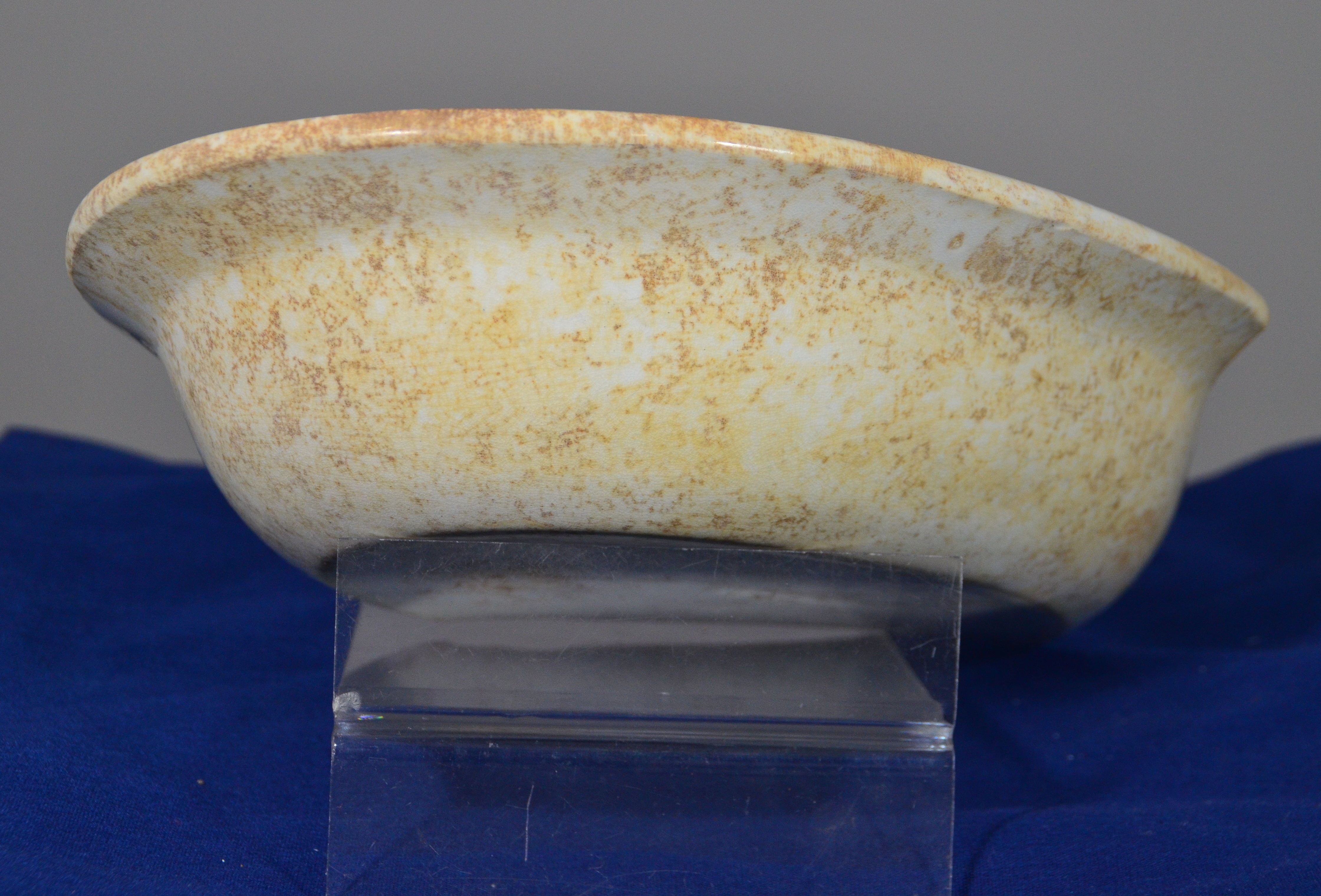
Ceramic ironstone bowl, partial, white glaze
: 9.25" x 7.0" x 2.25", 1.2 pounds
Hundreds of whole or broken pieces of ceramics were found on the river bottom, including four forged from ironstone.

Metal iron hook and eye: 11" x 7.5", 3.88 pounds

Copper alloy sabot: 6.5" (diameter) x 1.375", 7.8 pounds

The sabot, designed to ensure an artillery shell was in the proper position in the barrel, was described this way in the final report on the project:

“The shallow copper saucer, bowl or basin appearance of the aft face of a Brooke copper ratchet disc sabot. Interestingly, this is a spent or fired sabot indicated by the grooving on its exterior side. The hammer marks may have been a result of fitting the sabot onto the shell prior to firing.”


Light blue bottle
: 9.5" x 2.25" (diameter), 0.54 pounds, believed to have held wine

Colorless bottle, partial with broken neck: 6.0" x 1.75" (diameter), 0.5 pounds -- Photo of top of post
This “is a thick-walled, strangely shaped bottle with a small base of a diameter that would allow it to fit into one of the rings; glass fragments similar to this bottle were found in several units across the site. Seven glass bottle stoppers, divided into four categories, were recovered, and may belong to cruet or decanter sets.”


6-pounder iron cannon, Noble Brothers Foundry
:
125.25" (artifact length) 132" x 36" x 28" (crate), 1,240 pounds

This piece of ordnance is one of five recovered in 2015, and it was originally located on the spark deck aft. It is the only one of its type discovered in the river, and it was manufactured in Rome, Ga. It was presented to the Confederacy by the “Ladies of Rome.” The left trunnion is marked August 1862.

James Noble, an Englishman, organized the company with his six sons in 1855. By January 1862, the firm was heavily engaged in the production of cannon and battery equipment. “The Noble Brothers experienced considerable success in the casting of bronze and iron field guns. Between April 1861 and October 1862, some 58 field pieces were delivered to the Confederacy. Of these, at least 15 were cast iron 6 pounders.”

A dispute with the Confederate government in late 1862 ended all ordnance contracts with the foundry.

The Corps report says: “The Noble Brothers’ plant was destroyed when Sherman’s troops entered Rome on May 18, 1864. The large smokestacks of the foundry were blown up and the shops burned. The Union troops attempted to dismantle the lathe using sledgehammers, with little success. The hammer marks are still visible today and the fire caused minimum damage to the lathe. The massive machine stayed in production until the mid-1960s.”

Iron gun port, partial: 24.0" x 14.5" x 4.125", 192 pounds (photo above, with cannon)

(Civil War Picket photo)

Complete triple-bladed propeller
: 6' (diameter) 55" x 82" x 73" (crate), 2,700 pounds

From the final archaeological report prepared for the Army Corps:

“It is not known what kind of engine the CSS Georgia employed, but it is known that the LGA Steering Committee searched for one far and wide. In a letter written on June 11, 1862, John Elliot states that the vessel had a double engine and twin propellers. The engines were only able to make about 2 knots under full steam. All agreed they were inadequate for propelling the vessel against the swift currents or tides of the Savannah River. The engines did, however, serve a functional purpose, as one writer in 1862 stated, ‘Our iron floating battery is a splendid failure. She has been taken down between the forts and they are obliged to keep her engines at work the whole time to prevent her sinking, she leaks so badly’ It is thought that the vessel’s leaking was most likely a result of building her with unseasoned wood, a common practice in Confederate vessel construction.”


Complete propeller shaft
: 12' x 5.68" (diameter) 132" x 36" x 28" (crate), 1,510 pounds

The triple-bladed propeller is mounted on a 6-inch diameter shaft approximately 12 feet 6 inches in length. Because two of its three blades were buried, jetting was conducted to uncover the blades prior to lifting. Once lifted onto the barge deck, the shaft was cut free from the 8-foot blade with a saw for ease of transportation and conservation. A single strut indicates the vessel would have had two propellers, and historical sources indicate that the CSS Georgia was powered by “a double engine and twin propellers,” according to the Corps report.


Leather shoe sole and upper fragments
: 4 pieces, “10 5/16" x 3.5" x 0.02" (sole), 0.14 pounds

Some 68 boot or shoe fragments were recovered from the site. Most are small fragmentary pieces of leather with no complete shoe or boot, the soles of several examples being the most intact portion of recovered footwear.


Leather shoe heel with partial sole
: 4.1" x 2.6" x 0.98" (heel thickness/ 0.02" (sole thickness), 0.16 pounds

Leather fire hose, partial with small bag of leather fragments: “9.75 x 4.5 x 1.02”, 0.56 pounds

Copper alloy sword sheath: “2.52 x 1.6 x 0.6”, 0.06 pounds

Numerous small arms including a mostly complete pistol, eight Enfield bullet cartridges, 90+ bullets of varying caliber for pistol and rifle, two bullet molds, two gunflints and two sword and five bayonet hilts were recovered.


Copper alloy gun sight, forward with "N 714" (mark): “3.98" x 1.34" x 2.36", 1.16 pounds

A naval gun had to be raised to an appropriate degree of elevation to achieve the necessary range to strike a distant object at sea. This sight was placed on the front of the barrel.

Small partial iron anchor: “40.5" x 21.0" x 10.0", 180 pounds

The use of this particular anchor is unknown.

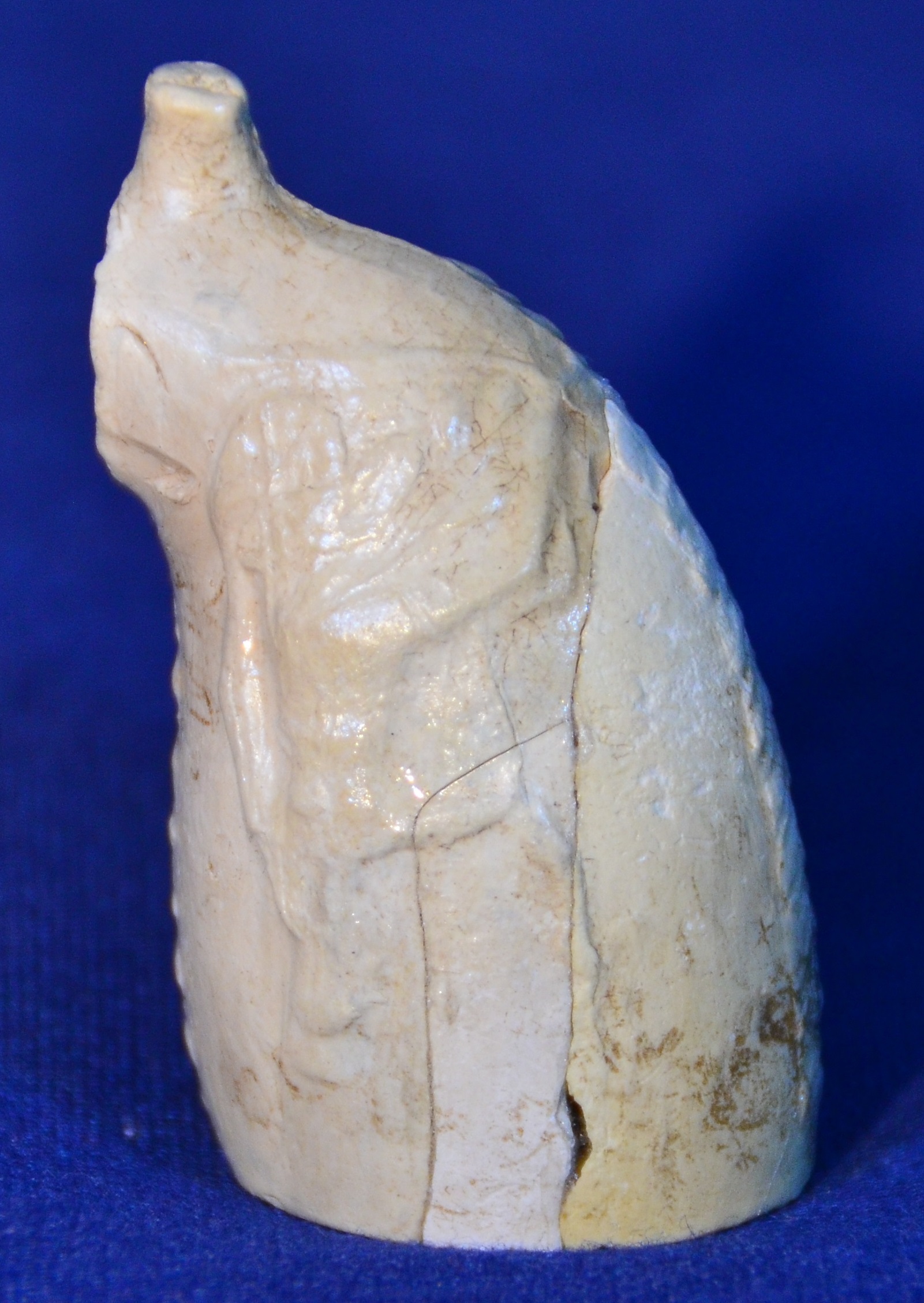
Kaolin pipe bowl, with floral decoration: “1.61" x 0.91" x 0.87", 0.02 pounds

Eight kaolin smoking pipes were recovered in the wreckage of the CSS Georgia. Similar to the prehistoric ceramics, and some percentage of the glass and historic ceramics recovered from the site, “the kaolin smoking pipe bowls are potentially intrusive (non-Civil War), although some if not all could easily have been personal property of those on board.”

Worm-eaten wood wedges: 2 pieces, “3.5" 1.54" x 0.94" (larger fragment), 0.06 pounds

Coal fragments: 2 pieces, “2.56" x 1.73" x 1.06" (larger piece) / “1.73" x 1.57" x 0.83" (smaller piece), 0.18 pounds

The CSS Georgia could have easily carried 100 tons of coal, but it’s unknown how much it carried at the time of its scuttling. Bunkers would likely have been located outboard of the boiler on both sides of the hull.
-----------------

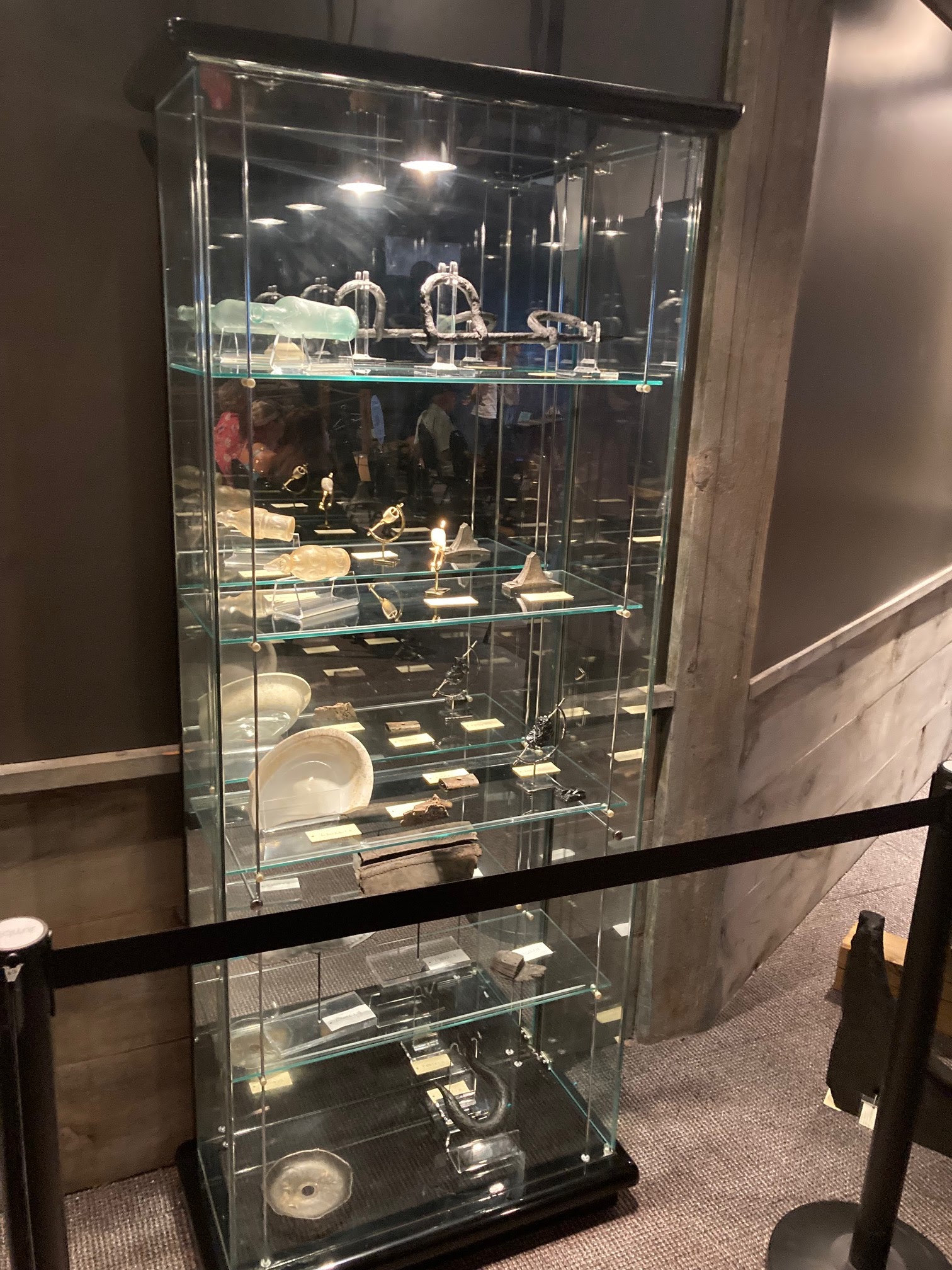
The Picket recently visited the museum, which put smaller artifacts in a large glass case. Signage and interpretation are still in the works.

Smaller CSS Georgia artifacts (Picket photo)

Sunday, May 8, 2022

CSS Georgia: Navy sends batch of ironclad artifacts pulled from Savannah River to National Civil War Naval Museum for display

CSS Georgia propeller is raised from Savannah River in 2015 (Dept. of Defense)
Updated May 18:

The National Civil War Naval Museum has received a first shipment of artifacts belonging to the CSS Georgia, the ironclad vessel that was part of Savannah’s effective river defenses.

The U.S. Navy recently lent about 20 conserved items to the Columbus, Ga., museum, which has worked for years to receive items from the Confederate floating battery. The CSS Georgia was scuttled by its crew when Union forces took Savannah in December 1864.

Museum executive director Holly Wait told the Picket that the shipment included a propeller, shaft, cannon, part of an anchor, part of a gun port, pipe stem, sword sheath, several glass bottles, an eye bolt, gun site and an elevation screw.

“It was a really big feather in our cap to get such a collection as this,” museum director of history and collections Jeff Seymour told the Ledger-Enquirer newspaper.

The Civil War Picket has written extensively about the CSS Georgia and reached out to the Naval History and Heritage Command for comment and further details.

"NHHC hopes that through display of the CSS Georgia artifacts at NCWNM, the public will benefit from a greater understanding of archaeology, conservation, Civil War history and US Navy history," said Lt. Anthony Ivester, public affairs officer for the command.

Conserved and shipped 6-pounder from CSS Georgia (Courtesy of NCWNM)
Most of the ironclad’s wreckage was removed a few years back as part of the U.S. Army Corps of Engineers’ deepening of the Savannah River to make room for larger tankers. Thousands of artifacts have undergone treatment at Texas A&M University, which shipped them to the Navy Yard in Washington, D.C. for storage.

The project, which involved contractors and U.S. Navy divers, recovered more than 30,000 artifacts, including 241 pieces of ordnance, five cannons and two large casemate sections. The latter were documented and left in the water.

In 2017, Navy officials invited several museums, including from Savannah, to the recovery site. The Columbus museum is the first to receive the artifacts from NHHC, which is the custodian of naval artifacts and history.

"We have received previous inquiries from other institutions, but there are no other active agreements for CSS Georgia artifacts," said Ivester.

The Navy and the museum reached an agreement on the loan in March and the items were shipped on May 3, officials said. For now, the CSS Georgia artifacts will be displayed in the museum's main gallery, Wait said.


When asked about long-term plans for a display, Ivester said:

"NCWNM has agreed to coordinate with NHHC as they develop the exhibit for the CSS Georgia artifacts. Archaeological artifacts are best compatible with certain materials and NHHC can provide specialized guidance on which materials are suitable for their continued preservation while on display."

Wait said the shipment was the first of a few expected over the next three to five years.

“The Navy has a standard 3-year loan agreement to confirm that items are cared for properly.  However, all our conversations with them have included our long-term plans," she wrote in an email.

The NHHC described the present loan as short-term, with the possibility of renewal.

Wait said the CSS Georgia will be the seventh Civil War vessel to be exhibited in the country. The museum has two others: the ironclad CSS Jackson and the twin-screw wooden ship CSS Chattahoochee.

Gordon Watts, who has dived on the CSS Georgia and was involved in its recovery and study of artifacts, told the Picket: "I think it is fantastic that museum personnel have been able to obtain a collection of artifacts from the Georgia. Now at least some of the numerous artifacts recovered from the wreck will be available for public access. Congratulations to the National Civil War Naval Museum on a significant addition to their already impressive exhibits."