Showing posts with label collection. Show all posts

Monday, August 10, 2026

At 99, Charles J. Turner Jr. has dug up Georgia battle relics nearly his whole life. That collection and an impressive array of purchases are finding new life at the Atlanta History Center's Civil War exhibits

Charles Turner in Chattanooga, Tenn., in 1938 and in 2023 with part of his enormous collection (AHC); canister and shrapnel Turner found at Pickett's Mill decades ago and artifacts he bought on display in "More Perfect Union (Picket photos)
Charles J. Turner Jr. was just a boy when the relic hunting bug hit, and he’s been at it ever since. At age 99, Turner’s still curious about what Civil War treasure rests in the soil of North Georgia.

Turner recalls a seminal moment in 1933 or 1934, during the Great Depression, while he was growing up on Lucile Avenue in Atlanta.

“One of the kids I went to school with lived in the area and he picked up a Minie ball in the woods one day and brought it to school and he showed it to me,” the retired electrical engineer recently told the Picket.

The young hobbyist subsequently got some suggestions for places to look from noted historian and artist Wilbur G. Kurtz, who refurbished the Cyclorama painting and was a technical adviser for the film “Gone with the Wind.”

Visitors can flip through digital version of Sherman's Barnard volume at top of case (Picket photo)
Turner’s passion for digging Civil War artifacts and buying militaria is an incredible boon for the Atlanta History Center. The collector is in the process of donating hundreds of collected items to the institution. Some items he purchased in recent years went directly to the AHC.

Patrons are beginning to see the fruits of Turner’s efforts. A display in the AHC’s new “More Perfect Union” exhibit includes a trove of artifacts he bought, including a flag of the consolidated 6th and 9th Tennessee Infantry.

There’s a lot more.

Nearby is a rare cartridge box and rusted canister from the pitched fighting at Pickett’s Mill northwest of Atlanta. Farther down is a copy of photographer George Barnard’s album recording Maj. Gen. William T. Sherman’s campaign in the South and Sherman’s rank insignia (Picket photo, left). Both items belonged to the Sherman family.

Turner bought the two items from an auction house a couple years back and donated them to the AHC; he dug up the Pickett’s Mill canister in the 1950s/1960s, before the site became a state park.

His generosity will result in educational opportunities for future generations, museum officials contend. Turner's items in "More Perfect Union" are the tip of the iceberg. A gallery opening in several months figures scores of items he personally obtained while relic hunting.

His dug relics will be unveiled in coming months

Much of the relic hunter’s finds and purchases filled a large room and now the AHC is using those items to buttress its already immense collection and tell more stories about the fighting in Georgia. (Photos below, courtesy Atlanta History Center)


The gallery in “More Perfect Union” dedicated to the Atlanta Campaign has been named the Charles J. Turner Family Gallery in his honor.

His dug collection of weaponry will be the backbone of “The Hard Hand of War: Soldiers, Weapons, and Mass Production,” the museum’s second new exhibit about the Civil War. It will open in several months.

“Together, his collection represents one of the most comprehensive covering the Atlanta Campaign,” the history center says.

It’s remarkable that a man who started collecting during President Franklin Delano Roosevelt’s first term in office is still in the game. Now, Turner says, it is time for others to appreciate his collection. Most have gone to the Atlanta History Center.

“That’s where they really ought to be, where people can see them,” Turner said.

Wilbur Kurtz gave the Atlanta boy lasting advice

Turner grew up at a time when stories about the Civil War weren’t far removed from those who experienced its triumphs and tragedies. He recalls the former Confederate soldiers’ home near Grant Park.

The war was very much part of the fabric that made up Atlanta during his youth. “There were sons and daughters of veterans who had stories to tell,” Turner related to the Civil War Picket in a recent phone call.

By the time he was a teen, Turner was on the prowl for finds across the battlefields of metro Atlanta. Relic hunting in Atlanta used to be quite common, since just about the whole city was a battlefield.


Around the time he turned 18 in February 1944, Kurtz wrote a letter to his father, Charles J. Turner, with relic location suggestions and the recommendation to learn the history of the battles. (Above, courtesy Atlanta History Center)

The correspondence, which is kept at the Atlanta History Center, starts with this detailed passage:

“Your son’s hobby is an excellent one – I’d say – but perhaps I’m prejudiced, since ‘tis the same one I’ve ridden for more than years than I’d like to say. As for Civil War relics – bullets, etc., the Atlanta area affords but poor pickings at this late date. The primary shortage was brought about by the impoverished citizenry during the trying period immediately following the close of the war – they found out that bullets could be sold as junk lead to hardware stores, etc, and the money could be spent for bacon and cornmeal, next door – so bullet hunting was perhaps more profitable than blackberry gathering – being an all-year-round opportunity and not seasonable. Miss Sarah Huff (died last spring) told me that she had picked them up by the gallon, as a child – and that she knew that many, many others were doing the same things – to the same end as cited above.”

Huff as a young girl experienced the impact of the war in Atlanta and later wrote a book about her experiences.

Kurtz went on to write that Ezra Church, Cascade Road, Beecher Park, Utoy Creek area (right), Venetian Hills, New Hope Church and Kennesaw Mountain still had the potential for discoveries.

(Now, as then, diggers should seek permission from owners of private property. Most governments ban relic collecting on battlefields, parks and other historic sites. Those government sites largely were not in existence during Turner’s youth.)

Gordon Jones, senior military historian and curator at the AHC, said the Turners saw Kurtz at the July 1944 dedication of the Peachtree Creek monument at Piedmont Hospital in the Buckhead area of the city.

“Great story, great connection,” he said of their friendship.

Enthusiast struck paydirt years ago at Pickett's Mill

About that time, Charles J. Turner Jr. was drafted into the U.S. Amy and spent the closing months of World War II in Germany, where his unit oversaw labor by Axis prisoners of war.

He later attended Georgia Tech, where he received two engineering degrees. He had a long career with Lockheed before retiring in the mid-1980s.

The lifelong Atlantan nurtured his hobby all this time, amassing a large collection. He stayed mostly within 100 miles of Atlanta, including sites in Resaca and Jonesboro.

Notable relic collectors in the area included Beverly M. DuBose Jr. and his son Beverly M. Dubose III. Their collection was the basis of the old AHC “Turning Point: The American Civil War” exhibit, which closed to make way for “More Perfect Union.”

Jones said the Turner and DuBose relics will comprise "A War in Our Backyards," the largest section within "The Hard Hand of War." The collections will be separate, featuring biographies of the collectors, stories of their discoveries and maps of where they collected. The DuBoses dug relics in several Southern states.

"Both collections highlight the enormous quantity of war materiel manufactured during the war," added Jones.

Turner spent a lot of time at Pickett’s Mill in the 1950s and 1960s “Most of the stuff I found at Pickett’s started out with an old Army mine detector. I graduated up to commercial.”

He found belt buckles, bayonets, rifle barrels, rifle parts, uniform buttons and more. (Turner in the 1990s, right)

“One of the things I enjoyed finding was the shot from the cannon down that gully.”

In late May 1864, cannons mowed down Federal attackers who futilely charged through a ravine toward Confederates waiting for them in strength. At "More Perfect Union," the case of canister is next to an artillery piece that may have fired some of those rounds. (Picket photo, right; click to enlarge)

Turner says he has found thousands of items in the field. He recalls spotting a locket in a creek bed near Dallas, Ga. The item contained a lock of a woman's hair.

The majority of the guns in his collection came from dealers and antique stores.

While in his 80s, Turner began to collect more items pertaining to the Atlanta Campaign, including the 6th/9th Tennessee flag. In the mid-2010s, he began working with the AHC to preserve his collection, officials said.

Charles J. Turner Jr. with the 6th/9th Tennessee flag before it went on display (AHC)

Gallery features a trove of Turner's collection

“More Perfect Union” tells a much wider story than “Turning Point” about the causes and repercussions of the conflict. Topics include slavery, secession, economic forces, Reconstruction and how all of this translates today.

But, of course, there are the items related to soldiers, uniforms and weaponry.

Cased Colt revolver presented by Col. Anson McCook to a fellow officer in the 2nd Ohio;  canteen used by Pvt. John Kemp, 11th Tennessee at the Dead Angle; cartridge box and cap pouch made by Wellborn, Nichols & Oliver of Dalton, Ga. 
Additional Turner items currently on display include:

-- Two canteens, including a Confederate one picked up by a Yankee soldier after the Battle of Resaca in May 1864;

--- Drum carried throughout the Atlanta Campaign by William A. McKinzie with the 78th Illinois;

-- Sword of Col. John G. Mitchell with the 113th Ohio;

-- Kepi of Confederate Brig. Gen Francis Cockrell with the Missouri Brigade. He commissioned the item for $35 from a hat maker in Mobile, Ala.; (right, Picket photo)

-- Cartridge box and cap pouch made by Wellborn, Nichols & Oliver in Dalton, Ga.

-- Smith & Wesson revolver used by a soldier with the 125th Ohio, known as “Opdycke’s Tigers”;

-- An Austrian Lorenz rifle-musket carried by William Blair Mosby of the 5th Mississippi;

-- Whitworth sharpshooter rifle used by J.E. Gilbert of the Rebel Army of Tennessee. Turner says he used to have four or five Whitworth rifles. “They are hard to find.”

Time has not diminished his passion for hobby

Charles Turner’s passion for collecting hasn’t much faded over the years. He was out in the field about a year ago, a close friend providing the transportation.

 “A lot of my friends are relic hunters just like me.”

The enthusiast looks for Civil War artifacts in 2012 (Courtesy AHC)
One pal drives him out to the field.

“He started hunting with me 20 years ago. I am still collecting whenever I have a chance. I am not able to get out in the field with a metal detector.”

Turner attended a AHC gala held the week “More Perfect Union” opened. He was among the special guests of honor

Wilbur Kurtz’s 1944 letter to Turner’s father was prophetic, calling the boy’s hobby “an excellent one.” (Click letter below to enlarge; courtesy Atlanta History Center)

The historian and artist finished the correspondence with encouragement for the teen to learn about the battles that shaped the destiny of the country and the South. He listed nearly a dozen books, including one by Union Maj. Gen. Jacob Cox and others by or about Joseph E. Johnston, John Bell Hood, Leonidas Polk and Patrick Cleburne.

“If that boy of yours is really serious about these things, encourage him to keep at it as a hobby to the end that he may become fully informed as to what happened – and where – during that storied summer of 1864.”

“Someone should carry the torch for this sort of thing – so why not Junior?”

Junior, who turns 100 in February, still tends to that flame.

Tuesday, June 4, 2024

Hands-on learning: These artifacts may not be eligible for the museum, but they still have a lot to teach Kennesaw Mountain park visitors about the Civil War

Several items from the federal park's education collection (KMNBP)
If an item is under glass at Kennesaw Mountain National Battlefield Park’s museum and visitor center, you can be sure provenance has been proven and it has a firm connection to the June 1864 fighting there or the Atlanta Campaign.

Many artifacts found on trails or donated to the park don’t meet that standard. But that’s OK – they can still educate visitors during interpretive programs and field trips.

I asked Jake Boling, a Kennesaw Mountain park ranger and education coordinator, for a little more detail after a  #MuseumMonday social media post about the education collection.

Boling stressed a museum-level item needs to have historic context, including a specific location and chain of custody.

“A good example of this is when a visitor brings in a box full of Minie balls that they found in their basement, which could be from any Civil War site,” Boling said in an email. “We would not be interested in the Minie balls for our museum collection, but they could be a useful educational tool.”

Unlike items at the museum, artifacts in the education collection can often be touched and held by visitors.

The North Georgia park posted a photograph (above) with many items of that type: three pocket Bibles, shell fragments on either side of a 12-pound solid shot, and at bottom, an Enfield round, musket ball and a Minie ball round.  (While all of the artifacts in the photo are original, some used for interpretation are reproductions.)

The Bibles are examples of those commonly carried by soldiers in the field, wrote Boling.

The shell fragments come various types of explosive artillery rounds. The solid cannon ball would have been used with a 12 pound, smoothbore Napoleon cannon. The Enfield round would have been used in Enfield rifles, whereas the Mine ball would have most likely been used in a Springfield model rifled musket, he said. The round ball could have been used in a number of different smoothbore muskets. 

Artifacts in the education collection are shown in a variety of programs. Sometimes, they are taken off-site.

“Broadly, these items help our interpretive audience actually feel and hold (in some cases) a piece of history. While we may not have the specifics on the when and where of these items, being able to feel the weight of a cannonball or the sharp edges of an artillery shell can facilitate a connection with the resources here,” said Boling. 

Kennesaw Mountain National Battlefield Park is putting on 160th anniversary programming this month. Events include hikes, music and infantry, artillery and signal corps demonstrations.

Monday, March 18, 2024

Lost (stolen), found and sold: 48 portraits from Herb Peck's prized collection, plundered in 1978 Nashville burglary, have new homes after auction

Florida soldier with carbine; siblings with 3rd Tennessee (Fleischer's Auctions)
Forty-eight photographs, mostly of young Southern men toting rifles, Bowie knives, revolvers and fierce gazes, sold for $259,000 (excluding buyer’s premium) at a weekend auction, pleasing the widow and son of an esteemed collector who curated the images before they were stolen in 1978.

The family of Herb Peck Jr. enlisted the help of law enforcement, other collectors and Military Images magazine in their hunt for 117 images taken during a burglary at their Nashville home.

Peck  began collecting in the 1950s ahead of the Civil War centennial, amassing one of thepremier collections of Civil War portrait photography at a time when the genre’s importance was only first being realized,” said Fleischer’s Auctions.

Peck died at age 67 in 2004 before any of the photographs were recovered. One was located in 2006, 39 were seized during a 2020 raid and eight more were returned in the past year.

Herb Peck Jr. with some of his photos in the 1970s. (Fleischer's Auctions)
Fleischer’s Auctions said representatives of the family attended the three-hour Saturday sale in Columbus, Ohio.

“It’s been an emotional process for everyone involved,” the company said in an email to The Civil War Picket.

Adam Fleischer, in a social media post after the sale, said high interest in the photographs reflected Peck’s eye for quality. “The Peck family's decision to share Herb’s captivating images with the public, following decades of uncertainty, resonated deeply with collectors and history enthusiasts alike.”

The top seller Saturday was lot 45, entitled “Confederate with Colt Revolving Rifle.” It went for $32,200 with the buyer’s premium. The subject wears an outdated cap topped by a havelock and holds a Model 1855 Colt revolving rifle. It’s possible he was from Virginia, according to Fleischer’s.

“This is a masterpiece of Southern photography and I chose it for the cover (left) that featured the story about Herb's collection,” Ronald S. Coddington, editor and publisher of Military Images, told the Picket. (Fleischer’s Auctions is an advertiser with the magazine)

Behind that was lot 34, entitled “Masterful Character Study,” which realized $24,300 with the buyer’s premium. The portrait depicts James and Calvin Walker of the 3rd Tennessee Infantry. Calvin was killed in action in Georgia in 1864, with an eyewitness noting that nothing was left of his head after he was hit by artillery shrapnel but “"...[a] chin and rather long whiskers.”

Images going for high prices included a Tennessee infantrymanFlorida soldier with carbine and a Confederate private armed with a Model 1842 musket, Bowie knife, and pair of large Colt Navy revolvers.

Coddington said he found lot 28, a photograph of a Confederate first sergeant, to be particularly compelling (right, courtesy Fleischer's Auctions).

He cites “the focal clarity of the image, the look of the soldier, the way he holds his saber and the unusual paper mat that was likely used as a substitute for brass mats that were unavailable in the South due to the blockade and loss of territory.

Ahead of the sale, Fleischer’s Auctions said the collection was once thought lost forever.

Coddington, in a Military Images article about Peck, said photographs from the collection were published in “The Civil War” by Ken Burns and in more than 50 books, magazines and articles, including Time-Life’s “The Civil War” series, the “Confederate Faces” series and “Civil War Times.”

Burglars hit the Peck home in September 1978, making away with 117 images, cameras and more than a dozen weapons.

Law enforcement agencies in Tennessee and the FBI worked on the case as several photographs appeared for sale on online sites. The FBI office in Indianapolis netted one image in 2006.

Peck’s son asked Military Images to revive the case in 2016 and he created a poster showing many of the photographs. The FBI and police in Ethridge, Tenn., recovered 39 images in an October 2020 raid. Eight more turned up later. (Southern musicians with fife and drum, left)

About 70 photographs are still to be recovered, according to Coddington. The publisher says the family is committed to their return. “Due to the active nature of the investigation and concerns from the family about jeopardizing the investigation, this is all I am able to state at this time.”

Saturday’s auction must have brought some satisfaction to Peck’s family.

Peck’s widow, Felicity, previously told Military Images: “I remember how distressed the collectors were at the time of the burglary. It has always been a comfort to me that others care about the importance of these images as historical, visible and tangible evidence of this country.”

Thursday, February 8, 2024

I've always thought George Meade's slouch hat was awesome. We asked experts to weigh in on it and five other iconic Meade items kept at Gettysburg

Courtesy of Gettysburg Foundation, from the collection of the Civil War Museum of Philadelphia
CWMP 86.13.33, Slouch hat; Meade photos Library of Congress and National Archives
If I ever get around to writing “Cool Hats of the Civil War,” my top choice (spoiler alert!) will go to Union Maj. Gen. George Meade’s slouch hat, followed closely by those of Ambrose E. Burnside and J.E.B. Stuart.

While the hero of Gettysburg and commander of the Army of Potomac is sadly overshadowed by many in the pantheon of Civil War commanders, Meade and his hat will always stand tall to me.

There are great images of him with that headgear: In front of his tent, seated among a throng of soldiers, or perched on a bench at the famous Grant “Council of War” at Massaponax Church in Virginia.

The Gettysburg Foundation operates Gettysburg National Military Park’s visitor center and museum. It also owns and curates thousands of items, including those of Meade from the collection of the Civil War Museum of Philadelphia: The slouch hat, a kepi, frock coat, flags, field glasses, sash and swords, among other fascinating items. Meade wore the hat and frock coat at Gettysburg in July 1863.

Kepi-topped Gen. Meade (center) with members of his staff (National Archives)
Meade’s slouch hat certainly was attention-getting.

“I am not sure if Meade had a preferred style of hat but, maybe his preference was more utilitarian; e.g., wearing the slouch hat on active campaign because it kept the sun and rain off of him; whereas wearing the kepi in static locations such as a winter quarters and formal occasions,” says Mike Kwolek, museum exhibition specialist for the foundation.

The general’s hometown was Philadelphia. For more than 70 years after his grandchildren donated them in 1937, Meade’s belongings were housed at the Civil War Museum of Philadelphia. Other items at the museum were donated by former Union officers, members of the Military Order of the Loyal Legion of the United States (MOLLUS). Meade died in 1872 at age 56.

Museum officials had hoped to erect a new building after it closed in 2008, but funding never came through and hundreds of artifacts went to the Gettysburg Foundation. (Paper documents relating to the officers are kept by the Union League of Philadelphia)

Gettysburg’s collection has many sources, including what was at the Philadelphia museum. (Photo at left, Courtesy of Gettysburg Foundation, from the collection of the Civil War Museum of Philadelphia; CWMP 86.13.32, Frock Coat)

I spoke with Kwolek – whose duties include designing and executing museum exhibits, collections management and registration – about a half dozen items in the Meade inventory. (I am grateful for his help and patience when I peppered him with myriad follow-up questions)

Here’s a close look at the six artifacts:

MEADE'S FELT SLOUCH HAT

Courtesy of Gettysburg Foundation, from the collection of the Civil War Museum of Philadelphia
CWMP 86.13.33, Slouch Hat
Talk about a close call. The general came to Gettysburg with two bullet holes in the hat, from fighting several months before at Fredericksburg, Va.

Army regulations allowed for officers to wear black felt hats. The height of the crown could be a little over 6 inches. The bindings were made of black ribbed silk. It features a bullion hat cord and insignia.

“These examples were similar, yet more elegant than the 1858 Hardee hat; however, many officers went to the private market and purchased black felt hats in a variety of shapes and sizes. The one that Maj. Gen. Meade wore, and housed at the Museum and Visitor Center, is one of those privately purchased hats,” says the foundation.

Meade, seated at far left, at Massaponax Church (Library of Congress)
His slouch hat has a pinched crown (click to enlarge)
The park doesn’t know when Meade got the hat, which he wore with the brim down. Kwolek said this headgear may have been produced in Philadelphia by the hatter William F. Warburton; who, in 1862, held three patents for military caps and hats.

Conservation was performed on the hat in 2012. The bullet holes, above his major general’s insignia, were stabilized during that work, said Kwolek.  

C. Paul Loane, co-author of “US Army Military Headgear, 1812-1872,”.recalls seeing the hat when it was at the museum in Philadelphia.

“It appeared to be the standard black felt headgear with black silk edging around the brim worn by most officers, he said. "His hat cords were all gold as called for in regulations for a general officer."

The hat and coat have been off-exhibit since 2016, following the park’s Treasures of the Civil War” exhibit.

CHASSEUR-STYLE KEPI

Courtesy of Gettysburg Foundation, from the collection of the Civil War Museum of Philadelphia
CWMP 86.13.34, Kepi
Of the Meade-associated items described here, only the wool kepi is currently (February 2024) on display. The exhibit has the words “Old Snapping Turtle,” a nickname given to the commander because of his famous ill temper.

Text below the kepi reads:

“Although often seen in contemporary photographs wearing his favored slouch hat in the field, Meade wore this regulation officer's cap (with gold trim for general officers) for dress and ceremonial occasions." 

National Archives, Library of Congress photos of Meade wearing a kepi; click to enlarge
This is the French style of cap that Maj. Gen. George B. McClellan advocated that officers use after his observations during the Crimean War, says Kwolek. Meade’s kepi was made by Wanamaker’s of Philadelphia, his hometown. The company was founded in 1861 and operated at Market and Sixth streets. Meade purchased it in 1862 or 1863.

Loane told the Picket the cap is “a slightly brighter blue than most examples (which flirt with being a midnight/almost black shade) and had a subtle ‘bagginess’ about it we collectors like. Two silver stars of a major general were affixed to the front within a gold embroidered wreath backed with black velvet. Staff officer buttons secured the chin strap and narrow black tape trimmed the sides and top.”

The classic-period kepi went through restoration in 2012, which included cleaning and stabilization.

MAJOR GENERAL FROCK COAT

Courtesy of Gettysburg Foundation, from the collection of the Civil War Museum of Philadelphia
CWMP 86.13.32, Frock coat; Meade photo Library of Congress
The maker of this dark blue frock is not known, but Meade is known to have worn it from at least Gettysburg onward. Kwolek wondered whether it was made by Brooks Brothers, which made uniforms for Federal officers. Brooks Brothers. told the Picket in an email it has no existing record of Meade.

The coat conforms to 1861 regulations and bears the rank of major general on its epaulets. For that rank, the coat had two rows of buttons on the breast, nine in each row, extending to the waist. Four buttons were on the back and skirt of the coat, according to the Gettysburg Foundation. The interior chest/torso region of the jacket exhibits quilting with patriotic motifs.

The coat went through extensive cleaning and stabilization 2012. Its condition before treatment exhibited extensive use, according to Kwolek.

ARMY OF THE POTOMAC HEADQUARTERS FLAG

Courtesy of Gettysburg Foundation, from the collection of the Civil War Museum of Philadelphia
CWMP 86.2.4, 34‐star Headquarters Flag
This flag has the distinction of the one that flew at Meade’s headquarters at Gettysburg. His descendants provided the provenance for this 34-star silk flag.

Kwolek says Maj. Gen. Joseph Hooker may have flown it before Meade took command of the army in late June 1863, just days before Gettysburg.

ARMY OF THE POTOMAC HEADQUARTERS FLAG (May 1864)

Courtesy of Gettysburg Foundation, from the collection of the Civil War Museum of Philadelphia
CWMP 86.2.5, Army of the Potomac Headquarters Flag 
This short-lived flag was most likely made by Sisco Brothers of Baltimore, according to the Gettysburg Foundation. It was made of faded soprano silk with a dark blue laurel wreath surrounding a gold eagle with arrows and laurel in its talons.

It has a swallowtail design with silk ties. It was used only in May 1864, in Virginia, and was replaced by a small national flag. According to Kwolek, this reversal might be due to Gen. Grant’s reaction to it, which was recorded by artist Alfred R. Waud: “What’s this! Is Imperial Caesar anywhere about here?”

ARMY OF THE POTOMAC V CORPS FLAG

Courtesy of Gettysburg Foundation, from the collection of the Civil War Museum of Philadelphia
CWMP 86.23, 5th Corps flag
Meade commanded the corps for only a month, six months before Gettysburg. The flag conforms to the Army of the Potomac's general order No. 10 that specified flags to be used for corps headquarters as blue swallowtailed, with the number of the corps in red on a white botonee-style cross.

Kwolek believes Maj. Gen. George Sykes may have flown it at Gettysburg when he led V Corps. The flag was probably returned to Meade once the 1864 style of headquarters flags were issued. The flag was donated to what was then the War Library and Museum in 1937 by his grandchildren and great-grandchildren. 

Other Pennsylvania venues that highlight Meade

Meade’s legacy is covered at several institutions in Philadelphia, including the Grand Army of the Republic Civil War Museum & Library. It has an exhibit on the general, including many photos, and another unusual item – the head of Old Baldy, Meade’s war horse.

The National Constitution Center, while it has no Meade items in its permanent collection, does have several on loan from the Gettysburg Foundation for the exhibitCivil War & Reconstruction: The Battle for Freedom and Equality.” Those are the general’s sword and scabbard, dress spurs and field glasses with case (shown in photo below among other artifacts).

From the collection of the Civil War Museum of Philadelphia, on loan from Gettysburg Foundation
 and National Constitution Center, photo courtesy NCC
"The
sword is a M1839 Topographical Engineers sword used by Meade and supposedly the one where he broke the tip of the blade off while striking a soldier at Fredericksburg,” said Kwolek.

The Union League has multiple papers, orders, photographs and other items related to Meade. Click here and here for examples.

“Our archives and collections are available to the public through research appointments,” Keeley Tulio, archivist and collections manager with the group’s Heritage Center, said in an email.

Meade was awarded The Union League of Philadelphia Silver Medal in 1863 and The Union League of Philadelphia Gold Medal in 1866.

Thursday, April 13, 2023

Treasure trove: Capt. James Lile Lemon kept spoils of war and all his belongings. Descendants got to see them at the Atlanta History Center

Gordon Jones with drum, a revolver and James L. Lemon's prize watch (Picket photos)
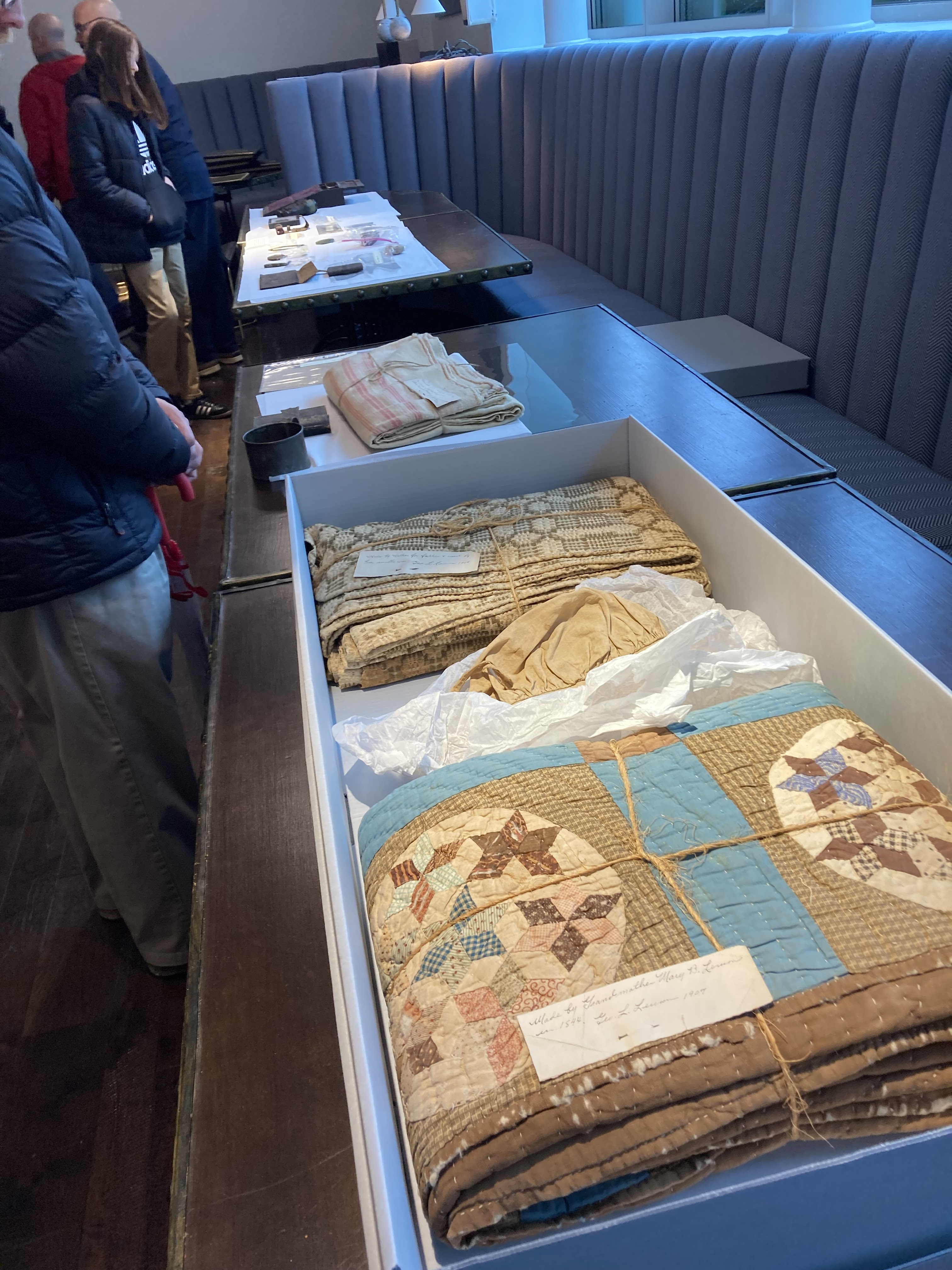
Last weekend, dozens of Civil War-period items were laid out on tables in the Atlanta History Center’s Cox Room. Almost all related to a single soldier -- a curator's dream.

There were personal items, a captured drum, revolver, letters, canteen, photographs and much more. Many artifacts were labeled with handwritten notes by Capt. James Lile Lemon of Company A, 18th Georgia Infantry, who fought in the Virginia theater and survived a year and a half in Union prison camps.

“I am speechless at this entire collection, to see it all together, said Heather Spann, of Kennesaw, Ga., a third great-granddaughter of Lemon (left).

“It is amazing how meticulous he was in keeping records,” said Fred Aiken, a member of the Atlanta Civil War Round Table.

Aiken, along with about 20 members of the Lemon family, most living in northern Georgia, were invited to the AHC to see the impressive collection the institution purchased from the widow of a Macon, Ga., collector in 2020. The set includes three wartime diaries.

“He literally saved everything,” said host Gordon Jones, senior military historian and curator at the AHC. Lemon was “an individual who was thinking ahead about his own legacy.”

Jones told the Lemon family that their ancestor is a quintessential example of the human experience in the Civil War. “This is storytelling stuff. People love it.” It is the history center’s fortune to have such a complete collection, he added.

Lemon descendants and others before seeing collection (Picket photo)
Before the Atlanta Cyclorama painting was moved to the AHC a few years ago, visitors filed through the exhibit “Turning Point: The American Civil War.” Many of the artifacts were collected by an Atlanta father and son team decades ago.

While “Turning Point” still attracts visitors, the AHC believes it is a dinosaur, and it is raising money for a new exhibit that will offer newer, fresher and more inclusive perspectives of the conflict. The Lemon collection, Jones said, will be shown to the public as part of that effort.

When the war broke out, Lemon was living in Acworth, about 30 miles northwest of Atlanta. His family had seven enslaved persons, and Lemon wrote in his memoirs that he freed them. There is some dispute over the claim, according to the AHC.

Descendant Mark Lemon lives in the Acworth home 
Early in the war, the 18th Georgia was part of John Bell Hood’s Texas Brigade. Lemon enlisted as a second lieutenant in 1861 for a three-year term in the Confederate army. 

The regiment fought in numerous Eastern battles – including Antietam, Fredericksburg, Second Manassas and Chancellorsville. The farmer and merchant had a close call at Gettysburg, when a Yankee bullet struck his canteencausing it to strike his head.

His combat days came to a close in November 1863, when Lemon was severely wounded by a Minie ball in the pharynx and taken prison after an assault on Fort Sanders in Knoxville, Tenn. 

Mark Lemon (left) brought sword given by Union NCO to J.L. Lemon (Picket photo)
By the time he arrived at Fort Pulaski near Savannah, in October 1864, Lemon had already been at three Federal prisons: One in Louisville, Ky; Camp Chase in Ohio and Fort Delaware, Delaware. 

The captain’s brief time at Pulaski is part of the story of the "Immortal 600", a fascinating footnote to the conflict. The story is involved, but here’s a summary:

In summer 1864, Confederate Maj. Gen. Samuel Jones essentially used 600 captured Union officers as human shields, in a section of Charleston, S.C., in the line of fire. The North retaliated by transporting 600 POWs from Fort Delaware to Morris Island, S.C., in direct line of Rebel guns.

“For nearly three months, the stalemate continued. It wasn’t until yellow fever broke out in the city of Charleston that the Confederacy removed the Union prisoners to newly erected prison camps further inland,” the National Park Service says. “With the Union prisoners removed from Charleston and no longer under fire from Union artillery, there was no need to keep the Confederate prisoners on Morris Island. With this realization, the next phase of their journey began and the Immortal 600 began the journey south, to Cockspur Island and Fort Pulaski.”

While held at Fort Pulaski, Lemon etched his name into a wall. (At right, blanket near top of photo was given to Lemon while he was held there. Click to enlarge)

Lemon and other prisoners were returned to Fort Delaware toward the war’s end.

He earned the respect of one of the prison staff, who also had the name Lemon. Sgt. Lemon Kline of the 215th Pennsylvania Infantry gifted him an NCO sword when the Confederate was paroled. Lemon, who somehow managed to get the weapon back to Georgia, wrote a notation about it, as was his practice.

Mark Lemon, great-great grandson of Lemon and author of “Feed Them the Steel!”, a history of Lemon and his regiment, brought the sword to the AHC, eliciting much excitement from Jones. The book, written as a narrative, includes many battle and POW accounts written by James Lile Lemon.

Lemon lives in the home built by his ancestor in 1856.

At war’s end, James Lile Lemon refused to take an oath of allegiance to the United States, citing his treatment, but he eventually did take it in June 1865. Family today considers him a “diehard” Confederate.

In his journal, Lemon wrote: “I have done the unspeakable but I am now paroled & to day set out for home. My duty to my country is done, mine to my family remains.”

The officer returned to Acworth and had 11 children with his wife Eliza. He was a retail merchant and then a bank executive, serving as president of the bank when he died on June 12, 1907, at age 72. Lemon had published a compelling memoir in 1886, the same year the Cyclorama was painted.

For Jones, Lemon’s meticulous record-keeping has paid off. “The story was there. It was just matching it to the artifacts.”

Here are some highlights from the AHC’s Lemon collection that were shown to the family:-

(Picket photo of sketch)
-- Original pen and ink sketch by Harper's Weekly artist Theodore Davis of the Lemon home in Acworth when used by William T. Sherman as his headquarters in early June 1864. “This is the only original Davis wartime sketch I have ever seen,” says Jones

-- An Adams revolver with “JL” and “18th GEO” carved into the grips (see photo at top of this post). Jones believes the officer gave the gun to his brother Smith, who used it while serving in the Georgia State Line. It saw action at the Battle of Atlanta in July 1864. (Lemon’s gun that he lost at Knoxville is today in a private collection in Milwaukee.)

-- Lemon’s engraved gold watch, made in Liverpool, presented by his brother Smith Lemon on October 27, 1861. Lemon lost the watch when he was wounded at Knoxville, but later spotted it on a Union soldier and managed to retrieve it, according to his memoir. (See photo at top of this article)

(Picket photo)
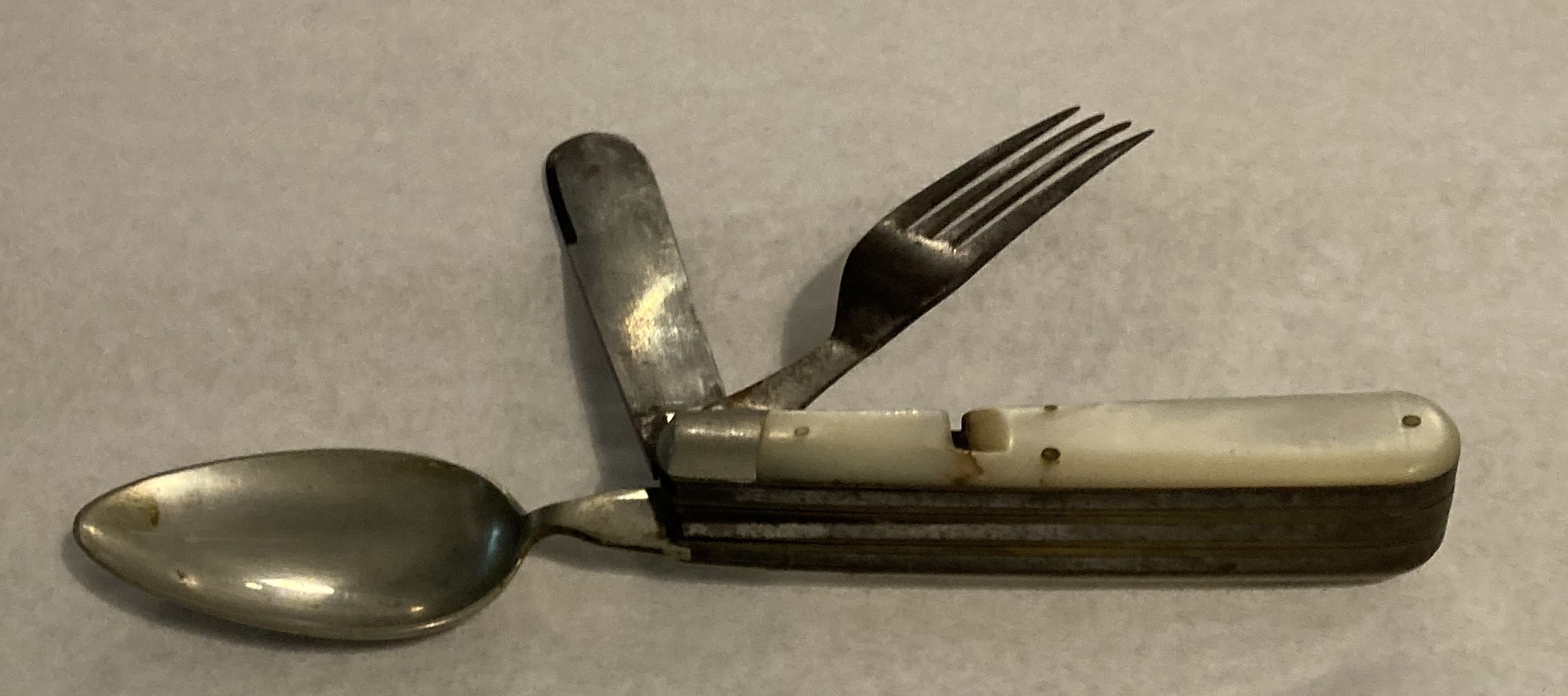
-- Knife/ fork/ spoon set Lemon took from a dead Federal soldier on the battlefield of Salem Church in Virginia, May 1863. He wrote in his memoir: “That evening, as we rested near the church, I had occasion to walk the field nearby. The ground was fairly strewn with every conceivable article of war, hundreds of Yankee dead and wounded lay everywhere, as well as scores of muskets, bayonets, accouterments of every type, haversacks and canteens ... As for myself, I allowed myself but one trophy, a nice little penknife with several blades and attachments, which an unfortunate Yankee corporal would no longer need. (It afterwards served me well and I have it still.”

-- Union canteen (below) Lemon picked up in the Wheatfield at Gettysburg after his own canteen had been ruined by a bullet (a Yankee bullet hit the canteen, and it struck the head of Lemon, who thought he had been shot). The strap bears Lemon's initials, date and initials of the dead 4th Michigan soldier from whom he got it.

(Picket photo)
-- Drum captured from two frightened young Pennsylvania drummer boys the day before the Battle of Sharpsburg (September 1862). Lemon tells the story of its capture by Pvt. Frank A. Boring in his memoir. The drumhead bears Boring's name in ink. This is James Lemon's handwriting, as indicated by pages in the diary and maps of battles shown in the memoir, according to Jones.  

Lemon wrote Pvt. Boring's name into drumhead (Picket photo)
Here is Lemon’s colorful account of the drummer boys, as written in his memoir:

“On the evening of the 16th our briggade was ordered to form line of battle & we advanced into a cornfield & into a piece of timber where we met almost by accident a force of the enemy. We drove them with style back through the woods, capturing some Yanks from the 1st & 3rd Penn'a Reserves. Among this bunch were a couple of drummer-boys, about 12 or 13 years old who were trying hard to "put on a brave face," but who were clearly terrified.

"Col. Ruff ordered their drums confiscated & then released as we were not equipped or inclined to care for children. Our drum had been damaged & thrown away at Groveton, so we took theirs as "spoils of war." Private Boring captured the boys. As he was driving them to the rear at point of bayonet they heaped so much abuse upon him -- out of their fear or nervousness -- that he had to be restrained from striking them with the clubbed musket.

"Of course, instantly the target of many wags among our company who joked with him about "scaring little boys" & etc. He replied that he would be d---d if he'd take such abuse from "d---d Yankee whelps." The boys were release(d) & "beat a hasty retreat" back to their lines, with Boring giving them a rite hard look as they went.”

One of James Lile Lemon's journals (Picket photo)