Showing posts with label kepi. Show all posts

Wednesday, February 28, 2024

Artillery Capt. William Hawley was wounded at Monocacy. The New Yorker's conserved kepi and frock coat will be part of revamped park museum in Md.

Capt. Hawley's frock coat and kepi in a 2nd-floor exhibit at Monocacy (NPS photo)
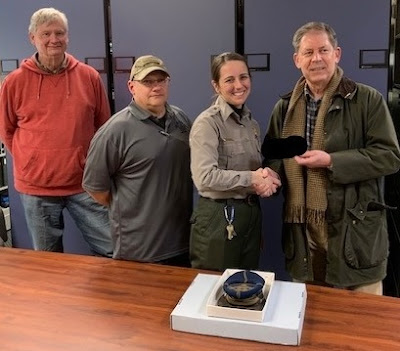
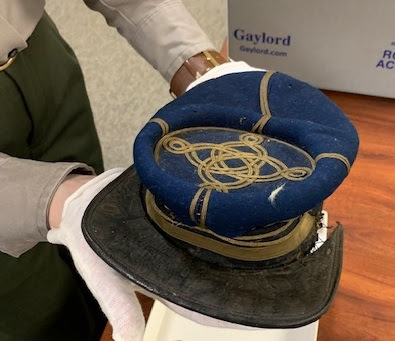
A mended kepi belonging to a New York officer wounded at Monocacy has been returned to the Maryland battlefield ahead of a planned overhaul of its museum.

Capt. William Hawley, Company E, 9th New York Heavy Artillery, was wounded in the arm on July 9, 1864. His hat and frock coat have been on display at Monocacy National Battlefield near Frederick since 2007.

Tracy Evans, acting chief or resource education and visitor services at the park, said Caring for Textiles of Washington, D.C., patched 10 small holes in the kepi's wool and reattached several open seams, including the leather trim.

At Monocacy, outnumbered Federals delayed Confederates bent on taking Washington. Union artillery did a lot to slow the Confederate advance, despite the latter having more guns. Jubal Early did not use the majority of his ordnance because he believed only militia was in his way. (Hawley's unit served as infantry at Monocacy.)

By the time Rebel troops reached the capital’s outskirts, Union reinforcements had arrived. 

Park officials say the revamped museum will tell more of the individual stories of soldiers and others. (Hawley's frock coat at left, NPS photo)

“The currently fiber-optic battle map will become a much larger map in the center of the museum that will be accessible,” Evans said in an email. “Surrounding exhibits will talk about all the people who lived on the farms, and how their stories intersect with the war and the Battle of Monocacy.

“It will also explore information about the campaign, battle, soldiers, post-battlefield hospital, (and) aftermath of the war/memorialization/effect of postwar on the people the war ultimately freed,” the ranger said.

Park officials anticipate the visitor center museum will close for renovation in September and reopen prior to Thanksgiving. 

Collector Richard Abel, in a comment on the park’s Facebook post about the kepi, said the Hawley cap and the coat were purchased from the family via an antique store in Gettysburg, Pa.

“I was always proud of this gift, to return the uniform to where it belongs, the field of battle, & to be viewed by the public,” he said. Abel donated many items, which were first kept at Gambrill Mill when it served as park headquarters.

Evans said Abel’s donations helped make up for a shortage of artifacts at the time. She added officials do not know whether Hawley wore that specific kepi and coat at Monocacy, only that he had them during the war.

Hawley was in his early 40s when he enrolled in Auburn as a lieutenant in the 138th New York Infantry in August 1862. The unit was designated as the 9th New York Heavy Artillery a few months later.

9th New York Heavy Artillery at a Washington, D.C., fort (Library of Congress)

The regiment helped defend Washington and participated in the Overland Campaign in Virginia before it fought at Monocacy, both times fighting as infantry. It served until the war’s end, suffering 461 casualties, nearly half from combat.

Hawley, who led a company, was honorably discharged in September 1864. Some newspaper accounts said his arm injury was slight, but it may have been more serious. He apparently applied for a pension in 1880 and died at age 77 in Wolcott, N.Y.,  in 1897, according to findagrave.com.

Evans says Hawley’s coat, featuring red shoulder boards and artillery buttons, is in very good condition. “The conservator created some padding to add to the mannequin to ensure the shoulders did not sag.”

While he was a captain at Monocacy, Hawley's shoulder bars are those for a lieutenant.

The coat was "rested" from the effects of light in spring 2020. "In the new museum, the frock coats will be rotated so that they have some rest from the mannequins and light," Evans said. 

At Monocacy, Union Maj. Gen. Lew Wallace’s troops used his limited artillery and the terrain to their advantage, says park ranger Matt Borders.

“Deployed along the ridge south of the Monocacy River, these cannons had a wonderful field of fire and high ground from which to engage. The scattered deployment of the artillery also gave the impression of more cannons than there actually were or the possibility that the ridge hid more cannons,” he says.

Ranger Evans adds curatorial stuffing to arm of frock coat  (NPS photo)
The cautious Confederates were targeted by an effective 24-pound smoothbore howitzer. Early’s cavalry looked for other crossing options at Worthington Ford on the Monocacy River.

“As Confederate forces got south of the river, more of the Federal artillery was shifted to the left of their line; eventually five of the six rifled artillery pieces were deployed on the rising ground near Thomas Farm to engage Confederate infantry and some of their artillery support,” Borders wrote in an email.

“It was the presence of these cannon that helped hold the Federal flank until 4 p.m., at which point they had used all their long-range ordnance and were compelled to retire. The Federal infantry stayed in line from 4ish to 5 p.m. in large part to make sure their artillery can successfully withdraw from the field."

All the while, Confederate artillery, which had been pushed forward into the very front yard of Best Farm, was firing across the Monocacy River enfilading the Federal line.

"Hawley and his men were some of the troops holding the line as the Federal artillery withdrew and were eating that enfilading fire coming from across the Monocacy River," said Borders.

This fire, along with an infantry attack against that same flank, eventually unhinged the Federal position, forcing it to give way around 5 p.m.“

Thursday, February 8, 2024

I've always thought George Meade's slouch hat was awesome. We asked experts to weigh in on it and five other iconic Meade items kept at Gettysburg

Courtesy of Gettysburg Foundation, from the collection of the Civil War Museum of Philadelphia
CWMP 86.13.33, Slouch hat; Meade photos Library of Congress and National Archives
If I ever get around to writing “Cool Hats of the Civil War,” my top choice (spoiler alert!) will go to Union Maj. Gen. George Meade’s slouch hat, followed closely by those of Ambrose E. Burnside and J.E.B. Stuart.

While the hero of Gettysburg and commander of the Army of Potomac is sadly overshadowed by many in the pantheon of Civil War commanders, Meade and his hat will always stand tall to me.

There are great images of him with that headgear: In front of his tent, seated among a throng of soldiers, or perched on a bench at the famous Grant “Council of War” at Massaponax Church in Virginia.

The Gettysburg Foundation operates Gettysburg National Military Park’s visitor center and museum. It also owns and curates thousands of items, including those of Meade from the collection of the Civil War Museum of Philadelphia: The slouch hat, a kepi, frock coat, flags, field glasses, sash and swords, among other fascinating items. Meade wore the hat and frock coat at Gettysburg in July 1863.

Kepi-topped Gen. Meade (center) with members of his staff (National Archives)
Meade’s slouch hat certainly was attention-getting.

“I am not sure if Meade had a preferred style of hat but, maybe his preference was more utilitarian; e.g., wearing the slouch hat on active campaign because it kept the sun and rain off of him; whereas wearing the kepi in static locations such as a winter quarters and formal occasions,” says Mike Kwolek, museum exhibition specialist for the foundation.

The general’s hometown was Philadelphia. For more than 70 years after his grandchildren donated them in 1937, Meade’s belongings were housed at the Civil War Museum of Philadelphia. Other items at the museum were donated by former Union officers, members of the Military Order of the Loyal Legion of the United States (MOLLUS). Meade died in 1872 at age 56.

Museum officials had hoped to erect a new building after it closed in 2008, but funding never came through and hundreds of artifacts went to the Gettysburg Foundation. (Paper documents relating to the officers are kept by the Union League of Philadelphia)

Gettysburg’s collection has many sources, including what was at the Philadelphia museum. (Photo at left, Courtesy of Gettysburg Foundation, from the collection of the Civil War Museum of Philadelphia; CWMP 86.13.32, Frock Coat)

I spoke with Kwolek – whose duties include designing and executing museum exhibits, collections management and registration – about a half dozen items in the Meade inventory. (I am grateful for his help and patience when I peppered him with myriad follow-up questions)

Here’s a close look at the six artifacts:

MEADE'S FELT SLOUCH HAT

Courtesy of Gettysburg Foundation, from the collection of the Civil War Museum of Philadelphia
CWMP 86.13.33, Slouch Hat
Talk about a close call. The general came to Gettysburg with two bullet holes in the hat, from fighting several months before at Fredericksburg, Va.

Army regulations allowed for officers to wear black felt hats. The height of the crown could be a little over 6 inches. The bindings were made of black ribbed silk. It features a bullion hat cord and insignia.

“These examples were similar, yet more elegant than the 1858 Hardee hat; however, many officers went to the private market and purchased black felt hats in a variety of shapes and sizes. The one that Maj. Gen. Meade wore, and housed at the Museum and Visitor Center, is one of those privately purchased hats,” says the foundation.

Meade, seated at far left, at Massaponax Church (Library of Congress)
His slouch hat has a pinched crown (click to enlarge)
The park doesn’t know when Meade got the hat, which he wore with the brim down. Kwolek said this headgear may have been produced in Philadelphia by the hatter William F. Warburton; who, in 1862, held three patents for military caps and hats.

Conservation was performed on the hat in 2012. The bullet holes, above his major general’s insignia, were stabilized during that work, said Kwolek.  

C. Paul Loane, co-author of “US Army Military Headgear, 1812-1872,”.recalls seeing the hat when it was at the museum in Philadelphia.

“It appeared to be the standard black felt headgear with black silk edging around the brim worn by most officers, he said. "His hat cords were all gold as called for in regulations for a general officer."

The hat and coat have been off-exhibit since 2016, following the park’s Treasures of the Civil War” exhibit.

CHASSEUR-STYLE KEPI

Courtesy of Gettysburg Foundation, from the collection of the Civil War Museum of Philadelphia
CWMP 86.13.34, Kepi
Of the Meade-associated items described here, only the wool kepi is currently (February 2024) on display. The exhibit has the words “Old Snapping Turtle,” a nickname given to the commander because of his famous ill temper.

Text below the kepi reads:

“Although often seen in contemporary photographs wearing his favored slouch hat in the field, Meade wore this regulation officer's cap (with gold trim for general officers) for dress and ceremonial occasions." 

National Archives, Library of Congress photos of Meade wearing a kepi; click to enlarge
This is the French style of cap that Maj. Gen. George B. McClellan advocated that officers use after his observations during the Crimean War, says Kwolek. Meade’s kepi was made by Wanamaker’s of Philadelphia, his hometown. The company was founded in 1861 and operated at Market and Sixth streets. Meade purchased it in 1862 or 1863.

Loane told the Picket the cap is “a slightly brighter blue than most examples (which flirt with being a midnight/almost black shade) and had a subtle ‘bagginess’ about it we collectors like. Two silver stars of a major general were affixed to the front within a gold embroidered wreath backed with black velvet. Staff officer buttons secured the chin strap and narrow black tape trimmed the sides and top.”

The classic-period kepi went through restoration in 2012, which included cleaning and stabilization.

MAJOR GENERAL FROCK COAT

Courtesy of Gettysburg Foundation, from the collection of the Civil War Museum of Philadelphia
CWMP 86.13.32, Frock coat; Meade photo Library of Congress
The maker of this dark blue frock is not known, but Meade is known to have worn it from at least Gettysburg onward. Kwolek wondered whether it was made by Brooks Brothers, which made uniforms for Federal officers. Brooks Brothers. told the Picket in an email it has no existing record of Meade.

The coat conforms to 1861 regulations and bears the rank of major general on its epaulets. For that rank, the coat had two rows of buttons on the breast, nine in each row, extending to the waist. Four buttons were on the back and skirt of the coat, according to the Gettysburg Foundation. The interior chest/torso region of the jacket exhibits quilting with patriotic motifs.

The coat went through extensive cleaning and stabilization 2012. Its condition before treatment exhibited extensive use, according to Kwolek.

ARMY OF THE POTOMAC HEADQUARTERS FLAG

Courtesy of Gettysburg Foundation, from the collection of the Civil War Museum of Philadelphia
CWMP 86.2.4, 34‐star Headquarters Flag
This flag has the distinction of the one that flew at Meade’s headquarters at Gettysburg. His descendants provided the provenance for this 34-star silk flag.

Kwolek says Maj. Gen. Joseph Hooker may have flown it before Meade took command of the army in late June 1863, just days before Gettysburg.

ARMY OF THE POTOMAC HEADQUARTERS FLAG (May 1864)

Courtesy of Gettysburg Foundation, from the collection of the Civil War Museum of Philadelphia
CWMP 86.2.5, Army of the Potomac Headquarters Flag 
This short-lived flag was most likely made by Sisco Brothers of Baltimore, according to the Gettysburg Foundation. It was made of faded soprano silk with a dark blue laurel wreath surrounding a gold eagle with arrows and laurel in its talons.

It has a swallowtail design with silk ties. It was used only in May 1864, in Virginia, and was replaced by a small national flag. According to Kwolek, this reversal might be due to Gen. Grant’s reaction to it, which was recorded by artist Alfred R. Waud: “What’s this! Is Imperial Caesar anywhere about here?”

ARMY OF THE POTOMAC V CORPS FLAG

Courtesy of Gettysburg Foundation, from the collection of the Civil War Museum of Philadelphia
CWMP 86.23, 5th Corps flag
Meade commanded the corps for only a month, six months before Gettysburg. The flag conforms to the Army of the Potomac's general order No. 10 that specified flags to be used for corps headquarters as blue swallowtailed, with the number of the corps in red on a white botonee-style cross.

Kwolek believes Maj. Gen. George Sykes may have flown it at Gettysburg when he led V Corps. The flag was probably returned to Meade once the 1864 style of headquarters flags were issued. The flag was donated to what was then the War Library and Museum in 1937 by his grandchildren and great-grandchildren. 

Other Pennsylvania venues that highlight Meade

Meade’s legacy is covered at several institutions in Philadelphia, including the Grand Army of the Republic Civil War Museum & Library. It has an exhibit on the general, including many photos, and another unusual item – the head of Old Baldy, Meade’s war horse.

The National Constitution Center, while it has no Meade items in its permanent collection, does have several on loan from the Gettysburg Foundation for the exhibitCivil War & Reconstruction: The Battle for Freedom and Equality.” Those are the general’s sword and scabbard, dress spurs and field glasses with case (shown in photo below among other artifacts).

From the collection of the Civil War Museum of Philadelphia, on loan from Gettysburg Foundation
 and National Constitution Center, photo courtesy NCC
"The
sword is a M1839 Topographical Engineers sword used by Meade and supposedly the one where he broke the tip of the blade off while striking a soldier at Fredericksburg,” said Kwolek.

The Union League has multiple papers, orders, photographs and other items related to Meade. Click here and here for examples.

“Our archives and collections are available to the public through research appointments,” Keeley Tulio, archivist and collections manager with the group’s Heritage Center, said in an email.

Meade was awarded The Union League of Philadelphia Silver Medal in 1863 and The Union League of Philadelphia Gold Medal in 1866.

Friday, January 7, 2022

'I am willing to die': Kepi worn by Georgia officer who fell near Kennesaw Mountain undergoes preservation work, to be displayed

Capt. George T. Burch's kepi after extensive treatment (NPS photo)
A kepi worn by a Civil War officer who was mortally wounded while leading a charge in northwest Georgia has undergone conservation and preservation treatment and is back in the collection of Kennesaw Mountain National Battlefield Park, officials announced Friday.

The hat belonged to Capt. George Tilley Burch of Company I, 29th Georgia Infantry. In the years following his death in July 1864, the cap's interior -- from its leather and lining to delicate silk -- had deteriorated to the point of being a pile of fabric. Small holes perforated the woolen exterior and the stitching connecting the brim to cap was loose, allowing a partial separation.

Now it has received some TLC.

The artifact was sent a couple years back to the National Park Service’s Harpers Ferry Center. Museum Conservation Services worked to stabilize the material and make some repairs and corrections. 

(NPS photo)
In a Facebook post Friday, the park described a partial list of the work:

“The sweatband and cardboard internal backing band were both humidified and reshaped, tears in the cardboard internal band were repaired, the sweatband was reattached using an edged lining of toned spun bond polyester, other sections were re-stitched and re-stabilized, and the visor was reattached and re-stabilized using the original stitching holes.”

The park near Atlanta received an $8,000 donation from the Artist Preservation Group to have the item – considered to be in poor condition -- sent off.

Due to the generous support of the Artist Preservation Group, Inc., this artifact will be able to continue to tell the story of this individual soldier for current and future generations,” the park said in Friday’s post, adding it plans to put it on display at some point.

Wear, damage in kepi's interior before conservation (NPS photo)
The kepi and a sash worn by Burch were donated to the park in 1978 by George Burch Fisher, his daughter Jenny Cummins of Seattle told the Picket. The Confederate soldier is her great-great uncle, Cummins said, and her father, brother and nephew were named for him.

The sash (below) has been on display at the Kennesaw museum, while the kepi had long awaited conservation.

(NPS photo of George T. Burch sash)
Burch’s headgear had been stored in a humidity-controlled environment, away from UV light, before it was sent away for work. Park ranger and curator Amanda Corman believes most of the damage and wear occurred before the donation.

She told the Picket in 2020 she felt it was a suitable candidate for conservation.

Cummins’ late brother, George Fisher Jr., a few years ago donated a portrait of the soldier to the park, Corman told the Picket in an email this week. “Unfortunately, due to a backlog the portrait has not been completely processed into the collection.”

Corman said the park eventually would like to display the kepi at its visitors center buts plans have not been firmed up. It’s possible it could be paired with a Confederate butternut kepi.

Amanda Corman, members of Artist Preservation Group, before hat sent off (NPS photo)
This kepi has a compelling story. Burch, 23, likely wore it during the Atlanta Campaign, which for him, ended in a charge on Union entrenchments at Pine Mountain near Kennesaw Mountain. He got within 30 feet of enemy lines before he was shot through both knees on June 15, 1864. He was taken to City Hall Hospital in Atlanta.

"He lingered four weeks, during which time his sufferings were frequently excruciating, but the Christian grace which sustained him on that bed of languishing far outshone his heroism on the battlefield," said this obituary, which noted the officer’s last words were, “I am willing to die, I am willing to die.” He passed away on July 13.

According to documents kept by the Gilder Lehrman Institute of American History, Burch was a graduate of central Georgia’s Mercer College – the class of 1861 had lost eight members in battle by summer 1864 -- joined the Confederate army in Savannah in August or September 1861 and fought in Mississippi and Georgia. He was elected captain in May 1862.

Another view of the kepi before treatment (NPS photo)
While a junior officer, Burch was in command of the 29th when it made its assault near Pine Mountain.

“In that fatal charge he was among the foremost and scorned to screen himself the hated foe, preferring rather to face them bravely in death, rather than cower and tremble before their approach,” the memoriam recounts. The 29th Infantry fought until war's end -- through the Atlanta Campaign, Hood's winter operations in Tennessee and at the Battle of Bentonville, N.C., in March 1865.

“In his disposition he was most affectionate, gentle in his manner, firm in action, incorrupt in principle, and pure in spirit," Burch's obituary reads. The officer is buried with family members in Newnan, about 40 miles southwest of Atlanta.

Like other family members, Cummins hails from Newnan, but she has lived in Seattle for decades. Her father told her the portrait of Burch at left may have been painted posthumously, perhaps from a photograph.

Cummins said she does not know what the star on the lapel represents. (Portrait courtesy of Jenny Cummins)

She was unaware of the work on the kepi until her daughter came across a February 2020 Civil War Picket article about it. Cummins said she in the past year has donated George T. Burch’s diary to a historical society in Newnan.

 “I am delighted they have done it and they are taking care of it,” she said of the kepi conservation and preservation effort.

29th Georgia marker at Chickamauga (Library of Congress)

Saturday, February 29, 2020

Every artifact has a story: Kepi worn by Georgia officer who fell near Kennesaw will get much-needed preservation work, go on display

Kepi worn by Capt. George Burch of the 29th Georgia
Wear, damage in kepi's interior (Photos: Kennesaw Mountain NBP)
An officer's kepi has been in storage for decades at Kennesaw Mountain National Battlefield Park, too fragile to go on public view. The cap's interior -- from its leather and lining to delicate silk -- has deteriorated since the Civil War to the point of being a pile of fabric. Small holes perforate the woolen exterior and the stitching connecting the brim to cap is loose, allowing for partial separation.

But the kepi, which belonged to Capt. George Tilley Burch of Company I, 29th Georgia Infantry, will soon receive new life. The park near Atlanta recently received an $8,000 donation from the Artist Preservation Group to have the item – considered to be in poor condition -- sent off for conservation and preservation treatments.

“Each item has a story,” park ranger and curator Amanda Corman says of Kennesaw’s artifact collection.

This kepi certainly has a story. Burch, 23, likely wore it during the Atlanta Campaign, which for him, ended in a charge on Union entrenchments at Pine Mountain near Kennesaw Mountain. He got within 30 feet of enemy lines before he was shot through both knees on June 14 or 15, 1864. He was taken to City Hall Hospital in Atlanta.

"He lingered four weeks, during which time his sufferings were frequently excruciating, but the Christian grace which sustained him on that bed of languishing far outshone his heroism on the battlefield," said this obituary, which noted the officer’s last words were, “I am willing to die, I am willing to die.” He passed away on July 13.

(Kennesaw Mountain National Battlefied Park)
According to documents kept by the Gilder Lehrman Institute of American History, Burch was a graduate of central Georgia’s Mercer College – the class of 1861 had lost eight members in battle by summer 1864 -- joined the Confederate army in Savannah in August or September 1861 and fought in Mississippi and Georgia. He was elected captain in May 1862.

“In his disposition he was most affectionate, gentle in his manner, firm in action, incorrupt in principle, and pure in spirit," Burch's obituary reads.

A broadside sheet created as a memoriam extolled his valor and belief in Southern patriotism. It describes his peers’ admiration for Burch’s leadership, faith and his strict “but ever just” demeanor.

While a junior officer, Burch was in command of the 29th when it made its assault near Pine Mountain.

“In that fatal charge he was among the foremost and scorned to screen himself the hated foe, preferring rather to face them bravely in death, rather than cower and tremble before their approach,” the memoriam recounts. The 29th Infantry fought until war's end -- through the Atlanta Campaign, Hood's winter operations in Tennessee and at the Battle of Bentonville, N.C., in March 1865.

Amanda Corman, members of Artist Preservation Group (NPS photo)
Burch’s kepi has been in the park’s collection since 1978, when it was donated by a nonfamily member, Corman told the Picket.

The Artist Preservation Group recently had their annual conference in Marietta, not far from the park. “They will reach out to various organizations they want to assist.”

Corman felt Burch’s kepi, which apparently was crafted for him in Savannah, was a good candidate. 

Even though the work to preserve it has been immense, after 155 years it shows some major signs of deterioration,” the park said on a Facebook page. It’s been stored in a humidity-controlled environment, not exposed to UV light.

Corman believes most of the damage and wear occurred before donation.

The artifact will spend about a year at the NPS Harpers Ferry Center. Museum Conservation Services will stabilize the material and make some repairs and corrections. 

While it won’t be returned to its original condition, Corman says, the park hopes to put the kepi on rotating display at its visitors center.

29th Georgia marker at Chickamauga (Library of Congress)
The Gilder Lehrman Institute collection on Burch includes a letter from his sister to a cousin for whom he had much fondness. The officer is buried with family members in Newnan, about 40 miles southwest of Atlanta.

The park thanked Artist Preservation Group for “keeping the story of Captain George Burch alive for current and future generations.”

[Feb. 2021 update from Amanda Corman: "The kepi has been transferred to NPS Harpers Ferry Center for conservation. As you can imagine, it is an extensive process. It is estimated that the process will require a year; however, that timeframe may differ depending upon what needs to be done. Currently, I do not have a date for its return."]