Showing posts with label monocacy. Show all posts

Thursday, November 20, 2025

An inside look at how Monocacy's new museum has taken shape: Better technology and overlapping stories of soldiers, civilians and the Maryland landscape

The story of Monocacy, the battle and its people, is told in an upstairs museum (NPS photos)
Having weathered delays, a broken air conditioning system and the government shutdown, staff at Monocacy National Battlefield near Frederick, Md., are putting the finishing touches on exhibits in the park’s revamped museum.

“The museum is undergoing a soft opening currently …We still have a few pieces to put out and some cosmetic elements to finish in-house,” park ranger Matt Borders said in e-mail to The Civil War Picket on Thursday.

The exhibits are upstairs in the visitor center.

The museum closed late last year for a long-overdue overhaul. Revamped exhibits are telling a wider story than when the old iteration opened in 2007, officials said.

"What is currently up are the big exhibits, the digital program, etc., that were done by the museum exhibit contractors and (look) really nice," Borders said of the new offerings.

The new museum themes include, combat, terror and tedium, care for the wounded and civilian-military interaction.

“Their stories overlap and those relationships are important to the story of Monocacy, and we want to focus on more personal stories,” said Tracy Evans, chief or resource education and visitor services.

Borders said reviews from visitors who have seen the new exhibits since the shutdown ended have been positive. One big change is a new map of the battle and troop movements. It will be projected onto a white surface rather the old physical map that sometimes had broken parts.

At Monocacy on July 9, 1864, outnumbered Federals delayed Confederates bent on taking Washington, D.C. By the time Rebel troops reached the capital’s outskirts, Union reinforcements had arrived. 

The staff shared three photos showing the phases of the work and Borders provided details, told in chronological order.

DECONSTRUCTION


Last December, Monocacy National Battlefield staff, along with staff from the Harpers Ferry Training Center, began the deconstruction of the visitor center museum. The museum space and exhibits were nearly 20 years old, so it was time for an upgrade. The removal of the central island in the museum, which had housed the electronics for the previous museum, opened up the floor plan and will allow guests to move much more freely around the space. We have also opened up the overheard, making the museum space brighter and utilizing the architecture of the building. 

TIME FOR DRYWALLING


While the center of the room was opened, we have also pushed out the walls, particularly on the east side of the building. This additional space will allow the new museum to focus more on the Monocacy Campaign than the previous museum had been. To do this. we will have several themes utilized throughout the museum, looking at not only the soldiers of the American Civil War, but also the civilian stories of the farms and those of the enslaved that worked the farms. 

PAINTED WALLS, READY FOR CARPET


With new paint and very shortly to have new carpets, the museum has really been coming together. One of the big questions we have received throughout this process has been, "Will you still have the electric map?"

Yes, sort of. The fiberoptic map was at the end of its life, so the entire map program has been redone and expanded upon. It will be located in the center of the museum now, to better accommodate guests, especially in large groups and will be on two large display screens to provide easy viewing and closed captioning. 

Thursday, January 9, 2025

'Painting the Past': At Monocacy National Battlefield on Saturday, bring your inner artist and paint toy soldiers in any scheme you desire. (You have to sign up first)


The forecast Saturday for Monocacy National Battlefield in Maryland is chilly with a certainty of indoor fun for those who come to paint toy soldiers.

“Painting the Past” is scheduled for 1 p.m. to 4 p.m. at the park near Frederick, with a repeat at the same time on Feb. 8. Participants are asked to be 10 or above and register ahead of time, as rangers limit the sessions to 18 at a time. (See bottom of this post for details)

All paints, brushes and other supplies are provided and participants can take their creations home.

The sessions were launched as an annual winter program in 2018, park ranger Matt Borders told the Picket. The idea was to have an indoor program to draw people to the battlefield during quieter winter months.

“The program looks at the wide range of uniforms in the American Civil War and encourages guests to paint up a toy soldier in whatever sort of uniform they envision,” said Borders.

The park provides infantry soldiers, as it was the largest branch in the service.

There was a wide variety of color used for uniforms, including flamboyant pantaloons and short jackets worn by Zouaves.

“As for the program, we have had everything from standard blue and gray, bright red and camo green,” said Borders.

Guests have painted soldiers with U.S. Colored Troops and even a memorial soldier with both gray and blue elements to their uniform, representing the modern 29th Division, the "Blue & Gray Division." 

“For those doing dedicated Federal and Confederate forces, it has always been pretty much evenly split.”

Borders will display replica uniforms (right) for attendees to see and feel and discuss aspects of camp life.

Participants also will learn about soldier painting as a hobby for both display and gaming. 

“We use the larger 54mm plastic models now. These are the sort of plastic soldiers you can find pretty much anywhere, including in our shop here at Monocacy National Battlefield,” said the ranger.

“This event does tend to attract a few more young people, but we have had many adults enjoy this program as well,” said Borders.

At Monocacy on July 9, 1864, outnumbered Federals delayed Confederates bent on taking Washington, D.C. By the time Rebel troops reached the capital’s outskirts, Union reinforcements had arrived. 

All photos Monocacy National Battlefield
To register for "Painting the Past," contact the park at mono_mail@nps.gov or 301-662-3515 to let the staff know how many participants will attend.

Wednesday, November 20, 2024

This ID tag belonged to a Ohio private who likely died at Monocacy. The battlefield in Maryland will display 3 disks on a rotating basis after its museum overhaul

The Edward Mathess tag (NPS) and ranger Matt Borders with photo of Gen. Wallace
In early July 1864, the 126th Ohio Volunteer Infantry and other regiments were rushed from Petersburg, Va., to Baltimore and then Frederick, Md., in a desperate attempt to blunt Confederate Lt. Gen. Jubal Early’s move on Washington, D.C.

The 126th OVI, part of Ricketts’ Division, subsequently put up a furious fight on July 9 at Monocacy, repelling at least one attack in the heart of the battle. The outnumbered Federal army, under the command of Maj. Gen. Lew Wallace, eventually was pushed off the field, albeit buying time for more reinforcements to reach and save the nation’s capital.

Among the scores of 126th OVI casualties was Pvt. Edward Mathess, Company B, listed as missing in a newspaper article and in the regimental history. (The 126th was formed in Belmont County in September 1862)

I learned about Mathess this past summer during a visit to Monocacy National Battlefield, a beautiful park set among western Maryland farms and a busy highway. There, I asked the staff (curator Brian Robinson, left, Picket photo) to show me identification badges that belonged to soldiers who fought there.

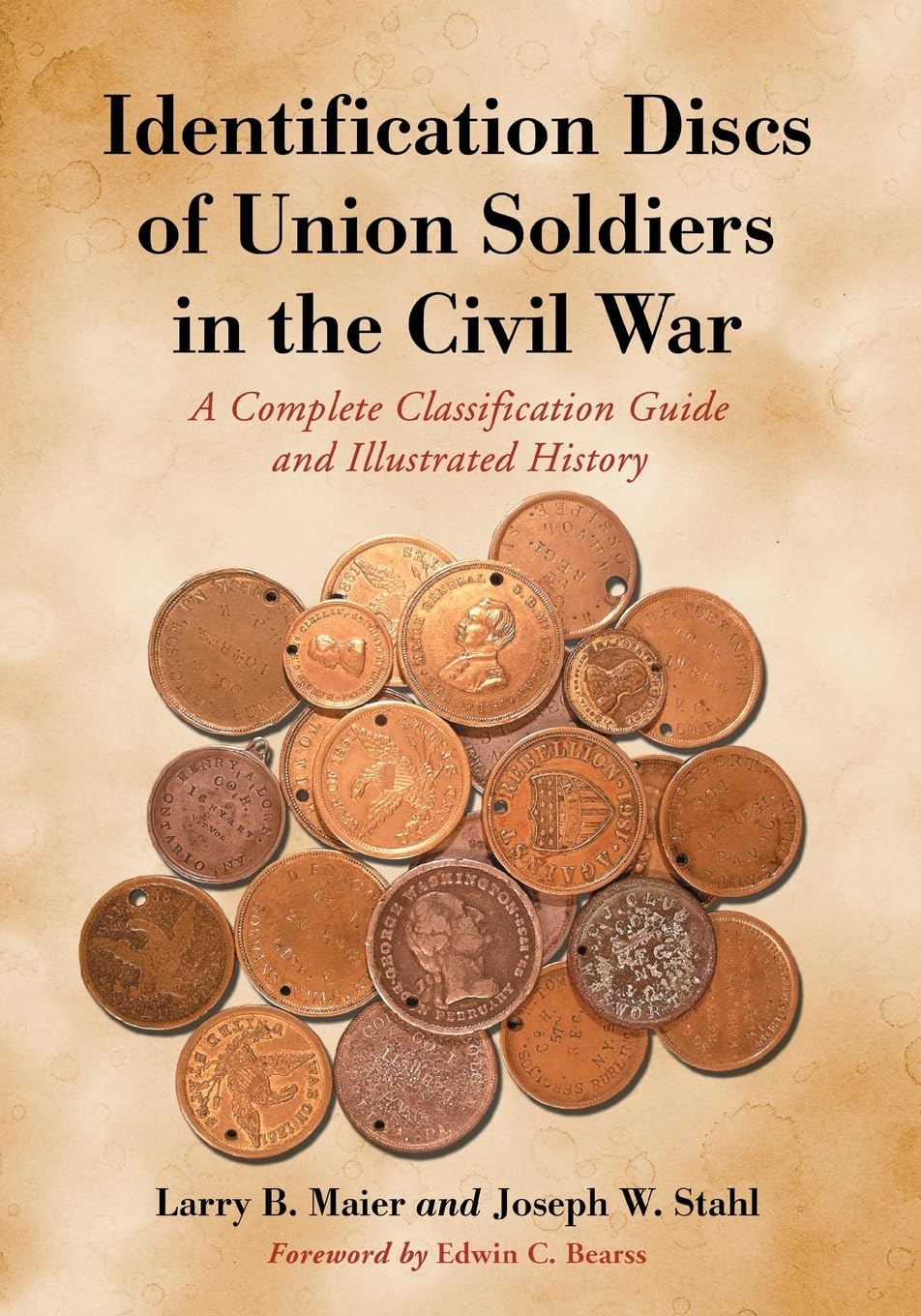
The U.S. military did not provide dog tags during the Civil War or have any formal way of tracking the status soldiers beyond roll call. Sometimes, soldiers would write their name on paper and pin it to their uniform before going into action.

Those who could afford it bought metal tags with their names so loved ones would know their fate should they die in battle.

Robinson, wearing white gloves, brought the boxed artifacts to a counter. I was familiar with two tags, having written about Pvt. Samuel M. Weigel (below) and Sgt. Nicholas G. Wilson of the 138th Pennsylvania

But I was unaware of the corroded metal disk for Mathess. One side shows an image of Union general George B. McClellan and the words “Union and Liberty.” On the reverse is stamped “E. Mathess, Co. B, 126 REG OVI.”

The three disks have not yet been displayed in the visitor center’s upstairs museum, which is closing in early December for a long-planned overhaul. "Everything is getting torn down," said Tracy Evans, chief or resource education and visitor services. The goal is to reopen the museum in April.


Evans said she expects the ID tags will be displayed on rotation once the museum reopens.

What we know about the Edward Mathess tag

Park officials believe Mathess died at Monocacy. I wonder when the Ohio private became separated from his ID tag. We’ll likely never know.

But I got a few details from Lynn Bristol, president of the Monocacy National Battlefield Foundation, a nonprofit that supports the park. The foundation purchased the disk for $1,500 in March 2023. It was described as very rare and possibly made from pewter.

The most intriguing part of the sale and packaging of the item, to me, was the word “excavated.”

Did someone dig this up on the battlefield before the park was established in 1934? Even then, many parcels had not been acquired. The Thomas Farm, near where the 126th OVI fought, wasn’t purchased until 2001, when it then gained federal protection from relic hunting.
Dealer packaging for the Mathess tag (Monocacy National Battlefield Foundation)
Cal Packard, owner of Museum Quality Americana, told the Picket in an email he doesn’t have record or notes on the Mathess tag he sold to the foundation. “As I recall, that was one of 20 or so ID (tags) that we offered from a lifetime collection.”

Joe Stahl, an ID disks collector and author on the subject, told the Picket the tags were effective in identifying a killed comrade.

In “Forty-Six Months with the Fourth R.I. Volunteers,” Cpl. George H. Allen of Company B wrote about finding a casualty at the Battle of the Crater (Petersburg) in 1864, said Stahl.

“Comrade Thomas Arnold and myself made our way out to the field in search of any dead or wounded of our company,” Allen wrote. “The dead were then unrecognizable, except by medals or letters found upon them. -- We found Augustus T. Thornton of our company --- I removed what few trinkets he had about him, and his medal, and a few days after sent them home to his father.”

Photo and ID tag of KIA Cpl. Alvin Williams of the 11th New Hampshire (Library of Congress)
It’s hard for Americans to understand the chaos of mass casualties and trauma during the Civil War.

I asked followers of the Authentic Campaigner Facebook page to explain why so men were listed as missing. Their take: Some men were taken prisoners, some wandered off in shock for some time or became stragglers, while others were obliterated by artillery fire. Others might be hospitalized or trying to escape capture.

“Keep in mind battles are confusion, and the reports are taken in the aftermath,” said one respondent. “Some men saw one thing, some saw another. And in the follow up the NCOs and officers are filling reports based usually on the men’s response to roll call. If no one came forward saying they saw x,y,z happen that soldier is ‘missing.’”

Tags were affordable, a way to leave behind a name

Stahl co-authored with Larry B. Maier the 2010 volume “Identification Discs of Union Soldiers in the Civil War.” They detailed 49 designs, including eagles and patriotic motifs, sold by vendors at camps and elsewhere.

The first thing to note, he said, is such disks were not available to Southern soldiers. Brass was too coveted and used solely in artillery and other military purposes.

Coin and token manufacturers such as Scoville could turn out discs for 5 cents to 10 cents, with a design on the front. They were probably sold to soldiers for less than 50 cents. One side was left blank so sutlers could stamp the buyer’s name and unit. A hole was typically drilled in at the bottom for a string or rawhide. Soldiers sometimes bought two; they wore one and sometimes sent one home as a love token.

Higher-end, more expensive tags made of silver were generally sold to officers. They were often engraved.

Stahl, who has about 110 ID badges, said he began collecting in the early 1980s. The items were affordable while manuscripts and signatures became expensive. 

Legendary Civil War historian Ed Bearss encouraged Stahl to submit articles about individual soldiers and disks to Gettysburg Magazine.

“When I started buying they were a couple hundred bucks.  If you can find something (today) less than $1,000 you are doing good,” said the collector. (At left, reverse of Sgt. Wilson pin at Monocacy, Picket photo)

Stahl warns buyers to be wary of counterfeits.

“The thing that is usually a dead giveaway for a modern reproduction is the fonts on the letters are incorrect.”

He mentioned the letter F as an example. While the originals have a line for the short bar of the letter, forgers might get lazy and punch a small triangle instead. Stahl’s also known of one soldier’s name appearing on tags for different regiments.

Ohio soldier's fate, family history are unknown

Besides digging deeper into ID disks, I wanted to know more about Mathess – but I did not get very far. The 1860 census lists a 25-year-old Edward Mathess from Ross County, Ohio. His occupation is listed as engineer.

Listed with him is a young woman, Notura Mathess, 17, Idia, 1, and William, a baby. I assume they were a family. The only other document I came across was an 1890 military pension request by his father, Obijah (right). I could not glean anything about these individuals.

Edward enlisted in August 1862 for a three-year term. An 1888 volume about Ohio soldiers in the “War of Rebellion” only says he was missing. “No further record found.”

I wondered: Did Edward fall on the battlefield and his remains never found? Was he buried elsewhere? Or did he somehow survive? The latter seems unlikely.

Pvt. Mathess is listed as missing at Monocacy in regimental history, with no further mention
“It is always possible that there are still partial remains on the battlefield, however the vast majority of the dead were removed from the field and buried in Mt. Olivet Cemetery here in Frederick shortly after the battle,” said Monocacy ranger Matt Borders. “The Confederate dead remain there to this day. The Federal dead were disinterred and reburied in Antietam National Cemetery in 1866/67 in time for the opening of the National Cemetery in 1867.”

Mathess does not appear in the roster of Antietam National Cemetery, so most likely he is one of the 1,400 unknowns buried there, Borders told the Picket.

Foundation bought 2 tags, photo of Confederate officer

Bristol said the foundation has purchased two tags – Weigel and Mathess -- and a CDV image of Confederate Col. William Raine Peck, who also fought at Monocacy.

Robinson said the colonel was at Monocacy with Hays’ Louisiana Brigade. “He would have been part of the main effort under Gen. John Brown Gordon's division that assaulted the Federal flank and forced a retreat.”

The image (right) was not signed.

“Given the paucity of Confederate artifacts overall, it is my humble opinion that the Peck CDV is well worth its price, quite possibly appreciating in value as time goes by,” said Bristol.

The tags and Peck photo are in the park’s collection.

“Matt Borders is a sleuth in identifying objects of interest and he has directed us toward those items. I myself am a collector of letters and prints: three letters I own are from Grant, Sherman and Lincoln, respectively,” Bristol wrote in an email.

Wilson’s ID tag was made of silver and Weigel’s made of brass. Vendors who sold these disks priced them on a sliding scale to meet a soldier’s income: Silver, brass to other/pewter, said Bristol.

Upstairs museum finally getting a refresh

The two-story visitor center at Monocacy National Battlefield opened in 2007 and the upstairs museum is due for a refresh, with enhanced technology. Park officials said the museum will  close after December 3 for several months.

One big change will be a new map of the battle and troop movements. The map "will be a projection onto a white surface. Then we don't have to worry about specialty parts breaking that are no longer made," said Evans

The park has made repairs on the feature (Picket photo, left) over the years but it is near its end of life. “We are looking into a second life for the topographic portion of the program. Other elements of the museum that involved any type of technology, which includes at least five exhibits, no longer work," said Evans.

The new map will physically be more accessible. "We are including the action at the Jug Bridge into the battle map as well,” Evans told the Picket. 

The revamped  exhibits will tell a wider story, officials said.

 “We will be focusing on both the civilians and soldiers who were here throughout the Civil War and specifically the day of the battlefield,” said Evans. “Their stories overlap and those relationships are important to the story of Monocacy, and we want to focus on more personal stories,” she said.

Robinson pointed out people were forced at act quickly when war came to Monocacy Junction. That included fleeing to a basement or cellar, hiding valuables and sending away livestock and horses.

The park also focuses on free and enslaved African-Americans whose lives and actions were integral to the battle and the Civil War as a whole. A recruiting station for the U.S. Colored Troops was established at Monocacy Junction.

Among the signature items in the museum are a bullet-struck Bible, a captured Confederate battle flag, Union Maj. Gen. Lew Wallace’s frock coat, cavalry items, an engraved musket and a frock coat worn by the 14th New Jersey’s Maj. Peter Vredernburgh Jr., who survived Monocacy but died two months later at Third Winchester.

"Certain elements, such as the tent/field office set up, and Glenn Worthington watching the battle through the boarded-up windows will be integrated back into the exhibit," said Evans.

The Monocacy visitor center is currently closed on Tuesday and Wednesday.

Friday, April 19, 2024

Andrew Banasik named next superintendent at Antietam National Battlefield

Longtime Civil War history enthusiast Andrew Banasik next month will become superintendent of Antietam National Battlefield in Maryland.

“I'm humbled to be chosen to care for such a consequential treasure of American history,” Banasik said in a news release. “I'm excited to bring my passion for caring for park staff and resources, serving our visitors and partnering for the future.” He starts May 19.

The National Park service tallies 22,720 men on both sides killed, wounded or missing/captured at the Battle of Antietam on Sept. 17, 1862, making it the bloodiest single day in U.S. history.

Banasik will move from a similar position at Monocacy National Battlefield, about 25 miles away. He has had a couple stints at that Civil War site near Frederick.

NPS regional director Kym A. Hall touts Banasik’s 25 years of park experience.

“At Monocacy, he integrated the park’s natural and cultural resources management programs, and preserved and protected historic structures, archeological sites, historic landscapes and wildlife habitat,” Hall said in the release. “He also expanded recreation opportunities by improving trails and park view sheds. I believe he will bring that tenacity and creative problem solving to his new role at Antietam.”

Banasik has also worked at Catoctin Mountain Park in Maryland and for the National Capital Region Exotic Plant Management Team.

Wednesday, February 28, 2024

Artillery Capt. William Hawley was wounded at Monocacy. The New Yorker's conserved kepi and frock coat will be part of revamped park museum in Md.

Capt. Hawley's frock coat and kepi in a 2nd-floor exhibit at Monocacy (NPS photo)
A mended kepi belonging to a New York officer wounded at Monocacy has been returned to the Maryland battlefield ahead of a planned overhaul of its museum.

Capt. William Hawley, Company E, 9th New York Heavy Artillery, was wounded in the arm on July 9, 1864. His hat and frock coat have been on display at Monocacy National Battlefield near Frederick since 2007.

Tracy Evans, acting chief or resource education and visitor services at the park, said Caring for Textiles of Washington, D.C., patched 10 small holes in the kepi's wool and reattached several open seams, including the leather trim.

At Monocacy, outnumbered Federals delayed Confederates bent on taking Washington. Union artillery did a lot to slow the Confederate advance, despite the latter having more guns. Jubal Early did not use the majority of his ordnance because he believed only militia was in his way. (Hawley's unit served as infantry at Monocacy.)

By the time Rebel troops reached the capital’s outskirts, Union reinforcements had arrived. 

Park officials say the revamped museum will tell more of the individual stories of soldiers and others. (Hawley's frock coat at left, NPS photo)

“The currently fiber-optic battle map will become a much larger map in the center of the museum that will be accessible,” Evans said in an email. “Surrounding exhibits will talk about all the people who lived on the farms, and how their stories intersect with the war and the Battle of Monocacy.

“It will also explore information about the campaign, battle, soldiers, post-battlefield hospital, (and) aftermath of the war/memorialization/effect of postwar on the people the war ultimately freed,” the ranger said.

Park officials anticipate the visitor center museum will close for renovation in September and reopen prior to Thanksgiving. 

Collector Richard Abel, in a comment on the park’s Facebook post about the kepi, said the Hawley cap and the coat were purchased from the family via an antique store in Gettysburg, Pa.

“I was always proud of this gift, to return the uniform to where it belongs, the field of battle, & to be viewed by the public,” he said. Abel donated many items, which were first kept at Gambrill Mill when it served as park headquarters.

Evans said Abel’s donations helped make up for a shortage of artifacts at the time. She added officials do not know whether Hawley wore that specific kepi and coat at Monocacy, only that he had them during the war.

Hawley was in his early 40s when he enrolled in Auburn as a lieutenant in the 138th New York Infantry in August 1862. The unit was designated as the 9th New York Heavy Artillery a few months later.

9th New York Heavy Artillery at a Washington, D.C., fort (Library of Congress)

The regiment helped defend Washington and participated in the Overland Campaign in Virginia before it fought at Monocacy, both times fighting as infantry. It served until the war’s end, suffering 461 casualties, nearly half from combat.

Hawley, who led a company, was honorably discharged in September 1864. Some newspaper accounts said his arm injury was slight, but it may have been more serious. He apparently applied for a pension in 1880 and died at age 77 in Wolcott, N.Y.,  in 1897, according to findagrave.com.

Evans says Hawley’s coat, featuring red shoulder boards and artillery buttons, is in very good condition. “The conservator created some padding to add to the mannequin to ensure the shoulders did not sag.”

While he was a captain at Monocacy, Hawley's shoulder bars are those for a lieutenant.

The coat was "rested" from the effects of light in spring 2020. "In the new museum, the frock coats will be rotated so that they have some rest from the mannequins and light," Evans said. 

At Monocacy, Union Maj. Gen. Lew Wallace’s troops used his limited artillery and the terrain to their advantage, says park ranger Matt Borders.

“Deployed along the ridge south of the Monocacy River, these cannons had a wonderful field of fire and high ground from which to engage. The scattered deployment of the artillery also gave the impression of more cannons than there actually were or the possibility that the ridge hid more cannons,” he says.

Ranger Evans adds curatorial stuffing to arm of frock coat  (NPS photo)
The cautious Confederates were targeted by an effective 24-pound smoothbore howitzer. Early’s cavalry looked for other crossing options at Worthington Ford on the Monocacy River.

“As Confederate forces got south of the river, more of the Federal artillery was shifted to the left of their line; eventually five of the six rifled artillery pieces were deployed on the rising ground near Thomas Farm to engage Confederate infantry and some of their artillery support,” Borders wrote in an email.

“It was the presence of these cannon that helped hold the Federal flank until 4 p.m., at which point they had used all their long-range ordnance and were compelled to retire. The Federal infantry stayed in line from 4ish to 5 p.m. in large part to make sure their artillery can successfully withdraw from the field."

All the while, Confederate artillery, which had been pushed forward into the very front yard of Best Farm, was firing across the Monocacy River enfilading the Federal line.

"Hawley and his men were some of the troops holding the line as the Federal artillery withdrew and were eating that enfilading fire coming from across the Monocacy River," said Borders.

This fire, along with an infantry attack against that same flank, eventually unhinged the Federal position, forcing it to give way around 5 p.m.“

Tuesday, March 23, 2021

Maryland resident given a live cannonball found near Monocacy battlefield calls the bomb squad

Cannonball before its disposal (Maryland State Fire Marshal)
A live Civil War cannonball found near Maryland’s Monocacy battlefield was disposed of after a homeowner who was given the ordnance became alarmed and called authorities.

The office of the Maryland State Fire Marshal on Tuesday said it got the call a day earlier from a homeowner in Jefferson in Frederick County.

The homeowner was given the cannonball by a family member who had found it near the site of the 1864 battle. Another family member told the resident that it could be live. Bomb technicians determined the fuse was intact, removed the artifact and conducted an emergency disposal, officials said.

“As proven today, the finding of military ordnance from the Civil War is not uncommon in Maryland, and these devices pose the same threat as the day they were initially manufactured,” the office said in a Facebook post.

Oliver Alkire, senior deputy state fire marshal, told the Frederick-News Post that the homeowner’s relative was using a metal detector near Monocacy National Battlefield, which does not permit them. No charges are expected, because the cannonball was found outside the park.

The cannonball was at the home for several months, Alkire told the newspaper, which indicated the round was blown up. "It would have caused significant damage" if it went off.

“If you should uncover or are unsure if an unidentified object may be military ordnance, be safe rather than sorry. Stay away and call 911,” said State Fire Marshal Brian S. Geraci.  “Marylanders need to be mindful that military ordnance, even vintage artifacts from previous conflicts, have the potential to explode.”

The fire marshal’s office did not specify what kind of shell was found. Some on social media lamented that the shell had not been defused by authorities and saved, but others said it may have been unstable and there are plenty of safe shells housed in museums and historic sites.

Wednesday, July 10, 2019

"It saved instant death": Bible struck by bullet during 1864 fighting is on display at Monocacy battlefield in Maryland

(Tracy Evans, Monocacy National Battlefield)
(Courtesy of Perry Adams Antiques)

A Confederate-issued Bible is on display at Monocacy National Battlefield in Maryland, where visitors can learn about the bullet that passed through it and wounded a Virginia soldier.

Pvt. Thomas Cox, a member of the Red House Volunteers, Company A, 21st Virginia Infantry, was captured after on July 9, 1864, at the battlefield near Frederick, Md. He was fighting near the Thomas farm when he was wounded.

The 33-year-old farmer from Carroll County died on Aug. 15 at a Baltimore hospital. 

Tracy Evans, curator and park ranger at Monocacy, said this is the first time the Bible has formally been on display. The exhibit was opened in May and the volume is expected to be out for a few more months.

The small Bible is closed, but visitors can see a photograph of it when opened and read some messages that were written on its pages.

“It’s not completely falling apart but to display it open could potentially cause it to,” said Evans. “If we turn it to a certain page the binding is fragile and you don’t want to tear loose the binding.”

Bible includes handwritten notations (Courtesy of Perry Adams Antiques)

The Bible is remarkable in its own way. There’s a gaping hole in the center of the book left by the bullet. “We are thinking it must have gone in sideways,” Evans previously told the Picket, adding that is perhaps the reason Cox was not killed outright.

Cox asked a fellow prisoner at the squalid West Building’s Hospital in Baltimore to inscribe a message in his battered Bible.

“The ball that struck this book entered my left brest (sic) and came out of right – it saved instant death & will be the means of saving my soul. Thomas Cox,” reads the penciled writing on the margins of a few pages. On succeeding pages is written: “Blessed are the dead that die in the Lord.”

(Monocacy National Battlefield)
In 2015, the park purchased the New Testament for $12,500 from brokers Perry Adams Antiques in Petersburg, Va. Attempts to find a Cox descendant have been unsuccessful, Evans told the Picket.

The park said the Bible is among the few items in its collection to have known Confederate provenance.

Cox said a conservationist examined the Bible and said it was best to keep it as is.

“It is a unique item,” she said. “I think people are interested in it because it has entries in it.”

Friday, August 25, 2017

Man donated Civil War artifacts to Monocacy battlefield. He called police about one rejected item. It turned out to be a live shell

Park was able to keep these artillery rounds, bullets (NPS)

A middle-aged man who lived within several miles of Monocacy National Battlefield near Frederick, Md., called rangers earlier this week. He had a box of artifacts that had been collecting dust for years and he wanted the park to have it.

The staff, interested in using Civil War items to educate visitors – even if they had no firm connection to the 1864 battle – met with him Tuesday and looked at the “very nice collection,” said curator Tracy Evans.

There were a cartridge box, breastplate, belt buckle, canteen, bullets, a cap box, two solid-shot shells -- and one more artillery round that got their attention.

Replica 10-pound Parrott gun (Charles Edward/wikipedia)

They could see the fuse for the 10-pound Parrott rifle shell had been removed, but because of rust and corrosion, they could not tell whether the round had gunpowder. “You are looking for evidence of a hole where it had been drilled (to remove the powder),” said Evans. “That’s when we said we were not sure if it was live or not.”

They told the man they could not accept it. The alarmed collector left and within minutes called police from the parking lot, setting in motion the 90-minute closing of the visitor center and the summoning of a state police bomb squad that detonated the round in a nearby field, Evans told the Picket on Friday.

The technicians used a small amount of C-4 explosives to bust the Parrott shell open.

“The C4 actually ignited the powder that was in it. It was live,” said Evans. Inside the cylindrical  shell was case shot with black powder.

Federal cartridge box among donation (NPS)

Park officials said they believed this was the first time a piece of live munitions had been brought by a layman to this particular National Park Service property.

The Office of the State Fire Marshal told the Frederick News-Post that there is always the potential for a citizen in historic areas of the state to find such an item.

“All the time we hear about someone saying I got this from my great-grandfather and this was in the house when I bought it,” said Evans. Park officials are advising people to be aware of the potential for problems with such ammunition.

A collector may think the round is solid shot, without black powder. “It can be very dangerous,” she said.

Police or other agencies almost always destroy artillery rounds when they get a call. The park's Facebook post about the incident drew many comments critical of the detonation, saying it was a waste of an artifact. The staff had this reply:

“As powder gets older it becomes more unstable. There is no way to know if it would never be a danger or explode even under the best conditions. Considering the lives of staff and visitors as well as the artifacts we house, it is our policy no to accept live projectiles. It is up to the owner to decide if they want to keep or dispose of it.”

Canteen will be shown for educational purposes (NPS)

Evans said the donor was “a very nice guy” who later told them “he always kind of wondered” about the shell’s status.

The park is keeping the rest of the items, including the solid shots. “To have … an actual historic piece really brings it to life to people,” Evans said.

The episode could have even more of a disruption if it occurred one day earlier. About 1,000 people were at the park and visitor center for the total solar eclipse.

Note: The Picket was unable to obtain a photo of the detonated shell

Sunday, October 2, 2016

Monocacy learns more about fallen Rebel soldier and the Bible that took a bullet

(Courtesy of Perry Adams Antiques)

Park rangers at Monocacy National Battlefield have seen success and setbacks in their bid to learn more about the life and death of a Confederate soldier wounded when a bullet passed through his Bible and went through his chest.

Pvt. Thomas Cox, a member of the Red House Volunteers, Company A, 21st Virginia Infantry, was wounded and captured on July 9, 1864, at the battlefield near Frederick, Md. The 33-year-old farmer from Carroll County died on Aug. 15, 1864, at a Baltimore hospital.

A park intern conducting research this past summer learned that Baltimore hospital records had been damaged or destroyed, possibly in a fire, curator Tracy Evans told the Picket.

What is known about Cox’ final weeks was that he asked a fellow prisoner at the squalid West Building’s Hospital to inscribe a message in his battered Bible.

“The ball that struck this book entered my left brest (sic) and came out of right – it saved instant death & will be the means of saving my soul. Thomas Cox,” reads the penciled writing on the margins of a few pages. On succeeding pages is written: “Blessed are the dead that die in the Lord.”

In 2015, the park purchased the New Testament from $12,500 for brokers in Petersburg, Va.

The park intern learned that Cox and his wife had two children before the war and one on the way when he enlisted in 1861. The soldier was able to return to his farm several times during the war and fathered two more children. He recuperated from two illnesses at home while on medical leave.

(Courtesy of Perry Adams Antiques)

The 21st Virginia had seen considerable action, including at Gettysburg, before the fight at Monocacy.

“After the men forded the Monocacy River, they formed up in battle line and assaulted the Union line. 5 According to Sgt. John Worsham, the men in the 21st tore down a fence railing and with the years of hardened experience behind them, rushed forward in a charge against Union positions without orders from their officers. Somewhere in this rush and exchanging volleys of fire, Private Cox was struck by a bullet,” intern Chris Sniezek and ranger Kelly Henderson wrote.

Cox died five weeks later of infection and was buried in Baltimore, where he remains buried.

Evans said the research led to emails to potential descendants, but officials have not heard back. They did learn from research of a relative in the Confederate unit that Cox’ widow remarried and was believed to have additional children.

The bullet-struck Bible is remarkable in its own way. There’s a gaping hole in the center of the book. “We are thinking it must have gone in sideways,” said Evans, adding that is perhaps the reason Cox was not killed outright.

Officials want to display the Bible next year, but they know it likely can hold up only to certain lighting conditions, and perhaps for brief periods of exposure. They are looking for more information on Cox and other soldiers whose names and information were written on the Bible’s pages. There is no known photo of the soldier.

“The Bible itself has been given an initial condition assessment and will likely go for light preservation next year with recommendations on how it should be put on display and for how long,” said Evans. “We would also like to have a better analysis done of possible blood on the Bible.” She cautioned there is no evidence of blood, but officials are curious as to whether small traces remain on the pages.

(Perry Adams Antiques)

Conservation experts at the National Park Service’s Harpers Ferry Center also will give advice on mounting of the Bible and whether it should be displayed opened or closed.

In an article prepared for an upcoming issue of Civil War News, the park researchers also delved into the story of the Bible’s publication. This one was published in 1862 by Wood, Hanletter, Rice and Company of Atlanta.

“Prior to the Civil War, Bibles were mostly printed and distributed by the American Bible Society based in New York. When the war broke out, the American Bible Society decided to continue distributing Bibles to Confederate soldiers, but a Union blockade soon left the South in a severe shortage. Faced with this shortage, the Confederate States Bible Society was established to print and distribute new Confederate Bibles.”

The dying Cox got the writing assistance from Pvt. H.S. Shepherd, a Confederate who was captured at Gettysburg in July 1863 and assisted sick comrades while serving as a ward master at the Baltimore hospital.

“I was with Thos. Cox when he died,” Shepherd wrote in the Bible. “He was willing … & appear ready to leave this world for a better one to come."

Another inscription indicates Cox asked that his ring be sent to his widow, Frances.