Showing posts with label missing. Show all posts

Thursday, May 8, 2025

Veterans of the 7th Georgia Infantry wanted people to know the specific positions they held at Bull Run. They traveled north to place seven markers and remember fallen comrades. You can learn about their effort at a park exhibit closing soon

7th Georgia veterans at an 1897 reunion in Marietta (Georgia Archives), fragment of second position marker, pins showing locations of Manassas markers, and a surviving marker at Ricketts' battery (Picket photos)
The graying veterans of the 7th Georgia Infantry Regiment – whether convening at a restaurant, saloon or the battlefield – savored snatches of humor amid the serious business of remembering the dead and shared experiences that bonded them for life.

Newspaper articles in Atlanta and Marietta from the early 1870s into the first decade of the 20th century contained long, florid prose about reunions. Many anecdotes referred to what was on the dinner table.

“Boys, you eat like you did in the army!” former Col. Lucius Gartrell said of a meal featuring fried salmon, trout, deviled crabs, spring chicken, sirloin and cakes.

These lines about a dinner -- as recorded in minutes of the regiment’s 1905 meeting in Groveton, Va. -- likely brought a chuckle:

“There is a charge to be made but not on a battery. There are tables heavily laden with all manner of good things and true to our record we charged, captured and held the fort.”

So it is no surprise the veterans' 1905 visit to the First Manassas (Bull Run) battle in Virginia, where the regiment first spilled and drew blood, promised “a grand and pleasant time and a series of interesting festivities,” according to the Marietta Journal.

Their trip by train was noteworthy for what the warriors planned to do: place six markers indicating where they were positioned during the July 1861 battle and another stone for a position at Second Manassas in August 1862. Other stops during the summer trip included Alexandria, Va., Washington, D.C., Fredericksburg, Richmond and Petersburg.

“We promise a grand and pleasant time and a series of interesting festivities,” the veterans association said, according to the article.

Since that visit, the marble markers fell victim to time, vandals and – possibly – a highway widening, with only two still on the field today, one of them rarely seen by visitors.

An exhibit at Manassas National Battlefield Park, installed in late 2022, contains pieces of two markers and describes the fate of all seven. But you better hurry if you want to see them. The exhibit's two markers are expected to be rotated out on May 21, placed in storage and made available for research by appointment. 

Fragment came 'home' years after it vanished

I learned about the 7th Georgia markers when I read a park Facebook post in March 2022 describing the return of a chunk from the “second position” marker to the Manassas battlefield.

How the top portion landed at the Country Day School in the upscale Langley neighborhood of McLean – about 45 miles away near the CIA headquarters – remains a mystery.

The son of the school’s director in the 1970s found it while doing construction work on an old barn on the school property. A 1990s Washington Post article about Langley includes a photograph of director Dorothy McCormick holding the stone, described as a tombstone. 

McCormick believed it to be a tombstone for a Georgia boy and it was an indication of the area's historical significance, she told the Post. She kept it on a hearth.

It wasn’t a grave marker, says Manassas National Battlefield Park museum specialist Jim Burgess, who documented the 7th Georgia position markers and tried to get this one donated to the park 30 years ago after he learned of its discovery. He had no success at the time, given the park had no legal claim because the stone disappeared before the park was established in 1940. 

McCormick kept the stone, apparently for sentimental reasons.

When the director died in 2018, her children sold her home to the school and left the artifact behind. In February 2022, the federal park got a phone call indicating the school’s desire to see the stone back at Manassas.

Burgess believes the lower half of the marker may be the gray stone in the middle of a fireplace, which was built by a farmer on what is now park property.

Jim Burgess points out the grayer stone in a park fireplace (Picket photo)
I stopped by the park last summer to meet with Burgess about the exhibit. He kindly showed me one of the surviving markers and drove me to the fireplace/grill to see the item for myself. It stands out a bit from the other stones and you can readily see how it might match up with the returned piece.

Burgess’ passion about the 7th Georgia markers is likely matched only by a retired Army lieutenant colonel who served in Vietnam and the 173rd Airborne Brigade.

He first saw these markers while a young man

To say Henry W. Persons Jr. of Severn, Md., is serious about chronicling the service of the 7th Georgia Infantry and its brigade wouldn’t quite capture the scope of his passion.

Henry W. Persons Jr. provided this photo of he and his impressive documents 
“I finished my chapter on the battle of Manassas several years ago. It is 214 pages double-spaced with 1,427 footnotes,” he told the Picket.

Persons, 80, has known Burgess for more than 20 years, and they have exchanged notes about the regiment and position markers. The ranger read Persons’ chapter and made some suggestions.

Persons first encountered the 7th Georgia position markers while walking to Henry Hill in the early 1960s with his father. He later came across what is called the “hidden” marker, which is deep in the woods and rarely seen by park visitors.

The researcher’s passion – perhaps obsession – was a big help to me as I researched this piece. He provided by email numerous newspaper articles, a roster and minutes of meetings held by the regiment’s veterans.

“I have 80 boxes filled with catalog material on Anderson’s brigade,” Persons said.

Brig. Gen. George Thomas “Tige” Anderson (left) was not in command of the brigade at First Manassas but he led it from early 1862 until war’s end.

Regiment suffered big casualties on a big day

The 7th was mustered into Confederate service in late May 1861. Most of the regiment’s soldiers were from Coweta, Paulding, DeKalb, Franklin, Fulton, Heard and Cobb counties in northern Georgia.

The unit was rushed to Virginia and saw heavy combat at Manassas on July 21, 1861, the first major battle in the Eastern Theater. (Sign at park, Picket photo)

Brigade commander Col. Francis S. Bartow was killed while leading his men against Federal Capt. James B. Ricketts’ battery on Henry Hill during a pivotal moment in the fighting. “One of their men is the first to jump up on the cannon,” said Persons.

The battle swung to the Confederates’ favor late in the day for a victory that left Union forces fleeing to Washington and dashing any hopes on either side for a quick war.

The 7th Georgia suffered a staggering 153 casualties out of 580 men present, according to American Battlefield Trust.

Persons had an ancestor, Aaron Wellborn (Welborn) Mashburn (right), who served with Company E, 7th Georgia, as a teamster and cook.

“I believe he did participate in First Manassas but that is supposition. My dad didn’t know.”

Persons, who was born in Atlanta, said learning about Mashburn led him to delve deeper into the regiment and brigade, which saw action in numerous, battles including Antietam and Gettysburg. His great-great-grandfather apparently was taken prisoner for a time, but was released and served until the Confederate surrender at Appomattox. He died in 1924 at age 81.

“I was curious what he experienced, having been in war myself.”

Researcher has left no stone unturned

After his 25 years of active duty, the officer retired in Maryland and worked as a civilian for the Army. Research was not new to him, having studied underground operations for Special Forces. He lives south of Baltimore and near Fort Meade.

Persons’ research over the years took him to Emory University on Atlanta, the University of Georgia in Athens and the Georgia Archives, among other institutions. (7th Georgia meeting minutes left, click to enlarge

Much of what he found at libraries was on microfilm (He has not conducted research in recent years).

He keeps reams of research and writing about Anderson’s brigade in Hollinger boxes.

“My annotated bibliographies for the brigade and each regiment, battalion and artillery company that was assigned to the brigade numbers some 1,200 single-spaced pages.  It is a wealth of information pertaining to the brigade, its actions and men,” said Persons, who has given several hundreds of pages to the Manassas park archives.

He’d like to see all of this published someday.

'Watching the clouds of dust rising'

I turned to the newspaper articles Persons sent me to gain some insight to the 7th Georgia veterans and why they got together.

An 1871 reunion included toasts to fallen and current members. “Several hours were passed in recalling the incidents of the war in which they each had taken a part, many of them amusing, many sad, and all of them interesting.”

The men paid tribute to Col. William T. Wilson, who fell at Second Manassas. ”He was the favorite of the regiment, and never will they forget his cheery shouts and words of encouragement to ‘my boys’ as they and he were seeking the thickest of the fights,” recorded the Atlanta Daily Sun.(At right, Burgess in front of exhibit, Picket photo)

An 1885 article recounted details from an evening at an Atlanta saloon.

“Most of them were men considerably past the meridian of life, but a franker, merrier set of men could not be found. There was something of the ring of the camp in their tones and the affectionate pride with which they alluded to their old regiment was as fresh as if they had just been through a campaign.”

The regiment’s flag flew over the dinner. Its words: “Repel the Invader.” The 7th Georgia veterans, wives and families made at least two trips to Manassas, in 1902 and 1905. (Below, what's left of the "Third Position" marker, Picket photo)

I will leave you with these passages from two unattributed and undated articles about their 1902 journey.

The Seventh Georgia veterans are here, the guests of Lee camp until tomorrow night, when they board their special for Fredericksburg. The grim old fellows spent the day tramping over battle fields of Manassas and along Bull Run, and a more tired or hungry party of southerners have not stopped off here in many a day. Lee camp and the ladies' auxiliary fixed them up a substantial and dainty repast at their hall, and will provide them with accommodation and interest them in a way that they will remember old Alexandria and her hospitality the balance of their days.”

And this one:

“Just forty one years ago to-day, many of you were standing with me near this spot listening to the rumbling of cannon and caisson on the Centreville pike and watching the clouds of dust rising from the confident tread of advancing thousands, followed by vehicles of different kinds, filled with spectators of both sexes, who had driven from Washington to enjoy the fun of seeing the Rebels run. A few hours later far greater clouds of dust could be seen caused by the furious retreat of these same parties to Washington.”

(Below, a map shows the location of all seven markers)

Wednesday, November 20, 2024

This ID tag belonged to a Ohio private who likely died at Monocacy. The battlefield in Maryland will display 3 disks on a rotating basis after its museum overhaul

The Edward Mathess tag (NPS) and ranger Matt Borders with photo of Gen. Wallace
In early July 1864, the 126th Ohio Volunteer Infantry and other regiments were rushed from Petersburg, Va., to Baltimore and then Frederick, Md., in a desperate attempt to blunt Confederate Lt. Gen. Jubal Early’s move on Washington, D.C.

The 126th OVI, part of Ricketts’ Division, subsequently put up a furious fight on July 9 at Monocacy, repelling at least one attack in the heart of the battle. The outnumbered Federal army, under the command of Maj. Gen. Lew Wallace, eventually was pushed off the field, albeit buying time for more reinforcements to reach and save the nation’s capital.

Among the scores of 126th OVI casualties was Pvt. Edward Mathess, Company B, listed as missing in a newspaper article and in the regimental history. (The 126th was formed in Belmont County in September 1862)

I learned about Mathess this past summer during a visit to Monocacy National Battlefield, a beautiful park set among western Maryland farms and a busy highway. There, I asked the staff (curator Brian Robinson, left, Picket photo) to show me identification badges that belonged to soldiers who fought there.

The U.S. military did not provide dog tags during the Civil War or have any formal way of tracking the status soldiers beyond roll call. Sometimes, soldiers would write their name on paper and pin it to their uniform before going into action.

Those who could afford it bought metal tags with their names so loved ones would know their fate should they die in battle.

Robinson, wearing white gloves, brought the boxed artifacts to a counter. I was familiar with two tags, having written about Pvt. Samuel M. Weigel (below) and Sgt. Nicholas G. Wilson of the 138th Pennsylvania

But I was unaware of the corroded metal disk for Mathess. One side shows an image of Union general George B. McClellan and the words “Union and Liberty.” On the reverse is stamped “E. Mathess, Co. B, 126 REG OVI.”

The three disks have not yet been displayed in the visitor center’s upstairs museum, which is closing in early December for a long-planned overhaul. "Everything is getting torn down," said Tracy Evans, chief or resource education and visitor services. The goal is to reopen the museum in April.


Evans said she expects the ID tags will be displayed on rotation once the museum reopens.

What we know about the Edward Mathess tag

Park officials believe Mathess died at Monocacy. I wonder when the Ohio private became separated from his ID tag. We’ll likely never know.

But I got a few details from Lynn Bristol, president of the Monocacy National Battlefield Foundation, a nonprofit that supports the park. The foundation purchased the disk for $1,500 in March 2023. It was described as very rare and possibly made from pewter.

The most intriguing part of the sale and packaging of the item, to me, was the word “excavated.”

Did someone dig this up on the battlefield before the park was established in 1934? Even then, many parcels had not been acquired. The Thomas Farm, near where the 126th OVI fought, wasn’t purchased until 2001, when it then gained federal protection from relic hunting.
Dealer packaging for the Mathess tag (Monocacy National Battlefield Foundation)
Cal Packard, owner of Museum Quality Americana, told the Picket in an email he doesn’t have record or notes on the Mathess tag he sold to the foundation. “As I recall, that was one of 20 or so ID (tags) that we offered from a lifetime collection.”

Joe Stahl, an ID disks collector and author on the subject, told the Picket the tags were effective in identifying a killed comrade.

In “Forty-Six Months with the Fourth R.I. Volunteers,” Cpl. George H. Allen of Company B wrote about finding a casualty at the Battle of the Crater (Petersburg) in 1864, said Stahl.

Comrade Thomas Arnold and myself made our way out to the field in search of any dead or wounded of our company,” Allen wrote. “The dead were then unrecognizable, except by medals or letters found upon them. -- We found Augustus T. Thornton of our company --- I removed what few trinkets he had about him, and his medal, and a few days after sent them home to his father.”

Photo and ID tag of KIA Cpl. Alvin Williams of the 11th New Hampshire (Library of Congress)
It’s hard for Americans to understand the chaos of mass casualties and trauma during the Civil War.

I asked followers of the Authentic Campaigner Facebook page to explain why so men were listed as missing. Their take: Some men were taken prisoners, some wandered off in shock for some time or became stragglers, while others were obliterated by artillery fire. Others might be hospitalized or trying to escape capture.

“Keep in mind battles are confusion, and the reports are taken in the aftermath,” said one respondent. “Some men saw one thing, some saw another. And in the follow up the NCOs and officers are filling reports based usually on the men’s response to roll call. If no one came forward saying they saw x,y,z happen that soldier is ‘missing.’”

Tags were affordable, a way to leave behind a name

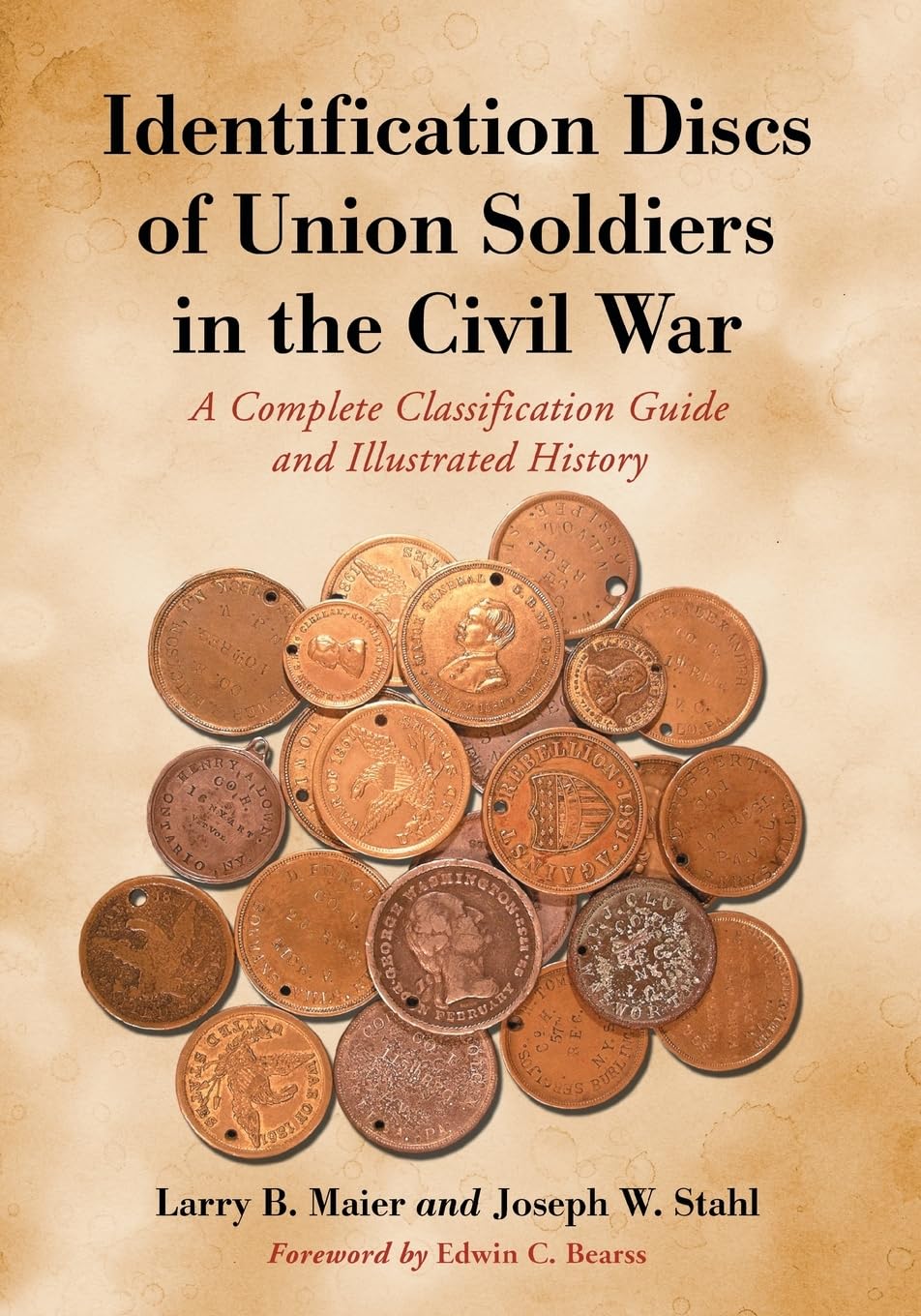
Stahl co-authored with Larry B. Maier the 2010 volume “Identification Discs of Union Soldiers in the Civil War.” They detailed 49 designs, including eagles and patriotic motifs, sold by vendors at camps and elsewhere.

The first thing to note, he said, is such disks were not available to Southern soldiers. Brass was too coveted and used solely in artillery and other military purposes.

Coin and token manufacturers such as Scoville could turn out discs for 5 cents to 10 cents, with a design on the front. They were probably sold to soldiers for less than 50 cents. One side was left blank so sutlers could stamp the buyer’s name and unit. A hole was typically drilled in at the bottom for a string or rawhide. Soldiers sometimes bought two; they wore one and sometimes sent one home as a love token.

Higher-end, more expensive tags made of silver were generally sold to officers. They were often engraved.

Stahl, who has about 110 ID badges, said he began collecting in the early 1980s. The items were affordable while manuscripts and signatures became expensive. 

Legendary Civil War historian Ed Bearss encouraged Stahl to submit articles about individual soldiers and disks to Gettysburg Magazine.

“When I started buying they were a couple hundred bucks.  If you can find something (today) less than $1,000 you are doing good,” said the collector. (At left, reverse of Sgt. Wilson pin at Monocacy, Picket photo)

Stahl warns buyers to be wary of counterfeits.

“The thing that is usually a dead giveaway for a modern reproduction is the fonts on the letters are incorrect.”

He mentioned the letter F as an example. While the originals have a line for the short bar of the letter, forgers might get lazy and punch a small triangle instead. Stahl’s also known of one soldier’s name appearing on tags for different regiments.

Ohio soldier's fate, family history are unknown

Besides digging deeper into ID disks, I wanted to know more about Mathess – but I did not get very far. The 1860 census lists a 25-year-old Edward Mathess from Ross County, Ohio. His occupation is listed as engineer.

Listed with him is a young woman, Notura Mathess, 17, Idia, 1, and William, a baby. I assume they were a family. The only other document I came across was an 1890 military pension request by his father, Obijah (right). I could not glean anything about these individuals.

Edward enlisted in August 1862 for a three-year term. An 1888 volume about Ohio soldiers in the “War of Rebellion” only says he was missing. “No further record found.”

I wondered: Did Edward fall on the battlefield and his remains never found? Was he buried elsewhere? Or did he somehow survive? The latter seems unlikely.

Pvt. Mathess is listed as missing at Monocacy in regimental history, with no further mention
“It is always possible that there are still partial remains on the battlefield, however the vast majority of the dead were removed from the field and buried in Mt. Olivet Cemetery here in Frederick shortly after the battle,” said Monocacy ranger Matt Borders. “The Confederate dead remain there to this day. The Federal dead were disinterred and reburied in Antietam National Cemetery in 1866/67 in time for the opening of the National Cemetery in 1867.”

Mathess does not appear in the roster of Antietam National Cemetery, so most likely he is one of the 1,400 unknowns buried there, Borders told the Picket.

Foundation bought 2 tags, photo of Confederate officer

Bristol said the foundation has purchased two tags – Weigel and Mathess -- and a CDV image of Confederate Col. William Raine Peck, who also fought at Monocacy.

Robinson said the colonel was at Monocacy with Hays’ Louisiana Brigade. “He would have been part of the main effort under Gen. John Brown Gordon's division that assaulted the Federal flank and forced a retreat.”

The image (right) was not signed.

“Given the paucity of Confederate artifacts overall, it is my humble opinion that the Peck CDV is well worth its price, quite possibly appreciating in value as time goes by,” said Bristol.

The tags and Peck photo are in the park’s collection.

“Matt Borders is a sleuth in identifying objects of interest and he has directed us toward those items. I myself am a collector of letters and prints: three letters I own are from Grant, Sherman and Lincoln, respectively,” Bristol wrote in an email.

Wilson’s ID tag was made of silver and Weigel’s made of brass. Vendors who sold these disks priced them on a sliding scale to meet a soldier’s income: Silver, brass to other/pewter, said Bristol.

Upstairs museum finally getting a refresh

The two-story visitor center at Monocacy National Battlefield opened in 2007 and the upstairs museum is due for a refresh, with enhanced technology. Park officials said the museum will  close after December 3 for several months.

One big change will be a new map of the battle and troop movements. The map "will be a projection onto a white surface. Then we don't have to worry about specialty parts breaking that are no longer made," said Evans

The park has made repairs on the feature (Picket photo, left) over the years but it is near its end of life. “We are looking into a second life for the topographic portion of the program. Other elements of the museum that involved any type of technology, which includes at least five exhibits, no longer work," said Evans.

The new map will physically be more accessible. "We are including the action at the Jug Bridge into the battle map as well,” Evans told the Picket. 

The revamped  exhibits will tell a wider story, officials said.

 “We will be focusing on both the civilians and soldiers who were here throughout the Civil War and specifically the day of the battlefield,” said Evans. “Their stories overlap and those relationships are important to the story of Monocacy, and we want to focus on more personal stories,” she said.

Robinson pointed out people were forced at act quickly when war came to Monocacy Junction. That included fleeing to a basement or cellar, hiding valuables and sending away livestock and horses.

The park also focuses on free and enslaved African-Americans whose lives and actions were integral to the battle and the Civil War as a whole. A recruiting station for the U.S. Colored Troops was established at Monocacy Junction.

Among the signature items in the museum are a bullet-struck Bible, a captured Confederate battle flag, Union Maj. Gen. Lew Wallace’s frock coat, cavalry items, an engraved musket and a frock coat worn by the 14th New Jersey’s Maj. Peter Vredernburgh Jr., who survived Monocacy but died two months later at Third Winchester.

"Certain elements, such as the tent/field office set up, and Glenn Worthington watching the battle through the boarded-up windows will be integrated back into the exhibit," said Evans.

The Monocacy visitor center is currently closed on Tuesday and Wednesday.

Sunday, August 6, 2017

Peoria monument: Lost? Thrown away?

A team of history enthusiasts in central Illinois is hunting for a Civil War memorial that went missing more than half a century ago. Peoria's Civil War monument was taken down during a construction project, but it was never returned, the Journal Star reported. Local historian Norman Kelly, a group member who has written about the disappearance, said he believes the monument "wasn't lost, it was thrown away." • Article