Showing posts with label bull run. Show all posts

Thursday, August 21, 2025

New park exhibits: Yankee cavalry wasn't much of a factor at First Manassas, but they rode to the rescue, literally, there a year later. It was a wild clash at Portici

Exhibit on fight at Portici, revolver holster for 6th Virginia trooper (NPS), Gens. Buford and Stuart
Ten months before he famously slowed the Confederate advance and secured high ground at Gettysburg, Brig. Gen. John Buford showed similar mettle at Second Manassas.

On Aug. 30, 1862, His outnumbered cavalry brigade protected the Federal retreat by boldly attacking Rebel troopers and slowing their pursuit. Buford’s defense was a bright spot on a day full of disaster for the men in blue.

The clash at Portici, a slaveholding plantation, was the largest cavalry engagement of the Civil War up to that point, to be eclipsed by Brandy Station nine months later.

Manassas National Battlefield Park has two new temporary exhibits marking the service of cavalry at First and Second Manassas. 

Museum specialist Jim Burgess said the case in the visitor center lobby features cavalry arms and equipment (Richmond Sharps rifle, M1860 light cavalry saber, M1860 Colt army revolver, picket pin, spurs, etc.) with brief descriptions of the cavalry action in both battles. (NPS photo below)


An exhibit in the main museum gallery provides more details about the fighting at Portici. The home served as the Confederate headquarters and a hospital at First Manassas in July 1861.

The National Park Service provides these details on the latter:

“Portici’s kitchen and hallways became operating rooms. The wounded, dead, and dying littered the floors throughout the house. Medical supplies and skilled personnel were scarce. Throughout the night of the 21st, the work of the surgeon’s saw transformed Portici from a stately manor into a charnel house.”

At Second Manassas (Bull Run), action at  Portici came late in the day. A park marker says this of the clash between Southern horsemen trying to cut off the Union escape and Buford’s force deployed at Lewis Ford on Bull Run:

“The opposing lines crashed together head-on in the nearby fields. Buford's troopers initially surprised and routed the leading Confederate regiment, only to fall back when the balance of General Beverly Robertson's brigade appeared. In danger of being cut off, the outnumbered Federals hastened across Bull Run. The Confederates broke off pursuit short of the Warrenton Turnpike.”

The scene must have been amazing and awful, with dying horses rolling in the dirt as wounded men tried to get away on foot. Buford suffered a wound to the knee.

Robertson’s brigade served in Maj. Gen. J.E.B. Stuart’s cavalry division.

I recently asked Burgess (right) to provide details on the two exhibits, Portici and other cavalry action in both battles. His responses have been edited for brevity and context.

Q. Were all these items at either of the battles, or representative?

A. Most of the displayed objects are representative. Only one of the displayed items can be traced back to its original owner. The revolver holster (photo at top) is marked on its flap, "C.H.S./Co. D/6th Va. Cav."  C.H.S. is Pvt. Charles H. Smith.

The 6th Virginia Cavalry was part of Beverly Robertson's (left) brigade, which saw action at Portici on the evening of Aug. 30, 1862. This item was among a collection of items donated to the park by Robert Lewis, a former owner of Portici, in 1942. How he got it is not known. 

The Confederate Sharps carbine and one of the spurs also came from the Robert Lewis collection as did the M1860 light cavalry saber in the museum exhibit. We have no clue where he found them, but like to think they may have been recovered on the farm after the battle.

The fight at Portici occurred on Day 3 of Second Manassas (Craig Swain, HMdb.org)
Q. From my reading, cavalry saw a big role at Second Manassas. Was there much cavalry action at First Manassas?

A. On the Confederate side, there were independent cavalry companies assigned to support each brigade in Beauregard's army. Evans, for instance, had two companies of Virginia cavalry (Captains Alexander and Terry) covering his flanks at Stone Bridge.

J.E.B. Stuart brought five companies of his 1st Virginia Cavalry to Manassas, leaving the balance of his regiment in the Shenandoah to watch Patterson. Stuart covered Jackson's flanks and made a notable charge on the Fire Zouaves (11th New York Infantry) in the Sudley Road around mid-afternoon, which contributed to the loss of infantry support for the Union batteries on Henry Hill. That, in turn, led to the capture of those guns by Jackson's and other infantry troops.

Stuart subsequently shifted farther to the west to cover the left flank of newly arrived troops on the Chinn farm. From there, Stuart pursued the retreating Union forces to Sudley Springs while companies of Radford's 30th Virginia Cavalry pursued in the direction of Centreville, capturing many Union artillery pieces abandoned at the Cub Run Bridge. 

(Federal commander) McDowell had only one battalion (7 companies) of regular cavalry under Maj. Innis Palmer (left) which was assigned to Andrew Porter's brigade. They were not leading the Union advance. They initially covered Porter's right flank on the John Dogan farm. 

Later, after Stuart caused havoc on the Sudley Road, they advanced up the hill and managed to capture one Confederate officer, Lt.  Col. George Steuart of the 1st Maryland Infantry. They attempted to help cover the retreat and rally the fleeing Union troops but without much success.

All in all, McDowell did not use his cavalry very effectively.

Q. Given so early in the war, I wonder how good the troopers were at First Manassas?

A. Palmer's battalion at least was regular army so they would have had some experience albeit some junior officers like 2nd Lt. George Armstrong Custer were fresh out of West Point. The Confederate cavalry may have had some experienced officers with former U.S. Army and/or militia service but the rank and file were probably green for the most part with no combat experience and perhaps not as well armed as their Union counterparts. 

Q. Besides Portici, was there significant cavalry action at Second Manassas?

A. The fight at Portici (photo below) was the most significant action in which opposing cavalry confronted each other during Second Manassas.   


Prior to the battle, the 1st Michigan Cavalry, making a reconnaissance south of the Rapidan River, nearly captured J.E.B. Stuart at Verdiersville early on the morning of Aug. 18.  Stuart escaped but Maj. Norman Fitzhugh of Stuart's staff was captured with papers outlining Lee's plans.  

Union cavalry confronted and came close to capturing Gen. (Robert E.) Lee at Salem (today Marshall) on Aug. 27. Lee's staff presented a strong front while Lee was ushered to the rear. The Union cavalry withdrew, not wanting to risk a fight.   

Confederate cavalry confronted Robert Milroy's brigade at Buckland on Aug. 27 and attempted to burn the turnpike bridge over Broad Run but were quickly driven off.   

On Aug. 28, the 1st New Jersey Cavalry was picketing Thoroughfare Gap and fell back to Haymarket on the approach of Longstreet's forces.   

The following morning, Aug. 29, Union cavalry brigade commander John Buford was in a position to observe several of Longstreet's brigades passing through Gainesville and reported this to McDowell, but it never reached (commander John A.) Pope.


Q. What can people see at Portici? I know of the reconstructed winter hut.

A. Unfortunately, not much. All we have are a couple of wayside markers. All evidence of the house (burned in November 1862) is buried. We have not made any attempt to mark the original house location on the surface, perhaps in the interest of protecting the archeological remains. In the late 1980s, archaeologists exposed the foundation (NPS photo above). Portici was subsequently covered again.   

Q. Regarding the crossed sabers, do you know anything about those particular weapons?

A. The saber with hilt on the left in the photo (at the top of this post) is a contract Model 1860 light cavalry saber imported from Solingen (Germany) during the Civil War. The bow & arrow marking on the blade indicates it was made by J.E. Bleckmann. These foreign-made sabers were close copies of those made by U.S. contractors (Ames, Mansfield & Lamb, Emerson & Silver, etc.) and the high demand for weaponry during the war spurred importation. Since it came (in 1942) from Robert Lewis, who owned Portici in the early 20th century, it is a possible battlefield pick-up that may have been handed down in his family. However, we have no idea where or when he got it so we can't prove anything.

The saber with hilt on the right in the photo is a Model 1840 "Dragoon" saber. These older M1840 sabers were commonly known as "wrist breakers" due to their slightly longer blades and heavier weight. This example exhibits the maker's initials "P.D.L." (P.D. Luneschloss), who was another one of the many swordsmiths in Solingen.

It was imported by Tiffany & Co. in New York who had a U.S. contract for cavalry sabers. The Tiffany imports were unusual in that they had iron guards on the hilt as opposed to brass guards seen on all other M1840 and M1860 cavalry sabers. This saber was transferred to the park from Saratoga Battlefield in 1951.

Both sides had M1840 and M1860 cavalry sabers and they would likely have been used at Portici. Domestically produced prewar M1840 sabers were perhaps more widely available to Southern units but if a lighter U.S. M1860 saber was captured, the Confederates would put it to good use. We have another M1860 saber on exhibit that was carried by Col. William S.H. Baylor who commanded the Stonewall Brigade at Second Manassas.

Q. How long might these two exhibits be up?

A. The two exhibits will be up at least to the end of the year and perhaps longer. The one in the museum may remain in semi-permanent status. It highlights a portion of Second Manassas that deserves more attention.

Thursday, May 8, 2025

Veterans of the 7th Georgia Infantry wanted people to know the specific positions they held at Bull Run. They traveled north to place seven markers and remember fallen comrades. You can learn about their effort at a park exhibit closing soon

7th Georgia veterans at an 1897 reunion in Marietta (Georgia Archives), fragment of second position marker, pins showing locations of Manassas markers, and a surviving marker at Ricketts' battery (Picket photos)
The graying veterans of the 7th Georgia Infantry Regiment – whether convening at a restaurant, saloon or the battlefield – savored snatches of humor amid the serious business of remembering the dead and shared experiences that bonded them for life.

Newspaper articles in Atlanta and Marietta from the early 1870s into the first decade of the 20th century contained long, florid prose about reunions. Many anecdotes referred to what was on the dinner table.

“Boys, you eat like you did in the army!” former Col. Lucius Gartrell said of a meal featuring fried salmon, trout, deviled crabs, spring chicken, sirloin and cakes.

These lines about a dinner -- as recorded in minutes of the regiment’s 1905 meeting in Groveton, Va. -- likely brought a chuckle:

“There is a charge to be made but not on a battery. There are tables heavily laden with all manner of good things and true to our record we charged, captured and held the fort.”

So it is no surprise the veterans' 1905 visit to the First Manassas (Bull Run) battle in Virginia, where the regiment first spilled and drew blood, promised “a grand and pleasant time and a series of interesting festivities,” according to the Marietta Journal.

Their trip by train was noteworthy for what the warriors planned to do: place six markers indicating where they were positioned during the July 1861 battle and another stone for a position at Second Manassas in August 1862. Other stops during the summer trip included Alexandria, Va., Washington, D.C., Fredericksburg, Richmond and Petersburg.

“We promise a grand and pleasant time and a series of interesting festivities,” the veterans association said, according to the article.

Since that visit, the marble markers fell victim to time, vandals and – possibly – a highway widening, with only two still on the field today, one of them rarely seen by visitors.

An exhibit at Manassas National Battlefield Park, installed in late 2022, contains pieces of two markers and describes the fate of all seven. But you better hurry if you want to see them. The exhibit's two markers are expected to be rotated out on May 21, placed in storage and made available for research by appointment. 

Fragment came 'home' years after it vanished

I learned about the 7th Georgia markers when I read a park Facebook post in March 2022 describing the return of a chunk from the “second position” marker to the Manassas battlefield.

How the top portion landed at the Country Day School in the upscale Langley neighborhood of McLean – about 45 miles away near the CIA headquarters – remains a mystery.

The son of the school’s director in the 1970s found it while doing construction work on an old barn on the school property. A 1990s Washington Post article about Langley includes a photograph of director Dorothy McCormick holding the stone, described as a tombstone. 

McCormick believed it to be a tombstone for a Georgia boy and it was an indication of the area's historical significance, she told the Post. She kept it on a hearth.

It wasn’t a grave marker, says Manassas National Battlefield Park museum specialist Jim Burgess, who documented the 7th Georgia position markers and tried to get this one donated to the park 30 years ago after he learned of its discovery. He had no success at the time, given the park had no legal claim because the stone disappeared before the park was established in 1940. 

McCormick kept the stone, apparently for sentimental reasons.

When the director died in 2018, her children sold her home to the school and left the artifact behind. In February 2022, the federal park got a phone call indicating the school’s desire to see the stone back at Manassas.

Burgess believes the lower half of the marker may be the gray stone in the middle of a fireplace, which was built by a farmer on what is now park property.

Jim Burgess points out the grayer stone in a park fireplace (Picket photo)
I stopped by the park last summer to meet with Burgess about the exhibit. He kindly showed me one of the surviving markers and drove me to the fireplace/grill to see the item for myself. It stands out a bit from the other stones and you can readily see how it might match up with the returned piece.

Burgess’ passion about the 7th Georgia markers is likely matched only by a retired Army lieutenant colonel who served in Vietnam and the 173rd Airborne Brigade.

He first saw these markers while a young man

To say Henry W. Persons Jr. of Severn, Md., is serious about chronicling the service of the 7th Georgia Infantry and its brigade wouldn’t quite capture the scope of his passion.

Henry W. Persons Jr. provided this photo of he and his impressive documents 
“I finished my chapter on the battle of Manassas several years ago. It is 214 pages double-spaced with 1,427 footnotes,” he told the Picket.

Persons, 80, has known Burgess for more than 20 years, and they have exchanged notes about the regiment and position markers. The ranger read Persons’ chapter and made some suggestions.

Persons first encountered the 7th Georgia position markers while walking to Henry Hill in the early 1960s with his father. He later came across what is called the “hidden” marker, which is deep in the woods and rarely seen by park visitors.

The researcher’s passion – perhaps obsession – was a big help to me as I researched this piece. He provided by email numerous newspaper articles, a roster and minutes of meetings held by the regiment’s veterans.

“I have 80 boxes filled with catalog material on Anderson’s brigade,” Persons said.

Brig. Gen. George Thomas “Tige” Anderson (left) was not in command of the brigade at First Manassas but he led it from early 1862 until war’s end.

Regiment suffered big casualties on a big day

The 7th was mustered into Confederate service in late May 1861. Most of the regiment’s soldiers were from Coweta, Paulding, DeKalb, Franklin, Fulton, Heard and Cobb counties in northern Georgia.

The unit was rushed to Virginia and saw heavy combat at Manassas on July 21, 1861, the first major battle in the Eastern Theater. (Sign at park, Picket photo)

Brigade commander Col. Francis S. Bartow was killed while leading his men against Federal Capt. James B. Ricketts’ battery on Henry Hill during a pivotal moment in the fighting. “One of their men is the first to jump up on the cannon,” said Persons.

The battle swung to the Confederates’ favor late in the day for a victory that left Union forces fleeing to Washington and dashing any hopes on either side for a quick war.

The 7th Georgia suffered a staggering 153 casualties out of 580 men present, according to American Battlefield Trust.

Persons had an ancestor, Aaron Wellborn (Welborn) Mashburn (right), who served with Company E, 7th Georgia, as a teamster and cook.

“I believe he did participate in First Manassas but that is supposition. My dad didn’t know.”

Persons, who was born in Atlanta, said learning about Mashburn led him to delve deeper into the regiment and brigade, which saw action in numerous, battles including Antietam and Gettysburg. His great-great-grandfather apparently was taken prisoner for a time, but was released and served until the Confederate surrender at Appomattox. He died in 1924 at age 81.

“I was curious what he experienced, having been in war myself.”

Researcher has left no stone unturned

After his 25 years of active duty, the officer retired in Maryland and worked as a civilian for the Army. Research was not new to him, having studied underground operations for Special Forces. He lives south of Baltimore and near Fort Meade.

Persons’ research over the years took him to Emory University on Atlanta, the University of Georgia in Athens and the Georgia Archives, among other institutions. (7th Georgia meeting minutes left, click to enlarge

Much of what he found at libraries was on microfilm (He has not conducted research in recent years).

He keeps reams of research and writing about Anderson’s brigade in Hollinger boxes.

“My annotated bibliographies for the brigade and each regiment, battalion and artillery company that was assigned to the brigade numbers some 1,200 single-spaced pages.  It is a wealth of information pertaining to the brigade, its actions and men,” said Persons, who has given several hundreds of pages to the Manassas park archives.

He’d like to see all of this published someday.

'Watching the clouds of dust rising'

I turned to the newspaper articles Persons sent me to gain some insight to the 7th Georgia veterans and why they got together.

An 1871 reunion included toasts to fallen and current members. “Several hours were passed in recalling the incidents of the war in which they each had taken a part, many of them amusing, many sad, and all of them interesting.”

The men paid tribute to Col. William T. Wilson, who fell at Second Manassas. ”He was the favorite of the regiment, and never will they forget his cheery shouts and words of encouragement to ‘my boys’ as they and he were seeking the thickest of the fights,” recorded the Atlanta Daily Sun.(At right, Burgess in front of exhibit, Picket photo)

An 1885 article recounted details from an evening at an Atlanta saloon.

“Most of them were men considerably past the meridian of life, but a franker, merrier set of men could not be found. There was something of the ring of the camp in their tones and the affectionate pride with which they alluded to their old regiment was as fresh as if they had just been through a campaign.”

The regiment’s flag flew over the dinner. Its words: “Repel the Invader.” The 7th Georgia veterans, wives and families made at least two trips to Manassas, in 1902 and 1905. (Below, what's left of the "Third Position" marker, Picket photo)

I will leave you with these passages from two unattributed and undated articles about their 1902 journey.

The Seventh Georgia veterans are here, the guests of Lee camp until tomorrow night, when they board their special for Fredericksburg. The grim old fellows spent the day tramping over battle fields of Manassas and along Bull Run, and a more tired or hungry party of southerners have not stopped off here in many a day. Lee camp and the ladies' auxiliary fixed them up a substantial and dainty repast at their hall, and will provide them with accommodation and interest them in a way that they will remember old Alexandria and her hospitality the balance of their days.”

And this one:

“Just forty one years ago to-day, many of you were standing with me near this spot listening to the rumbling of cannon and caisson on the Centreville pike and watching the clouds of dust rising from the confident tread of advancing thousands, followed by vehicles of different kinds, filled with spectators of both sexes, who had driven from Washington to enjoy the fun of seeing the Rebels run. A few hours later far greater clouds of dust could be seen caused by the furious retreat of these same parties to Washington.”

(Below, a map shows the location of all seven markers)

Thursday, June 21, 2018

Amputated limbs recovered from shallow pit at Manassas provide insight into surgeons' work

Erin Godwin excavates limb / Kate D. Sherwood, Smithsonian Institution

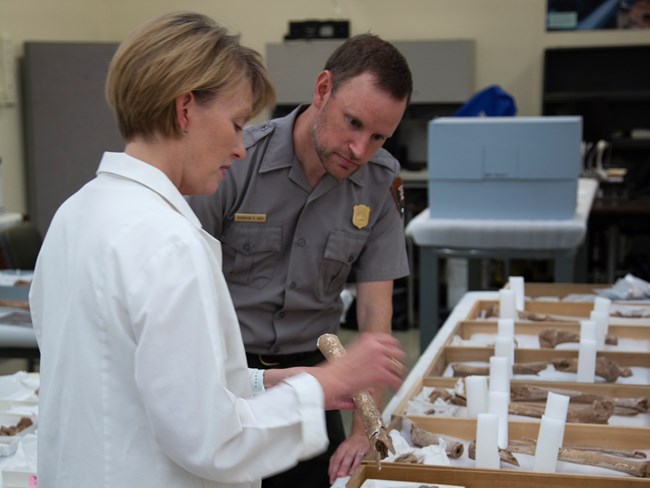
The extraordinary discovery of the remains of two Civil War soldiers buried next to 11 amputated limbs at Manassas National Battlefield Park in Virginia has brought new insight into how surgeons treated the critically wounded.

The National Park Service on Wednesday announced it’s the first time a surgeon’s “limb pit” from the conflict has been excavated and studied. It dates from the Second Battle of Bull Run in August 1862, a decisive victory for Confederates.

Bone fragments were found in an undisclosed area of the park during a utility project in 2014. The next year, NPS and Smithsonian Institution archaeologists excavated the site.

Beneath the surface, they found two nearly complete human skeletons, and several artifacts including buttons from a Union sack coat, a .577 Enfield bullet, three pieces of .31 caliber lead buckshot, and an assemblage of eleven arms and legs,” the park said.

Femur with lodged bullet / Kate
D. Sherwood, Smithsonian Institution
The team was able to determine that the bones belonged to Union soldiers. On Tuesday, the two skeletal remains were transferred to the U.S. Army, which will bury them at Arlington National Cemetery in caskets made from a fallen tree on the battlefield.

A glance of photographs of the amputated limbs shows the bleak realities of war. Surgeons sawed them off with precision because the bullets caused so much damage and soldiers needed an opportunity to ward off deadly infection.

As casualties piled into tents not far from the fighting, Civil War surgeons had to make quick decisions on who might have a chance of going home – without an arm or leg – and who was too seriously hurt to be operated on.

That appeared to be the case with the two soldiers.

The first was in his 20s and died of injuries from an Enfield bullet striking his upper leg.

“Surprisingly, the bullet was still lodged in the femur bone, likely because it slowed as it passed through the man’s cartridge box, the National Park Service said.

Cut marks show surgeon's skill / Kate D. Sherwood, Smithsonian Institution

Doug Owsley, lead physical anthropologist at the National Museum of Natural History, told the Smithsonian's online magazine that the soldier was shot in the buttocks while retreating.

The slug went in at an angle, causing a longitudinal fracture that caused the femur to snap, with bits splintering off inside his leg. “This is just so difficult to treat,” says Owsley, adding the wound was too high for amputation. The man was set aside and died.

The second skeleton is that of a man estimated to be between 30 and 34 years old. He died as a result of a buck and ball shot to the upper arm, pelvis and leg.

Regarding the amputated limbs, Owsley said the surgeon was skilled, given the precision of the cuts.

Brandon Bies assists in 2015 dig /
Kate D. Sherwood, Smithsonian Institution
“There’s a lot of choices that those surgeons had to make when they realized they were left and supplies were not coming in, and they basically had to fend for themselves along with thousands of wounded,” Kari Bruwelheide, a Smithsonian anthropologist, said in a video.

Manassas Superintendent Brandon Bries said, “We can start to have a personal connection to these soldiers and these remains. So instead of some bones, you are looking at somebody who was between 30 and 34 years old and was from the state of New York. That person may have had a wife, may have had children.”

The NPS said research on the recovered limbs continues and its possible they could be matched with a name.

“By examining the cuts, it is possible to determine the skill of the surgeon and even his physical position relative to the patient. With help from historical records, researchers believe it may be possible to match the bones with a specific surgeon and maybe even the soldier they belonged to, a truly unique discovery.

Bruwelheide, Bies examine bones / Nathan King, NPS

Bies, an archaeologist, told NPR that the men were likely wounded during a charge up Deep Cut, held by thousands of Confederates. “As (Union soldiers) start to get closer, within 300, 400 yards, they start to receive rifle fire and musket fire," he says. "Men are dropping left and right." 

Bullet entrance wound /
Kate D. Sherwood, Smithsonian Institution

Surgeons had a standard kit, with a variety of saws.

"If you could imagine sitting with a horrific wound of your own and hearing the moans and screams and seeing a growing pile of limbs from the surgeon, and knowing that your turn was coming, I can't possibly imagine what that would have been like,” Bies told NPR.

The bones were found in a shallow pit, indicating they likely were buried in haste. According to Smithsonian experts, the surgeons were allowed by Confederates to conduct the hasty operations after the battle, when the wounded had been in the sun and rain for days. They may not have had chloroform at their disposal.

Remains are in Army custody / Bradley Waldron, NPS
Foot of amputated leg / Kate D. Sherwood, Smithsonian Institution

Sunday, August 26, 2012

Crowds remember Second Manassas

Saturday, visitors sought out the fields around Manassas, searching for insight into the battle and marking its sesquicentennial. It was one of the South’s great victories. Confederate Gen. Robert E. Lee’s army outmaneuvered and outfought the army of Union Gen. John Pope, opening the door for the Confederacy’s first major incursion into Union territory in the East. • Article | • Schedule

Saturday, July 23, 2011

On the eve of battle, a poignant letter home

The Battle of Bull Run marked the start of some of the fiercest early fighting of the Civil War. In the days before the Union army attacked Confederate troops, Union Army Maj. Sullivan Ballou wrote a heartbreaking letter to his wife in Rhode Island. • Article

Sunday, July 17, 2011

Reality set in at Manassas Junction

This week thousands of reenactors, spectators and history buffs are returning to the fields around the once-remote railroad junction near Bull Run to remember the day the fledgling armies from North and South first met in 1861 — shadowed by picnickers, unaware of the dark future ahead. • Article

Saturday, July 10, 2010

Some cringe at pipeline work at Manassas

An Oklahoma-based energy firm is seeking to expand and replace a natural gas pipeline under a Northern Virginia Civil War battleground, work that local officials and history enthusiasts fear would disturb the Manassas hallowed ground and disrupt next year's planned 150th anniversary of the battle. • Article