Showing posts with label bones. Show all posts

Monday, June 9, 2025

As four Confederate soldiers are reburied in Williamsburg, archaeologists try to positively ID them through DNA testing and searches of records

The final resting place for four soldiers at Cedar Grove Cemetery (The Colonial Williamsburg Foundation)
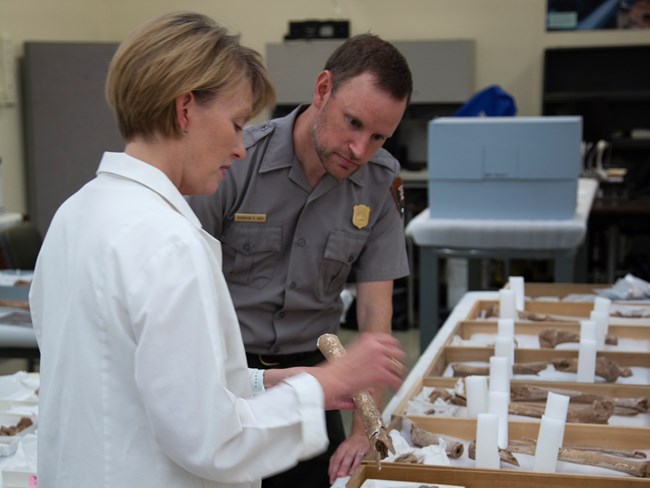
Archaeologists at Colonial Williamsburg in Virginia have recovered DNA from the remains of four Confederate soldiers uncovered two years ago and hope to use that material and hospital and other records to positively identify them, officials said last week.

The Colonial Williamsburg Foundation last week shared an update with local media and the Associated Press. The Picket previously wrote about the discovery of the bodies near the site’s powder magazine.

The archaeologists have narrowed the possible identities to four men who served in regiments from Alabama, Louisiana, South Carolina and Virginia, the AP reported

The museum is withholding the names as work continues.

Excavations in 2023 yielded a mass grave at the powder magazine. (The Colonial Williamsburg Foundation)
“The next step in the search for the soldiers’ identities is working with a genealogist and the recovered DNA to conclusively connect the Confederate burials to living relatives, a process that may take over a year,” Ellen Morgan Peltz, public relations manager for The Colonial Williamsburg Foundation, wrote the Picket in an email.

The remains of the four men were buried last week at Williamburg’s Cedar Grove Cemetery, where other Confederates rest. Remains of three amputated legs also were found during excavations around the magazine’s wall from February to April 2023. 

“Each soldier’s remains were placed in an individual stainless-steel box and buried in an individual vault. The three amputated limbs were buried together in their own box and vault for a total of five boxes and five vaults,” Peltz said. “The burials took place quietly and without ceremony.”

The soldiers likely took part in the May 5, 1862, Battle of Williamsburg in Virginia.

The inconclusive Battle of Williamsburg, according to the National Park Service, was the first pitched battle of the Peninsula Campaign, following a Confederate retreat from Yorktown. Hooker’s division attacked the Southerners at Fort Magruder, but was repulsed. Confederate counterattacks ultimately failed and they made a nighttime withdrawal toward Richmond. Casualties numbered more than 3,800.

Some wounded troops were treated at a Williamsburg makeshift hospital, officials said.

“The museum has recovered enough genetic material from the men’s teeth for possible matches,” the AP reported. “But the prospect of identifying them emerged only after the team located handwritten lists in an archive that name the soldiers in that hospital.”

Hancock's Federal troops launch attack on May 5, 1862 (Library of Congress)
The four soldiers had been buried respectfully, with their hands folded. Bullets, gold coins, buttons and suspender buckles were found with the skeletal remains. One had a bullet in his spine.

Rebel troops used the magazine in 1861 to store ordnance. Colonial Williamsburg was conducting a restoration project at the site when the grave was discovered.

The remains were sent to the Institute for Historical Biology at William & Mary, a nearby university, for analysis.

Jack Gary, Colonial Williamsburg’s executive director of archaeology, said his team used account books and newspapers to narrow down a historic list of 29 individuals who died on that site after the Battle of Williamsburg to a short list of individuals who might be matches for the burials.

The archaeologists eliminated soldiers who survived or lost an extremity, the AP reported. The four skeletons had all of their limbs. Death dates were key because three men were buried together, allowing the team to pinpoint three soldiers who died around the same time.

Use of the powder magazine dates to the American Revolution (The Colonial Williamsburg Foundation)
“Doing this type of identification with burials this old takes a unique set of circumstances. In this case we are lucky to have numerous lines of evidence we can draw on to try and determine the names of these individuals,” Gary said in a statement. Future efforts will include seeking DNA swabs from descendants

Women who visited the wounded kept some records with names. Those documents are kept at William & Mary. The Picket reached out Friday to the library’s special collections research center for details and possible images of the papers but has not heard back.

In a March 2023 article after the discovery of the grave, The Virginia Gazette quoted a local historian as saying the remains are likely Confederate.

“With the Union occupation of the city after the battle, Union remains were collected and ultimately buried at the cemetery in Yorktown,” said Will Molineux. It’s possibly reburial crews missed these two pits.

The article said battle expert Carson O. Hudson wrote in his book, “Civil War Williamsburg,” that the Confederates “were buried in large square pits on the west side of the building” adjacent to the magazine.

Sunday, May 18, 2025

The partial remains of three Union soldiers have been buried at Fredericksburg National Cemetery. Inside their tiny casket is a trove of military buttons, a coat remnant and other items that got mixed up with their bones

May 2 burial (City of Fredericksburg), examination of burial bundle and Connecticut button (Dovetail/Mead & Hunt)
Following the Civil War, the United States government undertook an exhaustive effort to ensure a proper resting place for Union soldiers who had given the “last full measure of devotion.”

Work parties scoured battlefields, back yards, pastures and countless other places to collect 300,000 bodies that were interred at 73 national cemeteries. Remains arrived in dribs and drabs at Fredericksburg National Cemetery in Virginia between 1866 and 1868. Most came with no name: Of the 15,243 soldiers, about 85 percent are unknown.

Contractors hired by the government often retrieved skulls and larger portions of the skeleton, leaving most behind. Such was the case with three Federal soldiers buried together at a site near Sophia Street in downtown Fredericksburg. They died at a hospital set up during the Battle of Fredericksburg in December 1862.

Fredericksburg Superintendent Lewis Rogers at cemetery burial (City of Fredericksburg)
Ten years after the discovery of the partial remains, the men were rendered full honors on May 2 when a small casket holding leg, toe, finger and other bones was buried at the national cemetery.

Among those on hand were Mayor Kerry Devine, members of the Sons of Union Veterans of the Civil War and Lewis Rogers, superintendent of Fredericksburg & Spotsylvania National Military Park. Assisting the reburial effort was the Missing in America Project.

“The placement of these remains closes an important and long journey for these men. They left home at a young age to fight for a cause they believed in, only to lose their lives hundreds of miles from home,” said Kerri Barile Tambs, senior practice lead at Dovetail Cultural Resource Group, which was hired by the city to conduct archaeological examinations during the Riverfront Park project and studied the bones.

There’s another fascinating aspect of the story: Barile Tambs (left) and other Dovetail staffers analyzed a “bundle” found with the men's remaining bones. The jumble of items included fabric from a uniform, military buttons, a pack of straight pins and a small bottle. They were likely kept in pants pockets.

Among the uniform buttons was one denoting Connecticut.

“The three individuals were buried as they died -- wearing their uniforms. By the time people came back … to remove parts of the burials, partial decomposition had occurred,” said Barile Tambs.

“These workers removed some of the bones but left others jumbled together. In the process, it appears that the coat of one of the soldiers was dislodged from the bones, ‘balled up,’ and put back in the hole with the bones they left behind.”

14th Connecticut, other units used house as hospital

A November 2015 article by The Free Lance-Star newspaper detailed the find near the Rowe-Goolrick house, which was constructed in the 1750s to face onto one of Fredericksburg's original ferry roads (and thus was perpendicular to Sophia Street).

The discovery was made after a Masonic hall next to the Rowe-Goolrick house site was torn down to make room for Riverfront Park and city officials called Dovetail in to study the site.

Bright green area is where the human remains were found in 2015 (NPS image)
Dovetail performed archaeological work and archival studies in the area four times between 2013 and 2019. The team located thousands of artifacts spanning from the precontact period through the 1970s.

A 2019 blog post on the Dovetail website details the discovery of several building foundations during the effort.

The Rowe-Goolrick house  was demolished in 1973 to make room for a parking lot that is now part of the park along the Rappahannock River. A fascinating 1863 photograph of the city shows the Rowe-Goolrick house. It was then the home of Absalom Rowe, a cattleman and future mayor of the town. Near it was the Eliza Eubank home, also shown in the picture. It still survives and may be the oldest building in Fredericksburg (circa 1746).

Wartime image of the town, shows Rowe-Goolrick home at right foreground, 
facing the Eliza Eubank home at left (Library of Congress)
A recent National Park Service page about the discovery of the burial site in town said the 14th Connecticut Infantry used the Rowe-Goolrick house, outbuildings and grounds as a hospital.

Second Lt. Charles Lyman of the regiment wrote about witnessing a leg amputation on a soldier placed on a rude operating table under a big buttonball tree in the yard.”

The NPS said the remains of the three soldiers showed no evidence of amputations.

Archaeologists determined the remains belonged to U.S. soldiers by using radiocarbon dating and the context in which they were found and associated artifacts, including uniform buttons, according to the city.

More about 113 items found in the 'bundle'

Barile Tambs told the Picket in an email the bundle was about 2-3 feet below the surface in what appeared to be a root cellar.

The NPS page provides these details about what her team found:

Straight pins were found among the jumble of material (Dovetail/Mead & Hunt)
The X-ray revealed a total of 113 artifacts in the small bundle. These materials included eagle buttons, a small patent medicine bottle, straight pins, a pocket watch key, a small horsehair brush, and a cuff-size Connecticut button. The identification of the Connecticut button was especially significant because the 14th Connecticut was the only Connecticut unit in the 3rd Division at the Battle of Fredericksburg, providing additional information as to the potential troops who occupied the site.

Dovetail – now a part of Mead & Hunt -- does not know anything about the straight pins. The bottle (right, photo Dovetail/Mead & Hunt) is believed to have contained a patent medicine most likely used to treat syphilis. The piece of cloth measured maybe 8 inches by 5 inches.

The archaeologist said the disturbance of the first grave near the Rowe-Goolrick house made it difficult to understand how the men were buried.

“The parts that were left behind were dislodged and jumbled thus no longer representing a standard skeletal position,” Barile Tambs said. “As such, we can't say much on the exact original configuration of the burials at the time of death -- we only have evidence that was left behind … during the partial removal process.”

Full honors for soldiers 160 years later

Fredericksburg National Cemetery sits on Marye’s Heights, a strategic area located southwest of the town’s historic downtown. During the Battle of Fredericksburg, Confederate troops held the high terrain and successfully repelled numerous Union attacks.

Before this month, the last burial of a soldier or veteran there was in 1945. Subsequent burials were spouses. The cemetery has been officially closed to interments since 2010.

Eagle buttons found amid bones, other artifacts in city of Fredericksburg (Dovetail/Mead & Hunt)
The city asked the NPS to bury the remains in 2017, with the need to find a location at the cemetery that had no evidence of a previous interment. The Virginia Department of Historic Resources also was consulted.

The Covid pandemic slowed the project. A 2021 effort to find a suitable plot came to a stop when archaeologists found a long-covered road and brick-lined culvert. A new location was found two years later.

“This 10-year process established protocols should other Civil War remains be found in the area to expedite the respectful reburial of these brave individuals,” Barile Tambs told the Picket. 

Sons of Union Veterans of the Civil War and dignitaries at service (City of Fredericksburg)

The May 2 ceremony included a dozen members of the SUVCW, including a color guard.

According to the city, the National Cemetery Administration has provided the headstone, which will match others in the cemetery and include the epitaph “Unknown.” Given the soldiers are unknown, officials do not where the first part of their remains were interred in the 1860s.

I asked Barile Tambs what became of the bundle.

“It has all been reburied with the remains. They are all grave goods,” she wrote.

Friday, July 16, 2021

Search for a spot at Fredericksburg cemetery to bury remains of Civil War soldiers makes a surprise find of road, culvert

A NARP archaeologist trowels around the culvert (NPS photo)
The search for a suitable location to bury remains of Civil War dead took an interesting turn recently at Fredericksburg National Cemetery in Virginia, with the discovery of a long-covered road and brick-lined culvert.

The National Park Service’s Northeast Archeological Resources Program was brought in to determine whether there were unmarked burial spots or other features that could be affected by interment of bone fragments found several years ago near the site of a temporary Civil War hospital in town.

Using ground-penetrating radar and magnetometer surveys, the team made the discovery, the program said in a Facebook post this week. They didn’t locate graves but decided to excavate an unexpected feature in the soil where the new vault had been proposed.

During excavation we uncovered a road/path that went around a site where a monument was proposed during the early design of the cemetery. That monument was never erected and through time the road was buried. Fortunately for us, the geophysics were right, and no evidence was found of a grave ever existing where we excavated,” the post said. “

The search also yielded the culvert. The post did not provide details on the length of the road or its construction. “Projects like this show just how complex park sites can be even just a few centimeters below the surface,” it said.

Fredericksburg and Spotsylvania National Military Park thanked the program and said it is evaluating the location and alternatives for the reinterment. The NARP will submit a report on its finds.

Eric Mink, historian and cultural resource specialist at the park, told the Picket in an email the bricks apparently were part of a gutter that once lined a drive or avenue in the cemetery.

“These gutters assisted drainage in the cemetery and were installed about 1867-1868. About 1878, the gutters were filled in to accommodate a horse-drawn lawn mower and ease pedestrian traffic in the cemetery. What was uncovered by the archaeologists may very well be a portion of one of those brick gutters. How much of the gutter survives is unknown, as the archaeologists only excavated a small unit.”

Mink said the avenue that was on the southern end of the cemetery was a circular drive around the Monument Mound. “It was reserved during the early design of the burial ground for a Soldiers Monument that was never erected. The mound was later used as a flower bed, before being removed in the 1880s. Even later, a rostrum was erected at this location.

Wartime image of the town, shows Rowe-Goolrick home at right foreground, 
facing the Eliza Eubank home at left (Library of Congress)
The cemetery holds the remains of more than 15,000 soldiers who fought for the Union during the Civil War; only about 2,500 are identified. It sits on Marye’s Heights, a strategic area located southwest of the town’s historic downtown. During the Battle of Fredericksburg, Confederate troops held the high terrain and successfully repelled numerous Union attacks.

The cemetery has not had a soldier or veteran buried there since 1945, but the city has asked the NPS to bury the remains at the cemetery.

John Hennessy, chief historian and chief of interpretation at the park, told the Picket: “This is part of the process of identifying a site for the permanent burial of the remains in the Fredericksburg National Cemetery. As you can see, they came across some unexpected features. The process continues.”

Hennessy said that the reported 100 bone fragments were found on city property – the site of the downtown Riverfront Park along the Rappahannock River – by a cultural resources firm working with the city.

Park officials have made no decisions about the timing or nature of any ceremony that may attend the reinterment of the soldiers’ remains.

A November 2015 article by The Free Lance-Star newspaper detailed the discovery of the bone fragments near the Rowe-Goolrick house, which served as a hospital during the December 1862 battle. A report said the bones were found mixed in with buttons and bits of fabric from Union infantry uniforms and other items in what may have been a root cellar.

The discovery was made after a Masonic hall next to the Rowe-Goolrick house site was torn down and officials called the company in to study the site. Presumably, remains of soldiers who died at the hospital were buried in the adjoining parcel.

Recent grave site testing at the national cemetery (NPS photo)
The Rowe-Goolrick house was demolished in 1973 to make room for a parking lot that has since been removed as part of work on the park.

As at other battle sites, temporary hospitals were established in Fredericksburg.

According to the Free Lance-Star, there are written accounts from several individuals, including some serving in the 14th Connecticut Infantry, that describe convalescing on the house’s grounds. Park officials in 2019 said graves were often overlooked in the years following the war.

Saturday, July 3, 2021

Their bones were found during work on a riverfront park. Now Union soldiers may be interred at Fredericksburg National Cemetery

Archaeologists test potential gravesite (National Park Service)
Scores of bone fragments found near the site of a hospital used during the Battle of Fredericksburg, Va., are expected to be interred at a federal cemetery that holds the remains of more than 15,000 soldiers who fought for the Union during the Civil War.

Fredericksburg and Spotsylvania National Military Park this week posted a Facebook update on the city’s request that the unidentified remains find a final resting place at Fredericksburg National Cemetery, which has not had a soldier or veteran buried there since 1945.

Park officials are trying to find a suitable spot for the burial. They posted  photographs of a National Park Service team at the cemetery testing the proposed location.

“Ground-penetrating radar (done earlier) indicates that the proposed location at the end of this row would work for a new gravesite,” the post says. “However, in this part of the process, the archaeologists need to make sure that the location of the proposed grave is clear of any other burials or archaeologically significant material.”

Wartime image of the town, shows Rowe-Goolrick home at right foreground, 
facing the Eliza Eubank home at left (Library of Congress)
John Hennessy, chief historian and chief of interpretation at the park, told the Picket in an email that the remains were found on city property – the site of the downtown Riverfront Park along the Rappahannock River – by a cultural resources firm working with the city.

“Any analysis of the remains has been done by them and to my knowledge has not been made public,” said Hennessy.

Hennessy said officials have made no decisions about the timing or nature of any ceremony that may attend the reinterment of the soldiers’ remains

The Picket reached out to Dovetail Cultural Resource Group but received no immediately reply.

Recent testing at the national cemetery (NPS photo)
A November 2015 article by The Free Lance-Star newspaper detailed the find near the Rowe-Goolrick house, which served as a hospital during the December 1862 battle. A report said the bones were found mixed in with buttons and bits of fabric from Union infantry uniforms and other items in what may have been a root cellar.

The discovery was made after a Masonic hall next to the Rowe-Goolrick house site was torn down and officials called the company in to study the site. Presumably, remains of soldiers who died at the hospital were buried in the adjoining parcel.

The Rowe-Goolrick house was among several on Sophia Street. It was demolished in 1973 to make room for a parking lot that is now part of the park development. The Picket reached out to the city for a status report on the park project, but received no reply.

A 2019 blog post on the Dovetail website details the discovery of several building foundations and artifacts in the historic area after excavations for the park. It describes the Rowe-Goolrick house:

The now-gone Rowe-Goolrick house in the 1930s (Library of Congress)
“Built in the mid-eighteenth century, this two-story, three-bay home did not face today’s street grid but rather the original town ferry lane, which ceased use shortly after the home was constructed. The foundation of the house was fashioned of local Aquia sandstone.”

As at other battle sites, temporary hospitals were established in Fredericksburg.

According to the Free Lance-Star, there are written accounts from several individuals, including some serving in the 14th Connecticut Infantry, that describe convalescing on the house’s grounds. Park officials in 2019 said graves were often overlooked in the years following the war.

Sophia Street fronts the Rappahannock River and was home to some of the earliest structures in Fredericksburg, Hennessy has written on his blog. A few survive.

A fascinating circa 1863 photograph of the city shows the Rowe-Goolrick house. It was then the home of Absalom Rowe, a cattleman and future mayor of the town. Near it was the Eliza Eubank home, also shown in the picture. It still survives and may be the oldest building in Fredericksburg (circa 1746).

The Eubank home (By Bradley Owen, HMdb.org)
In recent years, the Eubank home was renovated into office space and a sign outside uses the name Thornton’s Tavern to mark a pre-Civil War establishment in the building.

The Historical Marker Database’s page on the home includes this description on the marker:

“In December 1862, Union and Confederate forces clashed violently in the city's streets during the First Battle of Fredericksburg. The Tavern's owner … one of Fredericksburg's few female property owners at the time … returned after the fighting to find that her home had miraculously survived the battle with only minor damage.”

The park visitor center, about a mile from Sophia Street, interprets the story of several Civil War campaigns and battles in the area over a three-year period.

Fredericksburg, Chancellorsville, Wilderness, and Spotsylvania -- this is America's battleground, where the Civil War roared to its bloody climax,” its website says. “No place more vividly reflects the War's tragic cost in all its forms. A town bombarded and looted. Farms large and small ruined. Refugees by the thousands forced into the countryside. More than 85,000 men wounded; 15,000 killed -- most in graves unknown.”

Thursday, June 21, 2018

Amputated limbs recovered from shallow pit at Manassas provide insight into surgeons' work

Erin Godwin excavates limb / Kate D. Sherwood, Smithsonian Institution
The extraordinary discovery of the remains of two Civil War soldiers buried next to 11 amputated limbs at Manassas National Battlefield Park in Virginia has brought new insight into how surgeons treated the critically wounded.

The National Park Service on Wednesday announced it’s the first time a surgeon’s “limb pit” from the conflict has been excavated and studied. It dates from the Second Battle of Bull Run in August 1862, a decisive victory for Confederates.

Bone fragments were found in an undisclosed area of the park during a utility project in 2014. The next year, NPS and Smithsonian Institution archaeologists excavated the site.

Beneath the surface, they found two nearly complete human skeletons, and several artifacts including buttons from a Union sack coat, a .577 Enfield bullet, three pieces of .31 caliber lead buckshot, and an assemblage of eleven arms and legs,” the park said.

Femur with lodged bullet / Kate
D. Sherwood, Smithsonian Institution
The team was able to determine that the bones belonged to Union soldiers. On Tuesday, the two skeletal remains were transferred to the U.S. Army, which will bury them at Arlington National Cemetery in caskets made from a fallen tree on the battlefield.

A glance of photographs of the amputated limbs shows the bleak realities of war. Surgeons sawed them off with precision because the bullets caused so much damage and soldiers needed an opportunity to ward off deadly infection.

As casualties piled into tents not far from the fighting, Civil War surgeons had to make quick decisions on who might have a chance of going home – without an arm or leg – and who was too seriously hurt to be operated on.

That appeared to be the case with the two soldiers.

The first was in his 20s and died of injuries from an Enfield bullet striking his upper leg.

“Surprisingly, the bullet was still lodged in the femur bone, likely because it slowed as it passed through the man’s cartridge box, the National Park Service said.

Cut marks show surgeon's skill / Kate D. Sherwood, Smithsonian Institution
Doug Owsley, lead physical anthropologist at the National Museum of Natural History, told the Smithsonian's online magazine that the soldier was shot in the buttocks while retreating.

The slug went in at an angle, causing a longitudinal fracture that caused the femur to snap, with bits splintering off inside his leg. “This is just so difficult to treat,” says Owsley, adding the wound was too high for amputation. The man was set aside and died.

The second skeleton is that of a man estimated to be between 30 and 34 years old. He died as a result of a buck and ball shot to the upper arm, pelvis and leg.

Regarding the amputated limbs, Owsley said the surgeon was skilled, given the precision of the cuts.

Brandon Bies assists in 2015 dig /
Kate D. Sherwood, Smithsonian Institution
“There’s a lot of choices that those surgeons had to make when they realized they were left and supplies were not coming in, and they basically had to fend for themselves along with thousands of wounded,” Kari Bruwelheide, a Smithsonian anthropologist, said in a video.

Manassas Superintendent Brandon Bries said, “We can start to have a personal connection to these soldiers and these remains. So instead of some bones, you are looking at somebody who was between 30 and 34 years old and was from the state of New York. That person may have had a wife, may have had children.”

The NPS said research on the recovered limbs continues and its possible they could be matched with a name.

“By examining the cuts, it is possible to determine the skill of the surgeon and even his physical position relative to the patient. With help from historical records, researchers believe it may be possible to match the bones with a specific surgeon and maybe even the soldier they belonged to, a truly unique discovery.

Bruwelheide, Bies examine bones / Nathan King, NPS
Bies, an archaeologist, told NPR that the men were likely wounded during a charge up Deep Cut, held by thousands of Confederates. “As (Union soldiers) start to get closer, within 300, 400 yards, they start to receive rifle fire and musket fire," he says. "Men are dropping left and right." 

Bullet entrance wound /
Kate D. Sherwood, Smithsonian Institution
Surgeons had a standard kit, with a variety of saws.

"If you could imagine sitting with a horrific wound of your own and hearing the moans and screams and seeing a growing pile of limbs from the surgeon, and knowing that your turn was coming, I can't possibly imagine what that would have been like,” Bies told NPR.

The bones were found in a shallow pit, indicating they likely were buried in haste. According to Smithsonian experts, the surgeons were allowed by Confederates to conduct the hasty operations after the battle, when the wounded had been in the sun and rain for days. They may not have had chloroform at their disposal.

Remains are in Army custody / Bradley Waldron, NPS
Foot of amputated leg / Kate D. Sherwood, Smithsonian Institution