Showing posts with label found. Show all posts

Thursday, May 23, 2024

The bomb squad removed a cannonball from a flower bed south of Topeka. Was it part of a weapons cache during the Civil War or 'Bleeding Kansas' violence?

The item was found in a small garden in eastern Kansas (Overbrook Police Department)
A bomb squad this week removed a small cannonball from the garden of a house in Overbrook, Kan., near the old Santa Fe Trail, which ran through communities ravaged by the Civil War.

Overbrook Police Chief Eric Carlson said several agencies went to the home on Walnut Street after a call came in Tuesday afternoon. The suspected Civil War ball, described by Carlson as slightly larger than a softball, was removed by Topeka police.

The cannonball was outside in a garden and had been there since at least 2006,” Carlson said Thursday morning in an email to the Picket. “It is believed that the cannonball had been there much longer but buried and recent rain had brought it above ground.

Topeka police have the ordnance “pending a determination on whether or not it can be safely returned or needs to be destroyed,” said Carlson. 

“There is not suspected to be others in the garden and the area was checked. I am unable to identify the exact kind of shell,” Carlson said. “The metal was too thick for the X-ray used by the bomb squad. This is why further investigation was required.

If the ball is saved, he said, it will go the Overbrook Historical Society.

Lance Feyh, a public information officer for the state fire marshal's office, said Topeka police were to consult with the Army’s Fort Riley about the object. The Picket left a message with Topeka police.

Wade Sisson, a board member with the historical society, said the artifact was discovered on the former grounds of the original Overbrook Methodist Church, which was built in 1888. The property now is a private residence. "I'm told by someone who did the initial examination that they estimate it was made sometime between 1860 and 1865," he said in an email.

According to Sisson, the owner told them a basement and first floor for an addition at the church were built and completed in the 1950s. After a 2006 flood, the homeowner had the basement wall excavated to replace a drain.

The trail, shown in red, ran through Overbook, which is a few miles east of Wilmington (NPS map)

The cannonball was discovered during the excavation but it was so mud-packed, it was assumed to be a solid metal ball. The resident placed it in a garden bed by the back door and forgot about it. In May, his son found the item. A rain cleared some mud and when it was put back in a different position they noticed an angle that showed a plug. That is when the owner called authorities.

Carlson said officials determined the cannonball was from the mid-19th century “based on the plug hole and the fact that a large cache of cannonballs that had been stored in Overbrook during the Civil War and Bleeding Kansas period.”

“Kansas sided with the Union during the war and several confrontations during the Bleeding Kansas era were rumored to have taken place in the area," said the chief.

The farm and railroad town was not incorporated until 1886. Overbrook is about 20 miles southeast of Topeka and 25 miles southwest of Lawrence, scene of an 1863 Confederate guerrilla massacre of civilians. Kansas was beset before and during the war by violence among pro- and anti-slavery forces.

Santa Fe Trail Street in Overbrook – which is about a block from the scene -- runs directly along the Santa Fe Trail.

Several battles in Kansas were fought along the historic pioneer corridor, including in Olathe, Westport and Diamond Spring. No fighting was believed to have occurred in Overbrook.

The town's police department includes a Santa Fe Trail covered wagon in its logo (right).

About 1,000 people live in Overbrook.

Wednesday, August 23, 2023

Go deep for 50th anniversary of USS Monitor discovery: Printable 3D artifacts, webinar and a 360-degree video of ironclad's resting place

A shark roves over the Civil War wreck in a new 360-degree video (NOAA)
With printable virtual artifacts and a 360-degree video from the ocean floor, NOAA's Monitor National Marine Sanctuary is adding a wow factor to the celebration of the discovery of the famed ironclad USS Monitor 50 years ago this month.

The last days of August are the culmination of a yearlong effort to mark the anniversary. Offerings will include a webinar led by USS Monitor expert John Broadwater.

“We had planned for all of our celebrations to be virtual (in order) to reach a national audience,” said Tane Casserley, the sanctuary’s research coordinator. “Keeping in the spirit of USS Monitor being a marvel of technology and innovation, the sanctuary plans to continue that theme by using the newest technologies to celebrate the 50th anniversary.”

The USS Monitor, which fought the ironclad CSS Virginia in March 1862, ending the supremacy of wooden ships in combat, sank months later off Cape Hatteras, N.C., with 16 lives lost. The ironclad was located by a team of researchers on Aug. 27, 1973. The signature turret and hundreds of other artifacts have undergone conservation in recent years.

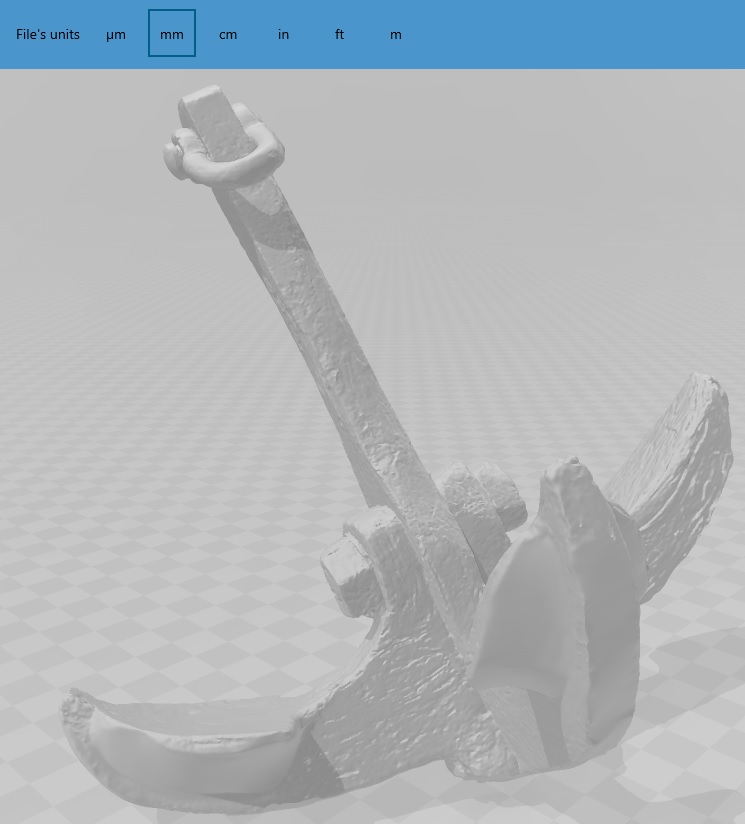
3D models of worm wheel, boot and gun tool (MNMS)

Virtual artifact collection – available now

NOAA now offers two web links (here and here) for accessing a selection of artifacts that have undergone or are still receiving treatment at the Mariners’ Museum and Park in Newport News.

A hammer, anchor, powder scooper, Wellington-style leather boots, various gun tools, wheel and other iconic artifacts were scanned earlier this year at the museum in a collaborative project involving the University of West Florida.

“The completed scans are available for viewing online and as a download for home 3D printing,” said Casserley.

Monitor’s artifacts are quite fragile after their conservation process has been completed and by virtually recreating and 3D printing the artifacts, (the sanctuary) can quite literally put history in people’s hands all while ensuring the safety of the original artifact.”

Visitors to the web pages can load the models and then rotate them. The models can be downloaded as STL files.

Virtual model of turret allows viewers to rotate image and press numbers for details (NOAA)

360-degree video – debuted Friday (Aug. 25)

The immersive experience brings people “virtually down to the ocean floor to see the shipwreck itself and its incredible marine life.”

The video shows multiple angles of the ironclad, which landed upside down, teeming with colorful marine life.

“Transformed from a weapon of war to an island of marine life, Monitor continues to serve as habitat for a wealth of marine life. Dive in to see sand tiger sharks, sea turtles, and more,” NOAA says.


NOAA has produced
a number of such videos and gives these instructions to reviewers:

“If you're on a desktop, click and drag to experience in 360 degrees, or pair your phone with your virtual reality headset. For the best viewing experience, watch the video in high-definition: click the gear symbol in the lower right corner, then select any of the HD options that pop up when you click ‘Quality.’”

John Broadwater webinar – 1 p.m. ET Aug. 31

Broadwater, a maritime archaeologist and author, has been on numerous USS Monitor expeditions and is former superintendent of the sanctuary. An overview of the webinar includes this description:

“Discover why the shipwreck was difficult to locate and learn about the expeditions to find it. Go back in time to August of 1973, when John G. Newton led a team of scientists in search of the elusive shipwreck. Learn why it continued to be difficult to identify once they thought they found it and what finally convinced the team it was indeed the USS Monitor.”

Broadwater told the Picket he will speak on the webinar about high interest in the Monitor back then. The moon and planets must have been aligned, because at least three different groups chose 1973 to search for the Monitor,” he said in an email. “I was in charge of one of the groups looking in the wrong place, because we believed the story published by Robert Marx, who claims to have found Monitor near Cape Hatteras lighthouse in the 1950s.”

Register for the webinar here.

Fans of the ironclad can follow all activities on the sanctuary’s Facebook page.

PICKET COVERAGE OF USS MONITOR

-- Cathryn Newton: At 16, she was the youngest crew member. She says the find was a group effort.
-- John Harris: He became a hang glider pilot and founded Kitty Hawk kites. But first, he ran the 1973 expedition's underwater camera system.
-- Go deep for 50th anniversary of USS Monitor discovery: Printable 3D artifacts, webinar and a 360-degree video of ironclad's resting place
-- USS Monitor: Navy recognizes Virginia museum for cleaning of ironclad's two Dahlgren guns, which are still being conserved
-- The USS Monitor overcame doubters. Its crew trusted the ironclad, even during the terrible storm that sank the famous ironclad.
-- What do USS Monitor, Jimmy Fallon have in common? Saugerties, NY. This town morphed from industrial 'Inferno' to a cool tourist spot

Thursday, May 25, 2023

Where eagles dare: Bronze bird was atop a U.S. flag during a doomed, but heroic Union assault at Georgia's Pickett's Mill. It's now on display

The bronze eagle finial now on exhibit at Pickett's Mill (Georgia DNR)
For about 25 years, a small bronze eagle sat on the library shelf at Pickett’s Mill Battlefield outside Atlanta. It was a bit of a curiosity. The bird’s feet were missing, one wing was broken and the other was turned inward. It was affixed, oddly, to a trophy stand.

Staff members and volunteers thought the weathered finial – an ornament placed on the top of a flag – might be a reproduction. But they couldn’t find a donation slip to help explain the story.

Now, after a finial expert weighed in and a park staff member began extensive research, officials and experts are saying this eagle isn’t a fake. Rather, they say, it earned its current condition while under fire at the Battle of Pickett’s Mill on May 27, 1864, when attacking Union regiments poured into a ravine and were pulverized by Confederate artillery and rifles.

The Federal finial will be formally unveiled to the public Saturday during the anniversary commemoration of the battle in Paulding County, Ga. Afterward, a wreath-laying ceremony will take place in the ravine where the flag topper was found in November 1963, just a few days before the JFK assassination. (See coverage here of Saturday's event)

“Next to the original cannon that sits in the museum, (the finial) is one of the rarest artifacts that could be found from any Civil War battlefield,” says John Hoomes, curator preservationist and interpretive ranger at Pickett’s Mill. “Especially the eagle finials. They are the rarest.”

A portion of the ravine where the finial was found at Pickett's Mill (Georgia DNR)
Pickett’s Mill is one of the best-preserved Civil War sites in the country, with its famous ravine and remains of artillery emplacements and earthworks.

Hoomes says his research on the finial over the past year has been like solving a mystery. “I was a skeptic. I didn’t think it was the real thing.”

The dedication and battle anniversary fittingly fall on the Memorial Day weekend.

“People actually fought and died there for an idea, no matter which side the dreamer was on,” says finial expert Del Thomasson. “The eagle tells a story with every crease, bend, break, that someone held it high and was willing to give their life for that dream and idea.”

It was an honorable and dangerous job

Our story begins 159 years ago as Confederate troops parried Maj. Gen. William T. Sherman’s army as he marched on Atlanta. Sherman learned some tough lessons when he tried to flank and push back his foe at Pickett’s Mill as he moved on Atlanta.

Troops under Union Maj. Gen. O.O. Howard clashed with those of Maj. Gen. Patrick Cleburne, fighting at extremely close quarters. The Federals – most Midwestern regiments -- charged down ravines and uphill against the Confederates. At least 700 of the men in blue died and the advance on Atlanta was delayed a week. The Union suffered about 1,600 total casualties in the slaughter, compared to the South's 500. 

Each regiment had two sets of colors, one the U.S. flag and the other a regimental flag. These banners were sacred -- a point of pride and a means of leading and rallying men amid the chaos of combat. The enemy always shot at color bearers and tried to seize flags. The Pickett's Mill finial is believed to have been put on an American flag.

“Carrying the colors into battle was an honor and privilege, as well as a dangerous job. Those that carried the colors needed to be courageous,” according to a page on Connecticut history. “The flags also symbolized national and regional pride for the soldiers as they went into battle.” (Sketch at left a quartermaster color bearer by Alfred Waud, Library of Congress)

Hoomes tells the Picket the location of the finial discovery in the 1960s lines up with the movement of a brigade led by Col. William H. Gibson. Among the five regiments were the 49th Ohio and the 32nd Indiana.

In his memoirs, Confederate Pvt. William J. Oliphant, who served in Granbury’s Texas brigade, recalled the charge of an Indiana unit. It’s quite possible it was the 32nd. Oliphant said the attackers almost reached their lines before being forced back.

“The color bearer of the regiment fell with his colors, instantly another siezed [sic] the flag and held it aloft only to fall dead. Again and again it was raised until six brave men yielded up their lives in trying to keep it flying. The sixth man fell with the flag in front of our company and only about ten or twelve feet from us. There it lay a prize within our grasp. I could have reached it with a single bound but thought as it was already ours, I would wait until their line had been completely driven back before picking it up. When the Indiana regiment broke and fell back for the last time, leaving their flag on the ground at our feet, one of the brave fellows turned, and seeing it was being left behind, threw down his gun, came back and picked it up. He straightened himself to his full height, gritted his teeth and flapped his flag in our faces. Instantly a half dozen rifles were leveled on him and in another moment he too would have fallen riddled with bullets, but just then one of our boys cried out "don't shoot him, he's too brave." We lowered our rifles and gave him a cheer as he carried his flag safely away.”

Postwar illustration of Pickett's Mill by famed artist Alfred Waud 
Hoomes says he believes the finial in the park’s collection was on the flag of either the 32nd Indiana or 49th Ohio. “Of all the units, they had the heaviest casualties.”

Josh Headlee, curator and historic preservation specialist with the Georgia Department of Natural Resources, prepared the finial for the exhibit. The accompanying interpretive text does not specify a regiment because of uncertainty.

“It was found in the area of the regiments in question and there is a high probability that it is from one of those regiments, but as you surely well know, during those heated battles projectiles, dirt, and debris were flying all over the place and it’s not inconceivable that it landed there after being blown there from further down the line,” Headlee says. “So I’d say that we are better than 90% sure, but not enough to (definitively) pin it to a particular regiment.”

'We found a bunch of stuff'

Tommy Carter grew up near Pickett’s Mill and lives in New Hope, site of another clash during the Atlanta Campaign. Carter and a cousin, Hubert Rackley, often searched for Civil War relics in the area.

Finial in 2022 when it was on a trophy stand (Del Thomasson and Georgia DNR)
He told the Picket he was 9 years old when he and Rackley, both descendants of the Malachiah Pickett family, went to the ravine in November 1963 with a minesweeper. They had permission to be there, Hoomes says.

(It’s important to note that this was private property at the time, about 10 years before the state began acquiring land for the park and later prohibited such activity. Federal and state park officials always remind visitors to not disturb cultural resources on public land; they can face charges.)

“We found a bunch of stuff that day,” says Carter. “That eagle was the main one. We found it in a creek near where the rocks were.” The artifact was lying on its side, about six inches down, he said. The feathers were caked with dirt.

Maj. Gen. William B. Hazen, who led a large brigade at Pickett’s Mill, took shelter behind a large rock about 50 yards away. Noted veteran and author Ambrose Bierce (right) was with Hazen and later wrote a caustic account of the futile Federal attack entitled “The Crime at Pickett’s Mill.”

Carter and Dennis Deal, a collector friend, believe the finial to be authentic and the same one found in 1963. Deal, also of New Hope, said Rackley showed him the artifact years ago. “I knew he found it and I (saw) it in his collection.”

Deal – who was not present at the discovery of the finial -- says he is in awe of the courage of the trapped Union soldiers and flag bearers at Pickett’s Mill. “It was really bad for the Yankees.”

Last year, Deal and Carter traveled to the ravine with park officials to discuss the finial and its location.

A book weight or perhaps a trophy

Flag topper expert Thomasson of Ringgold, Ga., was at a relic show in early 2022 when a volunteer at Pickett’s Mill came up and mentioned the finial sitting on the shelf. The volunteer, a member of the Friends of Picket’s Mill Battlefield, apparently believed the item was a reproduction and later sent photos.

Thomasson reached out to an eagle finials expert, relic collectors and, eventually, park officials.

Thomasson, who has a similar eagle in his collection, told them he believed the Pickett’s Mill item to be authentic.

“I thought it was a trophy or some kind of memorial. I did not know what it was. My boss at the time said it was like a book weight,” Hoomes says. Before it was remounted for the exhibit, the eagle was on a stand saying it was from the battle. The top line read "Federal Flag Staff Eagle."

Thomasson, the author of “Flagstaff Finials Toppers & Ferrules of the American Civil War,” paid a visit to Paulding County in March 2022. He visited the ravine and officials compared the Pickett’s Mill bird to a similar one in his collection.

Thomasson says the eagle likely belonged to an Ohio regiment, but it’s possible an Indiana unit carried it.

The position of Gibson's brigade (center) as it moved to attack (Georgia DNR)
After looking at accounts and hearing from Carter, Hoomes believes the finial to be battle-damaged and was carried during the second attack wave -- men under Gibson, not Hazen.

Bierce wrote of the attack: “Our brave color-bearers were now all in the forefront of battle in the open, for the enemy had cleared a space in front of his breastworks. They held the colors erect, shook out their glories, waved them forward and back to keep them spread, for there was no wind. From where I stood, at the right of the line -- we had “halted and formed,” indeed -- I could see six of our flags at one time. Occasionally one would go down, only to be instantly lifted by other hands.”

Carter took him to the site and there was a metal stake and orange ribbon nearby, Hoomes says. Someone, not an archaeologist, marked the site, the ranger says. If an archaeologist did not record the find, it does raise a question of provenance.

“I am convinced that it is real. I am convinced it is the one that Tommy and his (cousin) dug up.”

The evidence of authenticity adds up, he says

Some of the eagle finials in Wilson's collection (Courtesy of Kyle Wilson)
For his part, Thomasson contacted Kyle Wilson, an expert and collector of eagle finials.

Finials were made of higher quality material early in the Civil War, and makers included Tiffany and Co. and Cairns & Brother, both based in New York. Wilson, who lives in Lebanon, Illinois, told the Picket he is not certain who made the Pickett’s Mill finial.

He says the artifact is made of bronze and has remnants of gold gilding. The whole item, complete with mounting, would weigh up to two pounds. It was a solid piece and strongly attached to the wooden pole.

Wilson says the Pickett’s Mill wing could have been intentionally folded by its bearer so that it would not snag on overhanging tree branches, but he is not certain. The patina, evidence of oxidation and wear indicate the finial is real and that it was in ground for decades. “You can see wear where it was carried.”

Typical components of an eagle finial (Courtesy of Kyle Wilson)
And, he says, there are no known reproductions of the eagles. The manufacturing process was complicated and some were in three pieces, held together by soldering. A ball was attached to the feet and then attached to a base on top of the flag pole.

“It probably got blown off the staff by canister or possibly by a round ball,” he says. “I am 100 percent sure it was shot right off the pole,” instead of breaking off when the color bearer fell or dropped it.

It’s possible the flag was from an Indiana regiment. But, Wilson says, “If I was a gambling man, I would have to say it was Ohio. You see a lot more in Ohio.”

Hoomes said he hoped a metallurgical analysis would have been conducted to see what kind of shot hit the finial and broke off the wing, but that was not done.

'They bore witness'

There are varying accounts on how the finial came to be in the park collection. Carter says he does not know, while Deal says he believes Rackley donated it before his death in 1998. But Hoomes says Rackley obviously would have known it was real, and he wonders how the idea of a reproduction came about. Regardless, the mystery of the donation lingers.

A finial in Del Thomasson's collection next to the Pickett's Mill eagle
The finial is displayed in a small case at the visitor center. A new interpretive panel describes the importance of flags and decorative finials, which came in a variety of shapes, including spades, spheres and globes.

“The damage sustained as flagbearers carried them into battle help tell the story of the difficulty and violence faced by soldiers, like those at Pickett’s Mill. The damage visible on the Civil War era eagle finial to your right provides clues to the experience soldiers faced beneath it and the flag it once adorned,” part of the text reads.

“What caused the bent wing of the eagle? Could this finial have been with a flag flown in battle? Are the dents a clue? What happened to the eagle’s legs, which once would have grasped a metal globe on top of the flag staff?”

Park officials and others are excited about the display.

“What we thought was just a relatively mundane piece sitting on a shelf in the library has turned out to be quite an important artifact for the site there,” says the DNR’s Headlee. Hoomes says the finial symbolizes the Federal army of the Civil War and the United States today.

And, says Wilson, the eagles stood for patriotism just as much as the flags they topped.

They bore witness to the horrible things and travesty that happened during the battle,” he says.

Saturday’s program at Pickett’s Mill will include guided and unguided tours of various stations within the battlefield. Visitors can experience a glimpse of both military and civilian life that will include home skills and crafts, cannon firings, musketry, military drills and camp life. The unveiling of the finial exhibit will be around 10 a.m. ET. A food truck will be available. Site admission is $3 - $6. Click here for more information.

Thursday, August 18, 2022

Human remains are found near site of Nashville's Fort Negley

A developer has unearthed human remains that could be two centuries old while digging to lay the foundation of a new Nashville project not far from a Civil War fort and a cemetery dating back to 1822. The discovery marks the latest intersection of economic boom times and the city's rich and sometimes troubled history — where new amenities sprout up on or near lands where people long ago settled, battled or toiled, then died and were buried, often with little record of their final resting places. -- Article

Thursday, July 21, 2022

Fragment of stone monument marking location of a Georgia regiment is back 'home' at Manassas battlefield after disappearing decades ago

Then head of school Diane Dunne and Jim Burgess (Photos: The Country Day School)

A missing stone fragment that once marked a position held by a bloodied Georgia regiment is back at the Manassas battlefield in Virginia for today’s 161st anniversary, ending a saga that began decades ago.

The Civil War marker’s story is a fragmented tale whose pieces finally came together earlier this year when the chunk of marble was donated to the park by a small private school in McLean, about 45 minutes away.

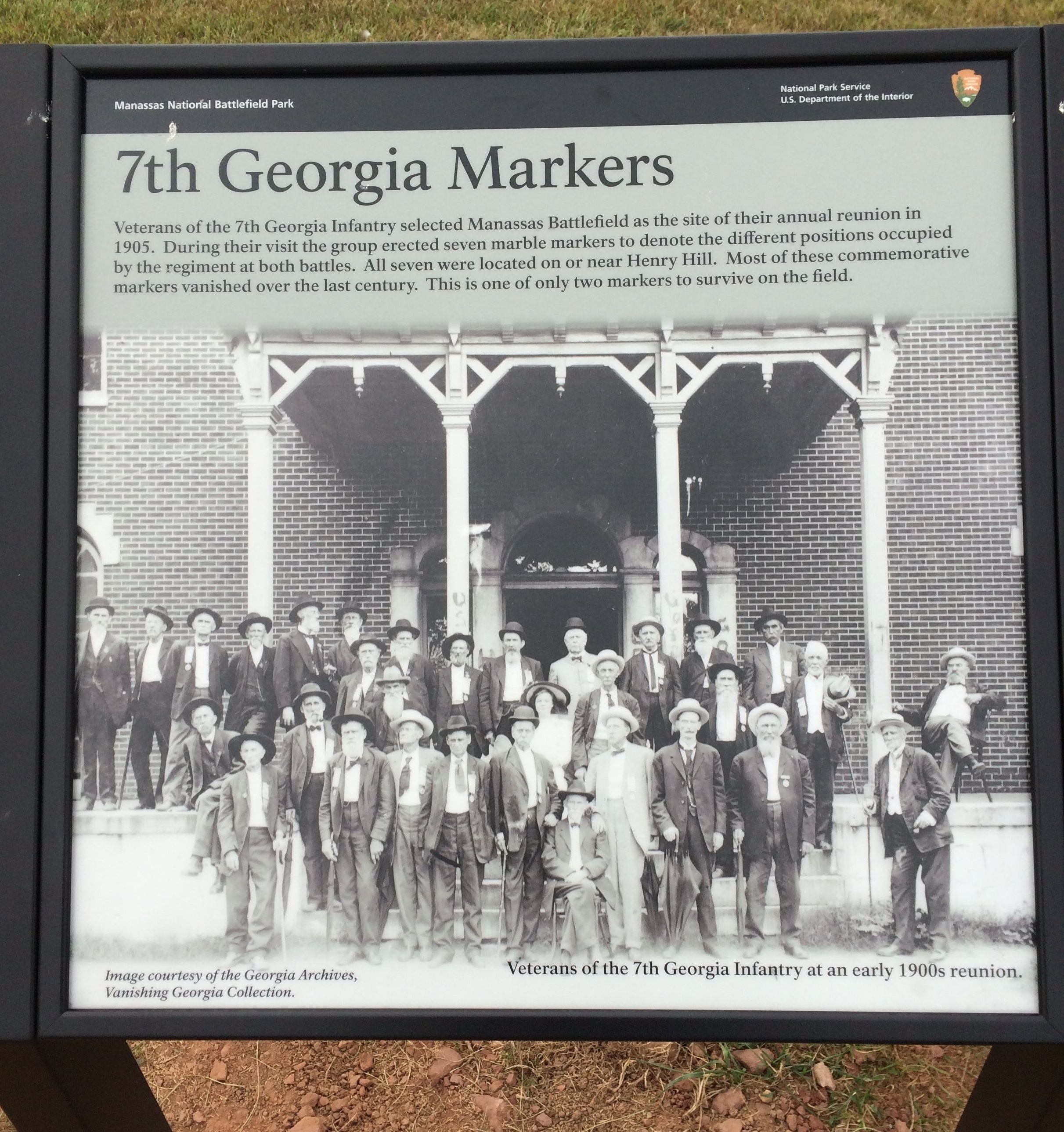
Veterans of the 7th Georgia Infantry – which was in the thick of fighting at the First Battle of Manassas (Bull Run) – in 1905 opted to place six markers indicating where they were positioned in that battle and another marker for a position at Second Manassas in August 1862.

The markers fell victim to time and vandals, with only two still on the field today, one of them rarely seen by visitors.

Officials believe this returned so-called “second position” marker disappeared before the park was established in 1940. How the top half landed in the upscale Langley neighborhood of McLean – near the CIA headquarters – remains a mystery. The son of the school’s director in the 1970s found it while doing construction work on an old barn on the school property. His mother believed it to be a tombstone for a Georgia boy.

A sketch of the barn on the school property (Courtesy of McCormick family)
That wasn’t the case, says Manassas National Battlefield Park museum specialist Jim Burgess, who has documented the 7th Georgia position markers and tried to get this one donated to the park nearly 30 years ago after he learned of its discovery.

The school’s director held onto the marker and Burgess moved on to other things. After the director died in 2018, her children sold her home to the school and left the artifact behind.

In February, the federal park got a call from the school, indicating the school’s desire to see the stone back at Manassas. Burgess got to the campus within two hours. 

“It has sort of been on the back burner,” Burgess said. “I was flabbergasted in getting the call.”

Sign at Manassas park has photo of 7th Georgia veterans (Shane Oliver/HMdb.org)
The fragment is about 10 inches by 10 inches and appears to have the first part of  “2nd POSITION” etched at top.

The park has put the piece in a temporary display case along with a photo of an outdoor stone fireplace/grill – a seemingly odd pairing.

Burgess believes the lower half of the marker may be the gray stone in the middle of the fireplace, which was built by a farmer on what is now park property.

Georgia veterans returned to battlefield

The 7th Georgia, part of a brigade led at Manassas by Col. Francis S. Bartow, was mustered into Confederate service in late May 1861. Most of the regiment’s soldiers were from Coweta, Paulding, DeKalb, Franklin, Fulton, Heard and Cobb counties in northern Georgia.

The unit was rushed to Virginia and saw heavy combat at Manassas on July 21, 1861, the first major battle in the Eastern Theater. (At left, photo of Pvt. John William Barrett of the 7th)

Bartow was killed while leading the 7th against Capt. James B. Ricketts’ battery on Henry Hill during a pivotal moment in the fighting, which swung to the Confederates’ favor late in the day for a victory that left Union forces fleeing to Washington. The 7th Georgia suffered a staggering 153 casualties out of 580 men present, according to American Battlefield Trust.

Decades later, 7th Georgia veterans decided to place the position markers, rather than a large single monument. They resembled tombstones and were scattered across the rolling hills.

Burgess’ records indicate the second position marker may have been broken and displaced when the Warrenton Turnpike was widened in the 1920s.

The top half ended up in McLean, while the bottom -- which has no inscription -- may be in the fireplace adjacent to the old George Sutton farm.

Piece of marble is in middle of large fireplace at Manassas. (Jim Burgess, MBNP) 
In 1970, Sutton said he built the fireplace with stones recovered from the area, but “This piece of marble here was picked up along the highway when we put the fence up there. Evidently it was a piece of a monument…”

The farm was acquired by the park in the 1950s.

Fragment was found among rocks

In the 1960s, Dorothy McCormick, a leader in early childhood education, started a small school at her Great Falls, Va., home. McCormick (right) later acquired Happy Hill School (renamed The Country Day School) in McLean in the early 1970s. 

The nonprofit venue, located in the suburban Washington, D.C, neighborhood, offers preschool and kindergarten classes. McCormick promoted motor skills training and an enrichment center, among other innovations.

“We called her the director. She was old school,” said son Robert McCormick. “Very sweet, but you didn’t give her any guff.”

Becky Benton, current officer coordinator at the private school, told the Picket that Mrs. McCormick, a widowed mother of six children, had a strong imprint on staff and parents.

“She had a way of attracting people to her mission,” Benton said.

The 5-acre property included a two-story cattle barn built in 1921.

Mrs. McCormick decided to live there after extensive renovations were made. Robert, who designs and builds homes, led that project. In 1977, he discovered the marker while moving rubble and other material from a fill pit while working on a deck foundation at the barn.

“It was in there. We had thought we had uncovered a Civil War grave site,” he said.

“She was very excited to think a soldier may have been buried here,” Benton said.

McCormick’s mother kept the fragment on the hearth as a conversation piece, and a 1990s Washington Post article about Langley includes a photograph of her holding the stone, described as a tombstone.

Mrs. McCormick told the paper it was an indication of the area’s historical significance.

“It was important for her to keep it safe,” Benton said. “She was history minded and appreciated the history of the school and America.”

Park communicated with educator 

After reading the article, Burgess contacted Dorothy McCormick by phone and through a March 1994 letter, sharing what he knew about the position markers and telling her the fragment was not a tombstone.

We did not know as much about the movements of the 7th Georgia Regiment and their markers at that time (of the letter) as we do today,” he told the Picket earlier this year.

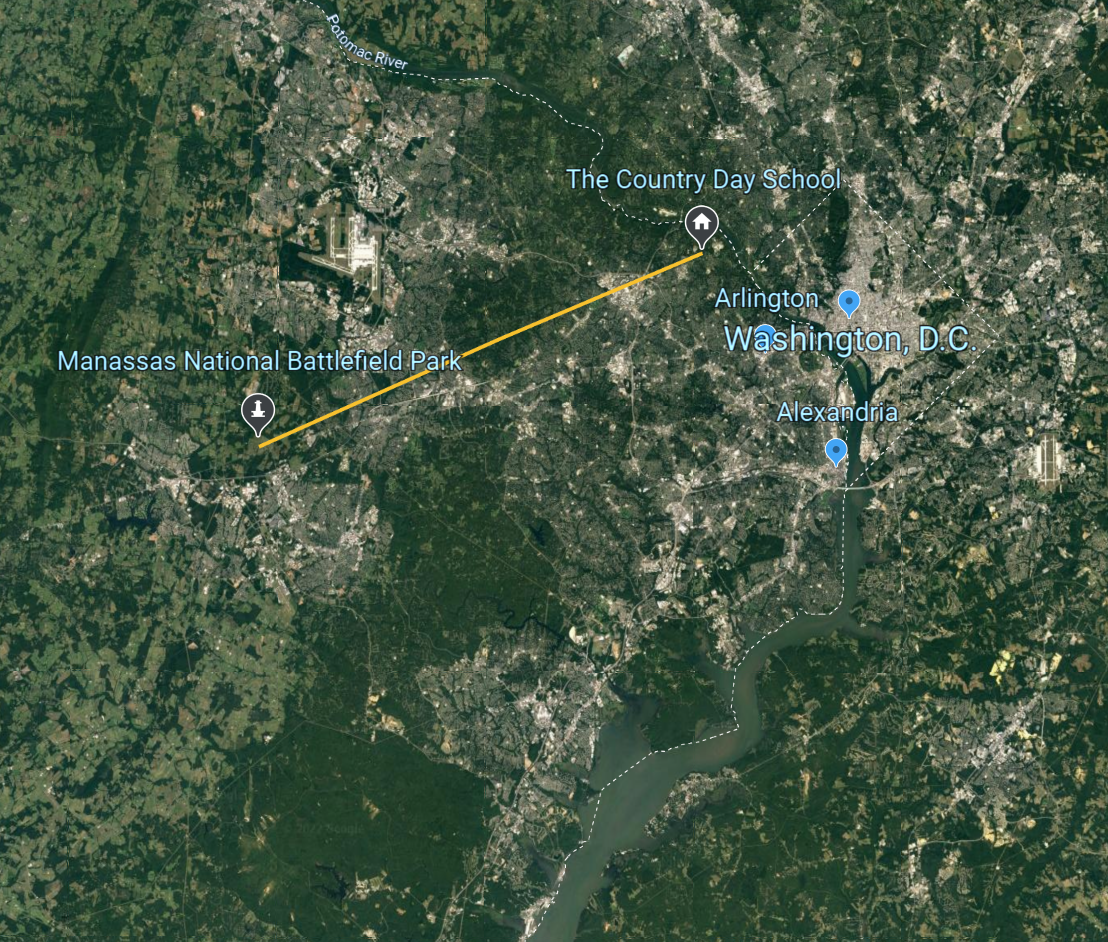
The school is in the Washington, D.C, area (Andrew Gast map, click to enlarge)
The official asked Mrs. McCormick to look at documentation of the markers. “Naturally, we feel the stone in your possession rightfully belongs at the battlefield. We would be most grateful to accept it as a donation to the park’s museum collection should you feel inclined to part with it,” Burgess wrote in 1994. (McLean is about 25 miles from Manassas.)

Burgess said after the letter was sent, the school director “indicated to us by phone that she wanted to retain it for sentimental reasons, I guess. We did not pursue it. We did not have any legal claim to it because it disappeared well before the park was established.”

The letter probably annoyed his mother, said Robert McCormick, and she likely forgot about it over the years, he said.

Dorothy McCormick sold the school and a cottage on the property in 1991 and continued living in the converted barn until her 2018 death at age 96. The family then sold the barn to The Country Day School, which in turn converted it into an office.

Robert McCormick says his mother was very happy while living in the rustic barn. “It was a cozy, homey place.”

Chance review of photos led to donation

The Country Day School and the surrounding neighborhood is rich with history. The main building was constructed in 1858 and at times it served as a church, Civil War hospital and residence. Mrs. McCormick lived in a cottage on the property before moving to the barn.

Converted barn and main building of The Country Day School in McLean (Picket photos)
After the McCormick family sold the old barn, they left school-related items, photos and the marker in the structure.

Early this year, Benton – the office coordinator – went to the structure to find old photographs of the main building for a class of children who are age 3.

She flipped through a photo album and came across the 1994 letter from Burgess. While Benton knew the marker was there, she had not seen the correspondence. “(Mrs. McCormick) did not necessarily agree it was not a soldier’s gravestone.”

“It was very sentimental for Mrs. McCormick. The children thought it belonged here. We felt it belonged to the battlefield.” The school decided to make the donation and reached out to the park.

Robert McCormick was not aware of the donation until reached by the Picket, but he says the family is satisfied with the disposition.

The two 7th Georgia markers still on the field (Manassas National Battlefield Park)
Burgess said he is pleased the marker is back “home.” He would like to see it displayed with a piece of another position marker and a map.

The stone fragment we just acquired lacks sufficient integrity to be put back in the ground.  It would be nice to replace all seven markers with exact reproductions and save the originals in the park collection,” Burgess wrote in an email.

The originals have been subject to damage from tree falls, road construction, vandalism and theft. It would be good to protect what is left of them and still mark the positions the veterans made effort to preserve for posterity. Unfortunately, we don't have the funding to do that.”

Burgess set up this display after the school's donation (Jim Burgess, MNBP)

Wednesday, June 8, 2022

Kennesaw Mountain park in Georgia gets back Civil War artillery shell that was taken away by bomb squad after its discovery

Bomb squad members gingerly removed this round from the battlefield (NPS photos)
Months after a firestorm erupted when the possibility arose of it being destroyed by a bomb squad, a Civil War artillery shell found on the Kennesaw Mountain battlefield in Georgia has been returned to the federal agency that administers the park.

“It is an archeological artifact and has been turned over to the National Park Service,” Cobb County Police spokesperson Officer Shenise Barner told the Picket in a recent email.

A team working on a trail project at Kennesaw Mountain National Battlefield Park in late February found the Parrott shell during a metal detecting survey. The NPS’s Southeast Archeological Survey said it “had a percussion fuse that did not ignite when it hit the ground.”

While police and the park would not indicate whether the shell was intact when it was returned by the bomb squad, their responses to Picket questions left the impression it may have been.

The shell was returned to Kennesaw Mountain National Battlefield Park (KEMO) as soon as the bomb squad rendered it inert and safe, which was approximately two weeks ago,” Chief Ranger Anthony P. Winegar wrote in late May.

Winegar was the trail team member who dug open the area containing the Parrott round, which was about 10 inches deep.

“No modifications were made to the shell other than what was necessary by the bomb squad to render it safe. Live munitions and explosives are rendered inert by removing all explosive compounds,” he recently wrote. “As stated before, the National Park Service (NPS) treats all munitions with extreme caution. The preservation of human life always takes precedence over the preservation of even the rarest museum objects.”

After he uncovered the ordnance, Winegar called the Cobb bomb squad, which took it away. A subsequent social media post about the find by Join Cobb Police brought a crescendo of concern about the shell’s fate, with some saying it could be easily and safely neutralized.

The page responded: "The bomb squad stated that they would love nothing more than to preserve this piece of history, however there is no way to safely render it without counter charging it. They try to use the smallest charge appropriate. This charge is very small and will perforate the case. Unfortunately, even small amount of live explosives can set the whole shell off."

Given that, it appeared the round would be destroyed in the process. In March, Barner told the Picket the ordnance was collected by the bomb squad for safe keeping.

The Picket remained in touch with the park and Barner in the past couple months. While they responded, answers were measured, possibly indicating the sensitivity of the topic.

When asked by the Picket on how the round was handled and whether it was soaked in water or its powder removed, as some experts suggested, Barner said: “We have no additional information to provide on this incident, and we can't disclose the practices and techniques to render inert any explosive compounds.”

Some historians, munition experts and others have questioned why it might be necessary to destroy or damage the item.

"Absolute travesty to destroy this historical object. These are easy to make inert," wrote one person on the Join Cobb Police Facebook page. Jack Melton, publisher of the Artilleryman Magazine, told the Washington Post that a solution was dipping the round in water.

“These shells used paper fuses and black powder, which is not unstable,” he told The Post. “Black powder becomes inert when it gets wet. Given that it was found 10 inches below the surface, it probably already is inactive. I’m sure it got wet from rainwater more than a few times in the past 157 years.”

Winegar and Cobb County police have stressed safety is the absolute priority.

“KEMO does not yet have a plan for what it will do with the shell,” the chief ranger said. “The Park has several inert Parrott shells in its museum collection, including a shell identical to the one found (Feb. 28.)”

Federal and Confederate forces tangled at Kennesaw Mountain and nearby sites from June 19 to July 2, 1864. A large frontal assault by Union Gen. William T. Sherman failed on June 27. Combat over several days produced about 4,000 casualties in the campaign to take Atlanta.

Artillery played a major role in the fighting, according to the NPS. Sherman, eliminating the element of surprise, launched a barrage from below the mountain on June 27 before the assault.

Parrott guns were a mainstay during the war; here one at Gettysburg (Wikipedia)
It had little effect on the Confederates above, who effectively used their guns to halt the subsequent Union attack.

Among the guns used at Kennesaw Mountain was the 10-pounder Parrott rifle, which had a range of nearly two miles.

When asked how the round came to be in the location, Winegar said in March: “I can only say that orientation of the artifact in situ would indicate that it came from the Confederate line towards the Union line. Based on the depth it is possible that it was fired and impacted, likely short of its intended target, and did not detonate. That, however, is speculation.”

At the time, he indicated the round would be “disrupted” – meaning it would be hit with a charge to render it safe. The park would then take custody of the remaining pieces. 

“This is common practice involving potentially unstable unexploded ordinance (UXO) that is not a rare item. Rarer pieces may be treated differently so that the intact piece is not lost. This does not appear to be a rare item.”

Subsequent responses by police and the park have not indicated the shell is now in pieces, but there was no confirmation of its current appearance.

Another view of the Parrott artillery round (NPS)