Showing posts with label cannonball. Show all posts

Monday, February 23, 2026

A cannonball found in North Myrtle Beach by a man with a metal detector likely came to shore during a recent beach nourishment project. Its story goes back to the days of Civil War blockade runners and the ships that chased them

Recovered shell (NMB); type of fuse on shell (Tyrus Tingle); pipe and bulldozer (Dylan Burnell, USACE, Charleston District)
When you’re dredging and then dumping two million cubic yards of sand – equal to 200,000 dump truck loads – onto a 26-mile stretch of shore, small objects are bound to make it through to the beach.

That appears to have been the case when the U.S. Army Corps of Engineers’ Charleston District conducted beach renourishment in North Myrtle Beach, S.C.

Days after that portion of the massive Grand Strand project was completed, a metal detector enthusiast found a 20-pound Civil War-era cannonball in the popular tourist destination. A Horry County Police Department bomb squad deemed the shell – which had a fuse and likely black powder inside -- to be dangerous and neutralized it.

Desirae Gostlin, a spokesperson for North Myrtle Beach police, told the Picket “dredging is our best guess” for the reason the ordnance ended up about a foot deep in front of a resort at 48th Avenue S. and S. Ocean Boulevard.

General vicinity of shell discovery, overlaid on USACE dredging zone map
The Corps said it could not confirm the shell went through a submerged pipeline and to the beach, where other pipes dump sand and water onto the work area. Heavy equipment then shape and grade the sand.

“Discoveries of historic ordnance during beach renourishment in the Charleston District are rare, said public affairs specialist Dylan Burnell.

Artillery shells have turned up elsewhere in the Palmetto State. For example, a Parrott round was found in 2004 at a residential construction site in Murrells Inlet, below Myrtle Beach.

While news reports focused on the metal detectorist and the fate of the cannonball, I wanted to dig into (pardon the pun) the story of the shell, which clearly was in the area of Union naval operations during the Civil War.

Jim Legg, public archaeologist for the South Carolina Institute for Archaeology and Anthropology (SCIAA), said the shell appears to be a 32-pounder that weighed between 21 and 25 pounds. The walls were thick and most likely had a U.S. Navy watercap time fuse with an adapter for a paper fuse.

Rick Simmons, author of “Defending South Carolina's Coast: The Civil War from Georgetown to Little River,” said there was no Confederate artillery in the vicinity of where the shell was presumably dredged up a few miles off North Myrtle Beach. Back then, the coastline was sparsely populated.

So it’s almost certain the ordnance is tied to Federal forces.

Their targets were the constant flow of blockade runners trying to bring desperately needed supplies to Southern ports, notably Wilmington, N.C.

The Official Records (OR) of the conflict include numerous accounts of ships capturing or sinking blockade runners such as the Argyle, James BaileyFlorida, Nicolai I, Vesta, Scotia and the Sue.

“The area from Wilmington to Charleston was quite active, and with no Confederate batteries for about 40 miles in the middle, the Union was always patrolling” near what is now called Myrtle Beach, Simmons wrote in an email.

“My guess is that it was artillery dropped from or fired by … a Union ship,” without the round exploding, he said.

Tourist can't take find back home with him

A metal detecting hobbyist from Dudley, Mass., told News 13 in Myrtle Beach he heard an unusual sound through his headset while walking near the North Beach and Beach Cove resorts on Feb. 7. A North Myrtle Beach police officer helped uncover the object and the county bomb squad was called in.

“HCPD Bomb Squad transported it to a secure, secondary location to safely neutralize it,” Horry County director of public information Thomas Bell told the Picket. “Best determination is that the cannonball dates back to 1850-1860. It was 20 lbs. with a black powder core, so it was determined to be potentially explosive.”

The finder told the local TV station he believes the shell belongs to him because he found it on public property and it has been rendered safe. (At left, authorities at the scene; photo NMB Police)

City and county officials disagreed. People cannot possess explosive devices in South Carolina without proper permits, said Gostlin.

“Although it would definitely be a cool relic to own, the cannonball was not taken home by anyone,” North Myrtle Beach Police said in a Facebook post. “Whether an item is historic or not, if it’s suspected to be explosive, it must be treated as live until professionals determine otherwise. Public safety always comes first.”

Bell said county police cannot release military munitions to the public, even upon demolition. The remains of the shell, he added, will be sent to Shaw Air Force Base.

State underwater archaeologist Jim Spirek said, unfortunately, bomb squads typically destroy ordnance if a fuse is found. “CW ordnance is quite harmless and when proper techniques are applied (they) can be ‘inerted’ safely and saved for study, display, etc.” He mentioned the conservation of scores of fused artillery shells found in the wreckage of the CSS Georgia in Savannah, Ga.

I asked Bell whether the county considered doing the same with this artillery round.

“HCPD places public safety as the highest priority when it comes to such incidents. Due to the nature of the cannonball, HCPD made the determination that disposal was the safest route,” he replied.

There weren't beachgoers back in the day

Now, back to informed speculation about the cannonball.

Spirek, who has conducted numerous studies of Civil War shipwrecks, echoed Simmons’ assertion there were no Yankee or Rebel batteries erected along this specific stretch of the South Carolina coastline.

“Perhaps a small sailing vessel was coming/in out when spotted by a Union warship on patrol that took a pot shot or two at the vessel, or even at a Confederate cavalry patrol. If dredged farther off the coast, then perhaps a shell from one of the running chases between Union blockaders and Confederate blockade runners,” the archaeologist wrote in an email.

Locations of two Rebel forts overlaid on current U.S. Geological Survey map; click to enlarge
Simmons, who has written numerous books and teaches writing and history at the Georgetown (S.C.) School of Arts and Sciences, described the wartime scenario in the region.

The Union navy shelled Fort Ward at Murrells Inlet relentlessly in late 1862 and early 1863. Above that, Fort Randall was positioned at Little River right near the North Carolina border. (Below, the Union's USS Monticello)

“In between you had a long 40-mile stretch of.....nothing. Technically, that whole area from above Georgetown to the North Carolina line is a big island, and if you think about it there are bridges that access the Grand Strand now in Georgetown, leading into Myrtle, and up at OD/North Myrtle. But at the time, it was difficult to get across as there were no real bridges.”

Only Murrells Inlet and Little River were ports, hence the two small, three-gun batteries at those locations.

“There were a few light artillery companies that floated around the district such as the Waccamaw Light Artillery and Santee Light Artillery and others, but while they did engage Union ships on occasion once they entered the rivers (such as the Black, Sampit, Pee Dee, Waccamaw), I don't recall ever seeing anything about them trying to engage Union ships along the coast,” Simmons wrote.

So that puts Federal gunfire on a blockade runner as the most likely scenario for the artifact.

Simmons first thought perhaps it was related to the long chase of the blockade runner Margaret and Jesse in 1863. The USS Nansemond and other vessels captured the vessel in the vicinity and likely opened fire. The author now says they may have nabbed the prize farther out to sea.

How the dredge may have sent round to shore

The U.S. Army Corps of Engineers announced one day before the discovery of the artillery shell it had completed the North Myrtle Beach phase of the beach renourishment. Work on Myrtle Beach follows. (You can follow the project at this tracker)

“The $72 million project is fully funded by the U.S. Army Corps of Engineers and is designed to reduce the risk to life and protect critical infrastructure behind the dunes along the Grand Strand,” the agency said.

I asked Burnell, the spokesperson for the Charleston District, to describe the process, given my curiosity about how the cannonball may have made its way ashore.

Basically, a dredge loosens sand and pumps it through a pipeline to the beach. The system transports dredged material (a mixture of sand and water) from the offshore borrow area to the shoreline.

“If an object is within the borrow area and small enough to pass through the system, it could be transported with the sand. However, we cannot confirm that this occurred in this instance,” Burnell said. (At left, another view of the shell; North Myrtle Beach Police)

At the end of the pipeline, a deflector directs the material into a temporary containment dike. Within the dike, the sand-water slurry spreads out, allowing the sand to settle while the excess water gradually drains back toward the ocean. 

After sufficient dewatering occurs, bulldozers and other heavy equipment shape and grade the sand in accordance with the project’s engineered template, restoring the beach to its designed elevation and profile.

Pipelines used to distribute sand on the shore at North Myrtle Beach (Dylan Burnell, USACE)
Burnell said the USACE wasn’t involved with the discovery of the cannonball or investigation.

Still, it has some advice.

“We appreciate the public’s vigilance and encourage anyone who encounters a suspicious object on the beach to avoid handling it and notify local authorities.”

Artillery shell after bomb squad set off small explosion to disarm (North Myrtle Beach Police)

Thursday, May 23, 2024

The bomb squad removed a cannonball from a flower bed south of Topeka. Was it part of a weapons cache during the Civil War or 'Bleeding Kansas' violence?

The item was found in a small garden in eastern Kansas (Overbrook Police Department)
A bomb squad this week removed a small cannonball from the garden of a house in Overbrook, Kan., near the old Santa Fe Trail, which ran through communities ravaged by the Civil War.

Overbrook Police Chief Eric Carlson said several agencies went to the home on Walnut Street after a call came in Tuesday afternoon. The suspected Civil War ball, described by Carlson as slightly larger than a softball, was removed by Topeka police.

The cannonball was outside in a garden and had been there since at least 2006,” Carlson said Thursday morning in an email to the Picket. “It is believed that the cannonball had been there much longer but buried and recent rain had brought it above ground.

Topeka police have the ordnance “pending a determination on whether or not it can be safely returned or needs to be destroyed,” said Carlson. 

“There is not suspected to be others in the garden and the area was checked. I am unable to identify the exact kind of shell,” Carlson said. “The metal was too thick for the X-ray used by the bomb squad. This is why further investigation was required.

If the ball is saved, he said, it will go the Overbrook Historical Society.

Lance Feyh, a public information officer for the state fire marshal's office, said Topeka police were to consult with the Army’s Fort Riley about the object. The Picket left a message with Topeka police.

Wade Sisson, a board member with the historical society, said the artifact was discovered on the former grounds of the original Overbrook Methodist Church, which was built in 1888. The property now is a private residence. "I'm told by someone who did the initial examination that they estimate it was made sometime between 1860 and 1865," he said in an email.

According to Sisson, the owner told them a basement and first floor for an addition at the church were built and completed in the 1950s. After a 2006 flood, the homeowner had the basement wall excavated to replace a drain.

The trail, shown in red, ran through Overbook, which is a few miles east of Wilmington (NPS map)

The cannonball was discovered during the excavation but it was so mud-packed, it was assumed to be a solid metal ball. The resident placed it in a garden bed by the back door and forgot about it. In May, his son found the item. A rain cleared some mud and when it was put back in a different position they noticed an angle that showed a plug. That is when the owner called authorities.

Carlson said officials determined the cannonball was from the mid-19th century “based on the plug hole and the fact that a large cache of cannonballs that had been stored in Overbrook during the Civil War and Bleeding Kansas period.”

“Kansas sided with the Union during the war and several confrontations during the Bleeding Kansas era were rumored to have taken place in the area," said the chief.

The farm and railroad town was not incorporated until 1886. Overbrook is about 20 miles southeast of Topeka and 25 miles southwest of Lawrence, scene of an 1863 Confederate guerrilla massacre of civilians. Kansas was beset before and during the war by violence among pro- and anti-slavery forces.

Santa Fe Trail Street in Overbrook – which is about a block from the scene -- runs directly along the Santa Fe Trail.

Several battles in Kansas were fought along the historic pioneer corridor, including in Olathe, Westport and Diamond Spring. No fighting was believed to have occurred in Overbrook.

The town's police department includes a Santa Fe Trail covered wagon in its logo (right).

About 1,000 people live in Overbrook.

Sunday, September 17, 2023

For nearly $1.8 million, you can own a Fredericksburg home that comes with elegant features, modern upgrades -- and a Civil War cannonball

408 Hanover Street has retained its character over the years (Jason Buttram Photograhy)
At 408 Hanover St. in Fredericksburg, Va., amid the architectural wonders – a spiral staircase, classic front porch and fluted Doric columns, among them – is an eye-grabbing piece of Civil War history. A cannonball rests among damaged red bricks on an upstairs interior wall, evidence of the December 1862 battle that defines much of the city’s identity.

The piece of ordnance is among the selling points for the 1848 Greek Revival residence that has an asking price of $1.795 million. The property has 5 bedrooms, 5.5 baths and features 5,400 square feet of space, much of it preserved and modernized by its current owners. An arbor, fire pit and rectangular pond provide for extra relaxation outside.

“This home appears to be steeped in history and seems to be very well-kept,” said Kelley Monahan, director of operations for Historic Fredericksburg Foundation Inc., in an email. “408 Hanover is a beautiful home in a historic district within a very historic town.”

The 19th century homes on Hanover Street and surrounding neighborhoods are part of the charm of which Fredericksburg boasts. They are among the survivors of the bombardment and street fighting that shattered the city during the Civil War battle and leveled many residences. Yankee troops moved through the street as they made their disastrous assaults on Marye's Heights.

Battle damage at Hanover and George streets (Library of Congress)
“Today, few visible examples of external battle damage survive in Fredericksburg,” wrote Fredericksburg and Spotsylvania National Military Park then-chief historian John Hennessy in 2010. “I am aware of only a few buildings that show it, and then only subtly. It’s a different story on the interior of buildings in town. Probably dozens still bear scars, and many owners consciously preserve the evidence of battle.”

Such was the case at 408 Hanover St., which has been sold numerous times since the Civil War. The current listing by Amy Cherry Taylor and Associates says the “cannonball room” awaits those ascending the staircase. “Once a sunporch, it now includes a full bath.” (See cannonball in photo 56 of this gallery).

Confederate shells also hit homes

Hennessy, who has since retired from the National Park Service, says that as many as 100 shells a minute exploded over the town during the Dec. 11, 1862, Union bombardment. Scores of homes were destroyed or heavily damaged.

“Bear in mind that not all these buildings were destroyed by Union fire,” he wrote in the park’s Mysteries & Conundrums blog said. “The Confederates fired into town, too, over the next four days; I would estimate that about one-quarter of the town’s damage came from Confederate guns.”

Hennessy has a deep knowledge of the city’s history and operates the “Fredericksburg Remembered” website. I asked him about 408 Hanover St., which he has not visited. (Photo at left of home during 2018 candlelight tour courtesy of HFFI)

“Virtually every house on Hanover had shell damage (much of it likely caused by Confederate artillery firing at the Federal troops as they exited town into the bloody plain beyond), and in several houses it still survives,” he wrote the Picket.

HFFI said it believes the solid-shot cannonball at 408 Hanover came from a Federal gun across the Rappahannock River.

Damage from cannonballs could be extensive and many walls were rebuilt, with the shell placed at the location of impact. Histories of 408 Hanover St. don’t indicate whether that was the case.

Hennessy told the Picket the house was almost certainly used as a hospital by the Union army. “Hanover Street was the main passageway for wounded being carried back into Fredericksburg. I have several accounts of the use of those houses as hospitals.”

The bombardment caused trauma for luckless residents who could not get out.

Fanny White, then 10, later wrote: I ran out into the yard, and as I turned toward the cellar steps I beheld what seemed to me the most brilliant light that I had ever seen….A shell had exploded at the back of the garden….As I looked, my aunt reached out her arms and pulled me, quivering with terror, into the cellar….For long hours the only sounds that greeted our ears were the whizzing and moaning of the shells and the crash of falling bricks and timber.”

The NPS diorama of Hanover Street (Courtesy of John Hennessy)
Interestingly, the oldest exhibit at Fredericksburg and Spotsylvania National Military Park -- in the visitor center basement -- is a detailed diorama depicting Hanover Street during the chaos of battle. The Union army briefly held the town before they were thrown back in a decisive Confederate victory.

The diorama is derived from the famous photograph showing some of Peter Goolrick’s ruined rental properties at the junction of Hanover and George Streets. The detail is amazing, down to addresses being written on the envelopes strewn in the street,” Hennessy wrote in 2010 on Fredericksburg Remembered.

Home was part of an early subdivision in town

The residence was built 15 years before the war came to Fredericksburg.

Realtor Amy Cherry Taylor, who represents the couple selling the home, referred me to the HFFI for further questions on the history of the property. The foundation provided two reports on 408 Hanover Street, adding rich details of its story.

Marker on 408 Hanover (Courtesy of Historic Fredericksburg Foundation)
When it researches a home, HFFI delves into ownership over the years and what changes and renovations have been made.

Anne Catherine Henry purchased lots in that part of Fredericksburg in the 1850s, one of them developed into the property now on sale. It shares a wall with an adjoining home, known as the Hurkamp House, at 406 Hanover Street.

Little is known about Henry’s time in the city; her sons fought for the Confederacy.

A local man acquired the property shortly before the Civil War, according to one report. He left the house and a few enslaved persons to his daughter.

“Prompted by ill health (or premonition), Robert W. Carter made a will in October 1861 that undoubtedly raised eyebrows when it was proved two months later. He left the two lots and house at 408 Hanover to his daughter Anne Catherine Carter for her lifetime, and he made it plain that he hoped she would die a spinster.”

Alfred Waud illustration in Harper's Weekly shows street fighting (Library of Congress)
(HFFI said in a candlelight tour script for the home that  Anne fled to the countryside during the December 1862 battle.)

The homes on Hanover Street were part of a posh subdivision called Allan Town, dating to the early 19th century, according to Hennessy. “It included the lots along the 400 block of Hanover Street. But Allentown never had the identity of, say, Liberty Town -- so few people then or now view the upper end of Hanover Street as part of a larger subdivision,” he said.

408 Hanover originally had 12 fireplaces (later trimmed to eight feeding four chimneys).

The house was rented in the years after the Civil War. In 1876, it was rented to two men named Green. In 1892, the house was sold to the Green family, according to a 2010 article in the Fredericksburg Free Lance Star. 

The Green family lived there for many years, including for a time by Duff Green Jr. and his wife Martha, who were described as gracious hosts.

'Continual restoration and renovation'

The HFFI reports provide extensive detail on major repairs and renovations to the house made beginning in the 1980s. Two second-floor bathrooms were added and the basement was renovated, among many other updates.

The patio behind the home today (Courtesy Jason Buttram Photography)
The home was auctioned in 2014, with the following description:

“An exceptional example of Greek Revival architecture and fine Flemish brick work, the entirety of the 4,800 square foot home has been completely restored to include many modern amenities, but still retains all of its period character. Civil War history literally resides in these walls.”

The cannonball rested at a spot then used as a laundry room.

HFFI reports cite the cannonball, the original spiral staircase and a photograph that the current owners found that was likely of an enslaved person. The chandeliers “somehow survived the Civil War.”

408 is on far right next to Hurkamp House (Courtesy of Jason Buttram Photography)
The property requires “continual restoration and renovation,” the foundation said.

Its current owners, a retired Marine Corps colonel and his wife, “are always mindful that their stewardship of a historical property requires that -- above all -- they maintain 408 Hanover’s authenticity and preserve its distinctive character.”

Friday, September 8, 2023

Officials: Reenactment cannonball found at North Carolina school

A crew clearing vegetation around a school in coastal North Carolina came across what is believed to be a Civil War reenactment cannonball, prompting evacuation of the school and response from a Camp Lejeune explosive ordnance disposal team.

The cannonball had been “in place long enough that woody vegetation had grown around it, to the point that it had to be cut away so the object could be removed,” Onslow County Schools said about the Thursday incident at the Onslow County Learning Center.

The EOD team from the Marine Corps base determined the object, which had been unseen for a significant amount of time, was found to be inert with no explosives, and it was removed, officials said.

“Safety is Onslow County Schools’ top priority, and we appreciate the support and collaboration of our local emergency responders, as well as our families, as we work to keep our schools safe and secure,” the district said.

The Picket asked the district how the shell may have come to be there and what happened to it after removal. Public information assistant Jessica Wells said Onslow County Schools had no other information it could share.

Friday, December 23, 2022

Cannonball found at Fort Sumter likely to be used for training

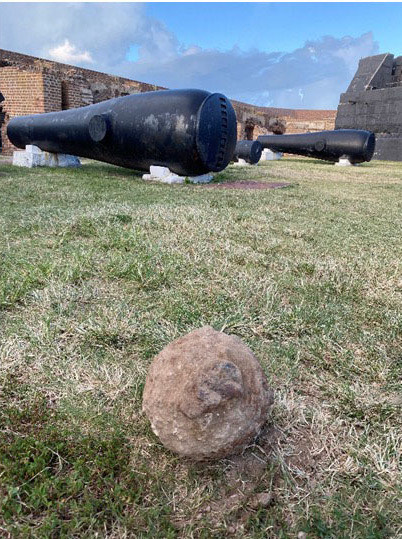
A cannonball spotted jutting out of the lower parade ground at Fort Sumter is being kept by the U.S. Air Force and likely will be used as a training aid, park officials said this week.

In August, a keen-eyed visitor at Fort Sumter, where the first shots of the Civil War were fired, noticed the corroded round. Experts from Joint Base Charleston were called in and they removed the ordnance (Photo: Charleston police).

The Picket asked Brett Spaulding, chief of interpretation at Fort Sumter and Fort Moultrie National Historic Park, for information on what became of the cannonball.

It was found to be solid shot, with no potentially hazardous black powder or fuse, he said. Spaulding said he not know what type of ordnance was found.

Spaulding in August said officials don’t have any documentation that would provide clues to how the shell came to be buried in the parade ground, when that occurred and whether it had been fired. It’s possible it was on site for 160 years, but he warned against speculation.

Confederates bombarded the South Carolina fort in April 1861, leading to its surrender. Union forces pounded away at Rebel defenders for the remainder of the conflict. Officials said they are uncertain whether the shell was Confederate or Union. No measurements were made on site.

The park said artifacts occasionally surface. “While digs have occurred on site, foot traffic, weather, erosion from elements, etc. can cause resources to be uncovered,” officials said in response to a question over how the shell just now was seen.

The Picket reached out to Joint Base Charleston public affairs for comment.

Tuesday, August 9, 2022

Fort Sumter visitor spies part of Civil War cannonball exposed in parade ground. How it got there and its back story remain a mystery

A keen-eyed visitor at Fort Sumter, where the first shots of the Civil War were fired, noticed a corroded cannonball protruding from the lower parade ground, prompting a bomb squad to be brought in, officials said on Tuesday.
 

The discovery occurred Saturday. The area was closed off and the last scheduled tour boat canceled, Fort Sumter and Fort Moultrie National Historical Park said in a Facebook update. Normal operations at the famous Charleston, S.C., venue resumed Sunday.


The park said artifacts occasionally surface. “While digs have occurred on site, foot traffic, weather, erosion from elements, etc. can cause resources to be uncovered,” officials said in response to a question over how the shell just now was seen.


“Only a small part of the ordnance was visible, making it easy to miss.” (Both photos: City of Charleston police)


Brett Spaulding, chief of interpretation at the park, told the Picket in an email that the visitor contacted staff who contacted Charleston police, which sent its explosive devices unit.


We do not know what type of ordnance it is. The ordnance was heavily corroded. The explosive technicians who examined suspected it was solid shot, but the final determination is made by military EOD,” Spaulding wrote in response to Picket questions. “The Air Force took the ordnance back to their facility to be x-rayed. We don't know what will happen after that. If they suspect black powder is present, it will be destroyed. We do not have the training to handle found ordnance.”

There were no injuries or damage to historic structures with the cannonball’s removal by experts with the military’s Joint Base Charleston.
 

Spaulding said officials don’t have any documentation that would provide clues to how the shell came to be buried in the parade ground, when that occurred and whether it had been fired. It’s possible it was on site for 160 years, but he warned against speculation.


Confederates bombarded the fort in April 1861, leading to its surrender. Union forces pounded away at the Rebel fort defenders for the remainder of the conflict. Officials said they are uncertain whether the shell was Confederate or Union. No measurements were made on site.


“The US Air Force will make further decisions as to what will happen with the cannonball. We hope to get a disposition report from them at some point,” Spaulding said, adding it was up to the military branch to identify the weapon.


Tuesday’s Facebook post said it is important for visitors to be aware of their surroundings and “look for even the tiniest of details.”


Furthermore, they should alert rangers of any such finds.

When asked whether there have been other such incidents, Spaulding told the Picket, “There are three solid shot rounds imbedded in the left face of Fort Sumter that visitors can see.  There is certainly a possibility of other discoveries, but we are unaware of any documentation that provides any information.” 

Friday, July 8, 2022

Police said a Civil War-era munition found at a Massachusetts antiques collector's home was destroyed by bomb squad

Police provided few details on the item (Mansfield Police)
Updated July 17: A police department in a Massachusetts town 40 miles south of Boston said an apparent Civil War-era cannon munition found in the home of a deceased antiques collector was detonated by a bomb squad.

Police in Mansfield -- which has a population of nearly 25,000 -- said on social media that the artifact was found Thursday evening (July 7) by family members at their deceased father’s home. They were cleaning the residence at the time.

An X-ray done by Massachusetts State Police found “an unknown substance inside that necessitated a prompt controlled demolition.” Mansfield police did not elaborate on the substance.

We want to apologize to our neighbors for the late-night noise,” the post said of the demolition.

“If you ever come across something similar, whether it be a cannonball or just old ammunition, call us and we will come to you. Don’t drive it to us and definitely don’t walk into the station with it.”

The Picket reached out Friday to the department with questions about the find and was told it would attempt to answer them.

The Facebook post showed a metal object in someone’s hand, with a hole at the top of the ball. The Picket asked readers of Facebook pages focusing on Civil War artillery for help identifying the item, but there was no consensus. Some said without more details they could not confirm it was a Civil War ball.

Massachusetts State Police on July 14 said the ball was 4 inches in diameter.

"The Bomb Squad Troopers ... took multiple x-rays of the object, which revealed inconsistencies within, indicating its interior was not homogenous matter. The x-ray image was consistent with cannonballs that have an interior void space filled with whatever explosive material was used by its manufacturer," read a Facebook post.

"Based on that finding, as well the Troopers’ experience and additional research, they determined that the item was a Civil War-era cannonball and that it could be live," the agency said, adding troopers said the best and safest decision was to blow it up.

"The manner in which the ball exploded when countercharged confirmed the Troopers’ suspicions that it was indeed live and still could have posed a threat."

Tuesday, March 23, 2021

Maryland resident given a live cannonball found near Monocacy battlefield calls the bomb squad

Cannonball before its disposal (Maryland State Fire Marshal)
A live Civil War cannonball found near Maryland’s Monocacy battlefield was disposed of after a homeowner who was given the ordnance became alarmed and called authorities.

The office of the Maryland State Fire Marshal on Tuesday said it got the call a day earlier from a homeowner in Jefferson in Frederick County.

The homeowner was given the cannonball by a family member who had found it near the site of the 1864 battle. Another family member told the resident that it could be live. Bomb technicians determined the fuse was intact, removed the artifact and conducted an emergency disposal, officials said.

“As proven today, the finding of military ordnance from the Civil War is not uncommon in Maryland, and these devices pose the same threat as the day they were initially manufactured,” the office said in a Facebook post.

Oliver Alkire, senior deputy state fire marshal, told the Frederick-News Post that the homeowner’s relative was using a metal detector near Monocacy National Battlefield, which does not permit them. No charges are expected, because the cannonball was found outside the park.

The cannonball was at the home for several months, Alkire told the newspaper, which indicated the round was blown up. "It would have caused significant damage" if it went off.

“If you should uncover or are unsure if an unidentified object may be military ordnance, be safe rather than sorry. Stay away and call 911,” said State Fire Marshal Brian S. Geraci.  “Marylanders need to be mindful that military ordnance, even vintage artifacts from previous conflicts, have the potential to explode.”

The fire marshal’s office did not specify what kind of shell was found. Some on social media lamented that the shell had not been defused by authorities and saved, but others said it may have been unstable and there are plenty of safe shells housed in museums and historic sites.

Thursday, February 13, 2020

They were digging a swimming pool in Charleston and thought they may have found a cannonball. It didn't turn out that way

A softball-sized object was found in yard. (Charleston Police)

It's not unusual for police in Charleston, S.C., to get a call about an artillery round discovered during construction or in the recesses of a building. After all, the Civil War began here, and there was plenty of ammunition stored, fired or lost during the conflict.

Case in point: On Wednesday, workers digging a swimming pool in the backyard of a residence on Ashley Avenue came across a round object they believed to possibly be a cannonball.

Instead, it was a wooden buoy, said police spokesman Charles Francis.

According to a police report, one of the workers described the item as being the size of a softball, possibly made of wood and "shaped like a small cannonball." He moved the object to ground level and contacted authorities. 

The police Explosive Devices Team determined the item was not lethal and deemed it harmless.

Just last week, an artillery shell was found in downtown Charleston in the basement of a building undergoing work. While first reports indicated it was likely a Parrott rifle shell, experts later said it was from around World War I.

In that incident, city police called an Air Force explosive ordnance disposal team to take it away. That wasn’t necessary on Wednesday, Francis told the Picket.

While he doesn’t keep track of such calls, the spokesman said the department does get calls from time to time about potentially dangerous wartime artifacts. They’ve been found on beaches and during construction.

Francis has simple advice for anyone who finds such an item: “Just call the police.”

Wednesday, November 30, 2016

Second cannonball will be blown up

A Savannah, Ga., police bomb squad and Fort Stewart’s Army EOD will conduct a controlled explosion Wednesday of a Civil War-era cannonball found at an excavation site near Broughton and Barr streets. It is the second found in recent days. • Article

Monday, June 21, 2010

The first cannonball fired at Fort Sumter sits outside a Georgia courthouse. Or does it?

Virginia planter Edmund Ruffin’s first foray into South Carolina seemed peaceful enough. He came to preach advancements in agriculture, crop rotation among them.

When he returned to Charleston on the eve of the Civil War, however, Ruffin brought with him the seeds of Southern independence.

At 4:30 a.m. on April 12, 1861, the 66-year-old slaveholder, "fire eating" secessionist and Palmetto Guards volunteer tucked his long white mane under his hat and fired one of the first shots of a war that would kill more than 600,000 Americans.

“The first shell from Columbiad No. 1, fired by the venerable Ruffin burst directly upon the parapet of the southwest angle of the fort,” wrote Capt. G. B. Cuthbert of the Palmetto Guards.

Thirty-four terrifying and exhausting hours after Ruffin put fire to fuse on Cummings Point, Col. Robert Anderson and his Union garrison surrendered.

The bombardment, of course, had thousands of eyewitnesses. Legends were born instantly.

One of them involves P.W. Alexander, an intrepid correspondent from Thomaston, Ga., who made a bee line to Fort Sumter with a purpose. He wanted to retrieve that historic first shot fired by Ruffin.

“The big 10-inch ball fell within Fort Sumter without doing any damage,” reads an old Thomaston Times article. “Alexander, who for years had boarded in the home of Mr. and Mrs. B. B. White, was an eyewitness to this scene. He saw just where the ball fell and immediately after the surrender procured it and sent it to his friend, B.B. White."

Today, nearly 800,000 people each year take the ferry ride to Fort Sumter to see where the carnage and restoration of the Union began. Many fewer tread on the grounds of the Upson County courthouse in Thomaston, 300 miles from Charleston and 60 miles south of Atlanta.

If they do, they’ll see a tall monument to Confederate dead and that cannonball retrieved by Alexander, perched on a marble monument with this 1953 inscription:

"Presented to the UDC [United Daughters of the Confederacy] by Mrs. Sallie White to whom it was given in 1861 by P.W. Alexander, leading Confederate war correspondent who was present when the ball was fired and knew it to be the first. The first marker stating these facts was erected on this square in 1919."

The cannonball had a more practical household purpose before it was ensconced on the monument pedestal.

“A colorful Upson tale says that P.W. Alexander retrieved the first cannonball fired in the Civil War from the mud in front of the fort, and brought it back to the B. B. White family in Thomaston,” according to a 1998 article by USGenWeb Archives. “The story maintains that this relic served as a door stop at the house, or lay under the porch, for several decades before being elevated to the marble pedestal on which it graces Thomaston's courthouse square today.”

Alexander, a lawyer and noted Confederate war correspondent who wrote about the brutality of war, can’t confirm the tale. He died in 1886.

Penny Cliff, director for the Thomaston-Upson Archives, and her staff have to do the talking for him.

"Whenever I give tours around the square I use the word 'allegedly' in regards to the 'first' cannonball fired at Fort Sumter," Cliff said.

"I do, however, believe it is definitely one of the 'hot shots' fired at the fort. Even if it is not the first, it is historically important in the fact that it is one of the cannonballs fired at Fort Sumter."

History, of course, is subjective and never 100 percent accurate. It’s fair to say that we really don’t know if this iron ball was, in fact, the first shot fired during the Civil War. Historians even disagree on whether another Confederate battery first fired on Sumter, cheating Ruffin of the honors.

But one thing is for certain.

In June 1865, two months after the South surrendered, a despondent Edmund Ruffin took up another firearm.

He propped his rifle on a trunk between his feet, stuck the barrel into his mouth and opened fire.

The war was over.