Showing posts with label artillery shell. Show all posts

Tuesday, September 29, 2026

Woman came across this Bormann shell while cleaning a house in NE Pennsylvania. Turns out she and property owner found it while scuba diving years before

A woman who came across a Civil War artillery shell while cleaning a residence in northeastern Pennsylvania told police she and the owner of the property found it decades ago on the East Coast.

Conyngham police Chief Thomas Eibach told the Picket in an email Tuesday he was notified of the discovery on Main Street on Sept. 24. The department photographed the item (left) for identification.

The bomb squad for Scranton police subsequently determined it was a Civil War shell that potentially still contained case shot and explosive material. Artillery expert Jack W. Melton Jr. said it appears to be a Bormann shell made for Union forces.

“The person cleaning out the property was not the property owner; however, (she was) a family friend who is an executor of the property, being its original owner has passed away,” said Eibach.

“In that same respect of being a family friend, she and the original owner of the property were avid scuba divers, diving all over the world. From her recollection, this item was discovered while diving on the East Coast approximately 20-30 years ago and brought home as a souvenir, not knowing what the item was.”

Someone who saw the artifact in a garage told the woman it was possibly military ordnance, officials said.

An Army Explosive Ordnance Disposal (EOD)  team, believed to be the 55th Ordnance Company based in Fort Belvoir, Va., was called in. (The closest military installation is Fort Indiantown Gap, a National Guard facility.)

Courtesy Jack W. Melton Jr. / CivilWarArtillery.com
Eibach said the team had forwarded him a Melton diagram (above) of a cross section of an artillery round of that type. The diagram indicates a Bormann fuse and deadly case shot inside.

The Army team took the artifact away. A public affairs spokesperson at Fort Belvoir said the round was likely destroyed. He did not know what type of shell it was. (Photograph, below, Conyngham Police)

Even 165 years later, Civil War ordnance is found, whether in homes, the ground or on coast lines. Several years ago, a huge cache was found at the Allegheny Arsenal in Pittsburgh, Pa. The facility made a wide variety of cannon shot for Federal forces.

Eibach said this type of incident was a first for him.

“However, several years prior an inert hand grenade was discovered in an attic during a home clean-out. From time-to-time, Revolutionary War Items are discovered in our area, some of which are on display at the Conyngham Valley Historical Society-Museum on Main Street. These items I believe are from the time surrounding the battle known as the Sugarloaf Massacre.”

The massacre occurred in September 1780. Native American warriors and British loyalists surprised militia, killing up to 15 soldiers. 

Tuesday, August 9, 2022

Fort Sumter visitor spies part of Civil War cannonball exposed in parade ground. How it got there and its back story remain a mystery

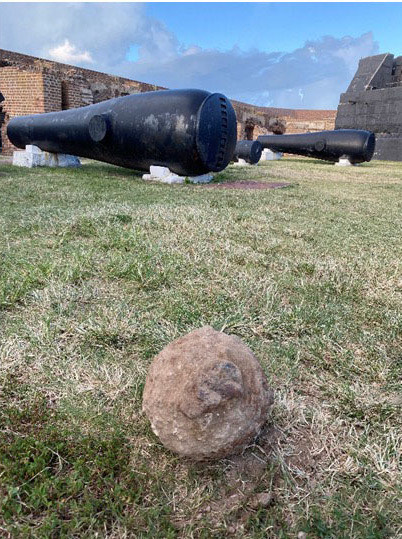
A keen-eyed visitor at Fort Sumter, where the first shots of the Civil War were fired, noticed a corroded cannonball protruding from the lower parade ground, prompting a bomb squad to be brought in, officials said on Tuesday.
 

The discovery occurred Saturday. The area was closed off and the last scheduled tour boat canceled, Fort Sumter and Fort Moultrie National Historical Park said in a Facebook update. Normal operations at the famous Charleston, S.C., venue resumed Sunday.


The park said artifacts occasionally surface. “While digs have occurred on site, foot traffic, weather, erosion from elements, etc. can cause resources to be uncovered,” officials said in response to a question over how the shell just now was seen.


“Only a small part of the ordnance was visible, making it easy to miss.” (Both photos: City of Charleston police)


Brett Spaulding, chief of interpretation at the park, told the Picket in an email that the visitor contacted staff who contacted Charleston police, which sent its explosive devices unit.


“We do not know what type of ordnance it is. The ordnance was heavily corroded. The explosive technicians who examined suspected it was solid shot, but the final determination is made by military EOD,” Spaulding wrote in response to Picket questions. “The Air Force took the ordnance back to their facility to be x-rayed. We don't know what will happen after that. If they suspect black powder is present, it will be destroyed. We do not have the training to handle found ordnance.”

There were no injuries or damage to historic structures with the cannonball’s removal by experts with the military’s Joint Base Charleston.
 

Spaulding said officials don’t have any documentation that would provide clues to how the shell came to be buried in the parade ground, when that occurred and whether it had been fired. It’s possible it was on site for 160 years, but he warned against speculation.


Confederates bombarded the fort in April 1861, leading to its surrender. Union forces pounded away at the Rebel fort defenders for the remainder of the conflict. Officials said they are uncertain whether the shell was Confederate or Union. No measurements were made on site.


“The US Air Force will make further decisions as to what will happen with the cannonball. We hope to get a disposition report from them at some point,” Spaulding said, adding it was up to the military branch to identify the weapon.


Tuesday’s Facebook post said it is important for visitors to be aware of their surroundings and “look for even the tiniest of details.”


Furthermore, they should alert rangers of any such finds.

When asked whether there have been other such incidents, Spaulding told the Picket, “There are three solid shot rounds imbedded in the left face of Fort Sumter that visitors can see.  There is certainly a possibility of other discoveries, but we are unaware of any documentation that provides any information.” 

Thursday, February 6, 2020

Artillery shell found by electrical workers in downtown Charleston building likely not from the Civil War, experts say

Artillery round awaits removal in parking lot. (Charleston Police)
[Updated Feb. 6]

It appears an artillery shell found in the basement of a Charleston, S.C., building may not be from the Civil War after all.

Roads were closed for a few hours Wednesday after workers found the round at an empty building on Gillon Street, Charleston police tweeted. A U.S. Air Force explosive ordnance disposal team (EOD) took custody of it. In most such cases, a shell is then destroyed.

Initially, police tweeted the shell was postwar, but a second tweet in the afternoon indicated it was determined to be from the Civil War.

The facility manager at the nearby Old Exchange and Provost Dungeon told the Post and Courier that the ordnance looked like an 8-inch round for a Civil War Parrott gun.

But Tony Youmans told the Picket on Thursday he later asked a retired historian at Fort Sumter about it. In turn, an artillery expert in the area weighed in.

"It turns out that the round is definitely post- American Civil War, either Spanish-American, WWI or WWII," Youmans said. "They believe WWI most likely. For reference, we do have an 8-inch Union Parrott round on display."

Jack Melton, who publishes the Civil War News and the Artilleryman magazine, told the Picket that while he couldn't immediately identify it, he believes the round is from World War I or later.

The Charleston newspaper said electrical workers found the shell in the corner of the basement and one carried it out to the parking lot, where they decided to call police.

“To me, what’s really scary is the fuse is in place, Youmans told the Post and Courier. 

The Picket reached out to Charleston police for comment.