Showing posts with label recovered. Show all posts

Tuesday, October 22, 2024

USS Cairo gets a much-needed deep cleaning at Vicksburg. The hope is one day the ironclad removed from the Yazoo River will be moved inside to safeguard its future

A conservator studies the white oak and yellow pine used in construction (NPS photo)
The first step in ensuring long-term protection of the remnants of USS Cairo, the first armored vessel sunk by an electrically detonated torpedo, has included the removal of 555 pounds of dirt and debris – and counting.

Terra Mare Conservation has been at Vicksburg National Military Park in Mississippi since September, conducting dry and wet cleaning of the canopy-covered Union vessel. Park officials say it’s the first time in more than a decade the vessel has undergone “critically needed cleaning and conservation work.”

Superintendent Carrie A. Mardorf told the Picket in an email that nothing is being rebuilt or replaced. “The NPS is taking a strictly preservation approach to the gunboat.”

Terra Mare also is repairing and stabilizing any damaged areas of the white oak and yellow pine used in construction. Corrosion on the bow and cannons is being treated and paint is being touched up.

The Cairo and accompanying museum officially opened in 1980 (NPS)
The ironclad sank in the Yazoo River on Dec. 12, 1862, after it struck a floating Confederate mine. It went down in 12 minutes. Recovered in the 1960s, the Cairo has been a popular draw at the Civil War park since the late 1970s.

The park has posted a couple updates on Facebook, prompting some commenters to ask why the famed wreck is not in a building, away from the elements..

“Enclosing the USS Cairo in an interior setting with climate control is ultimately the best way to preserve the boat for future generations,” Mardorf told the Picket. “All of the recent science and studies that the park has completed in the past year recommend protecting the gunboat with an interior enclosure; however, doing so would require specialized construction funding.”

Congress is currently considering reauthorization of the Great American Outdoors Act (GAOA), she said. “If renewed, GAOA may provide some funding for the long-term preservation of the USS Cairo.”

Recent work on the site and vacuum bags containing dirt and debris (NPS)
For now, conservators are giving the warship TLC and a top-to-bottom cleaning, removing dirt, dust, pollen, rodent and bird nests, bird guano and trash.

“The biggest surprise thus far has been the amount of dirt removed. As Terra Mare cleans, they are learning a lot more about the condition of the wood and metals, which will be summarized in a final report for the park,” said Mardorf.

The team this week is cleaning the metal pilot house and boilers.

Work is expected to conclude in mid-November. Further temporary closures of the exhibit are possible to protect the public from airborne particles.


The USS Cairo has been treated with a variety of chemical sprays and coatings since the 1970s. Additional studies will be carried out to determine if fungal and insect infestations are present, according to a park summary of the project. “Long-term, the park will embark on a regular, cyclic cleaning and conservation schedule for the ship.”

Mardorf says all of what the public sees is original, with the exception of the 1980s Glulam structure that holds the boat in place.  

The end comes in the Yazoo River above Vicksburg

The USS Cairo’s fame has far exceeded its brief history. Built in a hurry in Mound City, Ill., and commissioned in January 1862, the ironclad sank only 11 months later.

The USS Cairo at anchor in 1862 (Library of Congress)
At 175 feet long and with a top speed of six knots, the vessel carried 13 guns and 251 officers and men. Seven shallow-draft City Class river ironclads prowled the Mississippi River and connecting shallow waterways, menacing Confederate supply lines and shore batteries, the National Park Service says.

The Cairo saw limited action at Plum Point (Fort Pillow), Tenn., in May 1862 and Memphis the following month. Before the Federal attack on Haynes Bluff, Cairo skipper Lt. Cmdr. Thomas O. Selfridge Jr. (below) led a small flotilla of gunboats into the hazardous confines of the Yazoo River on Dec. 12, 1862.

“Tasked with destroying Confederate batteries and clearing the river of torpedoes (underwater mines) the flotilla inched its way up the murky waters. As the Cairo reached a point seven miles north of Vicksburg the flotilla came under fire and the aggressive Selfridge ordered his guns to the ready and called for full steam, bringing the ironclad into action,” the NPS says.

“Seconds later, disaster struck. Cairo was rocked by two explosions in quick succession. The first tore and gaping hole into the port (left) bow of the wooden hulled ironclad. The second detonated a moment later near the armored belt amidships on the starboard side. The hole on the bow proved to be catastrophic.”

Selfridge ordered the Cairo to be beached and the crew to abandon ship. The Cairo slid from the river bank into 36 feet of water with no loss of life. About a half dozen sailors were injured.

Mud protected the ironclad for almost 100 years

The ill-fated ironclad disappeared into history for nearly a century.

Using maps and an old military compass, the legendary Ed Bearss, a historian at Vicksburg National Military Park at the time, and two comrades found the mud-encased ironclad in 1956.

Despite financial shortfalls, barge problems and a zero-visibility river that deposited silt at an alarming rate, the vessel was eventually raised in 1960 and 1964-65.

A portion of the casemate rests on a barge in the Yazoo River (NPS)
Hopes of lifting the ironclad and her cargo of artifacts intact were crushed in October 1964 when the three-inch cables being used to lift the Cairo cut deeply into its wooden hull. It then became a question of saving as much of the vessel as possible. The decision was made to recover the USS Cairo in three sections.

Barges carried the remnants to Pascagoula, Ms. The wreck was moved in 1977 to the Vicksburg park, where it was partially reconstructed and placed on a concrete foundation.

The recovery of artifacts revealed a trove of weapons, munitions, naval stores, and personal property that help tell the story of the sailors that once called the ship home, according to the NPS.

Thursday, May 23, 2024

The bomb squad removed a cannonball from a flower bed south of Topeka. Was it part of a weapons cache during the Civil War or 'Bleeding Kansas' violence?

The item was found in a small garden in eastern Kansas (Overbrook Police Department)
A bomb squad this week removed a small cannonball from the garden of a house in Overbrook, Kan., near the old Santa Fe Trail, which ran through communities ravaged by the Civil War.

Overbrook Police Chief Eric Carlson said several agencies went to the home on Walnut Street after a call came in Tuesday afternoon. The suspected Civil War ball, described by Carlson as slightly larger than a softball, was removed by Topeka police.

The cannonball was outside in a garden and had been there since at least 2006,” Carlson said Thursday morning in an email to the Picket. “It is believed that the cannonball had been there much longer but buried and recent rain had brought it above ground.

Topeka police have the ordnance “pending a determination on whether or not it can be safely returned or needs to be destroyed,” said Carlson. 

“There is not suspected to be others in the garden and the area was checked. I am unable to identify the exact kind of shell,” Carlson said. “The metal was too thick for the X-ray used by the bomb squad. This is why further investigation was required.

If the ball is saved, he said, it will go the Overbrook Historical Society.

Lance Feyh, a public information officer for the state fire marshal's office, said Topeka police were to consult with the Army’s Fort Riley about the object. The Picket left a message with Topeka police.

Wade Sisson, a board member with the historical society, said the artifact was discovered on the former grounds of the original Overbrook Methodist Church, which was built in 1888. The property now is a private residence. "I'm told by someone who did the initial examination that they estimate it was made sometime between 1860 and 1865," he said in an email.

According to Sisson, the owner told them a basement and first floor for an addition at the church were built and completed in the 1950s. After a 2006 flood, the homeowner had the basement wall excavated to replace a drain.

The trail, shown in red, ran through Overbook, which is a few miles east of Wilmington (NPS map)

The cannonball was discovered during the excavation but it was so mud-packed, it was assumed to be a solid metal ball. The resident placed it in a garden bed by the back door and forgot about it. In May, his son found the item. A rain cleared some mud and when it was put back in a different position they noticed an angle that showed a plug. That is when the owner called authorities.

Carlson said officials determined the cannonball was from the mid-19th century “based on the plug hole and the fact that a large cache of cannonballs that had been stored in Overbrook during the Civil War and Bleeding Kansas period.”

“Kansas sided with the Union during the war and several confrontations during the Bleeding Kansas era were rumored to have taken place in the area," said the chief.

The farm and railroad town was not incorporated until 1886. Overbrook is about 20 miles southeast of Topeka and 25 miles southwest of Lawrence, scene of an 1863 Confederate guerrilla massacre of civilians. Kansas was beset before and during the war by violence among pro- and anti-slavery forces.

Santa Fe Trail Street in Overbrook – which is about a block from the scene -- runs directly along the Santa Fe Trail.

Several battles in Kansas were fought along the historic pioneer corridor, including in Olathe, Westport and Diamond Spring. No fighting was believed to have occurred in Overbrook.

The town's police department includes a Santa Fe Trail covered wagon in its logo (right).

About 1,000 people live in Overbrook.

Monday, March 18, 2024

Lost (stolen), found and sold: 48 portraits from Herb Peck's prized collection, plundered in 1978 Nashville burglary, have new homes after auction

Florida soldier with carbine; siblings with 3rd Tennessee (Fleischer's Auctions)
Forty-eight photographs, mostly of young Southern men toting rifles, Bowie knives, revolvers and fierce gazes, sold for $259,000 (excluding buyer’s premium) at a weekend auction, pleasing the widow and son of an esteemed collector who curated the images before they were stolen in 1978.

The family of Herb Peck Jr. enlisted the help of law enforcement, other collectors and Military Images magazine in their hunt for 117 images taken during a burglary at their Nashville home.

Peck  began collecting in the 1950s ahead of the Civil War centennial, amassing one of thepremier collections of Civil War portrait photography at a time when the genre’s importance was only first being realized,” said Fleischer’s Auctions.

Peck died at age 67 in 2004 before any of the photographs were recovered. One was located in 2006, 39 were seized during a 2020 raid and eight more were returned in the past year.

Herb Peck Jr. with some of his photos in the 1970s. (Fleischer's Auctions)
Fleischer’s Auctions said representatives of the family attended the three-hour Saturday sale in Columbus, Ohio.

“It’s been an emotional process for everyone involved,” the company said in an email to The Civil War Picket.

Adam Fleischer, in a social media post after the sale, said high interest in the photographs reflected Peck’s eye for quality. “The Peck family's decision to share Herb’s captivating images with the public, following decades of uncertainty, resonated deeply with collectors and history enthusiasts alike.”

The top seller Saturday was lot 45, entitled “Confederate with Colt Revolving Rifle.” It went for $32,200 with the buyer’s premium. The subject wears an outdated cap topped by a havelock and holds a Model 1855 Colt revolving rifle. It’s possible he was from Virginia, according to Fleischer’s.

“This is a masterpiece of Southern photography and I chose it for the cover (left) that featured the story about Herb's collection,” Ronald S. Coddington, editor and publisher of Military Images, told the Picket. (Fleischer’s Auctions is an advertiser with the magazine)

Behind that was lot 34, entitled “Masterful Character Study,” which realized $24,300 with the buyer’s premium. The portrait depicts James and Calvin Walker of the 3rd Tennessee Infantry. Calvin was killed in action in Georgia in 1864, with an eyewitness noting that nothing was left of his head after he was hit by artillery shrapnel but “"...[a] chin and rather long whiskers.”

Images going for high prices included a Tennessee infantrymanFlorida soldier with carbine and a Confederate private armed with a Model 1842 musket, Bowie knife, and pair of large Colt Navy revolvers.

Coddington said he found lot 28, a photograph of a Confederate first sergeant, to be particularly compelling (right, courtesy Fleischer's Auctions).

He cites “the focal clarity of the image, the look of the soldier, the way he holds his saber and the unusual paper mat that was likely used as a substitute for brass mats that were unavailable in the South due to the blockade and loss of territory.

Ahead of the sale, Fleischer’s Auctions said the collection was once thought lost forever.

Coddington, in a Military Images article about Peck, said photographs from the collection were published in “The Civil War” by Ken Burns and in more than 50 books, magazines and articles, including Time-Life’s “The Civil War” series, the “Confederate Faces” series and “Civil War Times.”

Burglars hit the Peck home in September 1978, making away with 117 images, cameras and more than a dozen weapons.

Law enforcement agencies in Tennessee and the FBI worked on the case as several photographs appeared for sale on online sites. The FBI office in Indianapolis netted one image in 2006.

Peck’s son asked Military Images to revive the case in 2016 and he created a poster showing many of the photographs. The FBI and police in Ethridge, Tenn., recovered 39 images in an October 2020 raid. Eight more turned up later. (Southern musicians with fife and drum, left)

About 70 photographs are still to be recovered, according to Coddington. The publisher says the family is committed to their return. “Due to the active nature of the investigation and concerns from the family about jeopardizing the investigation, this is all I am able to state at this time.”

Saturday’s auction must have brought some satisfaction to Peck’s family.

Peck’s widow, Felicity, previously told Military Images: “I remember how distressed the collectors were at the time of the burglary. It has always been a comfort to me that others care about the importance of these images as historical, visible and tangible evidence of this country.”

Saturday, November 18, 2023

Archaeologists found 500 Civil War items, including cannonballs, during tar cleanup in Columbia, S.C., river. Here's some of what they found in 'literal war zone'

Grapeshot, canister, 6-pound round (Photos courtesy of Sean Norris, TRC, 2023)
Some of the captured weapons and ammunition that Union Maj. Gen. William T. Sherman’s troops dumped into the Congaree River in Columbia, S.C., in the last months of the Civil War reemerged during a recent environmental project that removed tar from the riverbed.

Hundreds of Civil War artifacts have been recovered, including cannonballs, canister, remnants of a saber and wagon wheel and dozens of bullets. In February 1865, Sherman’s men threw Confederate war materiel into the river after they took what they wanted before marching to North Carolina.

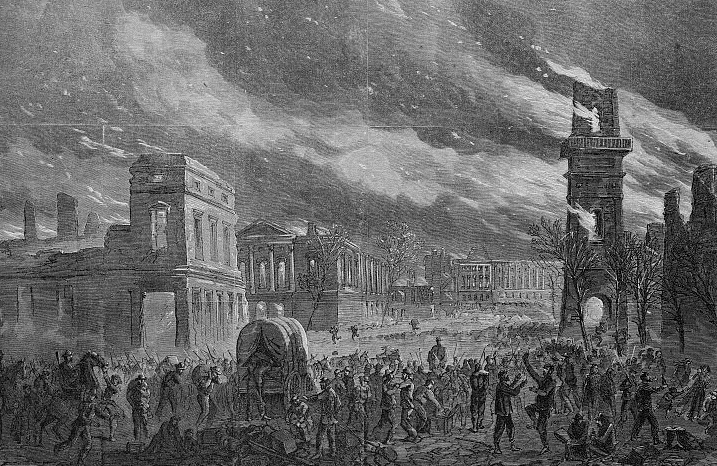
Much of the South Carolina capital went up in flames after the city's surrender.

State, local and Dominion Energy this week announced the completion of the work. Tests showed the material found near downtown in 2010 was coal tar created by manufactured gas plants that operated throughout Columbia more than century ago.

Starting in June 2022, crews installed cofferdams and dewatering pumps at two so they could work on a dry riverbed. Dominion Energy said. Some 35,000 tons of sediment was removed.

The Civil War Picket reached out to Sean Norris, program archaeologist for TRC Companies, a subcontractor for Dominion Energy that performed archaeological work. His responses have been edited and some questions have been reordered.

Q. Were all of the artifacts recovered since June 2022? Were they found in a particular area, or were they scattered?

A. A small amount of ordnance was recovered during the early phases of this project as far back as 2015. The vast majority of the ordnance was recovered this year. (Photo above of some artifacts courtesy of Sean Norris, TRC, 2023.)

Q.  Can you give me an approximate number of Civil War artifacts recovered?

 A. We anticipate close to 500 pieces of ordnance and Civil War-related artifacts, in addition to thousands of historic and pre-contact period artifacts.

Q. Can you please provide some specifics on the Civil War items? 

A. We do not have a finalized inventory yet. But of note, we have the following:

-- 10” shells (right) with fuse wells for wood fuse plug (photo courtesy of Sean Norris, TRC)-- Iron canister balls (five sizes)

-- Iron grapeshot balls, 2,”

-- Iron canister top and bottom plates for 24-pounder

-- 6-pounder solid shot cannon balls (one with a Bormann fuse)

-- 12-pounder common shells with wood fuse plugs

-- .69-caliber musket balls

-- .69-caliber Burton pattern Minie bullet

-- .577/58-caliber Pritchett bullet

-- .577/.58-caliber Pritchett bullets, short pattern

--  An encrusted saber is currently going through some stabilization and cleaning. 

Q. Are all of the Civil War items dumped in the river believed to be Confederate? Were they tossed in by Sherman's troops?

A. All the ordnance appears to be from the Confederate armories around the downtown area. None appear to have been fired.

Q. How deep were most of the artifacts when found?

A. All were found in the riverbed after it was dewaters.  Some were up to three feet deep in sediment.

Q. Can you tell me about parts of a wagon wheel, what makes that particularly interesting?

Burning of Columbia in Feb. 1865 (William Waud, Library of Congress)
A. There are reports in the records and in diaries of an explosion happening during the dumping of the ordnance. The explosion apparently blew up a wagon and oxen team and three federal soldiers, including Capt. Williamson M. Davis, who is buried in the Florence, S.C. national cemetery. The wagon wheel matches the size and characteristics of a military wagon; there is evidence of charring on the spokes of the wheel. It is possible that this wheel is an artifact of that explosion. 

Q. Did work crews find an unexploded shell of some type?

A. We had UXO team from a company named Tetra Tech on site at all times. They did an amazing job of doing the initial recovery and establishing safety protocols.  When fused ordnance was recovered they implemented protocols to render the ordnance safe for removal then transferred the ordnance for off-site disposal.

Q. Were you there for most or all of the archaeological work? Was it also done by Dominion Energy contractors? 

A. We were contracted through Dominion Energy. They have been great advocates for recovering and preserving these artifacts since the archaeological work for this project began years ago.

(Archaeological work at left. Photo courtesy of Sean Norris, TRC, 2023.)

Q. Will these items go to the South Carolina Confederate Relic Room and Military Museum? If so when?

A. Artifacts are undergoing analysis and the conservation process. It will likely be 18 months to two years before they are ready for display at the Relic Room. (The Picket has reached out to the museum for comment.)

The wagon wheel is currently submerged in a conservation tank at the Confederate Relic Room. The wood spokes started decaying as soon as it was removed from the water and exposed to oxygen. 

A view of the work over the summer (SC Dept. of Health and Environmental Control)
Q. Any particular moments of discovery that stand out to you, especially ones in which you were a part?

A. Lifting the 10-inch cannonballs was a highlight. Holding these artifacts and realizing that almost 160 years ago the place I was standing was a literal war zone was a sobering moment.

RelatedWas this wagon wheel shattered in explosion as Sherman's troops took S.C. capital? Experts hope to learn more when they conserve hundreds of artifacts. Read more