Showing posts with label nashville. Show all posts

Monday, March 24, 2025

The ironclad USS Montauk sank the Rattlesnake at Fort McAllister. After delays, a 3D model of the Federal monitor is being produced for display at Georgia park

Early model of Montauk; section of blueprints (SCAD) and Professor Johnson describing its operations (Picket photo)
Jason Carter, site manager at Fort McAllister State Park in Richmond Hill, Ga., believes a model of the ironclad USS Montauk -- which prowled the waters and bombarded Confederate earthworks -- will be a cool educational tool at its visitor center.

Carter would like to see it positioned next to an old model of the CSS Nashville (Rattlesnake), a commerce raider the Montauk blew out of the water in February 1863.

Greg Johnson says completing and printing a precise 3D model of the Montauk -- one of 10 Passaic-class monitors -- will be a boon for graduate student Wilson Han, who is in his gaming class at the nearby Savannah College of Art and Design.

“A legacy piece,” Johnson says of the effort.

And Han (left), a native of China, is likewise excited by the project, which involves modern technology and a bit of old-fashioned model-making.

“I am always interested in history,” he says.

Now, five years after Johnson visited the park and met former interpretive ranger Mike Ellis, the dream of having a Montauk model is finally close to reality. Han has been working on the model design for the past couple months, using Autodesk Maya software. Han said April 1 the modeling is going well but slowly because of a busy college quarter.

The original goal of the project was to create compelling interpretive panels, a 3D ship model and film that explained the role of USS Montauk and other innovative Federal monitors in the siege of Confederate outposts on the Atlantic Ocean, specifically Fort McAllister.

The plan turned out to be too ambitious, given SCAD graduations and the complexity of work, which ran up against limited class time. Still, a half dozen wall panels and a schematic of the Montauk were created by SCAD students and installed in late 2022.

Work on a model stalled after that, but when I reached back out in December to Johnson, interactive design and game development professor at SCAD, he asked for contact information for park leadership (Ellis had left by then) and I connected him with Carter.

Jason Carter measures CSS Nashville exhibit to aid in model for Montauk (Picket photo)
Carter met with Johnson and Han at the park on Feb. 1 to discuss the 3D model, and I tagged along. The professor explained a previous student had made a 3D model for in-game simulation (for the film) but that aspect never came to fruition. Hence, the current effort to convert that to a printable 3D model.

Johnson stressed the work would be tedious, that Han would have to check all specifications and ensure the model was ready for printing.

“I have to be certain to do the job right,” Han told the Picket.

Accuracy is paramount, says Johnson, who located the likely paint scheme for the ironclad

“It will be down to the bolt,” he says of the reproduction.

The Nashville was trapped near this bend in the Ogeechee River (Picket photo)
Key to the whole effort – for the wall display and the model – is something Ellis found by chance several years ago.

Finding blueprints was a stroke of fortune

Ellis, now a guide and trainer for Old Towne Trolley Tours in Savannah, recalls being in a storage area at Fort McAllister in 2017. There were piles of documents and papers everywhere.

“As rangers come and go, things get lost to time,” he says.

Ellis went through some of them and found a matted long tube. Inside: A precious copy of the USS Montauk’s blueprints, manufactured in dozens of sheets.

One of numerous photos of blueprints shows turret (Courtesy Greg Johnson)
“I knew immediately what is was,” says Carter. Now the staff could upgrade the monitor exhibit, putting a facsimile of the blueprints on one wall.

Everything clicked during Johnson’s visit to the site. “Me and Greg spent a better part of the day taking photos of (the blueprints) in detail.”

They used a custom-built rig to slide dozens of sheets under a camera to obtain high resolution.

“These images were then processed, enhanced and stitched together using photo editing tools to make the panels,” Johnson says. The image could then be used for the wall, model or the film.

Showdown on the Ogeechee was one-sided

USS Montauk receives fire from Fort McAllister as it hammers the Nashville
Andy Hall, A Civil War naval expert and author, told the Picket the Passaic monitors were the first large-class of monitors and many of them served together, such as the campaign against the earthen Fort McAllister in 1863 and 1864.

The Union navy, as it continued its chokehold on Southern ports and readied for offensive operations, sent the Montauk and sisters PassaicPatapsco and Nahantsupported by gunboats Seneca, Dawn and Wissahickon to bombard and capture Fort McAllister in January 1863.

The skipper of the Montauk was John Worden (left), famous for being the USS Monitor’s captain when it clashed with the CSS Virginia in 1862.

Capable Confederate gunners at Fort McAllister hit the ironclad 13 times in its first action, but caused little damage. A second attack on Feb. 1, 1863, found the vessel, according to histories, pounded by 48 shells. The Montauk's sister ships also took part in the action.

Its big day came on February 28. The sidewheeler Nashville, which was bottled up and hiding under the guns of Fort McAllister for protection, tried to get away from the Federal ironclads via Seven-Mile Bend on the Ogeechee River, but apparently ran aground.

The 215-foot blockade runner commanded by Lt. Thomas Harrison Baker became a sitting duck because of its lack of maneuverability and deep draft in a tight area, and the Montauk pounced.

All the monitors were designed for littoral or riverine operations, and so drew as little water as possible,” says Hall. “Nashville was built as an ocean-going steamship, so had a fuller, deeper hull.” That proved to be a disadvantage at McAllister.

Montauk’s XV- and 11-inch Dahlgrens were able to destroy the former commerce raider.

Worden was pleased with his destruction of ‘this troublesome pest’” wrote John V. Quarstein, director emeritus of the USS Monitor Center in a blog.

“However, Montauk suffered a huge jolt when it struck a Confederate torpedo en route down the Ogeechee River. Worden’s quick thinking saved his ironclad.” (Quarstein’s new biography of Worden will be published April 15).

The Union naval attacks on Fort McAllister itself were less successful. The low-profile earthen fort could withstand the shelling and repairs could be readily made.

While the Montauk was scrapped in the early 1900s, the park grounds and museum have a large number of CSS Nashville artifacts.

USS Montauk (left) and USS Lehigh in Philadelphia in 1902 (Wikipedia)
And in this corner, weighing in at . . .

On the afternoon of my visit, Carter, Johnson and Han -- who is majoring in game development and interactive design -- met in a conference room and a museum gallery that houses the wall panels, artifacts and the CSS Nashville model.

Carter used a tape measure to get the dimensions of the Nashville display case. That was to help ensure the Montauk 3D model would be built in the proper scale (1/78).

Wilson Han and Professor Johnson are working from this paint scheme (Courtesy Steven Lund)
This makes the USS Montauk model 30 11/16th inches or 780mm in length,” Johnson wrote in a later email. The ironclad, he says was slightly asymmetrical

Carter provided these vital statistics for the two warships:

Montauk, 200 feet long, beam 46 feet, draft 10 feet

Nashville, 215 feet long, beam 34 feet, draft 20 feet

While the monitors were mass-produced, they did undergo changes during the service, and SCAD students wanted to be sure the appearance of the Montauk matched the time it prowled off Fort McAllister.

SCAD is working from a Montauk paint scheme described in the work “Modeling Civil War Ironclad Ships” by Steven Lund and William Hathaway

The deck is lead gray, the turret and pilot house black with a narrow white ring, and the smokestack black with the upper one third in dark green.

To distinguish them, all 10 Passaic ironclads had some color variations.

Sources for such information on paint schemes are difficult to find, says model maker and writer Devin J. Poore.

“Black is very popular, (while) gray and white were used in really hot areas.”

3D printing is not for the faint of heart

Converting an item intended for a game to a 3D printable object requires numerous revisions.

The former are designed with much higher resolution so they can be used in interactive entertainment. Former SCAD student Collin Drilling created the original image of the USS Montauk. It had about 10,000 “holes;” he worked from May and Zbrush software.

Han’s task was to bring down the resolution and fine tune the details. Johnson had worked on the turret, and his student used that as a guide.

A version of the Montauk model before Han's work to modify it for printing (Courtesy SCAD)
Preparing the model for 3D printing is one thing, but ending up with a worthy final product is another. Lots of things can go wrong in printing – and often do, the SCAD team says. Plastic can shrink during the process, the printer footing may be off and a misfeed can occur.

The printer is like a dot matrix and the artist must determine how many pieces he should make for the ironclad model and figure in joints for assembly. While Han wants to keep it to perhaps one to three pieces, some items require more, says Johnson.

Poore (photo below) told the Picket the quality of any model, handmade or 3D designed and printed, depends on the skill of the modeler.

“3D models come off the printer needing sanding, priming, assembly, etc. Depending on how much work you put into the process depends on the result. There are certain benefits that 3D printing can have over hand making, such as pretty much guaranteed right angles and symmetry, but then again you have to worry about how to actually print a piece so that it comes out cleanly, and so that it won't warp in the future,” he says.

This project is a mix of newer and old technology. While the printing will produce the frame of the ship, finer pieces such as chains and rigging will need to come for a model kit or the like.

And the painting is definitely old school; Johnson said he expects to assist with that.

Passaics were primo, but had limitations

For Fort McAllister, the Montauk model will help further its education of visitors on the fort and various Federal attempts to subdue it.

Lund said the innovation and quality of the Passaic class made for the best monitors.

“Although two of the 10 produced were lost, some of them soldiered on into the 20th century. At least two were recommissioned to serve as harbor defense vessels in the Spanish-American War. One of them, the USS Camanche, guarded the San Francisco Bay during that conflict. She was sold for scrap in 1908 and her hull functioned as a coal barge as late as WW II.”

A model of the U.S.S. Carondelt being made for 3D printing (Courtesy Devin J. Poore)
Poore says the Passaic monitors were a stepping stone in warship development but were underutilized and not appropriate for most situations they encountered..

“For the work needed on the Atlantic coast, i.e. reducing forts, they weren't the best candidates. They were built to fight Confederate ironclads, and simply didn't see much action in that regard, due to the limited number of Confederate opponents.”

Poore is in the process of making his first full-blown printed ironclad, the city-class U.S.S. Carondelet. The vessel had notable service in the Western Theater.

Devin J. Poore's model of the USS Weehawken (Courtesy of the creator)

Saturday, September 28, 2024

Harvey was a friend to the 104th Ohio, was wounded and later served as a comfort animal. A monument now has a statue to tell his story, tout vets' mental health

Harvey's collar and Capt. D.M. Stearns (Courtesy Battle of Franklin Trust); replica statue of the dog
at a Civil War memorial in Cleveland (Courtesy Soldiers' and Sailors' Monument)
Harvey was one beloved dog. The mascot of the 104th Ohio Volunteer Infantry was a fixture at camp, bringing cheer and companionship. He was wounded at least once and, after death, remembered in an oil painting perched in front of rows of veterans at an 1880s reunion.

A red, white and blue collar, festooned with military motifs and names of battle in which the regiment fought, survives and is recreated in a bronze statue of the pup, which is on display at The Battle of Franklin Trust’s Carter House in Tennessee. Harvey was with the regiment at Franklin.

Now, a copy of the Harvey statue is at the Soldiers’ & Sailors’ Monument in Cleveland, which commemorates the Civil War and honors the citizens of Cuyahoga County who fought for the Union, officials announced Sept. 26.

The faithful canine will further tell the story of the 104th Ohio and post-traumatic stress disorder (PTSD). Harvey’s owner, Capt. Daniel Merrill Stearns, was said to never be the same after the war and was eventually institutionalized.

Harvey was believed to be a comfort animal for Stearns, and the monument has used their story in its annual veterans mental health program on the monument grounds, says executive director Greg Palumbo.

“It is a casual event where groups that provide non-traditional mental health therapies specifically directed toward veterans, such as Guitars 4 Vets, Paddle for Heroes, Irreverent Warriors, and many more, are able to interact with the public and hopefully make connections that help someone to find a place where they feel comfortable accepting help,” Palumbo said in an email.

Mental health resources for veterans largely did not exist during the Civil War.

“During the Civil War soldiers were left to deal with their mental health on their own, and if they were lucky enough to return home it was left to the family to quietly care for them behind closed doors (the) best they could,” said Palumbo.

Things got loud for 'Barking Dog Regiment'

Daniel Stearns, a native of Berea, Ohio, served in another regiment before he joined up with the 104th Ohio. Most histories say he brought Harvey with him to the unit, which was dubbed “The Barking Dog Regiment” for its canine mascots.

“Harvey was treasured by the men. Harvey gave everyone a morale boost,” says the Battle of Franklin Trust. “He may have brought something normal and fun for the men to enjoy during the brutal war.

A history of the regiment said Harvey “was an aristocrat and wore a brass collar with the legend, “I am Lieutenant D.M. Stearns’ dog, whose dog are you?” (Collar photo, courtesy Battle of Franklin Trust)

The regiment was active in the Atlanta Campaign and Harvey was reportedly wounded and captured at Kennesaw Mountain in June 1864. He recovered and was back with his comrades when they dug in at Franklin before a failed Confederate assault.

On Nov. 30, 1864, Adam Weaver of Company I wrote, “The regiment’s mascot, old dog Harvey, just paid us a visit. He somehow always looks me up. After a little bite and a hand pat too, moves on to Company ‘F’ boys.”

'His wife did the best she could'

Stearns and Harvey survived the fighting at Franklin, but the officer was grievously wounded at Nashville.

While the Battle of Franklin Trust said Harvey’s fate was unknown after Nashville, other accounts say the dog returned with Stearns to Ohio.

The Cleveland memorial said Harvey was an emotional support animal as this master dealt with undiagnosed PTSD. It’s possible other men in the 104th came to care for the pup.

Palumbo said war trauma had different names before PTSD came into use in the 1970s. (Exterior of the Soldiers' and Sailors' Monument in Cleveland)

“No one believed that there was such a thing as a mental condition, there were only mental symptoms of physical conditions. Often you would see otherwise healthy men being diagnosed with things like heatstroke, which is what Daniel was diagnosed with, so that a physical ailment could be linked to their mental issues.”

Stearns, married with several children, carried on as best he could, and worked in Pittsburgh before returning to Ohio.

“His wife did the best she could with her children for as long as she could but eventually had to pass Daniel back to his parents and brothers,” said Palumbo

“They cared for him as well as they could but he was unable to hold a job and his mood swings became more than they could handle and he eventually had to be institutionalized.”

Painting of Harvey (left, foreground) at 1880s 104th Ohio reunion
The veteran contracted a kidney disease and comrades from the 194th Ohio moved him to a boarding house closer to home. He died in 1890 at age 54.

“As to Harvey’s fate, we have searched but unfortunately, we have not yet been able to determine where he is buried or when he died,” said Joanna Stephens, director of historic sites and collections with The Battle of Franklin Trust.

Harvey’s collar was found with Stearns’ personal effects in the 1990s and is on loan to the trust.

Harvey serves a greater purpose today

The Franklin organization commissioned a likeness of Harvey in 2019 from local sculptor Janel Maher.

“We worked diligently with Janel to create a piece that showcased this beloved animal in the most accurate way possible. She used historic images and information to sculpt the piece, which includes a recreation of his red-white-and-blue collar with battle honors,” said Stephens.

The piece at Soldiers’ and Sailors’ was cast from the original molds with the trust’s blessing, she told the Picket. (Photo, courtesy The Battle of Franklin Trust)

The monument at 3 Public Square in Cleveland is 130 years old. Levi Scofield, the architect and sculptor, engineered the Union’s defensive works at the Battle of Franklin.

The venue has a 125-foot tall shaft topped with a goddess of freedom. Below is a memorial room featuring the names of 9,000 Cuyahoga County veterans who served in the Civil War.

Flower beds outside are in the shape of corps badges.

The Harvey statue is currently inside, but the monument will carve a space out of an existing landscaped bed between the monument and the Moses Cleaveland statue on the south edge of the square, officials said.

Display in Cleveland mentions PTSD, Stearns and Harvey (Soldiers' and Sailors' Monuments)
Harvey lives on in Franklin and Cleveland. His heroism and importance to human comrades is celebrated. His bond with Stearns is especially poignant.

“It is a sad story, one in which Harvey is a shining light,” said Palumbo. “Always a faithful companion. Brave in battle, a lover of music, compassionate to the other animal mascots, and beloved by the entire regiment.”

Wednesday, August 7, 2024

At Nashville's renovated Sunnyside mansion, you can look through windows at Civil War battle damage, view artifacts found in rifle pit and click to cool 3D images

Augmented reality view of Sunnyside and reveal windows showing battle and bullet damage (MNHC)
Visitors to Nashville’s Sunnyside mansion, which was struck by bullets from a Federal assault during the Civil War, now have a variety of ways – including the use of augmented reality – to experience the site’s rich history.

Built in 1852 in what is now Sevier Park, Sunnyside and a connected log cabin have undergone an extensive rehabilitation since 2022. While visitors can see the outside of the home and peer through windows to see the cabin logs and bullet damage, offices of the Metro Nashville Historical Commission open to the public Aug. 19.

Sunnyside’s main room now has architectural and historical displays; interpretive markers outside cover its early history, enslaved people, the Battle of Nashville, later owners and the 20-acre Sevier Park, near the 12South neighborhood.

“It is truly exciting to see how much history we were able to recover and to provide to the public,” said Adam Fracchia, an archaeologist with the commission. “The aim is to tell a wider story.”

Bottom floor of extension (ell) has five small windows showing bullet damage (MNHS)
I first spoke with Fracchia last year about a project involving Nashville police and archaeologists. The team has been analyzing the trajectory and proximity of gunfire from a Union attack from the north and west during the Dec. 15-16, 1864, battle. They wanted to solve the mystery regarding embedded bullets and holes discovered last year in the cabin walls. 

It has long been known that dozens of bullets, including Minie balls, were left on the porch door and columns on the big house at Sunnyside, which was occupied by Confederates. They were eventually forced to retreat.

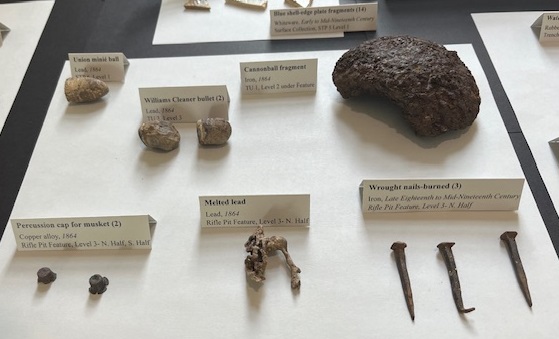
A rifle pit was found during the renovation, along with evidence of a trench. A new display case in the commission’s main room has artifacts from the battle, including percussion caps, melted lead and burned iron nails found in the rifle pit.

A ribbon cutting and open house was held in mid-July (MNHC photo)
The commission, working with partners, has created Nashville Sites, which provides overviews of city fixtures, with text, audio and virtual tour options. “We want them to get an understanding of what the building looked like,” Fracchia said of Sunnyside

The tour menu includes civil rights, a Civil War driving program, downtown Nashville and certain neighborhoods. The tour on Sunnyside covers its history since indigenous dwellers.

“Recovered artifacts from the pit, like burned nails and charcoal, suggest that soldiers made fires to stay warm using wooden planks from the side of the house or outbuildings After the battle, Sunnyside was used as a field hospital for wounded soldiers.”

I called Fracchia (left) this spring and we have since communicated via email about the renovation. His responses to my questions have been edited for brevity:

Q. What is your overall impression of the work and how it adds to the story of the site? You told me the new exhibits/upgrades will tell a wider story.

A. The renovations at Sunnyside attempt to preserve as much of the building as possible while making the mansion a usable office space for the Metro Historical Commission.  Along with the renovations, we have added several features to the site to allow interpretation of the long history of the property.

We have added six interpretative panels telling the history of the site from its Indigenous inhabitants to the Civil War to the modern urban park. One of the panels also discusses the details we know about the peoples enslaved at Sunnyside. With three of these panels we have added augmented reality views of the building to allow visitors to use their phones to see what the building may have looked like at different points at time. The tour is also available digitally as a Nashville Sites tour.

(Clockwise, top) Bullets, artillery fragment, wrought iron nails, melted led and percussion caps
We were able to add Plexiglass windows to the log cabin façade to show some of the damage to the cabin from the battle. One of the log outbuildings will receive additional interpretative panels and a glass window in the floor so that a pier and a log sill plate will be visible.

Additionally, in the office, we have added an exhibit case of the artifacts excavated in the last 1.5 years ahead of the renovation and a wall of historic architectural pieces from Nashville. We hope that another exhibit case could be used as a floating exhibit in other locations.

Q. How many static exhibits are in the renovated office? Can you tell me the range of topics they cover?

A. The display case has artifacts from 3,000 to 5,000 years ago to the mid-20th century and is meant to cover the history of the site. This includes artifacts from the Civil War. The architectural wall has several different architectural elements that were salvaged or donated from around Nashville.

Civil War Williams Cleaner bullets and iron nails found last year in rifle pit (MNHC)
Q. What specifically from the Civil War-era/the battle are now on display, and in what context?

A. On display, we have artifacts recovered from the battle such as bullets as well as melted lead, burnt nails and percussion caps from the rifle pit. We recently found more artifacts during the removal of the roadbed in front of the mansion. We recovered fragments of a cannonball, top of a tent stake, a gun tool and bullets.

Q. Are any of the interpretive displays outside, or they all inside, or a mix? You mentioned there might be five-six panels. Does one pertain to the Battle of Nashville?

A. All artifacts are inside the building but we have the five panels on the north face of the log cabin that show bullet damage and projectile damage. People can also see the construction of the log building including different chinking material and Roman numerals used to match the logs.

Q. You said three of the panels might have QR codes and viewers will be able to use their phones to move. Can you describe, please?

A. One of the AR (augmented reality) images shows the building in 1864 with lines representing the bullet trajectories. These AR images are now accessible and were built in collaboration with the MHC and the Vanderbilt Institute for Spatial Research.

Q. Do any of the new features tell the story of a specific person/people related to Sunnyside’s history before, during or shortly after the battle?

A. We tried to focus on the enslaved persons and later owners with the panels, specifically, Granville Sevier and Dr. L. G. Noel.  

Q. Can you tell me about the two cabins that were at Sunnyside during the Civil War?

A. The historic building had a historic ell (perpendicular building extension) that had fallen into disrepair. Inside the ell, there were two log cabins, one of which had to be partially deconstructed. The other log structure was incorporated into the new building that is connected via a glass connector and serves as a conference/meeting room.

One of six interpretive markers surrounding the mansion and buildings (MNHC)
Q. Anything recent on the police and forensic examination and analysis of the bullet trajectories?

A. We are trying to find more information on the battle at Sunnyside and determine the distance at which the Union firing lines were at. We hope we can find information from a metal detection survey in the fall.  We received a grant from the Tennessee Historical Commission to conduct a systematic and metal detector survey with the public.

Q. Anything new on the dendrochronology of the timbers used in the cabins? You told me at least one building had wood felled from the winter of 1823-1824.

A. We have not received any update on the dendrochronology yet. 

---------------

Postscript: Work at Sunnyside will continue into the fall. One area is what was believed to be the original smokehouse but, instead, is a domestic structure from the 19th century. “When we test below the floor we found evidence of earlier piers for another building,” said Fracchia, adding there were household artifacts and a trash pit. An investigation of that area will continue, as well as the reconstruction of a summer house near the well, the city says.

The commission also had this tidbit in its August "History Gram":

"The removal of the gravel roadbed around Sunnyside has exposed more history of the park. Artifacts from the Civil War were recovered just below the gravel, including cannon ball fragments, a bullet, tent hardware, and a gun tool (right). These artifacts were uncovered directly in front of the mansion along with charcoal stains in the soil which indicate the location of a Federal or Confederate encampment likely associated with the Battle of Nashville."

The items will be treated and eventually displayed.

---------------

Guidelines for visiting Sunnyside mansion

When you visit the park, start at the pedestrian entrance near 12th Ave. S/ Granny White Pike and read the historical marker, then follow the path around the house to see all six interpretive panels, as well as the viewing windows to the original cabins (now in the rear ell of the building) and the interpretation in the log outbuilding (formerly called the Smokehouse).

You can scan the QR codes on the panels to learn more about each era of Sunnyside’s history through the Nashville Sites walking tour; some of the panels also have 3-D augmented reality (AR) models so you can picture yourself in the past.

“Feel free to enter the office lobby Monday-Friday from 7:30 am-4 pm. Additional photos, artifact  and brochures are available there. The rest of the house is not open to the public or available for tours. Public restrooms are available behind the house in the white building between the log outbuilding and the Carriage House café."

Architectural features and cabin door at Sunnyside (Photos MNHC)

Tuesday, July 23, 2024

Williams Cleaners, Enfields and three-ringers: Each of these bullets found by Battle of Nashville Trust on acquired battlefield property has a story

Recovered Federal and Confederate spent and dropped bullets (Courtesy of BONT)
When I came across a bit of news this week from the Battle of Nashville Trust about efforts to prepare a portion of Shy’s Hill for public access, I marveled at a photo of fired and dropped bullets found during recent clearing of brush.

I confess to knowing little about Civil War ammunition, so my curiosity led me to ask the nonprofit to describe each bullet and artifact by row.

Lo and behold, I had the answer within minutes (see below).

Bobby Whitson, president of BONT, is a history enthusiast and expert in metal detecting. He provided the details and said Confederate pickets, probably from Georgia or Florida, were deployed on the newly acquired 1.2-acre site. The 5th Minnesota and 9th Minnesota on Dec. 16, 1864, rushed up the hill, signaling the beginning of the end of the Battle of Nashville, a major Union victory.

Howard Pyle's depiction of the Minnesota brigade charging Shy's Hill
BONT found evidence of fighting that occurred as the Confederate line, above and to the east, fired on the Union soldiers.

“Even though Civil War relic hunters have scanned Shy’s Hill for decades in their search for artifacts, the clearing of the property led to BONT recovering a number of bullets left undetected over the years, along with other relics including a Union uniform button and unidentified shrapnel,” the group said.

The organization emphasized relic hunting/metal detecting is prohibited on this and other battlefield ground it owns or maintains. That includes Shy’s Hill and Redoubt 1, a few miles north.

“Digging without permission on someone else's property violates many rules,” Whitson wrote in an email to the Picket.

His identification of bullets and other artifacts (photo courtesy Battle of Nashville Trust):

Top row: Silver-washed pewter button, .58-caliber three-ringer, the next eight are .570ish Confederate three-ringers.

Middle row: U.S. general service eagle button, fired three-ringer, six dropped Enfields (one is stepped on), dropped Williams Cleaner, fired three-ringer.

Bottom row: Fired three-ringer, fired Williams Cleaner with separated disk, fired Confederate three-ringer (note the difference in width of the base ring), fired Enfield, two fired Williams Cleaners, two fired three-ringers.

Also recovered were a sabot fragment from an artillery round and an unidentified brass piece (below, Battle of Nashville Trust).

Whitson said the Williams Cleaners are probably Federal “but the dropped three-ringers do not have even thickness in the bases of them, which almost always points to being a Confederate bullet; plus they mic' at .57 with a couple being spot on .577.”

“While not all Enfields can just be assumed to be Confederate, the location of these Enfields on the hillside and the arc across the land on which they were found, combined with the other Confederate drops, give them an extremely high probability of being Confederate drops. The fired bullets are a combination of Federal and Confederate,” he wrote.

The trust, with the assistance of American Battlefield Trust, bought the small “core battlefield” vacant lot in April and is hoping to open it to visitors this fall in time for the 160th anniversary of the battle. There are plans for parking at some point.

“BONT is working with Civil War Trails to install interpretive signage, both at the 4601 Benton Smith Road site and the plateau further up the hill where BONT has placed field artillery pieces in the area most likely used for Beauregard’s battery on Dec. 16, 1864.”

The site was the location of the Federal assault against Rebel troops holding the summit of Shy’s Hill on the second day of the battle. The boys in blue broke the line and routed Hood’s troops, and permanently disabling the Confederacy’s military capability in the Western Theater of the Civil War.

Looking up from the vacant lot toward the summit of Shy's Hill (BONT photo)
“We are devoting the highest level of expertise, time, energy, and resources to preserve fully this hallowed ground on which so many Minnesotans and others were wounded and killed assaulting the Confederate position on the hill,” Whitson said in the news release.

The tract is a short walk from BONT’s Shy’s Hill historic site and trailhead.

Whitson sometimes gives presentations on Tennessee metal detecting, including one in April at Lipscomb University in Nashville.

What interests each detectorist is different; some do it to get outside and get exercise, some do it for the thrill of the hunt, some do it to save the history, some do it to learn from what is in the ground, and some do it for all of the above reasons. We are simply stewards of the past and of the history; the more we find, the more we validate the history that we are trying to interpret for the community,” he said.

A monument to the 114th Illinois was dedicated at Shy's Hill last fall (BONT)
Items found on trust property are being kept separate from other collections and may eventually become part of a hoped-for museum.

“Unlike treasure hunters, we are historians with detectors that document everything in order to validate what we think we know from the written history,” Whitson said. “What's in the ground does not lie, and each artifact tells a unique story.”