Showing posts with label bullets. Show all posts

Wednesday, August 7, 2024

At Nashville's renovated Sunnyside mansion, you can look through windows at Civil War battle damage, view artifacts found in rifle pit and click to cool 3D images

Augmented reality view of Sunnyside and reveal windows showing battle and bullet damage (MNHC)
Visitors to Nashville’s Sunnyside mansion, which was struck by bullets from a Federal assault during the Civil War, now have a variety of ways – including the use of augmented reality – to experience the site’s rich history.

Built in 1852 in what is now Sevier Park, Sunnyside and a connected log cabin have undergone an extensive rehabilitation since 2022. While visitors can see the outside of the home and peer through windows to see the cabin logs and bullet damage, offices of the Metro Nashville Historical Commission open to the public Aug. 19.

Sunnyside’s main room now has architectural and historical displays; interpretive markers outside cover its early history, enslaved people, the Battle of Nashville, later owners and the 20-acre Sevier Park, near the 12South neighborhood.

“It is truly exciting to see how much history we were able to recover and to provide to the public,” said Adam Fracchia, an archaeologist with the commission. “The aim is to tell a wider story.”

Bottom floor of extension (ell) has five small windows showing bullet damage (MNHS)
I first spoke with Fracchia last year about a project involving Nashville police and archaeologists. The team has been analyzing the trajectory and proximity of gunfire from a Union attack from the north and west during the Dec. 15-16, 1864, battle. They wanted to solve the mystery regarding embedded bullets and holes discovered last year in the cabin walls. 

It has long been known that dozens of bullets, including Minie balls, were left on the porch door and columns on the big house at Sunnyside, which was occupied by Confederates. They were eventually forced to retreat.

A rifle pit was found during the renovation, along with evidence of a trench. A new display case in the commission’s main room has artifacts from the battle, including percussion caps, melted lead and burned iron nails found in the rifle pit.

A ribbon cutting and open house was held in mid-July (MNHC photo)
The commission, working with partners, has created Nashville Sites, which provides overviews of city fixtures, with text, audio and virtual tour options. “We want them to get an understanding of what the building looked like,” Fracchia said of Sunnyside

The tour menu includes civil rights, a Civil War driving program, downtown Nashville and certain neighborhoods. The tour on Sunnyside covers its history since indigenous dwellers.

“Recovered artifacts from the pit, like burned nails and charcoal, suggest that soldiers made fires to stay warm using wooden planks from the side of the house or outbuildings After the battle, Sunnyside was used as a field hospital for wounded soldiers.”

I called Fracchia (left) this spring and we have since communicated via email about the renovation. His responses to my questions have been edited for brevity:

Q. What is your overall impression of the work and how it adds to the story of the site? You told me the new exhibits/upgrades will tell a wider story.

A. The renovations at Sunnyside attempt to preserve as much of the building as possible while making the mansion a usable office space for the Metro Historical Commission.  Along with the renovations, we have added several features to the site to allow interpretation of the long history of the property.

We have added six interpretative panels telling the history of the site from its Indigenous inhabitants to the Civil War to the modern urban park. One of the panels also discusses the details we know about the peoples enslaved at Sunnyside. With three of these panels we have added augmented reality views of the building to allow visitors to use their phones to see what the building may have looked like at different points at time. The tour is also available digitally as a Nashville Sites tour.
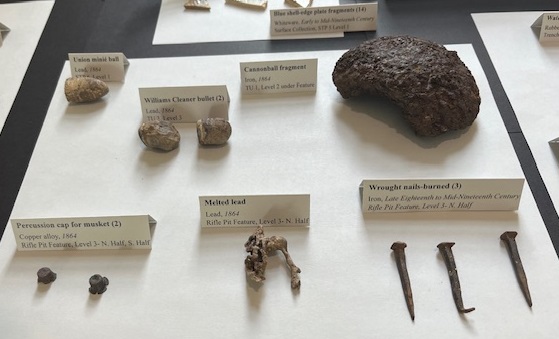
(Clockwise, top) Bullets, artillery fragment, wrought iron nails, melted led and percussion caps
We were able to add Plexiglass windows to the log cabin façade to show some of the damage to the cabin from the battle. One of the log outbuildings will receive additional interpretative panels and a glass window in the floor so that a pier and a log sill plate will be visible.

Additionally, in the office, we have added an exhibit case of the artifacts excavated in the last 1.5 years ahead of the renovation and a wall of historic architectural pieces from Nashville. We hope that another exhibit case could be used as a floating exhibit in other locations.

Q. How many static exhibits are in the renovated office? Can you tell me the range of topics they cover?

A. The display case has artifacts from 3,000 to 5,000 years ago to the mid-20th century and is meant to cover the history of the site. This includes artifacts from the Civil War. The architectural wall has several different architectural elements that were salvaged or donated from around Nashville.

Civil War Williams Cleaner bullets and iron nails found last year in rifle pit (MNHC)
Q. What specifically from the Civil War-era/the battle are now on display, and in what context?

A. On display, we have artifacts recovered from the battle such as bullets as well as melted lead, burnt nails and percussion caps from the rifle pit. We recently found more artifacts during the removal of the roadbed in front of the mansion. We recovered fragments of a cannonball, top of a tent stake, a gun tool and bullets.

Q. Are any of the interpretive displays outside, or they all inside, or a mix? You mentioned there might be five-six panels. Does one pertain to the Battle of Nashville?

A. All artifacts are inside the building but we have the five panels on the north face of the log cabin that show bullet damage and projectile damage. People can also see the construction of the log building including different chinking material and Roman numerals used to match the logs.

Q. You said three of the panels might have QR codes and viewers will be able to use their phones to move. Can you describe, please?

A. One of the AR (augmented reality) images shows the building in 1864 with lines representing the bullet trajectories. These AR images are now accessible and were built in collaboration with the MHC and the Vanderbilt Institute for Spatial Research.

Q. Do any of the new features tell the story of a specific person/people related to Sunnyside’s history before, during or shortly after the battle?

A. We tried to focus on the enslaved persons and later owners with the panels, specifically, Granville Sevier and Dr. L. G. Noel.  

Q. Can you tell me about the two cabins that were at Sunnyside during the Civil War?

A. The historic building had a historic ell (perpendicular building extension) that had fallen into disrepair. Inside the ell, there were two log cabins, one of which had to be partially deconstructed. The other log structure was incorporated into the new building that is connected via a glass connector and serves as a conference/meeting room.

One of six interpretive markers surrounding the mansion and buildings (MNHC)
Q. Anything recent on the police and forensic examination and analysis of the bullet trajectories?

A. We are trying to find more information on the battle at Sunnyside and determine the distance at which the Union firing lines were at. We hope we can find information from a metal detection survey in the fall.  We received a grant from the Tennessee Historical Commission to conduct a systematic and metal detector survey with the public.

Q. Anything new on the dendrochronology of the timbers used in the cabins? You told me at least one building had wood felled from the winter of 1823-1824.

A. We have not received any update on the dendrochronology yet. 

---------------

Postscript: Work at Sunnyside will continue into the fall. One area is what was believed to be the original smokehouse but, instead, is a domestic structure from the 19th century. “When we test below the floor we found evidence of earlier piers for another building,” said Fracchia, adding there were household artifacts and a trash pit. An investigation of that area will continue, as well as the reconstruction of a summer house near the well, the city says.

The commission also had this tidbit in its August "History Gram":

"The removal of the gravel roadbed around Sunnyside has exposed more history of the park. Artifacts from the Civil War were recovered just below the gravel, including cannon ball fragments, a bullet, tent hardware, and a gun tool (right). These artifacts were uncovered directly in front of the mansion along with charcoal stains in the soil which indicate the location of a Federal or Confederate encampment likely associated with the Battle of Nashville."

The items will be treated and eventually displayed.

---------------

Guidelines for visiting Sunnyside mansion

“When you visit the park, start at the pedestrian entrance near 12th Ave. S/ Granny White Pike and read the historical marker, then follow the path around the house to see all six interpretive panels, as well as the viewing windows to the original cabins (now in the rear ell of the building) and the interpretation in the log outbuilding (formerly called the Smokehouse).

You can scan the QR codes on the panels to learn more about each era of Sunnyside’s history through the Nashville Sites walking tour; some of the panels also have 3-D augmented reality (AR) models so you can picture yourself in the past.

“Feel free to enter the office lobby Monday-Friday from 7:30 am-4 pm. Additional photos, artifact  and brochures are available there. The rest of the house is not open to the public or available for tours. Public restrooms are available behind the house in the white building between the log outbuilding and the Carriage House café."

Architectural features and cabin door at Sunnyside (Photos MNHC)

Tuesday, July 23, 2024

Williams Cleaners, Enfields and three-ringers: Each of these bullets found by Battle of Nashville Trust on acquired battlefield property has a story

Recovered Federal and Confederate spent and dropped bullets (Courtesy of BONT)
When I came across a bit of news this week from the Battle of Nashville Trust about efforts to prepare a portion of Shy’s Hill for public access, I marveled at a photo of fired and dropped bullets found during recent clearing of brush.

I confess to knowing little about Civil War ammunition, so my curiosity led me to ask the nonprofit to describe each bullet and artifact by row.

Lo and behold, I had the answer within minutes (see below).

Bobby Whitson, president of BONT, is a history enthusiast and expert in metal detecting. He provided the details and said Confederate pickets, probably from Georgia or Florida, were deployed on the newly acquired 1.2-acre site. The 5th Minnesota and 9th Minnesota on Dec. 16, 1864, rushed up the hill, signaling the beginning of the end of the Battle of Nashville, a major Union victory.

Howard Pyle's depiction of the Minnesota brigade charging Shy's Hill
BONT found evidence of fighting that occurred as the Confederate line, above and to the east, fired on the Union soldiers.

“Even though Civil War relic hunters have scanned Shy’s Hill for decades in their search for artifacts, the clearing of the property led to BONT recovering a number of bullets left undetected over the years, along with other relics including a Union uniform button and unidentified shrapnel,” the group said.

The organization emphasized relic hunting/metal detecting is prohibited on this and other battlefield ground it owns or maintains. That includes Shy’s Hill and Redoubt 1, a few miles north.

“Digging without permission on someone else's property violates many rules,” Whitson wrote in an email to the Picket.

His identification of bullets and other artifacts (photo courtesy Battle of Nashville Trust):

Top row: Silver-washed pewter button, .58-caliber three-ringer, the next eight are .570ish Confederate three-ringers.

Middle row: U.S. general service eagle button, fired three-ringer, six dropped Enfields (one is stepped on), dropped Williams Cleaner, fired three-ringer.

Bottom row: Fired three-ringer, fired Williams Cleaner with separated disk, fired Confederate three-ringer (note the difference in width of the base ring), fired Enfield, two fired Williams Cleaners, two fired three-ringers.

Also recovered were a sabot fragment from an artillery round and an unidentified brass piece (below, Battle of Nashville Trust).

Whitson said the Williams Cleaners are probably Federal “but the dropped three-ringers do not have even thickness in the bases of them, which almost always points to being a Confederate bullet; plus they mic' at .57 with a couple being spot on .577.”

“While not all Enfields can just be assumed to be Confederate, the location of these Enfields on the hillside and the arc across the land on which they were found, combined with the other Confederate drops, give them an extremely high probability of being Confederate drops. The fired bullets are a combination of Federal and Confederate,” he wrote.

The trust, with the assistance of American Battlefield Trust, bought the small “core battlefield” vacant lot in April and is hoping to open it to visitors this fall in time for the 160th anniversary of the battle. There are plans for parking at some point.

“BONT is working with Civil War Trails to install interpretive signage, both at the 4601 Benton Smith Road site and the plateau further up the hill where BONT has placed field artillery pieces in the area most likely used for Beauregard’s battery on Dec. 16, 1864.”

The site was the location of the Federal assault against Rebel troops holding the summit of Shy’s Hill on the second day of the battle. The boys in blue broke the line and routed Hood’s troops, and permanently disabling the Confederacy’s military capability in the Western Theater of the Civil War.

Looking up from the vacant lot toward the summit of Shy's Hill (BONT photo)
“We are devoting the highest level of expertise, time, energy, and resources to preserve fully this hallowed ground on which so many Minnesotans and others were wounded and killed assaulting the Confederate position on the hill,” Whitson said in the news release.

The tract is a short walk from BONT’s Shy’s Hill historic site and trailhead.

Whitson sometimes gives presentations on Tennessee metal detecting, including one in April at Lipscomb University in Nashville.

“What interests each detectorist is different; some do it to get outside and get exercise, some do it for the thrill of the hunt, some do it to save the history, some do it to learn from what is in the ground, and some do it for all of the above reasons. We are simply stewards of the past and of the history; the more we find, the more we validate the history that we are trying to interpret for the community,” he said.

A monument to the 114th Illinois was dedicated at Shy's Hill last fall (BONT)
Items found on trust property are being kept separate from other collections and may eventually become part of a hoped-for museum.

“Unlike treasure hunters, we are historians with detectors that document everything in order to validate what we think we know from the written history,” Whitson said. “What's in the ground does not lie, and each artifact tells a unique story.”

Saturday, November 18, 2023

Archaeologists found 500 Civil War items, including cannonballs, during tar cleanup in Columbia, S.C., river. Here's some of what they found in 'literal war zone'

Grapeshot, canister, 6-pound round (Photos courtesy of Sean Norris, TRC, 2023)
Some of the captured weapons and ammunition that Union Maj. Gen. William T. Sherman’s troops dumped into the Congaree River in Columbia, S.C., in the last months of the Civil War reemerged during a recent environmental project that removed tar from the riverbed.

Hundreds of Civil War artifacts have been recovered, including cannonballs, canister, remnants of a saber and wagon wheel and dozens of bullets. In February 1865, Sherman’s men threw Confederate war materiel into the river after they took what they wanted before marching to North Carolina.

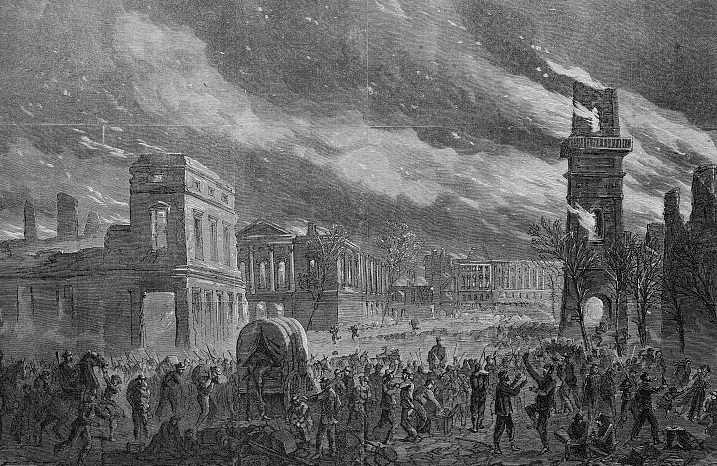
Much of the South Carolina capital went up in flames after the city's surrender.

State, local and Dominion Energy this week announced the completion of the work. Tests showed the material found near downtown in 2010 was coal tar created by manufactured gas plants that operated throughout Columbia more than century ago.

Starting in June 2022, crews installed cofferdams and dewatering pumps at two so they could work on a dry riverbed. Dominion Energy said. Some 35,000 tons of sediment was removed.

The Civil War Picket reached out to Sean Norris, program archaeologist for TRC Companies, a subcontractor for Dominion Energy that performed archaeological work. His responses have been edited and some questions have been reordered.

Q. Were all of the artifacts recovered since June 2022? Were they found in a particular area, or were they scattered?

A. A small amount of ordnance was recovered during the early phases of this project as far back as 2015. The vast majority of the ordnance was recovered this year. (Photo above of some artifacts courtesy of Sean Norris, TRC, 2023.)

Q.  Can you give me an approximate number of Civil War artifacts recovered?

 A. We anticipate close to 500 pieces of ordnance and Civil War-related artifacts, in addition to thousands of historic and pre-contact period artifacts.

Q. Can you please provide some specifics on the Civil War items? 

A. We do not have a finalized inventory yet. But of note, we have the following:

-- 10” shells (right) with fuse wells for wood fuse plug (photo courtesy of Sean Norris, TRC)-- Iron canister balls (five sizes)

-- Iron grapeshot balls, 2,”

-- Iron canister top and bottom plates for 24-pounder

-- 6-pounder solid shot cannon balls (one with a Bormann fuse)

-- 12-pounder common shells with wood fuse plugs

-- .69-caliber musket balls

-- .69-caliber Burton pattern Minie bullet

-- .577/58-caliber Pritchett bullet

-- .577/.58-caliber Pritchett bullets, short pattern

--  An encrusted saber is currently going through some stabilization and cleaning. 

Q. Are all of the Civil War items dumped in the river believed to be Confederate? Were they tossed in by Sherman's troops?

A. All the ordnance appears to be from the Confederate armories around the downtown area. None appear to have been fired.

Q. How deep were most of the artifacts when found?

A. All were found in the riverbed after it was dewaters.  Some were up to three feet deep in sediment.

Q. Can you tell me about parts of a wagon wheel, what makes that particularly interesting?

Burning of Columbia in Feb. 1865 (William Waud, Library of Congress)
A. There are reports in the records and in diaries of an explosion happening during the dumping of the ordnance. The explosion apparently blew up a wagon and oxen team and three federal soldiers, including Capt. Williamson M. Davis, who is buried in the Florence, S.C. national cemetery. The wagon wheel matches the size and characteristics of a military wagon; there is evidence of charring on the spokes of the wheel. It is possible that this wheel is an artifact of that explosion. 

Q. Did work crews find an unexploded shell of some type?

A. We had UXO team from a company named Tetra Tech on site at all times. They did an amazing job of doing the initial recovery and establishing safety protocols.  When fused ordnance was recovered they implemented protocols to render the ordnance safe for removal then transferred the ordnance for off-site disposal.

Q. Were you there for most or all of the archaeological work? Was it also done by Dominion Energy contractors? 

A. We were contracted through Dominion Energy. They have been great advocates for recovering and preserving these artifacts since the archaeological work for this project began years ago.

(Archaeological work at left. Photo courtesy of Sean Norris, TRC, 2023.)

Q. Will these items go to the South Carolina Confederate Relic Room and Military Museum? If so when?

A. Artifacts are undergoing analysis and the conservation process. It will likely be 18 months to two years before they are ready for display at the Relic Room. (The Picket has reached out to the museum for comment.)

The wagon wheel is currently submerged in a conservation tank at the Confederate Relic Room. The wood spokes started decaying as soon as it was removed from the water and exposed to oxygen. 

A view of the work over the summer (SC Dept. of Health and Environmental Control)
Q. Any particular moments of discovery that stand out to you, especially ones in which you were a part?

A. Lifting the 10-inch cannonballs was a highlight. Holding these artifacts and realizing that almost 160 years ago the place I was standing was a literal war zone was a sobering moment.

Related: Was this wagon wheel shattered in explosion as Sherman's troops took S.C. capital? Experts hope to learn more when they conserve hundreds of artifacts. Read more

Saturday, July 22, 2023

CSI: Nashville goes Civil War. Police 3D scanners and drones help plot trajectory of bullets fired on Sunnyside Mansion during battle

A mosaic shows likely trajectories of bullets fired by Union troops (MNPD)
What do police crime scene investigators and archaeologists have in common? It turns out, a lot.

Both take extreme care with evidence. They create detailed notes and photographs, make measurements and diagrams, then document and analyze the data.

These skill sets came into play when the Metro Nashville Historical Commission partnered with the Metropolitan Nashville Police Department to study two unoccupied log structures at Sunnyside Mansion in Sevier Park.

They wanted to solve the mystery regarding embedded bullets and holes discovered earlier this year in the cabin walls. The 44 “defects” – bullets, holes and chips – were associated with the December 15-16, 1864, Battle of Nashville, a significant defeat for the South.

Nashville police photographs of bullets, defects and removed projecticle
For Adam Fracchia, archaeologist with the historical commission, the ballistics project has provided an opportunity to learn more about the battle and its impact on the mansion. The house -- situated between battle lines -- was occupied for a time by Confederate pickets. Advancing Union troops fired upon Confederates in the log structures – made of stout cedar -- and used the residence as a hospital.

Sunnyside Mansion, the headquarters for the commission, has been undergoing an extensive restoration.

“I went and looked at the building and I noticed the bullet holes,” said Fracchia, who found more upon inspection. A forensics colleague suggested he reach out to the police department. “We wanted to get a (look at bullet) trajectory and where they were fired from.”

For Nashville police, the partnership was an excellent way to further test their FARO 3D scanners, which were used in the investigation of the 2020 Christmas Day bombing in the city. The scanners take 360-degree measurements and capture other details from a crime scene. (Photo courtesy of FARO Technologies)

Taking advantage of modern technology, police merged the scans with images they took by drones to make a mosaic of the mansion – which was built in 1852 – and show likely bullet trajectories and direction.

The project was only the second time that the department combined FARO and drone data, said Officer Douglas Belcher of the crime scenes detail.

“This gave us a great opportunity to test the technology we have and we think it did very well,” Belcher told the public during a July 13 presentation in the visitor center at Fort Negley, a large Union defensive fortification.

Another disastrous battle for Confederates

Nashville fell to Union forces in early 1862, relatively early in the Civil War. Tennessee was a strategic location for the Northern army and it built defenses in the capital.

Following a disastrous loss at the Battle of Franklin in November 1864, Confederate Lt. Gen. John Bell Hood moved upon Nashville, digging in below the city. Federal Maj. Gen. George Thomas attacked about two weeks later, sending Hood’s battered army off the field on Dec. 16.

The property now in Sevier Park is in the middle (click to enlarge map)
It has long been known that dozens of bullets, including Minie balls, were left on the porch door and columns on the big house at Sunnyside. Fracchia says you can still see evidence today.

The bullets and bullets in the log structures were found in February as restoration work reached that area on the north side of the house.

Until the damage was found, officials did not know whether the structures might have been elsewhere on the property before being moved to the house. Fracchia theorizes they may have been used as a kitchen or other ancillary purposes. Evidence of cabins for enslaved persons has not been found.

The north face in the 1980s and now (red is the area of study)
By the time of the Civil War, log structures were not fashionable and siding would have covered them, the archaeologist said. “The bullets likely went through the siding and they probably replaced the siding and the bullets were covered up.”

Fracchia said officials don’t have detailed descriptions of what happened on the property during the battle, but they believe Confederates must have been a significant target because of the number of bullets and holes. They eventually were forced to retreat.

Siding still covered the buildings when restoration began. “The more siding we took down, the more we found,” Fracchia said.

Crime scene unit logs entry points with rods (MNPD)
Old school and high tech meet

The police crime scene unit’s work at Sunnyside Mansion wasn’t all fancy gadgets. Officers did old-fashioned work first, marking and photographing the “defects” and using handheld rods to help determine trajectory and origin. An angle finder helped plot direction of impact – from the “leading edge” of the bullet. All of this information, including labeling of the defects, was used to complete the analysis.

“The goal is we want to determine origination. We are trying to figure out where the bullet came from,” crime scenes investigator George Bouton told the Fort Negley audience. “Bullets are predictably unpredictable,” he said. Flight paths are dynamic, including the effects of gravity on trajectory.

Police found and marked 44 bullet "defects" (Image MNPD)
Fracchia told the Picket that at some point after the battle, someone had chiseled out some of the bullets before the siding was replaced. “Nobody in active memory knew there were bullet holes in that wall.”

The archaeologist said a total of seven bullets were embedded in the two log structures. Most remain in the larger of the cabins. The smaller cabin, unfortunately, had to be taken down after the police examination because of its poor conditions. The logs have been kept.

The presentation included photos of a three-ring Minie ball and a Williams cleaner bullet.

“We are assuming they are Union bullets, given they were coming from the north, and fits the battle.” Some of the shots fired upon the mansion also came from the northwest.

The two embedded bullets mentioned by police are soft and burrowed themselves into the cedar. They are fairly well lodged in there, Fracchia said. “We don’t know exactly how far they were fired from.”


Officer Steven Jones said the logs had the density of railroad ties. “So it was extremely good cover.” He said most of the bullets were likely .40- or .50-caliber. "
It seems to be a heavy concentration of fire in one area.” 

While Sunnyside Mansion is not a crime scene, it was an interesting opportunity for the police department to employ old skills and new technology.

“The last time a human touched this was in 1864,” said Bouton. “It has been that long. It is still right there where it ended up.”

Maps of Federal attack and Southern positions and bullets (MNHC)
More research at site lies ahead

There’s more work ahead, but the project already is helping flesh out details of the fight around Sunnyside as Union forces swept in from the west and north.

“We see a much more complicated picture out of the battle and how it actually played out,” said Fracchia. “It was crucial to tell this part of the Battle of Nashville.”

The commission has found rifle pits and entrenchments on the land. One pit was found this spring when crews were digging a new sewer line to the mansion. “They hit a discoloration in the soil.”

“The soil was burned and there was charcoal. We found melted lead and two percussion caps.” Fracchia (left) said it was evidence of a small fire. “It was very cold during this time period.”

A researcher from Louisville, Kentucky, is doing dendrochronology work to determine the age of the logs.

“We are working on researching what else these bullet holes may tell us,” said Fracchia, adding he may do metal detector surveys and research the site using geophysics. (Metal detecting is illegal on any city property, including parks, he said).

The aim is to tell a wider story and put up interpretive panels next year after the renovation. The archaeologist would like the surviving cabin to have a few places left open so that visitors can see bullets, holes and chinking between the logs. (The holes would be protected by plastic or thick glass.)

Sunnyside Mansion was built in 1852 and it included outbuildings
Fracchia’s work experience has included archaeology in the East, including Baltimore, and forensic aviation archaeology -- he has helped identify fallen US service members overseas.

His goal in Nashville and Davidson County is to build awareness “that could lead to stewardship and ownership and preservation.”

“What is really surprising is the depth and interest in history and the fragility of these resources. We don’t know that they are there until we find them.”

Editor's note: Please contact Adam Fracchia at adam.fracchia@nashville.gov if you have questions or want to join the work on site.

One of the bullet holes tested in a log structure (MNPD)

The rear of the log structures; the one on the right has been removed (MNPD)

Wednesday, January 19, 2022

Civil War Picket special: Take a look at more than a dozen items found in the Lee monument cornerstone box in Richmond, Va.

Two minie balls found in cornerstone box (Virginia Department of Historic Resources photos)
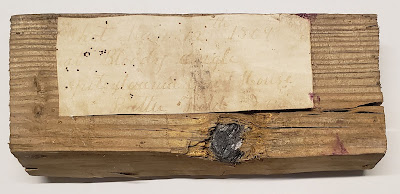
Piece of wood from the Bloody Angle at Spotsylvania with minie ball
State conservators in Virginia are working to solve some mysteries about the 71 items found last month in a cornerstone box that was placed under the Gen. Robert E. Lee statue in Richmond.

Why were 20 items found inside not mentioned in an 1887 newspaper article that detailed the donations? Do all the artifacts match what was described at the time?

An interesting assertion appeared last week in a Virginia Department of Historic Resources (DHR) update about the project, which included an inventory of the box's contents. The article challenges media descriptions of the 36-pound copper box as a time capsule. 

William Bryan Isaacs, a leading Freemason living in Virginia, oversaw the placement of the box. The article asks whether he and others meant for the box to be opened by a later generation, as is the case with time capsules.

“Isaacs and his contemporaries would not have thought so. Not only was the term not used widely until the 1930s, but cornerstone boxes were inherently foundational,” the update says. “The items inside were meant for 'a far remote posterity' and were not intended to be readily accessed and explored on a certain date in the future."

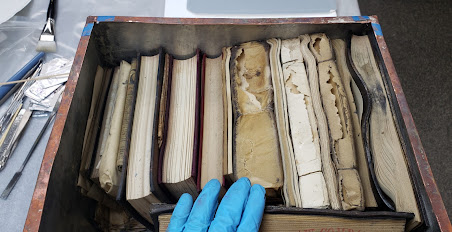
Despite some moisture, contents were in good shape (Virginia Department of Historic Resources)
The statue of Lee on his horse was removed in September, part of racial reckoning across the country following the death of George Floyd in Minneapolis. Richmond was the capital of the Confederacy and the building of Lee’s and other monuments across the South following the Civil War perpetuated the Lost Cause narrative, which asserts states’ rights, rather than the preservation of slavery, was the South’s chief cause. Many historians have challenged that view.

The Civil War Picket recently contacted the Department of Historic Resources for photographs of some of the artifacts in the box. Katherine Ridgway, state archaeological conservator, provided several and additional descriptions. The Picket believes it is the first publication to publish this many photographs related to the contents, with a focus on military-related items. (Some images are cropped)

It’s important to note the contents of the box did not highlight the contributions of many in the community. Local historian and author Dale Brumfield told ABC News, “What was not in it was anything relating to the Black community of Richmond. Richmond had a thriving Black middle class at the time ... and there was nothing pertaining to that."

"Gray and blue badge" and a muster roll of 21st Virginia (VDHR)
What was included was a wide array of items honoring Confederate soldiers and veterans, books, buttons, coins, newspapers and more. A few items pertained directly to Lee.

One more note before additional photographs below. The discovery of this box was not a surprise, given the newspaper article at the time detailing donations from area citizens. A box found shortly before in the statue pedestal was. It turned out to be items experts believe were placed by the monument's builders.


The inventory lists a Frank Brown as the donor of the piece of wood (top photo) from the Bloody Angle at Spotsylvania, dated May 12, 1864. It includes a shattered Minie ball and a piece of paper describing the location.

Brown also donated Minie balls described as coming from the Battle of Fredericksburg. The box included five bullets, with the 1887 inventory indicating Brown gave three. But which three belonged to Brown, and were all five from Fredericksburg, asks Ridgway and others.

Additional Minie balls, with two indicating impact (Virginia Department of Historic Resources)
The cornerstone included numerous items made of paper, including documents, books and regimental muster rolls.

The Virginia Confederate button below is associated with Capt. Cyrus Bossieux, who, according to findagrave, enlisted in 1861 and served with the 1st Virginia Regiment (Company A, in which he served, was known as the Richmond Grays) and the 3rd Virginia Artillery.

Bossieux, interestingly, is in a famous photograph of the Richmond Grays at the execution of abolitionist John Brown before the Civil War. It is in the collection of the Library of Congress.

Bossieux button (Virginia Department of Historic Resources)
Ridgway told the Picket that the other button found in the box is described a coming from the coat of a Capt. Bremond. "We are still working with experts to make sure everything is identified correctly, but since there were only two buttons and we thought there would be more, there is more research to do here."Among the published materials in the box was a copy of "Detailed Minutiae of Soldier Life in the Army of Northern Virginia, 1861-1865."

It was written in the early 1880s by Carlton McCarthy, a private in the Army of Northern Virginia, which was commanded by Lee. (Book from cornerstone box, below, courtesy of Virginia Department of Historic Resources)

Goodreads.com provides this summary of the volume: “This Civil War classic of soldiering in the ranks debunks all the romantic notions of war. Like his Northern counterpart, the Confederate soldier fought against bullets, starvation, miserable weather, disease, and mental strain. But the experience was perhaps even worse for Johnny Reb because of the odds against him."

DHR, in its article last week, said it will post future articles on the two boxes found in the Lee pedestal. They will be published on Wednesdays. 

"We have asked experts from across the Commonwealth to choose artifacts and tell us more about them," the agency said. "We are so lucky that the artifacts were in such good condition and that Virginia has such fantastic experts to call upon to help us create articles that keep those who live in the Commonwealth and further abroad informed."

(Virginia Department of Historic Resources)
The items above are described as a Masonic symbol and a Confederate battle flag, both reportedly fashioned from the tree above Gen. Thomas J. "Stonewall" Jackson's grave. The donor was listed as J.W. Talley.

At right, is a fragment of an iron shell purportedly fired at the Battle of Fredericksburg in 1862 and listed in the 1887 inventory as being donated by Frank Brown.

Ridgway says there are some questions about a rock described as being a piece of a stone wall at Fredericksburg, also donated by Brown.

"In the box was found a smooth stone, an aggregate of small stones, and a piece of what might be mortar. Are one or all of these the 'piece of a stone wall' mentioned in 1887? Some of these answers will take time and research," the DHR article says.

Rock found in box (Virginia Department of Historic Resources)
Ahead of the box's opening, Ralph Northam, who was Virginia's governor until this month, had tweeted about developments on what was then considered a time capsule. The opening of the box attracted national attention to Ridgway and others involved in the project.

"The whole thing has been kind of a whirlwind. While I was expecting the cornerstone box to be found, no one knew exactly when that would happen," Ridgway told the Picket this week in an email.

"Once they found it, there was a lot of work to do and the time flew by. I was working with such a great team of professionals from UVA, Colonial Williamsburg, and the VMFA (Virginia Museum of Fine Arts) that the process went very smoothly, even with all of the cameras and reporters. Now it is exciting to have curators and historians from around the Commonwealth coming to see the artifacts and help us understand the contents of the containers."

Recovered box before it was opened (Virginia Department of Historic Resources)