Showing posts with label richmond. Show all posts

Wednesday, January 24, 2024

Virginia's Henrico County has bought a James River parcel rich with history. Now it will decide how to tell the story of the Civil War, enslaved people and colonial days

Varina plantation home, cannonballs in wall and Benjamin Butler (Henrico Co. and Library of Congress)
Bald eagles, ducks and geese routinely take flight near a weathered two-story brick home that sits on a sloping hill southeast of Richmond. The dwelling has a circle driveway on one side and a view of the James River on the other. Fields that have been tilled for generations lie just to the north and west.

For all its bucolic setting, Varina Farms, or Varina on the James, has another facet: history as deep and rich as the soil. The former plantation is considered the birthplace of Henrico County, which curves around Richmond and is home to 340,000 residents.

In the early 1600s, English settler John Rolfe, husband of indigenous Princess Pocahontas, discovered the soil and climate at the site were suited for growing mild tobacco, with the name Varina linked to a form of Spanish tobacco.

The Civil War came to Varina Farms about 250 years later, and the property was a scene of combat, prisoner exchanges and the headquarters of Union Maj. Gen. Benjamin Butler. Confederate cannonballs struck the 1853 Classic Revival home, and there are signs of those today.

At one point, Butler built a pontoon bridge to carry his men and supplies across the river to attack Richmond in 1864.

Property fronts the James River, 10 miles south of Richmond (Henrico County map)
With land preservation and public use in mind, Henrico County leaders recently purchased the property from the Stoneman family, which had been its guardian since the early 1900s. The total for two purchases, which includes the battle-scarred 1853 Classic Revival home, came to about $18.5 million. Interstate 295 slices through the farm.

“By acquiring this beautiful, vast and irreplaceable property, Henrico County is making a once-in-a-lifetime move to ensure that our history as a county, a commonwealth and a nation are preserved and that our precious, scenic riverfront will remain protected and accessible for generations to come,” said Board of Supervisors Chairman Tyrone E. Nelson.

County has ideas for site, but wants input from citizens

County officials will now begin the process of determining future use for the farm, known as Aiken’s Landing during the Civil War.

The possibilities are as broad as the view of the river, says Julian Charity, division director for history, heritage and natural resources in the county park system.

The home has not been occupied for at least a decade (Henrico County photo)
“We have a number of ideas, but we’re also interested in what the public would like to see out there,” Charity told the Picket in an email.

The possibilities include:

-- Archaeology across the site, including colonial days;

-- Restoration of the house and interpretation of each lower-floor room for different aspects of the plantation’s history;

-- A new Civil War museum, riverboat historic tours and archaeological excavations of the original Varina site;

-- A commemorative site for the enslaved persons who worked the fields and house for about 250 years. The family of Albert Aiken owned about 60 enslaved people on the eve of the Civil War, according to Charity. Officials have begun compiling a listing of known names;

-- A Native American interpretive site

-- Wetlands restoration with the James River Association, pollinator gardens and agriculture classes for county schools.

View of home from "land" side, just past farmland (Henrico County photo).
County officials said any opening of the property is at least a year away. There are no facilities available to the public at this time and there are no restrooms.

Marc Wagner, senior architectural historian for the state Department of Historic Resources, said the agency has advised the county on possible archaeology and how to interpret the dwelling. “We are hoping the county will invite us back out.”

A lot more of Varina's history lies below the surface

The Department of Historic Resources champions preservation statewide and has an online database of sites. It is familiar with Varina Farms and is standing by to assist Henrico County, said Mike Clem, the department’s eastern regional archaeologist.

According to Charity, archaeology surveys done in the 1970s and 1996 were all surface observations and collection.

(Marc Wagner, Va. Department of Historic Resources)
“One of the first things we would like to do is archaeology,” Charity said. “We are intending to pinpoint the locations of the early buildings (courthouse, glebe, parish, ordinary, etc.), Butler’s wharves, enslaved cabin sites, and anything listed in the vast histories.” This goes back to the early colonial period.

He says the site has been picked over during the years, so many historic items are no longer available.

“As archaeology is performed, we fully expect to recover hundreds of artifacts pertaining to the Civil War,” Charity said.

Plantation was a busy crossroads, troops site

Not long into the Civil War, Richmond became a prime objective for the Union army, and dozens of battles and skirmishes took place in Henrico and nearby counties.

Varina on the James served as an eastern depot for the August 1862 exchange of about 6,000 prisoners, according to a history in the state’s archives. A brick barn – about 400 yards from  the home – briefly held Union prisoners during the war. The barn was near a wharf used for the exchanges. (Some histories say the plantation was home to the first cotton mill in the South.)

Federal bridge crosses James River at Varina Landing (Library of Congress)
The farm was also used as a major crossing point for Union troops, according to the county.

In November 1863, the controversial Butler received command of the Department of Virginia and North Carolina, and the following May was in the field again, this time at the head of the new Army of the James.

His army spent months southeast of  heavily defended Richmond, unsuccessful in making significant gains, though he notched a victory at New Market Heights, northwest of Varina, in September 1864. Fourteen members of the U.S. Colored Troops were awarded the Medal of Honor for their valor.

Butler used Varina for his headquarters during part of 1864. According to one history, the general rode one day to inspect his camps.

“As he passed some ditches which he thought were filled with his own men, the Rebels fired upon him. They had reclaimed the land. Butler outran the Rebels and made it safely to the fort where he met Grant.”

Home was struck by Rebel cannonballs

The history says Butler built a log cabin for his headquarters near the home and used it until war’s end, having failed in his assault on Petersburg and being driven back by Confederate troops.

“The dwelling still shows the damage by cannon balls, fired by the Confederate batteries, from the Chesterfield side near Dutch Gap,” according to a 1937 report on the plantation. (Photo of damaged area, Henrico County)

The brick west wall of the home today is pocked with small craters made by the artillery rounds.

Wagner said: “You can tell the cannon balls are cemented into the damaged brick.  On site we wondered if that was done for effect by later owners.  Would the cannon fire have hit the wall and lodged in or just bounced out -- possibly both happened?”

Charity says officials believe the round shots in the wall replaced original cannonballs removed in the 1960s.

“We do not believe that the cannonballs are modern, but we believe that they are replacements. More than likely, leftover cannonballs found on the property from Butler’s time there,” he said.

The Union pontoon bridge was later removed, but different references mention remnants still on or in the James River, according to Charity.

None of the other buildings of the time, other than the 1853 home and its kitchen outbuilding, along with remnants of the barn, are still standing, said Charity.

Cannonballs in the west wall (Marc Wagner (Va. Dept. of Historic Resources)
Home was modernized, but still has original elements

For fans of antebellum homes, the Aiken home just about has it all.

The interior has a variety of decorative elements, according to a 1976 nomination form for the home’s placement on the National Register of Historic Places.

The form says of the dwelling:

“The dwelling house is a two-story, common-bond brick structure connected by a long hyphen to a kitchen at the east and was built in 1853. It is five bays long with six-over-six sash and white wooden sills and lintels, except on the ground story of the river front where all of the window openings have French doors set into them. A one-story, decastyle Ionic porch, rebuilt after a 1941 tornado, stretches the length of the river front and is returned halfway along the west end. A one-story tetrastyle Ionic portico shelters the land front. “

Civil War photo shows flat roof, renovations included taller chimneys (Va. Dept. of Historic Resources)
The home is showing its age, though county officials say the Stonemans did a good job maintaining it and the property. No one has lived in the house for at least 10 years, and the electrical has not been updated since the 1970s.

“We have some work to do, but I’ve definitely seen structures in far worse condition,” said Charity.

Wagner with the state DHR said the house was updated in the early 20th century so the interior reflects a lot of that period. “The roof blew off the house during a tornado at one point so the whole roof area was rebuilt.”

He said the house appears to have undergone a substantial remodeling a little more than a 100 years ago.

One of the rooms at the old Varina home (Marc Wagner, Va. Dept. of Historic Resources)
“This was the period when farms got upgraded all over Virginia. Farming became more prosperous operations with the growth of cities, RR (railroads) and improved scientific farming methods -- and the owners would often upgrade these old plantations with modern bathrooms and kitchens.”

Parts of Varina’s main house interior date back to the 1850s, especially the room plan and central hall circulation. All of the brickwork, and some of the exterior trim is from the 1850s. The porches have been rebuilt over time in the same 1850s Greek Revival style, Wagner said.

“The kitchen interior is all modern,” he told the Picket. “It likely housed 5-10 enslaved persons (a guess) and had a large cooking space. It is rare to find the covered connected kitchen to house structure, original to the design -- the only one left in Henrico that is pre-1860. You can see in later years that a new entrance was added to the kitchen and the small upstairs window. The new entrance on the kitchen signals a difference use of the kitchen building, as just residential space.”

(Marc Wagner, Virginia Dept. of HIstoric Resources)
Charity said the county plans to move forward on preservation talks and work soon.

“We’ve gone through the general assessment phase where we’ve identified priorities (electrical, windows, plumbing, etc.), now we are in the contractor estimation phase. We have a number of contractors under contract (due to the other historic properties we manage), and are getting more information on exactly how to proceed.” (Aerial view of Varina, below, Henrico County)

Henrico County owns other Civil War-related properties, including portions of Malvern Hill, New Market Heights, Deep Bottom and Savage’s Station battlefields.

It is working with a consortium of groups and governments to build a bike/walking trail through the New Market Heights property to a Civil War site and one to Four Mile Creek, from the Revolutionary War.

The New Market Heights site has been master planned for a large passive park site, but it has not yet come to fruition.

Wednesday, January 19, 2022

Civil War Picket special: Take a look at more than a dozen items found in the Lee monument cornerstone box in Richmond, Va.

Two minie balls found in cornerstone box (Virginia Department of Historic Resources photos)
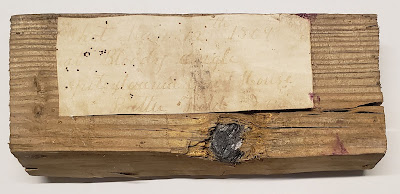
Piece of wood from the Bloody Angle at Spotsylvania with minie ball
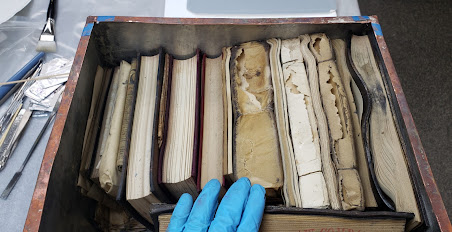
State conservators in Virginia are working to solve some mysteries about the 71 items found last month in a cornerstone box that was placed under the Gen. Robert E. Lee statue in Richmond.

Why were 20 items found inside not mentioned in an 1887 newspaper article that detailed the donations? Do all the artifacts match what was described at the time?

An interesting assertion appeared last week in a Virginia Department of Historic Resources (DHR) update about the project, which included an inventory of the box's contents. The article challenges media descriptions of the 36-pound copper box as a time capsule. 

William Bryan Isaacs, a leading Freemason living in Virginia, oversaw the placement of the box. The article asks whether he and others meant for the box to be opened by a later generation, as is the case with time capsules.

“Isaacs and his contemporaries would not have thought so. Not only was the term not used widely until the 1930s, but cornerstone boxes were inherently foundational,” the update says. “The items inside were meant for 'a far remote posterity' and were not intended to be readily accessed and explored on a certain date in the future."

Despite some moisture, contents were in good shape (Virginia Department of Historic Resources)
The statue of Lee on his horse was removed in September, part of racial reckoning across the country following the death of George Floyd in Minneapolis. Richmond was the capital of the Confederacy and the building of Lee’s and other monuments across the South following the Civil War perpetuated the Lost Cause narrative, which asserts states’ rights, rather than the preservation of slavery, was the South’s chief cause. Many historians have challenged that view.

The Civil War Picket recently contacted the Department of Historic Resources for photographs of some of the artifacts in the box. Katherine Ridgway, state archaeological conservator, provided several and additional descriptions. The Picket believes it is the first publication to publish this many photographs related to the contents, with a focus on military-related items. (Some images are cropped)

It’s important to note the contents of the box did not highlight the contributions of many in the community. Local historian and author Dale Brumfield told ABC News, “What was not in it was anything relating to the Black community of Richmond. Richmond had a thriving Black middle class at the time ... and there was nothing pertaining to that."

"Gray and blue badge" and a muster roll of 21st Virginia (VDHR)
What was included was a wide array of items honoring Confederate soldiers and veterans, books, buttons, coins, newspapers and more. A few items pertained directly to Lee.

One more note before additional photographs below. The discovery of this box was not a surprise, given the newspaper article at the time detailing donations from area citizens. A box found shortly before in the statue pedestal was. It turned out to be items experts believe were placed by the monument's builders.


The inventory lists a Frank Brown as the donor of the piece of wood (top photo) from the Bloody Angle at Spotsylvania, dated May 12, 1864. It includes a shattered Minie ball and a piece of paper describing the location.

Brown also donated Minie balls described as coming from the Battle of Fredericksburg. The box included five bullets, with the 1887 inventory indicating Brown gave three. But which three belonged to Brown, and were all five from Fredericksburg, asks Ridgway and others.

Additional Minie balls, with two indicating impact (Virginia Department of Historic Resources)
The cornerstone included numerous items made of paper, including documents, books and regimental muster rolls.

The Virginia Confederate button below is associated with Capt. Cyrus Bossieux, who, according to findagrave, enlisted in 1861 and served with the 1st Virginia Regiment (Company A, in which he served, was known as the Richmond Grays) and the 3rd Virginia Artillery.

Bossieux, interestingly, is in a famous photograph of the Richmond Grays at the execution of abolitionist John Brown before the Civil War. It is in the collection of the Library of Congress.

Bossieux button (Virginia Department of Historic Resources)
Ridgway told the Picket that the other button found in the box is described a coming from the coat of a Capt. Bremond. "We are still working with experts to make sure everything is identified correctly, but since there were only two buttons and we thought there would be more, there is more research to do here."Among the published materials in the box was a copy of "Detailed Minutiae of Soldier Life in the Army of Northern Virginia, 1861-1865."

It was written in the early 1880s by Carlton McCarthy, a private in the Army of Northern Virginia, which was commanded by Lee. (Book from cornerstone box, below, courtesy of Virginia Department of Historic Resources)

Goodreads.com provides this summary of the volume: “This Civil War classic of soldiering in the ranks debunks all the romantic notions of war. Like his Northern counterpart, the Confederate soldier fought against bullets, starvation, miserable weather, disease, and mental strain. But the experience was perhaps even worse for Johnny Reb because of the odds against him."

DHR, in its article last week, said it will post future articles on the two boxes found in the Lee pedestal. They will be published on Wednesdays. 

"We have asked experts from across the Commonwealth to choose artifacts and tell us more about them," the agency said. "We are so lucky that the artifacts were in such good condition and that Virginia has such fantastic experts to call upon to help us create articles that keep those who live in the Commonwealth and further abroad informed."

(Virginia Department of Historic Resources)
The items above are described as a Masonic symbol and a Confederate battle flag, both reportedly fashioned from the tree above Gen. Thomas J. "Stonewall" Jackson's grave. The donor was listed as J.W. Talley.

At right, is a fragment of an iron shell purportedly fired at the Battle of Fredericksburg in 1862 and listed in the 1887 inventory as being donated by Frank Brown.

Ridgway says there are some questions about a rock described as being a piece of a stone wall at Fredericksburg, also donated by Brown.

"In the box was found a smooth stone, an aggregate of small stones, and a piece of what might be mortar. Are one or all of these the 'piece of a stone wall' mentioned in 1887? Some of these answers will take time and research," the DHR article says.

Rock found in box (Virginia Department of Historic Resources)
Ahead of the box's opening, Ralph Northam, who was Virginia's governor until this month, had tweeted about developments on what was then considered a time capsule. The opening of the box attracted national attention to Ridgway and others involved in the project.

"The whole thing has been kind of a whirlwind. While I was expecting the cornerstone box to be found, no one knew exactly when that would happen," Ridgway told the Picket this week in an email.

"Once they found it, there was a lot of work to do and the time flew by. I was working with such a great team of professionals from UVA, Colonial Williamsburg, and the VMFA (Virginia Museum of Fine Arts) that the process went very smoothly, even with all of the cameras and reporters. Now it is exciting to have curators and historians from around the Commonwealth coming to see the artifacts and help us understand the contents of the containers."

Recovered box before it was opened (Virginia Department of Historic Resources)

Thursday, December 23, 2021

Some unexpected finds and absences in Lee statue time capsule

A rust-colored 1875 almanac, a cloth envelope and a silver coin were found in a time capsule that lay hidden beneath a towering statue of Confederate Gen. Robert E. Lee in Richmond, Va., for more than 130 years. As intriguing as the water-damaged items were, they’re not what many were expecting to see. Historical records led many to believe the capsule held dozens of objects related to the Confederacy as well as a picture of deceased President Abraham Lincoln -- Article

Tuesday, February 2, 2021

American Civil War Museum in Richmond has a new CEO

After a yearlong search, the American Civil War Museum has found its new CEO and president: Rob Havers. Most recently, Havers served as president and CEO of the Pritzker Military Museum and Library in Chicago.

According to the museum, Havers has extensive museum, research library, archival and not-for-profit management experience with an academic background in military history and strategic studies. -- Article

Tuesday, March 24, 2015

Looking at history -- through whiskers

You know the saying: What’s old is new again. Here’s one for you: Civil War facial hair. It’s what’s hot in 2015. The Valentine’s new show “Beard Wars” in Richmond, Va., re-creates 23 famous beards from Union and Confederate generals in the ultimate face-off salute to facial hair. • Article

Saturday, March 7, 2015

See what Richmond has planned for April

Richmond’s experience through and beyond the end of the Civil War will be commemorated at the beginning of April with enough activities to fill a 16-page brochure. The grand finale of the 150th anniversary commemoration will center on Capitol Square and Shockoe Bottom. Participating groups range from black re-enactors to historical museums. • Details

Tuesday, August 13, 2013

Richmond park acquires Glendale land

1864 engraving depicting fight over McCall's artillery
For the first time in 140 years, the public one day will be able to walk on a 251-acre section of an 1862 Virginia battle that was an opportunity for Gen. Robert E. Lee to perhaps garner a war-changing victory.

Richmond National Battlefield Park announced Monday that it received the land from the Civil War Trust. The acquisition more than doubles the park's holdings at Glendale to 394 acres. Glendale is in Henrico County, approximately 11 miles southeast of downtown Richmond.

"Although the Battle of Glendale was one the largest in Virginia, little of it had been preserved until recently, so the result of the acquisition is a virtually 'brand new' Civil War battlefield," the park said in a press release.

The three-mile swath extends from the upper end of the Glendale to the lower end of the Malvern Hill battlefield.

Known in the South as Frayser's Farm, the June 30, 1862, Battle of Glendale was the penultimate of the series of battles known as the Seven Days.

Lee designed his pursuit to cut off a Union retreat from Richmond to a new position on the James River, hoping to interdict the Union columns and win by dividing and conquering. The Confederates' attempts were unsuccessful and some historians argue that the battle at Glendale was one of Lee's best opportunities during the Civil War to win a comprehensive victory, according to the park.

The park property includes the spot where Gen. George G. Meade (later commander of the entire Union army in Virginia) was wounded.The park also owns the land where all 16 of the Union cannon were captured during the battle and where all of the hand-to-hand fighting took place.

Tuesday, July 3, 2012

Summer of '62: Impact of Seven Days Battles

Over seven days -- June 26, 1862 through July 1, 1862 -- Confederates under Robert E. Lee engaged in a series of six fierce clashes with Federals bent on taking Richmond, Va.

Historians sometimes argue that Gen. George B. McClellan didn't seem too bent on the taking the Southern capital -- given his caution and tendency to inflate enemy numbers. But on this occasion, he and Lee did fight, with significant consequences.

Writing this month in the Weekly Standard magazine, Geoffrey Norman details Lee's swing to the offensive outside Richmond.

The culmination of the Union's Peninsula Campaign, however, appeared to be inconclusive. Some 36,000 casualties later, McClellan left the field despite his subordinates urging him to press the attack after repelling Southern forces at Malvern Hill (above).

"The Seven Days is, in this regard, analogous to the Battle of the Marne in the First World War: Confused, inconclusive, and a tragically missed opportunity for both sides, after which the war would not merely go on, but take over and become a force beyond human control," writes Norman, spending much of his article taking McClellan to task for his hubris.

The Seven Days Battles is the subject of an upcoming lecture by Civil War historian and author Gary W. Gallagher (right).

The July 11 program in Richmond, co-sponsored by the National Park Service and the Virginia Historical Society, is entitled, "More Important Than Gettysburg: The Seven Days' Campaign as a Turning Point."

Gallagher, editor of "The Richmond Campaign of 1862: The Peninsula and the Seven Days" (2000), will discuss ramifications of McClellan's failure to take Richmond and where the armies went next as a result.

The Civil War Trust's summary of Seven Days says Lee's strategic victory would mean three more bloody years of war.

And Thomas Donnelly, also writing in the Weekly Standard, says between the conclusion of Seven Days and Gettysburg, "the course of the war, the fate of the American continent, and the prospects for human liberty hung by a thread."

Malvern Hill illustration, courtesy of Library of Congress. Gallagher's lecture is set for 5:30 p.m.- 7 p.m. July 11 at the Virginia Historical Society, 428 N. Boulevard, Richmond, Va. For more informaton: RICH_Interpretation@nps.gov or call 804-226-1981.

Tuesday, May 8, 2012

Sesquicentennial moves on to Richmond

Richmond's big chapter in the battlefield history of the Civil War will begin its 150th anniversary commemoration Wednesday and continue with 60 days of events. Activities will stretch from Chesterfield to Hanover counties with the theme "On this date. In this place. At this time." • Article

Sunday, March 18, 2012

Spotlight on Museum of the Confederacy

The commemoration of the Civil War's 150th anniversary is a welcome gift for the Museum of the Confederacy, bringing rare attention to a Richmond institution whose attendance has softened in the past two decades. Later this month, the museum wil opens its branch in Appomattox, site of Gen. Robert E. Lee's surrender. Spokesman Sam Craghead said the museum is trying to tell the story of a phase of American history. "If you're going to learn from history, you have to know everything." • Article

Tuesday, August 2, 2011

Tredegar center adds actor to its board

The American Civil War Center at Historic Tredegar has added some star power to its board. The Richmond, Va., attraction says Norfolk native Tim Reid is among four new members named to its board. • Article

Wednesday, August 11, 2010

48 hours in historic Richmond

Reuters correspondents help you get the most out of a 48-hour visit to the former Confederate capital that will commemorate the 150th anniversary of the Civil War in 2011. • Article

Tuesday, July 6, 2010

Living history this weekend at Malvern Hill

Richmond (Va.) National Battlefield Park is holding a two-day Malvern Hill living history this weekend. Rangers will talk about the final battle of the Seven Days campaign fought July 1, 1862, near the Confederate capital.

Walking tours and Union artillery and infantry demonstrations are planned Saturday (July 10) and Sunday (July 11). The free events last from 10 a.m.-5 p.m. Saturday and 10 a.m.-4 p.m. Sunday.

At sunset Saturday, rangers will hold a program about the battles fought around Richmond in 1862 and 1864.

Gen. Robert E. Lee launched several fruitless attacks on strong Union positions at Malvern Hill, suffering 5,300 casualties. Despite the victory, Union Gen. George B. McClellan withdrew his forces to Harrison’s Landing on the James River, ending his Peninsula Campaign. From there, Lee took the offensive against Maj. Gen. John Pope, culminating at Second Manassas.

• Click here for more information on the NPS program.