Parker, seated second from right, with Grant again, and after the war (Library of Congress, National Archives)
Ely Samuel Parker
was many things: Orator, soldier, engineer, Cabinet member, translator
and tribal diplomat.
But one title
Parker was not afforded – although he was richly qualified -- was attorney and
counselor in his native New York state. That’s because Native Americans were
not recognized as U.S. citizens until 1924 and he could not be admitted to the state bar.
The injustice was remedied Friday morning when the state’s Supreme Court, Appellate Division,
Fourth Department, posthumously admitted Parker to practice law in western and
central New York.
“The failure
was never his. It was the law itself,” descendant Melissa Parker Leonard said
during a courtroom ceremony in Buffalo. She spoke of her ancestor's dogged efforts as a sachem (leader) to protect his tribe's culture and land.
It’s a fair
bet to say most Americans who have followed 19th century American
history might best know Parker for his role as an aide and secretary to Union Gen.
Ulysses S. Grant during the last two years of the Civil War. He can be seen in
numerous photographs kept by the Library of Congress and the National Archives.
Col. Parker,
born into the Tonawanda Seneca Nation, was present at Confederate Gen. Robert
E. Lee’s surrender at Appomattox and he helped formulate documents. Lee
famously called Parker the one “real American” there. “We are all Americans,”
the officer responded.
Friday’s
events did mention Parker’s Civil War service, but as one speaker made clear, he
was more than a footnote in Grant’s life.
Ely S. Parker, seated far left, at the Grand Review of the Armies in 1865 (Library of Congress)
Parker, born
in 1828 with the name Hasanoanda,
studied law in Ellicottville, N.Y., in the late 1840s but was denied
consideration for admission.
“Despite the injustice of not being able to do so as a recognized member
of the bar, Mr. Parker nonetheless utilized his legal training to assist in
litigation to protect the ancestral homelands of the Tonawanda Seneca,
including two successful cases before the United States Supreme Court,” the
appellate court said in an article about its action.
Ely (pronounced Ee-Lee) Parker became an
engineer after studying at Rensselaer Polytechnic Institute. Early in
the Civil War, he was denied an opportunity to form an Iroquois regiment
in New York.
Circa 1850 daguerreotype of Parker by Edward T. Whitney, who later took Civil War views for Mathew Brady. Courtesy Peabody Museum of Archaeology and Ethnology, Harvard University, 35-5-10/53072
He served in the Army of the Tennessee and eventually
joined up with Grant, who he had met before the war.
When
hostilities ended, the officer remained as an aide to Grant and served in the 2nd
U.S. Cavalry before retiring at brevet brigadier general. Parker then became the nation’s first Native
American commissioner of Indian Affairs during the Grant presidency. He died in 1895.
Speakers at Friday’s event and a program Thursday evening at The Buffalo History Museum spoke of the prejudice Native Americans have endured, from relocation to boarding schools.Parker,
they said, fought for his people.
Lee Redeye (center) and Melissa Parker Leonard (far right) speak Thursday (The Buffalo History Museum)
Lee Redeye, deputy counsel for the Seneca
Nation, said Parker is now a victor, instead of a victim.
“We must
never forget our roots. We must remember where we come from. We must honor our
people. We must honor our nations,” Redeye said.
Kathleen
Sweet, president of the New York State Bar Association, issued a statement about
the court’s action:
“The
posthumous admission of Ely S. Parker to the New York Bar today corrects a
longstanding injustice. Parker wrote the final draft of the Confederate
surrender terms at Appomattox and was a lawyer in every sense of the word. As a
Native American, he could not be a citizen nor a counselor at law. Finally, he
has received this overdue recognition.”
The recognition of Parker coincided with Native American Heritage Month.
Cards for three soldiers, James Roantree's kepi and grave and photo of William Montgomery (NPS)
I don’t get
up to Virginia and Maryland very often, so I took advantage of my family
encouraging me to visit Petersburg, Monocacy (first time) and Manassas battlefields during a mid-August trip.
While leaving
the visitor center/museum at Petersburg National Battlefield’s Eastern Front
Unit, I spied boxes filled with surplus Civil War “trading cards” from the
sesquicentennial.
I felt like a kid! I scooped up the five cards detailing
specific soldiers, three of whom were killed near the war’s end.
I was familiar with two of the men but had not heard of the others. Thus began
a journey of discovery after the ever-helpful Emmanuel Dabney, chief of resource
management at Petersburg, got me started.
Dabney said
the park recently launched a 13-part StoryMap interactive page highlighting
the experiences of James Roantree (one of the trading cards) and his brother
Robert. The text largely draws upon letters and
James' 1864 diary, among several other fascinating resources.
"Their correspondence with their family members illustrates some common
themes of this period, but their bitter opposition to those Northerners who did
not wish to persecute the war in a manner that would destroy the Confederacy is
fascinating," said Dabney.
"It's the family's efforts in the years after the Civil
War to preserve the objects, letters, and diaries that really is of great value,”
he said of the project.
The
park has a chilling artifact: James Roantree’s kepi, which still has a bullet
hole entry. He was killed in the Battle of Boydton Plank Road southwest of
Petersburg.
I have used
park information and other sources to learn the stories of these five men. The card for Roantree has his last name misspelled.
UNION SGT. DECATUR DORSEY
Amid the
chaos following the Crater explosion at Petersburg on July 30, 1864, Sgt. Decatur Dorsey planted the flag on Confederate works as comrades with the 39th
USCT advanced into the breach.
Rare photo of black troops (background) in the field in Virginia (See more here)
Dorsey and
his flag rallied men when they were pushed back. His heroism -- just months
after gaining freedom from enslavement – earned him the Medal of Honor in November 1865. The park has nothing in its collections about Dorsey and, as is
typically the case with African-American soldiers, has no photograph of him.
Dabney did point me to some information about Dorsey's
life while enslaved in Howard County, Md. A researcher wrote that Dorsey’s
slave name was Cato. Dorsey attempted a store burglary after his master died in
1858, possibly “part of a plan to run away and
escape the risk of being ‘sold South.’”
After
conviction, Dorsey escaped, was captured and sent to prison to complete his
sentence. After he was released, he was purchased again, says the Howard County Historical Society.
A stack of trading cards at the Eastern Front visitor center (Picket photo)
At 28, he obtained
his freedom in some manner shortly before the spring campaign of 1864 began. He
enlisted with the 39th USCT in Baltimore and was promoted twice
before Petersburg.
Under
cover of darkness on July 29, 1864, Dorsey and his regiment filed in to the
trenches before Fort Morton on the eastern front of Petersburg, according to
the National Park Service.
The
Union army detonated a mine underneath the Confederate lines. After the mine's
detonation, Federal soldiers rushed forward only to become trapped inside the
crater and the defensive works on both sides. Dorsey was vulnerable as a target and the fact he could not use a weapon while carrying the flag.
The Union army was unable to
exploit any advantage they had gained and soon withdrew to their lines.
The
heavily engaged 39th USCT saw action at Weldon Railroad, Poplar
Grove church and Hatcher’s Run during the Petersburg campaign. It took part in
the capture of Fort Fisher in North Carolina in January 1865 and helped occupy
Wilmington.Dorsey
was honorably discharged in December 1865 while in Wilmington, North Carolina.
He
married soon after and died in 1891 from the effects of typhoid and rheumatism
he had contracted in Wilmington, at the approximate age of 55.
All who have
read about the Civil War – or any conflict, for that matter – have thought how cruel
it was for a combatant to die just days, or hours, before the fighting was
over.
Of course,
any death from 1861 to 1865 was a terrible loss to loved ones, friends and
comrades.
Pvt. William
Montgomery of the 155th Pennsylvania Infantry was mortally wounded
about the time a flag of truce was exchanged on April 9, 1865, at Appomattox
Court House. Confederate forces surrendered shortly afterward.
The Pittsburgh native had enlisted in Company I in August 1864 when he was 18,
weighed only 115 founds and stood 5 feet 6 inches tall.
“By this
point in the war, the 155th PA wore the iconic Zouave uniforms. These uniforms,
adopted from the French, stood out thanks to their red fez hats, a jacket with
yellow trim, a red sash, and baggy French Chasseur trousers,” according to
the National Park Service.
After taking
part in the siege of Petersburg, the 155th marched on the Maria
Wright House at Appomattox.Court House, an area held by the Confederate Richmond Howitzers..
Patrick A. Schroeder, historian at Appomattox Court House National Historic Park, wrote in his book "More Myths About Lee's Surrender," the 155th Pennsylvania was in a skirmish line when officers arrived with a ceasefire order. "As the firing began to die away, an artillery shell (or fragments of a shell) tore into young Montgomery. His fancy Zouave uniform was shredded, and much of his equipment was ripped from his body. The shell made a wound to Montgomery's inner right thigh."
He
lingered for nearly three weeks.
“Under the Maltese Cross,” a book about the 155th Pennsylvania, said, “Young
Montgomery’s last words were messages of love and affection to his mother and
the tender of comforting hopes that his injuries were not serious.”
He died the
next day, on April 29, 1865, “while the paroling ceremonies were being
enacted,” according to the book. (At left, NPS photo showing position of Rebel guns at Appomattox)
The young
soldier is believed to be the last enlisted man killed in Virginia during the
Civil War, but that is not possible to confirm. He is buried with other Federal dead at Poplar Grove National
Cemetery at Petersburg.
A wayside marker at Appomattox details last casualties (NPS photo; click to enlarge)
Montgomery’s mother applied for the soldier’s pension.
Schroeder wrote it was a myth that Montgomery was only 15 when he died. And the regimental history was incorrect in saying the soldier died during paroling ceremonies, he said.
I asked the NPS historian why the Montgomery story resonates today.
“Undoubtedly, any soldiers killed or mortally wounded at Appomattox
is tragic," Schroeder replied in an email. "Though it is myth that he was 15 as stated in the 155th Pa regimental history, he was still young, 19.
And he enlists as a substitute in the fall of 1864, probably to help support
his family, only to be hit by a shell in the waning moments of the battle on
the morning of April 9. Very sad."
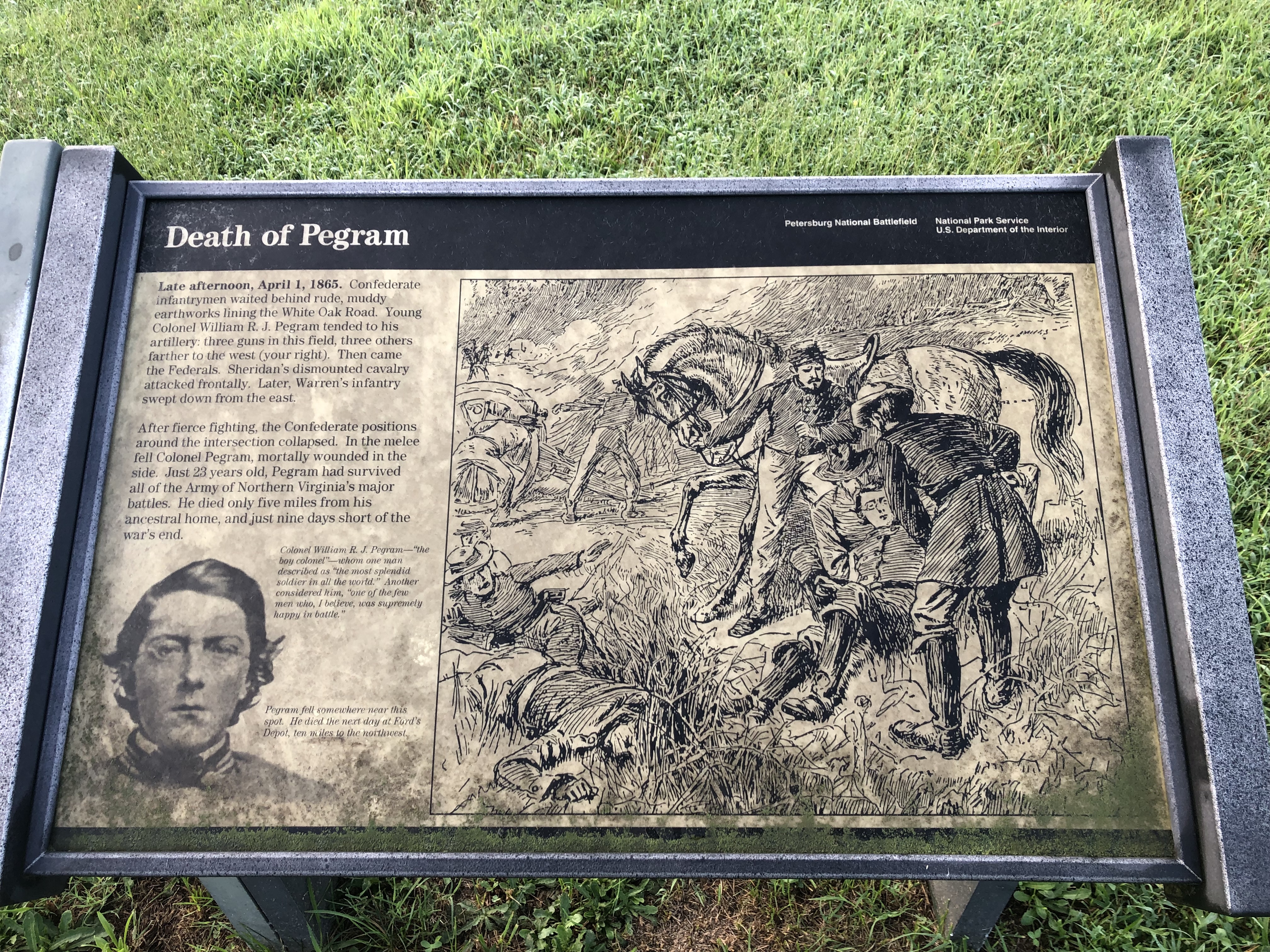
CONFEDERATE COL. WILLIE PEGRAM
Like other
boys of means in antebellum Virginia, William Ransom Johnson Pegram, or Willie,
was born to be a soldier. As a teen in the militia, Pegram witnessed John
Brown’s execution and as a law student joined the Confederate army when he was
19.
A marker showing the area in which Pegram fells (Devry Jones/HMdb.org)
Dubbed the “Boy Artillerist” by the late historian James “Bud:” Robertson, Pegram gained
fame at Mechanicsville and fought at Cedar Mountain, Antietam, Gettysburg, the
Wilderness, Cold Harbor and Petersburg, among other engagements.
“He was
notably nearsighted -- and the story in Richmond was that's why he had to get
so close to the enemy before engaging,” according to Antietam on the Web.
Rebel Maj. Gen. Henry Heth thought Pegram “one of the few men…supremely
happy in battle.”
Robertson wrote that statement was true.
“Soldiers never tired of telling how, one afternoon when
Pegram rode down his line of guns, an artilleryman waved his hat aloft and
shouted: ‘Come on, boys! Here comes that damned little man with the glasses!
We’re going to fight ‘em now.’
Living historians who have portrayed Pegram's unit at Petersburg (NPS photo)
Gen. Robert E. Lee declined to promote Pegram to general,
believing he was too valuable as an artillery officer and was needed with his
men and guns.
Nearly two months after his brother John, an infantry
general, was killed, Pegram met the same fate at the Battle of Five Forks. He
was mortally wounded during a Federal attack on April 1, 1865, and died the
next day.
“To the end, he believed God would see the Confederate cause
through to victory,” reads his trading card. He and John are buried together at
Hollywood Cemetery in Richmond.
Pegram’s
letters are in the collection of the Virginia Museum of History and Culture in
Richmond, said Dabney.
UNION 2nd
LT. JAMES ROANTREE
Like about a
half million other immigrants to the United States, brothers James and Robert Roantree heeded the call to arms to preserve the Union.
The Roantree
family had moved from England to upstate New York in Madison County, east of
Syracuse. James (photo left, courtesy of PNB) was about 10. He grew up to be a miller before the war.
The brothers enlisted in 1862 in the 157th New York, and James, at least, had no
shortage of patriotic fervor. Letters he wrote expounded on his determination to
help subdue the South and, during a furlough, he worked for President Lincoln’s
re-election in 1864.
Petersburg
National Battlefield has a poetic musing by James written some time during the
war. It is a florid story of love and loss, including these discouraging lines:
“She looked up in his face with earnest eyes and laid
her hand in his, and bade him wake. And love another, fairer, freer, maid. He
would be happy soon, she knew he would. He must for her dear sake.”
James soldiered
on and was wounded at Gettysburg while still with the 157th New
York.
After hospitalization in Philadelphia and further service, Roantree joined the
43rd U.S. Colored Infantry in September 1864 as a junior officer. He
expressed his zeal in a letter:
“As regards
commanding Negroes I think that someone must do it and believe it is perfectly
right that they should be employed and therefore (I) am willing to fight with
them and do what I can to put down this Rebellion.”
Roantree’s
service with the USCT was brief. He wrote ahead of the Oct. 27, 1864, fighting
at Boydton Plank Road.
“All we can
do is to hope and trust in him who holds the destinies of all in his hands to
bring us through. If I fall in the fray, I wish to fall at my post and I feel
that if I am not permitted to survive the contest I shall fall while doing my
duty.”
The bachelor
was the only officer with the 43rd USCT to die in the skirmish.
James Roantree's grave in New York (Courtesy of Douglas Holdridge)
Doug Holdridge of the Clockville Cemetery Association kindly took photos of the
graves for me. He said burials in the small agriculture community date to the
1700s. He was unaware of any direct Roantree descendants in the area.
The community acknowledges James on
Memorial Day with a veterans flag.
A
descendant donated a number of items
related to the brothers to Petersburg
National Battlefield back in the 1990s.
“We
have exhibited items from the collection at various times,” said Dabney.
One is a
clothes brush that belonged to either James or Robert. James’ pocket diary and
some letters home are in the collection, along with the kepi he wore when
killed.
A letter from James Roantree to his family and his pocket diary (Petersburg NB)
I asked
Dabney about the use of StoryMaps by the National Park Service.
“They are useful for
spatial data where there are changes over time. In the case of the Roantrees,
the StoryMap will highlight the brothers movements from England (where they
were born), to New York, to Virginia, Maryland, Pennsylvania, and for Robert to
the Deep South where he spent time in Florida, Georgia, and South Carolina
before mustering out.
David
L. Sadler, town of Lincoln historian, said Robert served as a school teacher in
Clockville after the war. Robert died in 1911 and is buried in Canastota, a few miles away from James.
UNION MAJ. GOV. GOUVERNEUR K. WARREN
After leading
troops at Second Manassas and the Peninsula Campaign, Warren earned everlasting
fame at Gettysburg. The chief engineer of the Army of the Potomac directed
troops to take unoccupied Little Round Top in July 1863.and save the Union left
and set up victory.
Warren peers for eternity at enemy troops below at Gettysburg (NPS)
A bronze
statue of Warren gazes below from the summit; it is among the Pennsylvania battlefield’s
most-famous landmarks.
Warren later
led II Corps in Virginia before taking over the V Corps. He did well during
much of the long Petersburg siege, but his reputation was sullied in the final
months of the war.
“He led his corps in the Battle of Five Forks, the first action of the
Appomattox Campaign. By that time Lt. Gen. Ulysses S. Grant had found Warren
troublesome because of his questioning of orders and unwelcome suggestions,”
reads an Army
Corps of Engineers biography.
“Grant gave Maj. Gen. Philip H. Sheridan authority to remove Warren from
command of V Corps, which Sheridan, who disliked Warren, promptly did, alleging
that Warren had not vigorously pressed the action at Five Forks.”
“After the
war, he resigned his commission as a major general in protest to Sheridan’s
actions, and returned to the Corps of Engineers. He spent the rest of his
career attempting to exonerate his name,” said the American Battlefield Trust.
The general,
known for his complex nature, called for a court martial to investigate the Sheridan
controversy. An 1879 inquiry issued a report exonerating Warren in 1882,
shortly after he died of diabetes
complications at age 52.
“At his
request he was buried in civilian clothing and without military honors,” the
Corps says.
The title of a biography on Warren might sum up his
complicated career: “Happiness Is Not My Companion.”
After almost
50 years spent in the basement of Ora McCoy’s Appomattox, Va., home, a family
bell passed down through five generations has found a new life ringing in
history along the East Coast. Originally unearthed for the commemoration of the
150th anniversary of General Robert E. Lee’s surrender at Appomattox Court
House in 2015, the bell found its way to other park ceremonies. McCoy’s
great-grandparents, Daniel and Phoebe Scruggs, once lived as slaves on the
Scruggs family farm in Appomattox. They have owned the bell since the Civil
War, passing it from hand to hand until it found its way to McCoy. In September, after a stint at the Fort Monroe
National Monument, the bell came home.• Article
Turkey wreath adorns a wall at Appomattox (NPS photo)
The folks at
Appomattox Court House National Historic Park in southern Virginia are offering
holiday cheer and punch Sunday at a free event that will show off greenery and
park additions since this time last year.
“People will
see the village dressed out for Christmas,” said Ernie Price, chief of
education and visitor services. “We will have an ornament-making station
targeting kids.”
Appomattox,
of course, is the site of Confederate Gen. Robert E. Lee’s surrender of the
Army of Northern Virginia on April 9, 1865.
History buffs
will have plenty to chew on at the open house, enjoying improvements made for this
past April’s 150th observance of the surrender. “If you haven’t been
here for a year, there are a lot of things to check out,” Price told the
Picket.
Exhibit erected for sesquicentennial of surrender (NPS)
Upstairs in
the visitor center – which is in the middle of the village -- is the
traditional museum, featuring exhibits on Federal cavalry. Downstairs is a
floor-to-ceiling trapezoidal exhibit case put in for the sesquicentennial. It
includes the battle flag of the 9th Virginia Cavalry, a U.S. flag
draped on President Abraham Lincoln’s coffin in Philadelphia during his funeral
procession, and accoutrements belonging to Union Maj. Gen. Phil Sheridan, who
bottled Lee up at Appomattox.
Visitors can
take in “With Malice Toward None,” a 14-minute film that debuted in March. It
is an overview of the campaign, the meeting of Lee and Union Gen. Ulysses S.
Grant at Appomattox, parole passes, the Confederate stacking of arms during the
surrender, and the effects of the war, including the passage of the 13th,
14th and 15th amendments, which were meant to ensure
equality for emancipated slaves.
Wreath made of tobacco leaves
The most
well-known structure at the park is the McLean House, where Lee and Grant met
to discuss the surrender terms. The home’s kitchen has a tribute to U.S. Colored Troops.
“We are
working toward getting something in the main museum. It is so packed right
now,” said Price.
African-American soldiers in the XXV Corps were involved in the
campaign, and two brigades fought at Appomattox on the morning of April 9,
1865, the day of the surrender. “There were casualties that were taken,” said
Price.
Bocock-Isbell home
County jail after restoration work (NPS photos)
In the last
year, work has been done on the Bocock-Isbell house and the county jail.
Upcoming is restoration of the Meeks stable and the Peers house.
The
Appomattox Garden Club, per tradition, has been decorating the village for
Christmas by using period-correct wreaths. The open house, Price said, is a
good time in particular for local residents to see the changes.
The open house is from 11 a.m. to 4
p.m. on Sunday, Dec. 13. Admission is free that day. The park is open Sunday from 8:30
a.m. to 5 p.m. Call 434-352-8987, ext. 226, for more information.
The Civil War Picket listened today via C-SPAN 3 and the National Park Service to a
ceremony marking the exact time on April 9, 1865, that Robert E. Lee and
Ulysses S. Grant met to finalize the surrender of Lee’s Army of Northern Virginia.
Their meeting took place at the McLean House at Appomattox Court House, Va. Here are updates from the event at the national historical park. (The Picket was not at the ceremony) 3:14 p.m.: Call for bells to be rung across America. Ceremony concludes and crowd slowly disperses to other activities at Appomattox.
3:08 p.m.: The descendant of a slave begins the bell-ringing, followed by a descendant of Ulysses S. Grant and then others. 3:06 p.m.: National Park Park Service officials prepare to play a bell to mark the 150th anniversary of Lee's surrender. Union officers walk out of the home onto the McLean porch.
3 p.m.: Grant and Lee ended their meeting at this time on April 9, 1865. John Hennessy of the National Park Service talks about all of the emotions present at Appomattox. (Lee actor leaves the building and walk down the stairs). The end of slavery was real and much reconstruction and reconciliation awaited, Hennessy tells the crowd. ("Auld Lang Syne" is played as Lee's horse is brought up. The general rides away.) 2:57 p.m.: There was a mixture of joy at war's end and mourning. Park Service historians talk about some of the soldiers who died near the end of the war. 2:48 p.m.: University of Richmond President Edward Ayers says the South did not believe Reconstruction would be militarily enforced. They did not see Appomattox as the beginning of a more profound revolution in America: Enslaved people would become full citizens who could vote. People in the North, Ayers says, knew that freed people would have to have laws, education, ability to obtain property and vote. Grant, when he become president, saw suppression of blacks in the South as not representing the spirit of Appomattox.
2:42 p.m.: Ayers speaks of the Southerners' sincerity to their cause: Freedom, rights and independence. They would say they fought for home and rights. But the fight for slavery was the reality underneath, Ayers tells the crowd. 2:38 p.m.: Historian Edward Ayers says Appomattox showed America at is best: The humility, restraint and generosity shown toward one another after four years of bloody war. "This story shows our best selves." Grant, Ayers said, helped create this version of the story. The Union commander allowed no salutes or unnecessary embarrassment of the Confederates. But Grant also criticized the cause for which his opponents fought. Ayers says this mixed message is one with which Americans wrestle.
2:35 p.m.: Noted Civil War historian and retiring president of the University of Richmond, Edward Ayers, gives remarks outside the Wilmer McLean House. (Union re-enactors march up to the home, to the beat of a drum) 2:30 p.m.: Recognition of descendant of Ely Parker (see below). 2:27 p.m.: Bigelow says his Confederate ancestor became a peacemaker after the Civil War. 2:22 p.m.: Dennis Bigelow, a descendant of Charles Marshall, the Confederate officer who accompanied Lee to the McLean House, gives remarks. Marshall wrote of the courtesy given by Federal officers to the defeated men in gray. 2:18 p.m.: (More recounting of the surrender:) Grant orders end to celebratory gunfire, saying the Rebels were now fellow countrymen.
Ely Parker
2:13 p.m.: Lt. Col. Ely Parker, a Grant aide who was a Native American, wrote down final terms of the surrender. Lee tells Grant that he has no rations for his men or captives. Abraham Lincoln's oldest son, Robert, is present. 2:11 p.m.: Lee and Grant, meeting in the parlor, talk about meeting during the Mexican-American War and then begin discussing surrender terms. (More Union re-enactors ride up to the McLean House). The two generals go over terms previously detailed in a letter. 2:05 p.m.: More details on April 9, 1865, when Lee decided the fight was over. Patrick Schroeder of the NPS talks about Grant's meeting message being delivered to Lee, who was resting near an apple tree. Lee would not leave the surrender responsibility to a subordinate. Wilmer McLean had first offered a different building for the surrender, but then offered his own home. Lee, wearing a new uniform, arrived at the home about one half hour before Grant, who had ridden on muddy roads. 2 p.m.: National Park Service historian Frank O'Reilly describes the physical and leadership characteristics of Ulysses S. Grant. "He has the tenacity of a bulldog." 1:58 p.m.: Spectators outside of the McLean House are told of Robert E. Lee's military prowess during the Civil War that ended ultimately in defeat at Appomattox. "His was a mind that craved the initiative and he was most effective when he possessed it," Hennessy said. 1:54 p.m.: Wilmer McLean and family came to Appomattox in 1863, having moved with his family from the battlefield in Manassas, Va. They thought (incorrectly) they had escaped the war. 1:47 p.m.: NPS historian John Hennessy, standing outside the home, talks about that meeting between the two generals. The Liberty Bell and bells around the country will ring at 3:15 p.m. ET to remember the symbolic end of the war. 1:46 p.m.: The actor portraying U.S. Grant has a cigar, fittingly, clamped in his teeth as he rides up. He returns a salute. He enters the McLean House to meet with Lee, who arrived at about 1:30 p.m. on April 9, 1865. 1:43 p.m.: Union officers ride on horseback through the crowd toward the McLean House, one of the staff members carrying an American flag.
1:40 p.m.: The U.S. Postal Service dedicates the final two stamps of the Civil War sesquicentennial series. One depicts the Battle of Five Forks and the other recalls the surrender at Appomattox. 1:32 p.m.: Park Superintendent Robin Snyder recalls diaries and letters from Civil War soldiers about the war's end. "They recall uncertainty, but also hope," she says. Snyder mentions coming equality for freed slaves. "Let us remember... that the hope of the moment often requires efforts of generations to realize." 1:30 p.m. The ceremony is underway. 1:28 p.m.: The actor portraying Robert E. Lee, in full formal dress, walks up the steps into the McLean House. 1:20 p.m.: Spectators are gathered under a cloudy sky around a white picket fence surrounding the McLean House in the historic Appomattox village. Living historians portraying Union officers are in the courtyard of the home. With them is a reproduction of Phil Sheridan's two-star headquarters flag. Lee will arrive at about 1:30 p.m. 1:14 p.m.: The National Park Service has a livestream of music, informal talks and living histories leading up to the 1:30 event. Click link.
Communities are being asked to
take part in a nationwide bell-ringing in April that will mark the 150th anniversary
of the symbolic end of the Civil War.
The National Park Service andAppomattox Court House National Historical Park in Virginia are
inviting churches, temples, schools, city halls and other public institutions
to take part in the commemoration at precisely 3:15 p.m. on April 9. Bells will ring for four minutes, each ring to mark one year of the
war.
“We ask participants to ring bells across the
nation as a gesture to mark the end of the bloody conflict in which more than
750,000 Americans perished,” the park service said in a press release this week.
“Some communities may ring their bells in celebration of freedom or a restored
Union, others as an expression of mourning and a moment of silence for the
fallen. Sites may ring bells to mark the beginning of reconciliation and
reconstruction, or as the next step in the continuing struggle for civil
rights.”
The bells will ring first at 3 p.m. at
Appomattox, to coincide with the historic meeting between Confederate Gen.
Robert E. Lee and Union Gen. Ulysses S. Grant at the McLean House in the small village in
southwestern Virginia. While Lee surrendered his army in Virgnia, fighting continued elsewhere across the South for more than a month, culminating with the capture of Confederate President Jefferson Davis in Georgia.
Officials are encouraging those who take part to
share how they observed it at #BellsAcrosstheLand2015.
Appomattox Court House National Historical Park and
its friends group have many other sesquicentennial events scheduled for April 8
through April 12. See the schedule here.
The park is looking for volunteers to assist in programming.
Sam Sweeney (in tent), drawn by Frank Vizetelly for Illustrated London News
The popular song went:
If you want to have a
good time, jine the cavalry!
Jine the cavalry! Jine the cavalry!
If you want to catch the Devil, if you want to have fun,
If you want to smell Hell, jine the cavalry!
We're the boys who went
around McClellian,
Went around McClellian, went around McClellian!
We're the boys who went around McClellian,
Bully boys, hey! Bully boys, ho!
Maj. Gen. J.E.B. Stuart, ever the dashing figure, was known
to dress handsomely and tap his feet joyously. On the trail, or by the campfire after a hard day’s ride, the Confederate
cavalier enjoyed the rollicking and homesick songs played by his personal, “appropriated”
banjo player, Sam Sweeney. “Jine (Join) the Cavalry” was a standard among Confederate horsemen.
Sweeney, from Appomattox, Va., was one of the famous Sweeney
brothers, three Irish-American musicians who played at raucous minstrel shows and even for
Queen Victoria in the years before the Civil War.
Sam Sweeney
Older sibling Joel Sweeney, experts say, is the first
documented white man to play the banjo, having learned the music from slaves by the mid-1830s. Considered
by many to be the first pop star in America, the so-called “father of
the banjo” was considered an innovator in the use of the five-string banjo, an
instrument with roots in Africa.
“He was the one who brought (the banjo) into white, middle-American
culture,” says David Wooldridge, a
museum technician with Appomattox Court House National Historical Park.
Wooldridge recently gave a talk about Sam Sweeney at the
Museum of the Confederacy’s venue in Appomattox.
“His brother (Joel) cast a long shadow and for a long time …
got all the credit,” Wooldridge tells the Picket. “Sam was supposed to be just
as good as his brother, or better.”
Joel and Richard Sweeney died before the war. Sam
Sweeney, also an adept fiddle player, joined Company H, Second Virginia Cavalry,
in January 1862. His skills and fame quickly came to the attention of Stuart,
who insisted the banjo player join his headquarters.
Col. T.T. Munford, from whom Sweeney was “borrowed,” later wrote, “Stuart’s feet would
shuffle whenever he was in Sweeney’s presence, or even at the calling of his
name.”
“Lorena,” “Cottage by the Sea,” “Soldier’s Dream and “Old
Gray Mare,” were among Stuart’s favorites, and Sweeney was often accompanied by
a bones player and tambourine.
Sweeney rode with Stuart during several notable campaigns,
including Gettysburg.
"Sam Sweeney's personality was much the same as his fun loving general and . ... he followed the dashing cavalier playing and singing songs that he and his brothers performed for many thousands of people," wrote John R. Broughton in a J.E.B. Stuart Birthplace Preservation Trust newsletter. "Wherever Stuart went, Sweeney was not far behind, his banjo ready."
The Charleston (S.C.) Mercury newspaper has this fascinating tidbit on Jan. 16, 1863:
"Are you readers aware that Gen. Jeb Stuart carries with him wherever he goes, in all his circuits and raids, a brother of Joe Sweeney, the famous banjo player? Such is the fact. Sweeney is also a banjoist, and Stuart calls him his band. He carries his banjo behind his saddle, wrapped up in a piece of oil cloth, and whenever the cavalry stops, even to water their horses, the band strikes up on the banjo and picks a merry air. The performance of the banjo band in Pennsylvania drove several Dutch farmers raving distracted, for Sweeney swore that his banjo strings were made out of the viscera of their departed relatives and friends!"
Two years into his military service, Sam Sweeney passed away at age 32 on Jan. 13, 1864, in winter camp. He likely never fired a shot in battle.
A grieving Stuart wrote of the loss to his wife, Flora. ”I Suppose you heard the sad tidings of poor Sweeney’s death. He died of small-pox while I was gone. His loss is deeply felt."
The general would himself be dead four months later, fatally wounded at Yellow Tavern, Va.
It was not until June 2010 that a headstone went up in Orange County, Va., to remember Sam Sweeney.
Wooldridge, a banjo player, helped organize a May 2013 eventat Appomattoxhonoring the legacy of the musical family.
Flyer for 2013 event in Virginia.
"We wanted to make it entertaining, educational and respectful of the banjo's history and its African origins."
Among the performers was Sule Greg Wilson, a musician, folklorist and writer living in San Diego.
Wilson considers the Sweeneys to be early crossover artists, the first to appropriate African-rooted music to play before white audiences in America.
"I would say (the banjo) became a more harmonic instrument. The European sense of rhythm and melody is a different aesthetic than the African one."
Among the songs played at the gathering was "Grapevine Twist," an 1840 selection attributed to Joel Sweeney. But Wilson doubts Sweeney actually created the tune.
According to Wilson, the song refers to slaves taking precautions while visiting friends without permission from their owners. On certain roads, they would take grapevines and twist them, leaving them hanging at the neck height of pursuing horsemen.
Although some songs of the era were about love, Joel Sweeney would play selections that appealed to everyday folks.
Sule Greg Wilson at Appomattox (courtesy of artist)
"He would talk about the neighborhood, people getting hurt or things getting burned down," says Wilson.
The Sweeneys would often perform in blackface during minstrel shows, a colorful if now-controversial form of entertainment that featured comedic skits and music that often would parody African-Americans and other ethnic groups.
Rhiannon Giddens, a member of the African-American string band the Carolina Chocolate Drops, said of minstrel music. “It is not hard to love it because the music is awesome. The words they are problematic. … There are some horrible words.” The earlier minstrel acts were not as racist as those once slaves were freed. Still, she said, the music tells us what was going on in America at the time and is part of our history.
A teaching lesson plan produced by the park says the story of the Sweeneys is part of the
rich cultural patchwork of the United States.
“For, within the story of the banjo in America is the story
of American culture; a story of cultural diffusion, a story of the power of
music to bring disparate sections of our society together to create something
distinctly American.”