Showing posts with label new york. Show all posts

Thursday, January 1, 2026

Brother, where art thou? A dogged New Yorker traveled twice to Virginia to retrieve body of sibling killed at the Wilderness. A Fredericksburg park volunteer and a descendant put together the poignant story, which is showcased in an exhibit

2nd Lt. Horace Hill (NY State Military Museum via Wayne Historians Organization), national colors of the 111th New York (NY State Military Museum) and park volunteer Steve Morin 
In spring 1864, Francis Abner Hill set out to do something thousands of others in his situation would have wanted to do, but did not have the money, time or tenacity.

Francis planned to bring back to Upstate New York the body of his younger brother, 2nd Lt. Horace Gilbert Hill, killed just a week before, on May 5, while leading his company at the Wilderness in Virginia.

The military action was still too hot in the area and Francis wasn’t allowed to search for the grave. But signs of his persistence were evident in his many visits to military hospitals in Washington, D.C., apparently to glean helpful information from wounded members of the 111th New York Infantry. He wanted to know if any of them knew where Horace was laid to rest.

Those interviews and letters sent to veterans and families after his return to Wayne County set the ground work for his second – and successful – trip to find Horace and bring the 23-year-old home (Hill family monument, right, courtesy Nancy Rosin).

“Francis Hill’s successful recovery efforts were not a common occurrence in the Civil War,” wrote Steve Morin, a retired federal government researcher and volunteer at Fredericksburg & Spotsylvania National Military Park, in a report about the sibling’s search for Horace. And such efforts did not blunt the pain.

Returning a Civil War soldier’s remains helped to establish a degree of closure, but it didn’t erase the lifelong anguish caused by the loss," according to Morin.

For years, the volunteer has transcribed documents for the park’s historical database. His curiosity routinely takes him to the internet to learn more about his subjects, as was the case in the Hills.

This spring, Morin turned to Ancestry.com for photographs and learned of a Hill family tree put together by Nancy Rosin of Rochester. “She answered my Ancestry message and I was floored when she told me she was Francis’s great-great-granddaughter,” he told the Picket in an email. Rosin is related through the maternal side of her family.

Using records (including a copy of Francis Hill's diary) already held by the park and letters and photographs from Rosin, the pair completed a compelling portrait of a family that sought closure amid its grief. 

On Friday evening (5p-7p Jan. 2), Morin spoke at a reception at the city's Fredericksburg Visitor Center about the project. The reception kicked off an exhibit about volunteers and their roles in supporting the mission of the federal park. 

“Finding Nancy was fortunate because she possessed so many letters, images, etc. that filled in gaps and provided personal insights into the family members,” Morin said. (At left, Francis and his wife Sophia, courtesy Nancy Rosin)

The researcher told FXBG Neighbors he likens his work using primary documents to solving a puzzle. (Read this Picket article about how he helped identify a grave at Fredericksburg National Cemetery)

I have always loved the way he views history,Ashley Ranalli, volunteer coordinator at Fredericksburg & Spotsylvania National Military Park, told FXBG Neighbors.

To me, Steve is looking to understand the people he is researching and make a connection.

Rosin told the Picket that Morin provided context on documents her family kept for 165 years. Other relatives also have material related to the brothers.
Lt. Horace Hill's 1864 pocket diary (NPS photo)
"My collaboration with Steve centered on the letters themselves. In the collection, there were about 40 letters written following Lieut. Hill’s death, from fellow soldiers and military officials tending to the details of pay owed, the return of personal effects, etc." Rosin said.

"But many of the letters were from area families whose sons had also died in the Wilderness and who, similarly, wanted to bring their remains home. Those letters were very helpful in unraveling the story of Francis’s recovery of his brother’s remains."

'Ready to defend the stars and stripes'

Horace Hill enlisted early in the war when he was 19 years old, Rosin said.

"A description of him written by a friend described him as popular with the girls and fond of staying out late at parties/social gatherings. When he left for the war, Horace and a young woman named Amanda Franklin were in a serious relationship and some of his letters home indicate they were planning a life together at war’s end," she wrote in an email. (Horace, left, before the war. Courtesy Nancy Rosin)

Hill served in another New York regiment before joining the 111th. He rose to sergeant and then second lieutenant in 1863. He fought in numerous battles, including Gettysburg, where the regiment suffered heavy casualties.

In March 1863, he wrote to Francis saying he wish he had expressed more appreciation for their relationship. "Your kindness is fully appreciated by a brother who tonight is a soldier sitting in his tent shedding bitter tears of regret as he remembers how little he manifested the love of a brother in days gone."

Horace Hill had a premonition of his death, according to a fellow officer with the 111th.

On the evening  of May 5, 1864, in the vicious fighting at the Wilderness, Company A tangled with Confederates. According to “Military History of Wayne County,” Hill was waving his sword, trying to rally his men, when he was instantly killed by a ball passing through his chin and neck. His body was found after Confederates retreated.

NPS map of Wilderness fighting around the time Lt. Horace Hill was killed.
The 111th New York is indicated near rectangle bearing Barlow's name. Click to enlarge
The young officer was buried at a farm with other soldiers. His family did not know the location.

The Rochester Express carried this pithy article about his death, according to a Facebook page about the 111th New York.

“Lieutenant Hill was almost idolized by the men under his command. He had gained that respect, not only by being an ever true and faithful soldier, but also by kindly caring for his men. His heart swelled with proud emotions at the thought of his country's glory, and he was ever ready to defend the stars and stripes from the insults of traitors. Though comparatively unknown his name may well stand side by side with Ellsworth, Lyon, Wadsworth, Sedgwick, and a host of others; heroes whose names generations yet unborn shall love to read and revere. He fell as a hero falls. Amid the carnage of battle, he yielded up his life, a noble sacrifice, for ‘God and home, and native land,’ and that God in whom he trusted will surely reward him.”

Francis Hill, an Ontario, N.Y., businessmen who cared for his ailing parents rather than enlist, decided to quickly find his brother’s remains. He used Horace’s 1857 diary, according to Morin, to take notes of his trip, including expenditures and notations. 

The diary highlighted the extensive planning, research, logistics and costs associated with returning Lt. Hill to his home near Lake Ontario, according to Morin. While he was not permitted to travel to the front in May 1864, Francis visited numerous hospitals in the Washington area.

Morin’s report -- which includes an extensive bibliography -- summarizes what Francis learned during and after his first visit to Virginia. Among the findings was his brother was buried near fellow New York 2nd Lt. James W. Snedaker (right, courtesy Wayne Historians Organization).

The plots were on the farm of William A. Stephens of Spotsylvania County, close to the battlefield.

Interestingly, Horace’s sword and scabbard had been sent to a Washington hospital after his death. The family later acquired it but Rosin said she is unaware of who has it in their possession.

Brother, father of another soldier communicated

Francis Hill, who was often called Abe or Abner by friends, planned to return to Virginia in late November 1864 and he received a letter (left, click to enlarge) from the U.S. Army authorizing his travel to the grave site. 

Business and personal matters, however, delayed his trip to summer 1865, shortly after the war ended.

In the diary, Francis noted directions to the Stephens farm, which held the bodies of several 111th New York soldiers.

At some point, Francis communicated with Adrastus Snedaker, father of killed Lt. James Snedaker. Francis and Adrastus had been in touch with a private who saw Horace after the latter's death and helped bury him, carving out a marker with an ax.

"This soldier wrote a very detailed letter to Francis that described his brother’s burial, the condition of the remains, and what he carved on the grave marker," said Morin. 

Adrastus Snedaker retrieved his son’s body in June 1865, one month before Francis was able to go and find Horace’s remains. Horace Hill was laid to rest at Ontario Center Cemetery. (Findagrave.com photo below courtesy Bob Davis)

"Horace now lies buried in a small pioneer cemetery on Ridge Road in Ontario, just a short distance from the Hill family homestead and the old mill pond, surrounded by three generations of his family," Rosin told the Picket.

One of his older military coats belongs to the Sterling Historical Society in New York.

For his part, Francis Hill, a prominent farmer, miller and town official, was married to Martha Sophia Patterson and they had five children, three of whom lived to adulthood. Their daughter, Martha Stella Hill, is Rosin's great-grandmother.

According to a diary, Francis wrote on April 24, 1874, about being at the beside of his dying mother.

“Her sufferings have been severe, but her death was peaceful and apparently easy and she retained consciousness almost to the last moment. A few minutes before she ceased to breathe and while laying partially on the left side she opened her eyes in apparent pleasure and exclaimed 'Horace G: Why Horace' as though she saw him & then spoke to him.”

Francis died in Ontario, N.Y., in 1903 at age 68.

"This story is important because it describes in such a personal way the impact of war on the lives of ordinary people. I think of my family, living in a small farming community, then their lives upended by the outbreak of the war," said Rosin.

"People often focus on the 'pomp and circumstance' of war -- the battles, the valor, etc. I think the story of Francis and Horace brings home the loss and grief in war’s aftermath. And of course, it’s a very touching story about the love of family…as Lieut. Hill put it, 'those near and dear to me.'”

Exhibit will look at work of park volunteers

Ranalli, the volunteer coordinator at Fredericksburg & Spotsylvania National Military Park, said the exhibition will be in place through Feb. 2. The visitor center is at 601 Caroline St., Fredericksburg, Va.

Morin was given the Hill documents to transcribe and found them to be intriguing, Ranalli said.

“Steve’s research into the story of the Hill brothers was inspired by several primary sources from the park’s bound-volume collection,” she said in an email. “This collection was started in the 1970s by then-chief of Interpretation Bob Crick, who sent college students to campuses across the country to photocopy primary documents related to the park. In the 1990s, the collection was opened to the public, and this particular item was likely donated by a visitor, possibly a relative of the Hill family.”

Rosin said the Francis Hill diary came to the park through relatives of one of his sons. She was not aware it existed until the park contacted her.

The exhibit portion about the Hills is entitled “In Search of Rest” and was created in partnership with the Fredericksburg tourism bureau.

“This marks the first time the Fredericksburg City Visitor Center has featured an exhibit highlighting the work of National Park Service volunteers,” added Ranalli.

A letter from Horace to his mother Elvira

Rosin provided the Picket a letter Lt. Horace Hill wrote to his mother shortly before his death.

Camp of 111th N.Y.V. Inf.

                                                                                                  April 23/64

My Dear Mother

     It being a kind of lonely dreary night and not feeling much like going to bed yet awhile I have taken my pen to write you a little. For the past two weeks we have been busy much of the time in preparing to move & we have gotten about ready so that should it not storm within a day or two, I think we will strike tents & be off for where of course I know not. But most likely it will not be very long ere we come upon the enemy at some point. With what anxiety are the soldiers of this army contemplating the results of the next few months which are fast drawing near. Not only the army but those at home are anxiously awaiting to know the fate of our army. Nearly everyone has a son, brother or some near relative here who is about to risk his life amid the dangers of the battlefield. Some will fall. A battle cannot be fought without some lives being lost. Who are the fated ones is the question asked by all of us. None of us think that it is ourselves or at least have a hope that it is not yet. We all run the same risk. I have been lucky thus far but for all of that I may be the first of many to stand in the way of some fatal shell. But I feel it is my duty to stand by my country as long as she is in trouble & if I fall while protecting her right against her enemies I shall die in a noble cause. One for whom thousands have laid down their lives. Am I not ready and willing to do as much if it will help to plant the standard of right over our nation? I am. Is it not better to die than live under the hand of tyranny, despotism?

     Yet when I think of home & friends who are dear I cannot help feeling sad & in a measure dread what is before us. I may pass through unharmed but there are many who will not. They have parents and friends who to them are as dear as mine. It is the same for them to leave them that it is for me. O Mother it is a sad, sad thing to look upon & I would to God that this evil war would cease before another life is lost upon the battlefield. But there are not such thoughts that cheer the soldiers’ hearts as is the thought of the happy days in store for him when he shall have cleared the land of the nations enemies & he shall have laid down his implements of warfare & returned to his home there to meet again his friends & associates & enjoy their society in peace under a reunited government.

     This perhaps is if we move the last letter I shall write to you for some time & may be the last one I shall ever write to you. Dear Mother do not feel sad because I speak thus for your boy is under the protection & guidance of Him who rules the universe. In Him is my trust. His will and mine be done. I go forth ready to receive whatever fate is in store for me.

     Should this be the last time given me to address you I would for your comfort have you know that although I am a wild and sinful boy yet have I remembered my God & through His power & agency have I learned to look for protection amid the trying scenes of life. Through His power alone can I be spared to return to you. Therefore let us trust it all to Him & all will be well in life or in death.

     Write as often as you can. Your letters may not reach us immediately. But it will come round after awhile. Give my love to father & tell him that I would like a taste of his sugar sap & that maybe I will be home next fall before it is all gone…I will close by bidding you goodnight. With much love

 I am ever affectionately your son      

­­                                                                                           H. G. Hill­

At the bottom of this page Horace’s father Ira Hill had written:

This is the last letter written by Lieut. Horace G. Hill to his mother.

                                                                                     Ira A Hill

Hill was killed 13 days later, May 5, 1864, at the Wilderness

Friday, November 14, 2025

Ely S. Parker was not allowed to practice law. The Native American leader and aide to Ulysses S. Grant has posthumously been admitted to the New York state bar

Parker, seated second from right, with Grant again, and after the war (Library of Congress, National Archives)
Ely Samuel Parker was many things: Orator, soldier, engineer, Cabinet member, translator and tribal diplomat.

But one title Parker was not afforded – although he was richly qualified -- was attorney and counselor in his native New York state. That’s because Native Americans were not recognized as U.S. citizens until 1924 and he could not be admitted to the state bar.

The injustice was remedied Friday morning when the state’s Supreme Court, Appellate Division, Fourth Department, posthumously admitted Parker to practice law in western and central New York.

“The failure was never his. It was the law itself,” descendant Melissa Parker Leonard said during a courtroom ceremony in Buffalo. She spoke of her ancestor's dogged efforts as a sachem (leader) to protect his tribe's culture and land.

It’s a fair bet to say most Americans who have followed 19th century American history might best know Parker for his role as an aide and secretary to Union Gen. Ulysses S. Grant during the last two years of the Civil War. He can be seen in numerous photographs kept by the Library of Congress and the National Archives.

Col. Parker, born into the Tonawanda Seneca Nation, was present at Confederate Gen. Robert E. Lee’s surrender at Appomattox and he helped formulate documents. Lee famously called Parker the one “real American” there. “We are all Americans,” the officer responded.

Friday’s events did mention Parker’s Civil War service, but as one speaker made clear, he was more than a footnote in Grant’s life.

Ely S. Parker, seated far left, at the Grand Review of the Armies in 1865 (Library of Congress)
Parker, born in 1828 with the name Hasanoanda, studied law in Ellicottville, N.Y., in the late 1840s but was denied consideration for admission.

“Despite the injustice of not being able to do so as a recognized member of the bar, Mr. Parker nonetheless utilized his legal training to assist in litigation to protect the ancestral homelands of the Tonawanda Seneca, including two successful cases before the United States Supreme Court,” the appellate court said in an article about its action.

Ely (pronounced Ee-Lee) Parker became an engineer after studying at Rensselaer Polytechnic Institute. Early in the Civil War, he was denied an opportunity to form an Iroquois regiment in New York.

Circa 1850 daguerreotype of Parker by Edward T. Whitney, who later took Civil War views for Mathew Brady. Courtesy Peabody Museum of Archaeology and Ethnology, Harvard University, 35-5-10/53072
He served in the Army of the Tennessee and eventually joined up with Grant, who he had met before the war.

When hostilities ended, the officer remained as an aide to Grant and served in the 2nd U.S. Cavalry before retiring at brevet brigadier general. Parker then became the nation’s first Native American commissioner of Indian Affairs during the Grant presidency. He died in 1895.

Speakers at Friday’s event and a program Thursday evening at The Buffalo History Museum spoke of the prejudice Native Americans have endured, from relocation to boarding schools. Parker, they said, fought for his people.

Lee Redeye (center) and Melissa Parker Leonard (far right) speak Thursday (The Buffalo History Museum)
Lee Redeye, deputy counsel for the Seneca Nation, said Parker is now a victor, instead of a victim.

“We must never forget our roots. We must remember where we come from. We must honor our people. We must honor our nations,” Redeye said.

Kathleen Sweet, president of the New York State Bar Association, issued a statement about the court’s action:

“The posthumous admission of Ely S. Parker to the New York Bar today corrects a longstanding injustice. Parker wrote the final draft of the Confederate surrender terms at Appomattox and was a lawyer in every sense of the word. As a Native American, he could not be a citizen nor a counselor at law. Finally, he has received this overdue recognition.”

The recognition of Parker coincided with Native American Heritage Month.

A Department of War article on Parker is here.

Wednesday, April 10, 2024

At Andersonville and elsewhere, crossing the 'deadline' meant death. Whatever the number of incidents, the existence of these barriers kept men in line

A.J. Klapp's drawing of a deadline shooting at Andersonville (Brown University Library)
Before the word deadline became synonymous with getting something done by a specific time, it was associated with a deadly feature of Civil War prisons. A captive crossing the deadline risked death, and there are instances of guards on both sides shooting them.

The deadline was intended to prevent the prison’s growing population from getting too close to the stockade wall, making escape more difficult. It was also supposed to reduce fraternization and trading between the prisoners and guards, according to the National Park Service.

Andersonville National Historic Site on Sunday marked the 160th anniversary of the completion of the deadline at the site (April 7, 1864). Stockade commander Capt. Henry Wirz had made this a priority.

The light railing was made from posts 3 to 4 feet long and driven into the ground. Horizontal pieces of wood topped the design, which was roughly 18-19 feet inside the stockade wall.

Confederate guards in sentry boxes kept a sharp eye for POWs who extended any part of their body past the deadline. (Not all camps had such features).

The first Union POW to die at Andersonville for crossing the deadline was Caleb Coplan (Copeland), a young Ohioan shot just two days after it was completed.

The prisoner was wandering the northeast corner of the stockade, apparently in search of material to patch his shelter or clothing, wrote William Marvel in “Andersonville: The Last Depot.” (Photo at left courtesy of John Banks' Civil War Blog)

“Something under the dead line caught his eye -- a scrap of flannel, some said -- and he ducked under the line to retrieve it. The guard brought his cumbersome old smoothbore to his shoulder and let fly with a charge of buck-and-ball. The range was too short to miss, and the .75-caliber ball bored through Coplan’s breast near the heart. Onlookers carried him to the hospital tents a few yards away, where he died the next day -- the first man killed at the dead line.” (Photo below of his grave at Andersonville courtesy of Kevin Frye.)

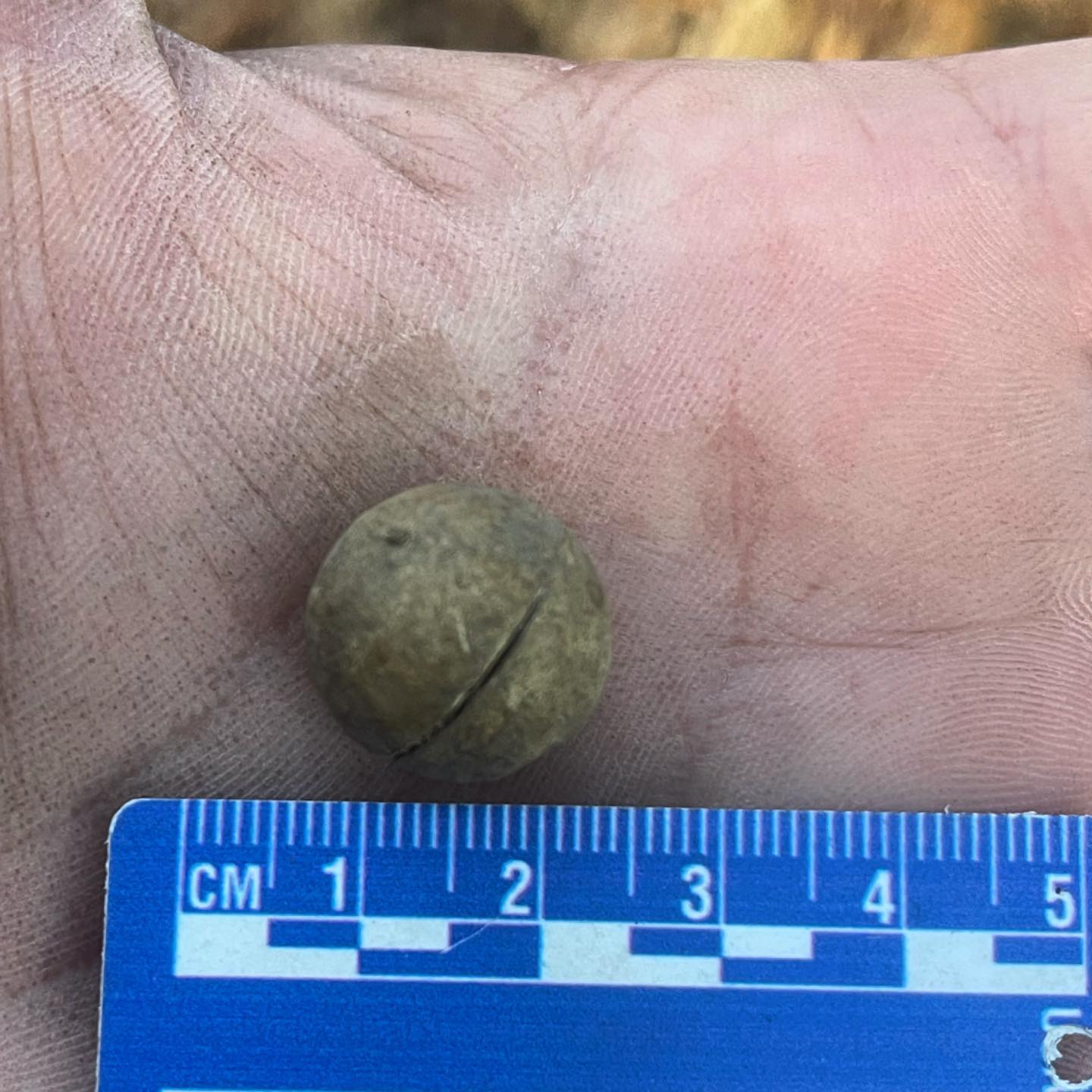
There would be more to come, at Andersonville and other prisons. Archaeology at Camp Lawton near Millen, Ga., has uncovered two Confederate bullets possibly fired at captives.

Those who have researched these prisons express caution about try to tabulate the number of shootings at the deadline.

Prisoners often exaggerated the number; at Andersonville this claim amounted to hundreds. “Sometimes this was done on purpose and sometimes they were simply mistaken or remember incorrectly,” says Teri A. Surber, park guide at Andersonville.

Regardless of where they occurred, shootings at the deadline had a profound psychological impact on POWs.

Surber and Michael Gray, a history professor and author of “Crossing the Deadlines: Civil War Prisons Reconsidered,” said Union prisoners might receive more pension money by showing they suffered during confinement. There was an incentive to lie about being a prisoner or witnessing horrific incidents, they say.

Bob Crickenberger, president of the Friends of Point Lookout (a Union prison in Maryland), said people should be leery of  hearsay stories told years after the war, particularly those that begin with, “I was told”, “I heard,” or “it’s been said.”

“Unless a prisoner was there and was an eyewitness to the shooting, and there were many witnesses, should (a story) be taken as truth. Kind of like all those folks that said Sherman burned their farms when they were miles out of the way when he came through.”

Was this .57-caliber bullet fired at a POW at Camp Lawton? (Georgia Southern U.)
Gray notes that in the last two years of the war, prisoners were often manned by older, extremely young or disabled soldiers and training was an issue. “You are going to send the best men to the front.”

By any measure, life in a Civil War prison was marked by privation and despair. Matters worsened after prisoner exchanges ended by mid-war, resulting in a huge increase in camp populations on both sides.

Between the skill of the guards and the desperation of prisoners, there are documented cases of shootings at the deadline or elsewhere in a camp. Firm numbers are impossible to ascertain, but here’s a look at several, including Elmira, Camp Lawton and Point Lookout:

ANDERSONVILLE/CAMP SUMTER (Georgia – Confederate camp)

A.J. Riddle photo of prisons in August 1864 (Library of Congress)
At Andersonville alone, nearly 13,000 men died over 14 months – an average of more than 30 a day in that span. (Overall, 30,000 Union and 26,000 Confederate soldiers died in captivity during the Civil War). A relative few were shot by guards.

Drawings of men being shot at the deadline were widely reprinted in Northern newspapers, and today, the term is almost synonymous with Andersonville prison,” according to the NPS.

Surber said there are eight documented cases of a guard shooting a prisoner.. A firm number will likely never be known.

"The only time guards shot at prisoners was when they crossed the deadline or if someone near them crossed it. There is an instance where a man reached over the line to get something, and the guard accidentally shot the man sleeping next to him," the park guide says.

(If someone had a gunshot wound from a battle, they were usually listed as having died of "wounds.")

“One confirmed shooting that I would say was the (wounding) of a man the prisoners called ‘Chickamauga.’ Robert Kellogg and several others wrote about the incident in their diaries or memoirs and also testified about it during the (Henry) Wirz trial. Another is Pvt. William Stewart, 9th Minnesota Infantry, whose cause of death is recorded as ‘gunshot.’"

During the trial, prisoner George Gray testified that Wirz himself shot Stewart and took some money from him. Wirz (left) denied anything to do with Stewart. “There were rumors that guards were given a 30-day furlough for shooting a prisoner, but there is no actual evidence of that,” Surber says, adding there is no evidence Wirz shot prisoners.

Albert Harry Shatzel of the 1st Vermont Cavalry wrote that he saw a shooting at the deadline.

“One of the poor Boys shot dead by Guard while geting a cup of watter,” Shatzel wrote, according to Civil War blogger John Banks. “The Ball passed through his head. He stuck his head under the Dead Line to get some watter but he will never go there again. Dam the laws of such men as those are hear for they consider it an honor to murder a man …all in all they are not to blame for they a Furlough of 35 days for every man they kill.”

Surber provided a list of the rare successful escapes at Andersonville.

None of the 33 dug out from the inside; they were already outside or on a work detail when they made a break for freedom.

The answer to how many were shot while trying to escape is fairly easy,” Surber says. “None, as far as we know. All eight of these men were shot for crossing the deadline and were inside the prison. Of course, it is possible that someone could have been shot while trying to escape, as would be the practice of the day, but there is no way to know for certain.”

(Photo above, re-creation of POWs arriving at Camp Sumter / NPS)

CAMP LAWTON (Georgia – Confederate camp)

POW Robert Knox Sneden's map shows deadline and sentry boxes (Library of Congress)
Camp Lawton operated for about six weeks in the fall of 1864. Prisoners were sent from Andersonville amid worries Union raiders would try to liberate the camp. Of 10,000 troops held at Lawton, at least 750 Federal soldiers died.

Ryan McNutt, director of the Camp Lawton archaeological project at Georgia Southern University, said historical sources are not complete enough to come up with a full count of POWs shot by guards.

“As ever, there are confused and scattered references,” he tells the Picket. “(POW John) McElroy states that he couldn't recall anyone being shot at Lawton for crossing the deadline, and he raised it as a curiosity since every other camp he was at had at least a few instances of executions by guards. However, Cpl. Aldrich said, ‘Once in a while the guards would shoot a poor fellow just to keep his hand in it, still, there was not as much shooting as at Andersonville. One poor fellow was shot within 10 feet of my tent one night and he was not within 10 feet of the deadline.’"

John K. Derden, author and professor emeritus of East Georgia College, said while there are diary accounts mentioning shootings, he found only one incident that was seemingly corroborated. Regardless, there were fewer shootings than at Andersonville.

James Vance wrote in his diary for Nov. 6, 1864). “2 men shot 1 killed. The first ones.” Sgt. Amos Yeakle wrote in his diary the same day, “There was one shot dead by the guard and one wounded for getting over the dead-line.”  

Work more than a decade ago at Confederate barracks area (GSU)
Derden, author of “The World’s Largest Prison: The Story of Camp Lawton,” contends prisoners might hear a guard firing to clear a musket and assume the round was meant for a Federal soldier.

“As for the climate in the prison, I believe that things were a bit less fractious because of the lack of overcrowding, the water situation that allowed prisoners to bathe and even swim, and (at least initially) the somewhat better food supply. Also, Commandant Vowles was generally well liked by the prisoners as opposed to their bitter attitudes toward Wirz at Camp Sumter.”

Regarding the deadline, archaeology seems to indicate about a 30-foot clear space between shebang remains and the wall, says Derden.

McNutt said students have recovered at least two Confederate bullets that may have been fired at the inside of the Lawton stockade. The team in early 2023 found a poorly cast ball, likely fired from a Springfield Model 1842 percussion cap musket (photo below, courtesy of Camp Lawton project).

Produced in large numbers, and floating around most of the arsenals in the South, these were still used despite the lack of accuracy and range in both the front lines and on the home front by militia. With a maximum range of 365 meters, and an average effective range from 90 to 275 meters, the location of the ball is well within range of the guard towers. And while most of the POWs at Camp Lawton recalled few instances of guards shooting POWs, our fired musket ball, along with other fired rounds from previous work inside the stockade, is a sobering reminder that Lawton still had many ways to die,” the professor writes.

Students led by Lance Greene, his predecessor, in 2010 found a spent .57-caliber bullet at the stockade. The round “has clear signs of rifling from being fired: deformation on the tip seems to show it only striking sand, though this doesn't preclude it having impacted a human,” McNutt says

Later analysis showed three groves and a right-hand twist indicating it was probably fired from a Pattern 1853 Enfield rifled musket. “Deformation on the nose matches experimental archaeology of impacts into soft surfaces, like sand or loamy soil,” according to McNutt. 

ELMIRA (New York – Union camp)

Confederate POWs at Elmira (Library of Congress)
Elmira did not have a deadline, even though it was a stockade prison. The camp was dubbed “Hellmira” by prisoners because of its 24 percent mortality rate. Gray said there are records of a Union guard shooting a Confederate prisoner.

According to the Star Gazette newspaper, Granville Garland shot A.P. Potts of the 38th Georgia Infantry during a July 31, 1864, disturbance. Potts survived.

Inmates at Elmira weathered hunger, illness and melancholia and, even worse, exposure to the cold weather, according to the National Park Service.

POINT LOOKOUT (Maryland – union camp)

(Library of Congress)
The overcrowded prison saw 4,000 Confederate prisoners succumb to various causes, especially disease. Some were killed by guards, according to experts and histories. About 52,000 Union soldiers went through the prison.

The camp’s deadline was a ditch inside the prison approximately 15 feet from the parapet wall. The ditch was a foot wide by a foot deep.

Official records show African-American guards, some formerly enslaved, sometimes shot prisoners for crossing the deadline or trying to escape, says Gray. The prison is known for its racial tension.

“One commanding officer claimed that the black guards were more zealous than the white when it came to enforcement of prison regulations and were apt to fire first while calling for the corporal of the guard,” says Crickenberger.

He estimates 19 prisoners were shot and killed or wounded by white and black guards between November 1863 and August 1864 alone. Prisoners reported that there were instances where guards fired at prisoners without inflicting casualties. (Photo, Friends of Point Lookout)

“They shot frequently but missed more often than they hit,” Crickenberger says. “Regardless of the accuracy of the guard, such incidents kept prisoners on their toes making them wary and continually fearful of being shot either night or day.”

A Confederate prisoner drew notable watercolors of life at the prison, including interactions with guards. It should be noted that black POWs held at Andersonville faced discrimination from friend and foe alike.

The friends group has helped restore the fort, the southwest corner of the stockade and assists with living histories and demonstrations of camp life.

ROCK ISLAND (Illinois-Iowa – Union camp)

The deadline at Rock Island consisted of a series of white stakes (left, photo Rock Island Arsenal Museum) that were illuminated by lanterns at night, according to the NPS.

The barracks were enclosed by a stockade fence 1,300 feet long, 900 feet wide and 12 feet high. Sentry boxes were placed every 100 feet.

During the 20 months the prison was open, 1,960 prisoners and 171 Union guards died.

The North had reduced rations in retaliation for the treatment of Union prisoners at Andersonville. Conditions at Federal prisons often were deplorable.

Sunday, January 21, 2024

Brace yourself as we update you on U.S.S. Monitor mystery maker's mark and explain how two rods stabilized ironclad's remarkable revolving turret

Braces under, near guns in recovered turret (top); rendering of them with crew (MMP, Andy Hall)
The 600-page “Drawings of the U.S.S. Monitor, published in 1985, depicts the venerable Civil War ironclad from practically every angle. Scores of sketches demonstrate the exacting work of the draftsmen – with some components drawn to the inch.

“To the men who had the imagination, knowledge and skill to produce these drawings and the Monitor,” reads the dedication in the volume, written by Ernest W. Peterkin for the North Carolina and federal governments.

I continue to marvel at the design and engineering skills of those who made the vessel that changed naval warfare in a single battle with the CSS Virginia in March 1862. My recent foray into learning a bit more about the vessel’s circular, ingenious turret – and its supporting braces -- put me back in touch with experts on Monitor.

As I further studied the turret after communicating with them – I had an amusing observation.

A drawing (below) at the top of the publication – “transverse section through turret” -- features a cross-section of Monitor, with the turret resting on top of a spindle.

Oh my, I thought. The turret and rod combined look like a child’s spinning top!

Transverse section through turret shows spindle beneath (Drawings of the Monitor)
The revolving turret was no toy, however. It housed two XI-inch Dahlgren guns that could smash both ship and man. But to make the setup work, designer John Ericsson had to overcome challenges with the turret, dubbed a “cheesebox on a raft.”

“It was enormously heavy … (and) was designed to be turned by machinery rather than by hand,” Civil War naval expert Andy Hall told me in a recent email.

“To improve this efficiency, Ericsson recognized that it was necessary to relieve part of the weight of the turret on the rollers around its perimeter by ‘jacking up’ the turret a bit, temporarily placing much of its weight on its central vertical spindle. To prevent the turret structure from sagging, Ericsson included diagonal braces from the central roof beam to the base forward, aft and on either side of the turret that could be adjusted using enormous turnbuckles.”

Aft diagonal brace with ULSTER, highlighted at right, click to enlarge (Courtesy Mariners' Museum and Park)
Maker's mark 'Ulster' leaves questions

The two diagonal support braces (forward and aft) inside the turret have been of interest to me following the 2017 announcement by The Mariners’ Museum and Park in Newport News, Va., that Monitor conservators removing corrosion from the aft brace uncovered the word “ULSTER.” It’s the first time a maker’s mark was found in the turret.

Officials theorized the two wrought-iron braces – which have undergone conservation since 2016 -- were produced by Ulster Iron Works in Saugerties and added to the turret interior. The scenic city along the Hudson River is about 100 miles north of New York City, where Monitor was assembled in late 1861 and early 1862.

The company, which operated from 1827 to 1888 and took advantage of iron deposits in the area, was a Navy contractor.

Cannon damage on USS Monitor after clash with Virginia (Library of Congress)
“While this firm was never mentioned as a supplier during the Monitor’s construction at Continental Iron Works, it is now believed that Ulster provided materials for modifications to the ship while it was undergoing sea trials at the Brooklyn Navy Yard,” says the museum, which houses the USS Monitor Center, home to artifacts and items still being conserved after they were recovered off Cape Hatteras, N.C., more than two decades ago.

I have been mesmerized since the announcement by the mystery of the Ulster mark.

I reached out last month to Will Hoffman, Monitor project manager, to see whether conservators have since confirmed any link between the vessel and Ulster Iron Works.

The short answer: No.

Hoffman has cited papers from Ulster Iron Works in the collection of William L. Clements Library at the University of Michigan in Ann Arbor.

A summary of the collection includes this line: “Among the factors that contributed to the success of the Ulster Iron Works was the ability of the owners of the corporation to arrange for government contracts, especially contracts with the Navy, for providing iron products for use in rockets, ships, and other materials.” (At left, the forward and aft braces, courtesy of Mariners' Museum and Park.)

I reached out to the library to ask whether Ulster Iron Works records make specific mention of Monitor.

Terese Murphy, head of reader services, says a bound volume has entries through 1863 – a year after Monitor was lost in a storm.

Murphy wasn’t able to find mention of Monitor, but kindly sent me photos of the pages that would have mentioned the ironclad. I wasn’t able to make all the writing, but I, too, didn’t see the Monitor in the notes – many descriptions of technology and project summaries. It is possible that the names of the vessels for projects were not inscribed. The descriptions are very technical.

The manufacturer, which drew workers from as far away as England and Wales, was known for using European technology. A process called “double puddling” could produce appreciable amounts of high-grade bar iron.

1862 page from volume on Ulster Iron Works (Courtesy Clements Library, U. of Michigan)
Hoffman says, despite some research by his staff, he has not learned much more.

“It kind of went dead after that,” he says of the search for the Ulster connection. “We know these braces are additions.” They are not shown in original blueprints.

I reached back out to Audrey Klinkenberg, Saugerties town historian, about whether anyone there have come across any mention of the USS Monitor and Ulster Iron Works since the 2017 news. She said no.

A delicate balancing act during battle

With the Ulster mystery still out there, I asked Hoffman and Hall, who writes the Dead Confederates blog, about the six braces that reinforced the turret. (BTW, it’s possible the forward diagonal supporting brace also had an ULSTER mark and it was eaten by corrosion or is still covered.)

The diagonal braces were installed near the two guns in a claustrophobic space manned by an executive officer and 16 sailors. Like Hall, Hoffman says the 160-ton turret had a revolutionary design for the time.

 Braces highlighted, “U.S.S. Monitor: The Ship that Launched a Modern Navy” by Edward Miller

“The turret is like a suspension bridge,” with the diagonal braces providing balance to “keep it from tipping while firing the gun,” the lead conservator told me. One crew fired a Dahlgren while the other reloaded the second.

Hall says turnbuckles on the braces were a particular benefit at close quarters, as in the Monitor-Virginia battle in Hampton Roads.

“The crew in the turret adopted the practice of firing as the gun muzzles rotated past the target, rather than trying to rotate the turret, lock it in place, and then fire,” he says.

“With both ships maneuvering for advantage, almost at point-blank range, keeping Monitor’s turret moving during the action was essential. The officer commanding in Monitor’s turret, Samuel Dana Greene, described this as the turret’s ‘whirligig motion.’”

In a post on Dead Confederates, Hall describes the turret as “a very crowded and chaotic place.”

Clevis used in aft diagonal support brace (Courtesy The Mariners' Museum and Park)
The “Ulster” brace and its mate have undergone extensive conservation.

Hoffman says in 2016 both got their first round of dry-ice cleaning, followed by another round in 2018, and the aft “Ulster” braces was disassembled. Conservation of its aft clevis (fastener) was completed in 2019. Last year, the forward brace and remaining after-brace components received additional cleaning.

Unroll the turret for cleaning, or leave as is?

The turret currently rests on a lower support pad in a giant Mariners’ Museum and Park tank where it has undergone conservation for two decades.

The guns and braces have been treated in separate areas.

More than 50 maker’s marks associated with Monitor have been noticed over the years, says Hoffman. Roman numerals were spotted on the turret armor plates (the roof is upside down in the tank) and there are Roman numerals on sockets of the canopy stanchion.

The next big thing will be the full cleaning of the turret – but that is still a couple years off. (At right, dry-ice cleaning. Courtesy of Mariners' Museum and Park)

 And there are two considerations:

1. Should the turret be left in its current ring configuration for cleaning? While unrolling the plating might allow conservators to get into its curved layers, replacing rivets afterward may be impossible. Hoffman says the decision was to keep it as is.

2. The team has studied ways to treat wrought iron, which is forged and several inches deep. The turret is too big to clean by hand, so the likely scenario is dry ice, going from solid to gas. The whole idea is to remove ocean salt (chlorides) from the metal, to stem further corrosion.

The lab is working on a plan for the turret treatment, which could take up to eight months.

The turret will be turned right-side up, and the roof taken apart. “There are potentially artifacts still to be found” in the roof because some may be captured in concretion, according to Hoffman. (The remains of two sailors and numerous artifacts were found in the turret.)

Using scaffolding, conservators will clean the ring.

Turret bracing goes down in history, literally

Monitor and Virginia fought to a tactical draw at the 1862 Battle of Hampton Roads.

Hall, author of “Civil War Blockade Running on the Texas Coast,” says Monitor earned the strategic victory because the Confederate ironclad never ventured out again to attack the U.S. fleet.

“The U.S. Navy immediately contracted for new monitors, with several classes of the type entering service before the war ended in 1865. Each new class of monitor was built on the hard-won lessons of those before, with incremental technical improvements in armament, machinery and armor,” he says. (At left, part of the aft diagonal brace assembly. Courtesy of Mariners' Museum and Park)

Monitor sank in the Atlantic storm on Dec. 31, 1862, with the loss of 16 lives.

The value of Ericsson’s bracing to keep the iron cylinder of the turret rigid proved to be beneficial to history as well, as it ensured that when Monitor capsized and sank in December 1862 after only a few months’ service, the turret fell off the ship but remained intact on the sea floor, from where it would be recovered in one piece in 2002,” says Hall.