Showing posts with label Guard. Show all posts

Wednesday, April 10, 2024

At Andersonville and elsewhere, crossing the 'deadline' meant death. Whatever the number of incidents, the existence of these barriers kept men in line

A.J. Klapp's drawing of a deadline shooting at Andersonville (Brown University Library)
Before the word deadline became synonymous with getting something done by a specific time, it was associated with a deadly feature of Civil War prisons. A captive crossing the deadline risked death, and there are instances of guards on both sides shooting them.

The deadline was intended to prevent the prison’s growing population from getting too close to the stockade wall, making escape more difficult. It was also supposed to reduce fraternization and trading between the prisoners and guards, according to the National Park Service.

Andersonville National Historic Site on Sunday marked the 160th anniversary of the completion of the deadline at the site (April 7, 1864). Stockade commander Capt. Henry Wirz had made this a priority.

The light railing was made from posts 3 to 4 feet long and driven into the ground. Horizontal pieces of wood topped the design, which was roughly 18-19 feet inside the stockade wall.

Confederate guards in sentry boxes kept a sharp eye for POWs who extended any part of their body past the deadline. (Not all camps had such features).

The first Union POW to die at Andersonville for crossing the deadline was Caleb Coplan (Copeland), a young Ohioan shot just two days after it was completed.

The prisoner was wandering the northeast corner of the stockade, apparently in search of material to patch his shelter or clothing, wrote William Marvel in “Andersonville: The Last Depot.” (Photo at left courtesy of John Banks' Civil War Blog)

“Something under the dead line caught his eye -- a scrap of flannel, some said -- and he ducked under the line to retrieve it. The guard brought his cumbersome old smoothbore to his shoulder and let fly with a charge of buck-and-ball. The range was too short to miss, and the .75-caliber ball bored through Coplan’s breast near the heart. Onlookers carried him to the hospital tents a few yards away, where he died the next day -- the first man killed at the dead line.” (Photo below of his grave at Andersonville courtesy of Kevin Frye.)

There would be more to come, at Andersonville and other prisons. Archaeology at Camp Lawton near Millen, Ga., has uncovered two Confederate bullets possibly fired at captives.

Those who have researched these prisons express caution about try to tabulate the number of shootings at the deadline.

Prisoners often exaggerated the number; at Andersonville this claim amounted to hundreds. “Sometimes this was done on purpose and sometimes they were simply mistaken or remember incorrectly,” says Teri A. Surber, park guide at Andersonville.

Regardless of where they occurred, shootings at the deadline had a profound psychological impact on POWs.

Surber and Michael Gray, a history professor and author of “Crossing the Deadlines: Civil War Prisons Reconsidered,” said Union prisoners might receive more pension money by showing they suffered during confinement. There was an incentive to lie about being a prisoner or witnessing horrific incidents, they say.

Bob Crickenberger, president of the Friends of Point Lookout (a Union prison in Maryland), said people should be leery of  hearsay stories told years after the war, particularly those that begin with, “I was told”, “I heard,” or “it’s been said.”

“Unless a prisoner was there and was an eyewitness to the shooting, and there were many witnesses, should (a story) be taken as truth. Kind of like all those folks that said Sherman burned their farms when they were miles out of the way when he came through.”

Was this .57-caliber bullet fired at a POW at Camp Lawton? (Georgia Southern U.)
Gray notes that in the last two years of the war, prisoners were often manned by older, extremely young or disabled soldiers and training was an issue. “You are going to send the best men to the front.”

By any measure, life in a Civil War prison was marked by privation and despair. Matters worsened after prisoner exchanges ended by mid-war, resulting in a huge increase in camp populations on both sides.

Between the skill of the guards and the desperation of prisoners, there are documented cases of shootings at the deadline or elsewhere in a camp. Firm numbers are impossible to ascertain, but here’s a look at several, including Elmira, Camp Lawton and Point Lookout:

ANDERSONVILLE/CAMP SUMTER (Georgia – Confederate camp)

A.J. Riddle photo of prisons in August 1864 (Library of Congress)
At Andersonville alone, nearly 13,000 men died over 14 months – an average of more than 30 a day in that span. (Overall, 30,000 Union and 26,000 Confederate soldiers died in captivity during the Civil War). A relative few were shot by guards.

Drawings of men being shot at the deadline were widely reprinted in Northern newspapers, and today, the term is almost synonymous with Andersonville prison,” according to the NPS.

Surber said there are eight documented cases of a guard shooting a prisoner.. A firm number will likely never be known.

"The only time guards shot at prisoners was when they crossed the deadline or if someone near them crossed it. There is an instance where a man reached over the line to get something, and the guard accidentally shot the man sleeping next to him," the park guide says.

(If someone had a gunshot wound from a battle, they were usually listed as having died of "wounds.")

“One confirmed shooting that I would say was the (wounding) of a man the prisoners called ‘Chickamauga.’ Robert Kellogg and several others wrote about the incident in their diaries or memoirs and also testified about it during the (Henry) Wirz trial. Another is Pvt. William Stewart, 9th Minnesota Infantry, whose cause of death is recorded as ‘gunshot.’"

During the trial, prisoner George Gray testified that Wirz himself shot Stewart and took some money from him. Wirz (left) denied anything to do with Stewart. “There were rumors that guards were given a 30-day furlough for shooting a prisoner, but there is no actual evidence of that,” Surber says, adding there is no evidence Wirz shot prisoners.

Albert Harry Shatzel of the 1st Vermont Cavalry wrote that he saw a shooting at the deadline.

“One of the poor Boys shot dead by Guard while geting a cup of watter,” Shatzel wrote, according to Civil War blogger John Banks. “The Ball passed through his head. He stuck his head under the Dead Line to get some watter but he will never go there again. Dam the laws of such men as those are hear for they consider it an honor to murder a man …all in all they are not to blame for they a Furlough of 35 days for every man they kill.”

Surber provided a list of the rare successful escapes at Andersonville.

None of the 33 dug out from the inside; they were already outside or on a work detail when they made a break for freedom.

The answer to how many were shot while trying to escape is fairly easy,” Surber says. “None, as far as we know. All eight of these men were shot for crossing the deadline and were inside the prison. Of course, it is possible that someone could have been shot while trying to escape, as would be the practice of the day, but there is no way to know for certain.”

(Photo above, re-creation of POWs arriving at Camp Sumter / NPS)

CAMP LAWTON (Georgia – Confederate camp)

POW Robert Knox Sneden's map shows deadline and sentry boxes (Library of Congress)
Camp Lawton operated for about six weeks in the fall of 1864. Prisoners were sent from Andersonville amid worries Union raiders would try to liberate the camp. Of 10,000 troops held at Lawton, at least 750 Federal soldiers died.

Ryan McNutt, director of the Camp Lawton archaeological project at Georgia Southern University, said historical sources are not complete enough to come up with a full count of POWs shot by guards.

“As ever, there are confused and scattered references,” he tells the Picket. “(POW John) McElroy states that he couldn't recall anyone being shot at Lawton for crossing the deadline, and he raised it as a curiosity since every other camp he was at had at least a few instances of executions by guards. However, Cpl. Aldrich said, ‘Once in a while the guards would shoot a poor fellow just to keep his hand in it, still, there was not as much shooting as at Andersonville. One poor fellow was shot within 10 feet of my tent one night and he was not within 10 feet of the deadline.’"

John K. Derden, author and professor emeritus of East Georgia College, said while there are diary accounts mentioning shootings, he found only one incident that was seemingly corroborated. Regardless, there were fewer shootings than at Andersonville.

James Vance wrote in his diary for Nov. 6, 1864). “2 men shot 1 killed. The first ones.” Sgt. Amos Yeakle wrote in his diary the same day, “There was one shot dead by the guard and one wounded for getting over the dead-line.”  

Work more than a decade ago at Confederate barracks area (GSU)
Derden, author of “The World’s Largest Prison: The Story of Camp Lawton,” contends prisoners might hear a guard firing to clear a musket and assume the round was meant for a Federal soldier.

“As for the climate in the prison, I believe that things were a bit less fractious because of the lack of overcrowding, the water situation that allowed prisoners to bathe and even swim, and (at least initially) the somewhat better food supply. Also, Commandant Vowles was generally well liked by the prisoners as opposed to their bitter attitudes toward Wirz at Camp Sumter.”

Regarding the deadline, archaeology seems to indicate about a 30-foot clear space between shebang remains and the wall, says Derden.

McNutt said students have recovered at least two Confederate bullets that may have been fired at the inside of the Lawton stockade. The team in early 2023 found a poorly cast ball, likely fired from a Springfield Model 1842 percussion cap musket (photo below, courtesy of Camp Lawton project).
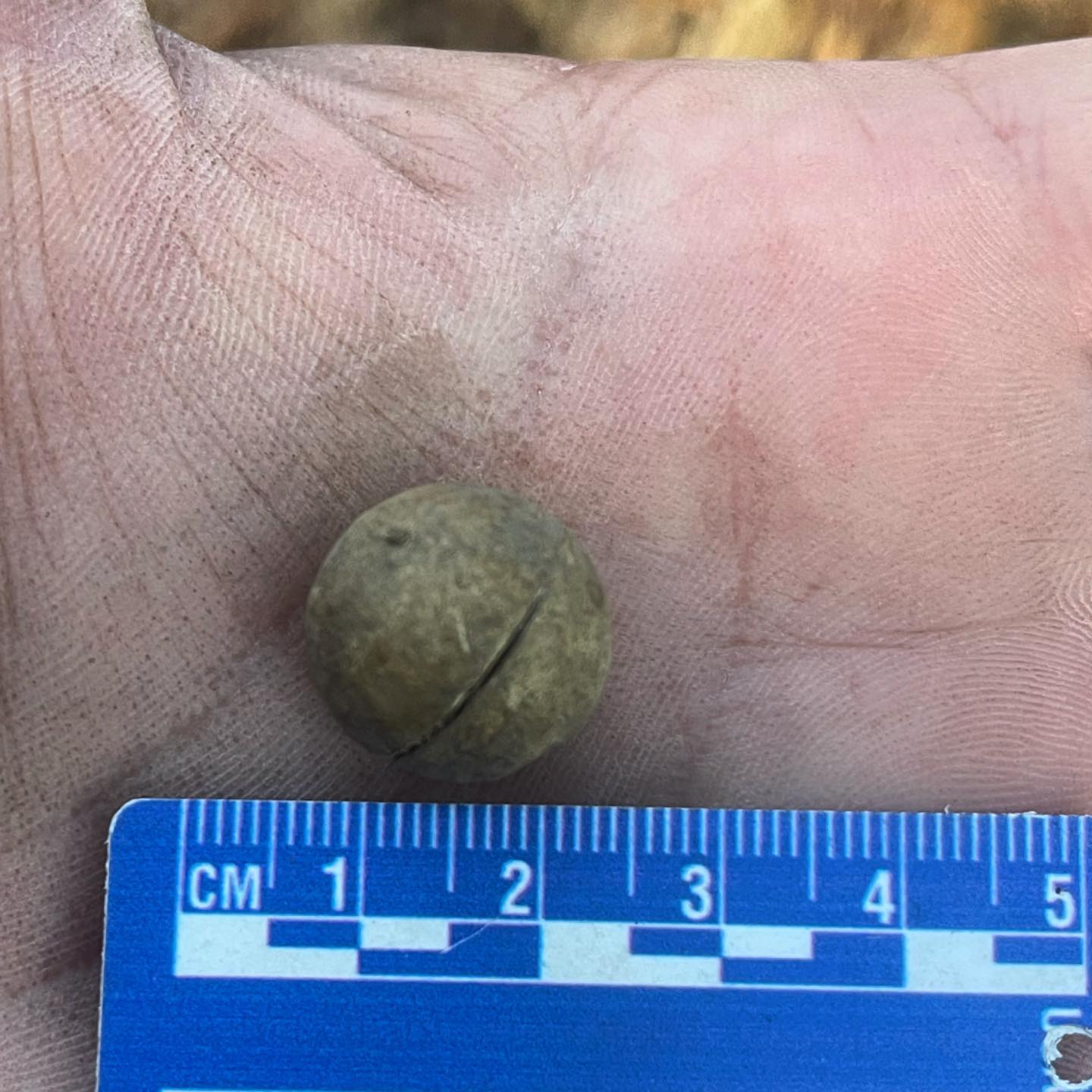
Produced in large numbers, and floating around most of the arsenals in the South, these were still used despite the lack of accuracy and range in both the front lines and on the home front by militia. With a maximum range of 365 meters, and an average effective range from 90 to 275 meters, the location of the ball is well within range of the guard towers. And while most of the POWs at Camp Lawton recalled few instances of guards shooting POWs, our fired musket ball, along with other fired rounds from previous work inside the stockade, is a sobering reminder that Lawton still had many ways to die,” the professor writes.

Students led by Lance Greene, his predecessor, in 2010 found a spent .57-caliber bullet at the stockade. The round “has clear signs of rifling from being fired: deformation on the tip seems to show it only striking sand, though this doesn't preclude it having impacted a human,” McNutt says

Later analysis showed three groves and a right-hand twist indicating it was probably fired from a Pattern 1853 Enfield rifled musket. “Deformation on the nose matches experimental archaeology of impacts into soft surfaces, like sand or loamy soil,” according to McNutt. 

ELMIRA (New York – Union camp)

Confederate POWs at Elmira (Library of Congress)
Elmira did not have a deadline, even though it was a stockade prison. The camp was dubbed “Hellmira” by prisoners because of its 24 percent mortality rate. Gray said there are records of a Union guard shooting a Confederate prisoner.

According to the Star Gazette newspaper, Granville Garland shot A.P. Potts of the 38th Georgia Infantry during a July 31, 1864, disturbance. Potts survived.

Inmates at Elmira weathered hunger, illness and melancholia and, even worse, exposure to the cold weather, according to the National Park Service.

POINT LOOKOUT (Maryland – union camp)

(Library of Congress)
The overcrowded prison saw 4,000 Confederate prisoners succumb to various causes, especially disease. Some were killed by guards, according to experts and histories. About 52,000 Union soldiers went through the prison.

The camp’s deadline was a ditch inside the prison approximately 15 feet from the parapet wall. The ditch was a foot wide by a foot deep.

Official records show African-American guards, some formerly enslaved, sometimes shot prisoners for crossing the deadline or trying to escape, says Gray. The prison is known for its racial tension.

“One commanding officer claimed that the black guards were more zealous than the white when it came to enforcement of prison regulations and were apt to fire first while calling for the corporal of the guard,” says Crickenberger.

He estimates 19 prisoners were shot and killed or wounded by white and black guards between November 1863 and August 1864 alone. Prisoners reported that there were instances where guards fired at prisoners without inflicting casualties. (Photo, Friends of Point Lookout)

“They shot frequently but missed more often than they hit,” Crickenberger says. “Regardless of the accuracy of the guard, such incidents kept prisoners on their toes making them wary and continually fearful of being shot either night or day.”

A Confederate prisoner drew notable watercolors of life at the prison, including interactions with guards. It should be noted that black POWs held at Andersonville faced discrimination from friend and foe alike.

The friends group has helped restore the fort, the southwest corner of the stockade and assists with living histories and demonstrations of camp life.

ROCK ISLAND (Illinois-Iowa – Union camp)

The deadline at Rock Island consisted of a series of white stakes (left, photo Rock Island Arsenal Museum) that were illuminated by lanterns at night, according to the NPS.

The barracks were enclosed by a stockade fence 1,300 feet long, 900 feet wide and 12 feet high. Sentry boxes were placed every 100 feet.

During the 20 months the prison was open, 1,960 prisoners and 171 Union guards died.

The North had reduced rations in retaliation for the treatment of Union prisoners at Andersonville. Conditions at Federal prisons often were deplorable.

Friday, October 13, 2023

Kennesaw Mountain is a 'leadership laboratory' for future Georgia National Guard officers. A cadet's coat helps further their training

Officer candidates in 2016 reenact Federal charge at Kennesaw Mountain (GMI photo)
Georgia Military Institute, which provided cadets for Confederate service and was burned by Sherman’s troops in 1864, lives on today as the Georgia National Guard’s officer candidate school – located about two miles from the original campus. 

The Clay National Guard Center near Dobbins Air Reserve Base in Marietta recently acquired on loan the GMI coat of Pierce M.B. Young, who went on to attend West Point in 1857 (where he was a roommate of George Armstrong Custer) and join the Confederate army before graduation in 1861.

Josh Headlee, curator/preservation specialist with Georgia State Parks, said Young’s cadet coat is the earliest one known to still exist. Young, a native of South Carolina who moved to Cartersville, Ga, at a young age, was a major general for the South, serving under Wade Hampton and J.E.B. Stuart. He later served in Congress and as a diplomat. Young died in 1896.

Young’s coat is on a three-year loan. Maj. William Carraway, historian with the Georgia Army National Guard, told the Picket that items such as Young’s and staff rides (which combine study and tours of battlefields) provide valuable insight and training for OCS students.

Pierce Young's GMI coat and as he appeared during, after Civil War
Carraway responded to the Picket’s questions about the training and museum exhibits:

Q. What do staff rides to Atlanta area Civil War sites accomplish? What can the war teach today's soldiers? 

A. A key component of the staff ride is participant research. This element of research is what differentiates a staff ride from a battlefield tour. The best staff rides therefore are tailor-made to the unit in question and its mission; therefore, the staff ride begins months in advance by identifying the training objectives of the unit and assigning research questions for individuals to study and brief on site. The staff ride is less of a lecture by a historian and more of a discussion facilitated by the historian based on the input provided by participating soldiers, their research and the insight they bring from their backgrounds and careers.  

The officer candidates of our current GMI consider Kennesaw Mountain in particular and the Atlanta Campaign in general as a leadership laboratory to examine the decisions made by commanders and how those decisions were influenced by terrain, weather and larger strategic considerations. The officer candidates examine the battle of Kennesaw Mountain from the perspective of staff functions – personnel, logistics, signal, medical, command, etc. and consider how they would make decisions based on the information gathered.

Maj. Carraway describes artillery action at Kennesaw Mountain (GARNG)
What options are available for the Federal and Confederate commanders? How are those options influenced by logistics? What is the enemy trying to do and how can a commander discern the enemy commander’s intent? What reconnaissance objectives should be designated to determine the enemy’s intent? How does the commander prevent the enemy commander from discerning his intent, composition and strength? All of these questions and others can be explored on ground on which past engagements were fought to inform the decision making process of current and future leaders. 

Q. When it comes to staff rides and other activities, what specifically does the Atlanta Campaign teach guard members? 

A. The U.S. Army and National Guard conduct staff rides to convey lessons of the past that apply to modern-day military problems and challenge Army leadership. The Atlanta Campaign specifically is replete with lessons for modern day logisticians, maneuver leaders, military intelligence and reconnaissance. Staff rides may be conducted for entry-level soldiers all the way to senior leaders. Many of the problems faced by commanders and staff officers of the American Civil War resonate today. Sherman’s logistical planning for the Atlanta Campaign has direct implications for modern commanders planning sustainment of short and long-term operations in the field. Commander’s selection of terrain similarly resonates to the modern soldier. 

A view of the GMI campus during the Civil War, as drawn by a Union officer
Q. How do you plan to interpret the Young coat? Is it specifically there because he attended GMI? 

A. The uniform provides an unparalleled opportunity to acquaint officer candidates of the current Georgia Military Institute with the full extent of the institute’s heritage and history. In addition to the American Civil War, graduates of GMI have served overseas during the Spanish American War, World War I, Vietnam, Iraq and Afghanistan. Georgia Military Institute graduates have served at the highest levels of the Georgia National Guard to include commanders of the Georgia Army National Guard and the adjutant general. 

Uniforms on exhibit at Clay Center (Georgia Army National Guard)
Q. I understand the coat is on exhibit at the headquarters building. With what other items?

A. The exhibit displays uniforms, artifacts and imagery reflective of the history of the Georgia National Guard. This presently includes uniforms from the Spanish-American War era, WWI, WWII and modern uniform articles. The GMI uniform of Cadet Young anchors a portion of the exhibit dedicated to the history of the Georgia Military Institute and its more than 2,500 graduates who have gone on to serve in the Georgia National Guard and U.S. Army. 

Q. How did the loan come about? 

A. Michael Hitt, historian at GMI, discovered that the uniform was in the holdings of the state. We began an inquiry and confirmed that our display location could meet the security and environmental control requirements for the proper display of the uniform. The loan allows the Georgia National Guard to display the uniform as part of its historic uniform exhibit at the Clay National Guard Center in Marietta. 

Gordon Jones of Atlanta History Center displays Civil War coats (GARNG)
Q. Is the exhibit available to the public? 

A. The uniform is on display at the Clay National Guard Center in Marietta, which is co-located with Dobbins Air Reserve Base. While the military bases have restricted access, members of the public may contact the Georgia National Guard history office to inquire about viewing the uniform and other holdings of the Georgia National Guard archives. 

Q. I know the officer school is named for GMI. How does the guard interpret the grounds' history? 

A. The first iteration of the Georgia Military Institute was located approximately 2.5 miles northwest of the Clay National Guard Center. The historian of GMI is very active in researching and interpreting the history of the original GMI as well as the second iteration of the institute which operated from 1891-1898 in Atlanta. Research is ongoing to identify graduates that served in our nation’s wars such as Maj. William Kendrick, a GMI instructor who served during the Spanish American War, and 1st Lt. Homer Ashford of GMI, who mobilized to the Mexican Border in 1916 and subsequently deployed to France with the 31st Division in 1918. Graduates of the current iteration of the Georgia Military Institute were among the first mobilized for the Berlin Crisis of 1961 and served during the Vietnam War. 

Officer candidates do survey of the 1864 fighting at Kennesaw (GARNG)
Q. What is the mission of the 161st Military History Detachment? Is it based at the Clay Center? Is there a Civil War-related aspect? 

The 161st MHD is based at the Clay National Guard Center. Military History Detachments are staffed and equipped to deploy overseas and stateside to collect vital documents and interviews for major operations. The MHD is vital to how we will tell the history of current operations in the future. While there is no direct Civil War link to the MHD mission, it is valuable for an MHD commander to consider how future historians will regard current operations, and examining how past campaigns were documented and remembered provides insight into how the MHD conducts its mission. The MHD must anticipate the questions future historians will have about current operations and strive to collect the materials, artifacts and interviews to answer those future inquiries.