Showing posts with label prisoners. Show all posts

Wednesday, April 10, 2024

At Andersonville and elsewhere, crossing the 'deadline' meant death. Whatever the number of incidents, the existence of these barriers kept men in line

A.J. Klapp's drawing of a deadline shooting at Andersonville (Brown University Library)
Before the word deadline became synonymous with getting something done by a specific time, it was associated with a deadly feature of Civil War prisons. A captive crossing the deadline risked death, and there are instances of guards on both sides shooting them.

The deadline was intended to prevent the prison’s growing population from getting too close to the stockade wall, making escape more difficult. It was also supposed to reduce fraternization and trading between the prisoners and guards, according to the National Park Service.

Andersonville National Historic Site on Sunday marked the 160th anniversary of the completion of the deadline at the site (April 7, 1864). Stockade commander Capt. Henry Wirz had made this a priority.

The light railing was made from posts 3 to 4 feet long and driven into the ground. Horizontal pieces of wood topped the design, which was roughly 18-19 feet inside the stockade wall.

Confederate guards in sentry boxes kept a sharp eye for POWs who extended any part of their body past the deadline. (Not all camps had such features).

The first Union POW to die at Andersonville for crossing the deadline was Caleb Coplan (Copeland), a young Ohioan shot just two days after it was completed.

The prisoner was wandering the northeast corner of the stockade, apparently in search of material to patch his shelter or clothing, wrote William Marvel in “Andersonville: The Last Depot.” (Photo at left courtesy of John Banks' Civil War Blog)

“Something under the dead line caught his eye -- a scrap of flannel, some said -- and he ducked under the line to retrieve it. The guard brought his cumbersome old smoothbore to his shoulder and let fly with a charge of buck-and-ball. The range was too short to miss, and the .75-caliber ball bored through Coplan’s breast near the heart. Onlookers carried him to the hospital tents a few yards away, where he died the next day -- the first man killed at the dead line.” (Photo below of his grave at Andersonville courtesy of Kevin Frye.)

There would be more to come, at Andersonville and other prisons. Archaeology at Camp Lawton near Millen, Ga., has uncovered two Confederate bullets possibly fired at captives.

Those who have researched these prisons express caution about try to tabulate the number of shootings at the deadline.

Prisoners often exaggerated the number; at Andersonville this claim amounted to hundreds. “Sometimes this was done on purpose and sometimes they were simply mistaken or remember incorrectly,” says Teri A. Surber, park guide at Andersonville.

Regardless of where they occurred, shootings at the deadline had a profound psychological impact on POWs.

Surber and Michael Gray, a history professor and author of “Crossing the Deadlines: Civil War Prisons Reconsidered,” said Union prisoners might receive more pension money by showing they suffered during confinement. There was an incentive to lie about being a prisoner or witnessing horrific incidents, they say.

Bob Crickenberger, president of the Friends of Point Lookout (a Union prison in Maryland), said people should be leery of  hearsay stories told years after the war, particularly those that begin with, “I was told”, “I heard,” or “it’s been said.”

“Unless a prisoner was there and was an eyewitness to the shooting, and there were many witnesses, should (a story) be taken as truth. Kind of like all those folks that said Sherman burned their farms when they were miles out of the way when he came through.”

Was this .57-caliber bullet fired at a POW at Camp Lawton? (Georgia Southern U.)
Gray notes that in the last two years of the war, prisoners were often manned by older, extremely young or disabled soldiers and training was an issue. “You are going to send the best men to the front.”

By any measure, life in a Civil War prison was marked by privation and despair. Matters worsened after prisoner exchanges ended by mid-war, resulting in a huge increase in camp populations on both sides.

Between the skill of the guards and the desperation of prisoners, there are documented cases of shootings at the deadline or elsewhere in a camp. Firm numbers are impossible to ascertain, but here’s a look at several, including Elmira, Camp Lawton and Point Lookout:

ANDERSONVILLE/CAMP SUMTER (Georgia – Confederate camp)

A.J. Riddle photo of prisons in August 1864 (Library of Congress)
At Andersonville alone, nearly 13,000 men died over 14 months – an average of more than 30 a day in that span. (Overall, 30,000 Union and 26,000 Confederate soldiers died in captivity during the Civil War). A relative few were shot by guards.

Drawings of men being shot at the deadline were widely reprinted in Northern newspapers, and today, the term is almost synonymous with Andersonville prison,” according to the NPS.

Surber said there are eight documented cases of a guard shooting a prisoner.. A firm number will likely never be known.

"The only time guards shot at prisoners was when they crossed the deadline or if someone near them crossed it. There is an instance where a man reached over the line to get something, and the guard accidentally shot the man sleeping next to him," the park guide says.

(If someone had a gunshot wound from a battle, they were usually listed as having died of "wounds.")

“One confirmed shooting that I would say was the (wounding) of a man the prisoners called ‘Chickamauga.’ Robert Kellogg and several others wrote about the incident in their diaries or memoirs and also testified about it during the (Henry) Wirz trial. Another is Pvt. William Stewart, 9th Minnesota Infantry, whose cause of death is recorded as ‘gunshot.’"

During the trial, prisoner George Gray testified that Wirz himself shot Stewart and took some money from him. Wirz (left) denied anything to do with Stewart. “There were rumors that guards were given a 30-day furlough for shooting a prisoner, but there is no actual evidence of that,” Surber says, adding there is no evidence Wirz shot prisoners.

Albert Harry Shatzel of the 1st Vermont Cavalry wrote that he saw a shooting at the deadline.

“One of the poor Boys shot dead by Guard while geting a cup of watter,” Shatzel wrote, according to Civil War blogger John Banks. “The Ball passed through his head. He stuck his head under the Dead Line to get some watter but he will never go there again. Dam the laws of such men as those are hear for they consider it an honor to murder a man …all in all they are not to blame for they a Furlough of 35 days for every man they kill.”

Surber provided a list of the rare successful escapes at Andersonville.

None of the 33 dug out from the inside; they were already outside or on a work detail when they made a break for freedom.

The answer to how many were shot while trying to escape is fairly easy,” Surber says. “None, as far as we know. All eight of these men were shot for crossing the deadline and were inside the prison. Of course, it is possible that someone could have been shot while trying to escape, as would be the practice of the day, but there is no way to know for certain.”

(Photo above, re-creation of POWs arriving at Camp Sumter / NPS)

CAMP LAWTON (Georgia – Confederate camp)

POW Robert Knox Sneden's map shows deadline and sentry boxes (Library of Congress)
Camp Lawton operated for about six weeks in the fall of 1864. Prisoners were sent from Andersonville amid worries Union raiders would try to liberate the camp. Of 10,000 troops held at Lawton, at least 750 Federal soldiers died.

Ryan McNutt, director of the Camp Lawton archaeological project at Georgia Southern University, said historical sources are not complete enough to come up with a full count of POWs shot by guards.

“As ever, there are confused and scattered references,” he tells the Picket. “(POW John) McElroy states that he couldn't recall anyone being shot at Lawton for crossing the deadline, and he raised it as a curiosity since every other camp he was at had at least a few instances of executions by guards. However, Cpl. Aldrich said, ‘Once in a while the guards would shoot a poor fellow just to keep his hand in it, still, there was not as much shooting as at Andersonville. One poor fellow was shot within 10 feet of my tent one night and he was not within 10 feet of the deadline.’"

John K. Derden, author and professor emeritus of East Georgia College, said while there are diary accounts mentioning shootings, he found only one incident that was seemingly corroborated. Regardless, there were fewer shootings than at Andersonville.

James Vance wrote in his diary for Nov. 6, 1864). “2 men shot 1 killed. The first ones.” Sgt. Amos Yeakle wrote in his diary the same day, “There was one shot dead by the guard and one wounded for getting over the dead-line.”  

Work more than a decade ago at Confederate barracks area (GSU)
Derden, author of “The World’s Largest Prison: The Story of Camp Lawton,” contends prisoners might hear a guard firing to clear a musket and assume the round was meant for a Federal soldier.

“As for the climate in the prison, I believe that things were a bit less fractious because of the lack of overcrowding, the water situation that allowed prisoners to bathe and even swim, and (at least initially) the somewhat better food supply. Also, Commandant Vowles was generally well liked by the prisoners as opposed to their bitter attitudes toward Wirz at Camp Sumter.”

Regarding the deadline, archaeology seems to indicate about a 30-foot clear space between shebang remains and the wall, says Derden.

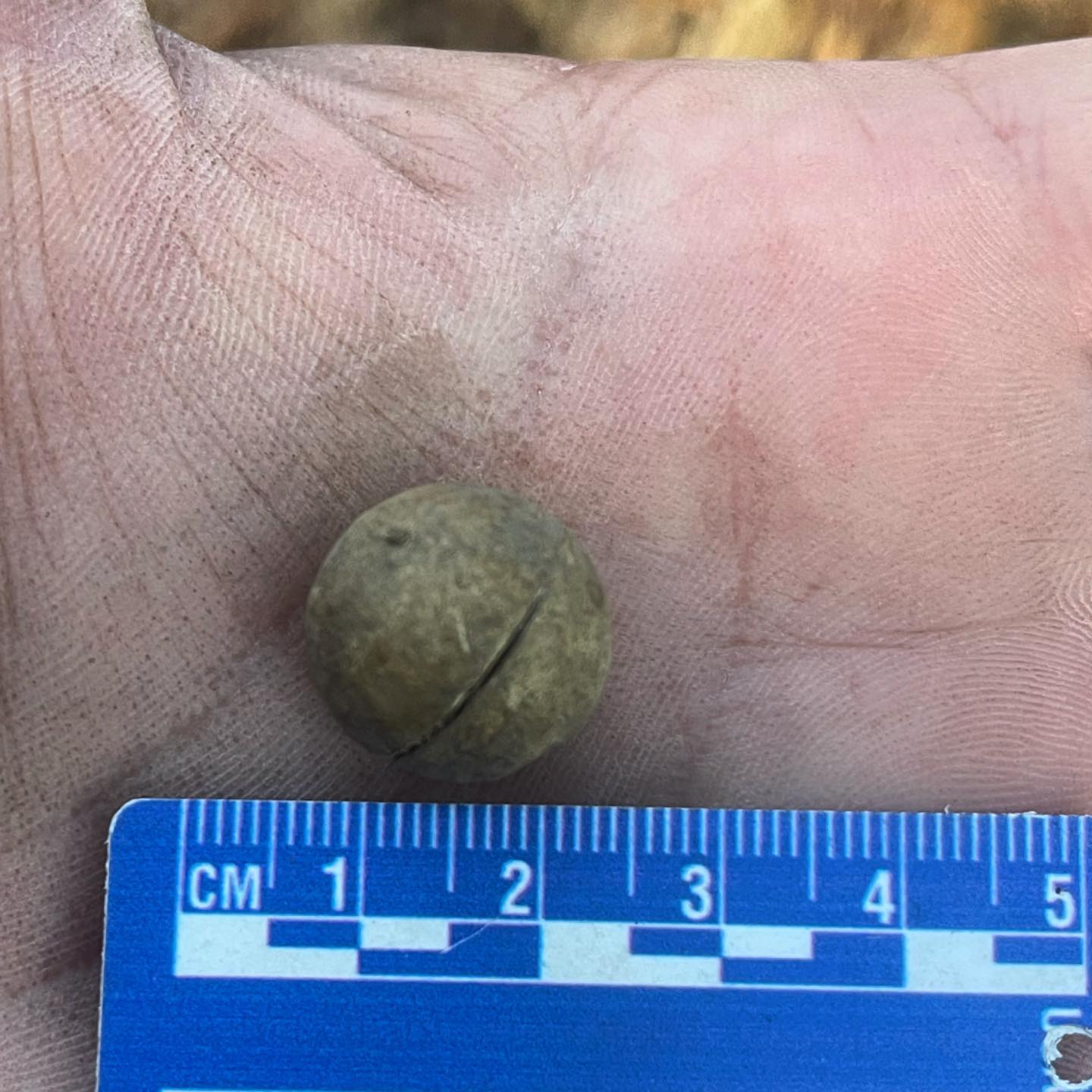
McNutt said students have recovered at least two Confederate bullets that may have been fired at the inside of the Lawton stockade. The team in early 2023 found a poorly cast ball, likely fired from a Springfield Model 1842 percussion cap musket (photo below, courtesy of Camp Lawton project).

Produced in large numbers, and floating around most of the arsenals in the South, these were still used despite the lack of accuracy and range in both the front lines and on the home front by militia. With a maximum range of 365 meters, and an average effective range from 90 to 275 meters, the location of the ball is well within range of the guard towers. And while most of the POWs at Camp Lawton recalled few instances of guards shooting POWs, our fired musket ball, along with other fired rounds from previous work inside the stockade, is a sobering reminder that Lawton still had many ways to die,” the professor writes.

Students led by Lance Greene, his predecessor, in 2010 found a spent .57-caliber bullet at the stockade. The round “has clear signs of rifling from being fired: deformation on the tip seems to show it only striking sand, though this doesn't preclude it having impacted a human,” McNutt says

Later analysis showed three groves and a right-hand twist indicating it was probably fired from a Pattern 1853 Enfield rifled musket. “Deformation on the nose matches experimental archaeology of impacts into soft surfaces, like sand or loamy soil,” according to McNutt. 

ELMIRA (New York – Union camp)

Confederate POWs at Elmira (Library of Congress)
Elmira did not have a deadline, even though it was a stockade prison. The camp was dubbed “Hellmira” by prisoners because of its 24 percent mortality rate. Gray said there are records of a Union guard shooting a Confederate prisoner.

According to the Star Gazette newspaper, Granville Garland shot A.P. Potts of the 38th Georgia Infantry during a July 31, 1864, disturbance. Potts survived.

Inmates at Elmira weathered hunger, illness and melancholia and, even worse, exposure to the cold weather, according to the National Park Service.

POINT LOOKOUT (Maryland – union camp)

(Library of Congress)
The overcrowded prison saw 4,000 Confederate prisoners succumb to various causes, especially disease. Some were killed by guards, according to experts and histories. About 52,000 Union soldiers went through the prison.

The camp’s deadline was a ditch inside the prison approximately 15 feet from the parapet wall. The ditch was a foot wide by a foot deep.

Official records show African-American guards, some formerly enslaved, sometimes shot prisoners for crossing the deadline or trying to escape, says Gray. The prison is known for its racial tension.

“One commanding officer claimed that the black guards were more zealous than the white when it came to enforcement of prison regulations and were apt to fire first while calling for the corporal of the guard,” says Crickenberger.

He estimates 19 prisoners were shot and killed or wounded by white and black guards between November 1863 and August 1864 alone. Prisoners reported that there were instances where guards fired at prisoners without inflicting casualties. (Photo, Friends of Point Lookout)

“They shot frequently but missed more often than they hit,” Crickenberger says. “Regardless of the accuracy of the guard, such incidents kept prisoners on their toes making them wary and continually fearful of being shot either night or day.”

A Confederate prisoner drew notable watercolors of life at the prison, including interactions with guards. It should be noted that black POWs held at Andersonville faced discrimination from friend and foe alike.

The friends group has helped restore the fort, the southwest corner of the stockade and assists with living histories and demonstrations of camp life.

ROCK ISLAND (Illinois-Iowa – Union camp)

The deadline at Rock Island consisted of a series of white stakes (left, photo Rock Island Arsenal Museum) that were illuminated by lanterns at night, according to the NPS.

The barracks were enclosed by a stockade fence 1,300 feet long, 900 feet wide and 12 feet high. Sentry boxes were placed every 100 feet.

During the 20 months the prison was open, 1,960 prisoners and 171 Union guards died.

The North had reduced rations in retaliation for the treatment of Union prisoners at Andersonville. Conditions at Federal prisons often were deplorable.

Tuesday, January 16, 2024

Man up: At Andersonville and other Civil War prisons, captives resisted and coped in a number of ways. They asserted a new form of masculinity

Desperate to be free: Union prisoners tunneling (National Park Service)
Sgt. Maj. Robert H. Kellogg and his comrades in the 16th Connecticut Infantry, like generations of American soldiers before them, believed the only manly death in war should occur on the battlefield.

But they would find their experience to be different as the Civil War wore on. The green regiment, chopped up at Antietam in September 1862, was captured in only its second engagement 19 months later in Plymouth, N.C.

Gone were the ideas of battlefield victories and fame. Kellogg realized their world had been turned upside down when the regiment surrendered in April 1864.

“On the morning of (April) 21st we awoke to new experiences. Instead of the calls to which we had -been wont to listen, and the labor we had been accustomed to perform, we were but passive beings, subject to the will of a conqueror,” Kellogg wrote in “Life and Death in Rebel Prisons,” published in March 1865 near war’s end.

The soldier could not have predicted the extreme privation and horror he would witness and endure at Andersonville prison in Georgia. He provided colorful details in his book, considered one of the best personal accounts about life and death at Andersonville.

Various photographs of Robert H. Kellogg (Museum of Connecticut History)
What Kellogg and soldiers from both sides experienced at prisons contributed to a change in the perception of 19th-century masculinity, according to many scholars, including conflict archaeologist Ryan K. McNutt.

As McNutt pointed out in a paper and a lecture in November at Andersonville National Historic Site near Americus, the Victorian ideal of manliness was courage through sacrifice and action – a good death on the battlefield, should it come to that.

“The POW experience was the direct antithesis of this ideal: Capture was socially seen the same as surrender,” wrote McNutt (the men of the 16th Connecticut said it was not their decision to surrender). “And the wartime experience of POWs in the American Civil War was passive, inactive – waiting. For exchange, for parole.”

The talk by the assistant professor of anthropology at Georgia Southern was titled “But Passive Beings, Subject to the Will of a Conquerer,” pulling the line from Kellogg’s book.

(At left, Father Peter Whalen prays for prisoners, Thomas O'Dea sketch, NPS)

As it turned out, men confined with Kellogg were not all that passive, McNutt told the November audience in the park visitor center. They resisted in a variety of ways, trying to survive while buttressing their sense of manliness.

Tries were usually futile. But they dreamed of escape

McNutt spoke about resistance at both Andersonville (Camp Sumter) and Camp Lawton, another Confederate prison site in Georgia. McNutt directs the GSU archaeological project at the latter site

Andersonville is the emblem of POW suffering at Union and Confederate camps during the Civil War. Of 45,000 men held there, 13,000 Union service members succumbed to horrible conditions. Rather than a quick battlefield death by a bullet or artillery round, they faced death on an hourly or daily occurrence. It could come at any time.


Themes of heroism through endurance, martyrdom and stoicism arose, McNutt argues.

Soldiers engaged in tunneling, trickery and barter with guards. They endured beatings and incidents of cruel treatment – all while trying to stand tall amid the misery.

“Attempting is just as important as being successful,” McNutt said of defiant acts. More than 80 tunnels were found at Andersonville. Only 30-40 men successfully escaped the prison, which held about 45,000 soldiers over its 13 months.

But that did not stop them from trying.

A National Park Service article about escape attempts includes a paragraph that gets at what McNutt and others have studied. By being taken captive, prisoners had to find other ways to “prove oneself” and disprove any notions of cowardice.

As a result, many prisoners faced the choice of either returning home after the war to be received as failures, or to attempt a dangerous escape. Those prisoners at Andersonville and elsewhere who never successfully escaped would often invent escapes or escape attempts in order to validate themselves in the eyes of their society,” the NPS says. (At right, Thomas O'Dea drawing of escape attempts at Camp Sumter)

'Can this be hell?

Kellogg was 20 years old when he passed through the gates of Andersonville into the chaos and suffering.

"As we entered the place, a spectacle met our eyes that almost froze our blood with horror…before us were forms that had once been active and erect -- stalwart men, now nothing but mere walking skeletons, covered with filth and vermin…Many of our men exclaimed with earnestness, 'Can this be hell?'" the sergeant wrote

The soldier survived Andersonville and was transferred after a few months to  prisons in South Carolina paroled in November 1864. He was a changed man.

Robert Kellogg (right) with Oscar Wiel (Museum of Connecticut History)
Kellogg tried to resume his career path as a druggist but found himself disconnected and isolated, according to an article in Zocalo Public Square. When a local deacon died, he wrote in his diary that he felt numb: “Death seems to have lost its solemnity in me since ‘Andersonville.’”

He later moved to Ohio and published his book. Kellogg worked for years to ensure “thousands of brave men” were not forgotten. He died in 1932. The Connecticut Historical Society has his diaries, letters to his parents and military service records, among other items.

The Museum of Connecticut History in Hartford contains numerous photographs of Kellogg and some information about this life. (Special projects curator Christine Pittsley was helpful while I researched this post.)

One of only a handful of photographs of Andersonville (National Park Service)
Mary Gorman, author of a book about the Andersonville Raiders and a member of the Descendants of Andersonville Prison Facebook page, says Kellogg’s is probably the best Andersonville memoir, drawing from his vivid diary.

“If you want to get the truest picture of Andersonville, stick mostly with diaries and the memoirs published within the first 5 years” after the war, Gorman wrote when I asked followers of the Facebook page about Kellogg.

McNutt concluded his paper outlining the impact of post-traumatic stress disorder (PTSD) suffered by Civil War prisoners.

“The restructuring of masculine identities, the resistance both physical and symbolic, the creation of crafts and games, such as chess pieces found under the brick oven at Lawton, all served to combat the depression and mental effects of long confinement, a final deadly symptom of structural violence of the internment system, through action and engagement,” he wrote.

“Acts of resistance, effective or ineffective, were acts of survival.”

Tuesday, October 31, 2023

Andersonville's Civil War weekend will include archaeologist's talks on how POWs coped with the trauma, resisted their captors

Former POW Thomas O'Dea's depiction of sickness at Andersonville (NPS)
A conflict archaeologist will speak this weekend at Andersonville National Historic Site in Georgia about emotional trauma endured by Civil War prisoners of war and how they reacted.

The site 10 miles northeast of Americus is having its annual Civil War weekend on Saturday and Sunday. Activities include cannon and musket demonstrations and activities geared toward young visitors.

Andersonville is the emblem of POW suffering at Union and Confederate camps during the Civil War. Of 45,000 men held there, 13,000 Union service members succumbed to horrible conditions.

Ryan McNutt (right), assistant professor of anthropology at Georgia Southern University, will be lecturing on resistance, masculinity and mental health in POW populations at both Andersonville (Camp Sumter) and Camp Lawton, another Confederate site in Georgia. McNutt directs the GSU archaeological project at the latter site.

For more than a decade, GSU students have conducted excavations and conducted research at a state park and former federal hatchery near Millen, Ga. About 10,000 Union prisoners were held at Lawton for about six weeks in 1864. They had been moved there from Camp Sumter.

Disease, hunger and unusually cold and moist conditions that year exacted a toll at Camp Lawton, with 700 or more prisoners dying before they were shipped off in the middle of the night to other Confederate prisons.

Susie Sernaker of Andersonville NHS told the Picket that McNutt’s lectures, at 1 p.m. both days in the park theater, will help spread public knowledge about the travails of those held at Lawton.

McNutt and his students have focused on the location of Confederate and Union structures at  and the difficulties prisoners and guards faced -- and their interactions.

The professor’s research interests include utilizing technology such as LIDAR and GIS to answer questions about battlefield and conflict sites, power and dominance in the landscape and the impact of violence on non-combatants. 

A study conducted a few years ago found that postwar-born sons of many Union POWS had shorter lives than sons of soldiers who weren’t held captive. Basically, the study found that fathers’ prison hardships, including food shortages, altered the function of his genes in ways that could be passed on to sons.

Excavation at Camp Lawton site in March 2023 (Picket photo)
The free programming this weekend at Andersonville lasts from 10 a.m. to 4 p.m. on Saturday and 10 a.m. to 3 p.m. on Sunday.

“Kids can drill like Civil War soldiers, build miniature shelters, and discover more about the Civil War period at Andersonville by participating in our Junior Ranger program,” the park said in a news release. “Living historians will be portraying Father Whelan, the women of Andersonville, Confederate guards, and Union prisoners, all to help the history of Camp Sumter, better known as Andersonville Prison, come to life.”

Cannon firing demonstrations will take place at 10:30 a.m. and 1:30 p.m. on Saturday and at 10 a.m. and 3 p.m.  on Sunday. Musket firing demonstrations will be at noon and 3 p.m. on Saturday and 11:30 a.m. on Sunday. 

For more information on the event or to find out how you can become a living history volunteer at the park, call 229-924-0343. 

Sunday, May 7, 2023

Fort Jefferson: Archaeological divers at Dry Tortugas National Park in Gulf survey submerged Civil War-era graves

Grad student Devon Fogarty at John Greer's grave (C. Sproul/NPS)
A submerged Gulf of Mexico island reportedly spotted from the air a few years ago contains a cemetery holding the grave of a laborer who died at Fort Jefferson, the Civil War-era fortress.

Dry Tortugas National Park recently announced the discovery of the cemetery and the remains of a small 19th-century quarantine hospital. The latter was used to treat yellow fever patients at the fort between 1890 and 1900. The park is 70 miles west of Key West, Fla.

Laborer John Greer died in the first year of the Civil War. The isolated Fort Jefferson is mostly associated with that time, when it held Confederate prisoners and Lincoln assassination conspirators.

Water color depicts hospital and cemetery on Dry Tortugas island (NPS)
The park released photos and video of the fascinating August 2022 find near Garden Key, with a maritime diver checking out Greer’s grave not far from the surface.

Research shows the post cemetery contains dozens of graves of US military personnel, prisoners and civilians who were at Fort Jefferson or nearby islands. Greer died at the fort on Nov. 5, 1861. His cause of death is currently unknown.

His grave was marked with a well-preserved large slab of greywacke, the material used to construct the first floor of Fort Jefferson. The slab was carved into the shape of a headstone and inscribed with his name and date of death. Greer’s is the only currently identified grave on the sand.

Greer's grave stone is still legible (C. Sproul/NPS)
“This intriguing find highlights the potential for untold stories in Dry Tortugas National Park, both above and below the water,” Josh Marano, maritime archeologist for the south Florida national parks and project director for the survey, said in a statement. “Although much of the history of Fort Jefferson focuses on the fortification itself and some of its infamous prisoners, we are actively working to tell the stories of the enslaved people, women, children and civilian laborers.”

Marano told The New York Times he noticed a strange pattern in the water while he was flying over the Gulf of Mexico in 2016. He then pored over nautical charts. “There was dry land here at one point. There was a structure on that island at one point,” Marano told the newspaper. “When did it disappear?”

The archaeologist and students surveyed the island last summer and have since been conducting more research.

John Greer's name appears on 1861 roll at Fort Jefferson (NPS)
Park officials note a couple factors that may explain why this island is now below water.

“While the facilities identified in this survey were originally built on dry land, the dynamic conditions caused many of the islands to move over time. Climate change and major storm events have even caused some islands to settle and erode beneath the waves.”

Fort Jefferson was ringed by other islands used for various purposes, including quarantine sites for ill military members, prisoners and civilians.

As the population of Fort Jefferson swelled, the risk of deadly communicable diseases, particularly the mosquito-borne yellow fever, drastically increased. Major outbreaks of disease on the island killed dozens throughout the 1860s and 1870s.

Fort Jefferson is surrounded by submerged and above surface islands (NPS)
The National Park Service’s South Florida National Parks Cultural Resources Program will monitor the archaeological site, and officials remind visitors it is protected by federal law.

Park cultural resources staff, assisted by members of the NPS Submerged Resources Center, the Southeast Archeological Center and a University of Miami graduate student conducted the 2022 survey. The park is not divulging the exact location of the site.

Fort Jefferson is accessible only by boat or seaplane. Visitors are required to provide their own food, water and all other supplies while at the park. 

Wednesday, September 22, 2021

Mackinac Island in Michigan briefly housed three Southern prisoners. Here's what we learned about them during a recent visit

Civil War-era barracks are in the background of this fort view (Picket photo)
Above the throng of tourists enjoying the restaurants, water views and fudge shops of Mackinac Island in Michigan stands a fort that briefly held three Southern prisoners during the Civil War.

I recently spent a few hours on the island, gawking at the Grand Hotel, moving to the side of roads to make way for carriage rides and taking a look at picturesque Fort Mackinac (pronounced Mackinaw), which is perched above the harbor. Before the visit, I did not know anything about its brief Civil War episode.

Fort Mackinac, now a state park, is most famous for two clashes during the War of 1812. But during the summer of 1862, it housed three Tennesseans who military Gov. Andrew Johnson (later president) had ordered arrested for support of the Confederacy and “treasonous inclinations.”

Johnson felt that the wealthy, planter class of the South was part of the reason for the war and he wanted the three men removed from Tennessee,” the fort’s website says.

Washington Barrow, Judge Guild and William G. Harding
Secretary of War Edwin Stanton arranged for the trio to be sent to Michigan.
Fort Mackinac had largely been used as deployment center during the mid-19th century and was not in much use when the Civil War began.

But after the arrests of Judge Josephus Conn Guild, Washington Barrow and William G. Harding, officials prepared their quarters and secured a 90-member militia unit, the Stanton Guard, from the Detroit area.

The prisoners, all from the Nashville area, were able to walk the grounds on their own, being confined to their quarters at night. They could walk downtown under guard but were not allowed to interact with anyone. The men were never criminally charged; instead they were considered political or state prisoners.

One of the blockhouses at Fort Mackinac (Picket photo)
The park’s website provides this information about the three:

“Judge Guild was originally from Virginia, had served in the Tennessee legislature and was a founder of the Louisville and Nashville Railroad. Washington Barrow was a lawyer who served as a congressman and attorney general in Tennessee. He signed the Tennessee secession ordinance and helped finance a Confederate cavalry company. William G. Harding owned the 3,500 acre plantation Belle Meade where he raised thoroughbred race horses. He served as adjutant general of the Tennessee militia.

A rifle firing demonstration on the grounds (Picket photo)
According to the Tennessee Encyclopedia, Guild was outspoken in his support for the Southern war effort. Early in the Civil War, Harding headed the Military and Financial Board of Tennessee, which spent $5 million arming and equipping Rebel soldiers. 

The three prisoners were on the island during its most pleasant months. Perhaps with thoughts of a possibly harsh winter ahead, Guild and Harding took a loyalty oath and were allowed to return to Tennessee.

Barrow was shipped to the military prison at Johnson’s Island in Ohio. He refused to take an oath but was exchanged in March 1863.

“Barrow returned to Tennessee, ran unsuccessfully for Confederate governor of the state, and spent the balance of the war as a private with the retreating Army of Tennessee,” the encyclopedia says. “After the defeat of the Confederacy, Barrow returned to Nashville, broken in health and financially ruined. He died within the year.”

Fort Mackinac was largely not garrisoned for the remainder of the war.

Several of the park’s 14 buildings go back before the Civil War, including its signature blockhouses and barracks that housed the Stanton Guard.

I enjoyed strolling the grounds and ramparts, and took in seasonal rifle firing and signal flag demonstrations put on by the staff.

Much of the programming focuses on the Army’s use of the fort in the 1870 into the 1890s, when it was deactivated.

Fort Mackinac is one of few surviving Revolutionary War forts.

The briefly constituted Stanton Guard at Fort Mackinac

Wednesday, April 28, 2021

Arkansas governor dedicates $750,000 for a larger museum about the steamboat Sultana explosion that killed hundreds of Union soldiers

Haizlip Studio rendering of new museum features replica smokestacks (Courtesy SHPS)
Survivors of the Sultana disaster lobbied 25 years for Congress to provide money for a monument along the Mississippi River, near where 1,200 soldiers and civilians died a few miles above Memphis, Tenn.

It never happened.

“The survivors of this tragedy and those family members of those that died deserve better,” John Fogleman, one of the leaders of the effort to build a permanent museum about the disaster, said Tuesday in Marion, Ark., during a capital campaign kickoff event.

The Sultana Historical Preservation Society, city officials and others hope to raise $7.5 million to make the dream happen. They got a big boost during the event: Gov. Asa Hutchinson announced the state will provide $750,000 over two years.

“I believe that this is a good investment for this region. It is a good investment for the state of Arkansas. It is an important marker that we need to have in history,” the governor told the crowd in the former high school gymnasium-auditorium that will house exhibits and serve as a community space.

Sultana artifacts and memorabilia (Courtesy of Gene Salecker)
Marion was the closest community to where the overcrowded steamboat – carrying hundreds of Federal soldiers home at the end of the Civil War -- exploded and caught fire. No one was formally held accountable for putting too many men on the Sultana, despite documented concerns about the safety of one of the boat's boilers, which exploded early on the morning of April 27, 1865.

Accounts of the tragedy – the worst maritime loss in U.S. history -- were overshadowed by headlines about the assassination of President Abraham Lincoln and the pursuit of John Wilkes Booth.

Hutchinson made note of that Tuesday, saying the tragedy garnered only a few lines in The New York Times. “This has never gotten the historical attention it would ordinarily receive.”


The governor said besides honoring the dead and their descendants, the museum will tell the story of Arkansans who rushed to the river to help in the rescue and treatment of the wounded.

The Fogleman and Barton families, descendants of local men who were part of that effort, will donate $100,000 for the new museum.

Gene Salecker, a Sultana author and lecturer, said the renovated space will be much larger than the current museum a few blocks away. “The new museum will be located in the center of the city along a major roadway, near city hall and the city library, and will encompass over 22,000 square feet.”

Before Tuesday’s campaign kickoff, Fogleman told the Civil War Picket the project had received donations and pledges totaling $1.2 million. “Under our contract with the City of Marion we may start construction once we have raised in donations and commitments for donations totaling $3 million.”

Among the speakers was architect Mary Haizlip with Haizlip Studio in Memphis, which is designing the facility. She touted its proximity to I-55 and expected contribution to tourism and economic development in the entire Delta.

This exhibit tells of events leading up to explosion (Courtesy of SHPS)
Visitors will be provided “experiential moments” in the lives of passengers – from their departure from prison camps to the moment of the explosion and the aftermath. A memorial plaza will feature pavers engraved with names. “It will also be a place to sit and reflect.”

Haizlip Studio’s design includes smokestacks meant to evoke images of the Sultana.

“The smokestacks are going to be an iconic beacon that will be visible along Military Road to further draw in people to share the experiences,” Haizlip said.

Tuesday’s event was long on both memory of the disaster and the potential dollars that could come to the region. Officials are hoping up to 50,000 patrons come annually.