Showing posts with label Georgia Southern University. Show all posts

Tuesday, October 31, 2023

Andersonville's Civil War weekend will include archaeologist's talks on how POWs coped with the trauma, resisted their captors

Former POW Thomas O'Dea's depiction of sickness at Andersonville (NPS)
A conflict archaeologist will speak this weekend at Andersonville National Historic Site in Georgia about emotional trauma endured by Civil War prisoners of war and how they reacted.

The site 10 miles northeast of Americus is having its annual Civil War weekend on Saturday and Sunday. Activities include cannon and musket demonstrations and activities geared toward young visitors.

Andersonville is the emblem of POW suffering at Union and Confederate camps during the Civil War. Of 45,000 men held there, 13,000 Union service members succumbed to horrible conditions.

Ryan McNutt (right), assistant professor of anthropology at Georgia Southern University, will be lecturing on resistance, masculinity and mental health in POW populations at both Andersonville (Camp Sumter) and Camp Lawton, another Confederate site in Georgia. McNutt directs the GSU archaeological project at the latter site.

For more than a decade, GSU students have conducted excavations and conducted research at a state park and former federal hatchery near Millen, Ga. About 10,000 Union prisoners were held at Lawton for about six weeks in 1864. They had been moved there from Camp Sumter.

Disease, hunger and unusually cold and moist conditions that year exacted a toll at Camp Lawton, with 700 or more prisoners dying before they were shipped off in the middle of the night to other Confederate prisons.

Susie Sernaker of Andersonville NHS told the Picket that McNutt’s lectures, at 1 p.m. both days in the park theater, will help spread public knowledge about the travails of those held at Lawton.

McNutt and his students have focused on the location of Confederate and Union structures at  and the difficulties prisoners and guards faced -- and their interactions.

The professor’s research interests include utilizing technology such as LIDAR and GIS to answer questions about battlefield and conflict sites, power and dominance in the landscape and the impact of violence on non-combatants. 

A study conducted a few years ago found that postwar-born sons of many Union POWS had shorter lives than sons of soldiers who weren’t held captive. Basically, the study found that fathers’ prison hardships, including food shortages, altered the function of his genes in ways that could be passed on to sons.

Excavation at Camp Lawton site in March 2023 (Picket photo)
The free programming this weekend at Andersonville lasts from 10 a.m. to 4 p.m. on Saturday and 10 a.m. to 3 p.m. on Sunday.

“Kids can drill like Civil War soldiers, build miniature shelters, and discover more about the Civil War period at Andersonville by participating in our Junior Ranger program,” the park said in a news release. “Living historians will be portraying Father Whelan, the women of Andersonville, Confederate guards, and Union prisoners, all to help the history of Camp Sumter, better known as Andersonville Prison, come to life.”

Cannon firing demonstrations will take place at 10:30 a.m. and 1:30 p.m. on Saturday and at 10 a.m. and 3 p.m.  on Sunday. Musket firing demonstrations will be at noon and 3 p.m. on Saturday and 11:30 a.m. on Sunday. 

For more information on the event or to find out how you can become a living history volunteer at the park, call 229-924-0343. 

Tuesday, April 4, 2023

Rolling the dice: Discovery of piece of gaming object at Georgia's Camp Lawton an example of the 'shadow economy' at POW sites

Views of the remains of the die, which may have had numerous sides (Camp Lawton Project)
Somewhere at an archaeological site in Georgia are the remains of a sutler’s cabin, where captured Federal soldiers could buy a whole range of goods, temporarily lifting them from misery that took the lives of 800 comrades.

The Camp Lawton sutler’s cabin and the grounds around it offered more than food and clothing. It was part of the prison’s shadow economy for six weeks in autumn 1864. Soldiers -- either with U.S. greenbacks they still held, or equipment and personal items – could obtain alcohol from guards, tobacco and play games of chance.

Ryan McNutt, who leads the Camp Lawton project at Georgia Southern University, and a couple dozen students have spent the spring looking for evidence of the cabin. Thus far, there have been no definitive finds. Maps produced in the 19th century gave different positions for the structure.

Patrick Sword and Audrey McGill at dig site (Picket photos)
On one bright note, part of a carved die was found a few weeks ago during digging, evidence of apparent gambling in the trade-and-sell part of the stockade.

Patrick Sword, a graduate student from the Atlanta area, is studying the shadow economy at Lawton. I met him and other students in late March during a brief visit to the site on the fenced grounds of an old federal fishery adjoining Magnolia Springs State Park.

The stockade was laid out in a grid fashion (left, click to enlarge) and much of the commercial activity took part on Market Street, Sword said. He is hoping to find more evidence of the shadow economy, but the team in recent weeks has found mostly modern stuff, including trash dumped by members of the Civilian Conservation Corps, who helped construct the state park in the late 1930s.

McNutt says the die is made of lead, probably fashioned from a small caliber round, likely a pistol or a .54-caliber ball. He says the artifact is probably one-half or one-fourth of the original die.

“Six-sided die are the most common, but there are also 10-sided, 32-sided, and 20-sided. If it's from a six-sided die, it is a half, split down the center to leave a quasi-pyramid shape,” McNutt wrote in an email after my visit.

In its six weeks' existence, the 42-acre Confederate stockade held about 10,000 men before it was closed when Union forces approached. Over the past dozen years, teams from Georgia Southern have found evidence of the stockade wall, Rebel officers’ quarters, brick ovens and sleeping areas for the POWs. Thus far, they have been unable to find the hospital or burial area.

Camp Lawton was one of several prisons in south Georgia that briefly held Federal prisoners sent from the larger Andersonville camp. They were moved back and forth because Confederate officials feared they would be freed by Sherman’s March to the Sea.

McNutt and his students in their spring dig have found a lot of postwar material, but also have come across cut nails, buckles, a bullet and files from the Civil War period. On the day of my visit they were working near a stream that divided the camp, and served as a drinking source and latrine a bit downstream.

“We get good historic Civil War stuff and then a modern fishing weight,” the associate professor tells me.

McNutt (right, on site) believes much of the area they were working on is where Union prisoners who served as an internal police force operated.

Not many prisoner items have been found here, unlike in the hill above. “No one is allowed to camp right near the stream.”

The professor is interested in the relationship between guards and prisoners. They were known to have traded at here and other sites, and morale among the former was low at Camp Lawton, not surprising given the Confederacy’s decline. Guards sometimes foraged away from the property.

Prisoner of war camps are “excellent places to hide contraband, personal items you are not supposed to have," McNutt told me several years ago when he became project director. 

The National Park Service, which maintains the much larger site at Andersonville, has an online page detailing life and diversions for Federal prisoners held there. It, too, had a sutler’s cabin, but it had other shops selling items to the captives as well.

Food, of course, was always on their minds.

Sutler's cabin in rear at Andersonville in 1864 (Library of Congress)
Here is an NPS description of Andersonville:

“Many of the Andersonville prisoners who arrived in the stockade in April and May were well supplied with money. The Federal armies were reclothed and paid off in the spring of 1864 for the spring campaigns. Many of the new recruits and reenlisted veterans had bounty money with them when captured. Greenbacks could be pressed into the sole of a shoe, or placed inside a brass button. Money was concealed about the person in various ways. Some swallowed their rings and others put their money into bowls of large Dutch pipes with a little tobacco sprinkled on top. When searched, they would pretend to be busy lighting their pipes and thus escape suspicion.

“Gambling was carried on quite extensively; faro, dice, and $10.00 stakes were commonly played for. Trade was carried on with the guards on the outside of the wall by talking through the cracks and throwing articles over the fence. Another trade was carried on as well, as noted by prisoner John Northrup, Co. D, 7th Connecticut Infantry: "There is one commodity never had in any market. It is ahead of any Dutch brewery extract; it is meal beer made by letting corn meal sour in water. The vendor cries, 'here is your nice meal beer, right sour, well-seasoned with sassafras.'"

POWS trade new rations for something more palatable (NPS)
McNutt believes there may be beer and rum bottle remains at the Camp Lawton site.

Trade, bartering and gambling were common at virtually all Civil War prisoners, both North and South, though there appeared to be some restrictions later in the war.

At Point Lookout in Maryland, where Confederates were held, a prisoner made compelling illustrations of camp scenes. All depicted guards were African-American soldiers.

“The drawings highlight the concerns and experiences of prisoners of war; most scenes show prisoners playing cards, buying food, or engaging in barter with food vendors,” the historical society says in a description of its collection.

Exchanging buttons for pepper at Andersonville (Library of Congress)
Confederate officer Henry Clay Dickinson wrote about gambling he witnesses while a prisoner of war at Fort Delaware, Delaware, in 1864, according to a Civil War Monitor article on gambling.

“The gambling saloons were a curious feature in prison, and were not only numerous but well patronized. Captain Coffee, of Mississippi, was the prince of faro dealers, being always gentlemanly in his manners and always attracting the greatest crowd. He never played cards until he was captured, except for amusement, and I am told that a Yankee guard was his first victim. The bettor wagered either in Confederate or Yankee money. He always had a large and anxious looking crowd around his booth. Some quartermasters having been captured, the amount of Confederate money in prison was very large, and changed hands frequently.

“I heard that Coffee once sent to Dixie from Point Lookout ten thousand dollars. How much United States money he (Coffee) made I cannot say, though at one time, when the Yanks were about searching quarters and persons, he hid in the grass one hundred and eleven dollars in gold, a gold watch, and several hundred dollars in notes, which, of course, some Yank, who knew he was flush, had seen him hide and took care to not let him find it again.”

Rusted metal likely from the 20th century (Picket photo)

Thursday, March 4, 2021

Archaeology students find likely evidence of a brief cavalry skirmish in southern Georgia during Sherman's March to the Sea

A Spencer repeating rifle casing and a toe tap with nails found during recent
excavation near Millen, Ga. (Courtesy of Camp Lawton Archaeological Project)
Archaeology students at a Georgia university have found artifacts that might derive from a skirmish between Union and Confederate cavalry during Maj. Gen. William T. Sherman’s March to the Sea.

Ryan McNutt, assistant professor of historical archaeology at Georgia Southern University in Statesboro, said recent field work yielded fired casings from a Spencer repeating rifle and from a likely Allen & Wheelock .32 Rim fire side hammer revolver, a fired percussion cap, toe caps from footwear and a bridle rosette that matches types used by Union cavalry.

McNutt heads up the school’s Camp Lawton Archaeological Project, which for several years has been researching the remains of a Confederate prison camp that was in operation for several weeks in fall 1864.

In 2020, the university was awarded a $116,247 grant from the National Park Service’s American Battlefield Protection Program to document and evaluate the archaeological integrity of two skirmish sites near the end of Sherman's campaign in Georgia: Buck Head Creek and Lawton (Lumpkin's) Station.

“Both of these conflicts occurred as the Confederacy attempted to tactically slow, or at least constrain, Sherman’s inexorable approach to southeast Georgia,” McNutt wrote in an email to the Picket.

Round believed to be from .32-caliber rimfire revolver (Camp Lawton Project)
The artifacts were found in the past month near the site of Lawton Station, a Dec. 4 clash that followed fighting at Buck Head Creek. Lawton Station had served the prison camp, which closed a few weeks before these skirmishes.

The Battle of Buck Head Creek on November 28, 1864, involved U.S. Brig. Gen. Judson Kilpatrick’s and Confederate Maj. Gen. Joseph Wheeler’s cavalry forces. It took place across what are now Jenkins and Burke counties, a fighting Union withdrawal north from the area around the still-standing Buck Head Creek Church, through Reynold’s Plantation across the course of a day and over approximately three miles of period roads, McNutt said.

Kilpatrick was in the area to destroy railroad between August and Millen and burn a trestle. Another objective was to release the Camp Lawton prisoners, but Union forces discovered they had been moved to other sites. Federal forces were able to destroy a mile of track.

Gens. Judson Kilpatrick and Joseph Wheeler
On the 28th, Wheeler “almost captured Kilpatrick, and pursued him and his men to Buck Head Creek. As Kilpatrick's main force crossed the creek, one regiment, supported by artillery, fought a rearguard action severely punishing Wheeler and then burned the bridge behind them,” says a National Park Service summary of the fighting. “Wheeler soon crossed and followed, but a Union brigade behind barricades at Reynolds's Plantation halted the Rebels' drive, eventually forcing them to retire.

The main body of Sherman’s army, notably the 14th and 20th corps, approached Millen days later and engaged with Rebel cavalry.

According to McNutt, Capt. S.P. Dobbs and the 9th Alabama Cavalry burned a bridge at Buck Head Creek Church and fell back to Lawton Station, “where they sheltered under fire for a period before withdrawing into Screven County toward Beaver Dam Creek.” (Lawton Station/Depot is where Federal prisoners were brought to the POW camp a couple months before.)

Front and back of bridle rosette (Camp Lawton Project)
The professor believes some of the Lawton Station fighting occurred with the boundaries of Magnolia Springs State Park, meaning it is protected. Much of the prison site, particularly the section where the guards lived, is inside the park. The Union prisoners lived in an area that is now federal property.

Georgia Southern students used Lidar, a remote sensing method, at the Lawton Station area and will do so again when they get to Buck Head Creek this summer. The aim of the project is to document any surviving above-ground indications of Lawton Station, field fortifications from Buck Head Creek, and historic roads, structures, houses, bridges that would have been used by both Confederate and Union forces throughout both battlefields.

McNutt believes the Lidar found what is believed to be the site of Lawton Station.

Students used metal detectors on an old road that went from the station, past Confederate barracks and the stockade to a larger road that goes north toward Augusta. This is where the artifacts were found.

“This would have been the retreat route of Captain Dobb's Confederate regiment, and the (pursuit) route of the Union cavalry,” McNutt wrote.

POW Robert Knox Sneden's map of prison (Library of Congress)
Beyond the artifacts mentioned above, the project found at Lawton Station “material culture remnants that are more ambiguous, but might be Union in origin.” That includes bits of saddlery and horse tack elements, “implying a greater presence of horse-mounted troops than were stationed at Lawton by the Confederates when it was operating as a prison camp,” McNutt said.

“These are all tantalizing bits of material culture that suggest we're looking at an edge of the skirmish, or at least an area where Union forces were firing at something or someone further along the road. As we progress through the spring field school, we'll fill this picture in more as we finish our search grid, and move up the road to investigate with another systematic metal detector survey the site of Lawton Station itself.”

McNutt concedes there is commingling of artifacts from the operation of the prison camp and the December skirmish. The survey has taken place on the edge of Rebel barracks and what may be an open parade ground.

But the Spencer and .32-cal rimfire round are really only going to come from Union cavalry, given the Confederacy's inability to manufacture cased ammunition, especially with the copper shortage. I'm pretty confident in saying at a minimum, the Spencer and the .32 round are specific to some kind of engagement, and the bridle rosette is likely to come from that as well.”

“We have a few other ferrous items that I need to investigate in more detail, but a few are potential gun furniture, and there is a possible carbine sling bolt. So in short, there is some comingling, but these items range from being certainly not Confederate in origin, to being ambiguous, and possibly Confederate or Union.”

The professor said Kilpatrick sent troopers to Lawton in late November, but a major did not report any fighting. “I suspect given as deep as they were in Wheeler's turf, with extended (and uncertain) supply lines, conservation of ammunition would have been enforced, so they're unlikely to have just rode into the barracks area guns blazing.

“The more likely possibility is that these are items from that December cavalry skirmish -- but we need more information to be sure, and hopefully we'll know more as we finish up our search area.”

(At left is an adjustable buckle found by metal detector.)

In the meantime, the Camp Lawton Archaeological Project is contacting landowners in the area of Buck Head Creek to obtain permission to do field work there in the summer.

This field work will continue into 2022. McNutt says landowners, anyone interested in volunteering and those who might have collections of artifacts and would like him to take a look should contact him at rmcnutt@georgiasouthern.edu

Tuesday, June 18, 2019

More Camp Lawton prison site artifacts: Railroad spike, sash clasps, bricks, whiteware sherd and a copper rivet

Clasp for sash worn by a Confederate (Camp Lawton Archaeology Project, GSU)
A spring-fed stream and a towering stockade wall separated Federal prisoners and the young men in gray who guarded them at Georgia’s Camp Lawton for a few short weeks in autumn 1864.

A lingering question for archaeologists who have been working on the site for nearly a decade is what else separated them -- especially when it came to food, supplies, shelter and general living conditions.

The 10,000 Union captives lived mostly on a hillside while their captors were scattered in different areas of the stockade exterior and artillery fortifications. The Federals built shebangs and other structures to provide shelter while the Confederates, mostly members of Georgia reserve regiments, apparently depended on tents and perhaps a barracks for officers.

Based on some archaeological finds in the past couple years, evidence suggests it “seems like the guards are a little better supplied than initially suggested,” said Dr. Ryan McNutt, director of the Camp Lawton Archaeology Project at Georgia Southern University in nearby Statesboro.

The Picket spoke recently with McNutt about artifacts that are linked to the Confederate troops who occupied camps in what is now Magnolia Springs State Park. The following items were found this year. You can read here about a stirrup found last week.


DIE-STAMPED SASH BUCKLES/CLASP

Clasp for sash worn by Confederate (Camp Lawton Archaeology Project, GSU)

Sashes apparently were used as marks of rank for Confederate militia and quasi-military officials. Different colors may have been used by company officers or noncommissioned officers.

They were commonly found in Savannah, at jails and courthouses, said McNutt.
One of the buckles found at Camp Lawton (top image) has a crown motif; it may have come from Europe into Savannah via blockade runners, he said.

It’s known that elements of the 1st through 5th regiments of the Georgia Reserves were stationed at the site.

LINE OF BRICKS

Courtesy of Camp Lawton Archaeology Project, Georgia Southern University

McNutt is not yet sure how these were used. While it could be the remains of a chimney, they also could have been used as a foundation for a wall tent, with planks placed above. Bricks previously have been found in the prisoner area, the remains of ovens and tent foundations.

RAILROAD SPIKE

(Courtesy of Camp Lawton Archaeology Project, Georgia Southern University)

This likely came from the depot at Lawton, the terminus of a railroad line that carried Federal prisoners from the small town of Millen. It could find all kind of uses in a camp, including tents and other structures.

CERAMIC // WHITEWARE SHERD

Courtesy of Camp Lawton Archaeology Project, Georgia Southern University

From a Camp Lawton Facebook post in May: “Our whiteware sherd from yesterday has two possible sources. One is Clementson Bros, a North Staffordshire manufacture that produced a variety of plain and transfer print wares for the North American domestic market, and starts trading under the Clementson Bros name in 1867. However, the edge of the decoration appears to be a quasi royal arms, with a recumbent lion. You can just make out the paw. This doesn’t match any of their marks. It may be from Clementson & Young, which were imported into New Orleans for the southern market during the mid-19th century.”

COPPER ALLOY RIVET FROM A SOLDIER’S ACCOUTREMENTS

Courtesy of Camp Lawton Archaeology Project, Georgia Southern University

The Georgia Southern team the past couple years has concentrated on finding evidence of the Confederate camp and stockade features.

McNutt said they may return to the prisoner occupation area next, to look at how the camp was set up, what artifacts say about ethnic divisions among the POWs and to search for the sutler’s cabin.

Saturday, June 15, 2019

'Out of the blue': A stirrup likely belonging to Confederate horse is a surprise find during excavations at Camp Lawton site in Georgia

The recovered stirrup (Camp Lawton Archaeology Project, Georgia Southern University)

It’s been a fruitful summer field school for Georgia Southern University archaeology students conducting excavations on the site of Camp Lawton, a Civil War prisoner of war site that operated for a brief time in 1864.

They have found evidence of Confederate guard tent structures and other items that speak to the lives of those reservist soldiers, who had to make due with limited supplies and furnishings.

But it was an out-of-the-blue discovery Thursday that yielded perhaps the most compelling artifact of the season.

Project director Dr. Ryan McNutt was checking ground depressions – made more evident by recent heavy rains -- to verify areas that may have been marked by previous archaeological explorations.

“I was just basically pulling away pine needles, rotted vegetation and checking the area with a metal detector, looking for those spikes. When the metal detector hit (one) area, it overloaded the detector.” He thought he likely had come across a piece of garbage.

McNutt found, just under the topsoil, a stirrup that he believes was thrown into a trash pit during the operation of the prison. “I think it is pretty impressive. (Mine) was probably the first hand that has touched it since it was discarded there.”

He believes the stirrup and related horse tack found in the pit are almost certainly Confederate. “It is pretty much concrete evidence of Civil War activity,” McNutt said. “It matches those found at Confederate sites elsewhere.”

It’s quite possible the artifact was made before the war and belonged to an officer at the camp, perhaps a member of a Georgia reservist regiment or a Florida light artillery company.

McNutt said a pretty good chunk of metal remains in the rusted stirrup, which he estimates weighs about a half pound. He did not find any evidence of surviving leather and does not know why it may have been discarded.

The Georgia Southern team will check the maker’s mark and manufacturing style of the recovered artifact. They also will give it electrolysis treatment to protect the iron.

Views of summer work. (Camp Lawton Archaeology Project, Georgia Southern University)

Lance Greene, McNutt’s predecessor as Lawton project manager, said material students have been finding support the interpretation that the stirrup belonged to a Rebel soldier.

I think that Dr. McNutt is beginning to get a sense of the location of some of the areas used by Confederates, which is especially difficult because a lot of that area has been intensively used since just after the Civil War,” said Greene, an associate professor at Wright State University in Ohio.  

Greene said another stirrup was recovered at the park long ago. “As I recall, it was a surface find, or at least did not have a good provenience.”

Archaeologists are accustomed to finding items from multiple time periods when working a site, and that’s occurred at the Lawton site, which was located on what is now Magnolia Springs State Park and an adjoining federal fish hatchery. But McNutt told the Picket on Friday that most of the items found this year come from the mid-19th century.

The Confederate camp broke into the news in 2010 when federal, state and campus officials announced that its location had been confirmed and the site already was yielding a trove of artifacts. Lawton was only open for about six weeks in autumn 1864. It held about 10,000 POWs moved from Andersonville and other sites as Union troops moved into central and south Georgia after taking Atlanta.

COMING SOON: Photos of more recent discoveries at Camp Lawton

Thursday, July 30, 2015

Camp Lawton dig director leaving, assesses findings and mysteries at prison site

Students conduct work during this summer's field school (GSU)

Assistant Professor Lance Greene, who directed Georgia Southern University archaeology students conducting field work and research at Camp Lawton, a Civil War prison, is leaving the school after three years to take a position at Wright State University in Dayton, Ohio. Greene, 51, has spoken often with the Picket about the Lawton project. We talked this week about his future and the status of efforts to learn more about Lawton, which held nearly 10,000 Federal soldiers for six weeks in fall 1864. Hundreds of artifacts have been recovered. The questions and responses below have been edited.

Q. Tell me about what you will be doing at Wright State.
A. I’ll be the only archaeologist on staff. In the fall, I will be teaching introduction to archaeology, field methods and archaeology. I’ll actually start a new project on Shawnee archaeology. This will cover southwest Ohio and the last 500 years, with a focus on the Revolutionary War period. They were resisting British and American intrusion. There are several villages from the 1770s and 1780s within 5 and 10 miles of our campus. This will be good for field school. The two I am most interested in were sizable villages. Old Chillicothe had 50 to 60 houses. I conducted research on the Cherokee before I came to Georgia Southern.

Greene
Q. What’s going to happen with the Camp Lawton project after your departure?
A. Next year will be tough for archaeology. Professor Sue Moore just retired this past spring (though she will continue to give lectures). This summer GSU went from three archaeologists to one. The coming semester will focus on hiring a replacement to me. The new Camp Lawton person will start in fall 2016.

Q. What will that mean to the field work?
A. There will be a one-year down time. Camp Lawton will be inactive for about a year. There will be no excavation for fall 2015 and spring 2016 semesters and no public days (to witness the digs). They will probably continue to give presentations.

Q. What’s the impact of this halt in excavations?
A. We hope it won’t be much of an interruption. This has been going full steam for about five years. I finished up a comprehensive site report of excavations since 2010. (The school and federal and state agencies) will look at it as a year to study and look at where the next phase of work should be. From their perspective, this is a good thing. It is a good stopping point to take a breath and look at what is coming next.

Q. Tell me about the most recent work. (Camp Lawton sat on what is now Magnolia Springs State Park and an old federal fish hatchery near Millen).
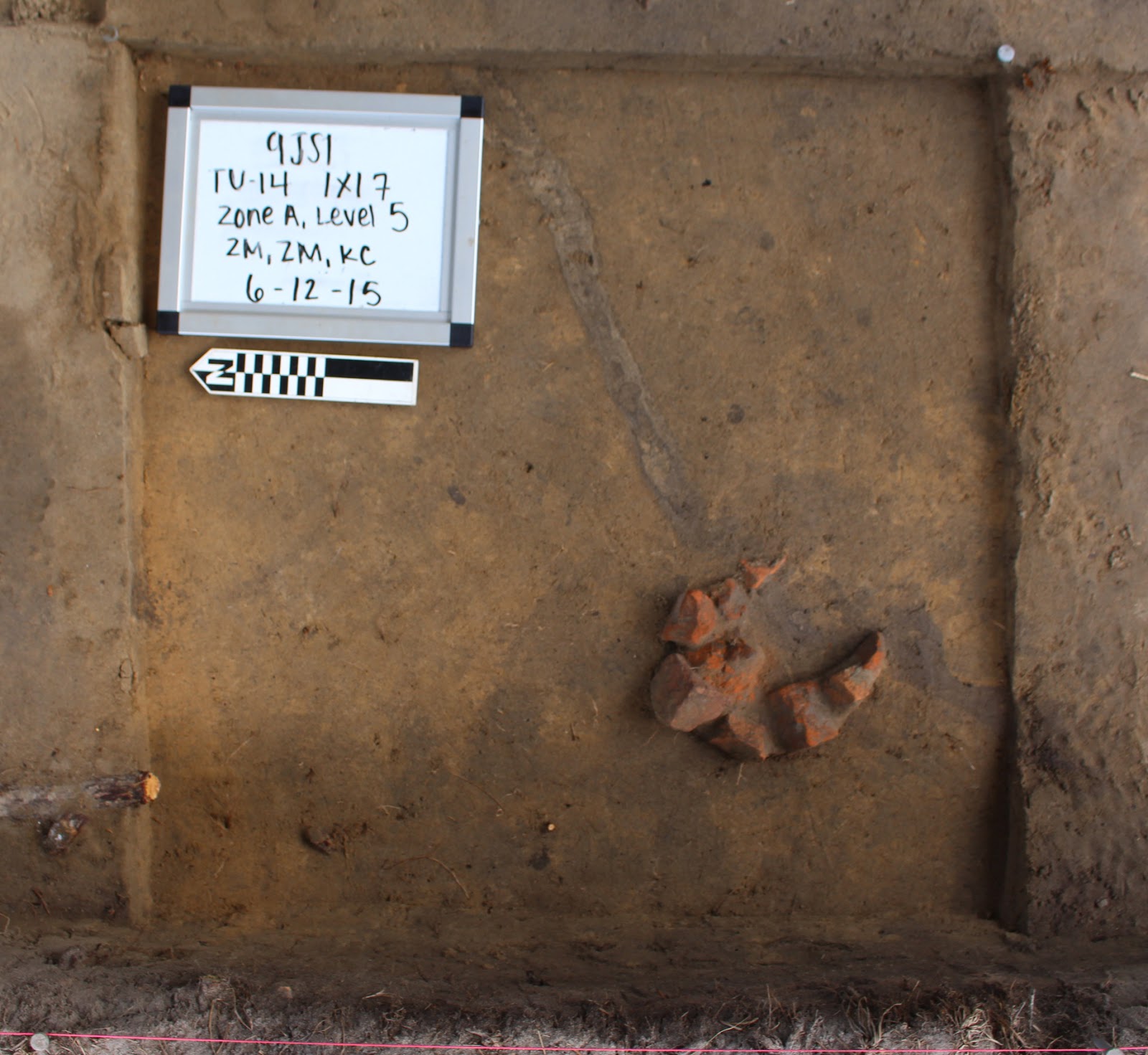
A. We had 12 students all together and did a lot during mid-May to mid-June during summer field school. We spent almost all of our time in the prisoner area. We continued the excavation of a brick oven and a hut. We wanted to get those finished and back-filled. I think that my conclusions add to what we interpreted last year. The brick oven (made for prisoners) was more of a substantial structure than what we thought. We found evidence of posts. The stratified layer was a lot deeper than what we thought it was. The Confederacy built these really substantial brick ovens as opposed to haphazard. The prisoners used this oven a lot more than we thought. They are focal points and used for food, warmth and social interaction. These may be hubs for a lot of the prisoners. About five or six were built.

Remains of prisoner residence (GSU)

Q. How about the hut?
A. There were not too many artifacts, thought we found a few machine-cut nails. It was a big, basin-shaped pit, roughly square. They stole the bricks to build a tiny chimney at the end. It probably housed two or three men. All of the bricks in the prisoner hut were complete. There were only brick fragments in the oven. It appears civilians after the war took the good bricks from there.

Q. Tell me some of the conclusions in your status report.
A. We’re finding out that the best-preserved part of the site is the prisoner encampment area. Everything within the stockade wall is very well preserved. We have yet to identify definite Confederation portions of the site. We don’t know if they have been destroyed or we are digging in the wrong place. Future work inside the stockade will be slow and will concentrate on feature deposits. Outside the stockade wall (in the Confederate area) will be a survey (as more is learned).

One of two brass harmonica reeds found at Lawton (GSU)

Q. What about the remains of an old residence in the Confederate area, where you found artifacts from different periods?
A. We believe that is Confederate. I think it was prewar frame house, probably tenant farmer. It was lived in again until 1870 or 1880, then burned. We do have an officer’s quarters there. That is the one good location we have that is Confederate occupation.

Q. What else?
A. In the prisoner area, the excavations are beginning to support that prisoner accounts are true. We have found a cow mandible. They were given cow heads. They are breaking these pieces of skull to hand out to prisoners to be more democratic. We are getting other pieces of bones, but they need analysis. It shows the Confederacy will impress livestock. Heads were carried by wagon into the prison. Very telling is the lack of things we see. There is no glass or ceramics in prison area. They are having to do with tin cups. The Confederacy is giving them nothing and they are getting bad cuts of meat if they get anything at all. A tin cup was used for water and to eat soup. They have nothing else. They reused items, railroad piece and metal scrap.

Q. Did you make any recommendations for future work on the project?
A.  For me, personally, the question is the difference in quality of life between prisoners and guards. This is one of the questions that drive the research design. Methodology I have suggested is that inside the stockade they need to dig slowly and methodically. This is feature excavation. Of course, my replacement may go somewhere else with this.

Darker soil shows evidence of stockade wall (GSU)

Q. Has Camp Lawton lived up to its billing from a few years ago as a virtual time capsule because of its remote location?
A. The site integrity is as big as they say it is. The prisoner area is one of the best preserved sites I have ever seen. We can reflect on what is going on during the Civil War in a lot of ways: The treatment of prisoners, race and more. I continue to think Camp Lawton is an incredibly important site.

Q. How have students benefited from the field work and research?
A. I think that Camp Lawton is an excellent training ground for students -- graduate and undergraduate. Right now we have graduated three master’s students with thesis research on Camp Lawton. We have two more about to finish up. There is a lot of historical research.

Q. Any special memories of the work on the site?
A. There are just a lot of moments. They often hinge on th discovery of really specific things in the field. I remember the moment we discovered a good example of stockade trench. It amazed everyone, including myself. This past summer, I had several students uncovering what was left of brick rubble and they were troweling, exposing material. Just in the floor, there was an old post hole with brick rubble shoved into it. It kind of took my breath away and it was a teaching moment for my students. We started finding evidence of how they built this structure. I am going to miss the site, doing research because it is one of the most incredible sites I have ever worked on. It will be tough to top that. I will miss the students and faculty.