Showing posts with label prison. Show all posts

Saturday, April 5, 2025

This Model 1840 sword wields a remarkable story. A Union sergeant bestowed it at war's end to a Confederate prisoner with whom he shared the name Lemon

Model 1840 sword, blade detail and leather frog (Picket photos), Capt. Lemon during the Civil War
Capt. James Lile Lemon might have walked with a limp to shield what he was carrying in his trousers. Or perhaps he somehow covered the gift as he left Fort Delaware for freedom after serving years in Union prisons.

Whatever the circumstances, the Confederate officer was determined to bring the item back to his home in Acworth, Ga. And that’s where it is kept today – 160 years later.

I visited the Lemon house recently during events marking two new Civil War markers out front, one describing Lemon’s service and the other the Federal occupation of the town in June 1864. Maj. Gen. William T. Sherman used the residence as his headquarters for a couple days.

I asked Mark Lemon, who was sitting in a rocker on his front porch, whether I could see any of the captain’s belongings. Lemon’s second great-grandfather was remarkable for not only his military service, but his penchant for saving nearly everything he owned during the Civil War.

Most of the artifacts are in the collection of the Atlanta History Center, which purchased them in 2020 from the widow of a Macon, Ga., collector.

But one that stayed in the family is an NCO sword given to James Lemon at Fort Delaware in June 1865 after he finally took an oath of allegiance to the United States. The Confederate had earned the respect of one of the prison staff, who also had the name Lemon -- Sgt. Lemon Kline of the 215th Pennsylvania Infantry. It’s easy to speculate whether the shared name had anything to do with their apparent friendship.

I don’t know whether the two men – who were both in their 30s during the Civil  – maintained a friendship after the war, but Mark Lemon said the story goes Kline told James Lemon, “Tell your family you once knew a good Yankee.”

Mark Lemon showed me the sword and a framed piece of paper written by James Lemon, who routinely made notes on his belongings. The note mentioned how he came to receive the sword.

(Civil War Picket photo)
One side of the blade (above) records it was made by Ames Manufacturing of Chicopee, Mass., a significant provider of weapons and tools for the Union. Some consider Ames the Cadillac of US military sword makers during the period.

The reverse has the stamp:

U.S.
ADK
1863

I am no sword expert, so I turned to the Authentic Campaigner Facebook group for help.

Built for combat, used mostly for presentation

I quickly learned the weapon is a Model 1840 sword for use largely by infantry and artillery NCOs. The initials ADK indicate the name of the manufacture inspector. The handle is made of brass.

When I examined the blade, I noticed it was quite light and not sharpened. Some commenters compared it to the spadroon, a light sword with a straight-edged blade.

One commenter said this model was mostly a symbol of rank and authority. The military used the sword, based on French and English models, for about 70 years.

So it is understandable Kline, as a sergeant, would have carried one. (At left, a Union NCO holds a Model 1840 sword, Library of Congress). Some of the weapons were issued to musician NCOs.

Another commenter presented a brief history of the weapon and a different take on its usefulness.

“Don't believe the hype where folks say that swords were unimportant to the war. This particular model sword may not have been frequently used in combat, mostly because sergeants would be using their bayonet in hand-to-hand combat before resorting to the sword.

"Regardless, this design of sword was intended for combat, with a design used for over a century, and not exclusively for presentation.”

The Model 1840 also could have been useful in “directing traffic” by keep troops and inmates in a straight line. 

Interestingly, the scabbard of Lemon's sword is made of leather. A few Authentic Campaigner commenters noted the "frog," a piece of leather which allows the wearer to carry a sword for a short time, likewise was in very good condition and at least as valuable as the sword.

Lemon items will get big play in next exhibit

Two years ago, the Atlanta History Center invited Lemon descendants to see the amazing collection, which is not currently on display. Mark Lemon showed the sword to AHC senior military historian and curator Gordon Jones.

Mark Lemon (left) brought the sword to the Atlanta History Center in 2023. (Picket photo)
The Lemon collection – which features  a captured drum, revolver, letters, canteen, photographs and much more -- will be showcased in its own case after a revamp of the center’s aged “Turning Point: The American Civil War” exhibit. (The sword will remain with the family).

“That story has a lot to say about Confederate soldiers' wartime experiences,” Jones recently told me.  

The historian said the new exhibit is set to open in June 2026. It will go deeper into “causes and results,” including slavery, politics and Reconstruction. There will still be plenty of weapons and military items on display in that space and the Goldstein gallery, Jones said.

The George Wray Jr. collection of rare Confederate weapons will be in the Goldstein space.

Confederate captain reluctantly took oath

Mark Lemon keeps this note by his ancestor near the Model 1840 sword (Picket photo)
James L. Lemon served with Company A, 18th Georgia Infantry, part of John Bell Hood’s Texas Brigade. He enlisted as a second lieutenant in 1861 for a three-year term. Lemon was described as having a “light complexion, dark hair, blue eyes, [and] 6 feet” in height.

The regiment fought in numerous Eastern battles – including Antietam, Fredericksburg, Second Manassas and Chancellorsville. The farmer and merchant from Acworth had a close call at Gettysburg, when a Yankee bullet struck his canteen, causing it to strike his head.

His combat days came to a close in November 1863, when Lemon was severely wounded by a Minie ball in the pharynx and taken prison after an assault on Fort Sanders in Knoxville, Tenn. .

By the time he arrived at Fort Pulaski, Ga., in October 1864, Lemon had already been in at three Federal prisons: One in Louisville, Ky; Camp Chase in Ohio and Fort Delaware, Delaware. He kept several diaries. The officer etched his name onto a wall at Pulaski.

Capt. Lemon etched his name and regiment into a wall at Fort Pulaski (Picket photo)
In March 1865, the Rebel officers, including Lemon, were returned to Fort Delaware, where they were held until the end of the war. Shortly after their return to Delaware, the captain’s diary describes harsh conditions at Fort Pulaski and alleged mistreatment by his captors. 

“We have recently returned to this place after a most brutal & cowardly outrage against humanity. I cannot now speak of the sufferings & deprivations & humiliations we were subjected to. Many among us are now dead from starvation, disease, shot or beaten to death and the rest of us are about used up from the shameful journey forced upon us by the Yanks. I know not of the reason for this but we are told it is for some reported offense against a few of their prisoners in Charleston.”

He held off taking the oath for two months after Appomattox but finally relented.

In his journal, Lemon wrote: “I have done the unspeakable but I am now paroled & today set out for home. My duty to my country is done, mine to my family remains.”

Lemon returned to Acworth and had 11 children with his wife Eliza. He was a retail merchant and then a bank executive. He was serving as president of the bank when he died on June 12, 1907, at age 71.

Mark Lemon has lived in the house for 30 years and with the help of friends, has been restoring the home’s exterior and side buildings, with plans to turn to the interior.

The house is painted in bright yellow (a suitable color?), but he says it was clad in white for at least a short time in the 19th century.

Illness sidelined Lemon Kline in two great battles

I have been unable to learn a great deal about Kline, beyond service and pension records. The blue-eyed farmer lived in York County before and following the Civil War.

Much of what I learned comes from a Findagrave page, which lists his birth as July 24, 1830.

Sgt. Lemon Kline's Pennsylvania veterans card via Fold3
Rosters indicate he first enlisted in the 30th Pennsylvania Infantry

“Admitted to a Washington hospital on September 9, 1862, for illness, he almost certainly missed the battle of Antietam. He returned to duty but was again hospitalized January 18 through July 1, 1863, thus missing the battle of Gettysburg,” says the page.

He was transferred to the state’s Veteran Reserve Corps and honorably discharged in June 1864.

Kline reenlisted in late March 1865 in Lancaster, joining the 215th Pennsylvania. Presumably at Fort Delaware, he was promoted to first sergeant on April 21. He was mustered out with his company on July 31.

He apparently got a disability pension in 1878. The 1880 census lists the veteran, his wife, Catharine, and three daughters and three sons. Kline died at age 69 in November 1899 and his widow received a pension. She died in 1904.

The York County History Center has not been able to locate a photograph of the soldier.

“However, it does seem we have some information on him and his family, including census abstracts, his marriage record, and cemetery record,” said library assistant Emma Streb.

(At right, Findagrave photo courtesy ajtarman710)

A view of the sword and scabbard on the porch of the Lemon house in Acworth, Ga. (Picket photo)

Wednesday, March 26, 2025

'The best of human nature': This Georgia woman cared for a Yankee POW at Andersonville while his friends tended to her brother at a Northern prison. How did this come to be? There is no single answer (and there's a Henry Wirz angle)

Living history at Andersonville (NPS) and Peter Kiene (Courtesy Mark Warren Collection)
Mary Rawson stepped into the witness stand at the Old Capitol Prison in Washington, D.C., near the completion of Capt. Henry Wirz’s trial on charges of murder and conspiracy.

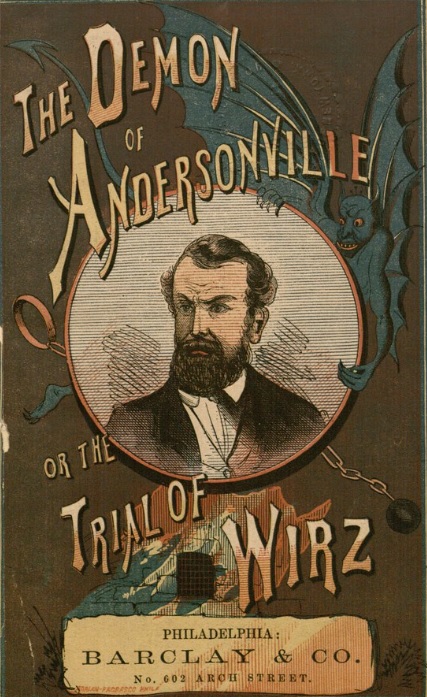
By this point, a parade of witnesses had pilloried the stockade commander at Andersonville prison. They said he personally killed men, was cruel and withheld food. A book published after the sensational case pulled no punches, labeling him “The Demon of Andersonville.”

But the Confederate officer had his advocates: They argued Wirz did the best he could with meager supplies, showed acts of mercy and had no control over certain aspects of the notorious operation in central Georgia.

Rawson’s testimony in early October 1865 was meant to buttress the defense claim their client was a human – not a monster.

The woman from Plains – hometown of Jimmy Carter -- told the military tribunal that beginning in early 1865 she would take the train 30 miles to the prison to bring food to  -- of all things -- a Union prisoner, Peter Kiene of the 16th Iowa Volunteer Regiment. With Mary’s help, Peter was able to get letters to his family

How did that come to be? Rawson encountered Wirz at the camp depot and asked whether she could care for a sick prisoner, according to her testimony. Another source provides a description of what could have led her there.

A New YorkTimes article cited Rawson’s testimony that “Capt. Wirz had never refused or denied her any privileges that she had asked of him; he was always agreeable and willing that she should bring anything to the prison; she never heard of Capt. Wirz treating any lady in an unkind way.”

Andersonville National Historic Site recently made a Facebook post about Rawson and Kiene timed to Women’s History Month in March and the 160th anniversary of the prison’s existence and Rawson’s visits.

There was a fascinating twist here: Mary’s brother, Pvt. Joseph Rawson of the 51st Georgia Infantry, was a Federal prisoner in Rock Island, Ill., after having been captured in Deep Bottom, Va. “Thoughts of Joseph suffering in an enemy prison led Mary to want to comfort a prisoner at nearby Andersonville,” says the social media post.

Park officials initially told the Picket they do not know why Mary Rawson chose to care for Kiene, who was just a teenager when he enlisted. He was reportedly captured in summer 1864 during fighting around Atlanta. 

After searching a bit more online and coming across a February 1882 edition of the Americus (Sumter County, Ga.) Reporter newspaper, I made an interesting discovery.

A brief entry indicates a Mr. and Mrs. Peter Kiene had traveled from Iowa, “that region of frost and snow,” solely to visit Mary Rawson, who lived in Magnolia Springs outside Americus.

"It seems that Mr. Kiene was a prisoner at Andersonville during the war, and that Mrs. Rawson had a brother who was imprisoned in Rock Island. This brother (Joseph), finding out from friends of Kiene's that Kiene was in Andersonville, wrote to his sister to provide for him particularly, as by so doing Kiene's friends would make his lot easier.

"Mrs. Rawson did so, and made Mr. Kiene as comfortable as possible, his friends reciprocating the favor by take care of her brother until the war was over and both released," it says. Kiene and his family lived in Dubuque, Iowa, about 50 miles from the prison camp.

There's yet another version from a 1964 article entitled "How a 15-Year-Old Dubuquer Survived Andersonville," in the Telegraph Herald newspaper.

It states the boy's father, Peter Kiene Jr., intervened to help Joseph Rawson after Mary Rawson learned Kiene was from Dubuque and then reached out. The father arranged for that assistance, says the article.

From Mary Rawson's testimony it is difficult to tell whether she had learned of Kiene's name beforehand.

Regardless of the circumstances, the episode is remarkable.

“For a prisoner of war, survival depends on emotional resilience as well as physical sustenance,” said the site’s Facebook post. “Mary Rawson’s kindness may have been the difference between hope and despair, helping both soldiers survive the hardships of imprisonment and return home to their families.”

Freed Union soldier returned to Georgia years later

Ranger Sherri Barnhard said Wirz allowed Mary Rawson – who came about every two weeks -- and Kiene to dine outside the prison walls. The commandant did not allow women inside the walls and was known at times to protect the vulnerable. Wirz testified he allowed captive drummer boys to be kept outside the stockade.

Joseph's compiled military service records indicate he was captured in December 1863, near Knoxville, Tenn., said Barnhard.

“The last record I have is the record showing ‘name appears as signature to an Oath of Allegiance to the United States, subscribed and sworn to at Rock Island barracks, ILL., June 20, 1865,” she said.

Photographer unknown, "[Peter Kiene seated at his desk]," Loras College Digital Collections, accessed March 18, 2025, https://digitalcollections.loras.edu/items/show/5235
By that time, both soldiers were beginning a new life after captivity.

“Kiene returned to his family in Dubuque and joined with his father in the iron business,” says an article about Iowa Civil War volunteers published in Military Images magazine. “Kiene went on to become successful in real estate and insurance, and active as a philanthropist and in the Grand Army of the Republic. He suffered a paralytic stroke in 1912 and succumbed to its effects at age 66. His wife, Caroline, and two children survived him.”

(See Iowa Civil War Images on Facebook here)

Sadly, the park has not yet learned anything much about the lives of Joseph and Mary Rawson after the war, but Barnhard said she is continuing research.

An 1870 U.S. Census entry lists a Mary Rawson, the mother, as keeping house. The younger Mary is described as being 40 years old, while Joseph, at age 35 or 36, was a farmer.

Graves of Joseph and Mary Johnson (Courtesy Brenda Darbyshire, Findagrave)
Joseph and Mary are buried near their parents at Lebanon Cemetery just outside Plains. Their headstones do not indicate when they were born and died. Barnhard said Mary is not believed to have married.

Interestingly, the cemetery is the resting place for James and Lillian Carter, Jimmy Carter’s parents.

Teri A. Surber, park guide at Andersonville, told the Picket why she believes the story of the Rawsons and Kienes resonates with people

“It shows the best of human nature shining against the darkness of one of the worst places in history, and that even though both families were on opposing sides, they could set that aside and help one another. Mary looked at Peter Kiene and saw her brother. She saw that they were not very different from one another after all. The story is full of hope. Hope that people will do what is right. Both families had to trust that a stranger, far away, was fulfilling their part of the bargain and taking care of the one they loved. There had to be trust, and in the end, the story has a happy ending. There's so much bad news today. Sometimes people need a happy ending.”

Commandant was a truly polarizing figure

Henry Wirz reclines (left) during his 1865 trial in Washington, D.C.
At some point between Wirz’s arrest and trial, his lawyers called upon Mary Rawson to speak on his behalf.

Rawson recalled seeing the captain occasionally during her visits to Kiene.

“I was there in the month of March 1865. I had on a brown dress. The captain always recognized me and asked me if I was going to see my prisoner. I would say ‘Yes,’ and I would carry another basket up and leave it. He never refused me.”

"I used to tie up a bushel basket and leave it, and my prisoner said that that would last him two weeks,” Rawson testified.

The park has told the story before and I asked Barnhard about this year’s timing with Women’s History Month. She said Mary Rawson’s story goes toward that, but there were larger results of the Civil War, including women largely filling the ranks of teachers and nurses. The park is holding a living history event this Saturday (March 29) and among the topics is the Woman’s Relief Corps, a charitable auxiliary to the Grand Army of the Republic.

But back to Wirz ...

In the end, the testimony of those defending him could not save him. The Swiss-born soldier was convicted of both charges and executed in the prison yard on Nov. 10, 1865. (At left, Old Capitol Prison, Library of Congress)

A National Park Service page calls him a complicated figure. “Wirz was unable to control the bureaucracy that plagued the Confederate military prison system, so he controlled the prisoners in the only way he could – through intimidation and punishment.”

Barnhard said Wirz demonstrated both kindness and cruelty. She wonders whether medication he took for a severe arm injury led to a “shift in moods.”

“The more I read about him, the more confused I become about him.”

Tuesday, January 16, 2024

Man up: At Andersonville and other Civil War prisons, captives resisted and coped in a number of ways. They asserted a new form of masculinity

Desperate to be free: Union prisoners tunneling (National Park Service)
Sgt. Maj. Robert H. Kellogg and his comrades in the 16th Connecticut Infantry, like generations of American soldiers before them, believed the only manly death in war should occur on the battlefield.

But they would find their experience to be different as the Civil War wore on. The green regiment, chopped up at Antietam in September 1862, was captured in only its second engagement 19 months later in Plymouth, N.C.

Gone were the ideas of battlefield victories and fame. Kellogg realized their world had been turned upside down when the regiment surrendered in April 1864.

“On the morning of (April) 21st we awoke to new experiences. Instead of the calls to which we had -been wont to listen, and the labor we had been accustomed to perform, we were but passive beings, subject to the will of a conqueror,” Kellogg wrote in “Life and Death in Rebel Prisons,” published in March 1865 near war’s end.

The soldier could not have predicted the extreme privation and horror he would witness and endure at Andersonville prison in Georgia. He provided colorful details in his book, considered one of the best personal accounts about life and death at Andersonville.

Various photographs of Robert H. Kellogg (Museum of Connecticut History)
What Kellogg and soldiers from both sides experienced at prisons contributed to a change in the perception of 19th-century masculinity, according to many scholars, including conflict archaeologist Ryan K. McNutt.

As McNutt pointed out in a paper and a lecture in November at Andersonville National Historic Site near Americus, the Victorian ideal of manliness was courage through sacrifice and action – a good death on the battlefield, should it come to that.

“The POW experience was the direct antithesis of this ideal: Capture was socially seen the same as surrender,” wrote McNutt (the men of the 16th Connecticut said it was not their decision to surrender). “And the wartime experience of POWs in the American Civil War was passive, inactive – waiting. For exchange, for parole.”

The talk by the assistant professor of anthropology at Georgia Southern was titled “But Passive Beings, Subject to the Will of a Conquerer,” pulling the line from Kellogg’s book.

(At left, Father Peter Whalen prays for prisoners, Thomas O'Dea sketch, NPS)

As it turned out, men confined with Kellogg were not all that passive, McNutt told the November audience in the park visitor center. They resisted in a variety of ways, trying to survive while buttressing their sense of manliness.

Tries were usually futile. But they dreamed of escape

McNutt spoke about resistance at both Andersonville (Camp Sumter) and Camp Lawton, another Confederate prison site in Georgia. McNutt directs the GSU archaeological project at the latter site

Andersonville is the emblem of POW suffering at Union and Confederate camps during the Civil War. Of 45,000 men held there, 13,000 Union service members succumbed to horrible conditions. Rather than a quick battlefield death by a bullet or artillery round, they faced death on an hourly or daily occurrence. It could come at any time.


Themes of heroism through endurance, martyrdom and stoicism arose, McNutt argues.

Soldiers engaged in tunneling, trickery and barter with guards. They endured beatings and incidents of cruel treatment – all while trying to stand tall amid the misery.

“Attempting is just as important as being successful,” McNutt said of defiant acts. More than 80 tunnels were found at Andersonville. Only 30-40 men successfully escaped the prison, which held about 45,000 soldiers over its 13 months.

But that did not stop them from trying.

A National Park Service article about escape attempts includes a paragraph that gets at what McNutt and others have studied. By being taken captive, prisoners had to find other ways to “prove oneself” and disprove any notions of cowardice.

“As a result, many prisoners faced the choice of either returning home after the war to be received as failures, or to attempt a dangerous escape. Those prisoners at Andersonville and elsewhere who never successfully escaped would often invent escapes or escape attempts in order to validate themselves in the eyes of their society,” the NPS says. (At right, Thomas O'Dea drawing of escape attempts at Camp Sumter)

'Can this be hell?

Kellogg was 20 years old when he passed through the gates of Andersonville into the chaos and suffering.

"As we entered the place, a spectacle met our eyes that almost froze our blood with horror…before us were forms that had once been active and erect -- stalwart men, now nothing but mere walking skeletons, covered with filth and vermin…Many of our men exclaimed with earnestness, 'Can this be hell?'" the sergeant wrote

The soldier survived Andersonville and was transferred after a few months to  prisons in South Carolina paroled in November 1864. He was a changed man.

Robert Kellogg (right) with Oscar Wiel (Museum of Connecticut History)
Kellogg tried to resume his career path as a druggist but found himself disconnected and isolated, according to an article in Zocalo Public Square. When a local deacon died, he wrote in his diary that he felt numb: “Death seems to have lost its solemnity in me since ‘Andersonville.’”

He later moved to Ohio and published his book. Kellogg worked for years to ensure “thousands of brave men” were not forgotten. He died in 1932. The Connecticut Historical Society has his diaries, letters to his parents and military service records, among other items.

The Museum of Connecticut History in Hartford contains numerous photographs of Kellogg and some information about this life. (Special projects curator Christine Pittsley was helpful while I researched this post.)

One of only a handful of photographs of Andersonville (National Park Service)
Mary Gorman, author of a book about the Andersonville Raiders and a member of the Descendants of Andersonville Prison Facebook page, says Kellogg’s is probably the best Andersonville memoir, drawing from his vivid diary.

“If you want to get the truest picture of Andersonville, stick mostly with diaries and the memoirs published within the first 5 years” after the war, Gorman wrote when I asked followers of the Facebook page about Kellogg.

McNutt concluded his paper outlining the impact of post-traumatic stress disorder (PTSD) suffered by Civil War prisoners.

“The restructuring of masculine identities, the resistance both physical and symbolic, the creation of crafts and games, such as chess pieces found under the brick oven at Lawton, all served to combat the depression and mental effects of long confinement, a final deadly symptom of structural violence of the internment system, through action and engagement,” he wrote.

“Acts of resistance, effective or ineffective, were acts of survival.”

Tuesday, April 4, 2023

Rolling the dice: Discovery of piece of gaming object at Georgia's Camp Lawton an example of the 'shadow economy' at POW sites

Views of the remains of the die, which may have had numerous sides (Camp Lawton Project)
Somewhere at an archaeological site in Georgia are the remains of a sutler’s cabin, where captured Federal soldiers could buy a whole range of goods, temporarily lifting them from misery that took the lives of 800 comrades.

The Camp Lawton sutler’s cabin and the grounds around it offered more than food and clothing. It was part of the prison’s shadow economy for six weeks in autumn 1864. Soldiers -- either with U.S. greenbacks they still held, or equipment and personal items – could obtain alcohol from guards, tobacco and play games of chance.

Ryan McNutt, who leads the Camp Lawton project at Georgia Southern University, and a couple dozen students have spent the spring looking for evidence of the cabin. Thus far, there have been no definitive finds. Maps produced in the 19th century gave different positions for the structure.

Patrick Sword and Audrey McGill at dig site (Picket photos)
On one bright note, part of a carved die was found a few weeks ago during digging, evidence of apparent gambling in the trade-and-sell part of the stockade.

Patrick Sword, a graduate student from the Atlanta area, is studying the shadow economy at Lawton. I met him and other students in late March during a brief visit to the site on the fenced grounds of an old federal fishery adjoining Magnolia Springs State Park.

The stockade was laid out in a grid fashion (left, click to enlarge) and much of the commercial activity took part on Market Street, Sword said. He is hoping to find more evidence of the shadow economy, but the team in recent weeks has found mostly modern stuff, including trash dumped by members of the Civilian Conservation Corps, who helped construct the state park in the late 1930s.

McNutt says the die is made of lead, probably fashioned from a small caliber round, likely a pistol or a .54-caliber ball. He says the artifact is probably one-half or one-fourth of the original die.

“Six-sided die are the most common, but there are also 10-sided, 32-sided, and 20-sided. If it's from a six-sided die, it is a half, split down the center to leave a quasi-pyramid shape,” McNutt wrote in an email after my visit.

In its six weeks' existence, the 42-acre Confederate stockade held about 10,000 men before it was closed when Union forces approached. Over the past dozen years, teams from Georgia Southern have found evidence of the stockade wall, Rebel officers’ quarters, brick ovens and sleeping areas for the POWs. Thus far, they have been unable to find the hospital or burial area.

Camp Lawton was one of several prisons in south Georgia that briefly held Federal prisoners sent from the larger Andersonville camp. They were moved back and forth because Confederate officials feared they would be freed by Sherman’s March to the Sea.

McNutt and his students in their spring dig have found a lot of postwar material, but also have come across cut nails, buckles, a bullet and files from the Civil War period. On the day of my visit they were working near a stream that divided the camp, and served as a drinking source and latrine a bit downstream.

“We get good historic Civil War stuff and then a modern fishing weight,” the associate professor tells me.

McNutt (right, on site) believes much of the area they were working on is where Union prisoners who served as an internal police force operated.

Not many prisoner items have been found here, unlike in the hill above. “No one is allowed to camp right near the stream.”

The professor is interested in the relationship between guards and prisoners. They were known to have traded at here and other sites, and morale among the former was low at Camp Lawton, not surprising given the Confederacy’s decline. Guards sometimes foraged away from the property.

Prisoner of war camps are “excellent places to hide contraband, personal items you are not supposed to have," McNutt told me several years ago when he became project director. 

The National Park Service, which maintains the much larger site at Andersonville, has an online page detailing life and diversions for Federal prisoners held there. It, too, had a sutler’s cabin, but it had other shops selling items to the captives as well.

Food, of course, was always on their minds.

Sutler's cabin in rear at Andersonville in 1864 (Library of Congress)
Here is an NPS description of Andersonville:

“Many of the Andersonville prisoners who arrived in the stockade in April and May were well supplied with money. The Federal armies were reclothed and paid off in the spring of 1864 for the spring campaigns. Many of the new recruits and reenlisted veterans had bounty money with them when captured. Greenbacks could be pressed into the sole of a shoe, or placed inside a brass button. Money was concealed about the person in various ways. Some swallowed their rings and others put their money into bowls of large Dutch pipes with a little tobacco sprinkled on top. When searched, they would pretend to be busy lighting their pipes and thus escape suspicion.

“Gambling was carried on quite extensively; faro, dice, and $10.00 stakes were commonly played for. Trade was carried on with the guards on the outside of the wall by talking through the cracks and throwing articles over the fence. Another trade was carried on as well, as noted by prisoner John Northrup, Co. D, 7th Connecticut Infantry: "There is one commodity never had in any market. It is ahead of any Dutch brewery extract; it is meal beer made by letting corn meal sour in water. The vendor cries, 'here is your nice meal beer, right sour, well-seasoned with sassafras.'"

POWS trade new rations for something more palatable (NPS)
McNutt believes there may be beer and rum bottle remains at the Camp Lawton site.

Trade, bartering and gambling were common at virtually all Civil War prisoners, both North and South, though there appeared to be some restrictions later in the war.

At Point Lookout in Maryland, where Confederates were held, a prisoner made compelling illustrations of camp scenes. All depicted guards were African-American soldiers.

“The drawings highlight the concerns and experiences of prisoners of war; most scenes show prisoners playing cards, buying food, or engaging in barter with food vendors,” the historical society says in a description of its collection.

Exchanging buttons for pepper at Andersonville (Library of Congress)
Confederate officer Henry Clay Dickinson wrote about gambling he witnesses while a prisoner of war at Fort Delaware, Delaware, in 1864, according to a Civil War Monitor article on gambling.

“The gambling saloons were a curious feature in prison, and were not only numerous but well patronized. Captain Coffee, of Mississippi, was the prince of faro dealers, being always gentlemanly in his manners and always attracting the greatest crowd. He never played cards until he was captured, except for amusement, and I am told that a Yankee guard was his first victim. The bettor wagered either in Confederate or Yankee money. He always had a large and anxious looking crowd around his booth. Some quartermasters having been captured, the amount of Confederate money in prison was very large, and changed hands frequently.

“I heard that Coffee once sent to Dixie from Point Lookout ten thousand dollars. How much United States money he (Coffee) made I cannot say, though at one time, when the Yanks were about searching quarters and persons, he hid in the grass one hundred and eleven dollars in gold, a gold watch, and several hundred dollars in notes, which, of course, some Yank, who knew he was flush, had seen him hide and took care to not let him find it again.”

Rusted metal likely from the 20th century (Picket photo)

Tuesday, February 21, 2023

At Camp Lawton stockade site in Georgia, archaeology students searching for sutler's cabin find POW buckles, nails and more

Nails may have had multiple uses, a Federal trouser buckle (Camp Lawton Archaeological Project)
Archaeology students trying to learn more about a Confederate prison that operated for less than two months in southern Georgia are exploring where Federal soldiers were held captive, and they’ve thus far turned up buckles, nails, a Rebel musket ball and intriguing turtle remains.

Georgia Southern University Associate Professor Ryan McNutt said this season’s dig on the site of Camp Lawton began in January and will go through April or early May. This is the first time the project has been on the Federal side of the stockade since 2014.

Hundreds of POWs died at Lawton during its brief existence in fall 1864. Prisoners were shuttled among several Southern prisons, most notably Andersonville as Union forces advanced on Savannah. The camp was built near Millen; a portion lies within Magnolia Springs State Park and the rest is on the grounds of a former federal fish hatchery.

Since the announcement in 2010 of the discovery of the Lawton site, GSU has studied several areas to get a better understanding of prisoner and guard life. McNutt responded this month to a series of questions from the Civil War Picket. His responses have been edited.

Q. One (Facebook) post said a prime focus is the sutler's cabin. Was it within the prison area (where Federal soldiers roamed)? What does the record say about the cabin, its purpose and operation? Why would you like to find evidence of the cabin?

Sutler cabin (top) at Camp Sumter/Andersonville (Library of Congress)
A. The sutler cabin seems to have been across the stream from the gate, and directly in line with it on the main west-east running road (in modern cardinal directions, not Robert Knox Sneden's). The record is frustratingly quite vague.

We know there was one, as there was at Andersonville (photo above, log structure with slanted roof), as POWs discuss it.

Sneden (see Union POW’s drawing below of Camp Lawton) seems to place it in the same general location, though in at least several instances he places it on opposite sides of the road leading to the bridge. 

Detail of Sneden's drawing shows sutler cabin, police area in center (Library of Congress)
The sutler at Andersonville seems to have been a James Selman Jr., followed by a James Duncan, who may have been a Confederate guard and was possibly replaced again by a James Selman. One of these individuals likely ran the sutler's (cabin) at Camp Lawton. They were authorized by the prison commandants to sell to the prisoners authorized items. From their stories, prisoners with money that they were able to hang on to, or make, could buy eggs, flour, bacon, cornbread, beans, baking soda, and blackberries; soap, shaving equipment, clothing, tobacco, tobacco pipes, cigars, reading material, and so on -- for eyewatering prices that were much higher than regular marker prices. Examples: Fifty cents an egg, six dollars for a pound of bacon, and 25 cents a spoon for baking soda.

We're looking for evidence of the cabin as part of a graduate student's thesis work, which is focused on shadow and underground economies inside prison camps. As one of the only sources of goods coming into the prison, it's like the sutler's cabin was the center point of much of the legal and illegal trade between prisoners, guards and prisoners and the sutler. 

We're hoping to find evidence of this in the material culture around the cabin, to get an idea of how heavily trafficked and used it may have been. Sneden certainly seems to imply the area around the cabin was always crowded. 

Students sift through soil (Camp Lawton Archaeological Project)
Q. What else are the students concentrating on this spring?

A. Essentially, just the area around the bank on the west side of the stream. Interestingly, while Sneden shows it lightly occupied, he does show an area of shebangs labeled 'Police' with no explanation, as well as potentially a chapel, though this might be reading too much into Sneden's maps and images.

We're also getting a better idea of how densely the camp was occupied, where we have evidence of POW activity, and in a very real way, the extent of past impacts on the site during its transition from timberland to state and then federal fish hatchery, and CCC work.

We used Lidar data to pinpoint potential anomalies that might be the sutler's cabin, and the students are learning how to locate those on the ground, test them and get an understanding that even with the most accurate technology you can get, archaeologists still have to dig to confirm our guess of flat areas and odd shapes that show up in Lidar.

Q. Can you briefly summarize what has been learned thus far in this field school? And what more you want to work on for the remainder of this session.

Q. So far we've got clear indications of a lightly occupied area of the stockade, and our current grid is likely just off of where the sutler’s cabin should be, but we have another area just west that might have more promise. We're working from our known to our unknown, from areas that were lightly tested in the past to areas that the project has never looked at before. We're almost finished with our current grid, which has clearly showed some POW occupation. Turtle bones and shells (left) possibly came from a hearth, and we have a few other spots that might be POW shelters. We'll explore these with test units, and we'll establish another area over our area of interest that might be closer to the sutler's cabin and the main road.

But we also clearly have empty spots, with no artifacts at all that seem to indicate the presence of roads and paths shown on the plan created by the Confederates as the camp was being built, and Sneden's water colors. 

Q. Social media photos by the project show numerous buckles -- trousers, knapsack or elsewhere. Are these believed to be from Union POWs? What about the iron nails --- suspected use for them?

A. So far, we have one whole and one partial trouser buckle, as well as three that are likely haversack or knapsack buckles. We also have some different files -- metal and wood working, that seem to have been fairly degraded when they were dropped. As well as one piece of ceramic and some fragments of glass bottles. One of which was likely a pickle or sauce bottle. These were all probably dropped by POWs. The trouser buckles are standard issue on several Federal trouser types, and the buckles match Federal issued equipment. While this isn't to say they are absolutely from POWs, the Confederates present at the camp do not seem to ever have been issued anything close to uniform items.

Some of the iron nails (right) are interesting, in that they fall into two groups. A couple (of them) are big enough to be structural and used to pin the corners of wooden structures together. Most, however, are of the size to come from express boxes (like those used on US Sanitary Commission aid boxes), and may represent the distribution of this material to the POWs, who are then repurposing the boxes.

The nails may have just been dropped -- most of them seem to have been pulled and bent, and aren't modified in any clear way. But we haven't done a full analysis yet.

We've also found a host of unknown items, and some personal effects such as what is possibly part of a match safe, and maybe even a cigar case. 

 [An] unexpected moment was one of our artifacts that is also the most puzzling. An iron strap with copper rivets, and a hinge on one side, and a threaded rod on the other, it still has preserved leather around several of the rivets. And it looks as though whatever it is, it may be period.

(The GSU team also found what appears to be a spent Confederate bullet. The Picket will have a separate article about this soon.)

Cast copper alloy buckle with iron tongue (Camp Lawton Project)

Q. Anything else readers might want to know?

A. I'd be interested in being contacted by anyone who might have an ancestor inside the stockade who left any memories, or anyone with photos of Magnolia Springs State Park and the stream going back to the CCC activity. Individuals are also always welcome to email me (rmcnutt@georgiasouthern.edu) with any questions, and I'll get back as soon as I can. They're also welcome to stop by the site, even if we're not running a public day. (The GSU team usually is on site Mondays, Wednesdays and Fridays during this field school.)

COMING SOON: Recovered Confederate bullets at Camp Lawton raise questions about how often and why guards fired upon prisoners there, at Andersonville and other sites. 

Previous coverage: