Two American Civil War veterans buried in Derby, England, are set to be given official US markers. Samuel Lander Hough, of the 2nd New Jersey Cavalry, and Henry Nathaniel McGuiness, of the 65th New York Infantry, are buried in Nottingham Road Cemetery. Both men moved back to England after the war and became friends. They never received appropriate headstones when they died but in October their graves will be marked like those at Arlington National Cemetery. – Read article
Showing posts with label soldiers. Show all posts
Showing posts with label soldiers. Show all posts
Monday, August 25, 2025


Wednesday, August 20, 2025
Riding the choppy waves: Opening of Sultana Disaster Museum in Arkansas delayed again as another $1.5 million must be raised to offset higher costs
 |
| A Harper's Weekly depiction of the April 1865 disaster in the Mississippi River (Library of Congress) |
“The escalation in cost of exhibit fabrication is the major
issue. There have also been change orders that were required but were
unanticipated due to working on a building as old as the gym was,” said John
Fogleman, president of the Sultana Historical Preservation Society.
Crews are
building a more robust Sultana Disaster Museum than the current small location
a few blocks away. It will be housed in the gymnasium of an old high school,
with a couple additions.
Officials
originally hoped the new site would open in April 2025, in conjunction with the
160th anniversary of the Civil War maritime tragedy. That was not
feasible and the timeline shifted to April 2026. Now the board of society has
decided to push back the opening several months, into the fall, though no new
date has been set.
Acclaimed
Sultana historian and author Jerry Potter, a member of the board, said
construction cost overruns also were cited in a July meeting. “We are seeking additional funding,” said
Potter, adding he is “very confident” in the project’s outlook.
“We need to raise about $1 (million) to1.5 million. We will use every tool available to us to try and achieve our goal, including fundraising events, grants and direct donation requests,” Fogleman wrote the Picket on Aug. 20.
 |
| The museum is currently housed in small building a couple blocks away |
About 1,200 passengers and crew
perished. Hundreds of Federal soldiers, many recently freed from
Confederate prisons, including Andersonville and Cahaba, were on their way
home.
In mid-2024, the Sultana Historical Preservation Society brought on Jeff Kollath, former longtime executive director of the Stax Museum of American Soul Music in
nearb y Memphis, Tenn., as executive director.
Kollath sent an email recently to the founder of the Sultana
Association of Descendants and Friends, explaining the new outlook.
“We have had
some additional delays in getting the building completed, yes, but also we've
had a funding opportunity come along that we will not know about until later
this year,” wrote Kollath, according to a post on the group’s Facebook page. “If
received, it would provide a significant influx of resources into the project
and allow us to build the museum we all want with the bells, whistles and
whatnot. While we are dismayed that we will not open on schedule, it gives us
time to acquire the funding we need.”
 |
| The attraction will be housed in the town's old high school gym (Sultana Disaster Museum) |
Norman Shaw
of the descendants group told the Picket he predicted between 200 and 250
people would have come to Marion in April 2026 for their annual meeting.
“We were
making plans for a special two-day 2026 Sultana reunion to be held the same
weekend in Marion as the museum's opening in April 2026, but not to conflict
with any plans being made by the museum's staff. The 2026 Sultana reunion
has now been postponed to coincide with the weekend of the opening of the new
museum in the fall of 2026, whenever that date is decided,” Shaw wrote.
He said he
believes most members of the group are disappointed by the additional delay.
But they likely believe they “can
certainly wait another six months.”
Tuesday, March 4, 2025
'Lady Victory' may have lost the battle with the wind, but the toppled statue won the war. Now she's back where she belongs in Mercer, Pa. -- standing tall
 |
| Two fallen figures, bent flagpole, broken musket, return of Lady Victory last week (Courtesy of Mercer County) |
All was well until March 2023, when calamity struck.
Sixty mph-winds rushing through Western Pennsylvania toppled the Civil
War statue dedicated in 1897, causing damage that reads like something from an
NFL injured reserve list:
-- Soldier’s
left knee blown out and he is bent backward; his right foot is separated from
base plate;
-- Weapon broke off at soldier’s wrist, and
butt stock of weapon is broken off base plate.

-- Flag bent
toward the front of the statue; eagle at the top of flagpole twisted to nearly a 90-degree
angle;
-- Base bent
and mangled and two side plates are broken loose;
Nearly two years after the top of the Civil War monument on the Mercer County courthouse square was knocked to the sidewalk, a crane late last week lifted the repaired statue back in place. (photo below, courtesy Mercer County)
The formal name of the monument, “Victory Crowning the Returned Soldier,”
seemed especially appropriate for such an occasion.
“I know it’s
kind of an iconic thing, that people were very upset when it was gone. We just
had that pillar there for the last couple years,” Grace Reiter, executive
director of the Mercer Area Chamber of Commerce, told TV station WKBN.
The return of
Lady Victory is being welcomed in a county with significant history related to the Civil War.

“Mercer
became a significant stopping point for the slaves,” said the Grove City Area Historical Society. “The Pew family farm was a ‘station’ on the railway. It is
believed Joseph Newton Pew and his siblings were personally involved in moving
the escaped slaves.”
Numerous
regiments drew from the area. That includes the 10th Reserves, 57th, 100th,
140th and the 145th Pennsylvania
infantry.
“These regiments fought in the Eastern Theater, with the
exception of the 100th that fought in both Eastern and Western
Theaters with the 9th Corps,” said Chris Conti, senior planner with
the Mercer County Regional Planning Commission.
Among the town’s Civil War heroes was Medal of Honor recipient Lewis Brest, (below) who captured a Confederate flag near war’s end at Sailor’s Creek, Va.
Mercer-born soldier
Martin J. Hawkins entered service in Ohio and received the medal for exhibiting
great courage during the Andrews Raid in Georgia in 1862. He was among two
dozen men who commandeered a Southern train.

Brian Gruber,
facility director for the county, told the Picket on Monday statues of two
soldiers representing the cavalry and artillery were not damaged by the windstorm.
They stand in the middle of the monument.
The memorial is called “Victory Crowning the Returned Soldier” but for short it is called “Lady Victory.” All three statues on the monument were built by W. H. Mullins of Salem, Ohio, said Gruber.
They were fashioned from stamped copper and bronze.
McKay Lodge Art Conservation Laboratory of Oberlin, Ohio, performed the repairs and Alex Restoration and Masonry Repairs out of New Castle, Pa., placed the repaired
status atop the base.
 |
| Early photos of the courthouse monument in the W.H. Mullins catalog |
An August 2024 storm damaged a clock on the west side of the courthouse. "We had a severe storm roll through and the high winds snapped the clock in half, imploding it into the inside of the building," said Gruber. A replacement will be installed March 12.
About 110,000
people live in Mercer County, which has the active historical society.
“As far as our economy, similar to all counties in Western
Pennsylvania, we have gone from rural/agricultural to industrial to ‘Rust Belt’
to attempting to diversify and redevelop,” said Conti. One of the largest
outlet malls in the nation is located on Interstate 79 in southern Mercer
County.

Reiter, with
the Chamber of Commerce, said Mercer – which has about 2,000 residents – is
loaded with small-town charm.
“We cherish the moments that give us that classic ‘Hallmark movie’ feeling, and lately, there's been a renewed energy -- a spark of rejuvenation and a strong desire to create meaningful community events and lasting memories,” she wrote to the Picket in an email.
“Our town has a unique character due to its proximity to the courthouse,
which brings a strong presence of nonprofits and government-related businesses.
However, there's also been an exciting wave of growth, with new retail shops
opening on the square and businesses growing.”
Thursday, January 9, 2025
'Painting the Past': At Monocacy National Battlefield on Saturday, bring your inner artist and paint toy soldiers in any scheme you desire. (You have to sign up first)

The forecast Saturday for Monocacy National Battlefield in Maryland is chilly with a certainty of indoor fun for those who come to paint toy soldiers.
“Painting the Past” is scheduled for 1 p.m. to 4 p.m. at the park near Frederick, with a repeat at the same time on Feb. 8. Participants are asked to be 10 or above and register ahead of time, as rangers limit the sessions to 18 at a time. (See bottom of this post for details)
All paints, brushes and other supplies are provided and participants can take their creations home.

The park provides infantry soldiers, as it was the largest branch in the service.
There
was a wide variety of color used for uniforms, including flamboyant pantaloons
and short jackets worn by Zouaves.
“As for the
program, we have had everything from standard blue and gray, bright red and
camo green,” said Borders.
Guests have
painted soldiers with U.S. Colored Troops and even a memorial soldier with both
gray and blue elements to their uniform, representing the modern 29th Division,
the "Blue & Gray Division."

Borders will display replica uniforms (right) for attendees to see and feel and discuss aspects of camp life.
Participants also will learn about soldier painting as a hobby for both display and gaming.
“We use the larger 54mm plastic models now. These are the sort of plastic soldiers you can find pretty much anywhere, including in our shop here at Monocacy National Battlefield,” said the ranger.
“This event does tend to attract a few more young people, but we have had many adults enjoy this program as well,” said Borders.
At Monocacy on July 9, 1864, outnumbered Federals delayed Confederates bent on taking Washington, D.C. By the time Rebel troops reached the capital’s outskirts, Union reinforcements had arrived.
 |
| All photos Monocacy National Battlefield |
Thursday, June 6, 2024
William Johnson was born enslaved, died a Civil War veteran. A Jacksonville consortium will revitalize a campus cemetery and restore his headstone amid larger effort to honor area USCT soldiers
 |
| New headstone, exterior of cemetery and old marker before it was stolen (Jacksonville University)' Sketch of Black soldiers in Florida (State Library and Archives of Florida) |
Regardless of
the setting, a nonprofit in Jacksonville, Fla., is attempting to track down the
graves of African-American soldiers – many of them formerly enslaved -- who
served in a United States Colored Troops regiment during the Civil War.
The idea is
to place government-approved headstones marking their service to country and,
when possible, to rehabilitate abandoned USCT gravesites, “bringing these
soldiers and their descendants the redemption they have so deserved.”
That initiative got some attention recently after Jacksonville University and the nonprofit, Local Initiatives Support Coalition (LISC) Jacksonville, announced plans to improve a fenced cemetery on campus that holds the remains of Cpl. William Johnson, Company F, 33rd USCT. A new VA-approved headstone, expected to be erected by Veterans Day, will replace one stolen after a university staffer rediscovered the neglected cemetery in the late 1980s.

“After the
Civil War, Black veterans and their families fought a completely different
battle; however, this one was a true logomachy, a war of words,” says the
introduction to a UNF page about the pensioners. “From pleading with Army
officials that they were who they said they were to widows who wouldn’t quit,
these pension records tell the stories of resilience in the face of
institutionalized discrimination and racism.”
Jacksonville University emeritus professor of history Craig Buettinger notified LISC about the unmarked Johnson grave in 2022 when the organization launched its Operation Final Hours initiative. The aim is to help Duval County families receive and install headstones from the Department of Veteran Affairs for an unmarked burial site. About 25 families have been helped thus far, LISC says.

Smith (left) said in the coming weeks, LISC will try to track
down the locations of other members of Johnson’s
Company F of the 33rd USCT.
“I won't have a total number until after we
complete our preliminary review in mid-June,” Smith said.
James Beasley, director of the UNF institute, told the Picket he is honored to help preserve the memory of the USCT pensioners and help students “engage in research that impacts the community. Students were able to take the skills that we teach in our classes and have it affect social change.”
From enslavement to serving the United States
Buettinger
said Cpl. Johnson's “life
is also mostly hidden from us, especially before his enlistment.”
The soldier
was likely born enslaved in Duval County and was believed to be a field hand. He traveled
to the Union lines at Fernandina, enlisting at Fort Clinch with one of the
first Black regiments to be raised after the 1863 Emancipation Proclamation.
(Confederate and Union forces battled over Jacksonville throughout the war.)
 |
| The 1st South Carolina before it became the 33rd USCT (Library of Congress) |
The 33rd
USCT was later formed from the 1st South Carolina, according to the
National Park Service. It served in South Carolina and took part in several
expeditions. The regiment was in occupied Charleston at war’s end and was
stationed there several months.
Pension records (below) show Johnson was shot in the hand and chest by a bushwhacker in October 1865, leaving him partially disabled. He was discharged the following year.
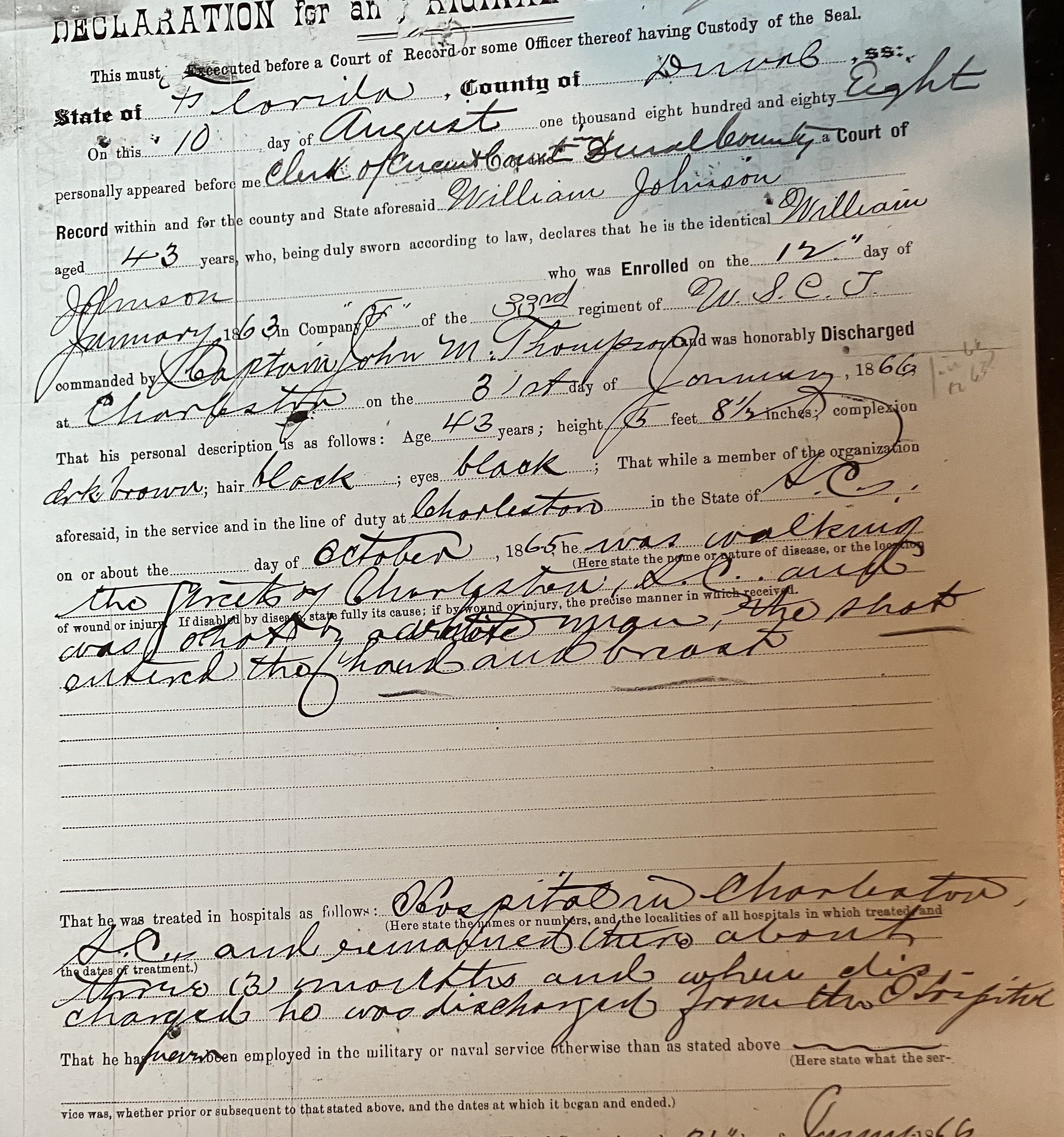 |
| William Johnson's pension request details wounding (click to enlarge) |
“Because of
his wounds, he could only do light gardening and he said he could only earn
half of what an able-bodied worker earned,” said the professor.
Johnson has
no living survivors. The exact location of his grave in the cemetery is not
known.
Now is the time to replace a stone headstone
Established
in 1934, Jacksonville University has five colleges, 11 schools and four
institutes. Its 235-acre riverfront campus is “minutes
from downtown and from beautiful area beaches.”
 |
| Dr. Craig Buettinger provides details about cemetery (Jacksonville University) |
By 1962,
the cemetery had fallen into neglect. There are no records, so officials don’t
know how many graves are on the site and few, if any, remain marked.
“When it was
rediscovered by JU staff member Jim Golden in 1989, only Johnson’s marble
veteran’s headstone remained. Golden,
himself a veteran, cleared up the grounds and held a ceremony for Johnson. Regrettably, that military headstone was
later stolen,” Buettinger wrote in a summary about Johnson and the cemetery.
Buettinger and Ray Oldakowski, professor of geography, led the university effort to replace the headstone.
 |
| Artifacts recovered from the cemetery parcel (Jacksonville University) |
Smith, with
LISC Jacksonville, said it is too early to place cost estimates on the cemetery revitalization and the organization is working on funding sources.
The Haskell Company, which does design, engineering and construction work, is providing pro bono help to LISC and Jacksonville University through design and scoping documents. A company spokesman told the Picket it’s possible Haskell will eventually become involved in contracted work.

JU President
Tim Cost says the school is committed to honoring veterans. “It’s not only important to us, but especially to the
Arlington community, to honor those who occupied this beautiful piece of land
before us.”
Beasley, of UNF, said, “It’s been extremely inspiring to see how looking for information and conducting research has led to the physical manifestation of the headstone being created. No matter how small what you’re doing in the classroom is, it might have a large effect in the community,” Beasley added.
Buettinger
believes the community and university have an opportunity to honor those buried on
the campus.
“We must make
sure that this cemetery is not again forgotten,” he said.
Thursday, March 21, 2024
Book about underage Civil War soldiers -- and how they were unsuited and unprepared -- wins prestigious Lincoln prize

Frances
M. Clarke and Rebecca Jo Plant will be honored April 4 at the Harvard Club in
New York City for “Of Age: Boy Soldiers and Military Power in the Civil War Era” (Oxford University Press).
The Gilder
Lehrman Lincoln Prize is awarded annually for the finest scholarly work in
English on Abraham Lincoln, the American Civil War soldier or the Civil War era.
The award includes a $50,000 prize and bronze replicas of Augustus
Saint-Gaudens’s life-sized bust, “Lincoln the Man.”
Clarke and Plant “determined that at least 10 percent of Union troops were under the
legal age of 21 (later 18 with an act of Congress) -- far higher than the 1.6
percent estimated by previous historians,” wrote Dave Kindy in an article last
year at History.net about the topic. Confederate troops had a similar proportion.
The Gilder
Lehrman Institute of American History and Gettysburg College recently announced
the award.
James G. Basker,
president of the institute, said the book "is
not only breakthrough history, it is a compelling and moving read, full of the
stories of children, some as young as 11 or 12, serving in the Civil War, and
the struggles of parents to reclaim or liberate their underage sons from armies
into which they had enlisted.
The authors also found African American youths discovered
that both Union and Confederate officers ignored their evident age when using
them as conscripts or military laborers.
Kindy wrote the work is “filled with accounts of teens on both
sides who heroically answered the call of duty and the tragedy of so many who
met their fate on the battlefield or succumbed to the rigors of a military life
that was wholly unsuited to young minds and bodies.”
Clarke is an associate professor of history at the University of Sydney, Australia. Plant is a professor of history and an Academic Senate Distinguished Teacher at the University of California, San Diego.
Tuesday, January 16, 2024
Man up: At Andersonville and other Civil War prisons, captives resisted and coped in a number of ways. They asserted a new form of masculinity
 |
| Desperate to be free: Union prisoners tunneling (National Park Service) |
But they
would find their experience to be different as the Civil War wore on. The green regiment, chopped up at Antietam in September 1862, was captured in only its
second engagement 19 months later in Plymouth, N.C.
Gone were the
ideas of battlefield victories and fame. Kellogg realized their world had been
turned upside down when the regiment surrendered in April 1864.
“On the morning of (April)
21st we awoke to new experiences. Instead of the calls to which we had -been
wont to listen, and the labor we had been accustomed to perform, we were but
passive beings, subject to the will of a conqueror,” Kellogg wrote in “Life and
Death in Rebel Prisons,” published in March 1865 near war’s end.
The soldier could not have predicted the extreme privation and horror he would witness
and endure at Andersonville prison in Georgia. He provided colorful details in
his book, considered one of the best personal accounts about life and death at Andersonville.
 |
| Various photographs of Robert H. Kellogg (Museum of Connecticut History) |
As McNutt
pointed out in a paper and a lecture in November at Andersonville National Historic Site near Americus, the Victorian ideal of manliness was courage
through sacrifice and action – a good death on the battlefield, should it come
to that.

The talk by the assistant professor of anthropology at Georgia Southern was titled “But Passive Beings, Subject to the Will of a Conquerer,” pulling the line from Kellogg’s book.
(At left, Father Peter Whalen prays for prisoners, Thomas O'Dea sketch, NPS)
As it turned
out, men confined with Kellogg were not all that passive, McNutt told the
November audience in the park visitor center. They resisted in a variety of
ways, trying to survive while buttressing their sense of manliness.
Tries were usually futile. But they dreamed of escape
McNutt spoke
about resistance at both Andersonville (Camp Sumter) and Camp Lawton, another
Confederate prison site in Georgia. McNutt directs the GSU archaeological project at the latter site
Andersonville is the emblem of POW suffering at Union and Confederate
camps during the Civil War. Of 45,000 men held there, 13,000 Union service
members succumbed to horrible conditions. Rather than a quick battlefield death
by a bullet or artillery round, they faced death on an hourly or daily
occurrence. It could come at any time.
Themes of heroism through endurance, martyrdom and stoicism arose, McNutt argues.
Soldiers engaged in tunneling, trickery and barter with guards. They endured beatings and incidents of cruel treatment – all while trying to stand tall amid the misery.
“Attempting
is just as important as being successful,” McNutt said of defiant acts. More
than 80 tunnels were found at Andersonville. Only 30-40 men successfully
escaped the prison, which held about 45,000 soldiers over its 13 months.
But that did not stop them from trying.

'Can this be hell?
Kellogg was 20 years old when he passed through the gates of
Andersonville into the chaos and suffering.
"As we entered
the place, a spectacle met our eyes that almost froze our blood with
horror…before us were forms that had once been active and erect -- stalwart
men, now nothing but mere walking skeletons, covered with filth and vermin…Many
of our men exclaimed with earnestness, 'Can this be hell?'" the sergeant
wrote
The soldier survived Andersonville and was transferred after a few months to prisons in South Carolina paroled in November 1864. He was a
changed man.
 |
| Robert Kellogg (right) with Oscar Wiel (Museum of Connecticut History) |
He
later moved to Ohio and published his book. Kellogg worked for years to ensure
“thousands of brave men” were not forgotten. He died in 1932. The Connecticut Historical Society has his diaries, letters to his parents and military service records, among other items.
The Museum of Connecticut History in Hartford contains numerous photographs of Kellogg and some information about this life. (Special projects curator Christine Pittsley was helpful while I researched this post.)
Mary Gorman, author of a book about the Andersonville Raiders and a member of the Descendants of Andersonville Prison Facebook page, says Kellogg’s is probably the best Andersonville memoir, drawing from his vivid diary.
 |
| One of only a handful of photographs of Andersonville (National Park Service) |
“If you want to get the truest picture of Andersonville, stick mostly with diaries and the memoirs published within the first 5 years” after the war, Gorman wrote when I asked followers of the Facebook page about Kellogg.
McNutt
concluded his paper outlining the impact of post-traumatic stress disorder
(PTSD) suffered by Civil War prisoners.
“The
restructuring of masculine identities, the resistance both physical and
symbolic, the creation of crafts and games, such as chess pieces found under
the brick oven at Lawton, all served to combat the depression and mental
effects of long confinement, a final deadly symptom of structural violence of
the internment system, through action and engagement,” he wrote.
“Acts of
resistance, effective or ineffective, were acts of survival.”
Sunday, August 20, 2023
Fascinating finds in graves of 4 Confederates at Williamsburg
The four Confederate soldiers were buried almost side by side. One still had the bullet that killed him embedded in his spine. Another was buried with his toothbrush and porcelain snuff bottle. And another was buried with two gold coins. These were the latest discoveries to emerge from Colonial Williamsburg’s examination of a Civil War burial found last year at the historical site. – Washington Post article
Sunday, May 14, 2023
Gettysburg to remember fallen from Civil War to Vietnam: Pliny White lingered a month after losing arm; Abel G. Peck fell early in battle
 |
| Pliny White (top) and Abel G. Peck are buried at the park cemetery |
But the vast majority are lesser-known. This
Memorial Day weekend, Gettysburg National Military Park and Eisenhower National Historic Site
will share a few of their stories. The program at Gettysburg National Cemetery
will discuss the site's creation and highlight several service members, from the Civil
War through the Vietnam. They were among 6,000 men and women laid to rest in the hallowed ground between 1863 and 1971.
The free, 90-minute guided program takes place
on Saturday, May 27, at 6 pm. Meet at the Taneytown Road entrance of the cemetery.
Park spokesman Jason Martz told the Picket
that two Civil War soldiers will be among those featured: Sgt. Abel G. Peck of
the 24th Michigan and Pvt. Pliny Fisk White of the 14th
Vermont. Peck is believed to be buried at the cemetery as unknown.
Here’s more about
the two soldiers:
Pvt.
Pliny Fisk White, 14th Vermont, Addison County
When the war
brought out in 1861, White was encouraged to stay home to take care of his
widowed mother. But he decided to enlist in October 1862 for a nine-month term.
After months stationed in the Washington, D.C., area, the regiment was attached
to the Army of the Potomac.
While in the
army, White frequently wrote home. His correspondence is excerpted from “Among
the Things That Were: Letters of a Vermont Farm Family,” by Barbara Freund
(2001)
 |
| White is buried in Vermont section (Gettysburg National Military Park |
“After Virginia comes forth from her
fiery trial purified it will be a good place to plant northern institutions. In
looking at the devastation on every side occasioned by the war, one can but be
reminded that the too long unheeded cry of oppressed is being amply avenged. As
the tide of oppression commenced here & rolled southward so it may be yes
must be with the merited retribution which slavery thus far has met.”
White wrote a
letter to Lemira, believed to be his fiancée, on the day before his unit went
to the front:
“The chances are very favorable that
to-day we shall go into battle. Though it is said that we are to be held in
reserve. I do not doubt but before the fight is over we shall be called. I am ready
and willing to go into battle and can trust myself in the hands of Him who is
our only trust. Though I do not fear, yet it may be if I go into battle this
may be the last time I shall write to you. Already the firing has commenced but
not briskly. I would like to see you, but as I cannot I thought just a word
would be better than nothing. I love you as ever and think of you often, and if
we meet no more on earth, I hope I shall be worthy to meet you where there will
be no more parting words.”
On July 3,
the final day of the Battle of Gettysburg, the 25-year-old was wounded by a
shell fragment as his regiment engaged with a Florida brigade that was supporting Pickett's Charge.
“His
shattered arm was amputated soon after the battle and Pliny was taken to a
field hospital set up in Gettysburg's Lutheran Seminary,” the National Park
Service says. “There the doctors and nurses believed Pliny would recover.”

“Through the kindness of a good
brother I will tell you how I am. I would not have you mourn on account of my
condition for I feel reconciled to my lot, although it is hard. You know that
we are taught in God’s Holy Word that ‘all things shall work together for the
good of those that love God.’ I have excellent care and good nurses, who are
doing all they can for me and take a deep interest in my recovery -- I have
good food also. I’ve had some fever and my pulse is quite high yet.”
White did not
recover and died on Aug. 5 at a
field hospital set up in Gettysburg's Lutheran Seminary. He was later buried in the Vermont section of the national cemetery.
“Had he survived Gettysburg, he would have by that date been back at home with his family in Vermont, for the nine-month term of service of the 14th Vermont expired in late July and the regiment was mustered out of service,” says the NPS. (14th Vermont monument at Gettysburg, Wikipedia)
Sgt. Abel G. Peck, 24th
Michigan
The 24th
Michigan was organized in Detroit in August 1862 and became part of the famed
Iron Brigade. The regiment had seen limited action until Gettysburg, but it had
a real baptism of blood on those three July days.
At age 42,
Abel Peck was an old soldier, by standards of the day. The farmer was a father of
two girls and twice a widower. “There must have been something about Peck's
bravery and integrity for he was soon after selected to carry the regimental
flag of the 24th Michigan, a post of high and great honor in a Civil War
regiment,” says the park service.
 |
| 24th Michigan veterans at Gettysburg in 1889 |
And a letter
to a few months later: “… if we have to
fight I expect to have to take my part and if I fal you must not morn for I
think I cam dooing my duty and you must think that the honor of having a Father
die in the defense of his Country will make up for the loss you will sustane
..”
Peck was
felled on July 1, early in the battle, as the Iron Brigade clashed with
Confederate troops in pitched fighting. His commanding officer, Col. Henry
Morrow, would later eulogize Peck, calling him a "brave and faithful
soldier," and "a man greatly admired for his almost saintly
character."

Peck was buried where he fell, but when the color bearer was reinterred at the national
cemetery, his remains were not identified and he is likely marked as unknown.
The 24th
Michigan’s casualties at Gettysburg were staggering: It went into action with
496 officers and men. Some 89 were killed or mortally wounded, 218 wounded and
56 captured, for a total of 363 casualties. Five color bearers were killed. But
the regiment helped buy time for Union forces to occupy the vital Cemetery
Ridge.
Subscribe to:
Posts (Atom)