Showing posts with label graves. Show all posts

Monday, March 2, 2026

Colonial Williamsburg asking descendants of South Carolina soldier to provide DNA to determine whether he was among 4 Confederates buried near Powder Magazine

2023 excavation of graves (The Colonial Williamsburg Foundation); 1907 view of church and Powder Magazine (Harry Mann photos, Special Collections Research Center, Swem Library, William & Mary); Battle of Williamsburg (LOC)

Last fall, the
Colonial Williamsburg Foundation mailed out a handful of letters, the correspondence topped by a drawing of the old Virginia Capitol and beneath it the words: “That the future may learn from the past.”

The heading read: RE: Potential Ancestral Connection to Skeletal Remains at Colonial Williamsburg.

Contained in the letter’s five paragraphs was a request that must have jolted the recipients and, if they complied, help fulfill the mission of making the past relevant.

The letter explained the remains of four Confederate soldiers had been found in 2023 in a pit and grave near the history site’s Powder Magazine. They died from wounds suffered in the May 5, 1862, Battle of Williamsburg. Further, the letter stated, a handwritten list of those treated at a makeshift hospital – established in a Baptist church near the magazine – still exists.

Then the inquiry became very personal.

“We are reaching out to you because our genealogist has identified you, based on publicly accessible data sources, as a descendant of … one of the soldiers who is named on the hospital list.” That individual mentioned in the letter believed to be among the four remains.

One of Isabella T. Sully's hospital patient list pages she recorded at Williamsburg Baptist (Tucker-Coleman Papers, Special Collections Research Center, Swem Library, William & Mary)

“If this matches your understanding of your family tree, would you be willing to participate in a DNA study to help confirm the name of this individual?,” the letter continued.

Four descendants said yes. On March 2, a kit was mailed out to each. The recipients will provide DNA from their cheeks and mail the swabs back for analysis.

Their presumed ancestor, says Jack Gary, executive director of archaeology at Colonial Williamsburg, was from the Piedmont region of South Carolina. DNA analysis showed him to be in his 20s. The infantryman was mortally wounded in fighting at Fort Magruder.

The South Carolinian has the most robust family tree of the four, and the project decided to confirm his identity first, aiming the letters at his kin. The soldiers’ names are being withheld for now as research and analysis continues.

Hospital list made the search possible

Gary, who signed the letter and heard from one descendant within a few days, said the endeavor has already been remarkable -- with much more to learn.

“I have not experienced this in my career,” he told the Picket in a recent phone call. “Not many archaeologists have used DNA this way.”

Final resting place for four soldiers at Cedar Grove Cemetery (The Colonial Williamsburg Foundation)
Gary’s team -- which includes staff archaeologist Eric Schweickart,  lab technician Evan Bell and Elizabeth Drembus, a genealogist at William & Mary -- are the beneficiaries of good fortune in their hunt to put names to the four sets of remains, which were buried last year at the city’s Cedar Grove Cemetery, near the graves of other Confederates killed in the battle.

Working from the hospital list, census, newspaper accounts, the ledger of an undertaker and other records, the team narrowed the possible identities to four men who served in regiments from Alabama, Louisiana, South Carolina and Virginia.

Without those documents, the effort would never have gotten off the ground.

“You have to have a known person to go off to trace their ancestry to the modern day,” said Gary (right, at another dig. Photo Colonial Williamsburg Foundation).

The list of names, made by a widow who visited the hospital and later raised money to rebury scores of Rebel soldiers who died at Williamsburg, was especially crucial.

It provided names and regiments of more than 60 soldiers and notes indicating if and when they died. Colonial Williamsburg did not see the hospital list until after the graves were found in 2023. Bell stumbled across it while doing research and the discovery opened the door.

Bell studied two versions to winnow the list of possible candidates down to the four soldiers.

Gary said, if the attempt to identify the remains is successful, descendants will know precisely what happened to the soldiers after they were sent to Virginia to fight. That knowledge will fill in gaps for each of their stories. Somehow, these four warriors were left behind when other hospital dead were moved to cemeteries.

Another aim is to eventually publish all four confirmed names.

“We should try to put a name back with the individual out of respect for human dignity,” Gary said of the South Carolinian. “If this is the man who we think this is, it will be incredibly rewarding.”

At Williamsburg, soldiers first saw the elephant

Hancock's Federal troops launch attack on May 5, 1862 (Library of Congress)
The inconclusive Battle of Williamsburg was the first pitched battle of the Peninsula Campaign, following a Confederate retreat from Yorktown. Most of the combatants had seen little or no action before the clash.

Federal Brig. Gen. Joseph Hooker’s division attacked the Southerners at Fort Magruder, but was repulsed. Confederate counterattacks ultimately failed and they made a nighttime withdrawal toward Richmond. Casualties numbered more than 3,800.

Federal forces took the city, holding it for the rest of the war. A few hospitals sprang up to handle the influx of wounded on both sides.

Williamsburg Baptist Church, which was formed in the early 19th century, had already been pressed into service before the battle, treating sick Confederates soldiers stationed at Fort Magruder and elsewhere.

Historic courthouse (left), the Powder Magazine and old Williamsburg Baptist church (right) / Special Collections, John D. Rockefeller Jr. Library, The Colonial Williamsburg Foundation

It received the largest crush of the wounded. 

The church, which moved to a new location in the 1930s, kept no records during the Civil War. But an article provided to the Picket by church office administrator Haley Matthews claims the old site was “greatly abused” during the chaos following the battle.

“Bloodstains were on the floors and the pews were stored in an open shed exposed to the weather. Soldiers were buried in the church yard near the west door, as many as 17 in one grave. Their bodies were afterwards removed to the cemetery.”

The 2023 surprise discovery at the Powder Magazine proved not all had been relocated.

Isabella Sully is the story's primary hero 

The Confederates treated at the Baptist church hospital were prisoners of war. The Union forces wanted to move those well enough to Fort Monroe.

But dozens, including these four, were grievously wounded and could not be sent elsewhere. Many died in the days and weeks following the battle.

Local residents and clerics came to the hospital, to give comfort to the wounded and send updates to family members.

Among them was Isabella Thompson Sully, a widow from Richmond who had traveled to Williamsburg. She and friend Cynthia Tucker Coleman provided riveting accounts of the suffering, with Coleman calling one drunken surgeon the “Head Devil.”

A 1937 article in the journal Religious Herald mentioned the 17 soldiers interred in the churchyard near the west door, “buried like sardines in a box.” The author said an African-American showed him the graves years before and they were removed to a cemetery.

In 1892, Sully wrote a letter (left, click to enlarge) that appeared in the Richmond Times, saying 25 of the Rebel dead were buried in the green near the Baptist church. She described the dearth of medicine and food until the Union army brought supplies.

“I shall never be able to tell how we managed to keep so many wounded and starving men alive, so that several days elapsed before I was able to make a list of those who remained,” wrote Sully.

As more men died, they were buried in pits near the first 25.

Critically, Sully in 1862 recorded the names of the wounded, their regiments and company. Dying soldiers were worried about being placed in unmarked graves

She recorded the date of death and burial locations, when possible. She gave the list to Coleman, and the latter’s papers ended up hiding in plain sight at William & Mary's Swem Library Special Collections.

Archaeologists at Colonial Williamsburg were aware of a list, but they had no idea where it was.

'They said they was goin' to take them up'

Following the Civil War, Sully and others raised money to move scores of Confederate soldiers from the graves around the church to Cedar Grove and Bruton Parish Church cemeteries.

A post-1892 monument at Bruton Parish (photo below) lists names of men allegedly buried there, but some apparently were laid to rest elsewhere in the city. One did not die at the battle, said Bell.

Bell believes the burial parties got those in the larger pits and trenches near the Baptist church but somehow did not come across the four soldiers. “It seems like they just barely were missed.”

Interestingly, a formerly enslaved woman mentioned those four burials in a conversation that appeared in a 1933 book.

"It is a pity, pity, pity, for people to treat each other so bad. Lots of men were buried around the Powder Horn. They said they was goin' to take them up, but I ain't never seen them do it,” Eliza Baker said.

I asked why officials did not excavate the graves after Baker mentioned the lost burials. Colonial Williamsburg as a tourist attraction had begun to take shape by the 1930s.

Archaeology was focused then on the site’s architecture and buildings, Bell said.

In 2023, archaeologists were working around the Powder Magazine, which was being renovated. A reconstruction of the 1757 Market House had replaced the old Baptist Church nearby. Both were near Duke of Gloucester Street.

At a reconstructed wall, they came across a single grave and a pit containing three men. All four had all of their limbs. Nearby was a pit with three amputated legs. It was a real surprise, since most histories indicated the dead from the hospital had all been accounted for and moved.

“There is a cluster of men who died around the same time,” Gary recalls. “We assumed they died the same day or one day and the next day. You are not going to leave a pit open.”

The research team determined the four soldiers died on and around May 15, 1862.

Cynthia Tucker Coleman (left), a writer and preservationist who advocated for the restoration of historic buildings at Williamsburg, provided a vivid account of the occupation of the town and the hospital.

“The writer can never forget seeing a dead soldier wrapped in his coarse blanket lying in the vestibule of the Church, his body kept for a comrade to die that the trouble of interment might be lessened – A Confederate woman placed a white rose upon his breast and shed a tear for those who loved him at home.”

Her account is kept at the William & Mary library and can be seen online here.

Bell recalls the archaeologists sanitized their excavation tools and wore personal protective equipment (PPE) to keep their own DNA away from the remains. Some of the deceased had personal items. They were not buried in uniforms.

Experts were able to extract genetic material from teeth and skull bones. Subsequent DNA analysis showed one soldier to be in late 40s or early 50s. One was maybe 15 while another was in his 20s and the fourth in his 20s-30s.

“We had well-preserved DNA,” said Gary, who has a theory as to why the skeletal remains were in relatively good condition.

The courtyard area around the magazine was paved with shell. “It is possible that the shell changed the pH of the soil, making it less acidic.”

His detective work soon began in earnest

Bell got to work on figuring out who these four soldiers were. The journey had a few twists and turns, but the key was finding Sully’s pages, which are kept at William & Mary.

While Bell (right) was looking at documents relating to Cynthia Coleman, he asked one of the Special Collections assistants, Carolyn Wilson, about the hospital list. That’s when he learned the pages were kept in papers related to Charles Washington Coleman, Cynthia’s son.

He recalls thinking, “Oh, my God. This is the list Isabella Sully was talking about. The archivist there saved the day.”

Bell later found a somewhat similar list at Washington & Lee University in Lexington, Va. The page is within the family papers of Samuel Blain. It is not known for certain who took those handwritten notes.

The Presbyterian minister visited the hospital and corresponded with the family of patient William Davis, who died in Williamsburg. The list at Washington & Lee helped Bell eliminate soldiers whose limbs were amputated.

The technician kept an Excel spreadsheet, ensuring the narrowed list did not mention men with amputations. He found some of the 60-plus patients at the church were buried elsewhere. Using the Blain list helped him cut the number of possibilities to 29.

Bell provided the Picket a breakdown of the numbers he used:

-- 66 names on the combined lists; this includes men who only stayed at private homes, not just the hospital.

-- 31 of the 66 survived Williamsburg leaving 35 men who died of their wounds after the battle.

-- 15 of the 35 have recorded burials or died in private homes leaving 20 men who died of their wounds after the battle, but do not have recorded burials. (At left, map of Fort Magruder, Library of Congress)

-- 5 of the 20 have recorded amputations leaving 15 men who died of their wounds after the battle, and did not have amputations. (11 of the 58 names on the Blain list have amputations)

That was how the list was reduced down to 15 names for analysis.

Death dates were key because three men were buried together, allowing the team to pinpoint soldiers who died about the same time.

 We believe they were some of the first to die,” said Bell.

The four apparently were buried close to a wooden fence. “There is no space for any other burials.” That means they were off by themselves from other pits dotting the green.

Trying to bring closure more than 160 years later

The research team, which includes Dr. Raquel Fleskes at Dartmouth College, noted that the South Carolina soldier had no children but several brothers and sisters. They are in touch with male descendants of one brother. 

Those who responded to Gary’s letter have the same last name as the unnamed soldier, who died in his 20s. (Below, Powder Magazine, Wikipedia)

“If we can make a match with him we can likely confirm the other individuals,” said Gary.

Bell said the challenge with the other three soldiers is there are either few siblings to work from or almost no information available on their families.

Even if Colonial Williamsburg is unable to match DNA matches, the descendants will know their ancestors fought at Williamsburg and struggled for life in a field hospital before passing away.

I want to see if my hypothesis is right and (we) bring closure to the descendants,” said Bell.

The result also could bring narrative stories to an American citizenry that doesn’t interact as much with history as they used to, he added.

Monday, August 25, 2025

Two Civil War veterans buried in England will get official headstones

Two American Civil War veterans buried in Derby, England, are set to be given official US markers. Samuel Lander Hough, of the 2nd New Jersey Cavalry, and Henry Nathaniel McGuiness, of the 65th New York Infantry, are buried in Nottingham Road Cemetery. Both men moved back to England after the war and became friends. They never received appropriate headstones when they died but in October their graves will be marked like those at Arlington National Cemetery. – Read article

Monday, June 9, 2025

As four Confederate soldiers are reburied in Williamsburg, archaeologists try to positively ID them through DNA testing and searches of records

The final resting place for four soldiers at Cedar Grove Cemetery (The Colonial Williamsburg Foundation)
Archaeologists at Colonial Williamsburg in Virginia have recovered DNA from the remains of four Confederate soldiers uncovered two years ago and hope to use that material and hospital and other records to positively identify them, officials said last week.

The Colonial Williamsburg Foundation last week shared an update with local media and the Associated Press. The Picket previously wrote about the discovery of the bodies near the site’s powder magazine.

The archaeologists have narrowed the possible identities to four men who served in regiments from Alabama, Louisiana, South Carolina and Virginia, the AP reported

The museum is withholding the names as work continues.

Excavations in 2023 yielded a mass grave at the powder magazine. (The Colonial Williamsburg Foundation)
“The next step in the search for the soldiers’ identities is working with a genealogist and the recovered DNA to conclusively connect the Confederate burials to living relatives, a process that may take over a year,” Ellen Morgan Peltz, public relations manager for The Colonial Williamsburg Foundation, wrote the Picket in an email.

The remains of the four men were buried last week at Williamburg’s Cedar Grove Cemetery, where other Confederates rest. Remains of three amputated legs also were found during excavations around the magazine’s wall from February to April 2023. 

“Each soldier’s remains were placed in an individual stainless-steel box and buried in an individual vault. The three amputated limbs were buried together in their own box and vault for a total of five boxes and five vaults,” Peltz said. “The burials took place quietly and without ceremony.”

The soldiers likely took part in the May 5, 1862, Battle of Williamsburg in Virginia.

The inconclusive Battle of Williamsburg, according to the National Park Service, was the first pitched battle of the Peninsula Campaign, following a Confederate retreat from Yorktown. Hooker’s division attacked the Southerners at Fort Magruder, but was repulsed. Confederate counterattacks ultimately failed and they made a nighttime withdrawal toward Richmond. Casualties numbered more than 3,800.

Some wounded troops were treated at a Williamsburg makeshift hospital, officials said.

“The museum has recovered enough genetic material from the men’s teeth for possible matches,” the AP reported. “But the prospect of identifying them emerged only after the team located handwritten lists in an archive that name the soldiers in that hospital.”

Hancock's Federal troops launch attack on May 5, 1862 (Library of Congress)
The four soldiers had been buried respectfully, with their hands folded. Bullets, gold coins, buttons and suspender buckles were found with the skeletal remains. One had a bullet in his spine.

Rebel troops used the magazine in 1861 to store ordnance. Colonial Williamsburg was conducting a restoration project at the site when the grave was discovered.

The remains were sent to the Institute for Historical Biology at William & Mary, a nearby university, for analysis.

Jack Gary, Colonial Williamsburg’s executive director of archaeology, said his team used account books and newspapers to narrow down a historic list of 29 individuals who died on that site after the Battle of Williamsburg to a short list of individuals who might be matches for the burials.

The archaeologists eliminated soldiers who survived or lost an extremity, the AP reported. The four skeletons had all of their limbs. Death dates were key because three men were buried together, allowing the team to pinpoint three soldiers who died around the same time.

Use of the powder magazine dates to the American Revolution (The Colonial Williamsburg Foundation)
“Doing this type of identification with burials this old takes a unique set of circumstances. In this case we are lucky to have numerous lines of evidence we can draw on to try and determine the names of these individuals,” Gary said in a statement. Future efforts will include seeking DNA swabs from descendants

Women who visited the wounded kept some records with names. Those documents are kept at William & Mary. The Picket reached out Friday to the library’s special collections research center for details and possible images of the papers but has not heard back.

In a March 2023 article after the discovery of the grave, The Virginia Gazette quoted a local historian as saying the remains are likely Confederate.

“With the Union occupation of the city after the battle, Union remains were collected and ultimately buried at the cemetery in Yorktown,” said Will Molineux. It’s possibly reburial crews missed these two pits.

The article said battle expert Carson O. Hudson wrote in his book, “Civil War Williamsburg,” that the Confederates “were buried in large square pits on the west side of the building” adjacent to the magazine.

Wednesday, May 28, 2025

'I'm very proud of my brother': Michigan siblings travel to Fredericksburg National Cemetery, where one joins others telling the stories of men who gave their all

Mark Fischer speaks at the grave of Sgt. Wallace Wight of the 24th Michigan (Photos courtesy Glenn Fischer)
Two brothers from Michigan are back from a super fun (and meaningful) road trip to Virginia.

Mark and Glenn Fischer traveled to Fredericksburg over the Memorial Day weekend. They took in the Civil War battlefield, the local library and the food and beverage scene, among other spots.

The main attraction, though, was the annual Memorial Day luminaria Saturday night at Fredericksburg National Cemetery. There, on a perfect weather evening, Mark stood next to the grave of Sgt. Wallace W. Wight of the 24th Michigan, telling visitors about the infantryman's service and death in December 1862.

Last year, Fischer, 53, helped a researcher with the National Park Service identify the grave of Wight and another Iron Brigade soldier, from Indiana.

Fredericksburg & Spotsylvania National Military Park invited the Livonia resident to join several others stationed in the burial ground to tell individual stories of those who died in service of their country.

“I had some folks ask me where the first burial site was, how much time passed between Wallace’s death and his father returning to the scene to reunite the remains,” said Mark Fischer, who conceded he could not provide firm answers to all questions..

Glenn Fischer, (left) director of the DeWitt District Library in DeWitt, was there to support his older brother over the weekend.

“While a somber and serious occasion, it was so moving to see how the public reacted to this event so positively,” Glenn told the Picket Tuesday upon their return to Michigan.

“I'm very proud of my brother for his dedication to this soldier's story. He's always been a very curious and persistent person when it comes to solving puzzles, so it was enlightening and satisfying to see him address this one successfully,” said Glenn.

Mark Fischer had wanted to know whether Wight was buried in Virginia or in Livonia, setting of a chain of research and correspondence with the park.

The citizen historian (right) worked with Steve Morin, a retired FBI researcher who volunteers at the park, to find information that led to grave identifications for Wight and Pvt. John S. Waller of the 19th Indiana. 

Correspondence led to Morin eventually finding a Detroit Free Press article that detailed how and where the two men died. Wight, 18, and several comrades were killed on Dec. 13, 1862, and buried at Pollock’s Farm in Stafford County.

He was later moved to Fredericksburg National Cemetery. Waller was killed by rifle fire in April 1863 while attempting to cross the Rappahannock River in Fredericksburg.

Wight’s grave at Fredericksburg National Cemetery has the wrong surname (Wright), which complicated the research. (At right, Mark Fischer)

Cemetery records have been updated to reflect the correct ID for Wight and to add Waller’s name, which was just marked “J.S.W.” on his headstone.

Because of their historic nature, the headstones will not be changed, park officials said last year.

Glenn Fischer said Saturday's event was well-organized and attended. "The event served as an important reminder of the importance of funding our National Park Service so that public events like this one can continue." 

He said the research is an example of why funding public libraries is "vital to preserving and providing access to these items and records. Without these resources, this young soldier's final resting place might remain a mystery."

Steve Morin talks about Pennsylvanian Alvin Whitaker (NPS photo)
Morin, the volunteer at Fredericksburg, was posted Saturday evening at the grave of 
Sgt. Alvin Whitaker of the 141st Pennsylvania, whose grave he helped properly identify.

Whitaker was killed in action in May 1864 and was buried on the field in Spotsylvania, Va. His grave at Fredericksburg National Cemetery was marked "O. Whittaker" with the 4th Ohio, but that name does not match records of soldiers killed on that date. Morin determined Alvin is likely buried in the grave.

"I think there were more visitors than last year. I was still talking to folks at 11 p.m.,” Morin said of the luminaria.

Mark Fischer told the Picket he would recommend everyone attend a luminaria service at national cemeteries.

"I can’t imagine a better way to honor all those who sacrificed so that we can live free today."

Mark Fischer educates visitors about Sgt. Wight during the cemetery event (NPS photo)

Tuesday, May 20, 2025

A persistent Michigander helped identify the graves of two soldiers buried at Fredericksburg. He will be at one's gravesite Saturday for Memorial Day luminaria

The Fredericksburg luminaria will remember 15,000 souls including Sgt. Wight (NPS photos)
A citizen historian from Michigan whose research helped lead to the identification of graves for two Iron Brigade soldiers buried at Fredericksburg National Cemetery will stand next to one’s headstone Saturday night during a Memorial Day luminaria.

Mark Fischer of Livonia will share the story of Sgt. Wallace Winfield Wight and his regiment, the 24th Michigan Infantry to visitors walking through the cemetery, which will be aglow from thousands of candles placed in white bags.

Fischer worked with Steve Morin, a retired FBI researcher who volunteers at Fredericksburg and Spotsylvania National Military Park in Virginia, to find information that led to grave identifications for Wight and Pvt. John S. Waller of the 19th Indiana.

“It’s an honor and a privilege to be invited; I also see it as a good citizen’s duty,” Fischer (left) wrote in an email, “and a way to thank all fallen soldiers for their service and sacrifice.”

Wight’s grave at Fredericksburg National Cemetery has the wrong surname (Wright) and Waller’s has only initials.

An email from Fischer to the park in 2023 began the saga.

Fischer’s research actually began with Wight’s father, an officer in the same regiment and who is buried in Livonia. A nearby stone with Wallace Wight’s named appeared to be a cenotaph -- an empty grave for someone who is believed to rest elsewhere. But that was not a certainty.

Fischer reached out the park, wanting to know whether the younger Wight rests there. 

That first contact did not prove fruitful because park officials could not find a Wight in their cemetery records (though the register did show a Wright, as later research came to show). So Fischer kept at it, looking at diaries, letters and old newspapers.

How persistence of 2 men cracked the code

Subsequent correspondence between Fischer and Morin led to the latter eventually finding a Detroit Free Press article, which broke the whole story open last year.

The lengthy piece (right) in December 1870 about a Grand Army of the Republic reunion included information about the deaths of Wight, Waller and other men in 1862 and 1863.

Interestingly, the mislabeled Wight marker includes a “Jr.”, likely because the teen and his father, Lt. Col. William Walker Wight, had the same initials.

After the Wight identification, Morin was able to do the same for Waller, whose grave is marked simply “J.S.W.”

The headstones have not been corrected, due to their historical nature and other factors, but the cemetery’s records were updated.

Park historian and ranger Peter Maugle credited Fischer for instigating the gathering “of the pieces of the puzzle.”

“This guy figured it out for us. He was persistent.”

Wight, 18, and several comrades were killed on Dec. 13, 1862, and buried at Pollock’s Farm in Stafford County, as the newspaper article detailed. He was later moved to Fredericksburg National Cemetery.

Waller was killed by rifle fire in April 1863 while attempting to cross the Rappahannock River in Fredericksburg.

The park decided to invite Fischer to this year's events as a sign of gratitude for his efforts.

Morin (left) on Saturday evening will be at the grave of a Pennsylvania soldier to discuss his service. A half dozen or so other people will be placed at additional grave sites of note.

Over the years, Maugle and his team have been able to “better” identify about 200 graves at Fredericksburg. About 85 percent of the graves at the cemetery are listed as unknown.

“Identification of soldiers is an ongoing project. It is very time intensive,” Morin (right) told the Picket. “It is great that records are continually being digitized by various organizations which really helps with the research work.” 

He called Fischer’s efforts to determine the location of Wight’s grave “relentless.”

Fischer said he would like to meet Maugle and Morin before the luminaria and thank them for their help. He hopes to visit the battlefield and see what the park archives have on the 24th Michigan.

The citizen historian is transcribing the diaries of Webster Wood, a musician in Wight’s company, for a descendant. Wood also was from Livonia.

Monday's events include ceremony, walking tours

The luminaria is scheduled for 8 p.m.-11 p.m. Saturday. In the event of rain, the event will be moved to Sunday.

“The luminaria honors those who died in the service of this country,” the park said in a news release. “Local scouts will light 15,300 candles in the cemetery – one for each person buried there. In addition, a bugler will play “Taps” every 30 minutes during the evening as park staff posted throughout the cemetery relate stories about some of the individuals.”

The cemetery is located at the intersection of Sunken Road and Lafayette Boulevard. Click here for more information on transportation and parking.

A Memorial Day ceremony and observance is planned for Monday. (At right, grave of Pvt. Waller, NPS)

The event will begin at 10 a.m. with a 15-minute ceremony in the cemetery, including the  playing of Taps and the presentation of the colors of the 23rd USCT living history group.

From 10:15 am to 4 p.m., park staff will be stationed in the cemetery to share stories about the history of Memorial Day in Fredericksburg and “facilitate remembrance activities to honor those who lost their lives in service to the United States.” Golf carts will be available to facilitate access up to the cemetery.

Join staff at 10:30 a.m. and 2 p.m. for walking tours of the Sunken Road. The tours will meet behind the Fredericksburg Battlefield Visitor Center, 1013 Lafayette Blvd, by the panoramic battle painting.  

Tuesday, November 12, 2024

A history sleuth from Michigan wanted to know: Was Wallace W. Wight of the Iron Brigade buried at Fredericksburg? He and a park researcher figured it out

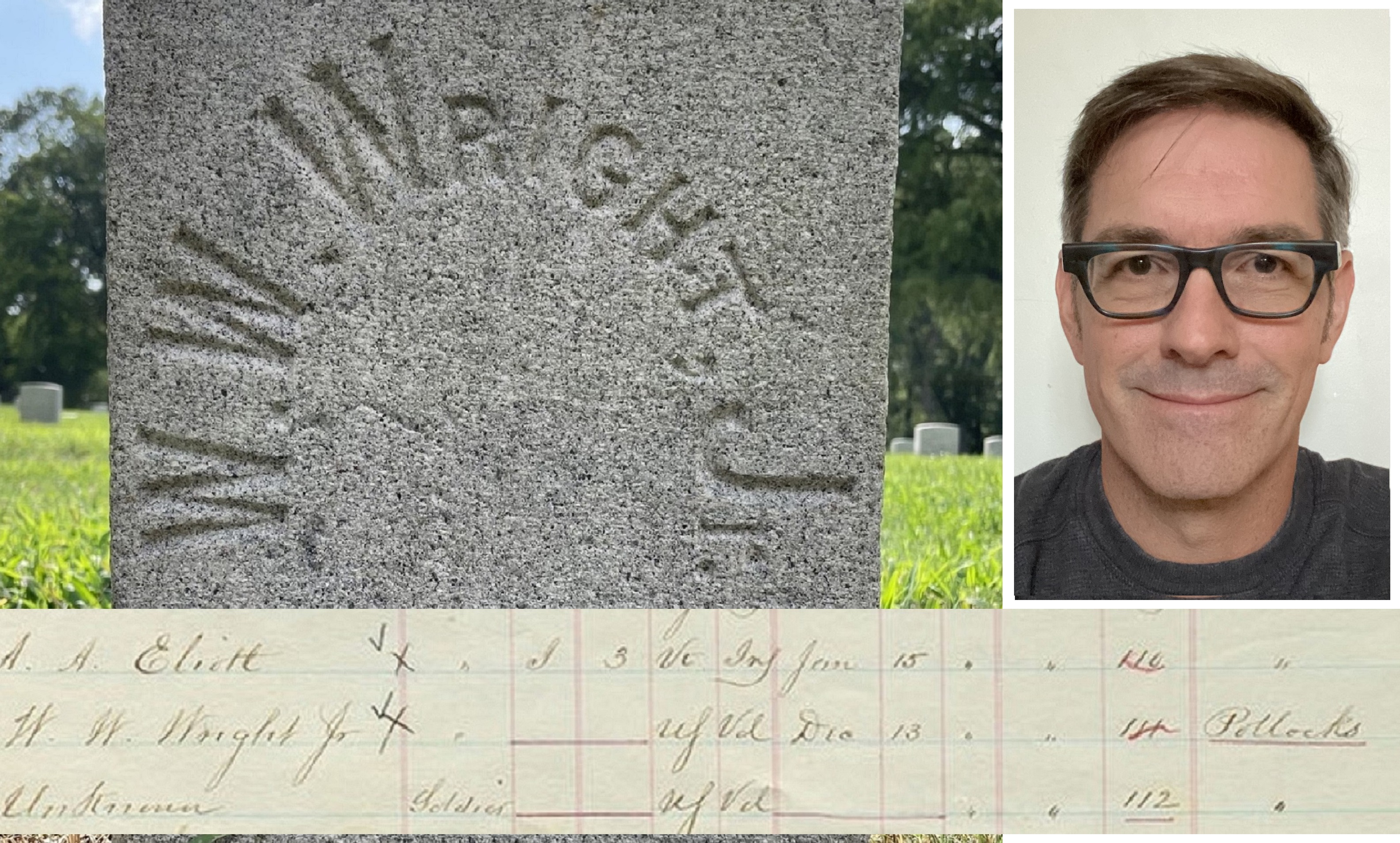
The grave in question (Peter Maugle/NPS), the registry for a W.W. Wright Jr. and citizen historian Mark Fischer
The recent identification of graves for two
Iron Brigade soldiers killed near Fredericksburg, Va., is due to persistent research by a citizen historian and a retired FBI researcher who dug up an 1870 newspaper article that provided crucial information.

Officials credit Mark Fischer of Livonia, Mich., and Steve Morin, a volunteer at Fredericksburg and Spotsylvania National Military Park, for gleaning information used to properly identify the graves of Sgt. Wallace Winfield Wight of the 24th Michigan and Pvt. John S. Waller of the 19th Indiana.

Wight’s grave at Fredericksburg National Cemetery has the wrong surname and Waller’s has only initials (photo below by Peter Maugle/NPS). Records now have been updated to show who lies beneath each stone. 

The turning point in the quest for identification was the discovery of a Detroit Free Press article, something the park said was akin to finding a needle in the haystack.

The effort is remarkable for a number of reasons, starting with how it came to be. Usually, the park initiates an ID search, sometimes from markers that might only have initials or scant information.

An email from Fischer to the park in 2023 was an exception to the rule.

“What makes Wight unique is someone out of the blue contacts the park on his own mission. He started with a name, we start with a grave,” said park historian and ranger Peter Maugle. “This has happened only one other time (to) my knowledge.”

Wight’s headstone at Fredericksburg National Cemetery is mislabeled as W.W. Wright Jr. -- one letter off from Wight. While one would think the mystery should have been solved easily, it took some digging for everything to add up, Maugle told the Picket.

Both soldiers were members of the Army of the Potomac’s Iron Brigade, known for its unflinching courage and high casualties during the war. They were known for wearing black felt Hardee hats.

The brigade, made up of several Midwestern regiments saw limited action at Fredericksburg, but was bloodied at First and Second Manassas, Antietam, South Mountain and Gettysburg. (Iron Brigade hat, below, worn by Elmer D. Wallace, 24th Michigan //  University of Michigan Bentley Historical Library)

While cemetery records have now been updated for Wight (Grave 4953) and Waller (Grave 5588), officials say the discoveries are not definitive. Without DNA samples, it is impossible to formally identify any of the 12,000 soldiers marked as unknown at Fredericksburg.

“We feel like this is 99.9% accurate,” says Maugle of Wight’s identity. “We don’t exhume.”

The headstones will not be corrected, due to their historical nature and other factors. (More about that below).

Fischer’s research actually began with Wight’s father, an officer in the same regiment and who is buried in Livonia. A nearby stone with Wallace Wight’s named appeared to be a cenotaph -- an empty grave for someone who is believed to rest elsewhere. But that was not a certainty.

Fischer reached out the park, wanting to know whether the younger Wight rests there. “I could not find an obituary for Wallace that would have suggested his remains” had been taken home to Michigan.

That first contact did not prove fruitful because park officials could not find a Wight in their cemetery records (though the register did show a Wright, as later research came to show). So Fischer kept at it, looking at diaries, letters and old newspapers.

Subsequent correspondence between Fischer and Morin led to the latter eventually finding the Detroit article, which broke the whole story open.

The lengthy article in December 1870 about a Grand Army of the Republic reunion included information about the deaths of Wight, Waller and other men in 1862 and 1863.

It said the meeting was the second of the regimental association and involved toasts and speeches, resulting in a "pleasant and successful" gathering at Young Men's Hall in Detroit.

After the Wight identification, Morin was able to do the same for Waller, whose grave is marked simply “J.S.W.”

Maugle credits Fischer for instigating the gathering “of the pieces of the puzzle.”

“This guy figured it out for us. He was persistent.”

He became curious about graves in his Michigan town

Fischer, 52, grew up in Ann Arbor, Mich., and lives in Livonia, where he works in IT.

When he and wife moved back to Livonia from Pennsylvania, Fischer stopped by a “cemetery that I have driven by thousands of times.”

He saw the 24th Michigan on several tombstones. The regiment had fought at Gettysburg. “That struck a chord with me.” Among those buried there was Lt. Col. William Walker Wight (photo below is cenotaph for Wallace W. Wight, courtesy Mark Fischer)

A self-described books guy, Fischer dug into histories, learning the father, then a captain, recruited his son, Wallace, and commanded him at Fredericksburg with Company K. (Another son, Gurdon, was wounded and survived the war.)

Fischer got service records from the National Archives. “The central question to me was, did Wallace make it home?”

He could not find any documentation. The fact that the marker in Livonia is shared with a brother-in-law and is not a government-provided stone made him curious whether Wallace Wight was buried at the Fredericksburg cemetery or nearby.

Morin asked for photos of Wallace’s grave. “The appearance of stone led him to think it to be just a marker.”

Wallace’s cenotaph is about six feet from his father’s grave and close to that of his sister. The marker also lists his brother-in-law, according to Fischer.

“How does the father lose the son and carry on? That is what I am trying to understand.”

Fredericksburg team's dogged pursuit to honor dead

Over the years, Maugle (right) and his team have been able to “better” identify about 200 graves at Fredericksburg. The process comes with a host of challenges.

First off, those who opened and operated the cemetery 160 years ago had little time to pursue identification, and there was no national cemetery system.

Remains -- sometimes only a few bones – arrived in dribs and drabs between 1866 and 1868. Most came with no name or, as possible in Wight’s case, with a weathered wooden marker. Stone markers did not replace wooden ones for several years.

The park pointed out in a Facebook post in September no soldier with the name Wight appears on Army rolls or casualty lists. The soldier and several comrades were killed on Dec. 13, 1862, and buried twice, including at Pollock’s Farm in Stafford County, before Wight was moved to Fredericksburg National Cemetery.

The graves at Fredericksburg were wooden until the mid-1870s (NPS).
Maugle told the Picket the wooden marker placed above Wight had to survive three years until reburial parties cam. “It may have been degraded until it is barely visibly.”

Morin wrote in his report about the grave it is possible that the misinterpretation of the surname ‘Wight’ as ‘Wright,’ sergeant as private and the missing company and regimental designations could be due to the grave marker’s exposure to the Virginia elements for several years, particularly if the inscriptions were written in pencil.

Initial emails led to no match for soldier

Most soldiers did not carry ID tags and unlike at other Civil War cemeteries, Maugle said, few of the Union soldiers passed away at nearby hospitals, where identification would have been easier. “They were buried on the field very hastily.”

The Fredericksburg cemetery has dead from four major battlefields and names were entered on the register – which, of course, is unsearchable – apparently when they arrived.

In Wight’s case, he was listed in the register as W.W. Wright Jr., along with a notation of burial at Pollock’s Farm prior to relocation to Fredericksburg. No regiment or rank was listed and the soldier was mistakenly identified as a private. The notation says “US Vol.” (Click image, courtesy NPS, to enlarge. Wright is near the bottom)

When Fischer first contacted the park, they only discussed a soldier named Wight. No one brought up the possibility of him being listed as Wright. Officials searched the register for anyone with the 24th Michigan and the name Wight. No match.

Unfortunately, no one had yet seen the newspaper article, which showed the sergeant was buried at Pollock’s Farm before the postwar move of remains to the current cemetery.

The email exchange ended in a dead end. “We kind of threw our hands up,” said Maugle.

Fischer got back to work.

One find led to another, to another, to another

Sgt. Wallace Winfield Wight, 18, and several others in the 24th Michigan were killed on December 13, 1862. He and at least one other soldier were believed to be decapitated by a Confederate shell.

Wight’s remains were recovered by his father (left).

The history of the 24th Michigan by O. B. Curtis says, "It was truly a mournful event when the Captain of Company K, that night, searched for the trunkless head of his son upon the battlefield, while the canister was whistling above him, and placed it with the young boy's remains for burial."

The men were first buried on the south side of the Rappahannock River.

“During the Chancellorsville campaign, his body was disinterred on April 30, 1863, and reburied at the Pollock House on the north side of the river. According to a May 1, 1863, letter written by Sullivan Dexter Green, Company F, 24th MI, Sergeant Wight’s grave was still fully marked when his body was moved.” Morin wrote. “Diary entries written on June 10, 1863, by Lieutenant Colonel Mark Flanigan, 24th MI, detailed a visit he made to the grave of ‘W.W. Wight, Jr.’ near the Pollock House on the north side of the Rappahannock River.”

Much of the above information was researched by Fischer and relayed to Maugle and Morin (right, NPS photo), who then found the newspaper article. Fischer said Green was essentially an embedded reporter for the Free Press while serving with the regiment.

Maugle said the newspaper article, while it does not mention the Pollock house by name, makes reference to "the hospital building ... on the opposite side of the road near the bank of the rive," narrowing it down. 

At that point, the park thumbed through the register looking for burials at Pollock’s Farm.

They came across W.W. Wright Jr.

“That name stuck out then,” said Maugle.

Bingo.

The mislabeled Wright marker includes a “Jr.”, likely because the teen and his father had the same initials.

Morin then turned his attention to Waller, whose grave is marked “J.S.W.”

According to the park, his grave lies between two casualties from the Army of the Potomac's crossing of the Rappahannock River at the outset of the Chancellorsville campaign in late April 1863. Cemetery records indicate the occupant is a U.S. soldier who died in 1863 and was initially buried at Fitzhugh's Farm in Stafford County.

Overlay shows Pollock's Mill/Farm in center, farm of Henry Fitzhugh (NPS)
“The 1870 article lists the names of several soldiers originally interred at the farm. One of them, Private John S. Waller of the 19th Indiana, fit the description and is likely the occupant of this grave. Cemetery records were updated to reflect that deduction.”

There are no known photos of Waller or Wallace Wight.

Why the NPS does not alter historic markers

When the park publicized the Wight story in September, some commenters asked why his marker could not be replaced with appropriate information.

In a nutshell, National Park Service policy does not allow the altering of historic gravestones due to errors of fact.

Lt. Col. Flanigan wrote about visit to Wight grave at Pollock's Farm (NPS)
Maugle said one reason is the cost and labor for replacing them. Some would receive a stone with a newer design, affecting the historic nature of the original.

There are some exceptions, such as if a tree fell and destroyed a marker.

There is another reason – going back to the concept that identification cannot be 100 percent confirmed. “What if someone comes in and says it belongs to someone else. We are in a quandary and we decided to make an adjustment to the grave,” said Maugle.

The citizen historian is invited to memorial event

Back in Michigan, Fischer wants to concentrate on what started this journey – a biography of William Walker Wight.

“Researching the father is how I became aware of the uncertainty about his son's final resting place,” he said. “A father lost his son under extraordinary circumstances.”

Lt. Col. Wight soldiered on as an officer – he was wounded at Gettysburg -- a citizen and a patriot.

Fischer has been invited to the park’s 2025 Memorial Day activities, notably a May 24 luminaria. Some 15,300 candles will be placed in bags to brighten the Fredericksburg National Cemetery. (Photo NPS)

Maugle said Fischer will primarily speak about Wallace Wight’s life and service.