Two American Civil War veterans buried in Derby, England, are set to be given official US markers. Samuel Lander Hough, of the 2nd New Jersey Cavalry, and Henry Nathaniel McGuiness, of the 65th New York Infantry, are buried in Nottingham Road Cemetery. Both men moved back to England after the war and became friends. They never received appropriate headstones when they died but in October their graves will be marked like those at Arlington National Cemetery. – Read article
Showing posts with label American. Show all posts
Showing posts with label American. Show all posts
Monday, August 25, 2025


Monday, September 16, 2024
'Sound trumpets! Let our bloody colors wave!: Professor using fellowship to learn more about how Americans turned to Shakespeare to interpret the Civil War
From the
White House desk of President Abraham Lincoln to book shelves in homes across
America, the works of William Shakespeare were omnipresent during the Civil War.
1864 cartoon depicting George McClellan and Abraham Lincoln in a "Hamlet" scene
Lincoln
favored “Macbeth,” soldiers staged Shakespearean plays and people in North and
South used the bard’s writings to justify their cause and express their deepest
emotions at a time of great sacrifice and loss.
Now, a Massachusetts Historical Society fellowship is
helping a history professor conduct research for a book she’s writing about
reading habits and practices during the Civil War, particularly in regard to
the works of Shakespeare.
Dr. Sarah Gardner, distinguished professor of history at Mercer University in Macon, Ga.,
is the recipient of the Suzanne and Caleb Loring Fellowship. The fellowship is
entitled “Shakespeare Fights the
American Civil War.”
She spent
part of the summer at the historical society, which specializes in Union war
efforts. Next June, she will travel to the Boston Athenaeum, which focuses on
the Confederate side and has print materials, including newspapers, journal
articles, books and poems.
Dr. Gardner has received more than 15 grants and fellowships (Mercer University)
“I became interested in Shakespeare because Shakespeare
was popular with the Civil War generation,” the cultural historian told the
Picket in an email. “He was evoked in speeches, he was popular on the lecture
circuit, his plays were performed by amateur and by professional actors,
allusions were deployed in magazines and in short and long fiction. I am
largely interested in the ways soldiers and people on the home front used
Shakespeare in their correspondence and diaries.”
Gardner, a cultural historian, has taught courses and written about the American South, the Civil War and Reconstruction. She gave three lectures in 2021 at Penn State University.
“Civil War-era Americans … turned to Shakespeare for
universal truths,” said a preview of the series. “Shakespeare, they
believed, spoke to abiding concerns, such as the soul of genius, the power
of the imagination, and of the heroic individual’s ability
to determine an event’s outcome.”

“I haven't
seen any meaningful difference between Unionists' and Confederates' uses of
Shakespeare. And they don't always cite Shakespeare to defend a cause,” Gardner
told the Picket.
Hamlet and
Macbeth were especially popular with Civil War Americans.
As Gardner
and other scholars point out, Shakespeare had a lot to say about war. Two lines
from “Richard II” and “Macbeth” on the
subject.
“He is come to open
The purple testament of bleeding war.”
And
“When the hurly-burly’s done,
When the battle’s lost and won.”
“Macbeth” apparently
was Lincoln’s favorite. As an essay published on the National Endowment for the
Humanities website says, the president did not suffer the weight of guilt and
excesses as did Macbeth – who spoke of powerlessness.
“Instead, he got something far more abstract from Macbeth’s
famous soliloquy. Throughout his life, Lincoln was deeply attracted to the idea
of unchanging destiny, and used this ‘predestination’ mindset to help him
survive even the most traumatic of events. In many ways, he saw his
presidential legacy not as the result of well-ordered strategy and political
planning, but as the sheer result of some higher order of which he was merely
an often unwitting tool.”

One of the most-famous cartoons of the Civil War was the “Chicago
Nominee,” drawn by Justin H. Howard. It shows Union Gen. George McClellan, who
ran against Lincoln in 1864, depicted as Hamlet in the graveyard scene.
“Instead of the skull of court jester Yorick, McClellan addresses the
head of President Abraham Lincoln, his Republican opponent. Governor Horatio
Seymour of New York is cast as Hamlet’s friend Horatio, and the grave digger is
a famished Irish immigrant,” says a description of the cartoon by the
Metropolitan Museum of Art.
“In 1862 Lincoln removed General McClellan, who had been in command of
the Union army, from active duty after he failed to achieve a decisive victory
at Antietam -- the bloodiest battle in American military history. The caption
at the bottom of the image alludes to false newspaper reports that Lincoln had
acted with inappropriate levity while touring the Civil War battlefield at
Antietam.
The caption borrows an Act IV line from “Hamlet”: “I knew him, Horatio; a fellow of infinite jest. Where be your gibes
now?”
Frederick Douglass was another big fan of Shakespeare. After the war, he was at a dinner with Powhatan Beaty, an African-American Medal of Honor recipient who became an actor, notably playing Macbeth.
A Mercer University news release about the fellowship says Gardner is reading
letters, diaries and books to learn more what they read, much of which was from
Shakespeare. People often used the author’s words to describe their experiences
during the Civil War.
“I’m really
interested in how people think and how they make sense of the world,” the professor and author said
in the release. “The history of emotions allows us to enter a world removed
from us, either by time or place. Everyone experiences joy or pain, but they
experience them differently. We can better understand our historical actors by
appealing to the history of emotions.”
Tuesday, July 7, 2020
Fritz Kredel: Versatile illustrator and wood-cut artist left Nazi Germany, depicted uniforms of Civil War, other American soldiers for book, mounted prints
 |
| The five Kredel illustrations I have had for years (Civil War Picket) |
That’s my
story, anyway.
Five illustrations of American soldiers in uniform – including two from the Civil War era – have been hanging in my garage for more than three decades. Back in the 1960s, they were lacquered onto pieces of thin board and sold in shops. Now, (like me) they are showing their age, scuffed and a little weathered.
Five illustrations of American soldiers in uniform – including two from the Civil War era – have been hanging in my garage for more than three decades. Back in the 1960s, they were lacquered onto pieces of thin board and sold in shops. Now, (like me) they are showing their age, scuffed and a little weathered.
My parents
bought them while my dad was attending command and general staff school at Fort
Leavenworth, Kansas. The $2 mounted prints made multiple moves until I settled
in the Atlanta area years ago.
 |
| Fritz Kredel |
That’s where
the journey to learn more about these five prints began. Who was this man?
My internet
searches peeled back multiple layers of a renowned German-born artist whose
work was distinct and was enjoyed by millions of Americans for
decades. I felt sheepish about my ignorance of his prodigious illustrations and wood cuts.
Kredel
learned wood engraving at a young age and that helped him become, as one
observer writes, a master illustrator of books and prints. Yale University has a collection about his artwork.
“He had the great ability to show
personality, movement and emotion with a tremendous economy of line,” wrote graphic designer Mark D. Ruffner in a 2012 post on his blog.
 |
| Depictions in "Soldiers of the American Army" (amazon.com/wayfair.com) |
Kredel fled Nazi Germany in the late 1930s, moved to Vienna
and ended up in the United States, where his career really took off. He and his
family lived in New York City and Kredel taught at Cooper Union. He was much in
demand as a book illustrator, and is remembered for his fairy tale characters
and botanical drawings, among many genres.
Kredel teamed
up with military historian and author Frederick Porter Todd for the volume “Soldiers of the American Army, 1775-1941," which came out just before America’s
involvement in World War II. It was updated in a 1954 edition. My prints are
reproduced from the book.

“He had a love for the heraldry, the
uniforms, the helmets and the details that distinguished the various uniforms
of different soldiers, and he was good at distinguishing those in various
illustrations,” the Iowa glass artist wrote in an email.
Dover, the current publisher, has this description: “Splendid pictorial
history of military apparel includes meticulously researched, beautifully rendered
illustrations of regimental attire from the Revolutionary War, uniforms worn by
the Texas Rangers (1846), Louisiana Zouaves (1861), Philippine Scouts (1904),
and members of the Women's Army Corps (1954). Descriptive text accompanies each
illustration. 32 full-color plates.”
The five in my small collection are:
-- Federal Infantry (1862) –
Iron Brigade of the West and Vermont Brigade. Both saw intense fighting and
endured high casualties. The Iron Brigade was known for its Maltese cross
insignia and black felt hats. The Vermonters had a staggering 1,200 casualties
at the Wilderness.
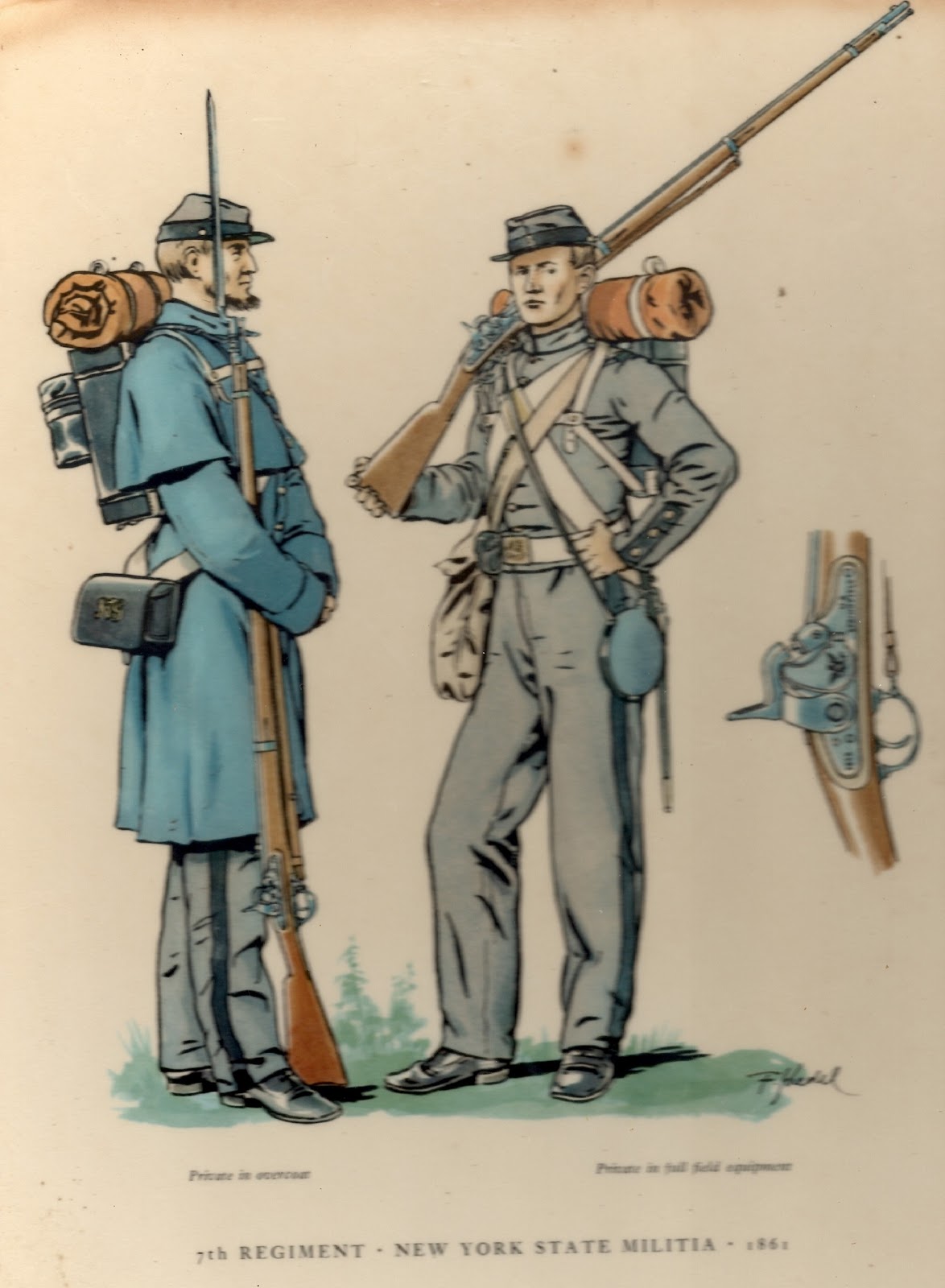
-- The Regiment of Artillerists
(1812) – matross and drummer, parade uniform
-- Thompson’s Pennsylvania Rifle
Battalion (1775) – musketman and rifleman
-- Cuban Expedition (1898) –
trooper, Rough Rider, in stable dress and private, 71st New York, in
full field equipment
 |
| "Corps d'Afrique (NY Public Library) |
The Corps d’Afrique was a predecessor of U.S. Colored Troops. It was
comprised mostly of recently freed slaves in Louisiana.
An order from Washington created several regiments that would fight for the Union.
One of the first to form was the 1st Louisiana Native Guard. It originated in 1862 in New Orleans during the Federal occupation. It was made up of freed men and slaves who came for nearby plantations.
An order from Washington created several regiments that would fight for the Union.
One of the first to form was the 1st Louisiana Native Guard. It originated in 1862 in New Orleans during the Federal occupation. It was made up of freed men and slaves who came for nearby plantations.
Famed Army Gen. Matthew Ridgway wrote a message on the back of hardbound copies of “Soldiers of the American Army” published in the 1950s.
 |
| Volume for sale at Abebooks.com |
While the
book may be the most well-known reminder of Kredel’s talents, there was so much
more to his creative output.
“My grandfather illustrated around 500 books and did dust
jackets for many more, and so the books on soldiers are only a small part of
what he illustrated,” says Swanson. “He also was very good at botanical
illustration, fairy tales and suiting his illustration to the time of a text.”
 |
| "Grimm's Fairy Tales" work by Kredel. Courtesy of Mark D. Ruffner |
Ruffner, the graphic
designer, said Kredel’s illustrations for children’s book were charming, witty
and romantic.
“Illustrators of children's books inform and influence
us at our most formative stage. At an early age -- if we are lucky -- we are
introduced to so many morality plays, and while the morals of the stories are
important, so too are the indelible cast of characters, and the way in which
they are presented.”
In 2000, there were three major shows on Kredel’s work, according to
Swanson. One was in his hometown of Michelstadt, about 30 miles southeast of
Frankfurt. The New York Times wrote about an exhibition that year at the
Grolier Club in New York City.
 “Drawings, watercolors, woodcuts, lettering, book
illustrations, maps, marionettes, political cartoons, paper dolls, the
presidential seal for John F. Kennedy's inauguration and other works on paper
sprang in profusion from Kredel's fertile imagination,” according to the article.
“Drawings, watercolors, woodcuts, lettering, book
illustrations, maps, marionettes, political cartoons, paper dolls, the
presidential seal for John F. Kennedy's inauguration and other works on paper
sprang in profusion from Kredel's fertile imagination,” according to the article.
Another major Kredel work, the article said, is a woodblock map of
Michelstadt as it appeared around 1650, replete with medieval buildings and
narrow streets.
Begun in Germany, it was completed in the United States in 1954. “Woodcuts, he felt, had a crispness and sharpness that could not be achieved in any other medium,” wrote Times art critic Grace Glueck.
Begun in Germany, it was completed in the United States in 1954. “Woodcuts, he felt, had a crispness and sharpness that could not be achieved in any other medium,” wrote Times art critic Grace Glueck.
His earlier works in his native country included “The Offenbacher Haggadah,” which was published in 1927 and is considered “a
landmark in German-Jewish bookmaking in Weimar Germany.” The Haggadah is text
cited at the Seder table during Passover.
Kredel died in 1973 at age 73. His obituary cited several accomplishments, including
winning the gold medal for book illustration at the 1938 Paris World
Exhibition, about the time he came to the United States.
 |
| Promotional card for 2010 event at the University of Kentucky |
“I have many things I hope to write, develop, and do in
honor of my grandfather,” says Swanson. “I am currently working on a
documentary and I hope to release that sometime in the next year or so.”
Thursday, May 15, 2014
Working to bring American chestnut back to glory it had during the Civil War
 |
| A chestnut burr at breeding farm (American Chestnut Foundation) |
It may be fitting that the birthplace of Abraham Lincoln, the man remembered for rising from humble beginnings to great heights, will be the planting ground for 20 saplings that are part of a broad effort to bring the American chestnut back to its former glory.
Volunteers at Abraham Lincoln Birthplace National Historical
Park in Hodgenville, Ky., on Saturday will plant year-old American chestnuts in the park’s
picnic area.
Officials hope the young chestnuts, part of the American Chestnut Foundation’s breeding and testing program, will grow to be resistant
to the blight that wiped out hundreds of millions of their ancestors early in
the 20th century.
This will be the second such planting at the site in the
past seven years.
 |
| Symbolic birthplace cabin in Kentucky (NPS) |
Several buildings there are made of chestnut, as is at least
part of the “Symbolic Cabin” that represents the tiny abode where the future 16th
president and commander in chief was born to Thomas and Nancy Lincoln in 1809.
During the Civil War, chestnuts made up about one in four
hardwoods in the Appalachian region that stretches from Maine to Alabama.
"Families in rural America, including the Lincoln family, once depended heavily upon the American chestnut for both food and shelter. The trees grew straight and tall and were rot-resistant, making the wood desirable for construction. The small nuts were sweet and fed entire families, as well as livestock and many species of wildlife," says park Superintendent Bill Justice.
Straight-grained chestnut timber was ideal for furniture,
telephone poles, railroad ties and plywood. Lighter than oak, chestnut logs
were used for river rafts.
 |
| (Lynn Garrison) |
But the blight’s fungus and another malady, root rot,
conspired against the fast-growing American chestnut.
Stacy Humphreys, chief of interpretation and resource
management at the federal site, says about 200,000 people come annually to
Sinking Spring Farm, the birthplace, and Knob Creek, where the family moved
when Lincoln was about 2. They moved to Indiana when he was 7.
Many visitors are surprised the actual birth cabin no longer
exists. That was confirmed when a test in 2004 showed the structure placed in a
stone memorial hall was actually from the 1840s. “We have to disappoint a lot
of people.”
Still, visitors, through a film and exhibits, gain insight
into the early days of Lincoln, who later became famous as the “Rail Splitter”
by splitting wood for rail fences.
Humphreys said that the planting and mulching will begin at
about 10 a.m. Saturday. Wire cages will be placed around the 2- to 3-feet-tall
saplings (above) “so the deer don’t eat them. We have a very robust deer population.”
The blight-resistant trees, known as Restoration Chestnuts
1.0, aren’t guaranteed to not become diseased, but continued breeding and
testing will increase the variety’s chances in the coming years.
A study last spring on Restoration 1.0 found 16% are highly
resistant and 50% moderately resistant, says Mila Kirkland, director of
communications for the American Chestnut Foundation, based in Asheville, N.C.
 |
| Giant chestnuts in the Great Smoky Mountains (ACF) |
“Now
and the coming years we are going to hone in on that 16 percent and continue to
breed with those trees,” she says.
The
foundation’s effort involves crossing the American chestnut with the Chinese
chestnut, which is resistant to the devastating blight. Many of the resulting
trees are grown at the organization’s farms in Meadowview, Va.
The foundation is doing “test” plantings all over the
country. Patience is required because the blight can take a while to develop,
says Kirkland, and the Restoration 1.0 program only began in 2005.
After an American and Chinese chestnut are crossed, the
resulting tree is crossed back with the American, resulting eventually in a
product that is 15/16th American.
The Chinese chestnut is shorter, with spreading branches. “The wood is not the
beautiful chestnut colored wood of our native trees. It is much more inferior
as a forest tree because it is an orchard tree,” says Kirkland.
 |
| Restoration 1.0 seeds (ACF) |
While
the American chestnut can be found in commercial nurseries, the hybrids
developed by the foundation and other groups are the best chance to develop
characteristics that will help the tree rebound in the coming generations.
The
native range is in the Appalachians. “They prefer slopes and well-drained
soils. They don’t like water and soggy bottom land,” says Kirkland.
She,
too, emphasizes the importance of the tree to man and wildlife during the
mid-19th century. “They were definitely prevalent at Lincoln
birthplace.” Animals and humans prized the nut as a food source.
“(Settlers)
would take these wagons full of chestnuts into cities and sell them as a cash
crop or trade for things they needed.”
The
American chestnut isn’t the only tree that has been ravaged by disease. A
canker devastated the butternut, a hardwood tree. During the Civil War,
the color of Confederate uniforms was created using butternut husks as a source
of dye.
The chestnut
foundation’s 16 state chapters, from Alabama to Maine, do the ground work of
breeding regionally adapted chestnuts. “A tree that is native to Georgia is not
going to work so well in Maine, for many reasons,” says Kirkland.
Lynn
Garrison, president of the Kentucky chapter, says he has high hopes for trees
being planted Saturday, but acknowledges it is still part of a larger test.
“You can’t tell when it shows up,” he says of the blight. “It
varies somewhat.”
He says his chapter’s goal is to cross trees that can work
in all 20 eco-regions in Kentucky
 |
| The American chestnut is a fast grower (ACF) |
“We will have trees
…. that will be mostly Kentucky genotypes. We want to preserve as much genetic
information as possible.”
The best hope against the blight is through the breeding program,
rather than fungicides and other chemicals, says Garrison. “They tried to cut
every chestnut tree and they thought it would stop migration of the blight, but
it didn’t.”
“We think the answer is in developing a resistance,” he
says. And while the foundation is moving forward with caution, it is hopeful
about restoration.
“We think it won’t be long before we are ready to start
restoring them in the forest.”
The Kentucky chapter has planted about 1,000 trees in
controlled settings over the past year.
The planting at the Lincoln birthplace can help educate
generations that were born long after the blight virtually wiped out the
American chestnut population. The effort has both historic and ecological
lessons, Garrison says.
In their heyday, chestnuts could live up to 300 years. Some
reached 120 feet and they were opportunistic mainstays in the forest canopy.
Of course, there will be setbacks along the way, as some
chestnuts succumb to the blight. But the breeding program will produce thousands
of hardy trees that will thrive.
Kirkland says the hope is that 50 years from now, the
American chestnut will be restored to the forest – “that it is a common tree people talk about, interact with
and use in their daily lives.”
Sunday, July 31, 2011
8 battlefields win government grants
More than $1.2 million in grants from the National Park Service’s American Battlefield Protection Program were awarded this week to a variety of national battlefield projects including eight Civil War sites in six states: Kansas, Kentucky, Maryland, Ohio, South Carolina and Virginia. • Article
Friday, December 10, 2010
Wreaths Across America: Remembering soldiers in the Civil War, other conflicts
On Saturday (Dec. 11), thousands of volunteers, many dressed for brutal cold, will fan across the nation’s cemeteries, placing holiday wreaths at the graves of veterans, including those who fought in the Civil War.
 Adorned with a red bow, the wreaths will represent a nation’s remembrance to those lost to battle and old age.
Civil Air Patrol cadets and Boy Scouts will place a couple hundred wreaths after a noon ceremony at Andersonville National Cemetery near Americus, Ga. The Sons of the American Revolution and the Patriot Guard also will be on hand, rain or shine.
They’ll place the wreaths after remarks from Robert “Chappy” Kelly, a police chaplain with the Americus Police Department and a major in the Civil Air Patrol.
“It’s pretty emotional,” Kelly said of the annual observance put on by the non-profit group Wreaths Across America.
 The program got its start in 1992 when the head of the Worcester Wreath Co. had the idea of honoring veterans buried at Arlington National Cemetery. Since, then it’s spread to hundreds of other cemeteries, including Andersonville.
The organization has grown from 13 volunteers to more than 160,000. It will deliver 219,000 wreaths to Arlington and to more than 300 state and national cemeteries, overseas, and to ships at sea.
“You meet a lot of nice people who need closure,” said Kelly, indicating he sends photos of headstones with wreaths to relatives who cannot come to the cemetery.
Eric Leonard, volunteer coordinator at Andersonville National Historic Site, which adjoins the site, told the Picket the cemetery is one of about a dozen national cemeteries holding the remains of Civil War soldiers.
Andersonville, of course, was the site of an infamous Confederate prisoner of war camp. About 13,000 Union soldiers died there.
Wreaths Across America this week dropped off about 150 wreaths, but Leonard said others will be placed by individuals at several hundred of the nearly 20,000 graves.
“We really want families to bring wreaths during the month of December,” he said.
 He asks that they be about 20 inches wide and made of Fraser fir. Each also has a red velveteen bow.
“We keep them out as long as they look good,” Leonard said.
Most of the Andersonville wreaths will be placed at those who have died in recent years, but several will also go in the Civil War-era sections.
“To really understand the scale [of the Civil War graves] you need to get out of your car and walk the rows,” Leonard said.
Andersonville is one of only two national cemeteries administered by the National Park Service still classified as open. It holds the remains of five soldiers killed in Afghanistan in Iraq. About 13 NPS Civil War sites are affiliated with national cemeteries.
“It’s just a way to honor those that went before,” said Kelly, who organized the annual event at Andersonville.
Photos courtesy of Andersonville National Historic Site
• More on Wreaths Across America, event locations
 Adorned with a red bow, the wreaths will represent a nation’s remembrance to those lost to battle and old age.
Civil Air Patrol cadets and Boy Scouts will place a couple hundred wreaths after a noon ceremony at Andersonville National Cemetery near Americus, Ga. The Sons of the American Revolution and the Patriot Guard also will be on hand, rain or shine.
They’ll place the wreaths after remarks from Robert “Chappy” Kelly, a police chaplain with the Americus Police Department and a major in the Civil Air Patrol.
“It’s pretty emotional,” Kelly said of the annual observance put on by the non-profit group Wreaths Across America.
 The program got its start in 1992 when the head of the Worcester Wreath Co. had the idea of honoring veterans buried at Arlington National Cemetery. Since, then it’s spread to hundreds of other cemeteries, including Andersonville.
The organization has grown from 13 volunteers to more than 160,000. It will deliver 219,000 wreaths to Arlington and to more than 300 state and national cemeteries, overseas, and to ships at sea.
“You meet a lot of nice people who need closure,” said Kelly, indicating he sends photos of headstones with wreaths to relatives who cannot come to the cemetery.
Eric Leonard, volunteer coordinator at Andersonville National Historic Site, which adjoins the site, told the Picket the cemetery is one of about a dozen national cemeteries holding the remains of Civil War soldiers.
Andersonville, of course, was the site of an infamous Confederate prisoner of war camp. About 13,000 Union soldiers died there.
Wreaths Across America this week dropped off about 150 wreaths, but Leonard said others will be placed by individuals at several hundred of the nearly 20,000 graves.
“We really want families to bring wreaths during the month of December,” he said.
 He asks that they be about 20 inches wide and made of Fraser fir. Each also has a red velveteen bow.
“We keep them out as long as they look good,” Leonard said.
Most of the Andersonville wreaths will be placed at those who have died in recent years, but several will also go in the Civil War-era sections.
“To really understand the scale [of the Civil War graves] you need to get out of your car and walk the rows,” Leonard said.
Andersonville is one of only two national cemeteries administered by the National Park Service still classified as open. It holds the remains of five soldiers killed in Afghanistan in Iraq. About 13 NPS Civil War sites are affiliated with national cemeteries.
“It’s just a way to honor those that went before,” said Kelly, who organized the annual event at Andersonville.
Photos courtesy of Andersonville National Historic Site
• More on Wreaths Across America, event locations
Saturday, March 27, 2010
'Confederate Southern American' on Census?
The Southern Legal Resource Center is calling on self-proclaimed "Confederates" to declare their heritage when they are counted in the 2010 Census. The organization is urging Southerners to declare their “heritage and culture” by classifying themselves as “Confederate Southern Americans” on the line on the form, question No. 9, that asks for race. • Details
Subscribe to:
Posts (Atom)