Showing posts with label artist. Show all posts

Tuesday, December 2, 2025

American as (apple) pie. Winslow Homer's depiction of a hungry Union soldier is acquired by SoCal museum, which will show it off Sunday in revamped galleries

Winslow Homer's 1863 painting "The Sutler's Tent" debuts Sunday (Courtesy The Huntington)
A Civil War camp scene painted by Winslow Homer – who captured war’s fury at the front and documented soldiers’ lives behind the lines – will debut Sunday as part of the relaunch of an American art gallery at a Southern California museum.

Homer (below) was in his mid-20s when he became an artist-reporter for Harper’s Weekly, embedding with the Union army in Virginia. While most of his work about the conflict was illustrations, he did produce several paintings, including “The Sutler’s Tent,” which was acquired by The Huntington.

The San Marino, Calif., institution recently announced the acquisition of the work, which was purchased for an undisclosed amount from a New York-based gallery. The Ahmanson Foundation funded the acquisition in honor of the 250th anniversary of the founding of the United States, officials said.

The 1863 painting, only 16-1/4 inches by 12 inches, shows two Yankee cavalry troopers near a tent, one munching on what appears to be a slice of pie (another theory has it as bread and cheese).

The blog Los Angeles County Museum on Fire points out the celebrated artist first depicted the subject in an 1862 sketch, which shows more than a half dozen members of the 3rd Pennsylvania Cavalry standing near a tent. One of them is sitting on a rail, enjoying a snack.

The drawing was modified for publication in Harper’s Weekly and entitled "Thanksgiving in Camp."

“Harper's Weekly reproduced Homer's war art as wood engravings. The Sutler's Tent is related to a Thanksgiving-themed illustration that ran in November 1862,” according to William Poundstone’s blog. “That means the engraving came before the painting, dated 1863. The horizontal-format print shows many more figures than the painting and clearly shows the tent. … Homer evidently felt the tight cropping of the painting made a stronger composition.”

Homer's 3rd Pennsylvania Cavalry (National Gallery of Art) and Harper's Weekly version (Metropolitan Museum of Art)
Homer honed his craft during the Civil War. A 2015 article in Yale News describes how the self-taught artist had to work quickly and be an astute observer. The young man grew a beard like many soldiers and also wore worn and dirty clothing.

“Homer, like other war correspondents, considered what he did to be a public service and felt as though he endured some of the same kind of experiences as soldiers did,” Keely Orgeman, a curator with the Yale University Art Gallery, told the publication. “When Homer was stationed in Yorktown on the front, he was unable to eat for three days, along with all of the soldiers. According to his mother, he was completely changed by that experience.”

Homer’s other well-known Civil War works include “Prisoners from the Front,”Home, Sweet Home” and “A Sharp Shooter on Picket Duty.”

Homer's "Prisoners from the Front" is owned by the Metropolitan Museum of Art and displayed in New York.
The purchase of “The Sutler’s Tent” was first reported by the Los Angeles Times.

Annabel Adams, vice president of communications and marketing for The Huntington, told the Picket the reasoning for acquiring the museum’s first Homer painting was “especially important as we set to launch a reinstallation of American art galleries on December 7 as part of our ‘This Land Is’ initiative.”

The multiyear effort includes the reinstallation of seven galleries in the Virginia Steele Scott Galleries of American Art.” One reopened in September; six will debut Sunday.

As Poundstone reported, “The Sutler’s Tent” will be the centerpiece of a room about the Civil War and Reconstruction. On display will be a signed copy of the Emancipation Proclamation from The Huntington’s Library and Jean-Baptiste Carpeaux’s scultpure "Why Born Enslaved!," The Huntington said in a news release.

Adams said the institution’s Civil War holdings are renowned. Among them:

-- Papers relating to President Abraham Lincoln’s bodyguard Ward Hill Lamon;

-- Ciphered communications between Abraham Lincoln and army commanders;

-- Lincoln memorabilia and manuscript collector Judd Stewart;

-- Scrapbooks made by war correspondent and illustrator James E. Taylor (left, courtesy The Huntington);

-- Alfred R. Waud’s 1863 drawing of Rebel prisoners at Brandy Station.

Christina Nielson, the Hannah and Russel Kully Director of the Art Museum at The Huntington, said “Sutler’s Tent” expands the dialogue between the art and library collections.

“As we look toward the 250th anniversary of the United States, the painting invites reflection on a pivotal chapter in our nation’s history -- one that continues to shape the American experience,” she said in the news release.

The Huntington also features botanical gardens and a research center.

Tuesday, July 7, 2020

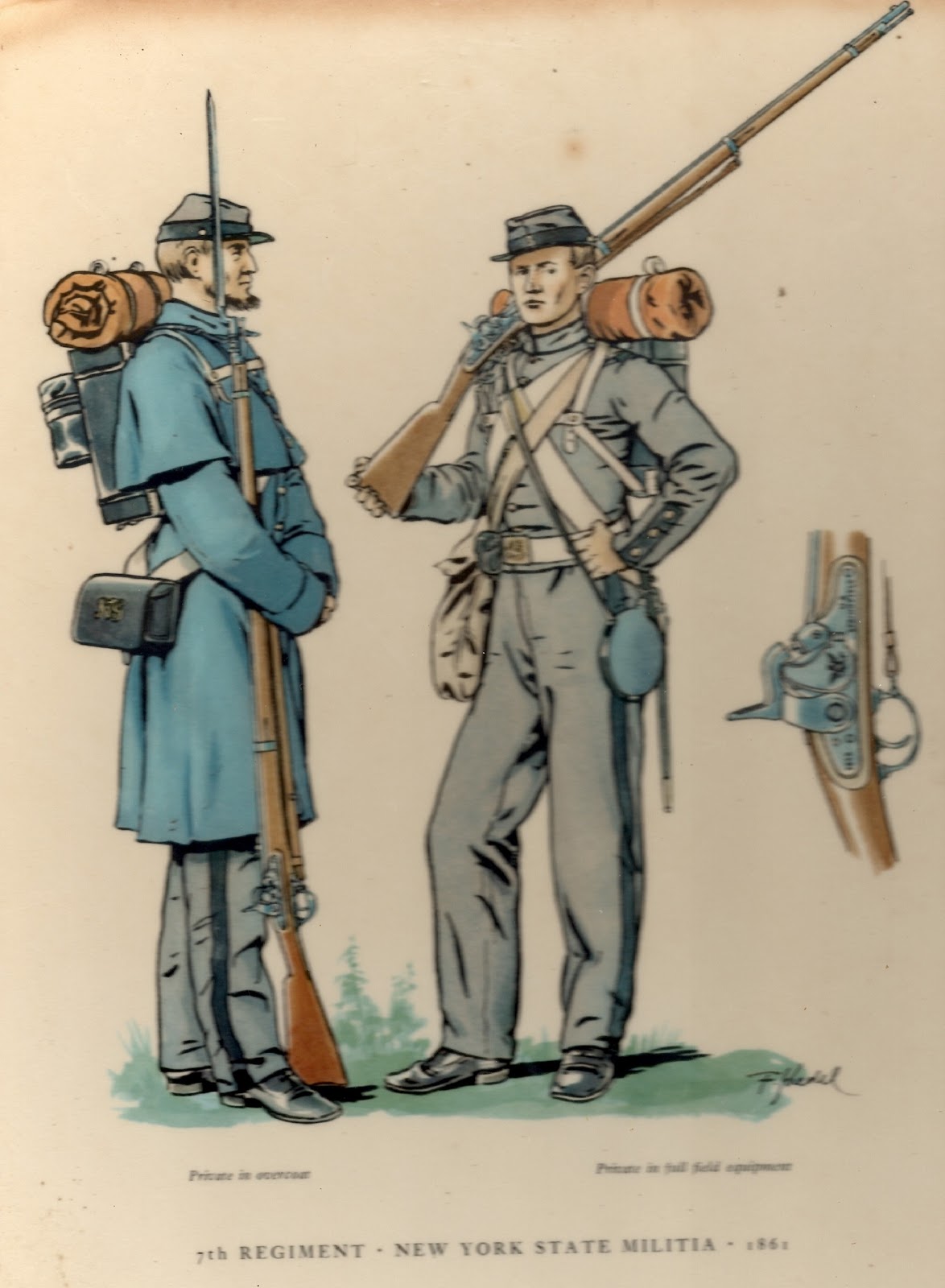
Fritz Kredel: Versatile illustrator and wood-cut artist left Nazi Germany, depicted uniforms of Civil War, other American soldiers for book, mounted prints

The five Kredel illustrations I have had for years (Civil War Picket)
A journey of discovery can begin with a few old pictures hanging on the pegboard wall of your garage.

That’s my story, anyway.

Five illustrations of American soldiers in uniform – including two from the Civil War era – have been hanging in my garage for more than three decades. Back in the 1960s, they were lacquered onto pieces of thin board and sold in shops. Now, (like me) they are showing their age, scuffed and a little weathered.

My parents bought them while my dad was attending command and general staff school at Fort Leavenworth, Kansas. The $2 mounted prints made multiple moves until I settled in the Atlanta area years ago.

Fritz Kredel
A few months ago, I took them down to have a closer look. The illustrator’s signature -- not surprisingly -- was a little tough to discern, but after a few Google tries I came up with his name: Fritz Kredel.

That’s where the journey to learn more about these five prints began. Who was this man?

My internet searches peeled back multiple layers of a renowned German-born artist whose work was distinct and was enjoyed by millions of Americans for decades. I felt sheepish about my ignorance of his prodigious illustrations and wood cuts.

Kredel learned wood engraving at a young age and that helped him become, as one observer writes, a master illustrator of books and prints. Yale University has a collection about his artwork.

He had the great ability to show personality, movement and emotion with a tremendous economy of line,” wrote graphic designer Mark D. Ruffner in a 2012 post on his blog.

Depictions in "Soldiers of the American Army" (amazon.com/wayfair.com)
Kredel, born in Michelstadt in 1900, was trained as a graphic artist and designer, and became adept at wood cuts, pen and ink and water colors.

Kredel fled Nazi Germany in the late 1930s, moved to Vienna and ended up in the United States, where his career really took off. He and his family lived in New York City and Kredel taught at Cooper Union. He was much in demand as a book illustrator, and is remembered for his fairy tale characters and botanical drawings, among many genres.

Kredel teamed up with military historian and author Frederick Porter Todd for the volume “Soldiers of the American Army, 1775-1941,which came out just before America’s involvement in World War II. It was updated in a 1954 edition. My prints are reproduced from the book.

I asked his granddaughter, Tilda Brown Swanson, about Kredel’s interest in uniforms and other forms of militaria.

He had a love for the heraldry, the uniforms, the helmets and the details that distinguished the various uniforms of different soldiers, and he was good at distinguishing those in various illustrations,” the Iowa glass artist wrote in an email.

Dover, the current publisher, has this description: “Splendid pictorial history of military apparel includes meticulously researched, beautifully rendered illustrations of regimental attire from the Revolutionary War, uniforms worn by the Texas Rangers (1846), Louisiana Zouaves (1861), Philippine Scouts (1904), and members of the Women's Army Corps (1954). Descriptive text accompanies each illustration. 32 full-color plates.”

The five in my small collection are:

-- Federal Infantry (1862) – Iron Brigade of the West and Vermont Brigade. Both saw intense fighting and endured high casualties. The Iron Brigade was known for its Maltese cross insignia and black felt hats. The Vermonters had a staggering 1,200 casualties at the Wilderness.

-- 7th Regiment, New York State Militia (1861) – private in overcoat and private in full field equipment. This volunteer, “silk stocking” militia unit was mustered into service early in the Civil War, and was reactivated a few times, mostly in support roles.

-- The Regiment of Artillerists (1812) – matross and drummer, parade uniform

-- Thompson’s Pennsylvania Rifle Battalion (1775) – musketman and rifleman

-- Cuban Expedition (1898) – trooper, Rough Rider, in stable dress and private, 71st New York, in full field equipment

"Corps d'Afrique (NY Public Library)
Other Civil War subjects in the book are Stuart’s Calvary Division, CSA (1862), colonel of cavalry and major of horse artillery, Corps d’ Afrique (1864), brigade bandsman and sergeant of heavy artillery, New York Zouaves (1863) 5th New York and 44th New York, Confederate Infantry (1863), and Louisiana Zouaves (1861), captain and Zouave.

The Corps d’Afrique was a predecessor of U.S. Colored Troops. It was comprised mostly of recently freed slaves in Louisiana.

An order from Washington created several regiments that would fight for the Union.

One of the first to form was the 1st Louisiana Native Guard. It originated in 1862 in New Orleans during the Federal occupation. It was made up of freed men and slaves who came for nearby plantations.

Famed Army Gen. Matthew Ridgway wrote a message on the back of hardbound copies of “Soldiers of the American Army” published in the 1950s.

Volume for sale at Abebooks.com
“The readers of this volume will become acquainted with the colorful story of our American uniform,” Ridgway wrote. “To every American soldier, his uniform is a symbol of the tradition of the past, of determination for the future. It is a reminder of the noble heritages which has been handed on by those who wore the uniform before us – a heritage of integrity and honor, of courage and steadfastness, of selfless devotion to country.”

While the book may be the most well-known reminder of Kredel’s talents, there was so much more to his creative output.

“My grandfather illustrated around 500 books and did dust jackets for many more, and so the books on soldiers are only a small part of what he illustrated,” says Swanson. “He also was very good at botanical illustration, fairy tales and suiting his illustration to the time of a text.”

"Grimm's Fairy Tales" work by Kredel. Courtesy of Mark D. Ruffner
His illustrations, many of them whimsical, were published in “Andersen’s Fairy Tales” (The Heritage Press, 1942) and “Grimm’s Fairy Tales (Grosset and Dunlap, 1945).

Ruffner, the graphic designer, said Kredel’s illustrations for children’s book were charming, witty and romantic.

Illustrators of children's books inform and influence us at our most formative stage. At an early age -- if we are lucky -- we are introduced to so many morality plays, and while the morals of the stories are important, so too are the indelible cast of characters, and the way in which they are presented.”

In 2000, there were three major shows on Kredel’s work, according to Swanson. One was in his hometown of Michelstadt, about 30 miles southeast of Frankfurt. The New York Times wrote about an exhibition that year at the Grolier Club in New York City.

“Drawings, watercolors, woodcuts, lettering, book illustrations, maps, marionettes, political cartoons, paper dolls, the presidential seal for John F. Kennedy's inauguration and other works on paper sprang in profusion from Kredel's fertile imagination,” according to the article.

Another major Kredel work, the article said, is a woodblock map of Michelstadt as it appeared around 1650, replete with medieval buildings and narrow streets.

Begun in Germany, it was completed in the United States in 1954. “Woodcuts, he felt, had a crispness and sharpness that could not be achieved in any other medium,” wrote Times art critic Grace Glueck.

His earlier works in his native country included “The Offenbacher Haggadah,” which was published in 1927 and is considered “a landmark in German-Jewish bookmaking in Weimar Germany.” The Haggadah is text cited at the Seder table during Passover.

Kredel died in 1973 at age 73. His obituary cited several accomplishments, including winning the gold medal for book illustration at the 1938 Paris World Exhibition, about the time he came to the United States.

Promotional card for 2010 event at the University of Kentucky
Swanson and her mother, Judith, over the years have written and spoken about Kredel’s work.

“I have many things I hope to write, develop, and do in honor of my grandfather,” says Swanson. “I am currently working on a documentary and I hope to release that sometime in the next year or so.”

Monday, August 15, 2016

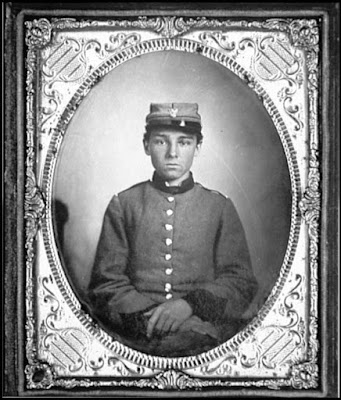
Exhibit's 'Toy Soldier' is a photographic 'delusion' of haunting Civil War portrait of Edwin Jemison

Pvt. Edwin Jemison (Library of Congress)

Wait a minute – I recognize him.

I was scrolling through my personal Facebook feed recently and came across a post with the image of a young Confederate soldier.

You no doubt have seen the haunting face of Pvt. Edwin F. Jemison, a native Georgian who enlisted at 16 and died at 17 at the Battle of Malvern Hill in Virginia while serving with the 2nd Louisiana Volunteer Infantry Regiment.

The Facebook image I saw was of a 2003 artistic interpretation of Jemision entitled “Toy Soldier.” It was created by Brazilian artist Vik Muniz, who uses what is called a playful and inventive approach in creating “photographic delusions.”

The text next to the work reads: “Struck by the profound sadness in a portrait of a child soldier during the Civil War, Muniz decided to re-create the portrait out of plastic soldiers.”


Last week, I paid a visit to the Muniz exhibit at the High Museum of Art in Atlanta. I gazed at his interpretation of iconic images of pop culture: Mona Lisa in peanut butter and jelly, Che Guevara in black beans and Dracula in caviar.

But I spent most of my time studying “Toy Soldier” from a variety of perspectives. It is part of a triptych, or three panels.

The High explained Muniz’ concept: “He assembled a distorted version of the image on the floor and photographed it from an angle to correct the perspective. As a result, some toy soldiers appear vastly larger than others, though they were all the same size. The final work is presented as a triptych with depictions of a horse and an American Indian, recalling subjects common to toy figurines.”


I’ve been wrestling with the artist’s intent here, but perhaps the use of toy soldiers is an example of innocence lost – and regained.

The American Battlefield Trust has a video featuring a National Park Service ranger at the Malvern Hill battlefield. She details the brief service of Jemison, who enlisted within a month of Fort Sumter’s fall and served in the Peninsula Campaign in Virginia. He was decapitated by Union artillery fire during a Rebel advance on July 1, 1862.

Jemison’s youthful face has graced magazine covers, books and other mediums, making him the “poster boy” of wartime innocence loss.

While there is a monument in Milledgeville, Ga., many believe his remains are among the unknown at Malvern Hill.


Muniz, the artist, is known for his interpretation of pop culture and celebrity. And it was fascinating to see what he creates out of a variety of objects.

“From a distance, the subject of each resulting photograph is discernible; up close, the work reveals a complex and surprising matrix through which it was assembled. That revelatory moment when one thing transforms into another is of deep interest to the artist.”

The Vik Muniz photography exhibit at the High Museum of Art runs through Aug. 21. Details here

Wednesday, October 7, 2015

Sculptor uses knowledge of artistic, medical anatomy to create Shiloh monument

Early model for Shiloh project. (Courtesy of Kim Sessums)

To capture a person's essence, Mississippi artist Kim Sessums wants to know as much as he can about the subject’s circumstances, background and outlook.

His works of figurative sculpture also strive to be anatomically accurate. Clay is shaped through écorché, the practice of sculpture with exposed muscle structure.

There are no artistic exaggerations, such as is the case with the subjects’ hands and feet in Rodin’s “The Burghers of Calais.”

“It feels real because it has to be real,” Sessums says of his finished products, which include bronze busts of Andrew Wyeth, Eudora Welty, Sonny Montgomery and the Rev. Billy Graham.

That attention to detail -- where the viewer is not distracted from the work’s central theme -- is reflected in a towering bronze and granite monument that will be unveiled Saturday (Oct. 10) at Shiloh National Military Park near Savannah, Tenn. Three young Mississippi soldiers converge to protect a flag during a doomed attack on Union positions in April 1862. The monument will honor about 6,000 Mississippians who fought at Shiloh.

Dr. Kim Sessums
Sessums, 56, said that Carmel, Calif., artist Richard Macdonald once told him he might be “cheating.”

That’s because Sessums is a physician in Brookhaven.

While “medical anatomy is different from artistic anatomy,” Sessums says it has informed his work. He made a reference to artist Jamie Wyeth, who studied cadavers at the New York City morgue.

The artist told the Picket he has parallel careers, as an OB/GYN during the day, while spending time on his art early in the morning, at night and on the weekends. He has created sculpture since 1995. “I would sculpt my kids to get the human likeness and humanity.”

Sessums grew up in rural Scott County, Ms. At 4, Sessums lost his father in an automobile wreck; his mother died of cancer a year later. He was raised by grandparents and continued his interest in drawing, eventually branching out into mixed media, pastels and bronzes.

The latter include former Ole Miss football coach John Vaught, campus benefactor Frank R. Day and the African-American Monument at Vicksburg National Military Park (below). That work consists of two black Union soldiers and a field hand.

NPS photo

“The field hand and one soldier support between them the second soldier, who is wounded and represents the sacrifice in blood made by black soldiers on the field of battle during the Civil War,” according to a National Park Service description. “The field hand looks behind at a past of slavery, while the first soldier gazes toward a future of freedom secured by force of arms on the field of battle.”

Sessums said he wanted to honor a people who had been through a tremendous hardship.

The Mississippi monument on Rea Field at Shiloh is not meant to show specific soldiers, but it is based on the 6th Mississippi, which suffered horrendous casualties in several assaults.

“They came up against the 53rd Ohio from a snake-infested swamp. They were trying to make a surprise attack," he said. “This is to show the dedication and valor of these young men.”

Sessums and Dale Wilkerson, superintendent at Shiloh, said artistic sensibilities have changed since the first monuments went up at the park a century or so ago.

Before the dedication of the Tennessee monument in 2005, artistic themes at Shiloh were allegorical, said Wilkerson. “They are kind of meant to represent a theme.”

NPS photo

The 1906 Iowa memorial (above) features a female figure at the base, fashioning an inscription. A bronze eagle is affixed to a small globe at the top of the monument.

“Fame” writes:

Brave of the brave, the twice five thousand men
Who all that day stood in the battle’s shock,
Fame holds them dear, and with immortal pen
Inscribes their names on the enduring rock.

Elsewhere at Shiloh, an angel cradles a Wisconsin soldier.

The 1917 Confederate Monument, the informal name for a work sponsored by the United Daughters of the Confederacy, is very allegorical, said Wilkerson.

Picket photo of Confederate Monument detail

According to the NPS, the central group in this sweeping work represents a "Defeated Victory." The front figure, representing the Confederacy, is surrendering the laurel wreath of victory to Death, on the left, and Night, on the right. Death came to their commander and Night brought reinforcements to the enemy, and the battle was lost.

“None of this was meant to represent real people, but ideas,” said the superintendent.

NPS photo

The Tennessee monument (above) was meant to represent what happened on the battlefield. It, too, depicts three men, one cradling a dead or dying comrade.

Sessums’ new work, Wilkerson said, is even closer to reality. “The 6th Mississippi did charge across the field and had seven color bearers shot down. The one is the middle has been shot, one of them is reaching for the colors and one is reaching to hold up the color bearer.”

The artist said he first made smaller figures after “very rough sketches" before crafting a miniature version. He focuses on physiology. “It gets in my arms, brain and my eyes.” When he goes to the full-size figures, in this case 8 and a half feet tall, “they always take on a life of their own. You hope it changes for the better.”

Sessums submitted a couple design ideas to the Mississippi Veterans Monument Commission. They turned down a camp scene (below), choosing the one that will be unveiled this weekend.

“I love it,” the artist said of the camp scene. “(It is) very intimate and contemplative. Less heroic. Have thought about finishing as a separate study for the monument. Would be a really moving small bronze.”

In an essay with his submission to the commission, Sessums included the story of a real Mississippian at Shiloh, Augustus Mecklin of Choctaw County. The private wrote, “No day of my life has been so full of stirring terrible events as this. Never may I see such another.  Even now my mind is agitated & as I think of what I have seen this day visions dark & bloody float before my eyes & sounds of death & suffering fill my eyes.”

The artist’s aim was to give the man of the ranks “his rightful measure of consideration.”

His son, Jake, 32, helped with  the Shiloh project. Jake helped apply the clay, and then his father scored the surfaces, using different tools.

“It starts taking on life right before your eyes,” Kim Sessums said.

• More on new Mississippi monument at Shiloh

Jake, who operates a food truck in Oxford, with Kim Sessums

Thursday, March 10, 2011

Part 2 of Alfred Waud: Combat artist brought war, postwar South to ordinary Americans

Alfred R. Waud was perhaps the Civil War’s most famous combat artist, a familiar bearded figure on horseback, almost always headed to the Union Army of the Potomac’s front lines.

With derring-do, paper, pencil, charcoal and china white pigment, Waud documented people, places and the realities of war.

Calling Waud prolific is an understatement. He produced thousands of sketches, shipping his work to New York, where magazines, including the venerable Harper’s Weekly, brought the war to the people.

This was before the mass production of photographs.

What Waud saw, Americans saw.

He carried a revolver and was known to fire, occasionally, at Confederate lines.

Less known, but perhaps artistically and journalistically as important, were his postwar trips out west. He documented New Orleans, the Mississippi River, other portions of the South and, even, the Great Chicago Fire.

Waud died in 1891 in Marietta, Ga., while touring and sketching Southern battlefields. He was 62.

Essential reading on Waud includes Frederic E. Ray’s “Alfred R. Waud: Civil War Artist.”

We asked three curators to tell us about the essential Waud (pronounced “WODE”). Please click images to enlarge.

SARA W. DUKE, curator, popular and applied graphic art, Prints and Photographs Division, Library of Congress

Duke’s first duty at the Library of Congress was cataloguing the more than 1,200 Waud works in the collection.

For her, it’s the reality of the artist’s subjects that make his work special.

“You can really see the faces,” Duke says. “He is capturing the likenesses of people.”

Duke’s comments on Waud bring to mind Robert Capa, the 20th-century war photographer Robert Capa, who said, “If your pictures aren't good enough, you're not close enough.”

Waud was usually at the front. One of the sketches in the library’s collection carries drops of blood, when he apparently got nicked.

And he braved sniper’s bullets during the Petersburg siege, climbing a tree to get a drawing of the Confederate lines for Gen. George Meade (left).

“He is positioning himself to see what is happening,” Duke says.

Waud, who sometimes wrote articles to accompany his illustrations, was the only artist to record Pickett’s Charge at Gettysburg.

He and his fellow “Bohemians” were the true visual artists of the time, largely because photographers concentrated on still scenes.

“The dead were not a problem,” Duke says of the lensmen. “War action was impossible.”

Waud is most known for providing sketches for Harper’s Weekly, hugely popular in the North during the Civil War.

Harper’s Weekly, Duke says, was interested in propaganda and wanted the public to think the war was always going well.

The publication took an image of Union soldiers slogging in the snow near Falmouth, Va., (above, the original) and made it cheerier. An 1862 sketch of wounded soldiers being assisted at Antietam was altered to hide the sight of an amputated limb.

“I think he was well liked. The men and the officers respected him,” Duke says of Waud. “To me, it’s his relationship with soldiers.”

Waud depicted African-American soldiers mustering out in 1866 in Little Rock, Ark. They are shown being greeted by family members.

“It [shows them as] empowered, as opposed to liberated,” the curator says.

DANIEL HAMMER, head of reader services, The Historic New Orleans Collection

Hammer is impressed by Waud’s ability to capture more than the immediate subject. The Englishman, he said, had an eye for acute detail.

The Historic News Orleans Collection, which is a museum, archive and publisher, has thousands of works by Waud and his brother, William. That includes Alfred’s early sketchbooks.

Waud traveled to New Orleans to record Reconstruction and returned in 1871 to travel the Mississippi River. He made it as far north as St. Louis, where he was dispatched to the Chicago fire. In 1872, Waud made sketches for "Picturesque America."

In the Civil War, Hammer says, Waud captured scenes quickly.

In New Orleans, “he captures human characters in a cosmopolitan city.”

Waud’s works include market scenes, the opera, bar patrons and, of course, the Mississippi River.

“His energy seemed to match the country he adopted,” said Hammer. “He also was a journalist, not just an artist.”

Hammer also lauds Waud’s accuracy in the scaling of buildings in New Orleans.

“They were meant to depict the scene as it was,” he says of the collection.

HARRY L. KATZ is an independent curator and writer. He is the former head curator in the Prints and Photographs Division at the Library of Congress. He is editor and co-author of “Baseball Americana: Treasures of the Library of Congress” and “Herblock: The Life and Work of the Great Political Cartoonist.”

Katz ranks Waud second behind Frank Vizetelly as the best Civil War sketch artist, able to get as close as possible to the truth.

“He epitomized the life of a sketch artist. They were photojournalists before they existed,” says Katz. “He was larger than life.”

The well-dressed correspondent was gregarious, a mischief maker and “was quite a character.”

Waud covered virtually every campaign in the Eastern Theater. “He was very brave,” Katz said. (Below, "Advance into the Crater before Petersburg.")

“He was one of the first to recognize that this was about death and dying and destruction.”

“Special artists,” as they were known, sketched their work on paper and had it sent to publishers, where craftsmen made wood block engravings. Sometimes, the emotion of a scene might get lost.

“He had a reputation among his peers,” Katz said of Waud.

The curator has a book coming out next year entitled, “Civil War Sketchbook: Drawings from the Battle Front.” It will include works by Waud, Edwin Forbes, Winslow Homer and artists in the Joseph Becker Collection.

Read Part 1 of our report on Alfred R. Waud

Credits (sequentially): Photograph of Waud, 1864, Library of Congress, LC-DIG-cwpb-03706; "Ammoniacal gas engine, New Orleans streetcar," The Historic New Orleans Collection, accession no. 1965.90.51; "In Front of Petersburg, sketch made for Gen. Meade, Library of Congress, LC-DIG-ppmsca-22584; "Winter Campaigning," Library of Congress, LC-DIG-ppmsca-22444; African-American soldiers mustered out, Library of Congress, LC-DIG-ppmsca-21005; "Noon on Sunday at the French Market N. Orleans", The Historic New Orleans Collection, accession no. 1965.13; "Bar of the Natchez," The Historic New Orleans Collection, accession no. 1965.90.33; "The Mouth of the Mississippi / a tow approaching the Gulf," The Historic New Orleans Collection, accession no. 1965.79; "Advance into the Crater before Petersburg," Library of Congress, LC-DIG-ppmsca-20996.

Monday, February 21, 2011

Part 1 of Alfred Waud: Living historian brings Civil War sketch artist off the page

John Rapp would gladly walk in Alfred Waud’s shoes.

From his felt hat and bewhiskered face to his leather haversack and boots, Rapp projects a living image of the famous Civil War sketch artist -- minus the English accent.

For more than 10 years, Rapp, 55, of Cornelius, N.C, has researched and portrayed what some consider the greatest illustrator of the war.

Authenticity is paramount.

Rapp takes school construction paper and weathers it to approximate the paper and colors used by Waud.

“I put it out in the sunlight to make the same shade,” he says.

Waud (pronounced WODE), saw it all with the Union’s Army of the Potomac -- from the bright-eyed optimism in 1861 to Gen. Robert E. Lee tired ride (below) following his surrender at Appomattox Courthouse in southern Virginia.

The artist, most famous for his illustrations used in Harper’s Weekly, was known for his bravery and quality of work.

Because reproducing photographs was in its infancy, Waud and other illustrators principally brought the action and army life to the public.

Why was Rapp, an 8th grade American history teacher in Charlotte, drawn to Waud specificially?

“The immediacy of his sketches,” Rapp says. “The freezing of action.”

“Here is a guy who was on the front line,” he added.

As a member of the Bohemian Brigade, a confederation of living historians doing impressions of Civil War correspondents and artists, Rapp has done significant research into the journalist he portrays.

“We are so far off the edge,” Rapp says of his Bohemian brothers. “Most of the people [who come to events] don’t know about artists. I am telling them something new.”

Rapp made several trips to the Library of Congress, which has a large collection of Waud’s works, and as a registered researcher he has held originals.

“It is chilling,” says the native of Shoemakersville, Pa., north of Reading. “It is thrilling. That this piece of paper was at Gettysburg.”

Rapp also has researched Alfred’s brother, William, a fine illustrator in his own right.

Other research includes a study of “Alfred E. Waud: Sketch Artist” by Frederic E. Ray and Philip Van Doren Sterns’s “They Were There,” a look at Waud and other Civil War journalists promoted by newspapers and weeklies of the time as “Special Artists.”

The four-volume, “Battles and Leaders of the Civil War” was the first significant Civil War book to portray the effort of these gregarious chroniclers.

Rapp, who sold RVs before switching to teaching, makes a reference to a Waud sketch (above) of the skirmish between the 14th Brooklyn and Confederate Cavalry at Antietam on Sept. 17, 1862.

“You can see the action going on,” he says.

Rapp, who includes sailing among his hobbies, has a particular fondness for doing his Waud impression at Gettysburg.

“Waud’s Rock” is the site of famed Civil War photographer Timothy O. Sullivan’s image of the jaunty artist, who was born in England in 1828.

Most of the time, Rapp sketches likenesses (right) of Waud’s work, but he sometimes does extemporaneous sketches for the public and friends.

He enjoys educating individuals about the amazing experiences of such artists.

“I’m a pretty good artist. Nothing fancy. I try to reproduce his work faithfully.”

Rapp does not sell his work. “I do it for the enjoyment and to educate.”

Some years, Rapp may go to 10 battle re-enactments or living history events. In 2011, so far he is going to an event in Rockford, N.C., a 19th century plantation and a meeting of a Sons of Union Veterans of the Civil War camp.

“People want to know who I am and why I am dressed like that,” he says.

Readers had plenty of material during the war, including the New York Illustrated News and Frank Leslie's Illustrated Newspaper. Rapp totes copies of Harper’s Weekly, which was read by about 1.5 million people each time it was printed.

Among Waud’s contemporaries were Theodore R. Davis and Edwin Forbes. Forbes was “better artistically but the immediacy and intimacy of Waud was different,” says Rapp.

Civil War photos were limited generally to camp life and scenes after battles.

“If you want to know what war looked like you have to look at the sketches,” says Rapp.

Upcoming in Picket: A deeper look at Waud's work, why he is important and his legacy. We'll look at collections in Washington, D.C., and New Orleans and will speak with curators.

Images: Photo of John Rapp, "Waud Rock" and his drawings, courtesy of John Rapp; photograph of Waud by Timothy O'Sullivan, Civil War Treasures from the New York Historical Society, digital ID nhnycw/ad ad07001; Waud drawing at Antietam, Library of Congress, LC-DIG-ppmsca-21027; Waud sketch of Lee, Library of Congress, LC-DIG-ppmsca-21320