Showing posts with label john. Show all posts

Friday, October 30, 2026

A reenactor wanted a monument put up to recall the service of his ancestor's Union brigade. John Fritz, who lives 1,700 miles away, bought 3 acres at Resaca

From left, John Fritz, Jake Boling and Robert Jenkins with installed monument near Resaca (Bob Jenkins)
Wherever the 105th Illinois Infantry fought during the Civil War, John Fritz has been sure to follow.

The reenactor -- whose great-great-grandfather, Christopher Fritz, served as a private in Company G -- has traveled to 20 or so sites in Georgia and the Carolinas.

In between, Fritz has volunteered at Kennesaw Mountain National Battlefield Park outside Atlanta for more than 10 years and driven north to Resaca, Ga., where his ancestor also fought.

Eventually, the Chandler, Az., resident (left, NPS photo) wanted something tangible to bear proof of the service of the 105th Illinois and other regiments in Brig. Gen. William T. Ward’s brigade in the 20th Corps.

About 10 years ago, after participating in the Resaca reenactment several times, Fritz decided to preserve part of that battlefield by buying a small parcel and erecting a monument to the brigade.

Fritz, who turns 64 in November, recently achieved the goal with the installation on three acres he bought from a family at U.S. 41 and tiny Pilgrim Way in Whitfield County.

“It has been a dream come true,” Fritz told the Picket, which learned about the purchase from a social media post by rangers at Kennesaw Mountain.

“Although the property is not part of Kennesaw Mountain National Battlefield Park, it preserves an important piece of the Atlanta Campaign story,” a park Facebook post said.

His ancestor helped clear the way for comrades

Pvt. Christopher Fritz was likely picked for an Army of the Cumberland 20th Corps detachment known as pioneers because he was a carpenter and dependable. Fritz, a native of Germany, enlisted in 1862 and mustered out in June 1865.

Reverse of monument lists regiments and casualties (Kennesaw Mountain NBP)
During the Atlanta Campaign, the acting engineers followed Union skirmishers and made sure roads and bridges were in place or passable for the main army, among other duties.

They were, in essence, tips of the spear.

The soldier lost a thumb to gunfire while on guard duty for several months at Fort Negley in Nashville. The incident apparently was accidental, John Fritz says. Christopher received a pension about 25 years after the war

The veteran had a family in Belvidere. Ill., and died in August 1903 at age 73. 

Three markers will be placed near brigade monument

John Fritz wanted some Resaca battlefield land to be preserved. When no battlefield parcels appeared on the market, he went door-to-door, talking to landowners in Whitfield and Gordon counties.

He obtained a tract where Ward’s troops gathered before the May 13-15, 1864, ferocious, but inconclusive, battle at Resaca.

The granite memorial, provided by North Georgia Monument in Calhoun, was erected in mid-October. Preservationists plan to place three markers on the parcel.

Robert Jenkins, executive director of the Blue and Gray Education Society and the leader of Save the Dalton Battlefields, said the spot is near where the Federal IV Corps arrived to the battlefield as they marched south from Dalton down U.S. 41 and deployed on the evening of May 13, 1864.

“On this land is where a Confederate surprise attack on the afternoon of Saturday, May 14, 1864. led by General John Bell Hood that had rolled up a portion of the Federal IV Corps was stalled and stopped by Peter Simonson’s 5th Indiana Battery and Robinson’s brigade of Williams’s division of the XX Corps,” Jenkins wrote in an email.

Circled area shows location of Ward's brigade before its advance on Confederate lines
On May 15, Maj. Gen. Joseph Hooker launched an assault against the Confederate right flank. Troops from Ward's brigade (including the 70th Indiana, led by future president Benjamin Harrison) stormed an earthen redoubt containing four 12-pounder Napoleon guns commanded by Capt. Max Van Den Corput. Ward's men overran the battery

Jenkins said the markers will follow the action on this land and surrounding area on each of three successive days. (Below, Brig. Gen. William T. Ward)

“Thanks to John’s acquisition of this land and his generosity in allowing us to place three markers there, (we will have) the ability to be able to interpret and tell this part of the battle from a perspective and portion of the battlefield that has never been done before.”

Jenkins said the three acres are north of and not connected with 303 acres of Resaca battlefield acquired by the American Battlefield Trust in partnership with Save the Dalton Battlefields, Friends of Resaca Battlefield and the Georgia Battlefields Association.

Kennesaw Mountain National Battlefield Park said historic “landscapes endure because people care enough to protect them.”

“Thank you, John Fritz, for helping preserve this important part of our shared history.”

John Fritz with monument on his land; click to enlarge (Kennesaw Mountain NBP)

Wednesday, May 22, 2024

Pvt. Christopher Fritz was a tip of the spear clearing roads during the Atlanta Campaign. At Kennesaw Mountain, a descendant is paying tribute this week

John Fritz describe weapons during a  talk May 22 at Kennesaw Mountain (NPS photo)
John Fritz’s great-great-grandfather, Christopher, toted a rifle and a whole lot more during his service in the 105th Illinois Volunteer Infantry -- namely, axes, hatchets, files, saws and augers.

Pvt. Fritz was likely picked for an Army of the Cumberland XX Corps detachment known as pioneers because he was a carpenter and dependable. During the Atlanta Campaign, the acting engineers followed Union skirmishers and made sure roads and bridges were in place or passable for the main army, among other duties.

They were, in essence, tips of the spear.

John Fritz, a reenactor from Chandler, Ariz., this week is making short presentations about Federal infantry weapons at Kennesaw Mountain National Battlefield Park near Atlanta. He has a pioneer chevron on his uniform sleeve as a tribute to his ancestor, who fought in many campaigns, including in June 1864 at Kolb’s Farm near Kennesaw Mountain.

“Those guys had their work cut out from them,” the electronic engineer told me over the phone, without first realizing the pun. “They were responsible for going ahead and clearing the roads and muddy creek crossings.”

Fritz, 61, will give talks at 1:30 p.m. Thursday and Friday near the park visitor center. (Photo left, National Park Service)

Fritz has volunteered at the park for the last 10 years during visits to Georgia to attend events. He just attended a reenactment in Resaca, Ga. (where the 105th Illinois fought), and will attend an anniversary event Saturday at the Pickett’s Mill battlefield west of Kennesaw Mountain.

Fritz wanders the Kennesaw Mountain battlefield and talks with visitors about the life of an infantrymen and specifically his ancestor, who fought in North Georgia and at Peachtree Creek in Atlanta. “I feel people like to hear that connection.”

This week, he has set up a table displaying four guns the Federal army used.

The reenactor did not know of his great-great-grandfather’s service until his father died in 2011. “The family didn’t say anything about it, even my grandparents,” John Fritz told the Picket.

His father, Dale, was from Elgin, Illinois, and the family moved to Southern California when John was young.

He has since learned that Christopher Fritz, a native of Germany, enlisted early in the war while in his early 30s. He served in the 105th's Company G.

“I basically followed his whole route, pretty much traced his footsteps from Belvidere, Illinois, to Washington, DC,” where Christopher mustered out in June 1865, two weeks after the Grand Review of the Armies.

The soldier lost a thumb to gunfire while on guard duty for several months at Fort Negley in Nashville. The incident apparently was accidental, John Fritz says. Christopher received a pension about 15 years after the war

The veteran had a family in Belvidere and died in August 1903 at age 73. John helped arrange for a new Veterans Administration headstone to be placed at the grave.(Photo courtesy of John Fritz)

John is a member of the Scottsdale Civil War Roundtable in Arizona. He has been to several battlefields where the 105th Illinois fought, including a couple in North Carolina.

“I just really got interested in learning about my ancestor and it turned into a project to honor him, learn more about him. I enjoy traveling. I had never been to the South.” 

Sunday, February 4, 2024

Repairs on Pemberton's Headquarters at Vicksburg finally moving full steam ahead. This is where the general stayed in last months of the siege

Workers are doing a total rebuild of the home's front porch (NPS photos)
After delays due to a redesign and the availability of quality wood, workers have finished the roof and are rebuilding the deteriorated front porch of Confederate Lt. Gen. John C. Pemberton’s headquarters in Vicksburg, Ms., officials said.

In December, crews finished repairing the roof the Willis-Cowan House, Vicksburg National Military Park recently announced regarding the major rehabilitation project on the dwelling. Porch work is expected to be completed by summer.

Pemberton used the home on Crawford Street as his headquarters from May 23-July 4, 1863, during the Union army’s siege on Vicksburg.

Pemberton – working from a first-floor office -- and his staff tried to manage the desperate situation. But by July 2, it appeared his isolated, famished and exhausted army could withstand no more. That night, they met and decided to negotiate for peace with Maj. Gen. Ulysses S. Grant. Pemberton sent a letter to Grant on July 3 and the surrender occurred the following day.

The home survived the Civil War, becoming a residence, Catholic school and bed and breakfast over the years. The NPS acquired the property in 2003 and opened it to visitors from 2008 to 2016, when it was closed because of safety concerns. Some observers have commented online about the lengthy closure.

The Picket reached out to the park about the extensive rehabilitation of the building. Superintendent Carrie Mardorf (left) provided these details. Responses have been edited.

Q. Regarding the porch, the park has said it wanted to use salvageable wood when possible. Has that happened? If so, can you generally detail how much is being reused and how? What type of new wood is going up?

A. Yes, salvageable wood was reused to the degree possible. However, during the dismantling of the porch, there was additional deterioration in several of the wood members that was not anticipated. Because if this, it was determined that 100% of the structural members (posts, joists, and rafters), and 70% plus of the balustrade and floor/ceiling planks had to be replaced. The new wood is a mixture of treated lumber for joists and rafters (to prevent future deterioration), and Southern yellow pine for columns and other millwork.

(NPS photo)
Q. Are the white column supports for the porch the ones that were already there?

A. Yes, those components were able to be reused. 

Q. The park had said: (Previous) shortening of the columns caused a flat roof over the west side of the porch to slope in the wrong direction, causing moisture problems. How has that been addressed? Are the new columns going to be longer?

A. New structural columns now rest on a metal column plate, which will not be seen once the trim boards are added. The plate will keep the bottom portion of the columns dry to prevent rot.  The lower portion of the previous structural columns rotted (and thus appeared shorter) because there was no metal plate. The replacement column height will be the original height.

A. Regarding the roof, the project listed this objective: Weathertight structure which will include a new slate roof, a stainless-steel coated metal roof, proper flashing at chimneys and walls, structural modifications throughout, and preservation repairs to wooden elements. Did all of that occur?

A. Yes, all of the work has occurred, and structural modifications were needed. Structural modification included the introduction of structural steel to support the weight of the new roof. Additional repairs are also underway for all the other millwork. The project paused due to the availability of quality structural lumber and the length of time to acquire it. (At right, a historic photo of the facade)

Q. Has the work been constant the past two years, or has it been done in spurts?

A. The project paused in 2022-2023 to redesign the porch to address structural concerns and replace additional wood members that had unforeseen deterioration. The redesign included more metal structural supports and the new plans had to be reviewed and approved by the State Historic Preservation Office.  Work resumed in November 2023. 

Q. The estimated price tag for the work two years back was $704,000. Is that current?

A. The project increased by $300,000 to incorporate the structural redesign and additional repairs to the porch. Total project construction cost is now approximately $1.1 million.

Pemberton and the Willis-Cowan house before work began (Library of Congress and NPS)
Q. Any interesting finds so far during the project -- artifacts, architectural and construction details?

A. No, Pemberton's Headquarters served as a private residence from the late 1800s to early 2000s. The building and site have been heavily altered over time by its previous residents. 

Q. What will become of the building? Will it be staffed/reopened to the public? If so, when might that happen?

A. The building will continue to be preserved. The roof and porch project is the first of several needed repairs to address deferred maintenance. Additional phases of work are planned to address interior repairs, exterior windows and doors, upgraded utilities including fire suppression system, and retaining walls. The structure will not be staffed or opened to the public until the phases of work are completed.

Monday, August 28, 2023

Cathryn Newton, then 16, was on watch when the USS Monitor was found. The project was an amazing collaborative effort, she writes

Cathryn R. Newton on Eastward in 1973 (Courtesy of MIT Museum). Her mother,
Sunny, asked her father whether they found the wreck. He whispered, 'We think so'
Cathryn R. Newton found her career calling while sailing as a teen on the RV Eastward with her father, John G. Newton, and other scientists. They located the Civil War ironclad USS Monitor on Aug. 27, 1973. Since then, the Syracuse University dean emerita and professor has conducted extensive research on shipwrecks and marine fauna and environments. Newton, who was raised in Beaufort, N.C, recently led a scientific team that traveled to Newfoundland. The Civil War Picket asked for her recollections of the Monitor expedition and she submitted this essay.

50 years ago: Just after noon, we found the wreck of the USS Monitor, the most famous missing ship in America, on Aug. 27, 1973. Four investigators conducted this two-week, blue-water expedition organized and funded through the work of my father, John G. Newton, a Duke oceanographer and marine superintendent of the oceanography program; Harold "Doc" Edgerton, strobe pioneer, inventor, and longtime MIT engineering faculty who’d invented many of the instruments we used; Bob Sheridan of Delaware (later Rutgers), accomplished and hard-charging marine geophysicist who had a nearby seismic survey funded; and Gordon Watts, the brand-new marine archeologist at the state of North Carolina (the inaugural one).

Duke University's research vessel Eastward
Our team decided to take Monitor’s (+ towship USS Rhode Island’s) mariners at their word --and search near the edge of the continental margin 16 miles off  Hatteras. {All but one of many other Monitor searches in summer 1973 were near shore). My father, Bob Sheridan and Doc Edgerton wrote the proposals that had secured funding for the E-12-73 cruise from NSF and National Geographic Society (NGS).

My father had mapped the NC continental margin in a recent geological atlas and, with Orrin Pilkey, published the first work on the Hatteras Submarine Canyon. This background elevated our odds of success, but did not guarantee it.

I was a 16-year-old Duke sophomore who’d worked all summer making cross sections and assembling geological/bathymetric data for the upcoming cruise; my friends Paul Kelly and Bob Springle were deployed in parallel. Shy, hardworking and unconfident, I logged many hours at the Duke Marine Lab preparing cruise materials, and had expressed an interest.

Yet the expedition consisted principally of towering figures in ocean sciences, with a few doctoral students. Then came a surprise: 24 hours pre-departure, a space held for a woman member of the NGS Explorers Club came vacant. This young girl leapt into the air with joy.

1973: Gordon Watts, front left, behind him John Harris; on right, from back,
Robert Sheridan, John Newton, Cathryn Newton and Harold Edgerton (NOAA)
Following the one best piece of advice ever from my mother Sunny Newton, I kept a journal of the expedition, the only one extant. When my father died without notice at 52 of heart failure in 1984, I inherited every bit of planning material for the expedition and all the files amassed while they (Dad, artist Sandy Belock and Gordon Watts) tried to figure out what we were seeing in this complex shipwreck. I have written a book manuscript on all this, with input from many, and sent it to my superb editor.

As I write, it is noon on August 27. Fifty years ago to the minute, our 12-4 midwatch came on duty. My watch was headed by get-it-done geophysicist Bob Sheridan. Second mate Tom Stout, a veteran Navy captain on loan from University of Rhode Island, was on the bridge. The other three investigators were having lunch in the galley. I was deployed to the Simrad recorder in the wet lab -- a basic depth recorder, not as refined a view of things as on the vertical PDR (portable diver recall) in the electronics lab.

Just after noon, it recorded something that looked like a smudge. I was trying to figure it out when veteran electronics technician Fred Kelly, one of my father’s closest colleagues, was coming in to put his fishing gear away and told me this could be it.

Bob and Tom Stout instantly reacted, and Stout remarkably brought the ship about immediately over the wreck. A high-contrast target appeared on the vertical PDR up above -- with the intensity expected for a metal wreck. It could be Monitor! Doc Edgerton’s side-scan sonar disclosed an arcuate piece that might be the turret, but in the wrong orientation.

We spent several days documenting the wreck, as the ship time ended on August 31. The target was not what we’d expected -- rather than atop the wreck, the turret was underneath, and had landed slightly to one side. But working with artist Sandra Belock, a recent Rhode Island School of Design graduate, and replaying the underwater television tapes again and again, and gaining input from Gordon Watts, the three figured it out.

By January 1974, Gordon confirmed their collective view that the ship had “turned turtle” as Doc said aboard E-12-73. The turret, which was only loosely articulated to the hull (in part to support the rotation) had fallen off as the ship inverted, and the upside-down hull fell only partly atop the turret.

We announced the find at a press conference at Duke University with then-president Terry Sanford, one that Dad, Gordon and I attended in early March 1974. But that is a story for another day. Walter Cronkite (CBS evening news broadcast) and The New York Times (front page) covered the story -- not bad for a group of ocean scientists out of Beaufort, North Carolina!

For my dear friends and students, you now see the origins of my impassioned commitment to undergraduate research. Being part of this changed my life. That is likely true of everyone involved -- all 60 people on three research vessels, including those of us on Duke’s RV Eastward. (Cathryn R. Newton at left)

There were more than 60 or us at sea and dozens more on land. John Newton would be the first to mention the tremendous contributions to finding Monitor from the remarkable people of Eastward, as well as boatswain (bosun) Curtis Oden Sr. of Beaufort or the stunning seamanship of Capt. Harold Yeomans of Down East in deploying both underwater television and two cameras simultaneously. He would mention the core contributions of historical cartographer Dorothy Nicholson of NGS, and would note with pride that the first woman ship’s mate at Duke, Susan Barker, was also part of this team.

These ocean scientists and Eastward's professional crew, both highly accustomed to mapping at sea, acted in an interdisciplinary way to find something that no marine archeologists at the time could have found -- they just were not yet using these techniques of swath mapping that are now standard.

Moreover, I remain sincerely and deeply grateful to every person who contributed -- both in E-12-73 and especially the stunning sanctuary, recovery and museum processes to follow. Let's honor the full expedition as well those who've done such a tremendous job to keep Monitor alive.

PICKET COVERAGE OF USS MONITOR

-- John Harris: He became a hang glider pilot and founded Kitty Hawk kites. But first, he ran the 1973 expedition's underwater camera system.
-- Gordon Watts: Young archaeologist confirmed location of shipwreck.
-- Go deep for 50th anniversary of USS Monitor discovery: Printable 3D artifacts, webinar and a 360-degree video of ironclad's resting place
-- USS Monitor: Navy recognizes Virginia museum for cleaning of ironclad's two Dahlgren guns, which are still being conserved
-- The USS Monitor overcame doubters. Its crew trusted the ironclad, even during the terrible storm that sank the famous ironclad.
-- What do USS Monitor, Jimmy Fallon have in common? Saugerties, NY. This town morphed from industrial 'Inferno' to a cool tourist spot

Sunday, July 24, 2022

In Atlanta, John A. 'Black Jack' Logan picked up the pieces and helped save the day for the Union. He inspired his men in several battles

In the nick of time, Logan rallies the troops on July 22, 1864 (Picket photo)
On Friday, I marked the 158th anniversary of the Battle of Atlanta in a rather unusual way. Rather than walking paved-over battleground, I drove to the Atlanta History Center and bought one of two puzzles it stocks depicting the Cyclorama painting. It's been a while since I put one together.

The AHC, of course, houses the colossal Battle of Atlanta Cyclorama, which focuses on a brief Confederate breakthrough on the afternoon of July 22, 1864, at the Troup Hurt house.

Galloping furiously to the rescue, hat in hand, is Union Maj. Gen. John A. “Black Jack” Logan, temporary head of the Army of the Tennessee. That’s the scene shown in the 48-piece puzzle (I know, not super challenging to put together).

Known for his flowing hair and marvelous mustache, Logan was perhaps the best “political” or non-West Point general fighting for the Union. His clutch performance in Atlanta and a few days before, at Dallas in nearby Paulding County, were perhaps his shining moment.

Capt. DeGress trails Logan as they ride forward (AHC)
Entering the battle, Logan, commanded the 15th Corps, which with the 16th  Corps and 17th Corps, made up the Army of the Tennessee. During the pitched fighting on the 22nd, Maj. Gen. James B. McPherson, commander of that group, was killed. Logan took command of the three corps and rallied troops after the breakthrough and pushed the Rebels back, securing a decisive victory.

“He was a damn good leader -- indispensable in restoring 15th Corps morale that afternoon,” says Gordon Jones, senior military historian and curator at the AHC.

Jones cited remarks made by J.W. Long of the 2nd Iowa Infantry in a National Tribune article in September 1888:

"No one can describe how Logan looked in battle any more than he could describe the raging sea. I am satisfied that the biggest coward in the world would stand on his head on top of the breastworks if Logan was present and told him to do so."

Logan excelled despite no military training before war (Library of Congress)
Logan, from Illinois, served in the U.S. House before the war. He opposed abolition of slavery, but his thoughts on that changed during the war and he later espoused equal rights for African-Americans. He served with distinction at Fort Donelson, where he was wounded, and Vicksburg.

In his review of Gary Ecelbarger’s biography of Logan, Charles R. Bowery writes of the general: “Logan was a quick study in tactics and the operational art. He took care of his men, shared hardships with them, and led by example at all times, placing himself in danger to inspire his men on numerous battlefields. The units he commanded responded in kind, often stopping to cheer him when he appeared on the field of battle to reverse a deteriorating situation.”

Such a potential situation presented itself at Atlanta, when Logan, as ranking officer, found himself in the hot seat after McPherson (right) was shot down. The news of the popular McPherson’s death tore through the Union lines that afternoon. He was a favorite of Gen. William T. Sherman.

Ten years after the war, Logan made these remarks at the unveiling of the McPherson monument in Washington, D.C.

“The news of his death spread with lightning-speed along the lines, sending a pang of deepest sorrow to every heart as it reached the ear; but, especially terrible was the effect on the Army of the Tennessee. It seemed as though a burning, fiery dart had pierced each breast, tearing asunder the flood-gates of grief, but, at the same time, heaving to their very depths the fountains of revenge. The clenched hands seemed to sink into the weapons they held, and from the eyes gleamed forth flashes terrible as lightning.

“The cry ‘McPherson, McPherson! and “McPherson and revenge!’ rose above the din of battle, and, as it rang along the lines, swelled in power, until the roll of musketry and booming of cannon seemed drowned by its echoes.”

The Cyclorama, which was painted in Milwaukee to show a Union victory, was later modified and misinterpreted in Atlanta as showing a Southern triumph – however short.

At 4 p.m. on July 22, the battery of Federal Capt. Francis DeGress was firing canister as fast as it could near the Troup Hurt house (left). Determined Confederates continued to push forward and were about to be upon them.

DeGress knew the horses could not pull back the guns in time, Jones said, and he had two guns spiked. The captain and Sgt. Peter Wyman stayed with the other two weapons, firing double canister. They eventually had to flee; Wyman was killed while DeGress fled back to the collapsed Federal line.

Fast-forward to the scene depicted in the Cyclorama: Logan – riding a black horse named Slasher -- rallying his troops and rushing toward the breach, with DeGress riding behind.

DeGress, already a respected veteran, is about to become a folk hero to the Northern cause. He retakes the four 20-pounder Parrott guns and turns them on the retreating Confederates.

(It’s important to note the battlefield on July 22 was much larger than what is shown in the painting. For example, troops clashed for a much longer time on Bald (Leggett’s) Hill south near current Interstate 20.)

Charlie Crawford, president emeritus of the Georgia Battlefields Association, told the Picket that Logan was “inspirational” at Dallas and Atlanta.

“Didn’t function much as an army commander, but was great at restoring the line of his own 15th Corps. McPherson and Dodge (16th Corps) deserve credit for repulsing the initial attack on the far left flank, and Blair (17th Corps), Leggett, and G.A. Smith did most of the command work in the Battle for Bald Hill.

“By the time (approx. 2:30) that Logan knew he was an army commander, 17th Corps was facing repeated attacks by Cleburne and Maney, but Blair, Leggett, and G.A. Smith were effective in their respective command roles without a lot of direction from Logan. Once breakthrough occurred in 15th Corps sector (approx. 4:30), Logan justifiably focused on that emergency.”

Logan, DeGress and others head for the Troup Hurt house breakthrough (AHC)
Despite his heroic service that day, Logan served as commander of the Army of the Tennessee for only four days. Sherman gave that job to Maj. Gen. Oliver O. Howard, a West Point grad. Sherman reportedly was skeptical of politicians in uniform, but there may have been personal differences, too. Logan was crushed by the news.

He “viewed this as a personal slight which gave him a very dim view of West Pointers in the future,” says the American Battlefield Trust. He performed well in the coming days at Ezra Church and Jonesboro.

“Logan put on his politician hat in the fall of 1864, returning to his home state to campaign for Abraham Lincoln -- a marked contrast for the erstwhile Democrat,” the trust says. “In December, the major general returned to the field at the head of the Fifteenth Corps until the cessation of hostilities. He was given command of the Army of the Tennessee on May 23, 1865 -- just in time to lead it in the Grand Review in Washington, DC.”

Logan got back into politics, serving several terms in the U.S. House and Senate. He was an unsuccessful Republican vice presidential candidate in 1884 and was considered a front-runner in the upcoming presidential election. He died in 1886 at age 60 from the effects of rheumatism.

The artists made this sketch of Logan, other figures for the painting (AHC)
He also is remembered today as the father of Memorial Day, which began as Decoration Day in 1868. As head of the Grand Army of the Republic, Logan lobbied for a special day to commemorate America’s war dead.

Logan obviously is the star of the Cyclorama, given there are no recognizable Confederate officers during the fight at the Troup Hurt house.

The circular painting debuted in Minneapolis in June 1886, a few months before the general died, but there is no evidence that he saw it (Logan later in life, right. Library of Congress photo) .

Harper's Weekly illustrator Theodore R. Davis is responsible for Logan and DeGress being prominently depicted in the painting. Davis, who traveled with the Federal army, submitted an illustration and article for the publication about DeGress soon after the battle and served as an advisor to the artists in Milwaukee.

Jones, the AHC military historian, told the Picket that stories claiming Logan commissioned the painting to promote a political campaign amount to an untrue urban legend.

“The Battle of Atlanta was paid for by about 40 Chicago-area investors in the American Panorama Company. Logan had nothing to do with it,” said Jones.

“Theodore Davis ... was a personal friend of Logan and all the top brass of the Army of the Tennessee. He was the one who placed Logan so prominently in the foreground of the painting. Besides, having him there would give the painting celebrity star power and help sell tickets in the upper Midwest.”

Advertisement for painting when it was show in Minneapolis in 1886 (Picket photo)

Wednesday, June 5, 2019

'In the silent camping ground of the dead': Sons of Union Veterans help dedicate grave site of soldier resting beneath Long Island church

Some of the SUVCW contingent (Courtesy of Patrick Young)
SUVCW members conduct ceremony near plaque above grave (Trinity Episcopal)
The singing of the “Battle Hymn of the Republic,” words from clergy and a ceremony conducted by the Sons of Union Veterans of the Civil War were highlights of the rededication of the burial site of a Civil War soldier who rests beneath a New York church.

Eight members of Moses A. Baldwin Camp #544, SUVCW, participated in Sunday morning’s ceremony at Trinity Episcopal Church in Roslyn on Long Island.

“This is the main mission of the Sons of Union Veterans of the Civil War -- to find the final resting place of every single Union veteran and make sure the grave is properly marked,” said Dennis Duffy, secretary-treasurer for the camp.

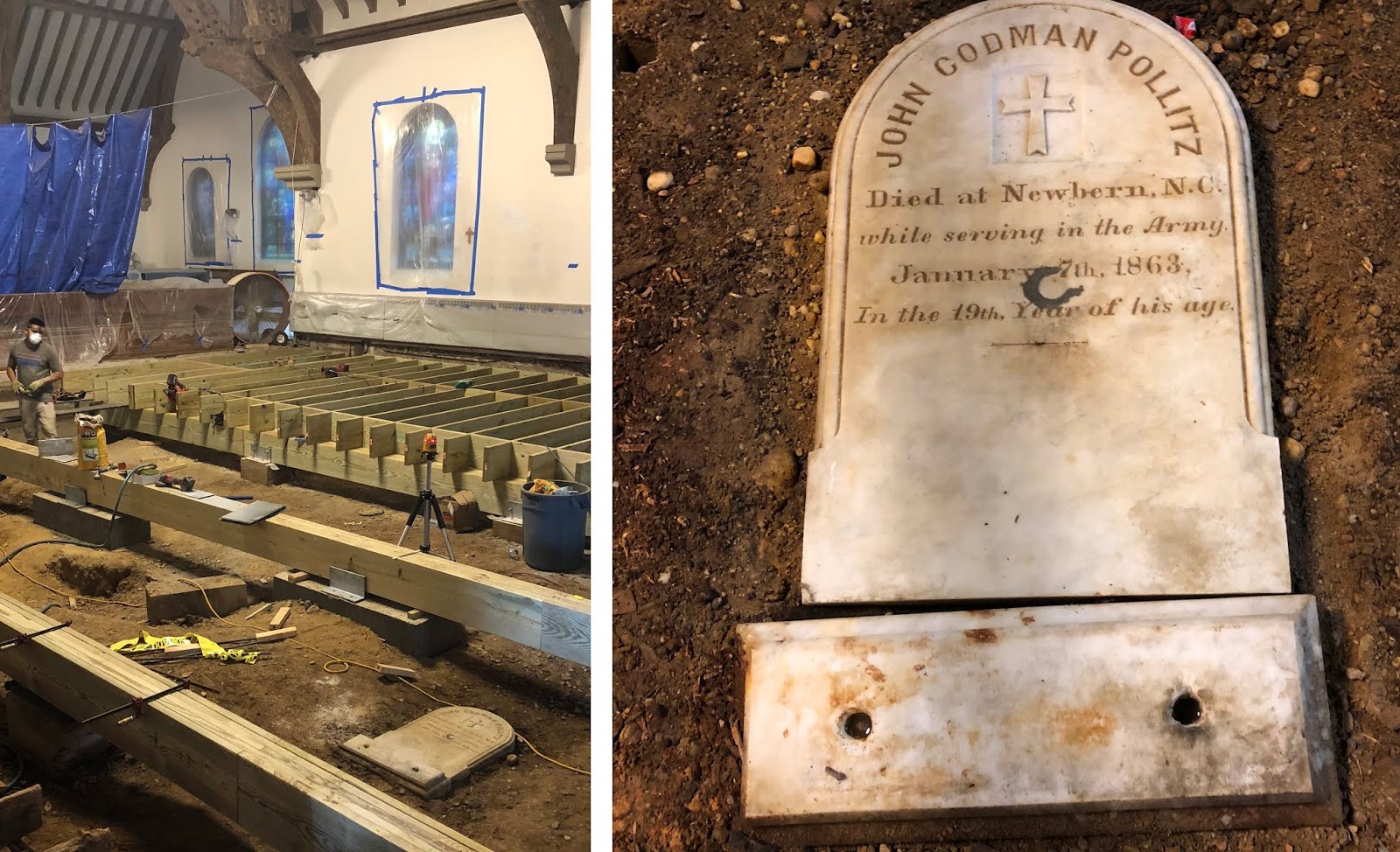
Parishioners had long known that Pvt. John Codman Pollitz’s 1863 grave was incorporated within the current building during construction in 1906. But most of them had no idea where; there was no recorded location.

That changed last summer, when the congregation fixed a longtime problem: The floor of the nave had been deteriorating and sinking. During the floor-replacement project, rotting wooden joists were removed and Pollitz’ headstone was exposed; it was lying flat in a crawlspace area.

Exposed church floor in 2018 and Pollitz headstone flat on ground
(Photos courtesy of Trinity Episcopal Church, Roslyn)
A new plaque marks the spot on the floor under which Pollitz rests. Sunday's dedication took place near the back of the nave, next to the small plaque.

Duffy told the Picket this week that the SUVCW has a database listing hundreds of thousands of graves.

He cited the work of the local Cemetery Restoration Committee of Pachogue, which last year dedicated new headstones for six Civil War veterans at historic cemeteries. Leaders at Trinity moved the Pollitz headstone from the floor area and are trying to determine where to place it.

It’s believed that the young Pollitz was living in Boston and barely 18 when he joined up with the 44th Massachusetts, ostensibly in the summer of fall of 1862. The regiment, which took part in skirmishes and sieges across North Carolina before it was mustered out in June 1863, was in New Bern for several months before transfer to Plymouth, N.C.

A history of the regiment detailed disease and illness that stalked the troops during campaigning and at their quarters. Pollitz, who served in Company F, died on Jan. 7, 1863.

According to the “Record of the Service of the Fourth-Fourth Massachusetts Volunteer Militia in North Carolina, August 1862 to May 1863,” Pollitz and 13 other soldiers in the regiment died from cerebrospinal meningitis.

(Photos courtesy of Patrick Young)
Pollitz’s father was an immigrant and businessman; a history of Roslyn indicated he immigrated from Northern Ireland. But an online search of ancestry-related pages shows Otto W. Pollitz was from Hamburg, Germany, and John’s mother was born in Massachusetts. Church members are unaware of any living descendants.

According to Duffy, John C. Pollitz attended Brooklyn Collegiate and Polytechnic Institute (now part of NYU) and had moved on to college in Massachusetts, where he enlisted with the 44th.

"John did not have to go to war. There was no draft at the time and when the draft would come six months after John's death, his family could have afforded to pay a substitute under the rules then in effect," Duffy wrote this week to other members of the SUVCW camp.

The Picket is grateful to Patrick Young, author of the Immigrants' Civil War Facebook page, for the use of several photos. He attended Sunday's event.