Showing posts with label mcpherson. Show all posts

Monday, July 21, 2025

Little evidence of the Battle of Atlanta remains. The Cyclorama painting, markers and a vivid imagination are a good start. Our experts weigh in on their must-sees

Sign off Memorial Drive, scene from the Cyclorama, McPherson monument and 1964 state map
People often lament Atlanta paved over its Civil War battlefields. But there are some vestiges of the fighting, and you can go to a couple museums and gaze at dozens of roadside markers to get a sense of what happened there.

Tuesday is the anniversary of the July 22, 1864, Battle of Atlanta, which led to the fall of the Southern city weeks later and likely assured the re-election of President Abraham Lincoln. 

I asked area historians, tour guides and preservationists to suggest places the interested can go to learn more about the battle and its importance. Among the suggested stops are markers where Union Maj. Gen. James B. McPherson and Confederate Gen. William H.T. Walker, a grizzled Confederate veteran nicknamed “Shot Pouch," were killed in action that day.

The following responses have been edited for context and brevity. A few sections have material from previous Civil War Picket posts. 

CHARLIE CRAWFORD, president emeritus of the Georgia Battlefields Association

Obviously, start at the Cyclorama at the Atlanta History Center. Spend at least half a day studying the painting and all the associated displays, including maps at the “War in Our Backyards” kiosk on the main floor, not far from the locomotive Texas display. It would help if you have already read related books by Albert Castel, Steve Davis, Earl Hess and Bill Scaife.

Go thereafter to the Carter Center bus parking lot and note three historical markers there, including the one for the Augustus Hurt House, which was Sherman’s HQ during the battle. 

View toward Stone Mountain in Cyclorama, which shows July 22, 1864; Decatur Road on right (Atlanta History Center)
Next, drive to Inman Park MARTA Station parking lot, start eastward on foot along DeKalb Avenue and note the Georgia historical markers, starting with the Pope House. Continue eastward on foot along DeKalb Avenue and turn north onto DeGress Avenue, which has three more markers, including a marker for the Troup Hurt House that you saw in the Cyclorama painting and a marker for the DeGress battery

The Old Decatur Road was more serpentine than DeKalb Avenue is now. It curved south of the railroad, then back north in the vicinity of the Confederate breakthrough. You can see this in the diorama at the base of the painting at AHC.

Return to you vehicle and drive eastward on Glenwood Ave SE and turn left (north) immediately past the I-20 interchange onto Wilkinson Drive. In 150 yards, turn left into the parking area for DeKalb Memorial Park. Walk back south to Glenwood Avenue. Note the Walker monument (upright cannon), its associated marker, and the marker across Glenwood Avenue for Terry’s Mill Pond. (Picket photo of Walker stone)

When done, walk back to your car and turn left (north) out of the parking lot until you hit Memorial Drive. Turn left (west) on Memorial Drive then take the first right onto Clay Street. Stop the car almost immediately and note the “Battle of Atlanta Began Here” marker on the west side of the street.

Safely find a way to turn around and head south, then make a right (west) on Memorial Drive. Take the second left (south) onto Maynard Terrace, and immediately after passing the I-20 interchange, turn right (west) onto McPherson Avenue. Park when you see the McPherson monument (upright cannon) on your left. Read the associated markers there. 

Not a comprehensive tour, but should be enough to prompt further research among the uninitiated.

Go to Georgia Historical Society’s marker page and read the texts ahead of time by searching DeKalb County and Fulton County markers.

JIM OGDEN, historian at Chickamauga and Chattanooga National Military Park

Charlie is certainly the expert here, so I would second his recommendations and add only a couple of others.  

While not 100% historically accurate, the visual of the Cyclorama is so valuable that going there or starting there is really important. It would also be really valuable to have a printed copy of it with you while you do the walk along DeKalb Avenue, particularly for when you're along DeGress or if you maybe even walk just a bit farther east on DeKalb and then turn around and look back west, holding that portion of the Cyclorama up in front of you. 

It's a window back in time through all the 21st and 20th century around you.  I can't remember if AHC is selling any sort of printed reproduction of it but there is the old Kurtz 30 p. booklet of it that probably can be found on the used market.

Marker at Springvale Park mentions remnant of ravine (David Seibert/HMbd.org)
This might be too obvious, but the only other thing I might note is that the many railroad tracks today on the south side of DeKalb are the modern version of the one track that is another one of the important landmarks in the Cyclorama.

For someone who might be up for a bit more of a walk, particularly if they want to do it a bit more from the perspective of the Confederate attack in the painting, would be to walk farther west on DeKalb, at least to Waverly Way, and then north to Springvale Park to see the remains of the low ground the Confederates crossed north of the railroad as they attacked east and the markers there. (Springvale Park has one of the few monuments to the battle. It has a marker as well, indicating that Manigault’s Confederate brigade reformed in the low ground there before making their final dash).

One could even go to Oakland Cemetery to the rise from which Hood watched the battle.  

Atlanta may have seemingly swallowed the July 22 battlefield, but there are still faint traces of that history to be found on the ground.

Artillery Capt. Francis DeGress trails Maj. Gen. Logan in Cyclorama scene (AHC)
PERRY BENNETT, local historian and tour guide

Perry Bennett, a retired Army lieutenant colonel, will be giving a free tour at 1 p.m. Tuesday.

The historian said the tour will start at a historical marker on the grounds of Alonzo A. Crim Open Campus High School, 256 Clifton Road SE. It is being given to the Longstreet Camp of the Sons of Confederate Veterans but anyone can attend. 

“I cover both sides but am focused upon when the battle began on this particular tour and what went well and what did not,” he said.

Bennett mentions markers where Bate’s Confederate division deployed, where two of his brigades were blocked during their attack and another sign indicating where Walker’s division attacked the same hill from Terry’s Mill pond

The tour will also make stops at the sites of McPherson’s and Walker’s killings.

Those interested can contact Bennett at lperrybennettjr@gmail.com

CHAD CARLSON, East Atlanta historian and Civil War photo collector

Chad Carlson, a historian with the Georgia Department of Transportation, suggests a stop in East Atlanta Village, at the intersection of Glenwood and Flat Shoals roads. The agency put up a Battle of Atlanta replica marker and interpretive panel in 2013 to replace a 1930s version that was removed in the 1970s. (Read about that here).

Carlson said he appreciates the simplicity of the marker, which describes military units and troops movements. It describes Confederate troops pushing Federal units back to Leggett’s Hill on July 22.

Marker about troop movements in East Atlanta (Georgia DOT)

GDOT made an exact replica but used a cheaper metal material, I think aluminum, instead of bronze, so (there is) less likelihood of it getting stolen.”

For years, local historians, Civil War buffs and the Battle of Atlanta Commemoration Organization (B*ATL) have worked to educate residents and visitors to the rich Civil War history of East Atlanta, Kirkwood and other Atlanta neighborhoods.

Tuesday, July 26, 2022

Rocky Face Ridge Park: North Georgia community celebrates 20-year effort to open scenic site featuring Civil War earthworks and recreation trails

Bob Jenkins (left) with reproduction 3-inch ordnance rifle at park. (Picket photo)
High above Crow Valley, on a ridge near Dalton, Ga., men of the 64th and 125th Ohio endured withering Confederate fire that cut down officers and enlisted men alike.

It was May 7-8, 1864, at Rocky Face Ridge, during the first battle in what became known as the Atlanta Campaign. Gen. William T. Sherman sent troops from the Chattanooga area as a feint while Maj. Gen. James B. McPherson rushed to Snake Creek Gap in a bid to cut Rebel forces off from a vital railroad.

But the feint did not come without cost: About 1,400 men from both sides became casualties in the fighting over several days at Rocky Face Ridge in northwest Georgia.

One of them was remembered Monday afternoon as Whitfield County and a host of Civil War, conservation, recreation and other entities formally opened Rocky Face Ridge Park just north of Dalton.

Georgia Division reenactors take part in ribbon cutting Monday (Picket photo)
Scott McIlvain was among the 100 attendees gathered under a pavilion on a sweltering day. His ancestor, Col. Alexander McIlvain of the 64th Ohio, died from wounds he received atop the ridge, which offered its defenders commanding views and defenses.

Rocky Face Ridge Park was 20 years in the making, following purchases of 625 acres -- in the shape of a rectangle -- on top of the mountain, and then 301 grassy acres below, where the ceremony took place.

The county touts the venue as a wonderful history magnet -- with the remains of Federal and Confederate earthworks, trenches, a replica cannon and 12 interpretive signs spread out over a 3-mile trail below the ridge. The signs have QR codes that link to online stories about the battle.

The purchases were in 2002 and 2016 (Courtesy of Whitfield County)
Many visitors will likely come for the recreation offerings, including 10 miles of bicycle trails and an area used for cross country runs.

It’s a beautiful setting, topped by the spiny ridge that offers breathtaking views.

“There are mountains on which you can see the whole Atlanta Campaign, from Lookout Mountain to Kennesaw Mountain, on a good day,” Kathryn Sellers, chair of the Dalton Historic Preservation Commission, told the crowd.

Getting to the mountaintop is not easy. It’s accessible from a bike trail, but officials are hoping a better-marked, hiking-only trail will one day be constructed. Visitors are rewarded with a great view and stone breastworks built by Confederate defenders.

T-shirt worn by bicyclists group features Civil War cannon (Picket photo)
The effort to open the park got a push in 2016 when the Southern Off-Road Bicycle Association (SORBA) became involved.

The association donated money and helped design the trail system. The Northwest Georgia chapter helps maintain the trails.

SORBA was able to convince officials that the trails would not damage Civil War features.

Gaye Rice, president of the local chapter of SORBA, told the audience on Monday that bicyclists using the Buzzard’s Roost trail come from all over the Southeast to ride the ridge. Riders have been using the trails for about two years.

One of a dozen markers placed on 300-acre tract below ridge (Picket photo)
Rocky Face Ridge Park was the site of two Civil War clashes.

Federal Maj. Gen. George Thomas probed the Confederate defenses in February 1864, ahead of the grinding march on Atlanta. The park is near Dug Gap, Mill Creek Gap and Tunnel Hill, other Civil War sites of interest.

And in early May, Union troops advanced toward Dalton, which was held by forces under Confederate Gen. Joseph E. Johnston. The Yankees “were the tip of the spear” that launched the Atlanta Campaign, said Jim Ogden, chief historian at Chickamauga & Chattanooga National Military Park.

Items shown Monday include detailed aerial view of ridge's top (Picket photo)
Sherman knew it would be impossible to take the mountain head on, but he wanted to divert his foe as McPherson moved to the south.

“At places, the crest of the ridge was only four-persons wide, with sheer drop-offs on either side. Confederates stacked rocks to create breast works and, where the ground allowed, dug earthen works,” says Emerging Civil War. “The line runs for miles, from the northern tip of the ridge southward to Mill Creek Gap and Dug Gap.”

Union troops were able to take part of the northern tip of the ridge in May, but attacks on the division of Maj. Gen. Carter Stevenson failed to dislodge the Rebels.


The American Battlefield Trust, which is a major player in the acquisition of Civil War battleground, has YouTube videos and articles about the fighting at Rocky Face Ridge and Resaca. It is here where Sherman and Johnston began their famous flanking game that eventually pushed the Confederates back to Atlanta.

One of the trust’s articles is a letter that was published in Confederate Veteran magazine in 1918. The author was Lt. Col. David H. Moore of the 125th Ohio, writing to a former foe. He describes the fierce fighting on the crest of Rocky Face Ridge. He suffered a hip wound from a bullet that killed another soldier. About 55 men in the regiment were casualties.

To the Confederate veteran, Moore (right) wrote:

“That night, as I recollect, your men reconsidered your purpose to hold the ridge, only to fall back to another and stronger position, thus inaugurating that series of unparalleled struggles which has gone down in history as the ninety days' battle. Your division was almost constantly opposed to us during the Atlanta Campaign. So accustomed had we become to your style of fighting and to the vicious soprano of your Minie balls and to the indescribable fury of your battle-shouts and charging-yells that it was lonesome when by chance we struck a stranger foe.

Johnston, surprised by McPherson’s move and seeing that Sherman was moving south, evacuated troops off the ridge and rushed them to Resaca. The Federal strategy had failed, given McPherson moved back to Snake Creek Gap when he thought his army might be in a precarious position. Sherman was angry about McPherson’s failure to attack and perhaps cut Johnston off from the railroad. The Battle of Resaca ensued, with Johnston having consolidated his troops.

Monday’s ceremony included a tribute to Mike Babb, the former Whitfield County commission chairman who was the driving force behind the park.

Three of several mounds showing position of Mississippi battery (Picket photo)
According to the Chattanooga Times Free Press, the $4 million effort was funded with about $3.2 million in local, state, and federal government funds, plus about $800,000 in grants. Numerous organizations supported the project, including the Georgia Battlefields Association and the Georgia Piedmont Land Trust

“The amazing thing about this park is how many people got involved in it,” said Babb.

Chris Welton, a trustee with the American Battlefield Trust, said partnerships resulted in a park that is a "poster child for what we are about." He cited funding from the National Park Service's American Battlefield Protection Program as a seed for preservation projects.

Following the ceremony, I was able to see Confederate trenches (left) and the remains of Stanford’s Mississippi battery. The unit fought in several major battles during the war, including Shiloh, Chickamauga and the Atlanta battles.

I am grateful for Brian Chastain, the county’s recreation director, and another employee for taking me there via a rugged utility vehicle. It's always poignant to see physical reminders of what occurred as Americans fought each other.

The remains of the entrenchments offer proof for a statement from Bob Jenkins, head of Save the Dalton Battlefields:

Dalton, Georgia, and the county she resides in, Whitfield County, have more undisturbed Civil War earthworks than any other county in the nation.

If you go: Rocky Face Ridge Park is accessible from 2209 Crow Valley Road, Dalton, Ga.

 Jim Ogden of Chickamauga and Chattanooga was among speakers (Picket photos)

Sunday, July 24, 2022

In Atlanta, John A. 'Black Jack' Logan picked up the pieces and helped save the day for the Union. He inspired his men in several battles

In the nick of time, Logan rallies the troops on July 22, 1864 (Picket photo)
On Friday, I marked the 158th anniversary of the Battle of Atlanta in a rather unusual way. Rather than walking paved-over battleground, I drove to the Atlanta History Center and bought one of two puzzles it stocks depicting the Cyclorama painting. It's been a while since I put one together.

The AHC, of course, houses the colossal Battle of Atlanta Cyclorama, which focuses on a brief Confederate breakthrough on the afternoon of July 22, 1864, at the Troup Hurt house.

Galloping furiously to the rescue, hat in hand, is Union Maj. Gen. John A. “Black Jack” Logan, temporary head of the Army of the Tennessee. That’s the scene shown in the 48-piece puzzle (I know, not super challenging to put together).

Known for his flowing hair and marvelous mustache, Logan was perhaps the best “political” or non-West Point general fighting for the Union. His clutch performance in Atlanta and a few days before, at Dallas in nearby Paulding County, were perhaps his shining moment.

Capt. DeGress trails Logan as they ride forward (AHC)
Entering the battle, Logan, commanded the 15th Corps, which with the 16th  Corps and 17th Corps, made up the Army of the Tennessee. During the pitched fighting on the 22nd, Maj. Gen. James B. McPherson, commander of that group, was killed. Logan took command of the three corps and rallied troops after the breakthrough and pushed the Rebels back, securing a decisive victory.

“He was a damn good leader -- indispensable in restoring 15th Corps morale that afternoon,” says Gordon Jones, senior military historian and curator at the AHC.

Jones cited remarks made by J.W. Long of the 2nd Iowa Infantry in a National Tribune article in September 1888:

"No one can describe how Logan looked in battle any more than he could describe the raging sea. I am satisfied that the biggest coward in the world would stand on his head on top of the breastworks if Logan was present and told him to do so."

Logan excelled despite no military training before war (Library of Congress)
Logan, from Illinois, served in the U.S. House before the war. He opposed abolition of slavery, but his thoughts on that changed during the war and he later espoused equal rights for African-Americans. He served with distinction at Fort Donelson, where he was wounded, and Vicksburg.

In his review of Gary Ecelbarger’s biography of Logan, Charles R. Bowery writes of the general: “Logan was a quick study in tactics and the operational art. He took care of his men, shared hardships with them, and led by example at all times, placing himself in danger to inspire his men on numerous battlefields. The units he commanded responded in kind, often stopping to cheer him when he appeared on the field of battle to reverse a deteriorating situation.”
Such a potential situation presented itself at Atlanta, when Logan, as ranking officer, found himself in the hot seat after McPherson (right) was shot down. The news of the popular McPherson’s death tore through the Union lines that afternoon. He was a favorite of Gen. William T. Sherman.

Ten years after the war, Logan made these remarks at the unveiling of the McPherson monument in Washington, D.C.

“The news of his death spread with lightning-speed along the lines, sending a pang of deepest sorrow to every heart as it reached the ear; but, especially terrible was the effect on the Army of the Tennessee. It seemed as though a burning, fiery dart had pierced each breast, tearing asunder the flood-gates of grief, but, at the same time, heaving to their very depths the fountains of revenge. The clenched hands seemed to sink into the weapons they held, and from the eyes gleamed forth flashes terrible as lightning.

“The cry ‘McPherson, McPherson! and “McPherson and revenge!’ rose above the din of battle, and, as it rang along the lines, swelled in power, until the roll of musketry and booming of cannon seemed drowned by its echoes.

The Cyclorama, which was painted in Milwaukee to show a Union victory, was later modified and misinterpreted in Atlanta as showing a Southern triumph – however short.

At 4 p.m. on July 22, the battery of Federal Capt. Francis DeGress was firing canister as fast as it could near the Troup Hurt house (left). Determined Confederates continued to push forward and were about to be upon them.

DeGress knew the horses could not pull back the guns in time, Jones said, and he had two guns spiked. The captain and Sgt. Peter Wyman stayed with the other two weapons, firing double canister. They eventually had to flee; Wyman was killed while DeGress fled back to the collapsed Federal line.

Fast-forward to the scene depicted in the Cyclorama: Logan – riding a black horse named Slasher -- rallying his troops and rushing toward the breach, with DeGress riding behind.

DeGress, already a respected veteran, is about to become a folk hero to the Northern cause. He retakes the four 20-pounder Parrott guns and turns them on the retreating Confederates.

(It’s important to note the battlefield on July 22 was much larger than what is shown in the painting. For example, troops clashed for a much longer time on Bald (Leggett’s) Hill south near current Interstate 20.)

Charlie Crawford, president emeritus of the Georgia Battlefields Association, told the Picket that Logan was “inspirational” at Dallas and Atlanta.

“Didn’t function much as an army commander, but was great at restoring the line of his own 15th Corps. McPherson and Dodge (16th Corps) deserve credit for repulsing the initial attack on the far left flank, and Blair (17th Corps), Leggett, and G.A. Smith did most of the command work in the Battle for Bald Hill.

“By the time (approx. 2:30) that Logan knew he was an army commander, 17th Corps was facing repeated attacks by Cleburne and Maney, but Blair, Leggett, and G.A. Smith were effective in their respective command roles without a lot of direction from Logan. Once breakthrough occurred in 15th Corps sector (approx. 4:30), Logan justifiably focused on that emergency.”

Logan, DeGress and others head for the Troup Hurt house breakthrough (AHC)
Despite his heroic service that day, Logan served as commander of the Army of the Tennessee for only four days. Sherman gave that job to Maj. Gen. Oliver O. Howard, a West Point grad. Sherman reportedly was skeptical of politicians in uniform, but there may have been personal differences, too. Logan was crushed by the news.

He “viewed this as a personal slight which gave him a very dim view of West Pointers in the future,” says the American Battlefield Trust. He performed well in the coming days at Ezra Church and Jonesboro.

“Logan put on his politician hat in the fall of 1864, returning to his home state to campaign for Abraham Lincoln -- a marked contrast for the erstwhile Democrat,” the trust says. “In December, the major general returned to the field at the head of the Fifteenth Corps until the cessation of hostilities. He was given command of the Army of the Tennessee on May 23, 1865 -- just in time to lead it in the Grand Review in Washington, DC.

Logan got back into politics, serving several terms in the U.S. House and Senate. He was an unsuccessful Republican vice presidential candidate in 1884 and was considered a front-runner in the upcoming presidential election. He died in 1886 at age 60 from the effects of rheumatism.

The artists made this sketch of Logan, other figures for the painting (AHC)
He also is remembered today as the father of Memorial Day, which began as Decoration Day in 1868. As head of the Grand Army of the Republic, Logan lobbied for a special day to commemorate America’s war dead.

Logan obviously is the star of the Cyclorama, given there are no recognizable Confederate officers during the fight at the Troup Hurt house.

The circular painting debuted in Minneapolis in June 1886, a few months before the general died, but there is no evidence that he saw it (Logan later in life, right. Library of Congress photo) .

Harper's Weekly illustrator Theodore R. Davis is responsible for Logan and DeGress being prominently depicted in the painting. Davis, who traveled with the Federal army, submitted an illustration and article for the publication about DeGress soon after the battle and served as an advisor to the artists in Milwaukee.

Jones, the AHC military historian, told the Picket that stories claiming Logan commissioned the painting to promote a political campaign amount to an untrue urban legend.

The Battle of Atlanta was paid for by about 40 Chicago-area investors in the American Panorama Company. Logan had nothing to do with it,” said Jones.

“Theodore Davis ... was a personal friend of Logan and all the top brass of the Army of the Tennessee. He was the one who placed Logan so prominently in the foreground of the painting. Besides, having him there would give the painting celebrity star power and help sell tickets in the upper Midwest.”

Advertisement for painting when it was show in Minneapolis in 1886 (Picket photo)

Thursday, July 29, 2021

Now you see them ... now you don't. Civil War markers sometimes are casualties to manmade and natural forces. In Georgia, a historical society and volunteers make them whole

Marker in 2008 (Photo by Felch Dumas, HMdb.org) and remnants of post, near stop sign (Picket photo)
It’s not easy being a historical marker. The elements take the shine off you, things fall from the sky, people sometimes want you moved and – worst of all – motor vehicles can take you out at any moment.

One of those casualty situations recently occurred in an Atlanta neighborhood. The “Battle of Atlanta Began Here” sign, detailing how marching Federal troops chanced into a surprise Confederate assault on July 22, 1864, was either hit by a vehicle or a downed power pole, said Henry Bryant, a local preservationist.

Like other safekeeping custodians of damaged markers in the area, Bryant is working with the Georgia Historical Society to see that repairs are made and the sign is put back up.

But that takes time, funding and the proper materials, depending on whether the sign, its pole or both are damaged.

A couple miles from where Bryant and a tour led by the Battle of Atlanta Commemoration Organization (B*ATL) encountered the damaged sign on July 18 is a spot where a suspected drunken driver knocked down another Civil War marker.

Marker before it was hit by car (Photo by Felch Dumas, HMdb.org) and in storage (David Mitchell)
This one, with the mesmerizing title “Noon Under the Trees,” details how Union Maj. Gen. James B. McPherson met for lunch with other commanders before riding toward the sound of gunfire, only to be killed a short time later.

The DeKalb Avenue marker was damaged a few years ago and is currently being kept by David Mitchell, executive director of the Atlanta Preservation Center, until it can be repaired. The base, where the post is inserted into the sign, is gone, Mitchell said.

James McPherson
“The marker is on the Georgia Historical Society’s list of projects to be addressed in the future,” said Elyse Butler, the organization’s marker manager. “Due to the damage marker collar, it will certainly need to be recast prior to reinstallation.”

The state of Georgia ran the Georgia historical marker program from the 1950s until the mid-1990s. The historical society began to erect new markers in 1998. GHS took over the coordination for maintaining the older state markers in 2015, Butler said.

“As such, we are currently working through the state’s backlog of marker projects. While it may take some time to address the damaged marker (Noon Under the Trees), please be assured a plan for replacing the marker is currently under review.”

Charlie Crawford, president emeritus of the Georgia Battlefields Association, has led countless tours of area Civil War sites and is very familiar with pertinent historical markers.

It was common for 50-60 historical markers to be in a state maintenance shop awaiting repairs in the mid-1990s, he said. They came from around Georgia, but the highest concentration was from metro Atlanta, scene of the worst traffic.

“I feel comfortable saying that more markers were victims of vehicle collisions in the Atlanta area than elsewhere around the state. Often, the aluminum markers would survive a vehicle collision but the posts would not, so not all markers would need repair, but they might languish in storage until resources -- i.e., workers, materials, and funds -- were available,” Crawford wrote in an email.

Another view of damaged Clay Street sign post near utility pole (Picket photo)
Sometimes, markers are moved, Crawford says. They can be precipitated by road widenings or homeowners who want them to be relocated because people walk through their lawns to view them. And motor vehicles are a constant threat.

“The Surrender of Atlanta” marker that was at the V-intersection of Northside Drive and Marietta Street was knocked over so frequently that it was moved to the west side of Marietta Street. A Georgia Tech alumni and businessman paid for the relocation, Crawford said. When it ran the marker program, the cash-strapped state increasingly turned to donations for maintenance.

A homeowner in Kennesaw, northwest of Atlanta in Cobb County, does not mind having a marker in his yard but would like it relocated a few yards away so that it doesn’t block his view of traffic when trying to exit his driveway,” said Crawford.

In 2010, the Picket wrote about a Civil War marker that mysteriously ended up a few miles from its original location. The sign, which details the movements of the Federal left wing in Decatur in 1864, had been missing for some time. The state picked it up and the marker eventually was reinstalled at the proper location near Interstate 285.

Volunteers expect to have this sign back up soon (Henry Bryant)
Back in East Atlanta, Bryant is coordinating the return of the Battle of Atlanta marker to its longtime home on Clay Street near Memorial Drive. All that currently remains of the marker is half of its shattered post, rebar jutting from the exposed end.

“The sign was not significantly damaged. The post was a near total loss. The power pole is still on the ground at the site. Fortunately, I had another post for the marker,” he said in an email.

He has located a power auger and will work with volunteers to make the repairs and installation. “At this point a schedule for completion is a matter of logistics.”

Bryant described what can happen when a sign needs to be fixed or replaced. The “Bate’s Battle Line” sign a couple blocks east on Memorial Drive is listed by the GHS as missing.

McPherson monument in East Atlanta (Henry Bryant)
The post he will use for the “Battle of Atlanta Began Here” repair was initially intended for the Bate marker. “We have had the money to recast that sign, but had run into issues with obtaining property owner permission. Now a new (grocery) store is being built at that location.”

A traffic accident last year damaged the fence to an East Atlanta monument where McPherson was killed. Two volunteers reconstructed the fence's pipe rails and masonry posts, Bryant said in email.

Tuesday, March 19, 2019

Treasured chest: Maj. Gen. James B. McPherson items, long kept at an Ohio farm, are part of new Atlanta Cyclorama exhibits

Chest and belt plate (Courtesy of Perry Adams Antiques)
The death of Maj. Gen. James B. McPherson, the only Union army commander to be killed in battle during the Civil War, wasn’t just a deep and sorrowful loss to his troops and commanders, Ulysses S. Grant and William T. Sherman. His was a young life so full of promise – with many believing he might have helped to bind the country’s wounds once the conflict ended.

Maj. Gen. McPherson
That promise died on July 22, 1864, when McPherson, 35, was shot from his saddle by a Confederate infantryman during the Battle of Atlanta.

His remains were returned to his hometown of Clyde, Ohio, amid great national mourning that extended to the White House. Many foes in the Confederate army, including West Point classmate John Bell Hood, also expressed grief.

McPherson’s 87-year-old grandmother wrote to Gen. Grant: His funeral services were attended in his mother’s orchard, where his youthful feet had often pressed the soil to gather the falling fruit; and his remains are resting in the silent grave scarce half a mile from the place of his birth. His grave is on an eminence but a few rods from where the funeral services were attended, and near the grave of his father.”

In addition to a grieving family and a fiancée, Emily Hoffman – who would never marry – McPherson left behind a number of personnel effects, including a travel (or campaign) chest, a captured Confederate canteen and the model 1851 belt plate he was said to be wearing on the day he died.

Now, nearly 155 years after those items made the sad journey to Ohio, they are back in Atlanta, exhibited with the newly restored Battle of Atlanta Cyclorama. The Atlanta History Center purchased the items late last year and the three artifacts are among the McPherson-associated artifacts on display in a gallery outside the painting rotunda.

New exhibit at the Atlanta History Center (Picket photo)
Gordon Jones, senior military historian at the history center, said McPherson was venerated across the country, including in Atlanta, where he led the Army of the Tennessee in battles that collectively spelled doom for the South’s military cause.

(Courtesy of Perry Adams Antiques)
“The first Civil War monument of any kind placed on an Atlanta battlefield was placed in his honor in 1877 by U.S. soldiers. That monument was adopted by the city of Atlanta to represent not only an iconic event, but also the unique wartime history of the city,” Jones told the Picket.

The monument to McPherson lies in the East Atlanta neighborhood, at the corner of McPherson and Monument avenues.

“Note Fort McPherson also named in his honor. Now you could say some of that was Southern bragging about killing the top U.S. general -- but a lot more of it was because of the story of his death, his friendship with Sherman, his fame and popularity, and the post-war desire in Atlanta for reconciliation between North and South.”

Exhibit includes bullet some say killed the general (Picket)

Final resting place for artifacts

The Atlanta History Center made the purchase through Perry Adams Antiques in Petersburg, Va., which detailed the fascinating postwar history of the trunk and other items on its website.

After McPherson’s death, the effects transferred to one of his brothers. Upon the latter’s death in 1877, the general’s nephew acquired them. But that man, in need of money, sold the items in 1924 to a family that lived outside Clyde. Perry Adams Antiques acquired the grouping when it attended the Ohio Civil War & Artillery Show and traveled to the family farm to view it.

“These effects are amongst the most important of Civil War artifacts we had the pleasure of offering,” the company said.

Co-owner Ben Greenbaum said the Atlanta History Center is the appropriate spot for the collection. Jones concurs: “McPherson' story almost certainly influenced the choice of this battle as the subject of a cyclorama, as opposed to all the others fought during the Atlanta Campaign.”

Detail of the Rebel canteen (Courtesy of Perry Adams Antiques)
Neither would disclose the sales price.

The small McPherson exhibit also includes the bullet that reputedly killed him and a post card with a photograph of the general, inset with a postwar scene of his death location. Those were already in the history center collection.

“We assume that McPherson had the trunk with him during the Atlanta Campaign; there is no provenance on the Confederate canteen, although it was not unusual for upper echelon officers to be presented with war souvenirs,” said Greenbaum.

Belt plate, canteen and campaign chest (Picket photo)
The trunk is similar to others in the history center’s holdings, down to the hardware and stencil lettering.

“It has obviously seen heavy use, has been repaired and has been in the family,” Jones said. “I don’t know for sure, but it probably (was) sent back to the family with his personal effects after he was killed.”

The cedar canteen, which has the original leather strap and roller buckle, features on one side the carved letters "McP.”

“That suggests to me that the general kept it as a souvenir much the same way a private soldier would,” Jones said. “On the other side of the canteen, someone has written ‘McPherson’ in pencil -- looks like a child's writing -- so I think that lettering was put there by a family member well after the war.”

Reverse side of the belt plate (Perry Adams Antiques)

Did bullet hit his belt plate?

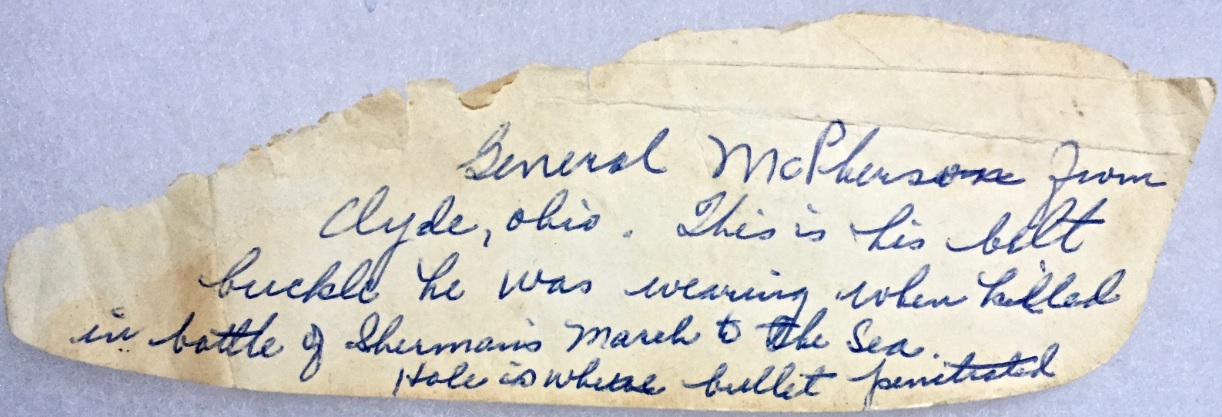
One of the more curious items in the case is the belt plate (or buckle) that McPherson was wearing when he was killed, according to family tradition.

Slips of paper that came with the collection have handwritten notations indicating the triangular nick in the plate came from the fatal bullet.

It is known that McPherson was surprised to encounter Rebel troops as he rode to inspect the position of troops relatively early in the battle. He was said to have tipped his hat before swinging his horse around in order to make his escape.

Old note claims belt was hit by bullet (Perry Adams Antiques)
Charlie Crawford, president of the Georgia Battlefields Association, said McPherson was leaning forward on his horse when a Cpl. Robert Coleman of the 5th Confederate (Cleburne’s Division) fired a single shot. The bullet went upward and hit McPherson’s lung and heart or aorta, exiting the chest.

A placard at the Atlanta History Center says the nick did not come from the bullet.

“It may have resulted from the impact of a rock or other object when McPherson’s body hit the ground.”

Other items in the collection

The general’s hat, some papers he was carrying in his pocket and watch were believed to have been taken by Confederates.

(Perry Adams Antiques)
The collection once included a frock coat, which was sold years ago to an Ohio antiques dealer. (Greenbaum says he has no idea what became of it.)

It also has a carte de visite signed by McPherson, his mother’s wedding band and an earring, along with several postwar items.

Regarding the image of McPherson (right), Jones said that while it is not currently on exhibit, it will be rotated with the post card. “That's so we can keep the exhibit fresh but also to limit prolonged light exposure on these paper items.”

The 1886 painting only a few yards from the McPherson depicts Federal soldiers rushing to plug a gap made during a brief Confederate breakthrough. An ambulance bearing McPherson’s body slowly makes its way to Sherman’s headquarters, where he had visited with his boss in the morning on the day of his last ride.

What the nation lost

McPherson remains an example of young talent that seems snuffed out to early.

He benefited from being a protege of Halleck and Grant, which is not a bad thing, but his daily interactions with both made his talents more readily observable and more quickly rewarded then perhaps some others,” said Crawford.

(Courtesy of Perry Adams Antiques)
McPherson had performed well under Grant in the Fort Donelson, Shiloh and at Vicksburg, where he was a corps commander. By April 1864, he joined Sherman’s forces during the Atlanta Campaign. At Resaca he received some criticism for not making a vigorous attack on a smaller foe. Sherman said afterward, "Well, Mac, you've missed the chance of a lifetime." 

But he was a favorite of Sherman and Grant -- who called him one of the army's "ablest, purest and best generals" -- until the end.

Sherman cried upon hearing the news of his death. A letter he wrote to authorities about the loss included these lines:

“I, his associate and commander, fail in words adequate to express my opinion of his great worth. I feel assured that every patriot in America, on hearing this sad news, will feel a sense of personal loss, and the country generally will realize that we have lost, not only an able military leader but a man who, had he survived, was qualified to heal the national strife which has been raised by designing and ambitious men.”

Cyclorama detail shows ambulance with body (Atlanta History Center)