Showing posts with label Duke. Show all posts

Monday, August 28, 2023

Cathryn Newton, then 16, was on watch when the USS Monitor was found. The project was an amazing collaborative effort, she writes

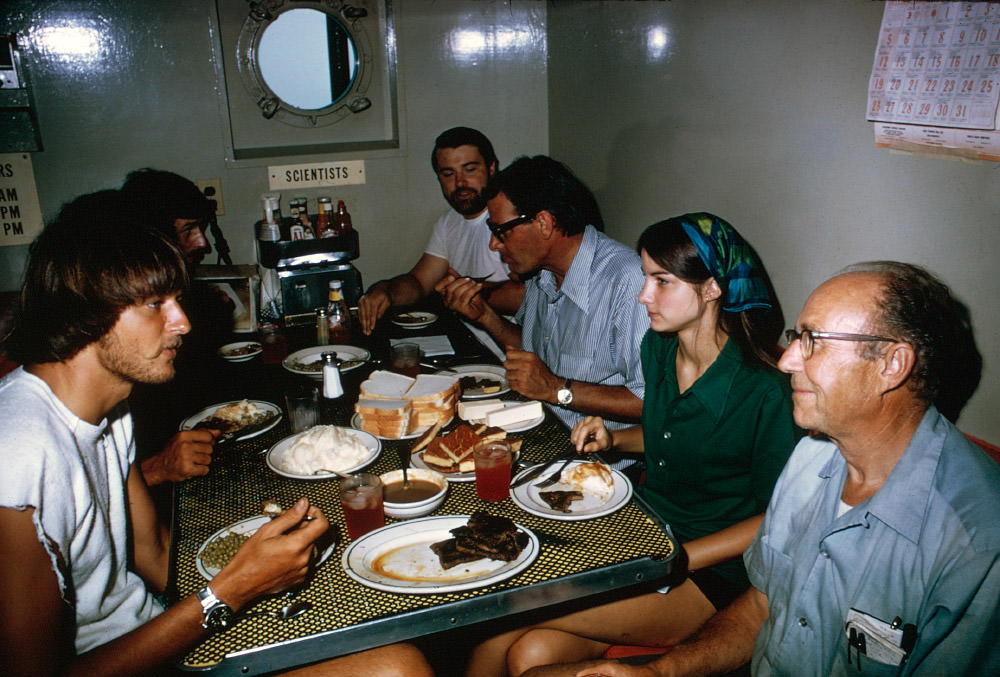
Cathryn R. Newton on Eastward in 1973 (Courtesy of MIT Museum). Her mother,
Sunny, asked her father whether they found the wreck. He whispered, 'We think so'
Cathryn R. Newton found her career calling while sailing as a teen on the RV Eastward with her father, John G. Newton, and other scientists. They located the Civil War ironclad USS Monitor on Aug. 27, 1973. Since then, the Syracuse University dean emerita and professor has conducted extensive research on shipwrecks and marine fauna and environments. Newton, who was raised in Beaufort, N.C, recently led a scientific team that traveled to Newfoundland. The Civil War Picket asked for her recollections of the Monitor expedition and she submitted this essay.

50 years ago: Just after noon, we found the wreck of the USS Monitor, the most famous missing ship in America, on Aug. 27, 1973. Four investigators conducted this two-week, blue-water expedition organized and funded through the work of my father, John G. Newton, a Duke oceanographer and marine superintendent of the oceanography program; Harold "Doc" Edgerton, strobe pioneer, inventor, and longtime MIT engineering faculty who’d invented many of the instruments we used; Bob Sheridan of Delaware (later Rutgers), accomplished and hard-charging marine geophysicist who had a nearby seismic survey funded; and Gordon Watts, the brand-new marine archeologist at the state of North Carolina (the inaugural one).

Duke University's research vessel Eastward
Our team decided to take Monitor’s (+ towship USS Rhode Island’s) mariners at their word --and search near the edge of the continental margin 16 miles off  Hatteras. {All but one of many other Monitor searches in summer 1973 were near shore). My father, Bob Sheridan and Doc Edgerton wrote the proposals that had secured funding for the E-12-73 cruise from NSF and National Geographic Society (NGS).

My father had mapped the NC continental margin in a recent geological atlas and, with Orrin Pilkey, published the first work on the Hatteras Submarine Canyon. This background elevated our odds of success, but did not guarantee it.

I was a 16-year-old Duke sophomore who’d worked all summer making cross sections and assembling geological/bathymetric data for the upcoming cruise; my friends Paul Kelly and Bob Springle were deployed in parallel. Shy, hardworking and unconfident, I logged many hours at the Duke Marine Lab preparing cruise materials, and had expressed an interest.

Yet the expedition consisted principally of towering figures in ocean sciences, with a few doctoral students. Then came a surprise: 24 hours pre-departure, a space held for a woman member of the NGS Explorers Club came vacant. This young girl leapt into the air with joy.
1973: Gordon Watts, front left, behind him John Harris; on right, from back,
Robert Sheridan, John Newton, Cathryn Newton and Harold Edgerton (NOAA)
Following the one best piece of advice ever from my mother Sunny Newton, I kept a journal of the expedition, the only one extant. When my father died without notice at 52 of heart failure in 1984, I inherited every bit of planning material for the expedition and all the files amassed while they (Dad, artist Sandy Belock and Gordon Watts) tried to figure out what we were seeing in this complex shipwreck. I have written a book manuscript on all this, with input from many, and sent it to my superb editor.

As I write, it is noon on August 27. Fifty years ago to the minute, our 12-4 midwatch came on duty. My watch was headed by get-it-done geophysicist Bob Sheridan. Second mate Tom Stout, a veteran Navy captain on loan from University of Rhode Island, was on the bridge. The other three investigators were having lunch in the galley. I was deployed to the Simrad recorder in the wet lab -- a basic depth recorder, not as refined a view of things as on the vertical PDR (portable diver recall) in the electronics lab.

Just after noon, it recorded something that looked like a smudge. I was trying to figure it out when veteran electronics technician Fred Kelly, one of my father’s closest colleagues, was coming in to put his fishing gear away and told me this could be it.

Bob and Tom Stout instantly reacted, and Stout remarkably brought the ship about immediately over the wreck. A high-contrast target appeared on the vertical PDR up above -- with the intensity expected for a metal wreck. It could be Monitor! Doc Edgerton’s side-scan sonar disclosed an arcuate piece that might be the turret, but in the wrong orientation.

We spent several days documenting the wreck, as the ship time ended on August 31. The target was not what we’d expected -- rather than atop the wreck, the turret was underneath, and had landed slightly to one side. But working with artist Sandra Belock, a recent Rhode Island School of Design graduate, and replaying the underwater television tapes again and again, and gaining input from Gordon Watts, the three figured it out.

By January 1974, Gordon confirmed their collective view that the ship had “turned turtle” as Doc said aboard E-12-73. The turret, which was only loosely articulated to the hull (in part to support the rotation) had fallen off as the ship inverted, and the upside-down hull fell only partly atop the turret.

We announced the find at a press conference at Duke University with then-president Terry Sanford, one that Dad, Gordon and I attended in early March 1974. But that is a story for another day. Walter Cronkite (CBS evening news broadcast) and The New York Times (front page) covered the story -- not bad for a group of ocean scientists out of Beaufort, North Carolina!

For my dear friends and students, you now see the origins of my impassioned commitment to undergraduate research. Being part of this changed my life. That is likely true of everyone involved -- all 60 people on three research vessels, including those of us on Duke’s RV Eastward. (Cathryn R. Newton at left)

There were more than 60 or us at sea and dozens more on land. John Newton would be the first to mention the tremendous contributions to finding Monitor from the remarkable people of Eastward, as well as boatswain (bosun) Curtis Oden Sr. of Beaufort or the stunning seamanship of Capt. Harold Yeomans of Down East in deploying both underwater television and two cameras simultaneously. He would mention the core contributions of historical cartographer Dorothy Nicholson of NGS, and would note with pride that the first woman ship’s mate at Duke, Susan Barker, was also part of this team.

These ocean scientists and Eastward's professional crew, both highly accustomed to mapping at sea, acted in an interdisciplinary way to find something that no marine archeologists at the time could have found -- they just were not yet using these techniques of swath mapping that are now standard.

Moreover, I remain sincerely and deeply grateful to every person who contributed -- both in E-12-73 and especially the stunning sanctuary, recovery and museum processes to follow. Let's honor the full expedition as well those who've done such a tremendous job to keep Monitor alive.

PICKET COVERAGE OF USS MONITOR

-- John Harris: He became a hang glider pilot and founded Kitty Hawk kites. But first, he ran the 1973 expedition's underwater camera system.
-- Gordon Watts: Young archaeologist confirmed location of shipwreck.
-- Go deep for 50th anniversary of USS Monitor discovery: Printable 3D artifacts, webinar and a 360-degree video of ironclad's resting place
-- USS Monitor: Navy recognizes Virginia museum for cleaning of ironclad's two Dahlgren guns, which are still being conserved
-- The USS Monitor overcame doubters. Its crew trusted the ironclad, even during the terrible storm that sank the famous ironclad.
-- What do USS Monitor, Jimmy Fallon have in common? Saugerties, NY. This town morphed from industrial 'Inferno' to a cool tourist spot

Monday, December 11, 2017

Submarine H.L. Hunley: 'Difference of opinion' arises at talk claiming torpedo shock wave killed its 8 crew members

(Courtesy of Friends of the Hunley)

Rachel Lance made a big splash this summer when her research on what may have caused the Civil War submarine H.L. Hunley to disappear got national attention.

Testing and analysis eliminated several theories and showed the eight crew members were killed by blast injuries caused by the detonation of their own torpedo, she wrote. Some news coverage had headlines indicating the mystery of the Confederate vessel’s loss may finally have been settled.

Dr. Lance
But there’s been pushback, including from the Friends of the Hunley and the U.S. Navy, which conducted its own tests. One of those experts challenged Lance’s theory after she spoke Monday in Washington, D.C., about the first submarine to sink an enemy vessel.

Dr. Lance, who conducted three years of research and tests on a 6-foot scale model of the 40-foot Confederate sub, detailed her findings at the William G. McGowan Theater at the National Archives. Research included studying human respiration and the transmission of blast energy.

When the torpedo blew up, sinking the USS Housatonic in Charleston Harbor, shock waves passed through the iron hull of the sub and fatally injured the crew, Lance said, reiterating findings she and others described in a paper published in August. She did the research while a PhD candidate at Duke University.

After the Hunley was raised in 2000, conservators found the men were still at their stations, indicating there was no rush to escape or movement to bring air into the boat. There were no obvious physical injuries.

Evidence of blast injuries

Lance said she ruled out suffocation, a “lucky shot” that brought torrents of water through a hole in the conning tour, and a concussive force. Rather, she said, it was pressure from the explosion. The torpedo was still attached to the Hunley by a spar when it was set off.

1/6th scale model used in testing (National Archives YouTube broadcast)

“The blast does not move you. It does not throw you,” she said. “It does not break bones. It does not destroy the material of your brain. That is exactly how the crew was found.”

On Feb. 17, 1864, the Hunley left its base on Sullivan’s Island and placed its torpedo into the Housatonic, one of many blockade vessels on the edge of the harbor. Those on board desperately opened fire on the attackers. Five U.S. sailors were killed in the explosion and a chaotic scene ensued as other Federal ships came to the rescue. The Hunley vanished, and there have been many theories – but no proof -- of what happened to it.

While Lance’s research brought a sense that the mystery had been solved, the Friends of the Hunley – a part of the Hunley Project, which was not involved in the new research – was skeptical and said the matter has not been resolved.

A week after the findings of Lance’s team were released, the Friends of the Hunley issued a press release that said Lance’s work is “unsubstantiated.”

“While the likely cause of the submarine’s demise has not been concluded, the scenario of a concussive wave killing the Hunley crew has been deemed not likely by those working on the actual submarine and who have access to this key data,” the organization said.

Lance did not have access to detailed forensic and structural information about the sub, it said. “As tempting as it may be, we are careful not to jump to definitive conclusions until all the research has been evaluated,” Friends executive Kellen Correia said in the statement.

A difference of opinion

At the Q&A that followed Lance’s talk Monday, Robert Neyland, who was involved in the recovery of the submarine and is head of the Naval History and Heritage Command’s Underwater Archaeology Branch, said there is a "difference of opinion."

Whereas Lance’s team had to use a smaller test explosive charge because of safety concerns, another team was able to do a full-scale test of a black powder charge for a 135-pound torpedo, Neyland said. “We have come up with different results that counter that.” 

Conrad Wise painting of H.L. Hunley (Wikipedia)

The blast did not cause fatal injuries to the Hunley crew, he said. “Maybe some heave on the motion of the submarine, but it would not have injured the crew.”

Lance, who previously worked with Navy civil service, said she has collaborated with some of the other scientists and agrees with some of their data. But she said two different theories have incorrectly been blended in the discussion. She said the other researchers’ project was on the theory of concussion. “They were not studying the (wave) propagation through the hull.” That confusion has been used to try to discredit her results, Lance said.

The researcher is a biomedical engineer and has studied respiratory physiology. She told the audience that one misconception is that a blast of the type she said killed the Hunley crew would have caused their bodies to move and show obvious injury.

While her team did not have the money to build a full-scale model, Lance said, the use of 6-foot scale model CSS Tiny was sufficient to replicate the impact of the torpedo detonation on the Hunley crew. The model included ballast tanks and was tested several times in North Carolina ponds.

Lance’s talk was promoted and carried on YouTube by the National Archives, where she found research materials that buttressed her theory.

Navy's study of pressure wave from Housatonic blast

Several scenarios, or combination, possible

Earlier this year, a new archaeological report issued by the U.S. Navy, South Carolina Hunley Commission and Friends of the Hunley looked at six theories on what might have happened. Among those are that a Federal vessel hit the sub, the Hunley submerged and lost oxygen, or the hull was breached.

Those organizations have cautioned that it could have been a combination of factors that caused the disappearance.

The Navy found the “imparted load” of the blast to the submarine was “relatively modest.” The primary response of the Hunley to the explosion was a rapid vertical motion resulting from the flow of water around the bubble, it said.

Hole in conning tower has raised questions (Friends of the Hunley)

While the archaeological report said there’s a possibility that a “lucky shot” from small arms fire by the Housatonic crew caused enough damage to a conning tower, leading to its sinking, Lance disagreed.

Analysis doesn’t show a clean bullet hole or wide fracturing of the armor from a shot, she said. A study of tides and currents on that cold, moonlit night showed it took 13-14 minutes for the sub to drift to where it was found nearly 140 years later. A shot from a single bullet meant it would take 58 minutes to sink, and the hole that it is evident on the tower would have caused it to sink in about 5 minutes, she said.

“Why were they not pumping out the water, or trying to get out of the boat?” Lance said.

Her team also ruled out suffocation.

“The crew had about a 30-minute air supply before they would have had painful and uncomfortable symptoms from carbon dioxide,” Lance said. “They made no efforts to try to save themselves or bring air into the boat.”

And the researchers ruled out the concussion, or blunt force, theory. There was no sign of skull fractures or other potentially fatal fractures. “They did not necessarily hit their heads hard enough to cause any kind of significant trauma.”

Lance also addressed accounts by a lone Housatonic sailor and Confederate battery officer on shore of seeing a blue light coming from the sub, a signal that it succeeded in its mission. She said the sailor had been exposed to miserable conditions in the water while awaiting rescue, a factor that may have affected his recollection.

As for the citing by the Rebel officer, there was no corroboration, no evidence of a signal fire to guide the sub home and the officer was several miles from the sub, meaning he would have had a hard time distinguishing a light, the engineer said.

Pressure waves fatal, she says

So that leaves, she said, blast, or wave, trauma that pushed into the submarine and killed the crew. Such strong pressure would rupture lungs and damage neurons and blood vessels and cause traumatic brain injuries that left the organ intact. The brains of the Hunley crew were found to be intact, she said.

USS Housatonic (Wikipedia -- public domain)

“It is just pressure waves. …. We are not saying people are getting hit, just the pressure exposure.”

The Navy has questioned why World War II submariners survived close depth charges while the Hunley crew did not survive the torpedo blast. Lance said modern hull armor is much thicker and would have provided more protection.

Lance said the watch of sub commander Lt. George Dixon provides further evidence of a traumatic blast. The hands stopped at 8:23 p.m, the estimated time the torpedo went off.

The audience saw a rendering showing the position of Dixon’s skeletal remains. It appears the officer’s body was locked in place by silt that filled the submarine after it sank.

“He seems to have simply been slumped over to the side. The position of his legs indicate he likely was still sitting on his bench.”