Brad Edgerton takes particular pride in one simple gesture amid his great-great-grandfather's many accomplishments: After commanding a regiment of Black soldiers during the Civil War, Alonzo Edgerton invited a family born into slavery to join him when he returned home to Minnesota. "Everyone knows the North was sympathetic to Black people, but Alonzo walked the walk and followed up the talk with philanthropy for a family he loved,” said Brad Edgerton. -- Article
Showing posts with label Edgerton. Show all posts
Showing posts with label Edgerton. Show all posts
Saturday, March 9, 2024


Monday, August 28, 2023
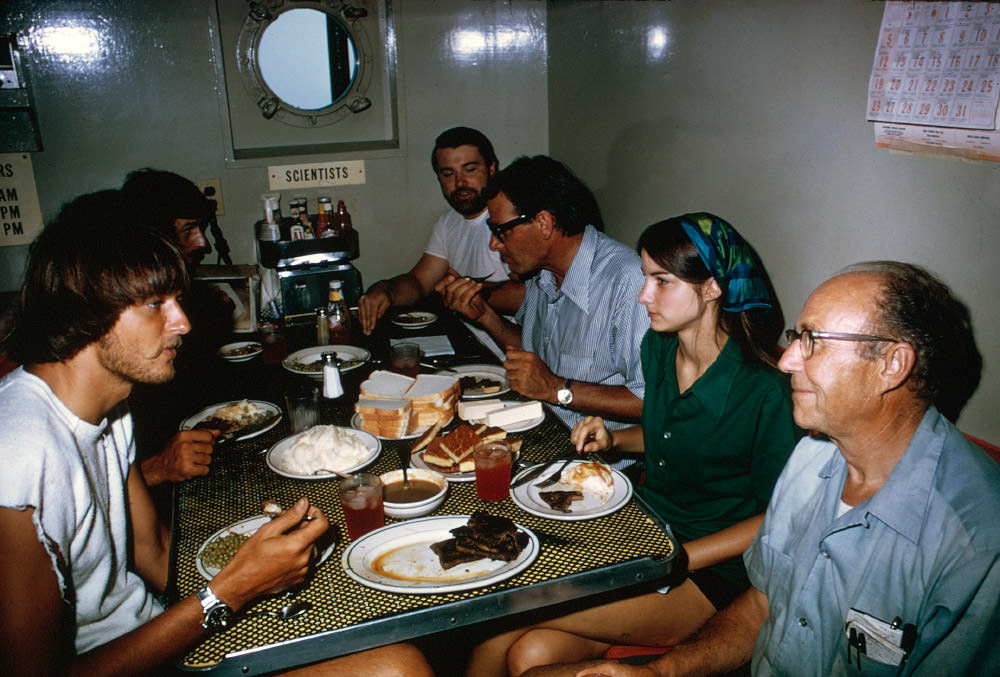
Cathryn Newton, then 16, was on watch when the USS Monitor was found. The project was an amazing collaborative effort, she writes
 |
| Cathryn R. Newton on Eastward in 1973 (Courtesy of MIT Museum). Her mother, Sunny, asked her father whether they found the wreck. He whispered, 'We think so' |
50 years ago:
Just after noon, we found the wreck of the USS Monitor, the most
famous missing ship in America, on Aug. 27, 1973. Four investigators conducted
this two-week, blue-water expedition organized and funded through the work of
my father, John G. Newton, a Duke oceanographer and marine superintendent of
the oceanography program; Harold "Doc" Edgerton, strobe pioneer, inventor, and longtime
MIT engineering faculty who’d invented many of the instruments we used; Bob Sheridan of Delaware (later Rutgers), accomplished and hard-charging marine
geophysicist who had a nearby seismic survey funded; and Gordon Watts, the
brand-new marine archeologist at the state of North Carolina (the
inaugural one).
 |
| Duke University's research vessel Eastward |
My father had
mapped the NC continental margin in a recent geological atlas and, with Orrin
Pilkey, published the first work on the Hatteras Submarine Canyon. This
background elevated our odds of success, but did not guarantee it.
I was a 16-year-old
Duke sophomore who’d worked all summer making cross sections and assembling
geological/bathymetric data for the upcoming cruise; my friends Paul Kelly and
Bob Springle were deployed in parallel. Shy, hardworking and unconfident, I
logged many hours at the Duke Marine Lab preparing cruise materials, and had
expressed an interest.
Yet the
expedition consisted principally of towering figures in ocean sciences, with a
few doctoral students. Then came a surprise: 24 hours pre-departure, a space
held for a woman member of the NGS Explorers Club came vacant. This young girl
leapt into the air with joy.
 |
| 1973: Gordon Watts, front left, behind him John Harris; on right, from back, Robert Sheridan, John Newton, Cathryn Newton and Harold Edgerton (NOAA) |
As I write,
it is noon on August 27. Fifty years ago to the minute, our 12-4 midwatch came
on duty. My watch was headed by get-it-done geophysicist Bob Sheridan. Second
mate Tom Stout, a veteran Navy captain on loan from University of Rhode Island,
was on the bridge. The other three investigators were having lunch in the
galley. I was deployed to the Simrad recorder in the wet lab -- a basic depth
recorder, not as refined a view of things as on the vertical PDR (portable
diver recall) in the electronics lab.
Just after noon, it recorded something that looked like a smudge. I was trying to figure it out when veteran electronics technician Fred Kelly, one of my father’s closest colleagues, was coming in to put his fishing gear away and told me this could be it.

We spent
several days documenting the wreck, as the ship time ended on August 31. The
target was not what we’d expected -- rather than atop the wreck, the turret was
underneath, and had landed slightly to one side. But working with artist Sandra
Belock, a recent Rhode Island School of Design graduate, and replaying the
underwater television tapes again and again, and gaining input from Gordon
Watts, the three figured it out.
By January 1974,
Gordon confirmed their collective view that the ship had “turned turtle” as Doc
said aboard E-12-73. The turret, which was only loosely articulated to the hull
(in part to support the rotation) had fallen off as the ship inverted, and the
upside-down hull fell only partly atop the turret.
We announced
the find at a press conference at Duke University with then-president Terry
Sanford, one that Dad, Gordon and I attended in early March 1974. But that is a
story for another day. Walter Cronkite (CBS evening news broadcast) and The New
York Times (front page) covered the story -- not bad for a group of ocean
scientists out of Beaufort, North Carolina!

There were
more than 60 or us at sea and dozens more on land. John Newton would be the
first to mention the tremendous contributions to finding Monitor from
the remarkable people of Eastward, as well as boatswain (bosun) Curtis Oden Sr.
of Beaufort or the stunning seamanship of Capt. Harold Yeomans of Down East in
deploying both underwater television and two cameras simultaneously. He would
mention the core contributions of historical cartographer Dorothy Nicholson of
NGS, and would note with pride that the first woman ship’s mate at Duke, Susan
Barker, was also part of this team.
These ocean scientists and Eastward's professional crew, both highly accustomed
to mapping at sea, acted in an interdisciplinary way to find something that no
marine archeologists at the time could have found -- they just were not yet
using these techniques of swath mapping that are now standard.
Moreover, I remain sincerely and deeply grateful to every
person who contributed -- both in E-12-73 and especially the stunning sanctuary, recovery and museum processes to follow. Let's honor the full
expedition as well those who've done such a tremendous job to keep Monitor
alive.
PICKET COVERAGE OF USS MONITOR
-- John Harris: He became a hang glider pilot and founded Kitty Hawk kites. But first, he ran the 1973 expedition's underwater camera system.
-- Gordon Watts: Young archaeologist confirmed location of shipwreck.
-- Go deep for 50th anniversary of USS Monitor discovery: Printable 3D artifacts, webinar and a 360-degree video of ironclad's resting place
-- USS Monitor: Navy recognizes Virginia museum for cleaning of ironclad's two Dahlgren guns, which are still being conserved
-- The USS Monitor overcame doubters. Its crew trusted the ironclad, even during the terrible storm that sank the famous ironclad.
-- What do USS Monitor, Jimmy Fallon have in common? Saugerties, NY. This town morphed from industrial 'Inferno' to a cool tourist spot
Saturday, August 26, 2023
USS Monitor: 50 years after its discovery, Gordon Watts recounts the mysteries of the ironclad and how he came to make a positive ID
 |
| Gordon Watts' sketch of turret and hull; Harold Edgerton top right with sonar; Watts (sketch courtesy of Watts; other photos courtesy of the MIT Museum) |
But Watts and expedition leader John
Newton of the Duke University Marine Laboratory had done their homework,
carefully reading records, letters and the log of the ship that was towing the
famous Union ironclad when it sank in a storm on Dec. 31, 1862, 16 miles off
Cape Hatteras, N.C. They had a bead on the wreck’s likely location about 240
feet down while others searched elsewhere in 1973 and 1974.

Sonar showed something that looked like
the Monitor’s turret – which made history during its clash with CSS Virginia in
March 1862 during the Civil War. But the rest of the wreck made little sense – no one knew before
the trip that the ironclad had landed upside down, partially covering the
turret, which was separated from the hull.
While there was elation on the Eastward,
there was no firm finding and the expedition was unable to confirm it found the
vessel when it returned to port. Watts, today the last surviving member of
the primary discovery team, got back to work and went on another trip to
confirm the Monitor’s location.
Sunday marks
the 50th anniversary of the initial discovery. We asked Watts, who
has a distinguished career studying and diving shipwrecks, to talk about the
experience and how he went about identifying the Monitor.
|
| 1973: Gordon Watts, front left, behind him John Harris; on right, from back, Robert Sheridan, John Newton, Cathryn Newton and Harold Edgerton (NOAA) |
It’s important
to remember the Monitor was no ordinary shipwreck. The ironclad revolutionized
naval warfare, ending the era of wooden ships plugging away at each other. The
war machine was a marvel of engineering and technology and has intrigued
conservators and historians who have pored over components retrieved since 1973.
Today the turret, ordnance, steam machinery and associated artifacts are
available to the public at The Mariners’ Museum and Park in Newport News, Va.
Watts’ responses to emailed questions about the anniversary
have been edited for brevity and in some cases combined.

A. The three principals in the RV Eastward cruise that located the remains of USS Monitor were John Newton at the Duke University Marine Laboratory, Dr. Harold Edgerton with Massachusetts Institute of Technology and myself, then the North Carolina state underwater archaeologist. Dr. Robert E. Sheridan, a geologist from the University of Delaware, was also on board Eastward to carry out a geological project.
In retrospect and by comparison
with today's technology, my most permanent recollection is associated with how
we were able to use Dr. Edgerton's side-scan sonar to locate the wreck and
adapt underwater camera and video systems to document significant features of
the wreck remains (team's search and location map at right).
The underwater video system used to collect image data at the site was
assembled aboard Eastward by John Harris, subsequently the founder and
president of Kitty Hawk Kites.
Film and video data collection was crudely controlled by maneuvering RV
Eastward back and forth over the wreck.

A. John
Newton and I joined the Eastward in Savannah. The trip to Hatteras was my first
aboard a ship. The entire trip can be characterized by rough seas, many over 20
feet. An East Carolina University prehistoric archaeologist along with us
to identify prehistoric cultural material in dredge samples we recovered off
Cape Fear spent the entire trip very and disgustingly sea sick. At Cape
Hatteras, he abandoned ship. Dr. Edgerton joined us and afforded the incredible
opportunity to work with someone for whom I had, and will always have, the utmost
respect and admiration. That was certainly the opportunity of a lifetime.
Off Cape Hatteras, we shared ship time with Dr. Sheridan.
When he was not conducting his geological research and sample collecting, we
ran remote sensing in the area I had identified based on historical and environmental
research. After locating a clearly modern WWII vessel, we subsequently
discovered a wreck with side-scan sonar that appeared to have a potential for
association with Monitor.
 |
| Armor belt near turret provided a big identification clue (NOAA) |
Following a brief synopsis of the cruise and our, at that
point, less than dramatic conclusions, I packed up to head back to my office at
Fort Fisher. For two hours I was surprised and much disappointed to
discover that while never seasick aboard Eastward, the lack of motion of the
ocean resulted in my first and so far ONLY case of landsickness. You had to be there.
Q. What
convinced you that you had found the Monitor? When was that epiphany?
A. Using
the RV Eastward photo and video data I was able to construct crude mosaics and
identify features of the armor belt, skeg and propeller shaft and confirm the
diameter and wall thickness of the exposed portion of the turret.
 |
| One of the Monitor mosaics put together by Watts, others (NOAA) |
I informed John Newton of my conclusions in a letter on 14
January 1974. Those conclusions were not universally accepted until,
thanks to Dr. Edgerton, we were able to return to the site with Alcoa Seaprobe.
That much more sophisticated and systematic investigation generated
comprehensive image data that confirmed my conclusions.
Q. How many times have you dived at the Monitor site since?
What stands out?
A. I would have to go back to my project logs to be sure how many dives I made on Monitor. However, my first dive was aboard a Harbor
Branch Oceanographic Institute Foundation submersible. That first dive was made
all the more exciting by identifying the red lantern that was the last evidence
of the historic ironclad that was observed by personnel aboard the USS Rhode
Island (which was towing Monitor when the latter sank). My lockout divers
from the Harbor Branch submersibles focused on an excavation within the officer
quarters forward, documenting the steam machinery inside the hull aft of the
boilers and investigating the gun ports in the turret underneath the hull
remains. It was exciting to be inside Monitor's engine room a century
after the ship was lost.

A. Harbor Branch diver
Richard Roesch locked out of the Johnson Sea Link submersible and recovered the
lantern. I think it remains as one of the most significant artifacts from
the USS Monitor. The fact that it was the first evidence of the wreck we
found on the first submersible dive at the site is beyond ironic.
Q. Anything else about your work on the USS Monitor recovery
and what it means today?
A. Still one of the
deepest underwater archaeological excavation and recovery projects to date.
Q. Why should we care today about the
USS Monitor and its conservation?
A. Today, most Americans are
probably unaware of USS Monitor and the brief role it played in the War Between
the Confederate States of America and the United States of America. For those
who are aware of the ironclad role, they likely also recognize the more
significant impact (John) Ericsson's first and subsequent ironclads vessel
played in the development of the modern turreted capital steam
warship. That role was indeed pivotal.
COMING
SOON: Recollections from John Harris, who operated the underwater video system
during the trip and became a hang gliding proponent and founder of Kitty Hawk
Kites in the Outer Banks of North Carolina, and Monitor explorer, expert and author John Broadwater.
 |
| Watts during work on the CSS Georgia in Savannah in 2017 (Picket photo) |
PICKET COVERAGE OF USS MONITOR
-- Cathryn Newton: At 16, she was the youngest crew member. She says the find was a group effort.
-- John Harris: He became a hang glider pilot and founded Kitty Hawk kites. But first, he ran the 1973 expedition's underwater camera system.
-- Go deep for 50th anniversary of USS
Monitor discovery: Printable 3D artifacts, webinar and a 360-degree video of
ironclad's resting place
-- USS Monitor: Navy recognizes Virginia museum for cleaning of ironclad's two
Dahlgren guns, which are still being conserved
-- The USS Monitor overcame doubters. Its crew trusted the ironclad, even during the terrible storm that sank the famous ironclad.
-- What do USS Monitor, Jimmy Fallon have in common? Saugerties, NY. This town
morphed from industrial 'Inferno' to a cool tourist spot
Subscribe to:
Posts (Atom)