Showing posts with label anniversary. Show all posts

Wednesday, April 16, 2025

Schenkl shell was unearthed near a historic home in Manassas. After it is disarmed, the ordnance will be showcased at 200th anniversary of Liberia House

Civil War artillery shell (left) after it was found near creek at Liberia House (City of Manassas)
On a sunny afternoon last week, contractors using heavy equipment at a creek near the historic Liberia House in Manassas, Va., unearthed something quite out of the ordinary.

Workers who are restoring eroded banks of Flat Branch Creek and safeguarding a spring house contacted city staff. Employees sprang into action, calling Manassas police. Police Sgt. Brett Stumpf said the department reached out to the Virginia State Police bomb squad.

Once on scene, experts carefully worked around a 3-inch artillery round caked in dirt but quite intact.

“It’s definitely a Schenkl shell – and it’s in really great shape,” Mary Helen Dellinger, curator for the Manassas Museum -- which manages the site -- told the Picket in an email Wednesday. “The fuse was not present when the shell was discovered.”

Map shows the Liberia House (top left) and the highlighted work area where the shell was found (City of Manassas)
The ordnance, which would have been filled with black powder, is now with Virginia State Police.

“It was determined to be a live round and was removed from the site by our agent,” said Matt Demlein, public relations coordinator for the agency. “At a later date, it will be turned over to Marine Corps Base Quantico for safe rendering and then returned to the City of Manassas.”

Rendering could include removing any explosive material inside. Stumpf said he had no timeline for the examination of the shell. It's possible it will be exploded if it cannot be rendered safe, he added.

City Manager Steve Burke mentioned the April 9 discovery during a council meeting on Monday night. His announcement was first reported by the local Patch news site.

Local officials believe the shell will be a great addition to events marking the 200th anniversary of the city-owned house, which is notable for its large number of enslaved persons working the plantation before the Civil War and graffiti left by Union soldiers who occupied the dwelling.

The Liberia House is made of bricks fired from red clay on site (City of Manassas)
The Schenkl was primarily used by Federal artillerymen in a variety of cannons, including the Parrott..

“As far as Federal vs. Confederate shell – it’s difficult to say,” said Dellinger of this example. “We do know that during the Battle of Bull Run Bridge the 2nd New York was stationed on the property (exact location unknown) and were firing at the Confederates at Fort Beauregard (located about ½ mile from Liberia). Because of the history of both sides being on the property during the war, it’s really hard to say which side left the shell behind.”

About 400,000 Schenkl shells were made during the Civil War. They came in several styles, including ones that contained case shot. It had a Papier-mache sabot.

Generals stayed here, and so did soldier graffiti

Before war came to Manassas and other communities in Northern Virginia, the landscape was dotted with small farms and large plantations.

Liberia House was built for William J. and Harriett Weir in 1825. Enslaved laborers did most of the construction on the two-story, Federal style brick home. They are believed to have crafted much of the stylish interior, too. Its 1,600 acres made Liberia House a large working farm and plantation.


The Prince William County property served as headquarters for Confederate and Union forces early in the war. Jefferson Davis (in 1861) and Abraham Lincoln (in 1862) came here to confer with their generals. “Proof of occupation is displayed as faded graffiti left by Union soldiers is visible on interior walls,” the city says.

Soldiers from both sides wrote graffiti in many structures in the region. Those surviving at Liberia Hall are Union.

Among the inscribers were Capt. Levin Bevins Day (left) of the 3rd Delaware and Leverett Horatio Waldo of the 130th New York. The inscriptions date from 1863 to 1864.

“Armed with pencils, red crayons or charcoal from a fire, graffiti was a way for soldiers to leave a piece of themselves behind as they marched into uncertain conditions,” a city website says.

Dellinger told the Picket past archaeological digs at Liberia yielded numerous Civil War-related pieces, among them buttons, bullets, small bits a pieces of metal that relate to horse equipage, other accoutrements and a sword -- “the coolest thing until this shell.”

“We’ve also found evidence of civilian life -- clay marbles, shards of dinnerware, bits of old brick, pottery and pieces of farm equipment,” the curator said.

City has long told history of the enslaved

Manassas, obviously, is associated with two major battles and numerous smaller operations and skirmishes. But the city also touts its extensive Black history by creating a trail for residents and visitors.

The Liberia House tells the story of the enslaved people on the land at the time of the war.


“Eliza and Phillip. Frances and Nathaniel. Susan and George. These and more than 70 others, their names lost to history, were enslaved to the Weir Family of Liberia,” a Manassas Museum sign says. “Decade after decade, two generations of men, women and children, regarded as personal property, lived and toiled on this land.”

A 2015 Washington Post article on Liberia House discussed how stories of the enslaved were finally getting attention in many historic sites.

“At the Liberia Plantation … scholars and historians have engaged in an extended debate about whether the name is a reference to the nation of Liberia, where African Americans settled in 1820, or a nod to the Libra sign of the zodiac,” the article says.

The city has told the story of enslaved people at Liberia for more than two decades.(19th century photo right, Library of Congress)

Linneall Naylor, a descendant of one slave who bought his freedom, told the Post said she learned to embrace the past.

“No one talked about it – it was such a touchy subject, especially for African Americans,” she said. “Slavery was such a hardship for families, and a lot of people moved to get away from the memories.”

Celebrating Liberia House through the fall

Manassas officials hope to share the Schenkl shell with the public at the main 200th anniversary celebration in October.

“We are also putting together a special exhibition, “Liberia: Sentry to the Ages” in honor of the 200th,” Dellinger said. “That exhibit will open at the Manassas Museum on June 6 and remain on public view through next spring.”

Liberia House and Manassas Museum are among eight historic sites administered by the city.

Rachel Goldberg, programs and education coordinator at the museum, said a daylong event is planned for Oct. 11.

Among events leading up to that are a "basement to attic" tour this Saturday, open house days on Saturdays during the summer and a “history happy hour” in August.

Liberia House is located at 8601 Portner Ave., Manassas. The house is open for special events and tours and an annual bee festival, which is scheduled for June 21. The grounds are open from sunrise to sunset. For more information, contact the Manassas Museum at 703-368-1873.

Friday, May 3, 2024

The scrappy 'Jersey Boys' are getting their due with a sign at Battle of Williamsburg site in Virginia. Here are events tied to Sunday's 162nd anniversary

Steve Barnes and Don Klein of Williamsburg Battlefield Association place sign along road;
Five members of the 7th New Jersey from Fairfield; nearby Redoubt Park in Williamsburg)
Four regiments of “Jersey Boys” had barely been battle tested when on May 5, 1862, they were rushed in to reinforce Union troops tangling with Confederates at Williamsburg, Va.

With the 5th New Jersey supporting artillery, Brig. Gen. Francis E. Patterson (photo, below) of Hooker’s division ordered the men of the 6th, 7th and 8th New Jersey regiments into a ravine near the Rebels’ Fort Magruder.

The fighting was fierce. Terrain was won and lost as men fought in tangled undergrowth and on swampy ground. Finally, Alabama and Mississippi regiments commanded by Brig. Gen. Cadmus M. Wilcox pushed back the men in blue, who were exhausted and out of ammunition.

The outnumbered New Jersey troops had their largest casualties of any battles in which they participated, but they won acclaim for their valor. Brig. Gen. Joseph Hooker was said to have called them bulldogs.

That sacrifice will be remembered Sunday morning as a new Civil War Trails marker is dedicated not far from the ravine. About 40 members of the Old Baldy Civil War Roundtable of Philadelphia, most living in New Jersey but some traveling from Colorado and North Carolina, are expected to participate.

“I couldn’t be prouder of our organization and members for sponsoring this sign,” said Frank Barletta, a board member with the roundtable. “I cannot think of a more fitting memorial to this overlooked major battle of the war.”

Fort Magruder and other Rebel works near Williamsburg (Wikipedia)
The inconclusive Battle of Williamsburg, according to the National Park Service, was the first pitched battle of the Peninsula Campaign following the Confederate retreat from Yorktown.

Hooker’s division attacked the Southerners at Fort Magruder, but was repulsed. Confederate counterattacks ultimately wore out and they made a nighttime withdrawal toward Richmond. Casualties numbered more than 3,800.

The American Battlefield Trust and other groups in 2020 protected the "Bloody Ravine" and 29 acres for posterity.

Another 162nd anniversary commemoration will take place from 1 p.m.-5 p.m. Sunday about a half mile away at the Fort Magruder Hotel and Conference Center. The Williamsburg Battlefield Association will lead the program, which includes historical displays and costumed interpreters, music by the William & Mary brass band.

“Learn about the battle, its impact on the emancipation movement, medical practices during the war and female soldiers,” the association says in a program overview. “See the battle and 19th-century town of Williamsburg through maps and images, and understand current battlefield preservation efforts.”

Nov. 2021 dig at powder magazine wall (The Colonial Williamsburg Foundation)
A highlight will be a 2 p.m. presentation by archaeologists with the Colonial Williamsburg Foundation. They will talk about the remains of four Confederate soldiers found early last year near the powder magazine at the venue. Some wounded troops were treated at a nearby hospital, officials said. Bullets, buttons and suspender buckles were found with the skeletal remains.

The ceremony for the new Civil War Trails marker will include a color guard from Joint Base Langley-Eustis. A wreath will be laid and there will be a reading of a New Jersey Senate resolution that praises the Old Baldy Civil War Round Table for its commitment to the sign and “ensuring that the brave soldiers from New Jersey are memorialized for posterity.”

The roundtable is taking a bus from Cherry Hill, N.J., on Saturday morning and will tour the battlefield, site of Fort Magruder and Redoubt Park in the afternoon. After the 9 a.m. Sunday sign dedication, the group will tour the Lee Hall Mansion in Newport News before heading home.

Based in Williamsburg, Civil War Trails is considered the world’s largest “open air museum,” with signs and markers at about 1,500 sites across six states: Maryland, North Carolina, Pennsylvania, Tennessee, Virginia and West Virginia.

The bravery of the New Jersey soldiers also is honored by the Lawrence Township Historical Society in the state. Dan Casella with the group said it has books that have newspaper articles and correspondence from Cedarville and Cumberland County soldiers in southern New Jersey who served in the 5th, 6th and 7th volunteer regiments.

Casella in 2022 wrote a fascinating article about his research on a photograph  (right, Library of Congress) showing five 7th New Jersey boys from Fairfield. He wanted to know their fate. One, Capt. Benjamin F. Ogden, wrote about the battle two weeks later.

“I must speak of our contest,” Ogden wrote, “although it makes me feel sad every time, I mention it; for it renews the recollection that one of our number still lies beneath the battle ground…when the battle commenced, six of us Cedarville men were in the front rank. At night, one lay dead on the field, and two in hospital wounded. Three came out without a scratch, although I had three bullet holes in my overcoat cape….”

He went on to discuss other casualties. (You can read Casella’s article here to learn the fate of Ogden and the four other soldiers in the photograph.

“General Hooker says we were whipped three times yesterday but did not know it; he says we are not Soldiers, but Bulldogs! We do not stay in one place long but keep closing on Richmond.”

Richmond did not fall for another three years, accompanied by hundreds of thousands of casualties.

The new Civil War Trails sign is located at the Teamsters Hall, 7294 Merrimac Trail, Williamsburg. Guests attending the ceremony are encouraged to park along nearby Orange Drive.

Monday, August 28, 2023

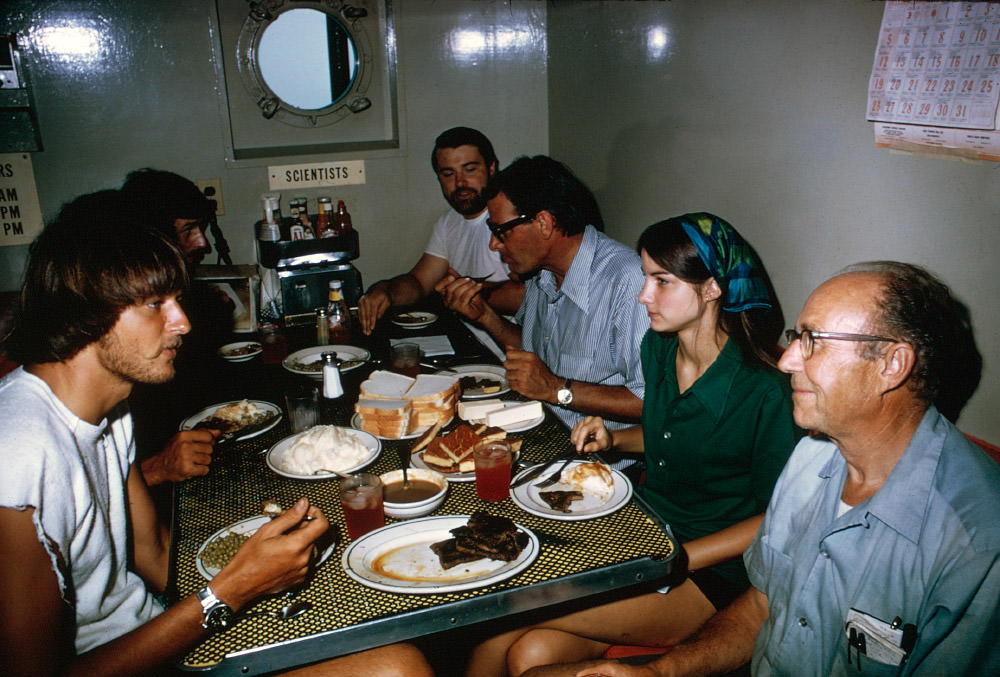
Cathryn Newton, then 16, was on watch when the USS Monitor was found. The project was an amazing collaborative effort, she writes

Cathryn R. Newton on Eastward in 1973 (Courtesy of MIT Museum). Her mother,
Sunny, asked her father whether they found the wreck. He whispered, 'We think so'
Cathryn R. Newton found her career calling while sailing as a teen on the RV Eastward with her father, John G. Newton, and other scientists. They located the Civil War ironclad USS Monitor on Aug. 27, 1973. Since then, the Syracuse University dean emerita and professor has conducted extensive research on shipwrecks and marine fauna and environments. Newton, who was raised in Beaufort, N.C, recently led a scientific team that traveled to Newfoundland. The Civil War Picket asked for her recollections of the Monitor expedition and she submitted this essay.

50 years ago: Just after noon, we found the wreck of the USS Monitor, the most famous missing ship in America, on Aug. 27, 1973. Four investigators conducted this two-week, blue-water expedition organized and funded through the work of my father, John G. Newton, a Duke oceanographer and marine superintendent of the oceanography program; Harold "Doc" Edgerton, strobe pioneer, inventor, and longtime MIT engineering faculty who’d invented many of the instruments we used; Bob Sheridan of Delaware (later Rutgers), accomplished and hard-charging marine geophysicist who had a nearby seismic survey funded; and Gordon Watts, the brand-new marine archeologist at the state of North Carolina (the inaugural one).

Duke University's research vessel Eastward
Our team decided to take Monitor’s (+ towship USS Rhode Island’s) mariners at their word --and search near the edge of the continental margin 16 miles off  Hatteras. {All but one of many other Monitor searches in summer 1973 were near shore). My father, Bob Sheridan and Doc Edgerton wrote the proposals that had secured funding for the E-12-73 cruise from NSF and National Geographic Society (NGS).

My father had mapped the NC continental margin in a recent geological atlas and, with Orrin Pilkey, published the first work on the Hatteras Submarine Canyon. This background elevated our odds of success, but did not guarantee it.

I was a 16-year-old Duke sophomore who’d worked all summer making cross sections and assembling geological/bathymetric data for the upcoming cruise; my friends Paul Kelly and Bob Springle were deployed in parallel. Shy, hardworking and unconfident, I logged many hours at the Duke Marine Lab preparing cruise materials, and had expressed an interest.

Yet the expedition consisted principally of towering figures in ocean sciences, with a few doctoral students. Then came a surprise: 24 hours pre-departure, a space held for a woman member of the NGS Explorers Club came vacant. This young girl leapt into the air with joy.

1973: Gordon Watts, front left, behind him John Harris; on right, from back,
Robert Sheridan, John Newton, Cathryn Newton and Harold Edgerton (NOAA)
Following the one best piece of advice ever from my mother Sunny Newton, I kept a journal of the expedition, the only one extant. When my father died without notice at 52 of heart failure in 1984, I inherited every bit of planning material for the expedition and all the files amassed while they (Dad, artist Sandy Belock and Gordon Watts) tried to figure out what we were seeing in this complex shipwreck. I have written a book manuscript on all this, with input from many, and sent it to my superb editor.

As I write, it is noon on August 27. Fifty years ago to the minute, our 12-4 midwatch came on duty. My watch was headed by get-it-done geophysicist Bob Sheridan. Second mate Tom Stout, a veteran Navy captain on loan from University of Rhode Island, was on the bridge. The other three investigators were having lunch in the galley. I was deployed to the Simrad recorder in the wet lab -- a basic depth recorder, not as refined a view of things as on the vertical PDR (portable diver recall) in the electronics lab.

Just after noon, it recorded something that looked like a smudge. I was trying to figure it out when veteran electronics technician Fred Kelly, one of my father’s closest colleagues, was coming in to put his fishing gear away and told me this could be it.

Bob and Tom Stout instantly reacted, and Stout remarkably brought the ship about immediately over the wreck. A high-contrast target appeared on the vertical PDR up above -- with the intensity expected for a metal wreck. It could be Monitor! Doc Edgerton’s side-scan sonar disclosed an arcuate piece that might be the turret, but in the wrong orientation.

We spent several days documenting the wreck, as the ship time ended on August 31. The target was not what we’d expected -- rather than atop the wreck, the turret was underneath, and had landed slightly to one side. But working with artist Sandra Belock, a recent Rhode Island School of Design graduate, and replaying the underwater television tapes again and again, and gaining input from Gordon Watts, the three figured it out.

By January 1974, Gordon confirmed their collective view that the ship had “turned turtle” as Doc said aboard E-12-73. The turret, which was only loosely articulated to the hull (in part to support the rotation) had fallen off as the ship inverted, and the upside-down hull fell only partly atop the turret.

We announced the find at a press conference at Duke University with then-president Terry Sanford, one that Dad, Gordon and I attended in early March 1974. But that is a story for another day. Walter Cronkite (CBS evening news broadcast) and The New York Times (front page) covered the story -- not bad for a group of ocean scientists out of Beaufort, North Carolina!

For my dear friends and students, you now see the origins of my impassioned commitment to undergraduate research. Being part of this changed my life. That is likely true of everyone involved -- all 60 people on three research vessels, including those of us on Duke’s RV Eastward. (Cathryn R. Newton at left)

There were more than 60 or us at sea and dozens more on land. John Newton would be the first to mention the tremendous contributions to finding Monitor from the remarkable people of Eastward, as well as boatswain (bosun) Curtis Oden Sr. of Beaufort or the stunning seamanship of Capt. Harold Yeomans of Down East in deploying both underwater television and two cameras simultaneously. He would mention the core contributions of historical cartographer Dorothy Nicholson of NGS, and would note with pride that the first woman ship’s mate at Duke, Susan Barker, was also part of this team.

These ocean scientists and Eastward's professional crew, both highly accustomed to mapping at sea, acted in an interdisciplinary way to find something that no marine archeologists at the time could have found -- they just were not yet using these techniques of swath mapping that are now standard.

Moreover, I remain sincerely and deeply grateful to every person who contributed -- both in E-12-73 and especially the stunning sanctuary, recovery and museum processes to follow. Let's honor the full expedition as well those who've done such a tremendous job to keep Monitor alive.

PICKET COVERAGE OF USS MONITOR

-- John Harris: He became a hang glider pilot and founded Kitty Hawk kites. But first, he ran the 1973 expedition's underwater camera system.
-- Gordon Watts: Young archaeologist confirmed location of shipwreck.
-- Go deep for 50th anniversary of USS Monitor discovery: Printable 3D artifacts, webinar and a 360-degree video of ironclad's resting place
-- USS Monitor: Navy recognizes Virginia museum for cleaning of ironclad's two Dahlgren guns, which are still being conserved
-- The USS Monitor overcame doubters. Its crew trusted the ironclad, even during the terrible storm that sank the famous ironclad.
-- What do USS Monitor, Jimmy Fallon have in common? Saugerties, NY. This town morphed from industrial 'Inferno' to a cool tourist spot

Thursday, July 21, 2022

Fragment of stone monument marking location of a Georgia regiment is back 'home' at Manassas battlefield after disappearing decades ago

Then head of school Diane Dunne and Jim Burgess (Photos: The Country Day School)

A missing stone fragment that once marked a position held by a bloodied Georgia regiment is back at the Manassas battlefield in Virginia for today’s 161st anniversary, ending a saga that began decades ago.

The Civil War marker’s story is a fragmented tale whose pieces finally came together earlier this year when the chunk of marble was donated to the park by a small private school in McLean, about 45 minutes away.

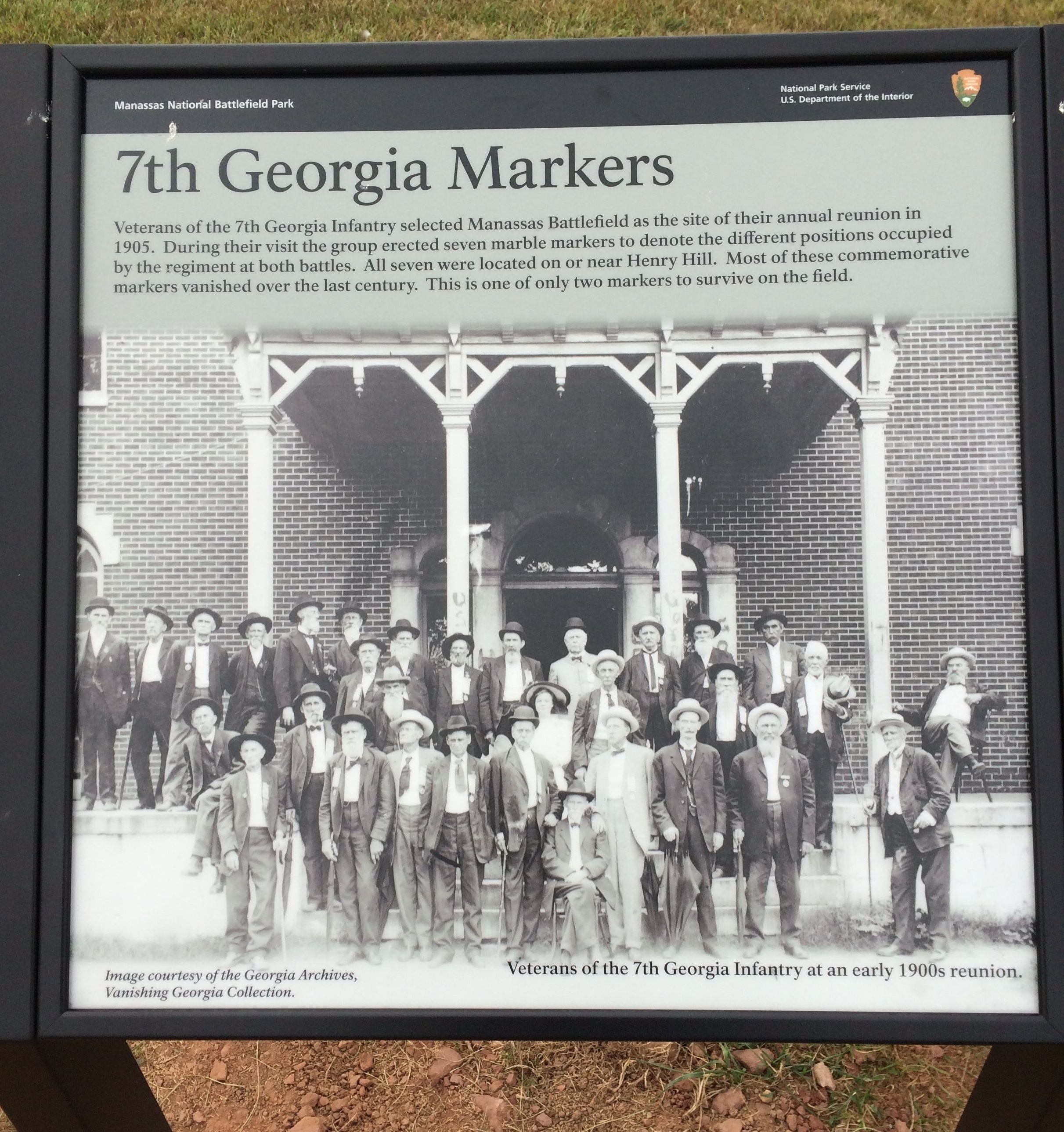
Veterans of the 7th Georgia Infantry – which was in the thick of fighting at the First Battle of Manassas (Bull Run) – in 1905 opted to place six markers indicating where they were positioned in that battle and another marker for a position at Second Manassas in August 1862.

The markers fell victim to time and vandals, with only two still on the field today, one of them rarely seen by visitors.

Officials believe this returned so-called “second position” marker disappeared before the park was established in 1940. How the top half landed in the upscale Langley neighborhood of McLean – near the CIA headquarters – remains a mystery. The son of the school’s director in the 1970s found it while doing construction work on an old barn on the school property. His mother believed it to be a tombstone for a Georgia boy.

A sketch of the barn on the school property (Courtesy of McCormick family)
That wasn’t the case, says Manassas National Battlefield Park museum specialist Jim Burgess, who has documented the 7th Georgia position markers and tried to get this one donated to the park nearly 30 years ago after he learned of its discovery.

The school’s director held onto the marker and Burgess moved on to other things. After the director died in 2018, her children sold her home to the school and left the artifact behind.

In February, the federal park got a call from the school, indicating the school’s desire to see the stone back at Manassas. Burgess got to the campus within two hours. 

“It has sort of been on the back burner,” Burgess said. “I was flabbergasted in getting the call.”

Sign at Manassas park has photo of 7th Georgia veterans (Shane Oliver/HMdb.org)
The fragment is about 10 inches by 10 inches and appears to have the first part of  “2nd POSITION” etched at top.

The park has put the piece in a temporary display case along with a photo of an outdoor stone fireplace/grill – a seemingly odd pairing.

Burgess believes the lower half of the marker may be the gray stone in the middle of the fireplace, which was built by a farmer on what is now park property.

Georgia veterans returned to battlefield

The 7th Georgia, part of a brigade led at Manassas by Col. Francis S. Bartow, was mustered into Confederate service in late May 1861. Most of the regiment’s soldiers were from Coweta, Paulding, DeKalb, Franklin, Fulton, Heard and Cobb counties in northern Georgia.

The unit was rushed to Virginia and saw heavy combat at Manassas on July 21, 1861, the first major battle in the Eastern Theater. (At left, photo of Pvt. John William Barrett of the 7th)

Bartow was killed while leading the 7th against Capt. James B. Ricketts’ battery on Henry Hill during a pivotal moment in the fighting, which swung to the Confederates’ favor late in the day for a victory that left Union forces fleeing to Washington. The 7th Georgia suffered a staggering 153 casualties out of 580 men present, according to American Battlefield Trust.

Decades later, 7th Georgia veterans decided to place the position markers, rather than a large single monument. They resembled tombstones and were scattered across the rolling hills.

Burgess’ records indicate the second position marker may have been broken and displaced when the Warrenton Turnpike was widened in the 1920s.

The top half ended up in McLean, while the bottom -- which has no inscription -- may be in the fireplace adjacent to the old George Sutton farm.

Piece of marble is in middle of large fireplace at Manassas. (Jim Burgess, MBNP) 
In 1970, Sutton said he built the fireplace with stones recovered from the area, but “This piece of marble here was picked up along the highway when we put the fence up there. Evidently it was a piece of a monument…”

The farm was acquired by the park in the 1950s.

Fragment was found among rocks

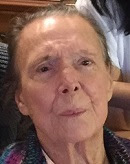
In the 1960s, Dorothy McCormick, a leader in early childhood education, started a small school at her Great Falls, Va., home. McCormick (right) later acquired Happy Hill School (renamed The Country Day School) in McLean in the early 1970s. 

The nonprofit venue, located in the suburban Washington, D.C, neighborhood, offers preschool and kindergarten classes. McCormick promoted motor skills training and an enrichment center, among other innovations.

“We called her the director. She was old school,” said son Robert McCormick. “Very sweet, but you didn’t give her any guff.”

Becky Benton, current officer coordinator at the private school, told the Picket that Mrs. McCormick, a widowed mother of six children, had a strong imprint on staff and parents.

“She had a way of attracting people to her mission,” Benton said.

The 5-acre property included a two-story cattle barn built in 1921.

Mrs. McCormick decided to live there after extensive renovations were made. Robert, who designs and builds homes, led that project. In 1977, he discovered the marker while moving rubble and other material from a fill pit while working on a deck foundation at the barn.

“It was in there. We had thought we had uncovered a Civil War grave site,” he said.

“She was very excited to think a soldier may have been buried here,” Benton said.

McCormick’s mother kept the fragment on the hearth as a conversation piece, and a 1990s Washington Post article about Langley includes a photograph of her holding the stone, described as a tombstone.

Mrs. McCormick told the paper it was an indication of the area’s historical significance.

“It was important for her to keep it safe,” Benton said. “She was history minded and appreciated the history of the school and America.”

Park communicated with educator 

After reading the article, Burgess contacted Dorothy McCormick by phone and through a March 1994 letter, sharing what he knew about the position markers and telling her the fragment was not a tombstone.

We did not know as much about the movements of the 7th Georgia Regiment and their markers at that time (of the letter) as we do today,” he told the Picket earlier this year.

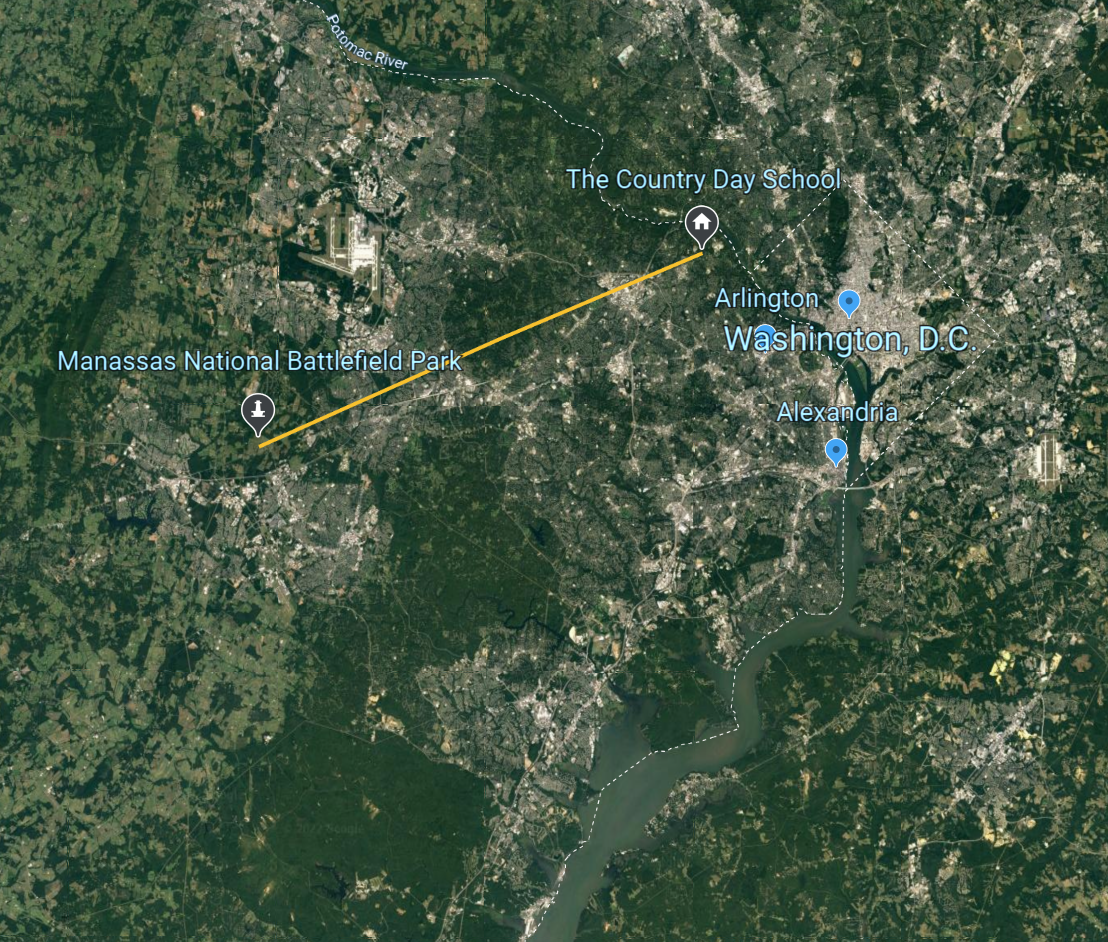
The school is in the Washington, D.C, area (Andrew Gast map, click to enlarge)
The official asked Mrs. McCormick to look at documentation of the markers. “Naturally, we feel the stone in your possession rightfully belongs at the battlefield. We would be most grateful to accept it as a donation to the park’s museum collection should you feel inclined to part with it,” Burgess wrote in 1994. (McLean is about 25 miles from Manassas.)

Burgess said after the letter was sent, the school director “indicated to us by phone that she wanted to retain it for sentimental reasons, I guess. We did not pursue it. We did not have any legal claim to it because it disappeared well before the park was established.”

The letter probably annoyed his mother, said Robert McCormick, and she likely forgot about it over the years, he said.

Dorothy McCormick sold the school and a cottage on the property in 1991 and continued living in the converted barn until her 2018 death at age 96. The family then sold the barn to The Country Day School, which in turn converted it into an office.

Robert McCormick says his mother was very happy while living in the rustic barn. “It was a cozy, homey place.”

Chance review of photos led to donation

The Country Day School and the surrounding neighborhood is rich with history. The main building was constructed in 1858 and at times it served as a church, Civil War hospital and residence. Mrs. McCormick lived in a cottage on the property before moving to the barn.

Converted barn and main building of The Country Day School in McLean (Picket photos)
After the McCormick family sold the old barn, they left school-related items, photos and the marker in the structure.

Early this year, Benton – the office coordinator – went to the structure to find old photographs of the main building for a class of children who are age 3.

She flipped through a photo album and came across the 1994 letter from Burgess. While Benton knew the marker was there, she had not seen the correspondence. “(Mrs. McCormick) did not necessarily agree it was not a soldier’s gravestone.”

“It was very sentimental for Mrs. McCormick. The children thought it belonged here. We felt it belonged to the battlefield.” The school decided to make the donation and reached out to the park.

Robert McCormick was not aware of the donation until reached by the Picket, but he says the family is satisfied with the disposition.

The two 7th Georgia markers still on the field (Manassas National Battlefield Park)
Burgess said he is pleased the marker is back “home.” He would like to see it displayed with a piece of another position marker and a map.

The stone fragment we just acquired lacks sufficient integrity to be put back in the ground.  It would be nice to replace all seven markers with exact reproductions and save the originals in the park collection,” Burgess wrote in an email.

The originals have been subject to damage from tree falls, road construction, vandalism and theft. It would be good to protect what is left of them and still mark the positions the veterans made effort to preserve for posterity. Unfortunately, we don't have the funding to do that.”

Burgess set up this display after the school's donation (Jim Burgess, MNBP)

Tuesday, July 20, 2021

These 3 men fought at Peachtree Creek on this day in 1864. One carried a wound that eventually killed him. Their belongings tell their stories at Atlanta History Center

Pvt. Johnson's coat, Lt. Young's hat, Capt. Lindsay's sword (Courtesy Atlanta History Center)
Alabama Pvt. John E. Johnson had yet to meet his infant son. Capt. David J. Lindsay, who had been deemed too indispensable to be allowed to resign, was with his men of Company I, 149th New York Volunteers.  And 1st Lt. George Young of the 143rd New York Volunteers was about to go on a horseback assignment that would change his life.

On July 20, 1864, the lives of these three men and thousands of others collided near and in the wooded ravines above Atlanta in the Battle of Peachtree Creek -- Lt. Gen. John Bell Hood’s ill-fated debut as the head of the South’s Army of Tennessee. Hood had hoped to isolate and destroy Union Maj. Gen. George Thomas’ command before two other Federal armies could come to his help.

Lt. Young (Courtesy Seward Osborne)
Johnson, of the CSA’s 29th Alabama, and Lindsay were killed in the pitched fighting. Young suffered a leg wound that would eventually take his life 45 years later.

They all fought in the sector where Rebel forces perhaps had their most success that day: against the far right of the Army of the Cumberland. The end of the day saw a Union victory, just two days before the Battle of Atlanta. Confederates suffered about 2,500 casualties in just a few hours.

Lindsay’s sword, Johnson’s bloodstained frock coat and the hat, coat and trousers that Young was wearing that day area in the same display case at the Atlanta History Center’s “Turning Point” permanent exhibit on the Civil War and Atlanta.

“What is the chance of those three (soldiers’ belongings) surviving from the same part of the battlefield?” asked Gordon Jones, the AHC’s senior military historian and curator. “These three objects, the way they work together is spooky. They really speak to you.”

These were ordinary men who fought in a battle that helped shape the future of the country. On the anniversary of the battle, here’s more about the three and their units.

Peachtree Creek artifacts are at left (Picket photo)
1st Lt. George Young, 143rd NY Volunteers

At 4:30 p.m. on the afternoon of July 20, Young, 23, of the 143rd New York, was riding with urgent orders to regimental commanders from the brigade commander, Col. James Robinson. Confederate forces had launched an unexpected attack, and Robinson’s brigade was under heavy fire.

Bullets killed the officer’s horse and struck Young’s leg in the right tibia below his knee, splitting two bones. Young spent four days in the hospital and returned to New York, but his combat days were over due to the disability. An honorable discharge was issued on Oct. 26, 1864.

While he went on to marry and father two sons, work in the foundry business in Ellenville, N.Y., purchase a paper mill and serve as Ulster County sheriff, Young could never escape the effects of his wound.

He endured repeated operations and procedures to heal his leg, but the wound became reinfected each time.

An account of Young’s life and his medical condition were detailed by Seward R. Osborne Jr. in the March-April 1980 issue of the North South Trader. A copy of the article and other documents and papers pertaining to Young are in the AHC’s collections. (Photo at left, courtesy of Atlanta History Center, shows bullet hole in Young's pants)

Osborne wrote about how the veteran endured excruciating suffering. By 1906, he was losing weight and strength. On March 31, 1909, a doctor wrote of Young:

“His suffering was intense and had become general throughout his right side including arm as well as leg.” Young died at noon April 1 after trying to write some letters and drink eggnog.

The chronic infection had finally claimed his life -- 45 years after the Battle of Peachtree Creek.  The chief cause of death was "Gunshot wound, right tibia, chronic septic infection many years." Young was 66 or 67.

Osborne – a Civil War historian, collector and writer – for several years had Young’s hat, coat and trousers. He recalls paying about $200 for the items from a seller who likely got them at an estate sale. “This guy bought cheap and sold cheap.” Osborne told the Picket this week.

“What drew me to it was it was the first uniform that I have ever owned,” he said. “The fact it had a bullet hole, this is just dripping with research material, which I love to do. It just snowballed from there.”

Rebel attack at Peachtree Creek (Courtesy Georgia Battlefields Assn.)
Osborne, formerly of Olivebridge, N.Y., said he was unaware that Young’s clothing was at the AHC until the Picket contacted him this week. “I am ecstatic to learn where it is,” adding he became emotional upon seeing a photo of the exhibit. He’s been to Young’s grave several times

Osborne, now 75 and living near Gainesville, Fla., said he sold the uniform several years later for $15,000. He said he regrets having sold it, knowing the soldier grew up and later lived not far from where he lived. (The AHC acquired the items in 1992)

Osborne detailed the conditions of the hat, trousers and coat in the North South Trader article more than 40 years ago. 

He described the hat as a felt Stetson with gold braid. A five-pointed star made of red velvet represents the 1st Division, 20th Army Corps. “The crown has numerous repaired tears which were undoubtedly mended in the field, either by Young or an (aide), giving it great character.”

The coat, made of dark blue broadcloth and standard issue for a first lieutenant, is single-breasted with nine brass buttons. “Its condition is extremely fine with only the most negligible moth damage.”

Osborne found the trousers to be the most compelling item. They are made of heavy wool with gold cord on the outer seam, designating an officer of the general staff and staff corps.

“Just below the right knee, still very prominent, is the bullet hole. This jagged, gaping orifice tells the awful tale at a glance. The events from his wounding until his death literally flashed before my eyes as I viewed the trousers. The magnetism was powerful. Upon close examination it becomes quite apparent that the trousers have never been cleaned. They have remained virtually the same since the wounding. One sees, mingled with the Georgia clay, the stains of the life blood shed by George Young for his country and the preservation of the Union.”

The AHC also has a canteen that belonged to the young officer.

Jones said of the Young items: “There’s no better way to relate the human experience of combat (that was) literally in people’s back yards, a mile from where we stand, then to see the artifact with the hole in it.”

(Photo above right of Lt. Young, courtesy Seward Osborne Jr.)

Pvt. John E. Johnson, 29th Alabama Volunteers

The 29th was formed in Pensacola, Florida, in February 1862. Its members were recruited from the Alabama counties of Blount, Shelby, Talladega, Barbour, Russell, Montgomery, Bibb and Conecuh. After service in Mobile, the regiment joined the Army of Tennessee with 1,000 men in spring 1864. It would endure heavy casualties over the next year.

While Confederate forces were poorly coordinated and faced challenging terrain at Peachtree Creek, Maj. Gen. Edward C. Walthall’s division created a crisis on the Federal right flank, briefly collapsing it.

The 29th Alabama, part of Cantey’s Brigade (led by Col. Edward O’Neal), broke through the Union line and charged into a wooded ravine (map at left courtesy of Georgia Battlefields Association)

Union troops overlooking the ravine soon caught the Southerners below in a terrible crossfire,” the AHC says. “A bullet tore through John Johnson’s neck.” The coat was hit by two bullets; Jones said he does not know if Johnson was struck by the other.

The Southern attack, which had brief success, was repulsed by Brig. Gen. John W. Geary’s Second Division.

Jones said Johnson’s wife and son traveled about 100 miles to see him and were perhaps en route when he was fatally wounded. They likely saw him in the hospital at some point.

“John Johnson died on Aug. 9. His wife saved his bloodstained coat as a reminder of her slain husband. It is likely that she made it herself; his initials are embroidered above the right interior breast pocket,” the exhibit says.

A Findagrave page indicates Johnson, of Company C, is buried at Rose Hill Cemetery in Macon, Ga. He likely passed away at a hospital in that city. The AHC does not have a photo of the soldier.

The AHC received a package with the coat from a Houston man in the mid-1980s, saying he wanted the center to have it. The donor, Jones told the Picket, said the frock coat was made by his great-grandmother for Johnson in 1862.

Pvt. Johnson's coat on exhibit (Civil War Picket photo)
The coat is clearly homemade and Jones said the maker used extra strips of cloth in one area where material ran out.

The battlefield long ago became a busy residential neighborhood in the Buckhead community. Jones believes Johnson and Lindsay died in the same area, perhaps near current Springlake Park, above Collier Road.

In 2014, on the sesquicentennial of the battle, the AHC led a tour of the battlefield and, in a rare moment involving an artifact, took the coat to the site. Someone in a neighboring residence came out. “He had a box of Minie balls he found in the yard and he wanted to show to us,” Jones told the Picket.

Bloodstains near the garment's collar (Atlanta History Center)
The Alabama Department of Archives and History details the 29th’s heavy losses during the last year of the war:

“The Twenty-ninth was engaged at the battle of Resaca with a loss of about 100 killed and wounded, out of 1,100 men engaged. At New Hope the loss was very heavy, and at Peachtree Creek the regiment was cut to pieces. Again, July 28, near Atlanta, half of the regiment was killed and wounded in the fierce and protracted assault on the enemy's line. The Twenty-ninth then moved into Tennessee with Gen. Hood, and lost very heavily in casualties at Franklin, and largely in casualties and prisoners at Nashville. A remnant of it moved into the Carolinas, and was engaged at Kinston and Bentonville with considerable loss. About 90 men surrendered at Greensboro, N.C.”

Capt. David J. Lindsay, 149th NY Volunteers

The 149th and Lindsay were veterans of many battles in the east, including Chancellorsville, Gettysburg, Lookout Mountain and Kennesaw Mountain.

A few months before Peachtree Creek, Lindsay, in his mid-30s, tried to leave the army so he could attend to his family and his failing business, the exhibit says. “Lindsay’s colonel considered the captain indispensable and refused to allow him to resign.”

Regimental colors for the 149th (New York State Military Museum)
Jones said Lindsay, a builder, must have become concerned about whoever was running the business while he was in the service. The officer made one leave request and two attempts to resign, but a document said Lindsay was a good officer and the regiment would be harmed by his leaving.

On July 20, the 149th was deployed with Geary’s division near the far right of the Union line. It was in the 3rd Brigade, commanded by Col. David Ireland.

A report by regimental commander Col. Henry A. Barnum recounted the fighting that day and how Yankee troops formed a new line against the Rebel onslaught (which included the 29th Alabama).

“At this time Gen. Hooker rode along the line, and with stirring cheers, the contest was renewed, and the enemy thoroughly repulsed. At about 6 p. m. the brigade advanced to the ground it occupied in column before the attack, and threw up works on the second line. In the brave effort to check the mad onslaught of the enemy Lieut. Col. Charles B. Randall and Capt. David J. Lindsay were instantly killed, at about the same time.”

Another view of Capt. Lindsay's sword (Picket photo)
Lindsay was shot in the heart as he and others met a charge head-on. The officer from Onondaga County (Syracuse) left a wife, Mary, and three small children, Albert, Mary and Cora.

The regiment reportedly suffered its most casualties of the Atlanta Campaign, with 17 killed, 25 wounded and 10 missing at Peachtree Creek.

Jones said the staff and field officer sword, engraved with Lindsay’s name, became part of the DuBose family collection, possibly in the 1970s.