Showing posts with label Cape Hatteras. Show all posts

Monday, March 9, 2026

USS Monitor: How was it modified during its brief service? How did it sink? Remarkable 3D images, animation will add to our appreciation of ironclad, crew

View of the bow and forward section, with armor belt section nearby; 3D model of USS Monitor as it appeared in July 1862; another view of the inverted hull, captured last fall. (Northrop Grumman)
New breathtaking, high-resolution images of the USS Monitor wreck are available on a government website that includes animation of the famous ironclad’s sinking and 3D models of how it appeared at various times during its brief life.

NOAA’s Monitor National Marine Sanctuary rolled out the page – which includes a four-part timeline about the vessel – on Saturday after a presentation on the results of a September 2025 mapping of the wreck site off Cape Hatteras, N.C.

Sanctuary research coordinator Tane Casserley told an audience at Mariners’ Museum and Park in Newport News, Va., that the ironclad, despite damage from its March 1862 fight with CSS Virginia, its sinking ninth months later and artifact recovery projects 25 years ago, looks great.

“It is in fantastic shape, so the same armor belt that was built to repel cannonballs in the Civil War is now holding that cultural heritage together today,” he said. “I was surprised by just how intact things were.”

NOAA and its partners Northrop Grumman and Stantec showed off some of the sonar-produced images of USS Monitor, which was discovered in 1973. A Northrop Grumman unmanned underwater vehicle was equipped with a micro synthetic aperture sonar (µSAS) system during the expedition. The system is a big upgrade over old side-scan sonar.

The system penetrated low-visibility conditions to generate extraordinary imagery of the wreck and its surrounding debris field, including detailed views of hull remains and internal structure, according the museum.


The website features a 41-second animation of the Monitor’s sinking during a storm on Dec. 31, 1862. The clip shows the doomed ironclad bobbing in heavy seas and the “glub glub” of water as it dips beneath the surface and turns before slamming into the sea floor 240 feet down. The turret tumbles away upon collision.

John Broadwater (photo below), a maritime archaeologist who has been on numerous Monitor expeditions and is a former superintendent of Monitor Marine National Sanctuary, was among those attending Saturday’s program and his name was mentioned when the unveiling turned to the animation.

“Two of the developers of that animation came up to me and enthusiastically said they were glad to meet me," Broadwater told the Picket. "One said that when she was working on the sinking sequence, she had my Monitor book ('USS Monitor: A Historic Ship Completes Its Final Voyage'] in her lap, trying to follow my description of the sinking, which was based on archaeological evidence and long discussions with naval engineers, salvage experts and my colleagues at the Marine Forensics Committee of the Society of Naval Architects and Marine Engineers. From my perspective, Northrop Grumman and NOAA got it right."

Sixteen men, including four officers, perished when the Monitor went down. The remains of two sailors were found in the turret when it was recovered in 2002. The turret and hundreds of other Monitor artifacts have been or are being conserved at Mariners’ Museum and Park.

The vessel’s stern and part of the starboard side struck the sand as it landed upside down. The bow and forward section are still intact.

The new images shows the stern is gone, with some of that displaced by the recovery of the turret, anchor and other components from 1998-2002. (Image at left, Northrop Grumman)

The Picket asked Casserley for his thoughts on how the animation was done.

 “When the wreck was discovered in 1973, we observed damage at the stern and starboard side, as well as rudder missing from the site. From these observations and damage found to some of the aft bulkheads we recovered, we can theorize how the vessel sank -- which is reflected in the animation.”

Images on the website show a detached part of the ironclad’s armor belt and some wire rigging used during salvage operations. Navy divers had to remove a section of the belt and some hull plating during the recovery of the turret, which rested beneath the vessel.

The sonar imagery is so precise you can see an automobile tire or two that somehow came to be in the area.

Mariners’ Museum and Park -- which houses thousands of Monitor artifacts -- said the aim is to improve interpretation and perhaps protection of the wreck, which is slow deteriorating.

Those interested in 3D modeling can turn to the NOAA website and Sketchfab to see three reconstructions of USS Monitor produced by Northrop Grumman, a defense contractor. Viewers can use their mouse to see the vessel from different perspectives.

Built as a prototype for a brand new type of warship, Monitor was continually improved during its brief life afloat in 1862. These improvements included different deck layouts.

3D deck view of the Monitor as it appeared during the Battle of Hampton Roads (Northrop Grumman)
The first image shows the ironclad as it appeared for the March 8-9, 1862, Battle of Hampton Roads against the CSS Virginia (Merrimack). In July 1862, the Monitor got a modified pilot house at the bow and extended air intake vents and smoke boxes toward the stern.

The third model is an artist’s interpretation of work in November 1862 at the Washington Navy Yard. Repairs and further improvements were undertaken. A telescoping smokestack and taller air ventilation boxes were fitted, which improved efficiency, according to NOAA.

Saturday morning’s presentation also heralded the Monitor’s role as an artificial reef and thriving ecosystem. A Northrop Grumman “Wreck to Reef” visualization shows how the wreck hosts fish, invertebrates and plant life.

Kelly Swindle, a senior marine biologist with Stantec, said the team took environmental DNA sampling from the water around the wreck and identified several fish, including the lancer dragonet, largehead hairtail, pearly razorfish and the twospot flounder.

Cannon damage on USS Monitor after clash with CSS Virginia (Library of Congress)
Casserley told the audience people can learn so much new about the ironclad from the comfort of their armchair. “We can now bring Monitor to you virtually.”

“It's one thing to read a historical account and it's a whole other experience seeing it come to life before your eyes,” he told the Picket in the email.

The sonar images help the agency track changes over time “by showing the hull and armor belt integrity with hyper-accuracy. It will provide the sanctuary with a valuable baseline for future monitoring and inspire the next generation of marine scientists and archaeologists alike,” Casserley wrote in the email.

Broadwater said he was impressed by Northrop Grumman’s technology and the educational products developed in cooperation with the museum.

 “I only wish we'd had that technology back before we recovered the engine and turret. I tried hard to get an accurate 3D image of the Monitor before we disturbed the hull.”

Tuesday, February 24, 2026

Wow factor: Hi-res views of USS Monitor will be unveiled March 7 at Battle of Hampton Roads event. The aim is to promote education, protection in a new way

Monitor has been on the sea floor163 years (NOAA/GFOE); sonar vehicle used in 2025 (Tane Casserley/NOAA)
The public will have its first opportunity March 7 to see new “groundbreaking” sonar-produced images of the USS Monitor wreck and a 3D reconstruction of what the famous Union ironclad looked like before it sank during a storm off Cape Hatteras, N.C.

Monitor National Marine Sanctuary and Northrop Grumman officials will make the 10 a.m. presentation during the annual Battle of Hampton Roads event at the Mariners’ Museum and Park in Newport News, Va.

About 60 people will be able to attend the program at the museum’s Explorers Theater. Those unable to attend can register here to watch the presentation online.

A Northrop Grumman unmanned underwater vehicle created scans of the December 1862 wreck site during high-resolution mapping in September 2025. The vehicle is equipped with a micro synthetic aperture sonar (µSAS) system.

A Northrop Grumman vessel deployed the technology last September (Tane Casserley/NOAA)
The system penetrated low-visibility conditions to generate extraordinary imagery of the wreck and its surrounding debris field, including detailed views of hull remains and internal structure, according the museum.

Discovered in 1973 and designated as the nation's first national marine sanctuary in 1975, USS Monitor rests nearly 240 feet below the ocean's surface.

Along with these scans, Northrop Grumman created several new visualizations of Monitor for us to help interpret its historic legacy and its role now as a thriving reef,” sanctuary research coordinator Tane Casserley told the Picket.

The museum is hosting the daylong event remembering the March 8-9, 1862, clash between the innovative Monitor and the Confederacy’s Virginia.

Cannon damage on USS Monitor after clash with Virginia (Library of Congress)
The venue -- which houses thousands of Monitor artifacts -- said the aim is to improve interpretation and perhaps protection of the wreck, which is slow deteriorating.

Officials have been finalizing speakers for the program and have declined to release any of the sonar images ahead of the unveiling. Among those joining in the presentation are NOAA, museum and Northrop Grumman officials and technical experts.

The day’s activities (see details here) are aimed at inspiring young visitors to explore engineering, science and cutting-edge technology.

"By unveiling this new technology alongside hands-on STEM activities, we’re showing the community that history and innovation go hand-in-hand,” said Will Hoffman, director of conservation and chief conservator at the Mariners’ Museum. “These experiences provide visitors a new window into the past, enabling people to engage with USS Monitor through a different lens, and potentially, drawing in new audiences of all ages to learn about the little ship that saved the nation.”

According to a sanctuary article, all data products from the project -- including 3D models, visualizations, and animations -- will be transferred to NOAA and made available for public use, “supporting transparency, education and long-term stewardship of the site.

Casserley said images and more details on the project will be released March 7 at the sanctuary website.

Wednesday, August 30, 2023

'Monitor fever' gripped John Broadwater. While his team came up short, the archaeologist helps keep the ironclad's story alive

John Broadwater witnesses raising of Monitor turret in 2002
John Broadwater, a maritime archaeologist and author of the book "USS Monitor: A Historic Ship Completes Its Final Voyage," has been on numerous Monitor expeditions and is former superintendent of the Monitor Marine National Sanctuary. He will lead a webinar at 1 p.m. ET Aug. 31 (Thursday) about the ironclad. Broadwater will talk about several 1973 expeditions that tried to find the USS Monitor, including one that was successful. The Civil War Picket asked for his recollections and he submitted this essay.

In 1972, as a young scuba diver with a passion for diving on shipwrecks, I joined Underwater Archaeological Associates, a group of avocational archaeologists in North Carolina. We read a book called “
Always Another Adventure,” by famous underwater explorer Robert Marx.

We were excited to read that he claimed to have discovered (in 1955) the famous USS Monitor lying in 45 feet of water less than two miles from Cape Hatteras lighthouse. He wrote that he was never able to confirm the discovery because shifting sands had covered the wreck.

We decided to (locate) the Monitor and become famous and respected among ocean explorers. After much networking and begging, we were able to borrow a top-of-the-line Klein Associates side-scanning sonar, an instrument that could locate object protruding from the ocean bottom. We also obtained a high-quality magnetometer, capable of detecting very small amounts of iron or steel. Our members contributed their own boats and dive gear.

Before the year was out, we discovered that “Monitor fever” had spread to other adventurers. In all, at least seven different groups conducted searches for the Monitor in what I began calling “the Year of the Monitor”.

The team I led consisted of Underwater Archaeological Associates, Marine Archaeological Research Services (a company I co-founded), and, eventually, the USS Monitor Foundation of Washington, DC. One day, another search team dramatically made itself known: a U.S. Navy P-3 Orion flew low over our search boat at Hatteras.

The Orion is designed to locate submerged submarines by detecting the metal in their hulls. We later learned that it was searching for the Monitor in support of “Project Cheesebox”, a class project at the U.S. Naval Academy.

In August, a former Naval Academy graduate announced that he was going to look for the Monitor in deep water south of Diamond Shoals where the U.S. Navy had detected a shipwreck in 1950 using a device called an Underwater Object Locator. The Monitor had not been so popular since its battle with CSS Virginia on March 9, 1862.

However, we found nothing at all near the Marx location. No shipwreck or other debris of any kind. In August 1973, I learned from Gordon Watts that the Monitor had been discovered 16 miles southeast by the R/V Eastward, from Duke University Marine Laboratory. We had failed in our quest because we trusted Marx’s story. (Marx died in 2019).

'Discovering' Monitor in Gordon Watts’s living room

One of my most prized recollections of the Monitor discovery took place during a late December (1973) visit to Gordon Watts’s home. I had been working part time in Gordon’s lab and we had become good friends. He invited me to his house to show me his latest interpretation of the many video views of the wreckage he believed was the Monitor. Because of the poor quality of the video and the limited coverage of the site, most people were skeptical of the identification.

Broadwater was on Alcoa Seaprobe on Monitor trip in April 1974
Gordon led me into a room whose floor was completely covered with sketches, photographs and videotapes, save for a narrow walkway leading to his television and a tape player. He methodically showed me the video, which was so grainy and confusing. I couldn’t make much sense of it. He then began to replay the video while showing me the still photos he’s extracted from the video, along with a number of sketches he’d made. I was still uncertain of what I was looking at.

Then Gordon said, “OK, now look again, but this time assume the Monitor is lying upside down, lying on top of its gun turret.” He showed me a hypothetical sketch he’d made of this configuration, viewed from the stern.

My mental image of the site almost instantly became clear: Monitor had rolled over, her turret had fallen to the bottom, and her hull landed atop the displaced turret. It was obvious that Gordon has solved the mystery! I was the first person Gordon had shared his theory with so, in a sense, I’ve always felt like I played a small role in the “discovery” of the Monitor.


There were still plenty of doubters, however, and it wasn’t until a photomosaic (above) of the wreck was produced aboard the R/V Alcoa Seaprobe in April of the following year  that the question was put to rest. I was honored to have helped develop that mosaic.

PICKET COVERAGE OF USS MONITOR

-- Cathryn Newton: At 16, she was the youngest crew member. She says the find was a group effort.
-- John Harris: He became a hang glider pilot and founded Kitty Hawk kites. But first, he ran the 1973 expedition's underwater camera system.
-- Gordon Watts: Young archaeologist confirmed location of shipwreck.
-- Go deep for 50th anniversary of USS Monitor discovery: Printable 3D artifacts, webinar and a 360-degree video of ironclad's resting place
-- USS Monitor: Navy recognizes Virginia museum for cleaning of ironclad's two Dahlgren guns, which are still being conserved
-- The USS Monitor overcame doubters. Its crew trusted the ironclad, even during the terrible storm that sank the famous ironclad.
-- What do USS Monitor, Jimmy Fallon have in common? Saugerties, NY. This town morphed from industrial 'Inferno' to a cool tourist spot

Monday, August 28, 2023

Cathryn Newton, then 16, was on watch when the USS Monitor was found. The project was an amazing collaborative effort, she writes

Cathryn R. Newton on Eastward in 1973 (Courtesy of MIT Museum). Her mother,
Sunny, asked her father whether they found the wreck. He whispered, 'We think so'
Cathryn R. Newton found her career calling while sailing as a teen on the RV Eastward with her father, John G. Newton, and other scientists. They located the Civil War ironclad USS Monitor on Aug. 27, 1973. Since then, the Syracuse University dean emerita and professor has conducted extensive research on shipwrecks and marine fauna and environments. Newton, who was raised in Beaufort, N.C, recently led a scientific team that traveled to Newfoundland. The Civil War Picket asked for her recollections of the Monitor expedition and she submitted this essay.

50 years ago: Just after noon, we found the wreck of the USS Monitor, the most famous missing ship in America, on Aug. 27, 1973. Four investigators conducted this two-week, blue-water expedition organized and funded through the work of my father, John G. Newton, a Duke oceanographer and marine superintendent of the oceanography program; Harold "Doc" Edgerton, strobe pioneer, inventor, and longtime MIT engineering faculty who’d invented many of the instruments we used; Bob Sheridan of Delaware (later Rutgers), accomplished and hard-charging marine geophysicist who had a nearby seismic survey funded; and Gordon Watts, the brand-new marine archeologist at the state of North Carolina (the inaugural one).

Duke University's research vessel Eastward
Our team decided to take Monitor’s (+ towship USS Rhode Island’s) mariners at their word --and search near the edge of the continental margin 16 miles off  Hatteras. {All but one of many other Monitor searches in summer 1973 were near shore). My father, Bob Sheridan and Doc Edgerton wrote the proposals that had secured funding for the E-12-73 cruise from NSF and National Geographic Society (NGS).

My father had mapped the NC continental margin in a recent geological atlas and, with Orrin Pilkey, published the first work on the Hatteras Submarine Canyon. This background elevated our odds of success, but did not guarantee it.

I was a 16-year-old Duke sophomore who’d worked all summer making cross sections and assembling geological/bathymetric data for the upcoming cruise; my friends Paul Kelly and Bob Springle were deployed in parallel. Shy, hardworking and unconfident, I logged many hours at the Duke Marine Lab preparing cruise materials, and had expressed an interest.

Yet the expedition consisted principally of towering figures in ocean sciences, with a few doctoral students. Then came a surprise: 24 hours pre-departure, a space held for a woman member of the NGS Explorers Club came vacant. This young girl leapt into the air with joy.

1973: Gordon Watts, front left, behind him John Harris; on right, from back,
Robert Sheridan, John Newton, Cathryn Newton and Harold Edgerton (NOAA)
Following the one best piece of advice ever from my mother Sunny Newton, I kept a journal of the expedition, the only one extant. When my father died without notice at 52 of heart failure in 1984, I inherited every bit of planning material for the expedition and all the files amassed while they (Dad, artist Sandy Belock and Gordon Watts) tried to figure out what we were seeing in this complex shipwreck. I have written a book manuscript on all this, with input from many, and sent it to my superb editor.

As I write, it is noon on August 27. Fifty years ago to the minute, our 12-4 midwatch came on duty. My watch was headed by get-it-done geophysicist Bob Sheridan. Second mate Tom Stout, a veteran Navy captain on loan from University of Rhode Island, was on the bridge. The other three investigators were having lunch in the galley. I was deployed to the Simrad recorder in the wet lab -- a basic depth recorder, not as refined a view of things as on the vertical PDR (portable diver recall) in the electronics lab.

Just after noon, it recorded something that looked like a smudge. I was trying to figure it out when veteran electronics technician Fred Kelly, one of my father’s closest colleagues, was coming in to put his fishing gear away and told me this could be it.

Bob and Tom Stout instantly reacted, and Stout remarkably brought the ship about immediately over the wreck. A high-contrast target appeared on the vertical PDR up above -- with the intensity expected for a metal wreck. It could be Monitor! Doc Edgerton’s side-scan sonar disclosed an arcuate piece that might be the turret, but in the wrong orientation.

We spent several days documenting the wreck, as the ship time ended on August 31. The target was not what we’d expected -- rather than atop the wreck, the turret was underneath, and had landed slightly to one side. But working with artist Sandra Belock, a recent Rhode Island School of Design graduate, and replaying the underwater television tapes again and again, and gaining input from Gordon Watts, the three figured it out.

By January 1974, Gordon confirmed their collective view that the ship had “turned turtle” as Doc said aboard E-12-73. The turret, which was only loosely articulated to the hull (in part to support the rotation) had fallen off as the ship inverted, and the upside-down hull fell only partly atop the turret.

We announced the find at a press conference at Duke University with then-president Terry Sanford, one that Dad, Gordon and I attended in early March 1974. But that is a story for another day. Walter Cronkite (CBS evening news broadcast) and The New York Times (front page) covered the story -- not bad for a group of ocean scientists out of Beaufort, North Carolina!

For my dear friends and students, you now see the origins of my impassioned commitment to undergraduate research. Being part of this changed my life. That is likely true of everyone involved -- all 60 people on three research vessels, including those of us on Duke’s RV Eastward. (Cathryn R. Newton at left)

There were more than 60 or us at sea and dozens more on land. John Newton would be the first to mention the tremendous contributions to finding Monitor from the remarkable people of Eastward, as well as boatswain (bosun) Curtis Oden Sr. of Beaufort or the stunning seamanship of Capt. Harold Yeomans of Down East in deploying both underwater television and two cameras simultaneously. He would mention the core contributions of historical cartographer Dorothy Nicholson of NGS, and would note with pride that the first woman ship’s mate at Duke, Susan Barker, was also part of this team.

These ocean scientists and Eastward's professional crew, both highly accustomed to mapping at sea, acted in an interdisciplinary way to find something that no marine archeologists at the time could have found -- they just were not yet using these techniques of swath mapping that are now standard.

Moreover, I remain sincerely and deeply grateful to every person who contributed -- both in E-12-73 and especially the stunning sanctuary, recovery and museum processes to follow. Let's honor the full expedition as well those who've done such a tremendous job to keep Monitor alive.

PICKET COVERAGE OF USS MONITOR

-- John Harris: He became a hang glider pilot and founded Kitty Hawk kites. But first, he ran the 1973 expedition's underwater camera system.
-- Gordon Watts: Young archaeologist confirmed location of shipwreck.
-- Go deep for 50th anniversary of USS Monitor discovery: Printable 3D artifacts, webinar and a 360-degree video of ironclad's resting place
-- USS Monitor: Navy recognizes Virginia museum for cleaning of ironclad's two Dahlgren guns, which are still being conserved
-- The USS Monitor overcame doubters. Its crew trusted the ironclad, even during the terrible storm that sank the famous ironclad.
-- What do USS Monitor, Jimmy Fallon have in common? Saugerties, NY. This town morphed from industrial 'Inferno' to a cool tourist spot

Sunday, August 27, 2023

'Everybody gasped': John Harris, who went on to fly hang gliders and start Kitty Hawk Kites, recalls moment 1973 team saw Monitor turret

John Harris prepares for 1974 flight at Grandfather Mountain (UNC-Chapel Hill)
A year before he reached for the sky, becoming the first person to jump off North Carolina’s Grandfather Mountain with a hang glider, John Harris was focused on what lie beneath the ocean’s surface east of Cape Hatteras.

Harris, then working as an engineer for Western Electric in Winston-Salem, N.C., had heard the exciting news of an expedition setting off in August 1973 to find the legendary Civil War ironclad USS Monitor, which sank in rough seas in 1862.

Harris begged his boss to let him take part and use the company’s underwater video system.

One little problem: He knew nothing about the gear, one of two in use in the United Sates.

“Underwater photography was brand new and underwater video (was) in its infancy.  When I asked for an operating manual for the system, my boss laughed and gave me a wiring schematic, the only information they had.” 

Harris, then 26, demonstrated the moxie that has long distinguished his life and career, from the 1974 Grandfather Mountain adventure to forming a hang-gliding school and Kitty Hawk Kites in the state’s Outer Banks.

Today, 50 years after scientists on a Duke University research vessel located the USS Monitor in about 240 feet of water, Harris savors the memory. “It was a great adventure.” (Harris at left, with equipment he used,)

Relatively few people know about this chapter in Harris’ life, despite its importance.

“I keep it mostly to myself. I live in Monitor country but nobody knows that part of my history except for Gordon (Watts) and John Broadwater and those guys.”

Watts, a maritime archaeologist, was a co-leader on the 1973 trip and Broadwater is a renowned USS Monitor expert and researcher. Harris went with Broadwater on a subsequent expedition to the wreck site.

A few months after the 1973 journey, Watts used photos, Harris’ video footage and other data to help prove the team found the ironclad.

Producing the video wasn’t easy.

'Nothing worthwhile is ever easy'

Visibility could be very limited and Harris often encountered electrical problems. “I’d splice the cables and seawater kept seeping in and shorting out.” 

The young engineer, who grew up and received his schooling in Missouri, would turn to Harold “Doc” Edgerton – famous for developing side-scan sonar and equipment for deep-sea photography – for advice when things went wrong.

“I would tell him what failed. ‘What should I do?’ And he would come back every time and say, ‘John, nothing worthwhile is ever easy.’”

Harold Edgerton onboard RV Eastward (Courtesy of MIT Museum)
The team worked from a grid, dropping sonar first and then camera equipment at about a dozen wreck sites -- mostly boats from the World War I or World War II era -- Harris recalls. 

“In most cases, we would see … that there was a bridge or deck structure that definitely was not the Monitor. We could discount them fairly quickly.”

As the days and searches ticked by, the crew was getting a bit anxious.

“We were running out of time. We knew our window was closing. The (ship) Eastward had to be back and we were running out of resources,” Harris recalls.

Then, a week and a half in, on Aug. 27, sonar pinpointed what turned out to be the Monitor.

“We tried our best to hover over the wreck, which was hard to do because of current, drop it (cameras) over the side, and get as much data as we could,” Harris told the Picket, adding he had a small monitor that allowed him to view what his camera was seeing.

1973: Gordon Watts, front left, behind him John Harris; on right, from back,
Robert Sheridan, John Newton, Cathryn Newton and Harold Edgerton (NOAA)
The team made numerous passes, and something that looked like the ironclad’s famous turret appeared -- a feature that was very different from anything else they had come across.

“Everybody gasped because it did look like the edge of the turret. We thought we had it, but the rest of the wreck made no sense. We could not understand why the hull was upside down.”

There was only about 10-feet visibility and the cameras couldn’t give high enough to see the whole turret. It was only months later, that Watts determined the Monitor had flipped when it went to the bottom during the storm and rested on a portion of the turret.

Harris felt there was 80 percent probability the team had found the vessel. Watts and others could not definitively claim success until 1974, after further research and the construction of a photo mosaic of the rusting wreck.

Hang gliding, kites and a big business

Harris returned to Winston-Salem and Western Electric after the nearly two-week expedition. His original plan was to start an engineering company that would focus on human activities in the ocean.

He had always been interested in flying, but his true career path began when he picked up a copy of the local newspaper and saw a photo of a hang glider.

“It was so simple and inexpensive. It was a cheap way to fly. … I got really excited about it.”

John Harris and wife Sandra Allen at The Mariners' Museum and Park in Newport News.
He traveled later in 1973 to Jockey’s Ridge on the Outer Banks, near where the Wright Brothers made flight history. “We started to hear stories of other people coming down to fly there.”

Harris was planning to return to graduate school at Old Dominion University to study physical oceanography, but the lure of hang gliding proved too much. He dropped out of school.

From a leased space, working with business partner Ralph Buxton, Harris grew the hang-gliding instruction business and then branched out into other outdoor sports and retail goods, including kites. Kitty Hawk Kites today operates about 15 stories and has a second hang-gliding school in New Hampshire, according to Our State magazine.

The sport is made for thrill seekers, and an article about him in Our State says his July 1974 jump from Grandfather Mountain would result either in his death or making history. Obviously, he won out.

Harris rarely flies these days, but the memories are etched in his mind.

“When you launch, it’s like throwing your fate to the wind or Mother Nature,” he told the magazine. “But if you do the right things, you can stay up for a while and you feel like you’ve mastered Mother Nature or maybe life for a moment.”

Looking back on a trip that made history

At age 76, Harris is a famous figure in the Outer Banks still leads Kitty Hawk Kites. The grandfather lives in Southern Shores about a dozen miles north of Jockey’s Ridge. He’s looking forward to another 50th anniversary celebration next year -- his company’s. “It’s a fun business.”

He recalls the 1973 trip with fondness. “I learned so much from that trip. It was an honor to work onboard with Dr. Edgerton.” He kept up with the late Edgerton, a renowned professor at MIT.


“He thought I was crazy starting a hang gliding school but he would drop by and see me and would … occasionally send me one of his famous postcards.”

The expedition was led by the late John Newton of the Duke University Marine Laboratory. Harris said Newton was passionate about his work and very dedicated to making the research and work first-rate.

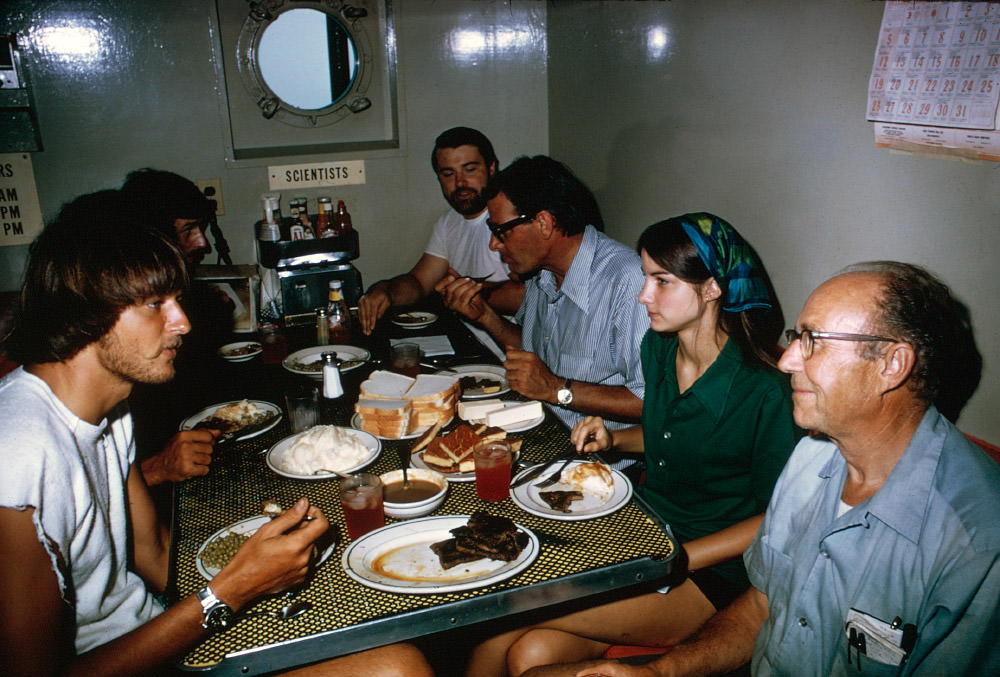
The RV Eastward was a well-maintained vessel. There was always a diesel smell onboard, the businessman said. “It was fun sitting around the table with those people,” he said, adding they were fed well. “It was great chow.”

The team usually had a beer at the end of the day; Harris can’t recall how the turret find was celebrated.

50 years later, the trip of a lifetimes still resonates with Harris.

“The Monitor experience is right up at the top. For anyone who enjoys adventure and the outdoors, you just can’t beat it. It was a great team.”

 PICKET COVERAGE OF USS MONITOR

-- Cathryn Newton: At 16, she was the youngest crew member. She says the find was a group effort.
-- Gordon Watts: How he confirmed the location of the shipwreck
-- Go deep for 50th anniversary of USS Monitor discovery: Printable 3D artifacts, webinar and a 360-degree video of ironclad's resting place
-- USS Monitor: Navy recognizes Virginia museum for cleaning of ironclad's two Dahlgren guns, which are still being conserved
-- The USS Monitor overcame doubters. Its crew trusted the ironclad, even during the terrible storm that sank the famous ironclad.
-- What do USS Monitor, Jimmy Fallon have in common? Saugerties, NY. This town morphed from industrial 'Inferno' to a cool tourist spot

Saturday, August 26, 2023

USS Monitor: 50 years after its discovery, Gordon Watts recounts the mysteries of the ironclad and how he came to make a positive ID

Gordon Watts' sketch of turret and hull; Harold Edgerton top right with sonar; Watts
(sketch courtesy of Watts; other photos courtesy of the MIT Museum)
Gordon Watts was only 23 when he set off for the adventure of a lifetime – trying to locate the legendary USS Monitor. He and a field of experts in the field were competing with a half dozen groups that also were intent on snaring the prize.

But Watts and expedition leader John Newton of the Duke University Marine Laboratory had done their homework, carefully reading records, letters and the log of the ship that was towing the famous Union ironclad when it sank in a storm on Dec. 31, 1862, 16 miles off Cape Hatteras, N.C. They had a bead on the wreck’s likely location about 240 feet down while others searched elsewhere in 1973 and 1974.

Using relatively new technology, the team on RV Eastward dropped side-scan sonars and photo and video cameras in the water (photo of cameras, courtesy of MIT Museum), coming up against very limited visibility as they searched a grid. They had ruled out other wrecks, many dating to World War II, until the somewhat dispirited team made a hit on Aug. 27, 1973, shortly before they would have run out of time.

Sonar showed something that looked like the Monitor’s turret – which made history during its clash with CSS Virginia in March 1862 during the Civil War. But the rest of the wreck made little sense – no one knew before the trip that the ironclad had landed upside down, partially covering the turret, which was separated from the hull.

While there was elation on the Eastward, there was no firm finding and the expedition was unable to confirm it found the vessel when it returned to port. Watts, today the last surviving member of the primary discovery team, got back to work and went on another trip to confirm the Monitor’s location.

Sunday marks the 50th anniversary of the initial discovery. We asked Watts, who has a distinguished career studying and diving shipwrecks, to talk about the experience and how he went about identifying the Monitor.

1973: Gordon Watts, front left, behind him John Harris; on right, from back,
Robert Sheridan, John Newton, Cathryn Newton and Harold Edgerton (NOAA)
“50 years: Whodathunkit??” the legendary underwater archaeologist wrote, when we asked him to recall the adventure.

It’s important to remember the Monitor was no ordinary shipwreck. The ironclad revolutionized naval warfare, ending the era of wooden ships plugging away at each other. The war machine was a marvel of engineering and technology and has intrigued conservators and historians who have pored over components retrieved since 1973.

Today the turret, ordnance, steam machinery and associated artifacts are available to the public at The Mariners’ Museum and Park in Newport News, Va. 

Watts’ responses to emailed questions about the anniversary have been edited for brevity and in some cases combined.

Q. As among the very few who discovered the Monitor wreck in 1973, what do you recall about the expedition? What were the highlights? Who else was with you?

A. The three principals in the RV Eastward cruise that located the remains of USS Monitor were John Newton at the Duke University Marine Laboratory, Dr. Harold Edgerton with Massachusetts Institute of Technology and myself, then the North Carolina state underwater archaeologist. Dr. Robert E. Sheridan, a geologist from the University of Delaware, was also on board Eastward to carry out a geological project.

In retrospect and by comparison with today's technology, my most permanent recollection is associated with how we were able to use Dr. Edgerton's side-scan sonar to locate the wreck and adapt underwater camera and video systems to document significant features of the wreck remains (team's search and location map at right).

The underwater video system used to collect image data at the site was assembled aboard Eastward by John Harris, subsequently the founder and president of Kitty Hawk Kites.

Film and video data collection was crudely controlled by maneuvering RV Eastward back and forth over the wreck. 

Q. What was it like on board the Eastward and can you describe the project?

A. John Newton and I joined the Eastward in Savannah. The trip to Hatteras was my first aboard a ship. The entire trip can be characterized by rough seas, many over 20 feet.  An East Carolina University prehistoric archaeologist along with us to identify prehistoric cultural material in dredge samples we recovered off Cape Fear spent the entire trip very and disgustingly sea sick. At Cape Hatteras, he abandoned ship. Dr. Edgerton joined us and afforded the incredible opportunity to work with someone for whom I had, and will always have, the utmost respect and admiration. That was certainly the opportunity of a lifetime.

Off Cape Hatteras, we shared ship time with Dr. Sheridan. When he was not conducting his geological research and sample collecting, we ran remote sensing in the area I had identified based on historical and environmental research. After locating a clearly modern WWII vessel, we subsequently discovered a wreck with side-scan sonar that appeared to have a potential for association with Monitor.

Armor belt near turret provided a big identification clue (NOAA)
Using Eastward's 35mm drop camera and the underwater television rigged by for documenting the wreck by John Harris we were able to collect sufficient almost random images that ultimately identified Monitor. The Eastward cruise ended at the Duke University Marine Laboratory dock in Beaufort, N.C., where the waiting press was disappointed to learn we had not located and identified the Monitor.

Following a brief synopsis of the cruise and our, at that point, less than dramatic conclusions, I packed up to head back to my office at Fort Fisher. For two hours I was surprised and much disappointed to discover that while never seasick aboard Eastward, the lack of motion of the ocean resulted in my first and so far ONLY case of landsickness. You had to be there.

Q. What convinced you that you had found the Monitor? When was that epiphany?

A. Using the RV Eastward photo and video data I was able to construct crude mosaics and identify features of the armor belt, skeg and propeller shaft and confirm the diameter and wall thickness of the exposed portion of the turret.

One of the Monitor mosaics put together by Watts, others (NOAA)
From those data I was able to make a drawing of the wreck profile to confirm the hull was upside down and resting on the displaced turret. Even with crude image mosaics and drawings, confirming my conclusion that we had indeed found (John) Ericsson's first ironclad was a hard sell.

I informed John Newton of my conclusions in a letter on 14 January 1974. Those conclusions were not universally accepted until, thanks to Dr. Edgerton, we were able to return to the site with Alcoa Seaprobe. That much more sophisticated and systematic investigation generated comprehensive image data that confirmed my conclusions.

Q. How many times have you dived at the Monitor site since? What stands out?

A. I would have to go back to my project logs to be sure how many dives I made on Monitor. However, my first dive was aboard a Harbor Branch Oceanographic Institute Foundation submersible. That first dive was made all the more exciting by identifying the red lantern that was the last evidence of the historic ironclad that was observed by personnel aboard the USS Rhode Island (which was towing Monitor when the latter sank). My lockout divers from the Harbor Branch submersibles focused on an excavation within the officer quarters forward, documenting the steam machinery inside the hull aft of the boilers and investigating the gun ports in the turret underneath the hull remains. It was exciting to be inside Monitor's engine room a century after the ship was lost.

Q. The red lantern (right) was found in 1977, the first artifact recovered, I believe. What do you remember most about its recovery?

A. Harbor Branch diver Richard Roesch locked out of the Johnson Sea Link submersible and recovered the lantern. I think it remains as one of the most significant artifacts from the USS Monitor. The fact that it was the first evidence of the wreck we found on the first submersible dive at the site is beyond ironic.

Q. Anything else about your work on the USS Monitor recovery and what it means today?

A. Still one of the deepest underwater archaeological excavation and recovery projects to date.

Q. Why should we care today about the USS Monitor and its conservation?

A. Today, most Americans are probably unaware of USS Monitor and the brief role it played in the War Between the Confederate States of America and the United States of America. For those who are aware of the ironclad role, they likely also recognize the more significant impact (John) Ericsson's first and subsequent ironclads vessel played in the development of the modern turreted capital steam warship. That role was indeed pivotal. 

COMING SOON: Recollections from John Harris, who operated the underwater video system during the trip and became a hang gliding proponent and founder of Kitty Hawk Kites in the Outer Banks of North Carolina, and Monitor explorer, expert and author John Broadwater.

Watts during work on the CSS Georgia in Savannah in 2017 (Picket photo)

PICKET COVERAGE OF USS MONITOR

-- Cathryn Newton: At 16, she was the youngest crew member. She says the find was a group effort.
-- John Harris: He became a hang glider pilot and founded Kitty Hawk kites. But first, he ran the 1973 expedition's underwater camera system.
-- Go deep for 50th anniversary of USS Monitor discovery: Printable 3D artifacts, webinar and a 360-degree video of ironclad's resting place
-- USS Monitor: Navy recognizes Virginia museum for cleaning of ironclad's two Dahlgren guns, which are still being conserved
-- The USS Monitor overcame doubters. Its crew trusted the ironclad, even during the terrible storm that sank the famous ironclad.
-- What do USS Monitor, Jimmy Fallon have in common? Saugerties, NY. This town morphed from industrial 'Inferno' to a cool tourist spot