Showing posts with label school. Show all posts

Tuesday, August 11, 2026

What's the story with a Civil War bullet found on a coastal North Carolina school playground? It looks like a Federal soldier removed it to unload his weapon

Boys with three-ring bullet they found at school (Morehead City Elementary photo); Map of area (Wikipedia)
Morehead City Elementary School at Camp Glenn isn’t just the home of the Dolphins. It’s also home to a boatload of North Carolina military history -- from Confederate and Union camps during the Civil War to a National Guard training center in the early 20th century.

That rich history collided in mid-May with two fifth-graders, Evan J. and Will B., who were enjoying recess in the front playground. They found a .58-caliber bullet observers believe likely was used by a Union soldier in 1862 during the siege of nearby Fort Macon.

The artifact has since been placed in a display case near the front entrance; where it will greet students returning to school next week.


“It was located along the fence/property line where a new fence has been installed in the last year, where our school grounds butt up against a boat dealership,” Principal Christy Propst told the Civil War Picket. (Morehead City Elementary photo)

“I feel certain the bullet was unearthed during the process of installing the fence. During other projects like installing a playground set, we have found old tin cans and lids that are roll top of that makes sense.”

Paul Branch Jr., an author and retired historian for Fort Macon State Park, said the Camp Glenn training site and the elementary school are located in what was formerly a small coastal settlement known as Carolina City.

Joseph Shadek of the 8th Connecticut Infantry made this sketch of an 1862 Union military camp in Carolina City (Courtesy of the Bridgeport History Center, Bridgeport Public Library)
“A Confederate camp called Camp Argyle existed briefly near Carolina City for the 7th North Carolina Regiment before it was sent to New Bern,” said Branch. “After the battle of New Bern, Union forces advancing from New Bern to capture Fort Macon occupied Carolina City on March 22, 1862, and established their headquarters there, with camps for Connecticut and Rhode Island troops in the area,” he said.

Carolina City also had a railroad spur line leading to a wharf on the sound, from which Union soldiers, siege artillery and supplies were ferried across Bogue Sound to occupy Bogue Banks during the siege of Fort Macon, added Branch, who has written two books about the fort.

“Although there was no fighting at Carolina City, the bullet was probably dropped by one of the soldiers while camped there and then found by the two children,” he said.

Case at school includes photo of boys, bullet (lower right) and history of Camp Glenn
I asked readers of the Authentic Campaigner Facebook page to identify the discovered bullet. They said it was a three-ringer Burton or Minie Ball – and said it was likely Federal and had been “pulled.” I asked for an explanation.

“Loaded into a rifle, not fired, pulled out with a screw attached to the rammer,” said one commenter. “Happened mostly for misfires or if coming off picket line or any other situation where you couldn't just fire it, but needed the gun unloaded.” 

The very top of the round shows evidence a worm screw had been used to reach the bullet in the barrel, commenters said.

Propst said the school at first used Google AI to try to identify the bullet. She then reached out to the History Museum of Carteret County (below) for help.

Museum executive director Gracie Bender said researcher Dee Lewis and volunteer curator Barbara McCreary determined the round came from the Civil War.

“Discoveries like this do turn up from time to time along the Crystal Coast, though they’re not an everyday occurrence,” Bender said. “While Morehead City itself did not see major battles, the area was part of a heavily militarized coastline. Union forces occupied nearby Beaufort and Fort Macon early in the war, and troops moved throughout the region. Because of that activity, stray artifacts occasionally surface.”

“It’s hard to say whether it was dropped during the Civil War or arrived later through soil brought in during construction,” she added.

The museum interprets the Civil War as part of the larger story of coastal North Carolina — focusing on Fort Macon, Union occupation, local civilian experiences and the strategic importance of the ports and sounds. Fort Macon was forced to surrender in April 1862.

Carolina City died out after the Civil War and was absorbed by Morehead City. In the early 1900s, Camp Glenn was established on part of the land as the annual training grounds for the North Carolina State Guard/National Guard. (At right, Craig Swain photo at HMdb.org)

A Coast Guard/Navy Air Station was briefly established here in the early 1920s. A Navy Section Base was also established here in World War II.

“Carolina City and its environs have seen a lot of military use over the years,” said Branch.

Propst, the principal, said after Camp Glenn the grounds were home to a naval hospital and a state highway patrol training facility before becoming a school.

“Lots of history on these grounds,” she added. “I’m not local to the area, but it has been interesting to learn.”

Thursday, May 8, 2025

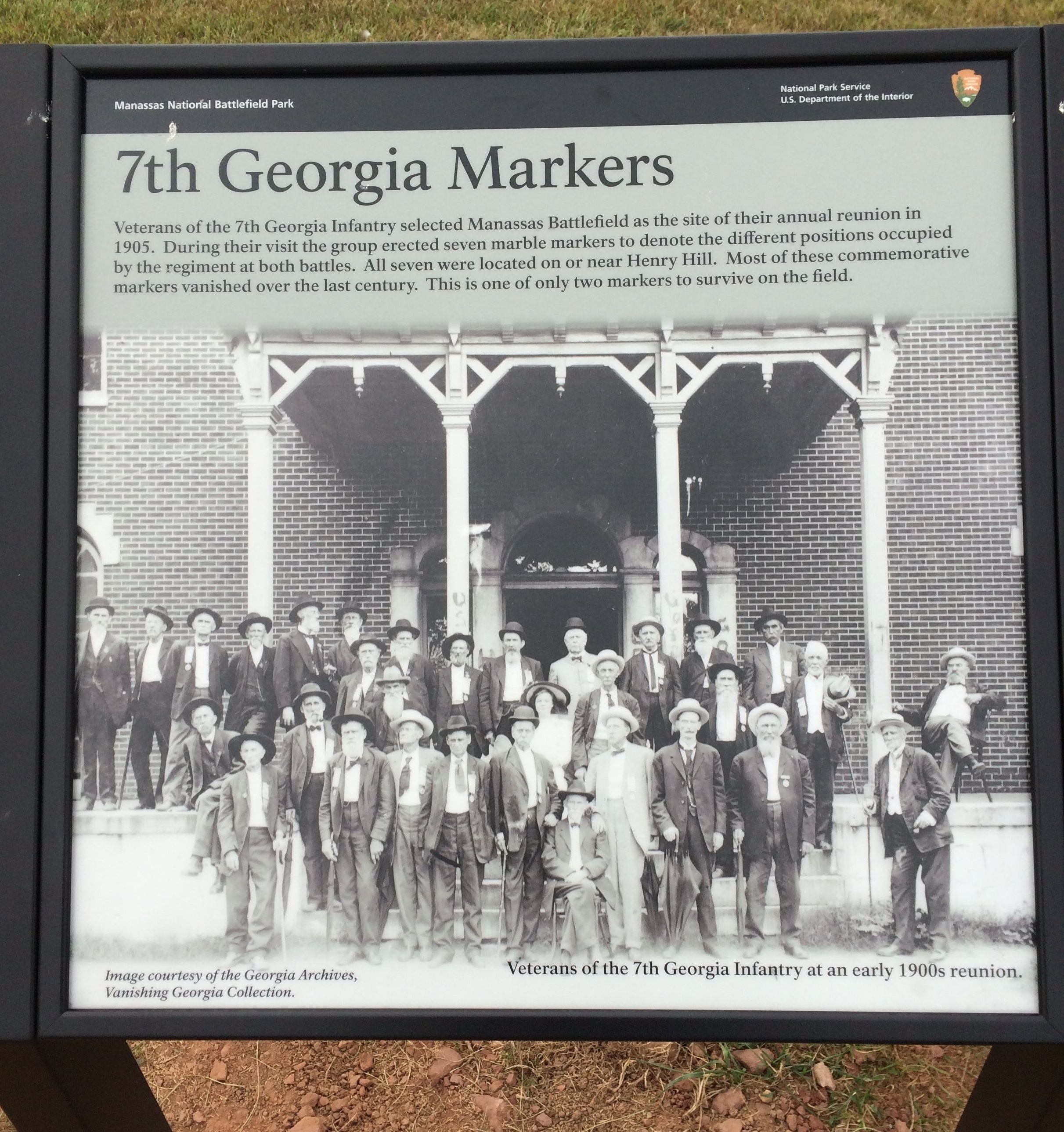
Veterans of the 7th Georgia Infantry wanted people to know the specific positions they held at Bull Run. They traveled north to place seven markers and remember fallen comrades. You can learn about their effort at a park exhibit closing soon

7th Georgia veterans at an 1897 reunion in Marietta (Georgia Archives), fragment of second position marker, pins showing locations of Manassas markers, and a surviving marker at Ricketts' battery (Picket photos)
The graying veterans of the 7th Georgia Infantry Regiment – whether convening at a restaurant, saloon or the battlefield – savored snatches of humor amid the serious business of remembering the dead and shared experiences that bonded them for life.

Newspaper articles in Atlanta and Marietta from the early 1870s into the first decade of the 20th century contained long, florid prose about reunions. Many anecdotes referred to what was on the dinner table.

“Boys, you eat like you did in the army!” former Col. Lucius Gartrell said of a meal featuring fried salmon, trout, deviled crabs, spring chicken, sirloin and cakes.

These lines about a dinner -- as recorded in minutes of the regiment’s 1905 meeting in Groveton, Va. -- likely brought a chuckle:

“There is a charge to be made but not on a battery. There are tables heavily laden with all manner of good things and true to our record we charged, captured and held the fort.”

So it is no surprise the veterans' 1905 visit to the First Manassas (Bull Run) battle in Virginia, where the regiment first spilled and drew blood, promised “a grand and pleasant time and a series of interesting festivities,” according to the Marietta Journal.

Their trip by train was noteworthy for what the warriors planned to do: place six markers indicating where they were positioned during the July 1861 battle and another stone for a position at Second Manassas in August 1862. Other stops during the summer trip included Alexandria, Va., Washington, D.C., Fredericksburg, Richmond and Petersburg.

“We promise a grand and pleasant time and a series of interesting festivities,” the veterans association said, according to the article.

Since that visit, the marble markers fell victim to time, vandals and – possibly – a highway widening, with only two still on the field today, one of them rarely seen by visitors.

An exhibit at Manassas National Battlefield Park, installed in late 2022, contains pieces of two markers and describes the fate of all seven. But you better hurry if you want to see them. The exhibit's two markers are expected to be rotated out on May 21, placed in storage and made available for research by appointment. 

Fragment came 'home' years after it vanished

I learned about the 7th Georgia markers when I read a park Facebook post in March 2022 describing the return of a chunk from the “second position” marker to the Manassas battlefield.

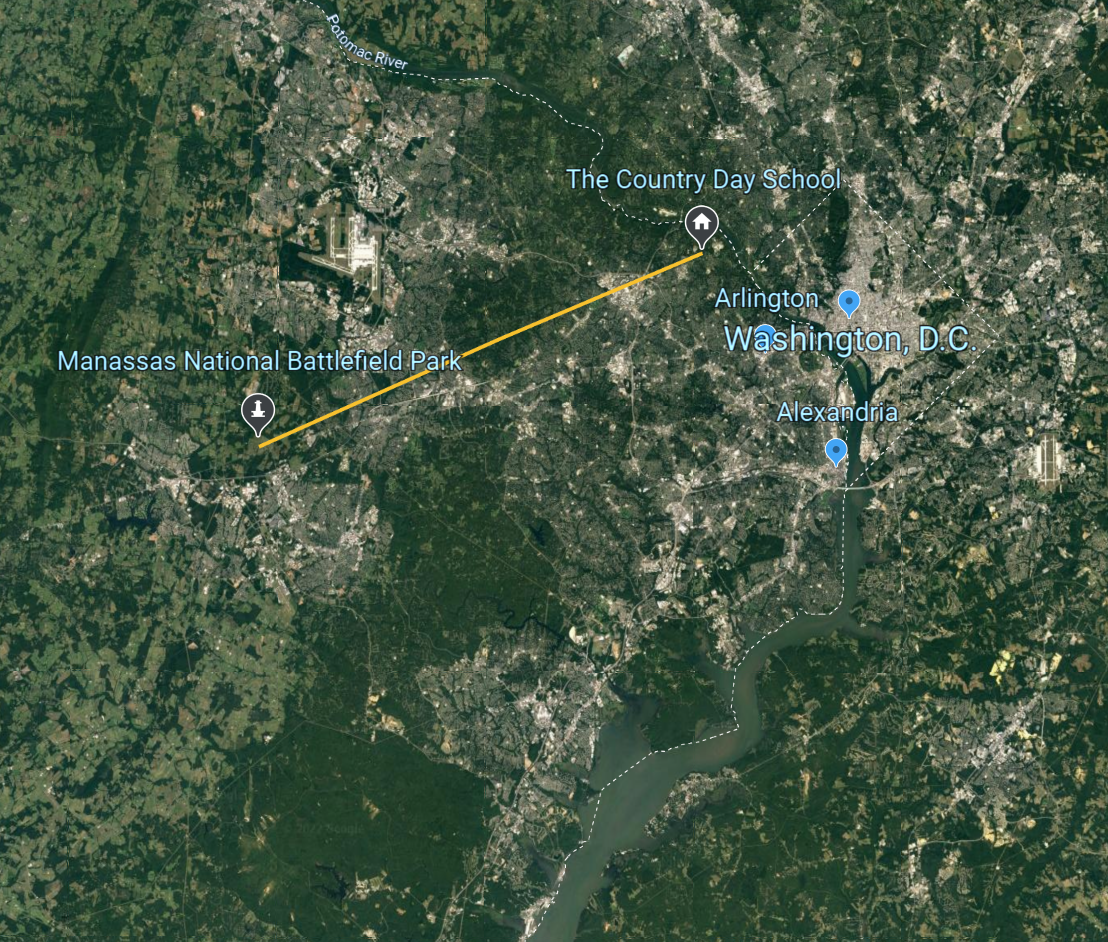
How the top portion landed at the Country Day School in the upscale Langley neighborhood of McLean – about 45 miles away near the CIA headquarters – remains a mystery.

The son of the school’s director in the 1970s found it while doing construction work on an old barn on the school property. A 1990s Washington Post article about Langley includes a photograph of director Dorothy McCormick holding the stone, described as a tombstone. 

McCormick believed it to be a tombstone for a Georgia boy and it was an indication of the area's historical significance, she told the Post. She kept it on a hearth.

It wasn’t a grave marker, says Manassas National Battlefield Park museum specialist Jim Burgess, who documented the 7th Georgia position markers and tried to get this one donated to the park 30 years ago after he learned of its discovery. He had no success at the time, given the park had no legal claim because the stone disappeared before the park was established in 1940. 

McCormick kept the stone, apparently for sentimental reasons.

When the director died in 2018, her children sold her home to the school and left the artifact behind. In February 2022, the federal park got a phone call indicating the school’s desire to see the stone back at Manassas.

Burgess believes the lower half of the marker may be the gray stone in the middle of a fireplace, which was built by a farmer on what is now park property.

Jim Burgess points out the grayer stone in a park fireplace (Picket photo)
I stopped by the park last summer to meet with Burgess about the exhibit. He kindly showed me one of the surviving markers and drove me to the fireplace/grill to see the item for myself. It stands out a bit from the other stones and you can readily see how it might match up with the returned piece.

Burgess’ passion about the 7th Georgia markers is likely matched only by a retired Army lieutenant colonel who served in Vietnam and the 173rd Airborne Brigade.

He first saw these markers while a young man

To say Henry W. Persons Jr. of Severn, Md., is serious about chronicling the service of the 7th Georgia Infantry and its brigade wouldn’t quite capture the scope of his passion.

Henry W. Persons Jr. provided this photo of he and his impressive documents 
“I finished my chapter on the battle of Manassas several years ago. It is 214 pages double-spaced with 1,427 footnotes,” he told the Picket.

Persons, 80, has known Burgess for more than 20 years, and they have exchanged notes about the regiment and position markers. The ranger read Persons’ chapter and made some suggestions.

Persons first encountered the 7th Georgia position markers while walking to Henry Hill in the early 1960s with his father. He later came across what is called the “hidden” marker, which is deep in the woods and rarely seen by park visitors.

The researcher’s passion – perhaps obsession – was a big help to me as I researched this piece. He provided by email numerous newspaper articles, a roster and minutes of meetings held by the regiment’s veterans.

“I have 80 boxes filled with catalog material on Anderson’s brigade,” Persons said.

Brig. Gen. George Thomas “Tige” Anderson (left) was not in command of the brigade at First Manassas but he led it from early 1862 until war’s end.

Regiment suffered big casualties on a big day

The 7th was mustered into Confederate service in late May 1861. Most of the regiment’s soldiers were from Coweta, Paulding, DeKalb, Franklin, Fulton, Heard and Cobb counties in northern Georgia.

The unit was rushed to Virginia and saw heavy combat at Manassas on July 21, 1861, the first major battle in the Eastern Theater. (Sign at park, Picket photo)

Brigade commander Col. Francis S. Bartow was killed while leading his men against Federal Capt. James B. Ricketts’ battery on Henry Hill during a pivotal moment in the fighting. “One of their men is the first to jump up on the cannon,” said Persons.

The battle swung to the Confederates’ favor late in the day for a victory that left Union forces fleeing to Washington and dashing any hopes on either side for a quick war.

The 7th Georgia suffered a staggering 153 casualties out of 580 men present, according to American Battlefield Trust.

Persons had an ancestor, Aaron Wellborn (Welborn) Mashburn (right), who served with Company E, 7th Georgia, as a teamster and cook.

“I believe he did participate in First Manassas but that is supposition. My dad didn’t know.”

Persons, who was born in Atlanta, said learning about Mashburn led him to delve deeper into the regiment and brigade, which saw action in numerous, battles including Antietam and Gettysburg. His great-great-grandfather apparently was taken prisoner for a time, but was released and served until the Confederate surrender at Appomattox. He died in 1924 at age 81.

“I was curious what he experienced, having been in war myself.”

Researcher has left no stone unturned

After his 25 years of active duty, the officer retired in Maryland and worked as a civilian for the Army. Research was not new to him, having studied underground operations for Special Forces. He lives south of Baltimore and near Fort Meade.

Persons’ research over the years took him to Emory University on Atlanta, the University of Georgia in Athens and the Georgia Archives, among other institutions. (7th Georgia meeting minutes left, click to enlarge

Much of what he found at libraries was on microfilm (He has not conducted research in recent years).

He keeps reams of research and writing about Anderson’s brigade in Hollinger boxes.

“My annotated bibliographies for the brigade and each regiment, battalion and artillery company that was assigned to the brigade numbers some 1,200 single-spaced pages.  It is a wealth of information pertaining to the brigade, its actions and men,” said Persons, who has given several hundreds of pages to the Manassas park archives.

He’d like to see all of this published someday.

'Watching the clouds of dust rising'

I turned to the newspaper articles Persons sent me to gain some insight to the 7th Georgia veterans and why they got together.

An 1871 reunion included toasts to fallen and current members. “Several hours were passed in recalling the incidents of the war in which they each had taken a part, many of them amusing, many sad, and all of them interesting.”

The men paid tribute to Col. William T. Wilson, who fell at Second Manassas. ”He was the favorite of the regiment, and never will they forget his cheery shouts and words of encouragement to ‘my boys’ as they and he were seeking the thickest of the fights,” recorded the Atlanta Daily Sun.(At right, Burgess in front of exhibit, Picket photo)

An 1885 article recounted details from an evening at an Atlanta saloon.

“Most of them were men considerably past the meridian of life, but a franker, merrier set of men could not be found. There was something of the ring of the camp in their tones and the affectionate pride with which they alluded to their old regiment was as fresh as if they had just been through a campaign.”

The regiment’s flag flew over the dinner. Its words: “Repel the Invader.” The 7th Georgia veterans, wives and families made at least two trips to Manassas, in 1902 and 1905. (Below, what's left of the "Third Position" marker, Picket photo)

I will leave you with these passages from two unattributed and undated articles about their 1902 journey.

The Seventh Georgia veterans are here, the guests of Lee camp until tomorrow night, when they board their special for Fredericksburg. The grim old fellows spent the day tramping over battle fields of Manassas and along Bull Run, and a more tired or hungry party of southerners have not stopped off here in many a day. Lee camp and the ladies' auxiliary fixed them up a substantial and dainty repast at their hall, and will provide them with accommodation and interest them in a way that they will remember old Alexandria and her hospitality the balance of their days.”

And this one:

“Just forty one years ago to-day, many of you were standing with me near this spot listening to the rumbling of cannon and caisson on the Centreville pike and watching the clouds of dust rising from the confident tread of advancing thousands, followed by vehicles of different kinds, filled with spectators of both sexes, who had driven from Washington to enjoy the fun of seeing the Rebels run. A few hours later far greater clouds of dust could be seen caused by the furious retreat of these same parties to Washington.”

(Below, a map shows the location of all seven markers)

Thursday, July 21, 2022

Fragment of stone monument marking location of a Georgia regiment is back 'home' at Manassas battlefield after disappearing decades ago

Then head of school Diane Dunne and Jim Burgess (Photos: The Country Day School)

A missing stone fragment that once marked a position held by a bloodied Georgia regiment is back at the Manassas battlefield in Virginia for today’s 161st anniversary, ending a saga that began decades ago.

The Civil War marker’s story is a fragmented tale whose pieces finally came together earlier this year when the chunk of marble was donated to the park by a small private school in McLean, about 45 minutes away.

Veterans of the 7th Georgia Infantry – which was in the thick of fighting at the First Battle of Manassas (Bull Run) – in 1905 opted to place six markers indicating where they were positioned in that battle and another marker for a position at Second Manassas in August 1862.

The markers fell victim to time and vandals, with only two still on the field today, one of them rarely seen by visitors.

Officials believe this returned so-called “second position” marker disappeared before the park was established in 1940. How the top half landed in the upscale Langley neighborhood of McLean – near the CIA headquarters – remains a mystery. The son of the school’s director in the 1970s found it while doing construction work on an old barn on the school property. His mother believed it to be a tombstone for a Georgia boy.

A sketch of the barn on the school property (Courtesy of McCormick family)
That wasn’t the case, says Manassas National Battlefield Park museum specialist Jim Burgess, who has documented the 7th Georgia position markers and tried to get this one donated to the park nearly 30 years ago after he learned of its discovery.

The school’s director held onto the marker and Burgess moved on to other things. After the director died in 2018, her children sold her home to the school and left the artifact behind.

In February, the federal park got a call from the school, indicating the school’s desire to see the stone back at Manassas. Burgess got to the campus within two hours. 

“It has sort of been on the back burner,” Burgess said. “I was flabbergasted in getting the call.”

Sign at Manassas park has photo of 7th Georgia veterans (Shane Oliver/HMdb.org)
The fragment is about 10 inches by 10 inches and appears to have the first part of  “2nd POSITION” etched at top.

The park has put the piece in a temporary display case along with a photo of an outdoor stone fireplace/grill – a seemingly odd pairing.

Burgess believes the lower half of the marker may be the gray stone in the middle of the fireplace, which was built by a farmer on what is now park property.

Georgia veterans returned to battlefield

The 7th Georgia, part of a brigade led at Manassas by Col. Francis S. Bartow, was mustered into Confederate service in late May 1861. Most of the regiment’s soldiers were from Coweta, Paulding, DeKalb, Franklin, Fulton, Heard and Cobb counties in northern Georgia.

The unit was rushed to Virginia and saw heavy combat at Manassas on July 21, 1861, the first major battle in the Eastern Theater. (At left, photo of Pvt. John William Barrett of the 7th)

Bartow was killed while leading the 7th against Capt. James B. Ricketts’ battery on Henry Hill during a pivotal moment in the fighting, which swung to the Confederates’ favor late in the day for a victory that left Union forces fleeing to Washington. The 7th Georgia suffered a staggering 153 casualties out of 580 men present, according to American Battlefield Trust.

Decades later, 7th Georgia veterans decided to place the position markers, rather than a large single monument. They resembled tombstones and were scattered across the rolling hills.

Burgess’ records indicate the second position marker may have been broken and displaced when the Warrenton Turnpike was widened in the 1920s.

The top half ended up in McLean, while the bottom -- which has no inscription -- may be in the fireplace adjacent to the old George Sutton farm.

Piece of marble is in middle of large fireplace at Manassas. (Jim Burgess, MBNP) 
In 1970, Sutton said he built the fireplace with stones recovered from the area, but “This piece of marble here was picked up along the highway when we put the fence up there. Evidently it was a piece of a monument…”

The farm was acquired by the park in the 1950s.

Fragment was found among rocks

In the 1960s, Dorothy McCormick, a leader in early childhood education, started a small school at her Great Falls, Va., home. McCormick (right) later acquired Happy Hill School (renamed The Country Day School) in McLean in the early 1970s. 

The nonprofit venue, located in the suburban Washington, D.C, neighborhood, offers preschool and kindergarten classes. McCormick promoted motor skills training and an enrichment center, among other innovations.

“We called her the director. She was old school,” said son Robert McCormick. “Very sweet, but you didn’t give her any guff.”

Becky Benton, current officer coordinator at the private school, told the Picket that Mrs. McCormick, a widowed mother of six children, had a strong imprint on staff and parents.

“She had a way of attracting people to her mission,” Benton said.

The 5-acre property included a two-story cattle barn built in 1921.

Mrs. McCormick decided to live there after extensive renovations were made. Robert, who designs and builds homes, led that project. In 1977, he discovered the marker while moving rubble and other material from a fill pit while working on a deck foundation at the barn.

“It was in there. We had thought we had uncovered a Civil War grave site,” he said.

“She was very excited to think a soldier may have been buried here,” Benton said.

McCormick’s mother kept the fragment on the hearth as a conversation piece, and a 1990s Washington Post article about Langley includes a photograph of her holding the stone, described as a tombstone.

Mrs. McCormick told the paper it was an indication of the area’s historical significance.

“It was important for her to keep it safe,” Benton said. “She was history minded and appreciated the history of the school and America.”

Park communicated with educator 

After reading the article, Burgess contacted Dorothy McCormick by phone and through a March 1994 letter, sharing what he knew about the position markers and telling her the fragment was not a tombstone.

We did not know as much about the movements of the 7th Georgia Regiment and their markers at that time (of the letter) as we do today,” he told the Picket earlier this year.

The school is in the Washington, D.C, area (Andrew Gast map, click to enlarge)
The official asked Mrs. McCormick to look at documentation of the markers. “Naturally, we feel the stone in your possession rightfully belongs at the battlefield. We would be most grateful to accept it as a donation to the park’s museum collection should you feel inclined to part with it,” Burgess wrote in 1994. (McLean is about 25 miles from Manassas.)

Burgess said after the letter was sent, the school director “indicated to us by phone that she wanted to retain it for sentimental reasons, I guess. We did not pursue it. We did not have any legal claim to it because it disappeared well before the park was established.”

The letter probably annoyed his mother, said Robert McCormick, and she likely forgot about it over the years, he said.

Dorothy McCormick sold the school and a cottage on the property in 1991 and continued living in the converted barn until her 2018 death at age 96. The family then sold the barn to The Country Day School, which in turn converted it into an office.

Robert McCormick says his mother was very happy while living in the rustic barn. “It was a cozy, homey place.”

Chance review of photos led to donation

The Country Day School and the surrounding neighborhood is rich with history. The main building was constructed in 1858 and at times it served as a church, Civil War hospital and residence. Mrs. McCormick lived in a cottage on the property before moving to the barn.

Converted barn and main building of The Country Day School in McLean (Picket photos)
After the McCormick family sold the old barn, they left school-related items, photos and the marker in the structure.

Early this year, Benton – the office coordinator – went to the structure to find old photographs of the main building for a class of children who are age 3.

She flipped through a photo album and came across the 1994 letter from Burgess. While Benton knew the marker was there, she had not seen the correspondence. “(Mrs. McCormick) did not necessarily agree it was not a soldier’s gravestone.”

“It was very sentimental for Mrs. McCormick. The children thought it belonged here. We felt it belonged to the battlefield.” The school decided to make the donation and reached out to the park.

Robert McCormick was not aware of the donation until reached by the Picket, but he says the family is satisfied with the disposition.

The two 7th Georgia markers still on the field (Manassas National Battlefield Park)
Burgess said he is pleased the marker is back “home.” He would like to see it displayed with a piece of another position marker and a map.

The stone fragment we just acquired lacks sufficient integrity to be put back in the ground.  It would be nice to replace all seven markers with exact reproductions and save the originals in the park collection,” Burgess wrote in an email.

The originals have been subject to damage from tree falls, road construction, vandalism and theft. It would be good to protect what is left of them and still mark the positions the veterans made effort to preserve for posterity. Unfortunately, we don't have the funding to do that.”

Burgess set up this display after the school's donation (Jim Burgess, MNBP)

Thursday, December 15, 2016

Will school named for gov. get new name?


Joseph E. Brown
The Atlanta Board of Education is considering changing the name of a middle school named after Georgia’s Civil War governor. WSB-TV reports that school board Chairman Courtney English has assembled a committee to take input from the community over possibly changing the name of Brown Middle School. Founded in 1923, the southwest Atlanta school is named after Joseph E. Brown, who owned slaves. • Article

Tuesday, November 29, 2011

N.C. launches website for lessons

North Carolina students now have a way to link their classroom lessons about the Civil War with the actual sites where historic events took place. A website for teachers offers activities and lesson plans based around 12 state historic sites such as Bentonville Battlefield and Fort Fisher. The materials can be used alone if classes can't visit the sites. • Website