Showing posts with label SUVCW. Show all posts

Sunday, May 18, 2025

The partial remains of three Union soldiers have been buried at Fredericksburg National Cemetery. Inside their tiny casket is a trove of military buttons, a coat remnant and other items that got mixed up with their bones

May 2 burial (City of Fredericksburg), examination of burial bundle and Connecticut button (Dovetail/Mead & Hunt)
Following the Civil War, the United States government undertook an exhaustive effort to ensure a proper resting place for Union soldiers who had given the “last full measure of devotion.”

Work parties scoured battlefields, back yards, pastures and countless other places to collect 300,000 bodies that were interred at 73 national cemeteries. Remains arrived in dribs and drabs at Fredericksburg National Cemetery in Virginia between 1866 and 1868. Most came with no name: Of the 15,243 soldiers, about 85 percent are unknown.

Contractors hired by the government often retrieved skulls and larger portions of the skeleton, leaving most behind. Such was the case with three Federal soldiers buried together at a site near Sophia Street in downtown Fredericksburg. They died at a hospital set up during the Battle of Fredericksburg in December 1862.

Fredericksburg Superintendent Lewis Rogers at cemetery burial (City of Fredericksburg)
Ten years after the discovery of the partial remains, the men were rendered full honors on May 2 when a small casket holding leg, toe, finger and other bones was buried at the national cemetery.

Among those on hand were Mayor Kerry Devine, members of the Sons of Union Veterans of the Civil War and Lewis Rogers, superintendent of Fredericksburg & Spotsylvania National Military Park. Assisting the reburial effort was the Missing in America Project.

“The placement of these remains closes an important and long journey for these men. They left home at a young age to fight for a cause they believed in, only to lose their lives hundreds of miles from home,” said Kerri Barile Tambs, senior practice lead at Dovetail Cultural Resource Group, which was hired by the city to conduct archaeological examinations during the Riverfront Park project and studied the bones.

There’s another fascinating aspect of the story: Barile Tambs (left) and other Dovetail staffers analyzed a “bundle” found with the men's remaining bones. The jumble of items included fabric from a uniform, military buttons, a pack of straight pins and a small bottle. They were likely kept in pants pockets.

Among the uniform buttons was one denoting Connecticut.

“The three individuals were buried as they died -- wearing their uniforms. By the time people came back … to remove parts of the burials, partial decomposition had occurred,” said Barile Tambs.

“These workers removed some of the bones but left others jumbled together. In the process, it appears that the coat of one of the soldiers was dislodged from the bones, ‘balled up,’ and put back in the hole with the bones they left behind.”

14th Connecticut, other units used house as hospital

A November 2015 article by The Free Lance-Star newspaper detailed the find near the Rowe-Goolrick house, which was constructed in the 1750s to face onto one of Fredericksburg's original ferry roads (and thus was perpendicular to Sophia Street).

The discovery was made after a Masonic hall next to the Rowe-Goolrick house site was torn down to make room for Riverfront Park and city officials called Dovetail in to study the site.

Bright green area is where the human remains were found in 2015 (NPS image)
Dovetail performed archaeological work and archival studies in the area four times between 2013 and 2019. The team located thousands of artifacts spanning from the precontact period through the 1970s.

A 2019 blog post on the Dovetail website details the discovery of several building foundations during the effort.

The Rowe-Goolrick house  was demolished in 1973 to make room for a parking lot that is now part of the park along the Rappahannock River. A fascinating 1863 photograph of the city shows the Rowe-Goolrick house. It was then the home of Absalom Rowe, a cattleman and future mayor of the town. Near it was the Eliza Eubank home, also shown in the picture. It still survives and may be the oldest building in Fredericksburg (circa 1746).

Wartime image of the town, shows Rowe-Goolrick home at right foreground, 
facing the Eliza Eubank home at left (Library of Congress)
A recent National Park Service page about the discovery of the burial site in town said the 14th Connecticut Infantry used the Rowe-Goolrick house, outbuildings and grounds as a hospital.

Second Lt. Charles Lyman of the regiment wrote about witnessing a leg amputation on a soldier placed on a rude operating table under a big buttonball tree in the yard.”

The NPS said the remains of the three soldiers showed no evidence of amputations.

Archaeologists determined the remains belonged to U.S. soldiers by using radiocarbon dating and the context in which they were found and associated artifacts, including uniform buttons, according to the city.

More about 113 items found in the 'bundle'

Barile Tambs told the Picket in an email the bundle was about 2-3 feet below the surface in what appeared to be a root cellar.

The NPS page provides these details about what her team found:

Straight pins were found among the jumble of material (Dovetail/Mead & Hunt)
The X-ray revealed a total of 113 artifacts in the small bundle. These materials included eagle buttons, a small patent medicine bottle, straight pins, a pocket watch key, a small horsehair brush, and a cuff-size Connecticut button. The identification of the Connecticut button was especially significant because the 14th Connecticut was the only Connecticut unit in the 3rd Division at the Battle of Fredericksburg, providing additional information as to the potential troops who occupied the site.

Dovetail – now a part of Mead & Hunt -- does not know anything about the straight pins. The bottle (right, photo Dovetail/Mead & Hunt) is believed to have contained a patent medicine most likely used to treat syphilis. The piece of cloth measured maybe 8 inches by 5 inches.

The archaeologist said the disturbance of the first grave near the Rowe-Goolrick house made it difficult to understand how the men were buried.

“The parts that were left behind were dislodged and jumbled thus no longer representing a standard skeletal position,” Barile Tambs said. “As such, we can't say much on the exact original configuration of the burials at the time of death -- we only have evidence that was left behind … during the partial removal process.”

Full honors for soldiers 160 years later

Fredericksburg National Cemetery sits on Marye’s Heights, a strategic area located southwest of the town’s historic downtown. During the Battle of Fredericksburg, Confederate troops held the high terrain and successfully repelled numerous Union attacks.

Before this month, the last burial of a soldier or veteran there was in 1945. Subsequent burials were spouses. The cemetery has been officially closed to interments since 2010.

Eagle buttons found amid bones, other artifacts in city of Fredericksburg (Dovetail/Mead & Hunt)
The city asked the NPS to bury the remains in 2017, with the need to find a location at the cemetery that had no evidence of a previous interment. The Virginia Department of Historic Resources also was consulted.

The Covid pandemic slowed the project. A 2021 effort to find a suitable plot came to a stop when archaeologists found a long-covered road and brick-lined culvert. A new location was found two years later.

“This 10-year process established protocols should other Civil War remains be found in the area to expedite the respectful reburial of these brave individuals,” Barile Tambs told the Picket. 

Sons of Union Veterans of the Civil War and dignitaries at service (City of Fredericksburg)

The May 2 ceremony included a dozen members of the SUVCW, including a color guard.

According to the city, the National Cemetery Administration has provided the headstone, which will match others in the cemetery and include the epitaph “Unknown.” Given the soldiers are unknown, officials do not where the first part of their remains were interred in the 1860s.

I asked Barile Tambs what became of the bundle.

“It has all been reburied with the remains. They are all grave goods,” she wrote.

Wednesday, June 5, 2019

'In the silent camping ground of the dead': Sons of Union Veterans help dedicate grave site of soldier resting beneath Long Island church

Some of the SUVCW contingent (Courtesy of Patrick Young)
SUVCW members conduct ceremony near plaque above grave (Trinity Episcopal)
The singing of the “Battle Hymn of the Republic,” words from clergy and a ceremony conducted by the Sons of Union Veterans of the Civil War were highlights of the rededication of the burial site of a Civil War soldier who rests beneath a New York church.

Eight members of Moses A. Baldwin Camp #544, SUVCW, participated in Sunday morning’s ceremony at Trinity Episcopal Church in Roslyn on Long Island.

“This is the main mission of the Sons of Union Veterans of the Civil War -- to find the final resting place of every single Union veteran and make sure the grave is properly marked,” said Dennis Duffy, secretary-treasurer for the camp.

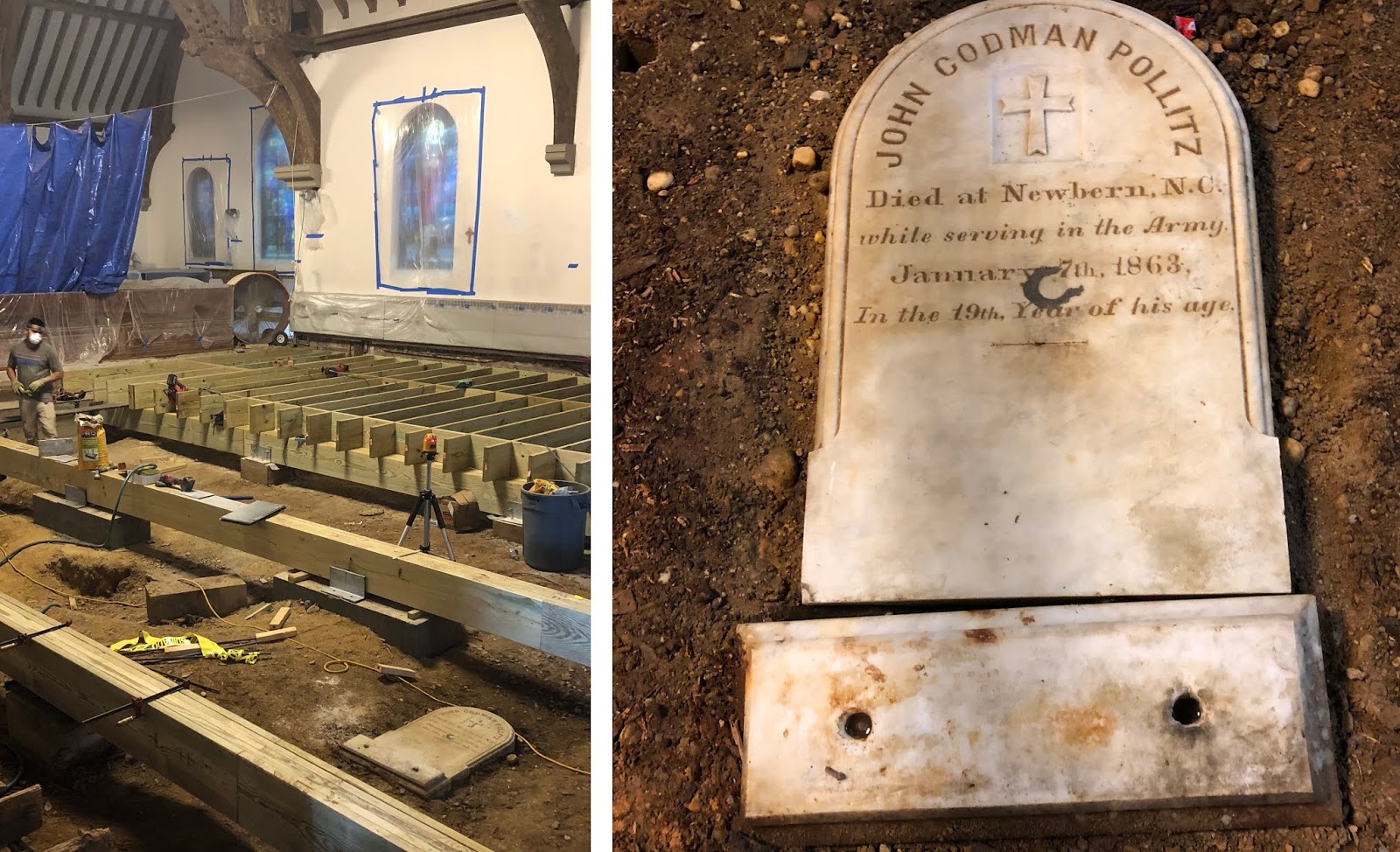
Parishioners had long known that Pvt. John Codman Pollitz’s 1863 grave was incorporated within the current building during construction in 1906. But most of them had no idea where; there was no recorded location.

That changed last summer, when the congregation fixed a longtime problem: The floor of the nave had been deteriorating and sinking. During the floor-replacement project, rotting wooden joists were removed and Pollitz’ headstone was exposed; it was lying flat in a crawlspace area.

Exposed church floor in 2018 and Pollitz headstone flat on ground
(Photos courtesy of Trinity Episcopal Church, Roslyn)
A new plaque marks the spot on the floor under which Pollitz rests. Sunday's dedication took place near the back of the nave, next to the small plaque.

Duffy told the Picket this week that the SUVCW has a database listing hundreds of thousands of graves.

He cited the work of the local Cemetery Restoration Committee of Pachogue, which last year dedicated new headstones for six Civil War veterans at historic cemeteries. Leaders at Trinity moved the Pollitz headstone from the floor area and are trying to determine where to place it.

It’s believed that the young Pollitz was living in Boston and barely 18 when he joined up with the 44th Massachusetts, ostensibly in the summer of fall of 1862. The regiment, which took part in skirmishes and sieges across North Carolina before it was mustered out in June 1863, was in New Bern for several months before transfer to Plymouth, N.C.

A history of the regiment detailed disease and illness that stalked the troops during campaigning and at their quarters. Pollitz, who served in Company F, died on Jan. 7, 1863.

According to the “Record of the Service of the Fourth-Fourth Massachusetts Volunteer Militia in North Carolina, August 1862 to May 1863,” Pollitz and 13 other soldiers in the regiment died from cerebrospinal meningitis.

(Photos courtesy of Patrick Young)
Pollitz’s father was an immigrant and businessman; a history of Roslyn indicated he immigrated from Northern Ireland. But an online search of ancestry-related pages shows Otto W. Pollitz was from Hamburg, Germany, and John’s mother was born in Massachusetts. Church members are unaware of any living descendants.

According to Duffy, John C. Pollitz attended Brooklyn Collegiate and Polytechnic Institute (now part of NYU) and had moved on to college in Massachusetts, where he enlisted with the 44th.

"John did not have to go to war. There was no draft at the time and when the draft would come six months after John's death, his family could have afforded to pay a substitute under the rules then in effect," Duffy wrote this week to other members of the SUVCW camp.

The Picket is grateful to Patrick Young, author of the Immigrants' Civil War Facebook page, for the use of several photos. He attended Sunday's event.

Monday, July 1, 2013

Cannonball pyramid will rise again at Chickamauga battlefield

Lytle Monument today ... (SUVCW)
Imagine one of the ancient pyramids of Egypt reduced to only its bottom level of stones. Kind of loses its visual impact, right?

That’s what happened over time to one of eight monuments – built with about 320 cannonballs – that honor senior officers killed at the Battle of Chickamauga in northwest Georgia in September 1863.

Ohio Brig. Gen. William H. Lytle, known as the “poet warrior,” fell during a failed counterattack on Sept. 20, 1863. The well-known poetry and bravery of Lytle, twice wounded in previous battles, brought him high esteem among his Confederate adversaries, who placed a guard around his body until it could be returned to Union lines.

... Back in its glory days (SUVCW)
This Sept. 20, 150 years to the day after Lytle fell, the fully restored Lytle Monument will be rededicated during a ceremony at Chickamauga & Chattanooga National Military Park.

Groups that supported the restoration and, possibly, Lytle descendants will join park and local dignitaries for the formal observance of the 150th anniversary of the battle, which ended in Confederate victory.

A separate Battle of Chickamauga re-enactment, set for Sept. 19-22 and sponsored by the Blue Gray Alliance, will be held in Walker County, Ga.

The monument project has proven a challenge for park staff, said Jim Szyjkowski, chief resource manager.

Fund-raising led by the Friends of the Park and the General William H. Lytle Camp #10 of the Sons of Union Veterans of the Civil War, totaling about $65,000, was critical to moving the project forward. “Typically, you cannot do something like this with a park budget. You have to go outside,” said Szyjkowski.

Officials had to consult old plans for the cannonball pyramids and find a welder and manufacturer who could faithfully duplicate the work.

Brig. Gen.W.H. Lytle
“It is exciting because it has been a different kind of project the park has taken on. It is great to see it restored to its onetime grandeur,” Szyjkowski told the Picket.

Vandalism took its toll gradually after the Lytle Monument was dedicated in 1894. As the pyramid shrank, some of the cannonballs – surplus artillery shells from the Civil War – were used to repair other monuments at the park.

The exact number of original cannonballs is either 317, by Szyjkowski’s count, or 323. Only 120 of the original shells remain.

Szyjkowski said the pyramid monuments at Chickamauga recognize four Union and four Confederate mortally wounded officers.

They have a mortar skeleton, meaning they are not entirely made of artillery shells.

“All of them were victims of vandalism,” he said.

The Lyle Monument was eventually reconfigured to one level.

The restored monument – back to its original height -- will be made of reproduction 8-inch shells produced by a local foundry. The old shells will be stored for possible future use.

Szyjkowski said his staff is working from original monument plans designed by park engineer Edward E. Betts.

Original plans for Chickamauga pyramid monuments (NPS)
Kerry Langdon, a Cincinnati Realtor and past commander of the Lytle SUVCW camp, is thankful the park has improved maintenance around the monument -- which is a bit off the beaten track -- northeast of the towering Wilder Brigade Monument.

A few years back, Langdon and his wife, Wanda, contacted the Friends of the Park to help further along the restoration project to honor a “brave soldier” who Langdon said should be considered for a posthumous Medal of Honor.

In 1895, Chickamauga was the first of the four original federal Civil War sites to open, a testament to the desire of veterans of both sides to see a lasting symbol of the bloody clash.

“We are now on the same side and working together and we love this country,” said Kerry Langdon, who visited the federal cemetery at Chattanooga, Tennessee, when he was a small boy. “It is a good example of how forgiving both sides were after the war and we are united.”

One of the intact pyramid monuments (NPS)
The Friends of the Park, formed in 1986, supports educational programming and restoration and preservation projects.

“We are having huge success in working with individuals and corporations for the 150th,” said executive director Patrice Glass.

The Friends, which operates the Jewell Memorial Restoration Fund, is helping governments and the National Park Service with 150th anniversary events, including a Chattanooga Symphony Orchestra concert at the battlefield on Sept. 21.

An emphasis this year has been the Lytle Monument.

“It is the first monument to be completely restored through the fund-raising of the Friends and other organizations,” said Glass.

The Sept. 20 Lytle rededication ceremony will recall the sacrifice of soldiers and others for the entire battle.

National Park Service
“That is the moment where we will stop and pause and will say here is what happened here and the significance,” said Glass. “This is where reunification happened. … Those veterans said we need to mark this and we need to remember it.”

Other sesquicentennial events that week at Chickamauga include ranger-led programs and the Civil War timeline, at which living historians "will propel visitors through North Georgia between 1861 and 1864."

Kerry Langdon said about 25 members of the Cincinnati SUVCW will be at Chickamauga for the rededication.

“The ceremony is going to be based on a Grand Army of the Republic ceremony back when monuments were first being up,” said Wanda Langdon.

Her husband will be one of the speakers, and will make note of Lytle’s poetry skills and military leadership.

“We feel it is our duty and privilege to honor the honorable,” Kerry Langdon said. “We will be moved, likely to tears, that this monument, through (the work of) so many, has been fully restored.”

COMING SOON: A closer look at Lytle’s life and his poetry.