Showing posts with label church. Show all posts

Tuesday, May 21, 2024

More than 160 years ago, photographer Timothy O'Sullivan took breathtaking images of Grant council of war at Virginia church. Today, O'Sullivan is still a man of mystery

Grant leans over Meade's shoulder (Library of Congress); balcony view today (Kathy Hart)
Timothy O’Sullivan's Civil War photographs documented the horror of combat and the grind of camp life, drilling and marching in less deadly moments. While best known for those four years, O'Sullivan is getting attention now for his compelling images made a few years later out West.

Robert Sullivan, in his new book, “Double Exposure: Resurveying the West with Timothy O’Sullivan,” focuses on the enigmatic photographer’s work after the Civil War.

O’Sullivan, as the author tells the Columbia Journalism Review, left no autobiography, letters or papers. While O’Sullivan is well-known in Civil War circles, it’s safe to say most Americans know little to nothing about him. He died at age 42 of tuberculosis.

Thankfully, O’Sullivan’s work speaks for itself – from “A Harvest of Death” at Gettysburg (1863) to Iceberg Canyon on the Colorado River, circa 1871.

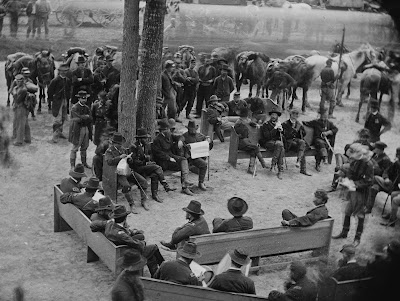
At about noon on May 21, 1864, O’Sullivan (left), using a stereo camera, captured an extraordinary moment on the grounds and from the second-floor balcony of Massaponax Baptist Church in northern Virginia. Union generals Ulysses S. Grant and George Meade and others rested on church pews, wrote orders and surveyed a map after the bloody fighting at nearby Spotsylvania Court House.

John Hennessy, retired chief historian at Fredericksburg and Spotsylvania National Military Park and a history blogger, told the Picket the images are simply remarkable.

“The series at Massaponax Church is a rare, completely candid series of shots of the army headquarters functioning,” he wrote. “I know of nothing else like it from the Civil War.”

My sole visit to the church came in 2016. With my parents, I walked the grounds. The sanctuary was closed, so I could not ascend the balcony to see what O’Sullivan saw below.

Since then, I have been trying to get an image replicating the view, and late last year Kathy Hart, a lifelong member of Massaponax Baptist Church and its history team, came through, taking the photo above on a rainy day.

Hart has been helpful in describing soldiers’ graffiti still on the walls of the church, Civil War tours she leads and more about the small congregation today.


A team from the American Battlefield Trust last summer shot photos and video at Massaponax for its “Step into History” series. The video was released in February.

In the immersive video, Garry Adelman, director of history and education for the Trust, says O’Sullivan must have been excited as he ascended the stairs to record Grant’s council of war.

I asked the trust for more information about the video shoot at the church, which is at the corner of a very busy U.S. 1 (then called Telegraph Road) and Massaponax Church Road. (The church address is 5101 Massaponax Church Road)

Adelman (left) and team at Massaponax Church (Courtesy of Garry Adelman)
“Doing this was complex stuff,” Adelman said. “Shooting in the church and since we shot in 360 making sure that crew didn’t show up in video was a challenge. Then, outside the church was done on a ladder and using a stick to approximate the window height, as seen in the photo.”

O’Sullivan’s treasured photographs are in the collection of the Library of Congress.

In one candid view, Grant leans over Meade’s shoulder to study a map as they plot the next phase of the Overland Campaign -- a move toward the North Anna River. In another, Grant sits with a cigar clenched in his teeth. Also present is Assistant Secretary of War Charles Dana and staff officers. Wagons of the Federal V Corps rumble by in the background on what is now Massaponax Church Road. Grant’s chief of staff John Rawlins also was there.

Grant realized on May 21 that Confederates remained in strong positions after fierce fighting at Spotsylvania and he decided to move to the southeast to try to get them out in the open. Much of the Union army used Smith Station Road and Massaponax Church Road as it started its march to the North Anna, according to Hennessy.

Period map shows church and Telegraph Road (Library of Congress; click to enlarge)
John Cummings, in his Spotsylvania Civil War Blog, has written about the day that Grant and his subordinates stopped by the church.

According to Cummings, Grant wrote one dispatch from Massaponax, to Maj. Gen. Ambrose Burnside. One of the O’Sullivan photographs shows Grant scribbling on a paper pad.

GENERAL: You may move as soon as practicable upon the receipt of this order, taking the direct ridge road to where it intersects the Telegraph road, thence by the latter road to Thornburg Cross-Roads. If the enemy occupy the crossing of the Po in such force as to prevent your using it, then you will hold the north side at Stanard's Mill until your column is passed, and move to Guiney's Bridge. General Wright will follow you and will cover the crossing of the Po for his own corps. At Guiney's Bridge you will receive further directions if you are forced to take that road. If successful in crossing at Stanard's your march will end at Thornburg.
U. S. Grant,
Lieutnant-General
.

Grant writer an order while seated on church pew (Library of Congress)
The Metropolitan Museum in New York, which has a copy of one of the photographs, says of that day:

“The chaotic study is one of the most daring made by any Union photographer. … Evidence suggests that it had been a disastrous day for the Union troops, as the losses were heavy and no strategic advantage had been gained. In the background are rows of horse-drawn baggage wagons and ambulances transporting supplies for the next day’s engagement and the wounded to field hospitals.

A soldier in one of the O’Sullivan photographs went on to receive the Medal of Honor for postwar gallantry. You can read about that here.

In 1863, during the middle of the conflict, Massaponax gave letters of dismissal to black members and they formed smaller churches. Confederate and Union forces alternately used the church as a stable, hospital and meeting place during various campaigns.

For a time, the graffiti on the balcony was covered by whitewash that covered “unsightly marks and the sad stories were forgotten.” The faded writing is now protected by Plexiglass.

A portion of graffiti left by Civil War soldiers (Massaponax Baptist Church)
According to a document kept by the history team, noted historian Douglas Southall Freeman had this to say about the graffiti:

 “A careful survey of the whole subject of the inscriptions at Massaponax Church leads me to conclude that you have something almost unique. The church was located in the no man’s land on the right flank of the Confederate position at Fredericksburg. The church was consequently visited by men of both armies. I do not know of another instance where inscriptions of both sides have survived to this extent. To extinguish them in any way would be to destroy a treasure which will become more and more interesting to visitors as it is known.”

Today, the church has one foot in history and the other very much in the 21st century, meeting the needs of those near and far.

The congregation’s diverse 50 or so active members – many of whom commute to work in the Washington, D.C, metro area -- sponsor a food pantry. They also take part in the Samaritan’s Purse ministry, an international relief effort. “We teamed up with the local elementary school to help provide snacks for low-income students. Also, we visit the seniors at a nearby nursing facility playing bingo,” says Hart. (Photo, courtesy Kathy Hart)

A contemporary service is held at 11 a.m. on Sundays.

“Our mission is to love God and each other through worship; to grow in Christ through discipleship; to serve and fellowship together and to impact the community and the world for Christ,” says Hart.

Civil War aficionados stop by all the time to gaze at the church or a historical marker outside about Grant’s council of war.

O’Sullivan, 160 years after he traveled to Massaponax, is getting new attention through Sullivan’s book.

The photographer was an integral part of Clarence King's survey of the West, undertaken between 1867 and 1872. It covered a vast swath of terrain, from the border of California eastward to the edge of the Great Plains. 

Sullivan, in his Q&A with the Columbia Journalism Review, says his subject “never stopped being a war photographer in the sense that there was violence enacted on the communities that the surveys moved through: either by the surveyors, or the way the surveyors framed the land, or the people who were there.”

Keith F. Davis and Jane L. Aspinwall in 2011 published “Timothy H. O’Sullivan: The King Survey Photographs.”

Davis, a photography curator, author and collector, said O’Sullivan was a key and essential figure of his time.

“The challenge was to grapple with a set of related but distinct questions: what he did, why the pictures look the way they do and why this work remains so relevant to today’s artistic practice,” Davis told the Picket in a recent email.

“Despite (or because of?) the dearth of information about O’Sullivan the person, his pictures have had genuinely special resonance for every succeeding generation of viewers. O’Sullivan is an extraordinary, mysterious gift that keeps on giving.”

Monday, May 2, 2022

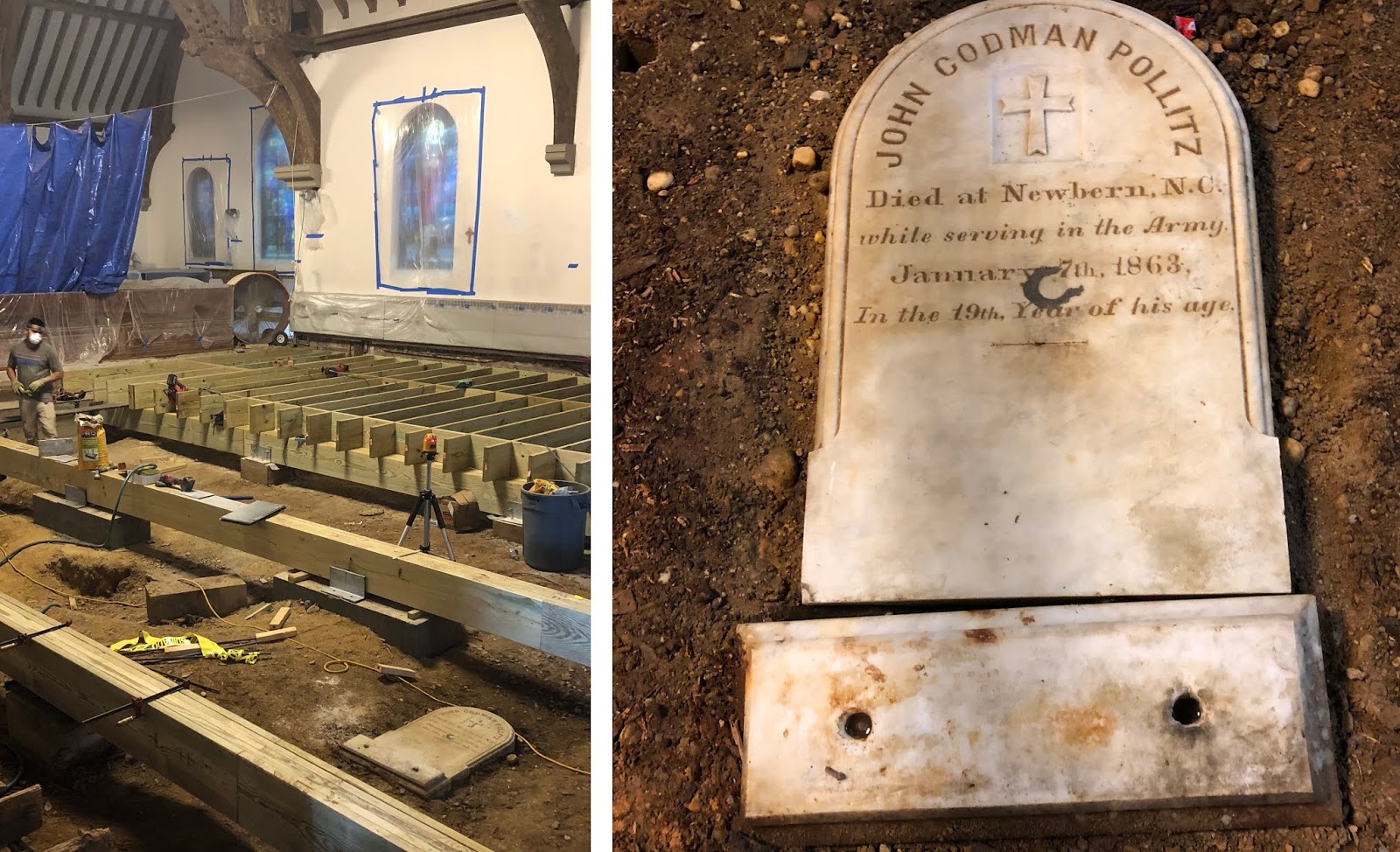
Headstone of Union soldier buried beneath a Long Island church awaits its final resting place. John C. Pollitz died of disease while serving in N.C.

Current location of the Polllitz headstone (Trinity Episcopal Church)
The headstone of a Union soldier buried beneath a Long Island, New York, church awaits a permanent location nearly four years after it was found during a renovation project.

The Picket wrote two articles about the unusual circumstances involving parishioner Pvt. John Codman Pollitz, who died in 1863 while serving with the 44th Massachusetts in North Carolina.

Trinity Episcopal Church in Roslyn has long known that Pollitz’s 1863 grave was incorporated within the current building during construction in 1906. But most of them had no idea where; there was no recorded location. That changed in summer 2018, when rotting wooden floor joists were removed and Pollitz’ headstone was exposed; it was lying flat in a crawlspace area.

“My assumption was that the headstone was too high standing up for the crawlspace. I believe they simply laid it down on that same spot” during the 1906 construction, church property manager and sexton Mike Callahan told the Picket.

Removal of the floor exposed headstone for John C. Pollitz (Trinity Episcopal)
A June 2019 ceremony rededicated the soldier’s grave, which still lies beneath the floor. A plaque marks the spot on the floor under which Pollitz rests. Members of an area camp of the Sons of Union Veterans of the Civil War took part in the ceremony.

At the time, the church said it was trying to determine what to do with the headstone.

“Plans are to build a cabinet mounted on the wall, but that’s going to take some engineering,” Father George Sherrill, priest in charge, told the Picket in a recent email. “The stone weighs a ton and affixing to the wall is going to be difficult, so no real timetable as of yet.”

The priest said the headstone does elicit conversation when people see if for the first time.

The headstone is currently propped up against a bell that has its own interesting history.

Bell was used during the funeral (Courtesy of Trinity Episcopal)
According to a June 1914 article in The New York Times, a dying Pollitz asked comrades to ensure his body was sent to Roslyn, where it was to lie in the shadow of the belfry. “With his army pay he had bought a bell as a gift to the parish, and its arrival and his death were so close together that it was tolled for the first time at his funeral,” the article said.

It’s believed that the young Pollitz was living in Boston and barely 18 when he joined up with the 44th Massachusetts, ostensibly in the summer of fall of 1862.

The regiment, which took part in skirmishes and sieges across North Carolina before it was mustered out in June 1863, was in New Bern for several months before transfer to Plymouth, N.C.

A history of the regiment detailed disease and illness that stalked the troops during campaigning and at their quarters. Pollitz, who served in Company F, died on Jan. 7, 1863 in New Bern.

Sons of Union Veterans lead 2019 ceremony near plaque (Trinity Episcopal)
According to the “Record of the Service of the Fourth-Fourth Massachusetts Volunteer Militia in North Carolina, August 1862 to May 1863,” Pollitz and 13 other soldiers in the regiment died from cerebrospinal meningities.

His remains were sent north to Long Island. “Shortly after his burial, February 1, 1863, the bell was taken down and another put in its place. John Pollitz’s bell was inverted, filled with dirt and flowers, and stood by his grave for many years,” a church newsletter states.

In 1914, the bell was moved and restored after church officials discovered the grave under that floor while investigating a break in the foundation walls, according to The Times.

Construction of floor during 2018 (Trinity Episcopal Church)

Wednesday, June 5, 2019

'In the silent camping ground of the dead': Sons of Union Veterans help dedicate grave site of soldier resting beneath Long Island church

Some of the SUVCW contingent (Courtesy of Patrick Young)
SUVCW members conduct ceremony near plaque above grave (Trinity Episcopal)
The singing of the “Battle Hymn of the Republic,” words from clergy and a ceremony conducted by the Sons of Union Veterans of the Civil War were highlights of the rededication of the burial site of a Civil War soldier who rests beneath a New York church.

Eight members of Moses A. Baldwin Camp #544, SUVCW, participated in Sunday morning’s ceremony at Trinity Episcopal Church in Roslyn on Long Island.

“This is the main mission of the Sons of Union Veterans of the Civil War -- to find the final resting place of every single Union veteran and make sure the grave is properly marked,” said Dennis Duffy, secretary-treasurer for the camp.

Parishioners had long known that Pvt. John Codman Pollitz’s 1863 grave was incorporated within the current building during construction in 1906. But most of them had no idea where; there was no recorded location.

That changed last summer, when the congregation fixed a longtime problem: The floor of the nave had been deteriorating and sinking. During the floor-replacement project, rotting wooden joists were removed and Pollitz’ headstone was exposed; it was lying flat in a crawlspace area.

Exposed church floor in 2018 and Pollitz headstone flat on ground
(Photos courtesy of Trinity Episcopal Church, Roslyn)
A new plaque marks the spot on the floor under which Pollitz rests. Sunday's dedication took place near the back of the nave, next to the small plaque.

Duffy told the Picket this week that the SUVCW has a database listing hundreds of thousands of graves.

He cited the work of the local Cemetery Restoration Committee of Pachogue, which last year dedicated new headstones for six Civil War veterans at historic cemeteries. Leaders at Trinity moved the Pollitz headstone from the floor area and are trying to determine where to place it.

It’s believed that the young Pollitz was living in Boston and barely 18 when he joined up with the 44th Massachusetts, ostensibly in the summer of fall of 1862. The regiment, which took part in skirmishes and sieges across North Carolina before it was mustered out in June 1863, was in New Bern for several months before transfer to Plymouth, N.C.

A history of the regiment detailed disease and illness that stalked the troops during campaigning and at their quarters. Pollitz, who served in Company F, died on Jan. 7, 1863.

According to the “Record of the Service of the Fourth-Fourth Massachusetts Volunteer Militia in North Carolina, August 1862 to May 1863,” Pollitz and 13 other soldiers in the regiment died from cerebrospinal meningitis.

(Photos courtesy of Patrick Young)
Pollitz’s father was an immigrant and businessman; a history of Roslyn indicated he immigrated from Northern Ireland. But an online search of ancestry-related pages shows Otto W. Pollitz was from Hamburg, Germany, and John’s mother was born in Massachusetts. Church members are unaware of any living descendants.

According to Duffy, John C. Pollitz attended Brooklyn Collegiate and Polytechnic Institute (now part of NYU) and had moved on to college in Massachusetts, where he enlisted with the 44th.

"John did not have to go to war. There was no draft at the time and when the draft would come six months after John's death, his family could have afforded to pay a substitute under the rules then in effect," Duffy wrote this week to other members of the SUVCW camp.

The Picket is grateful to Patrick Young, author of the Immigrants' Civil War Facebook page, for the use of several photos. He attended Sunday's event.

Wednesday, February 28, 2018

The bullet, ball field and Baton Rouge: Battle artifact discovery at church prompts a look at neighborhood -- then and now

Renovation of baseball field (Courtesy of Sacred Heart)

[Click here for a February 2019 update!]

Perhaps it was dropped by a young Confederate soldier working furiously to reload his rifle as his regiment advanced. Or maybe a shot fired by the opposing 14th Maine or 21st Indiana regiments missed its mark and drilled harmlessly into the soil.

Whatever the circumstances, the Minié ball rested, was covered by more dirt and -- eventually -- by a baseball field at the northeast corner of what's now Florida Boulevard and North 22nd Street in the Mid City area of Baton Rouge, La.

A 1916 Sanborn insurance map shows the ball field being used by African-American teams. The Stanocolas, a squad fielded by the Standard Oil Company of Louisiana, followed in the 1920s. Since the late 1930s, Sacred Heart of Jesus Catholic Church -- which did not exist during the Battle of Baton Rouge in August 1862 – has owned and used the recreational parcel.

All those years, the bullet stayed undiscovered -- until last week. Crews renovating the church parcel spotted the artifact in soil excavated for a new light pole.

“You never know what you might find,” the church’s Facebook page said.


For church Deacon David Dawson, the find brought some headlines, and a bit of attention.

“I have people 80 years old coming up and saying they played baseball on this field,” he said.

Reading about this tiny bullet led me to delve deeper into the battle, the neighborhood and the church that serves a diverse flock.

Counting on an ironclad

Baton Rouge has always been a river city. The Mississippi, unsurprisingly, played a dominating role during the Civil War, when the capital had about 5,500 residents.

The much larger New Orleans fell to Federal forces in late April 1862. Baton Rouge was abandoned and occupied by Adm. David Farragut a few weeks later. Confederates wanted to regain control of the city so that they could launch attacks along the Red River and retake New Orleans.

CSS Arkansas (Navy Art Collection)

Maj. Gen. John Breckinridge advanced from the east, preparing for the Aug. 5 assault.

Key to success was the formidable CSS ram Arkansas, which had run through the U.S. Navy fleet at Vicksburg just a few weeks before. The plan was for the Arkansas to scatter ships that would drop devastating fire on the attacking Rebels. Parts of the downtown area were reduced by Federal forces so that the ships could better give support to artillery and infantry.

William A. Spedale, in his book “The Battle of Baton Rouge,” wrote: “With the aid of the Arkansas, the Confederates had every reason to feel confident of victory, and the Yankees knew it. Their old wooden ships were no match for the low-profile iron-clad ram.”

Confederates gave it a shot

Click to see battle map
The entrenched Union forces had positions at what is now Sacred Heart church and its ball field. At that time, it was just woods and fields.

Breckinridge’s Hunt and Smith brigades began the push toward the river and the fighting extended to the public cemetery (now called Magnolia Cemetery, across the street from Sacred Heart and its ballfield).

“A fierce fight soon developed across the length and width of the cemetery, most of it in hand-to-hand combat. The tomb and monuments were chipped and pockmarked where Minie balls struck them, and the magnolia and cedar trees were scarred and twisted from cannon fire,” Spedale wrote.

The Rebels pushed the Yankees back toward the river, but had to endure artillery rounds lobbed by U.S. Navy ships. They knew something was wrong.

A National Park Service summary gives the rest of the story.

“The Arkansas could have neutralized the Union gunboats, but her engines failed and she did not participate in the battle. Federal land forces, in the meantime, fell back to a more defensible line, and the Union commander, Brig. Gen. Thomas Williams, was killed soon after. The new commander, Col. Thomas W. Cahill, ordered a retreat to a prepared defensive line nearer the river and within the gunboats’ protection. Rebels assailed the new line, but finally the Federals forced them to retire. The next day the Arkansas’s engines failed again as she closed on the Union gunboats; she was blown up and scuttled by her crew. The Confederates failed to recapture the state capital.”

Damage to Baton Rouge from the battle (Wikipedia)

Phillip E. Faller, author of  “The Indiana Jackass Regiment in the Civil War," told the Picket that Federal forces withdrew a couple weeks later.

“They got the message from Gen. (Benjamin) Butler to burn the town, and get on the transports and get down to New Orleans.”

Some of the community was burned. But the Confederate hold of Baton Rouge was short-lived. It was reoccupied a few months later and was in Union hands for the duration of the war.

View of national cemetery across street (Sacred Heart)
Soldiers battle among tombstones (Wikipedia)

Few reminders of the battle

Of course, many artifacts have turned up in Baton Rouge in the decades since the Civil War.

Bullet marks behind marker (J. Potts)
“I have heard of people over the years going into Magnolia Cemetery and finding this and that,” said Mary Lee Eggart, an artist and archivist for Sacred Heart.

The city today is known for being the headquarters of state government, a large petrochemical industry and Louisiana State University.

John Potts, program director for the Baton Rouge Civil War Round Table, said there are few Civil War spots to visit today.

One is the national cemetery, below Magnolia Cemetery. It contains the remains of Union dead. The Foundation for Historical Louisiana and other groups hold a memorial service at Magnolia Cemetery each summer.

(Courtesy John Potts)
“It is now under concrete,” Faller says of the majority of Civil War Baton Rouge.

But there are still some reminders of the bloody fighting near and on what is church ground.

Several headstones at Magnolia Cemetery bear fading nicks and damage from bullets.

Baseball field has seen many teams

Sacred Heart of Jesus came to the neighborhood in 1924 as a mission of St. Joseph Church. Its picturesque basilica rises above the community and a parochial school is across the street.

Within decades of the Civil War, Baton Rouge was growing to the east. The church served Italian immigrants who came in the late 19th century. The congregation at that time gathered a block away.

Click to enlarge (Courtesy Sacred Heart)
The ballfield was not then in church hands. Early in the 20th century, it was marked as a “Negro” ball park.

“It is uncertain exactly when the area became a ball field, but as early as 1916, a Sanborn insurance map of Baton Rouge notes it on the far eastern edge of the city as ‘Ball Park,” a church history of the field says. “The 1923 Sanborn insurance map of Baton Rouge labels it as ‘Base Ball Park,’ and shows structures labeled ‘grandstand’ and ‘bleachers.’”

The Standard Oil team, the Stanocolas, and the Cotton States League Highlands played on the field in the 1920s. “Children would wait for foul balls to sail over the third-base wall and then stage a bicycle relay through Magnolia Cemetery to hold on to them. These souvenirs were collected and exchanged for game tickets,” the history says.

Map shows relation of field to Civil War units (P. Faller/ML Eggart)

Sacred Heart, wanting to expand, in 1937 purchased the parcel containing the ballfield and what would become the sanctuary. (Improvements to the field were made in the following years.)

“Despite the hardship of the Depression the parishioners were very generous” and raised money for the new building, Eggart said. It was completed in 1942.

Peak membership was in the 1950s, when the church had about 1,200 families. Today, there are about 800.

1947 aerial photograph of the church, field below it (Sacred Heart)

Serving community's many needs

Sacred Heart, which describes itself as having traditional worship, is a fixture in a neighborhood with many challenges. The area is largely African-American and there are many poor families.

“We are on the edge of North Baton Rouge, which has been for many decades a very impoverished part of town,” said Eggart, a lifelong church member.

While most Sacred Heart members live outside its traditional boundaries, about 20-25 percent of members are black. “We are probably one of the more diverse congregations in Baton Rouge,” said Dawson.

Sacred Heart has one of the largest Society of Saint Vincent de Paul groups in the parish, making home visits and helping residents with bills.

(Courtesy of Sacred Heart)

Collections from some Masses go to the society, Dawson said. Most who live around the church are not Catholic, but the church considers itself strong in charitable giving.

“The biggest challenge is people coming to church,” he said.

There’s been a concerted effort to breathe new life into Mid City, through development and low-cost housing. Part of the effort is spearheaded by the city; and there are groups, including the nonprofit Mid City Studio, which is fostering entrepreneurship and cultural resources.

Eggart said revitalization in downtown Baton Rouge in the past decade is starting to spread to Mid City.

The immediate area around the Sacred Heart campus has only seen minimum effects as of yet, possibly because it is more residential and the Mid City growth has largely been with new businesses locating there. But we are hopeful that the trend will continue in our direction as Mid City becomes more attractive as a place to do business AND to live.” 

After Easter, it will be 'Play ball!'

Dawson, the church deacon, was put in charge of the ball field overhaul as a “last hurrah” before he goes to seminary in New Orleans.

Magnolia Cemetery is on the other side of the fence (Sacred Heart)

The renovation includes new metal light poles, large safety nets, grading, leveling and resodding. The bullet was unearthed when crews dug down about 3 feet for the light pole. It’s not clear how deep down the artifact had been resting.

Besides baseball, the field is used by church-affiliated groups, including a young girls running group, practice for softball and flag football teams, and child soccer. "We also on occasion let non-school teams use it," said Dawson.

The church is having a family day after Mass on April 8. Gov. John Bel Edwards have been invited to throw the first pitch.

What will happen to the Minié ball?

Staff members are tossing around ideas, but Dawson said perhaps it will be hung on the concession stand wall, with a placard. “When people come to the games they can see it was a battlefield. I don’t want to put it in a jar.”

Friday, June 17, 2016

At Massaponax: A church that was the site of famous Grant council of war is ministering to 'changing and evolving' world

Ulysses Grant leans over George Meade's shoulder (Library of Congress)
Grant stood near shrubbery area in this modern view

I’ve long been fascinated by a rare series of Civil War photographs showing a council of war – outside a Virginia church on a late spring day in 1864. The images are simply remarkable.

On May 21, 1864, Timothy O’Sullivan, traveling with the Federal Army of the Potomac, set up his heavy camera at a window on the balcony of Massaponax Church and photographed Generals Ulysses Grant and George Meade and others as they relaxed on church pews, wrote orders and surveyed a map after the bloody fighting at Spotsylvania Court House.

In one candid view, Grant leans over Meade’s shoulder to study a map as they plot the next phase of the Overland Campaign -- a move toward the North Anna River. In another, Grant sits with a cigar clenched in his teeth. Also present is Assistant Secretary of War Charles Dana and staff officers. Wagons of the Federal V Corps rumble by in the background.

Grant (seated between two trees) enjoys a cigar (Library of Congress)
Best modern angle I could do without being on the balcony

My parents and I paid a quick visit to Massaponax Baptist Church a few weeks ago after visiting part of the Spotsylvania battlefield earlier in the afternoon. The church is at the corner of a very busy U.S. 1 (then called Telegraph Road) and Massaponax Church Road. Unfortunately, the sanctuary was closed. Still, it was interesting to walk around where these giants of the Union plotted strategy.

Today, the church has one foot in history and the other very much in the 21st century, meeting the needs of those near and far.

On a video posted on Facebook this week, incoming pastor Dusty Carson encouraged the congregation to pray for the Orlando massacre victims and their families. “We are called to love. The greatest act of love we can do is pray for them.” He said that Jesus Christ will help heal the battered community.

Shirley Wilson, a deacon at the church, answered the phone when I called to ask about the Baptist church’s ministries today.

The congregation’s diverse 100 members – many of whom commute to work in the Washington, D.C, metro area -- sponsor a food pantry that serves 150 to 200 families. They also provide school supplies for homeless and low-income children and take part in the Samaritan’s Purse ministry, an international relief effort.

“The world is changing and evolving,” Wilson told me.

Another Timothy O'Sullivan, before council of war (Library of Congress)
(Picket photo)

There are two Sunday services: 9:15 a.m. is traditional and the 10:30 a.m. service, which draws more worshippers, is considered contemporary.

Being in a heavy traffic zone can be a plus, Wilson said. “Lot of good things happen because of that.” People who drive by and see the food pantry operation sometimes send money.

I asked whether many people interested in the Civil War and the O’Sullivan photographs stop by. “All the time,” she said. “We think it is a fantastic thing.” Graffiti left by Federal troops is protected and visible on the balcony, although much of it has faded over time. “We tried to save most of it.”

The church was established in 1788. The current brick sanctuary was erected in 1859. Pastor Joseph Billingsley was famous for preaching long sermons of about two and a half hours.

“This did not sit well with the congregation,” the church website says. “On one occasion, it is said that they wedged the door to exclude him, but he preached his sermon in the church yard.”

Fuller views of Grant consulting and writing order (Library of Congress)

In 1863, during the middle of the conflict, Massaponax gave letters of dismissal to black members and they formed smaller churches. Confederate and Union forces alternately used the church as a stable, hospital and meeting place during various campaigns.

For a time, the graffiti was covered by whitewash that covered “unsightly marks and the sad stories were forgotten.”

Back to that day in 1864: Grant realized on May 21 that Confederates remained in strong positions at Spotsylvania and he decided to move to the southeast to try to get them out in the open.

John Cummings, in his Spotsylvania Civil War Blog, has written about the morning that Grant and his subordinates stopped by the church.

According to Cummings, Grant wrote one dispatch from Massaponax, to Gen. Ambrose Burnside. One of the O’Sullivan photographs shows Grant scribbling on a paper pad.

GENERAL: You may move as soon as practicable upon the receipt of this order, taking the direct ridge road to where it intersects the Telegraph road, thence by the latter road to Thornburg Cross-Roads. If the enemy occupy the crossing of the Po in such force as to prevent your using it, then you will hold the north side at Stanard's Mill until your column is passed, and move to Guiney's Bridge. General Wright will follow you and will cover the crossing of the Po for his own corps. At Guiney's Bridge you will receive further directions if you are forced to take that road. If successful in crossing at Stanard's your march will end at Thornburg.
U. S. Grant,
Lieutnant-General
.

The Metropolitan Museum in New York, which has a copy of one of the photographs (which are stored at the Library of Congress), says of that day:

“The chaotic study is one of the most daring made by any Union photographer. … Evidence suggests that it had been a disastrous day for the Union troops, as the losses were heavy and no strategic advantage had been gained. In the background are rows of horse-drawn baggage wagons and ambulances transporting supplies for the next day’s engagement and the wounded to field hospitals.

A soldier in one of the photographs went on to receive the Medal of Honor for postwar gallantry. You can read about that here.

View of busy U.S. 1 (Jefferson Davis Highway)