Showing posts with label Baton Rouge. Show all posts

Thursday, February 28, 2019

Update: They found a bullet last year at a Baton Rouge church ballfield. Here's what they have learned about it

Gov. Edwards throws out first pitch (Courtesy of Sacred Heart)
Details of bullet (Courtesy of Phillip Faller)
A Picket article posted one year ago today resonated with readers curious about a Civil War bullet that was found during the renovation of a church ballfield in Baton Rouge, La.

I decided to check back to see whether there has been anything gleaned about its origin.

Author Phillip E. Faller told me Wednesday that he checked the .54-caliber, flat-base bullet last fall. It was made for Merrill rifles, which were manufactured in Baltimore, he said.

“I took one of my own Merrill bullets with me to compare and make sure,” Faller said of his visit to Sacred Heart of Jesus Catholic Church, which sits on property that saw action during the Battle of Baton Rouge and owns the ballfield where the bullet was found.

Besides this determination, Faller reaffirmed his believe that such a rifle likely belonged to a soldier with Company H or Company K of the 21st Indiana, which fought in the August 1862 battle. The regiment was the only Federal unit at the battle believed to have been equipped with the breechloader Merrills, he said.

Field after 2018 renovation (Courtesy of Sacred Heart)
Faller, author of  “The Indiana Jackass Regiment in the Civil War," believes the bullet was fired because of a chip and other slight wear. “It very likely was fired ... but with the caveat it could have been dropped when the regiment was retreating.”

The 21st Indiana and 14th Maine had entrenched positions at what is now Sacred Heart and its ballfield. At that time, it was just woods and fields.

Confederate brigades began the push toward the Mississippi River and the fighting extended to the public cemetery (now called Magnolia Cemetery, across the street from Sacred Heart and its sports field).

“A fierce fight soon developed across the length and width of the cemetery, most of it in hand-to-hand combat. The tomb and monuments were chipped and pockmarked where Minie balls struck them, and the magnolia and cedar trees were scarred and twisted from cannon fire,” William A. Spedale wrote in his book “The Battle of Baton Rouge.”

Father Walsh blesses the field (Sacred Heart)
Several headstones at Magnolia Cemetery bear fading nicks and damage from bullets. (Faller said the uncovered bullet is not a Minie ball.)

Mary Lee Eggart, an archivist for Sacred Heart, said the renovated ballfield was blessed by pastor Fr. Miles Walsh on April 8, 2018. Gov. John Bel Edwards threw out the first pitch.

“The field has seen a lot of use for baseball and other school athletic activities in the past year. Our students and parishioners are very proud of our beautiful ballfield,” she said.

Deacon David Dawson, who spearheaded the renovation, began his studies for the priesthood at Notre Dame Seminary in New Orleans last August. “We miss him but are glad he is close enough to come back and visit regularly,” Eggart said.

Damaged tombstone (John Potts)
Dawson told the Picket last year about the discovery of the bullet in soil excavated for a new light pole. The staff was kicking around ideas on how to showcase the find, perhaps on a concession wall at the field, he said.

“We have no definite plans for displaying the bullet as of yet,” Eggart said this week. “We thought about a small display at the ballfield itself, but we couldn't come up with a display method that would keep it secure from environment or thievery. (We) will display it when we have church history exhibits on special occasions.”

• Read our first article about the bullet

August 2024 update: The bullet, while still in the church collection, has not gone on display.

Wednesday, February 28, 2018

The bullet, ball field and Baton Rouge: Battle artifact discovery at church prompts a look at neighborhood -- then and now

Renovation of baseball field (Courtesy of Sacred Heart)

[Click here for a February 2019 update!]

Perhaps it was dropped by a young Confederate soldier working furiously to reload his rifle as his regiment advanced. Or maybe a shot fired by the opposing 14th Maine or 21st Indiana regiments missed its mark and drilled harmlessly into the soil.

Whatever the circumstances, the MiniĆ© ball rested, was covered by more dirt and -- eventually -- by a baseball field at the northeast corner of what's now Florida Boulevard and North 22nd Street in the Mid City area of Baton Rouge, La.

A 1916 Sanborn insurance map shows the ball field being used by African-American teams. The Stanocolas, a squad fielded by the Standard Oil Company of Louisiana, followed in the 1920s. Since the late 1930s, Sacred Heart of Jesus Catholic Church -- which did not exist during the Battle of Baton Rouge in August 1862 – has owned and used the recreational parcel.

All those years, the bullet stayed undiscovered -- until last week. Crews renovating the church parcel spotted the artifact in soil excavated for a new light pole.

“You never know what you might find,” the church’s Facebook page said.


For church Deacon David Dawson, the find brought some headlines, and a bit of attention.

“I have people 80 years old coming up and saying they played baseball on this field,” he said.

Reading about this tiny bullet led me to delve deeper into the battle, the neighborhood and the church that serves a diverse flock.

Counting on an ironclad

Baton Rouge has always been a river city. The Mississippi, unsurprisingly, played a dominating role during the Civil War, when the capital had about 5,500 residents.

The much larger New Orleans fell to Federal forces in late April 1862. Baton Rouge was abandoned and occupied by Adm. David Farragut a few weeks later. Confederates wanted to regain control of the city so that they could launch attacks along the Red River and retake New Orleans.
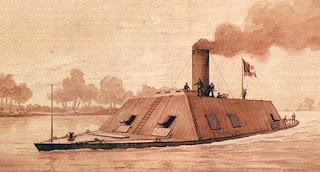
CSS Arkansas (Navy Art Collection)

Maj. Gen. John Breckinridge advanced from the east, preparing for the Aug. 5 assault.

Key to success was the formidable CSS ram Arkansas, which had run through the U.S. Navy fleet at Vicksburg just a few weeks before. The plan was for the Arkansas to scatter ships that would drop devastating fire on the attacking Rebels. Parts of the downtown area were reduced by Federal forces so that the ships could better give support to artillery and infantry.

William A. Spedale, in his book “The Battle of Baton Rouge,” wrote: “With the aid of the Arkansas, the Confederates had every reason to feel confident of victory, and the Yankees knew it. Their old wooden ships were no match for the low-profile iron-clad ram.”

Confederates gave it a shot

Click to see battle map
The entrenched Union forces had positions at what is now Sacred Heart church and its ball field. At that time, it was just woods and fields.

Breckinridge’s Hunt and Smith brigades began the push toward the river and the fighting extended to the public cemetery (now called Magnolia Cemetery, across the street from Sacred Heart and its ballfield).

“A fierce fight soon developed across the length and width of the cemetery, most of it in hand-to-hand combat. The tomb and monuments were chipped and pockmarked where Minie balls struck them, and the magnolia and cedar trees were scarred and twisted from cannon fire,” Spedale wrote.

The Rebels pushed the Yankees back toward the river, but had to endure artillery rounds lobbed by U.S. Navy ships. They knew something was wrong.

A National Park Service summary gives the rest of the story.

“The Arkansas could have neutralized the Union gunboats, but her engines failed and she did not participate in the battle. Federal land forces, in the meantime, fell back to a more defensible line, and the Union commander, Brig. Gen. Thomas Williams, was killed soon after. The new commander, Col. Thomas W. Cahill, ordered a retreat to a prepared defensive line nearer the river and within the gunboats’ protection. Rebels assailed the new line, but finally the Federals forced them to retire. The next day the Arkansas’s engines failed again as she closed on the Union gunboats; she was blown up and scuttled by her crew. The Confederates failed to recapture the state capital.”

Damage to Baton Rouge from the battle (Wikipedia)

Phillip E. Faller, author of  “The Indiana Jackass Regiment in the Civil War," told the Picket that Federal forces withdrew a couple weeks later.

“They got the message from Gen. (Benjamin) Butler to burn the town, and get on the transports and get down to New Orleans.”

Some of the community was burned. But the Confederate hold of Baton Rouge was short-lived. It was reoccupied a few months later and was in Union hands for the duration of the war.

View of national cemetery across street (Sacred Heart)
Soldiers battle among tombstones (Wikipedia)

Few reminders of the battle

Of course, many artifacts have turned up in Baton Rouge in the decades since the Civil War.

Bullet marks behind marker (J. Potts)
“I have heard of people over the years going into Magnolia Cemetery and finding this and that,” said Mary Lee Eggart, an artist and archivist for Sacred Heart.

The city today is known for being the headquarters of state government, a large petrochemical industry and Louisiana State University.

John Potts, program director for the Baton Rouge Civil War Round Table, said there are few Civil War spots to visit today.

One is the national cemetery, below Magnolia Cemetery. It contains the remains of Union dead. The Foundation for Historical Louisiana and other groups hold a memorial service at Magnolia Cemetery each summer.

(Courtesy John Potts)
“It is now under concrete,” Faller says of the majority of Civil War Baton Rouge.

But there are still some reminders of the bloody fighting near and on what is church ground.

Several headstones at Magnolia Cemetery bear fading nicks and damage from bullets.

Baseball field has seen many teams

Sacred Heart of Jesus came to the neighborhood in 1924 as a mission of St. Joseph Church. Its picturesque basilica rises above the community and a parochial school is across the street.

Within decades of the Civil War, Baton Rouge was growing to the east. The church served Italian immigrants who came in the late 19th century. The congregation at that time gathered a block away.

Click to enlarge (Courtesy Sacred Heart)
The ballfield was not then in church hands. Early in the 20th century, it was marked as a “Negro” ball park.

“It is uncertain exactly when the area became a ball field, but as early as 1916, a Sanborn insurance map of Baton Rouge notes it on the far eastern edge of the city as ‘Ball Park,” a church history of the field says. “The 1923 Sanborn insurance map of Baton Rouge labels it as ‘Base Ball Park,’ and shows structures labeled ‘grandstand’ and ‘bleachers.’”

The Standard Oil team, the Stanocolas, and the Cotton States League Highlands played on the field in the 1920s. “Children would wait for foul balls to sail over the third-base wall and then stage a bicycle relay through Magnolia Cemetery to hold on to them. These souvenirs were collected and exchanged for game tickets,” the history says.

Map shows relation of field to Civil War units (P. Faller/ML Eggart)

Sacred Heart, wanting to expand, in 1937 purchased the parcel containing the ballfield and what would become the sanctuary. (Improvements to the field were made in the following years.)

“Despite the hardship of the Depression the parishioners were very generous” and raised money for the new building, Eggart said. It was completed in 1942.

Peak membership was in the 1950s, when the church had about 1,200 families. Today, there are about 800.

1947 aerial photograph of the church, field below it (Sacred Heart)

Serving community's many needs

Sacred Heart, which describes itself as having traditional worship, is a fixture in a neighborhood with many challenges. The area is largely African-American and there are many poor families.

“We are on the edge of North Baton Rouge, which has been for many decades a very impoverished part of town,” said Eggart, a lifelong church member.

While most Sacred Heart members live outside its traditional boundaries, about 20-25 percent of members are black. “We are probably one of the more diverse congregations in Baton Rouge,” said Dawson.

Sacred Heart has one of the largest Society of Saint Vincent de Paul groups in the parish, making home visits and helping residents with bills.

(Courtesy of Sacred Heart)

Collections from some Masses go to the society, Dawson said. Most who live around the church are not Catholic, but the church considers itself strong in charitable giving.

“The biggest challenge is people coming to church,” he said.

There’s been a concerted effort to breathe new life into Mid City, through development and low-cost housing. Part of the effort is spearheaded by the city; and there are groups, including the nonprofit Mid City Studio, which is fostering entrepreneurship and cultural resources.

Eggart said revitalization in downtown Baton Rouge in the past decade is starting to spread to Mid City.

The immediate area around the Sacred Heart campus has only seen minimum effects as of yet, possibly because it is more residential and the Mid City growth has largely been with new businesses locating there. But we are hopeful that the trend will continue in our direction as Mid City becomes more attractive as a place to do business AND to live.” 

After Easter, it will be 'Play ball!'

Dawson, the church deacon, was put in charge of the ball field overhaul as a “last hurrah” before he goes to seminary in New Orleans.

Magnolia Cemetery is on the other side of the fence (Sacred Heart)

The renovation includes new metal light poles, large safety nets, grading, leveling and resodding. The bullet was unearthed when crews dug down about 3 feet for the light pole. It’s not clear how deep down the artifact had been resting.

Besides baseball, the field is used by church-affiliated groups, including a young girls running group, practice for softball and flag football teams, and child soccer. "We also on occasion let non-school teams use it," said Dawson.

The church is having a family day after Mass on April 8. Gov. John Bel Edwards have been invited to throw the first pitch.

What will happen to the MiniƩ ball?

Staff members are tossing around ideas, but Dawson said perhaps it will be hung on the concession stand wall, with a placard. “When people come to the games they can see it was a battlefield. I don’t want to put it in a jar.”

Thursday, February 26, 2015

Donated gunboat model will be star of Sat. program at Louisiana's Port Hudson site

USS Essex (Marvin Steinback, Port Hudson SHS)
The USS Essex was a great big sister. Mess with me, and you’ll have to deal with her.

The Essex was converted in stages from a steam ferry to a fully armored Federal gunboat. Along the way, the crew saw action in the Fort Henry, Vicksburg, Port Hudson and Red River campaigns. The vessel took a beating, but it helped save the garrison in Baton Rouge, La., and it contributed to eventual victory at Port Hudson.

A 1:32 scale model of the gunboat was recently donated to Louisiana’s Port Hudson State Historic Site off U.S. 61 north of Baton Rouge.

“It is one of seven remote-controlled vessels that have a relationship to Port Hudson that I have built,” said Robert Seal, a park volunteer. “It is the largest, by far, and the most complicated.”

Using foam insulation and balsa wood, Seal, 69, crafted a vessel that is nearly 7 feet long and weighs about 30 pounds. “Everything is scratch built,” Seal told the Picket this week.

USS Essex in 1862 (Library of Congress)
(Martin Steinback, Port Hudson SHS)
Local artist Bill Toups has assisted with the USS Essex model, using a lathe to make 13 guns that comprise the business end of the ironclad.

The historic site and Seal at 11 a.m. Saturday will put on a program, “The Waterfront: Vicksburg, Port Hudson and the Fight for the Mississippi.” The event will be held at a pond that seasonally holds 1:32 models of ships that took part in Mississippi River and other campaigns. (The models are kept inside the rest of the year)

Seal, who researches their design and history, built them all, including a few in his personal collection. His entire fleet will be at Saturday’s program. The USS Essex and CSS Arkansas  -- which clashed in July 1862 -- will briefly sail across the water to help educate visitors.

The Confederacy put a lot of effort and manpower into defending the vital Mississippi River in 1861-1863.

“The whole purpose was to keep the Federals from going upriver at Port Hudson, while Vicksburg was to keep them from going downriver,” said Mike Fraering, an interpretive ranger at Port Hudson. The two forts were about 175 miles apart.

The Federal army and navy early in the war realized the importance of waterways and by controlling the Mississippi River, they could cut the Confederacy in half, disrupting commercial and military traffic and communication.

Annual re-enactment at Port Hudson (Robert and Pat Seal)
The USS Essex was heavily damaged by enemy gunfire at Fort Henry in February 1862. She was fitted with stronger armor and returned to service to take part in the Vicksburg campaign that summer. The Essex later hammered the CSS Arkansas and repelled an attack on Baton Rouge. The Arkansas was scuttled by its Rebel crew.

For a time, the USS Essex was the only Federal ironclad gunboat below Vicksburg, until July 1863.

“All the other gunboats on the southern end of the Mississippi were wooden or seagoing gunboats,” said Fraering. “The Essex had guard duty and protected wooden gunboats from gunfire. ‘Here comes the Essex to the rescue.'”

The Essex took part in the 1863 siege against Port Hudson and later served in the Red River.

The garrison at Port Hudson surrendered on July 9, 1863, five days after Vicksburg fell to the Union. Exhausted, short of supplies and knowing the fall of Vicksburg left them in a hopeless situation, the Confederates laid down their weapons after 48 days – the longest true siege on U.S. soil.

But it did not come without a few tries and heavy casualties among Federal troops and sailors over several months.

In March 1863, Union Adm. David Farragut defied Port Hudson, an earthen fort built on the east bank of the river.

“What we have on the pond is an annual static fleet,” said Seal. “They are anchored in position that represented the movement of Farragut as he attempted the battery.”

The 10 models on the pond include the Kineo, Genesee, Albatross, Monongahela, Richmond and Hartford. Seal acknowledges those models are not built with great detail, given visitors see them from about 50 feet away.

Port Hudson withstood the assault, and several of Farragut’s vessels were damaged. The USS Essex – which was about 200 feet long and had a crew of 250 -- helped rescue the crew of the sinking USS Mississippi.

The post was attacked two months later by a large Union ground force, among them soldiers of the Louisiana Native Guard, the first significant use of African-American troops during the war.

They earned respect of generals and white comrades, and black soldiers would see more action elsewhere in the months ahead.

“They were repulsed. (But) they showed they were capable,” said Fraering. “Everyone else got repulsed that day.”

The siege would continue for another six weeks.

Models are in pond February into June each year (Marvin Steinback)
Seal, an LSU retiree, said he wants to help schoolchildren learn what happened in Louisiana during the Civil War. He built a diorama of the Native Guard assault and has helped with other exhibits.

He and Fraering decided the Port Hudson story needed more of the naval aspect. “We like our boats,” Seal quipped about Louisianans.

Given the fact that he puts many of them in the water and transports and handles them, Seal says he cannot build his models to detail that includes individual rivets.

“(The Essex) is not sitting like a pretty girl. They break and if I put all the rigging and stuff on, you would have a difficult time launching them.”

Still, he wants them to be of high quality and reflect his research and period photographs.

CSS Arkansas model (Robert and Pat Seal)
Here’s a description of a radio-controlled models Seal will bring Saturday. They all likely will be placed in the water during an annual re-enactment on March 28-29.

-- CSS Arkansas: After the ironclad was intentionally sunk, its crew rushed to Port Hudson to help fortify its defenses.

-- CSS Manassas: Converted vessel fitted with iron plating, the Manassas did not see direct action at Port Hudson.

- - USS Barataria: The converted sternwheeler was lost in April 1863 during Louisiana operations.

CSS Missouri (Robert and Pat Seal)
-- CSS Missouri: Confederate ironclad paddle steam deployed in the Red River.

-- USS Carondelet: The City-class ironclad was “very effective in bombardment” and was used against Vicksburg and in the Red River Expedition.

Seal occasionally lets children use the radio controls to move the models.

“It would be good for people to learn something they didn’t know about the era, ships, crew and the different actions,” he said. “It lights me up on school days. We’ll have a couple hundred kids. There might be in a class of 30 with one or two kids that really connect with the program.”

Admission to the site and Saturday’s event is $4 per person and free for children 12 and under and those 62 and older. For more information, call (888) 677-3400 toll free or (225) 654-3775.