Showing posts with label Grant. Show all posts

Friday, November 14, 2025

Ely S. Parker was not allowed to practice law. The Native American leader and aide to Ulysses S. Grant has posthumously been admitted to the New York state bar

Parker, seated second from right, with Grant again, and after the war (Library of Congress, National Archives)
Ely Samuel Parker was many things: Orator, soldier, engineer, Cabinet member, translator and tribal diplomat.

But one title Parker was not afforded – although he was richly qualified -- was attorney and counselor in his native New York state. That’s because Native Americans were not recognized as U.S. citizens until 1924 and he could not be admitted to the state bar.

The injustice was remedied Friday morning when the state’s Supreme Court, Appellate Division, Fourth Department, posthumously admitted Parker to practice law in western and central New York.

“The failure was never his. It was the law itself,” descendant Melissa Parker Leonard said during a courtroom ceremony in Buffalo. She spoke of her ancestor's dogged efforts as a sachem (leader) to protect his tribe's culture and land.

It’s a fair bet to say most Americans who have followed 19th century American history might best know Parker for his role as an aide and secretary to Union Gen. Ulysses S. Grant during the last two years of the Civil War. He can be seen in numerous photographs kept by the Library of Congress and the National Archives.

Col. Parker, born into the Tonawanda Seneca Nation, was present at Confederate Gen. Robert E. Lee’s surrender at Appomattox and he helped formulate documents. Lee famously called Parker the one “real American” there. “We are all Americans,” the officer responded.

Friday’s events did mention Parker’s Civil War service, but as one speaker made clear, he was more than a footnote in Grant’s life.

Ely S. Parker, seated far left, at the Grand Review of the Armies in 1865 (Library of Congress)
Parker, born in 1828 with the name Hasanoanda, studied law in Ellicottville, N.Y., in the late 1840s but was denied consideration for admission.

“Despite the injustice of not being able to do so as a recognized member of the bar, Mr. Parker nonetheless utilized his legal training to assist in litigation to protect the ancestral homelands of the Tonawanda Seneca, including two successful cases before the United States Supreme Court,” the appellate court said in an article about its action.

Ely (pronounced Ee-Lee) Parker became an engineer after studying at Rensselaer Polytechnic Institute. Early in the Civil War, he was denied an opportunity to form an Iroquois regiment in New York.

Circa 1850 daguerreotype of Parker by Edward T. Whitney, who later took Civil War views for Mathew Brady. Courtesy Peabody Museum of Archaeology and Ethnology, Harvard University, 35-5-10/53072
He served in the Army of the Tennessee and eventually joined up with Grant, who he had met before the war.

When hostilities ended, the officer remained as an aide to Grant and served in the 2nd U.S. Cavalry before retiring at brevet brigadier general. Parker then became the nation’s first Native American commissioner of Indian Affairs during the Grant presidency. He died in 1895.

Speakers at Friday’s event and a program Thursday evening at The Buffalo History Museum spoke of the prejudice Native Americans have endured, from relocation to boarding schools. Parker, they said, fought for his people.

Lee Redeye (center) and Melissa Parker Leonard (far right) speak Thursday (The Buffalo History Museum)
Lee Redeye, deputy counsel for the Seneca Nation, said Parker is now a victor, instead of a victim.

“We must never forget our roots. We must remember where we come from. We must honor our people. We must honor our nations,” Redeye said.

Kathleen Sweet, president of the New York State Bar Association, issued a statement about the court’s action:

“The posthumous admission of Ely S. Parker to the New York Bar today corrects a longstanding injustice. Parker wrote the final draft of the Confederate surrender terms at Appomattox and was a lawyer in every sense of the word. As a Native American, he could not be a citizen nor a counselor at law. Finally, he has received this overdue recognition.”

The recognition of Parker coincided with Native American Heritage Month.

A Department of War article on Parker is here.

Friday, April 25, 2025

Repairs on Gen. Pemberton's headquarters in Vicksburg come to a halt because of federal spending cuts. Will the Greek Revival home be revived one day?

Photos of work two years ago on the federal property in Vicksburg (NPS)
Recent government spending cuts have brought an end to the rehabilitation of the Vicksburg, Ms., house Confederate Lt. Gen. John C. Pemberton used as his headquarters during the Federal siege of the city.

“No work has been completed in the past 12 months, and the contract for Pemberton's Headquarters was terminated for the convenience for the federal government,” Vicksburg National Military Park Superintendent Carrie Mardorf said in an email to the Picket on Thursday.

“The contractor will be removing their tools from the site in the upcoming weeks. That's all the information I can provide at this time," Mardorf said.

I previously wrote two posts about the project at the Willis-Cowan House on Crawford Street, and had recently checked in with the superintendent and other park employees.

The superintendent did not detail what remains to be done or why there was no work done in the eight and a half months before President Donald Trump took office and initiated massive staffing and spending cuts across federal agencies.

“There is no timeline for completion since there is no funding for this project,” Mardorf wrote. (At right, a historic photo of the facade)

She referred me to a federal website that outlines “Termination for Convenience of the Government.”

The first line of the page is, “The Government may terminate performance of work under this contract in whole or, from time to time, in part if the Contracting Officer determines that a termination is in the Government’s interest.

The term has entered the lexicon because of spending cuts by the Department of Government Efficiency (DOGE). Trump and DOGE chief Elon Musk say they are targeting waste, while critics argue much of the spending is essential.

The Vicksburg Post reported earlier this year seven park employees were terminated, but most apparently were reinstated.

Pemberton (left) – working from a first-floor office -- and his staff tried to manage the desperate situation during Maj. Gen. Ulysses Grant’s siege of Vicksburg in 1863.

By July 2, it appeared Pemberton’s isolated, famished and exhausted army could withstand no more. That night, they met and decided to negotiate for peace with Maj. Gen. Ulysses S. Grant. Pemberton sent a letter to Grant on July 3 and the surrender occurred the following day – a major defeat for the Confederacy the same week it lost at Gettysburg.

The Greek Revival home survived the Civil War, becoming a residence, Catholic school and bed and breakfast over the years. The NPS acquired the property in 2003 and opened it to visitors from 2008 to 2016, when it was closed because of safety concerns

The $1.3 million Pemberton project paused in 2022-2023 to redesign the two-story, front porch to address structural concerns and replace additional wood pieces that had unforeseen deterioration. Some observers had commented online about the lengthy closure before work resumed; officials said the condition of many of the home's features were worse than anticipated.

In December 2023, crews finished repairing the roof of the Willis-Cowan House and moved on to major work on the porch. A park page on the project has not been updated since October 2024. It says the work was expected to be completed late this year. That included reconstruction of a smaller porch.

Officials had hoped the building would reopen to visitors one day.

Tuesday, May 21, 2024

160 years ago today, photographer Timothy O'Sullivan took breathtaking images of Grant council of war at Virginia church. Today, O'Sullivan is still a man of mystery

Grant leans over Meade's shoulder (Library of Congress); balcony view today (Kathy Hart)
Timothy O’Sullivan's Civil War photographs documented the horror of combat and the grind of camp life, drilling and marching in less deadly moments. While best known for those four years, O'Sullivan is getting attention now for his compelling images made a few years later out West.

Robert Sullivan, in his new book, “Double Exposure: Resurveying the West with Timothy O’Sullivan,” focuses on the enigmatic photographer’s work after the Civil War.

O’Sullivan, as the author tells the Columbia Journalism Review, left no autobiography, letters or papers. While O’Sullivan is well-known in Civil War circles, it’s safe to say most Americans know little to nothing about him. He died at age 42 of tuberculosis.

Thankfully, O’Sullivan’s work speaks for itself – from “A Harvest of Death” at Gettysburg (1863) to Iceberg Canyon on the Colorado River, circa 1871.

At about noon on May 21, 1864, O’Sullivan (left), using a stereo camera, captured an extraordinary moment on the grounds and from the second-floor balcony of Massaponax Baptist Church in northern Virginia. Union generals Ulysses S. Grant and George Meade and others rested on church pews, wrote orders and surveyed a map after the bloody fighting at nearby Spotsylvania Court House.

John Hennessy, retired chief historian at Fredericksburg and Spotsylvania National Military Park and a history blogger, told the Picket the images are simply remarkable.

“The series at Massaponax Church is a rare, completely candid series of shots of the army headquarters functioning,” he wrote. “I know of nothing else like it from the Civil War.”

My sole visit to the church came in 2016. With my parents, I walked the grounds. The sanctuary was closed, so I could not ascend the balcony to see what O’Sullivan saw below.

Since then, I have been trying to get an image replicating the view, and late last year Kathy Hart, a lifelong member of Massaponax Baptist Church and its history team, came through, taking the photo above on a rainy day.

Hart has been helpful in describing soldiers’ graffiti still on the walls of the church, Civil War tours she leads and more about the small congregation today.


A team from the American Battlefield Trust last summer shot photos and video at Massaponax for its “Step into History” series. The video was released in February.

In the immersive video, Garry Adelman, director of history and education for the Trust, says O’Sullivan must have been excited as he ascended the stairs to record Grant’s council of war.

I asked the trust for more information about the video shoot at the church, which is at the corner of a very busy U.S. 1 (then called Telegraph Road) and Massaponax Church Road. (The church address is 5101 Massaponax Church Road)

Adelman (left) and team at Massaponax Church (Courtesy of Garry Adelman)
“Doing this was complex stuff,” Adelman said. “Shooting in the church and since we shot in 360 making sure that crew didn’t show up in video was a challenge. Then, outside the church was done on a ladder and using a stick to approximate the window height, as seen in the photo.”

O’Sullivan’s treasured photographs are in the collection of the Library of Congress.

In one candid view, Grant leans over Meade’s shoulder to study a map as they plot the next phase of the Overland Campaign -- a move toward the North Anna River. In another, Grant sits with a cigar clenched in his teeth. Also present is Assistant Secretary of War Charles Dana and staff officers. Wagons of the Federal V Corps rumble by in the background on what is now Massaponax Church Road. Grant’s chief of staff John Rawlins also was there.

Grant realized on May 21 that Confederates remained in strong positions after fierce fighting at Spotsylvania and he decided to move to the southeast to try to get them out in the open. Much of the Union army used Smith Station Road and Massaponax Church Road as it started its march to the North Anna, according to Hennessy.

Period map shows church and Telegraph Road (Library of Congress; click to enlarge)
John Cummings, in his Spotsylvania Civil War Blog, has written about the day that Grant and his subordinates stopped by the church.

According to Cummings, Grant wrote one dispatch from Massaponax, to Maj. Gen. Ambrose Burnside. One of the O’Sullivan photographs shows Grant scribbling on a paper pad.

GENERAL: You may move as soon as practicable upon the receipt of this order, taking the direct ridge road to where it intersects the Telegraph road, thence by the latter road to Thornburg Cross-Roads. If the enemy occupy the crossing of the Po in such force as to prevent your using it, then you will hold the north side at Stanard's Mill until your column is passed, and move to Guiney's Bridge. General Wright will follow you and will cover the crossing of the Po for his own corps. At Guiney's Bridge you will receive further directions if you are forced to take that road. If successful in crossing at Stanard's your march will end at Thornburg.
U. S. Grant,
Lieutnant-General
.

Grant writer an order while seated on church pew (Library of Congress)
The Metropolitan Museum in New York, which has a copy of one of the photographs, says of that day:

“The chaotic study is one of the most daring made by any Union photographer. … Evidence suggests that it had been a disastrous day for the Union troops, as the losses were heavy and no strategic advantage had been gained. In the background are rows of horse-drawn baggage wagons and ambulances transporting supplies for the next day’s engagement and the wounded to field hospitals.

A soldier in one of the O’Sullivan photographs went on to receive the Medal of Honor for postwar gallantry. You can read about that here.

In 1863, during the middle of the conflict, Massaponax gave letters of dismissal to black members and they formed smaller churches. Confederate and Union forces alternately used the church as a stable, hospital and meeting place during various campaigns.

For a time, the graffiti on the balcony was covered by whitewash that covered “unsightly marks and the sad stories were forgotten.” The faded writing is now protected by Plexiglass.

A portion of graffiti left by Civil War soldiers (Massaponax Baptist Church)
According to a document kept by the history team, noted historian Douglas Southall Freeman had this to say about the graffiti:

 “A careful survey of the whole subject of the inscriptions at Massaponax Church leads me to conclude that you have something almost unique. The church was located in the no man’s land on the right flank of the Confederate position at Fredericksburg. The church was consequently visited by men of both armies. I do not know of another instance where inscriptions of both sides have survived to this extent. To extinguish them in any way would be to destroy a treasure which will become more and more interesting to visitors as it is known.”

Today, the church has one foot in history and the other very much in the 21st century, meeting the needs of those near and far.

The congregation’s diverse 50 or so active members – many of whom commute to work in the Washington, D.C, metro area -- sponsor a food pantry. They also take part in the Samaritan’s Purse ministry, an international relief effort. “We teamed up with the local elementary school to help provide snacks for low-income students. Also, we visit the seniors at a nearby nursing facility playing bingo,” says Hart. (Photo, courtesy Kathy Hart)

A contemporary service is held at 11 a.m. on Sundays.

“Our mission is to love God and each other through worship; to grow in Christ through discipleship; to serve and fellowship together and to impact the community and the world for Christ,” says Hart.

Civil War aficionados stop by all the time to gaze at the church or a historical marker outside about Grant’s council of war.

O’Sullivan, 160 years after he traveled to Massaponax, is getting new attention through Sullivan’s book.

The photographer was an integral part of Clarence King's survey of the West, undertaken between 1867 and 1872. It covered a vast swath of terrain, from the border of California eastward to the edge of the Great Plains. 

Sullivan, in his Q&A with the Columbia Journalism Review, says his subject “never stopped being a war photographer in the sense that there was violence enacted on the communities that the surveys moved through: either by the surveyors, or the way the surveyors framed the land, or the people who were there.”

Keith F. Davis and Jane L. Aspinwall in 2011 published “Timothy H. O’Sullivan: The King Survey Photographs.”

Davis, a photography curator, author and collector, said O’Sullivan was a key and essential figure of his time.

“The challenge was to grapple with a set of related but distinct questions: what he did, why the pictures look the way they do and why this work remains so relevant to today’s artistic practice,” Davis told the Picket in a recent email.

“Despite (or because of?) the dearth of information about O’Sullivan the person, his pictures have had genuinely special resonance for every succeeding generation of viewers. O’Sullivan is an extraordinary, mysterious gift that keeps on giving.”

Sunday, July 3, 2022

Ruff's Mill: Archaeological report on July 4, 1864, battle in Ga. urges preservation, education opportunities about soldiers, slaves and citizens

Field work was conducted in late 2020; here artillery item (Lamar Institute)
A growing and diverse suburb of Atlanta should be thinking of how to preserve more portions of a Civil War battlefield and educate its residents about how the conflict affected civilians and enslaved persons, authors of an archaeological report have concluded.

Despite the loss of large parts of the Ruff’s Mill battlefield in Smyrna, Ga., to development, residents and Cobb County government have the opportunity to protect remaining areas on public and private property, the Lamar Institute wrote in a report, “Linchpin in Atlanta’s Fall.”

The Battle of Ruff’s Mill (Nickajack Creek) on July 4, 1864, occurred in what is now the Concord Covered Bridge Historic District and Heritage Park. It was one of several brief clashes waged as Union forces under Maj. Gen. William T. Sherman continued their relentless push on Atlanta after a setback at Kennesaw Mountain.

The Confederate lines taken at Ruff’s Mill 158 years ago Monday were among the few defenses taken by direct assault during the Atlanta Campaign, authors of the report say.

The Savannah-based nonprofit Lamar Institute, working with local landowner Philip Ivester and other Smyrna area residents, set out to determine the location of the fighting and more fully identify the Federal and Confederate troops involved. Much of the work was funded by the National Park Service’s American Battlefield Protection program, which awarded the Lamar Institute a $96,000 grant.

Researchers said they corrected some misconceptions about exactly where the battle occurred and pinpointed three battle areas and 11 trenches. They also analyzed nearly 530 artifacts.

“The project was rewarding because we were able to locate and document exact battle areas on the modern landscape, uncover a huge amount of new information from the archaeological and historical research that will be available to the public and to those entities wishing to include the information in interpretive efforts, and to work with a large number of very interested and dedicated members of the public,” Rita Elliott of the Lamar Institute told the Picket in an email.


The project team in May gave an overview of their excavations and research to about 60 preservation-minded people at the Smyrna Public Library. They also showed an accompanying 40-minute documentary entitled “Double Quick and Bayonets Fixed” detailing the Atlanta Campaign and Ruff’s Mill.

Charlie Crawford, president emeritus of the Georgia Battlefields Association, says Ruff’s Mill has gotten relatively little attention because it was a brief incident between much more notable events -- namely the Battle of Kennesaw Mountain (June 27) several miles north and the crossing of the Chattahoochee River by Federal forces (July 9) to the southeast.

After his army had repulsed Sherman at Kennesaw Mountain, Confederate Gen. Joseph E. Johnston once again had to resort to delaying tactics and a slow retreat toward Atlanta. “Johnston occupied the Smyrna Line principally to buy time for his wagons to retreat behind the Chattahoochee, and he did not intend to hold the line once that was accomplished,” said Crawford.

Rita Elliott (in dress) and Philip Ivester with items he found (Smyrna Public Library)
On July 4, 1864, Brig. Gen. John Fuller’s brigade with the 16th Corps, supported by Sweeney’s division, attacked works held by Rebels in Hood’s command at Ruff’s Mill. “The Southerners fell back and dug in.

Union casualties in this action totaled 140 killed and wounded. Confederate losses are not reported,” writes historian and author Stephen Davis.

That night, Johnston withdrew troops to their next position, even closer to the river.

Attack of Fuller's Ohio brigade at Ruff's Mill (Wikipedia Commons)
While the documentary is heavy on military strategy and combat, it highlights other topics, including enslaved African-Americans forced to construct Rebel defenses in and around Atlanta. The report also looked at white residents, slaves and free blacks in the community.

That part of the presentation brought “in the perspectives of … people who had been overlooked in the past,” including the formerly enslaved in Georgia who fought for the Union army, said library director Mary Moore.

Moore told the Picket about educational opportunities to get more people involved in studying Smyrna’s history, and what it means today.

About one-third of the city’s 56,000 population is African-American and there are many newcomers. “One way you build community is make people aware of what happened before you came to this community,” she said.

A local historical society, plaques, parks, arts council and the Smyrna History Museum have a role in education, she said. The Jonquil City Historical Trail, an online guide, could add compelling information generated by the report.

The popular Silver Comet Trail brings tens of thousands of walkers and bicyclists through Heritage Park each year. The project could provide an excellent opportunity to educate them about the Civil War. (Right, entrenching tool found during dig, courtesy Lamar Institute)

Philip Ivester’s interest in his neighborhood’s history and an extensive collection of Civil War bullets and other relics he’s found on his property were the spark for the archaeological survey at Ruff’s Mill.

His parents in the mid-1970s purchased the remaining 11 acres from the Martin Luker Ruff property dating to the 19th century.

Ivester talks in the documentary about finding numerous Civil War artifacts on their land, the heart of the Federal assault. He recalls finding nine bullets in one day. Friction primers found on a knoll show where cannons were placed, he said.

He recently posted a link about the report on the Concord Covered Bridge website, saying it was available in print to members.

“Beyond the military campaign itself, the report goes in-depth into life in Cobb County in the 1860s. This report includes perspectives of women, children, African Americans (both enslaved and freed), and everyday civilians affected by the Civil War. Numerous maps, diaries, photographs, letters, and aerials supplement the narrative and make this report a valuable research tool for future use.

The updated Smyrna History Museum a few miles away includes interpretive panels and artifacts about the Civil War in the city and Cobb County. (At left, a map painted on the museum floor, photo by Picket. Click to enlarge)

Ivester told the Picket he is planning to make a donation or loan of “artifacts with known provenance” to the facility.

While nearby Kennesaw Mountain National Battlefield Park preserves about 3,000 acres, no such federal protection was afforded to other Civil War sites in the area, including Ruff’s Mill.

The report covers ideas for saving battlefield from relentless development.

County-owned land should be protected from looting, vandalism and inadvertent damage from visitors or recreation-related construction, it says.

“Purchasing parcels from agreeable landowners at fair market value would be a first step in the long-term preservation of the battlefield," a summary says.

Ruff's Mill is adjacent to the Concord Covered Bridge (Picket photo)
"Other options may be to work with landowners to create conservation easements and other legal mechanisms for ensuring that land parcels stay protected in perpetuity.”

Cobb County Commissioner Lisa Cupid, who is African-American, said the artifacts found at Ruff’s Mill are a tangible link to the past.

“If you can see where things were so many years ago and where things are today, maybe it even gives you a chance to appreciate how far we have come,” Cupid says in the documentary. (The Picket reached out to Cupid for additional comment but did not receive a reply.)

Patricia Burns and Cobb Commissioner Cupid at the site (Cobb County)
Moore, of the Smyrna library, said she and her son volunteered on one of the days the public was invited to take part in the archaeological digs. It brought home what occurred on hills, farmland and ravines around Ruff’s Mill.

“I have come to appreciate the legacy of the war, how disastrous it was … how it shaped (us) for a century and more afterwards. We are still dealing with the ramifications of what happened.”

You can download the report. Note: Each file is very large and takes several minutes to download. Search Ruff's Mill here for report 230.

Sunday, May 2, 2021

Chattanooga: Steamboat opened 'Cracker Line' to feed hungry Union troops. Students think they may have found its wreckage

Chattanooga reportedly was made with parts from other vessels
On either side of dark area are wood framing and planks. Sonar image
provided by UTC may show part of paddlewheel (circular area on top right) 
An anthropology professor and his students believe they may have found the wreckage of a steamboat that was a crucial part of the
Union’s “Cracker Line,” which provided supplies and food to famished troops near Chattanooga, Tenn., in fall 1863.

Morgan Smith, an assistant anthropology professor at the University of Tennessee at Chattanooga, and his students used sonar to scour the bottom of the Tennessee River near downtown, according to a press release from the school.

The team believe images it captured are of the Chattanooga, a homemade craft celebrated for its relief of Federal troops who were about to go on the offensive against Confederate forces that had vanquished them weeks earlier at Chickamauga

“It had a big role in American history and it is unrecorded as far as archaeological sites go,” Smith told students as they set out in a pontoon boat in mid-April. Smith believes a circular shape noted in the sonar may be part of the USS Chattanooga’s paddlewheel, according to the release.

UTC says the next step is to compare the sonar imagery with archival data to get an idea of the length and width of the boat. Construction techniques used during the Civil War will be examined to see if the wreck matches.


Officials say the boat sat on the northern side of the river after the war, across from what is now the Tennessee Aquarium and Riverfront. Eventually, it fell apart and sank.

Smith likens the Chattanooga to a "Frankenstein" -- made from parts scavenged from other ships, according to UTC.

When Union Gen. Ulysses S. Grant arrived in October 1863, he quickly determined the Army of the Cumberland, which was besieged by the enemy, needed a new supply route.

His forces seized Brown’s Ferry at Moccasin Point, a spot that could be reached by Federal supply boats, which brought food, uniforms and reinforcements. The USS Chattanooga is said to be the first steamboat built by the Federals on the upper Tennessee River, at Bridgeport. It was put together in less than a month.

Assistant quartermaster William Le Duc, who commanded the improvised and flat-bottom USS Chattanooga, later wrote about a successful run down the river in late October:

USS Chattanooga (Wikipedia)
“And in due time we tied the steamboat and barges safely to shore, with 40,000 rations and 39,000 pounds of forage, within five miles of General Hooker's men, who had half a breakfast ration left in haversacks; and within eight or ten miles of Chattanooga, where four cakes of hard bread and a quarter pound of pork made a three days' ration. In Chattanooga there were but four boxes of hard bread left in the commissary warehouses on the morning of the 30th [October].

"About midnight I started an orderly to report to General Hooker the safe arrival of the rations. The orderly returned about sunrise, and reported that the news went through the camps faster than his horse, and the soldiers were jubilant, and cheering "The Cracker line open. Full rations, boys! Three cheers for the Cracker line," as if we had won another victory; and we had.”

A 2014 post in Emerging Civil War by author Frank Varney challenges what he calls the myth of the Cracker Line. He argues descriptions of starving Union troops were exaggerated and that it was in Grant’s interest to depict conditions under deposed Maj. Gen. William Rosecrans as being particularly bad.

Professor Morgan Smith (right) with students on the site (UTC)

Monday, February 1, 2021

'Deafening noise' of war: Researchers find more evidence of Battle of Ruff's Mill near Atlanta, gather artifacts and soldiers' accounts

Crew member uses ground penetrating radar (The Lamar Institute)
With the help of letters, diaries and homeowners who allowed excavations in their back yards, archaeologists are beginning to fill in details of a July 4, 1864, battle that occurred just outside Atlanta.

Analysis of November 2020 field work, including artifacts recovered at the Ruff’s Mill site, is well underway.

Thus far, the project, led by the Lamar Institute, a nonprofit archaeological group based in Savannah, has been able to document Union and Confederate positions and areas of attack and defense, trenches, possible camp areas and some boundaries of the fighting.

The Battle of Ruff’s Mill (Nickajack Creek) occurred in what is now the Concord Covered Bridge Historic District near Smyrna, Ga. It was one of several brief clashes waged as Union forces under Maj. Gen. William T. Sherman continued their relentless push on Atlanta after a setback at Kennesaw Mountain.

Recovered bullet at Ruff's Mill site (The Lamart Institute)
Rita Elliott, education coordinator for The Lamar Institute, told the Picket that research has yielded much about the plan of Federal attack. The project has located diaries and letters to and from soldiers in Ohio, Illinois and Indiana regiments and has communicated with descendants of men who took part in the battle. The team is trying to learn more about Confederate units, including those from Georgia, but they have fewer documents from which to work, she said.

“What continues to surprise me is the huge number of troops involved in the Battle of Ruff's Mill, both on the frontal assault and those large numbers backing them up,” Elliott wrote in an email.

“It is mind-boggling to imagine thousands of troops marching through the small hamlets and farms of Cobb County in 1864, attacking, defending, withdrawing and scavenging along the way. The deafening noise of the battle; the war zones of annihilated woods and trenched agricultural fields and pastures; the use of isolated farmhouses and other structures as sharpshooter outposts, headquarters, and hospitals; and the despoiling of livestock and possession would have resulted in the Ruff's Mill community becoming an unrecognizable area of unbelievable destruction.”

Much of the work is being funded by the National Park Service’s American Battlefield Protection, which awarded the Lamar Institute a $96,000 grant to document the boundaries and features of the battle. The work has included extensive research off-site.

The institute applied for the grant after local homeowner Philip Ivester contacted them and showed officials a collection of Civil War bullets and other relics he’s found on his property over the years.

Ivester told the Picket he assisted the Nov. 2-22 field work in neighborhoods that dot the battleground (click GBA map at left to see July 3-4, 1864 lines).

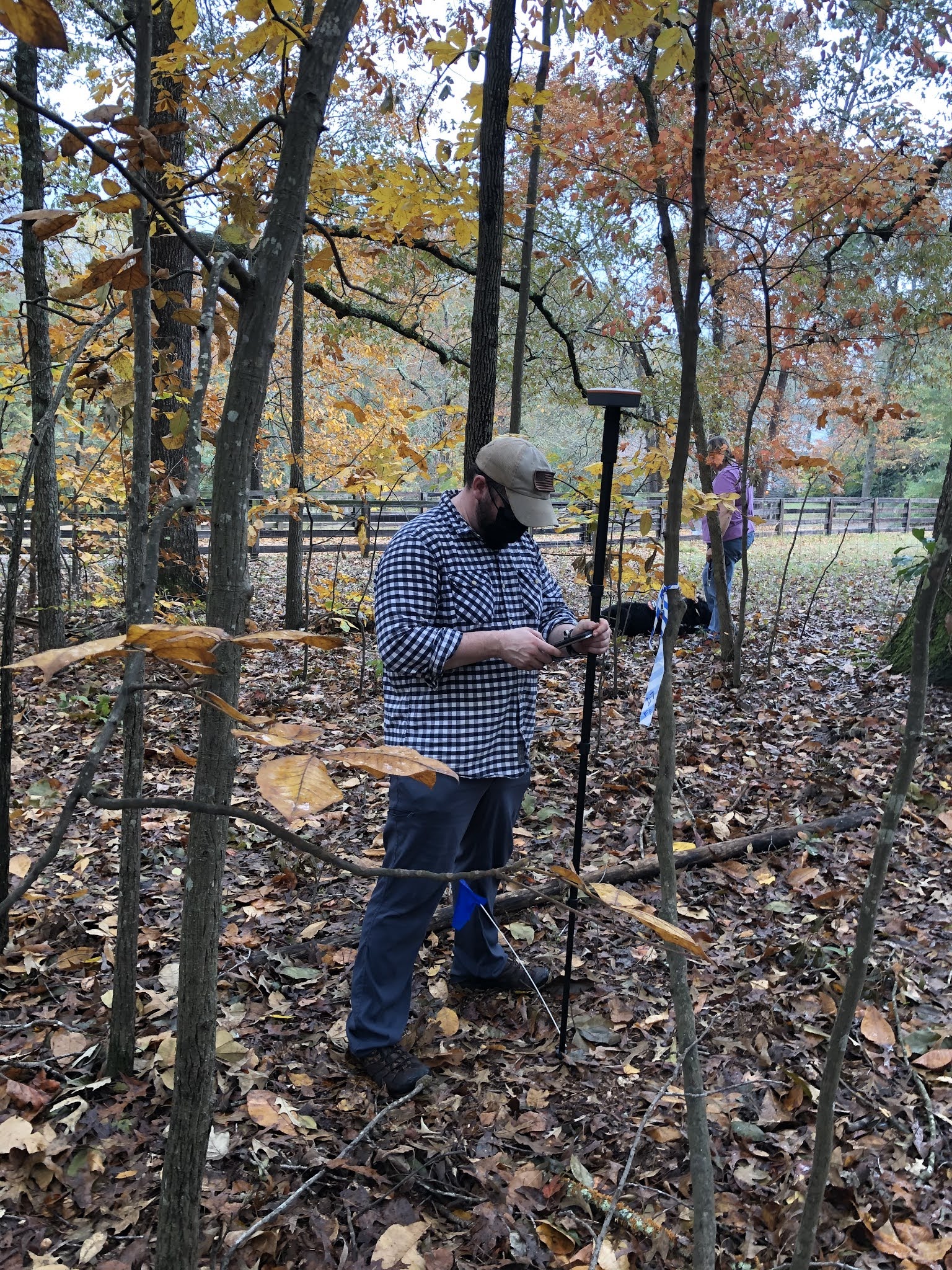
Not having an archaeological background, I enjoyed learning the methodical process of the field work. There are a lot of details in laying out a site for GPR (ground penetrating radar) work -- slow methodical work,” Ivester wrote in an email. “It also takes a long time to record latitude, longitude, depth, etc. for metal-detected finds but it allows you to understand who was where and what they were shooting at to get a better picture of Civil War battles.”

Officials have stressed the importance of the community’s participation in the work -- by allowing access to researchers and archaeologists. And residents and private landowners came through, providing about one third of the acreage covered.

Elliott said 10 volunteers supplemented the work of three professional archaeologists. The project has been supported by the Cobb County government, historical societies, museums and volunteers.

Documenting a metal detector find
As far as procuring new information about the battle, the team located and documented numerous trenches that were not recorded on Civil War maps, or had been noted in the wrong position, Elliott said.

Charlie Crawford, president emeritus of the Georgia Battlefields Association, says Ruff’s Mill has gotten little attention because it was a brief incident between much more notable events -- namely the Battle of Kennesaw Mountain (June 27) several miles north and the crossing of the Chattahoochee River by Federal forces (July 9) to the southeast.

After his army had repulsed Sherman at Kennesaw Mountain, Confederate Gen. Joseph E. Johnston once again had to resort to delaying tactics and a slow retreat toward Atlanta. “Johnston occupied the Smyrna Line principally to buy time for his wagons to retreat behind the Chattahoochee, and he did not intend to hold the line once that was accomplished,” said Crawford.

On July 4, 1864, Brig. Gen. John Fuller’s brigade with the 16th Corps, supported by Sweeney’s division, attacked works held by Rebels in Hood’s command at Ruff’s Mill. “The Southerners fell back and dug in. Union casualties in this action totaled 140 killed and wounded. Confederate losses are not reported,” writes historian and author Stephen Davis.

That night, Johnston withdrew troops to their next position, even closer to the river.

Elliott said the research thus far as identified dozens of regiments from Illinois, Indiana, Ohio, Iowa, Kentucky and other states taking part in the battle.

Attack of Fuller's Ohio brigade at Ruff's Mill (Wikipedia Commons)
The team came across a letter from Confederate Cpl. Frank E. Blossman, of Company A, 6th Texas Infantry in Cleburne’s division. Blossman provided a vivid account of a Federal assault in nearby Smyrna on the same day.

“They came with the best yell I ever heard come out of Yankee throats, and at first I really thought they meant to interest us but when they came within a hundred yards our boys answered with a shout of defiance. This angered the Yanks, and the officers commenced shouting: ‘Forward, men! Forward!’ Our men answered by shouting: ‘Come on, boys! Come on!’ Just then a Dutch officer shouted to the Yanks, ‘Trow avay de knapsacks!’ and our men shouted not to throw them off, as we wanted them.”

The attack ended in a Union retreat. (Interestingly, Blossman’s letter to back home did not reach his family until decades after the war, according to the 1899 Confederate Veteran magazine. Blossman was killed about a month after the battle.)

Elliott told the Picket the project’s aims include learning more about affected by the battle, including enslaved African Americans who built defenses for the Confederate army.

Artifacts collected by Philip Ivester (Courtesy of Brian Hall Photography)
“Our upcoming research will examine slave schedules and later census records to try to identify African Americans enslaved on area plantations before and during the war, and then freedmen and women in the area following the war,” she said. “This will contribute to our understanding of who may have been pressed into the service of the military building defenses or in support roles. Having these names may also help us research any records associated with them that may actually detail their roles in the war.”

A 1904 book indicated a man told Federal officers that he and about 1,000 other enslaved persons had worked to construct several miles of Confederate defensives lines outside Atlanta.

Elliott and others on the team did conduct four GPR surveys, but most of the field work involved metal detecting.

Historic bridge on Concord Road (Courtesy of Georgia Battlefields Assn.)

Ivester says individuals not from the area should not do any metal detecting; the land is either privately owned or belongs to Cobb County.

The battlefield was the scene of Rebel and Federal artillery firing, as well as small-arms fire.

“The ... obstacle to locating the battle has been the repeated metal detecting of the area over the past eight decades. This has removed many of the artifacts which have been redistributed across the SE and around the world, with no exact locations on where they were recovered or what they were,” Elliott said. “In spite of the lower density of artifacts on these sites, we were able to locate and document the exact positions of enough battle-related artifacts to uncover key components of the story.”

The archaeological team found artifacts ranging from 1 inch to 12 inches below the surface. They are mostly bullets and artillery shell fragments. The bullets will be studied for clues to their manufacture and which side used them.

“It is the location of these artifacts that undeniably tell the story of the military strategy. A limited amount of other arms and personal items were documented that help put a human face on the battle, such as a button, a pocket watch cover, an entrenching shovel,” Elliott said.

Analysis will enable the institute to create maps showing where every artifact was recovered, identifying Confederate and Union locations. “These maps can be compared with historic maps of the battle and used to corroborate, expand, or change the historical narrative, depending on what they tell us.”

Recording finds from metal detector survey (The Lamar Institute)
Elliott and her team are grateful for the support of private landowners.

One thing we have yet to accomplish is to document a large number of artifact collections from the area,” she wrote. “If anyone has a collection from the area and can identify with certainty where their artifacts came from and would like us to document them, we would love to talk with them. We are currently in the process of documenting one extensive collection from the area. This collection is particularly important as the collector recorded the location of the finds.”

The Lamar Institute will continue its analysis and research for much of the year. After that, a draft report will be submitted to the National Park Service. The final report will include recommendations to the community on preserving sites and educating the public. A documentary film also will be made available.

Elliott said the project is thankful for all who have pitched in.

“It is an ongoing pleasure to work in a community that appreciates its historical sites and understands how archaeological documentation of its underground resources can help tell the story of our collective past -- no matter who we are.”