Showing posts with label project. Show all posts

Monday, August 24, 2026

At Vicksburg, woven gabions were used to build trenches and protect soldiers. A new retaining wall there features a modern version to prevent further road washouts

Grant Circle retaining wall, detail of mesh and stone gabions (NPS); old ones at Battery Hickenlooper (Library of Congress)
A giant new retaining wall at Vicksburg National Military Park – part of a $7.4 million project to restore a tour road damaged by heavy rain in 2020 -- features a modern use of gabions, a common feature in fortifications at the Civil War battlefield.

While the 50-foot gabion basket at Grant Circle is made of heavy wire mesh and stone and is meant to improve road stability and drainage, those erected 160 years ago were open-ended and made of woven baskets filled with whatever material soldiers could muster. They were built to protect men.

The National Park Service found the comparison worthy of note in its recent announcement the project at Grant Circle and North Union Avenue had been completed.

Gabions bookend recreated section of Fort Garrott (Vicksburg National Military Park)
“During the (1863) siege, both armies used gabion baskets woven with cane reeds and filled with earth and stone to strengthen trenches and ramparts. While the materials have changed, the core engineering remains the same to reinforce an 1863 fortification or a present-day road,” the agency said.

A large portion of the Vicksburg project included the retaining wall, intended to improve road slope stability and allow water to pass through, reducing the risk of drainage pipe failures.

The historic gabions were a cylindrical basket, open at both ends. When filled with dirt, they could be used as a revetment to form parapets on trenches, according to the park. Both sides would have used gabions in the construction of their fortifications.

Trench line with gabions and tree trunks at Coonskin's Tower at Vicksburg
The Federal army used them to help construct trenches they dug across the Vicksburg landscape as part of the successful siege. Battery Hickenlooper was a prime example.

It was hot work.

In order to dig those trenches, soldiers would have to construct gabions and sap rollers, which were used to dig approach trenches and enabled troops to have cover as they advanced on the Confederate position, the park said in an old Facebook post about fortifications.

Troops turned to giant cane (Arundinaria gigantea), a fast-growing bamboo found across the Deep South. “It became a lifesaver during the Siege of Vicksburg. Soldiers used it to build fascines (bundled cane walls) and gabions (earth-filled baskets) to reinforce trenches and fortifications.” (At left, example of gabions at Fort Sedgwick (Fort Hell) at Petersburg, Va. Library of Congress)

A soldier with a Minnesota artillery battery wrote a June 1863 letter mentioning the features at Vicksburg:

“The embrasures, through which we fire, are made by setting up gabions on each side of the space left for the embrasure, where they are staked down and filled with earth. A gabion is made of stakes, with grapevines, young cane or flexible bushes woven through them, so as to form a hollow cylinder something like a large willow basket without the bottom, only much longer.

"The stakes are left projecting at one end some distance beyond the wicker work, and when the gabion is put in its place these projecting ends are driven into the ground and the gabion is filled with dirt. When we first came into the work the embrasures were not lined with gabions, and the consequence was that in one day's firing we blew out the embrasures so wide that a two horse wagon could have been driven through one of them.”

Before and after view of road section at Grant Circle (Vicksburg NMP)
The completion of the road project means the entire 16-mile tour road is now open to visitors for the first time since 2020, when heavy rainfall created a landslide.

Additional work at Grant Circle included milling and asphalt paving, new striping, curb and gutter replacements and installation of a new drainage system on the west side of the circle. 

Along North Union Avenue, work crews installed 900 aggregate piers under the new roadway as reinforcement to improve vertical load transfer and reduce the risk of lateral soil failure, the park said.

Before and after section of North Union Avenue (Vicksburg NMP)
The Friends of Vicksburg National Military Park helped advocate for the funding.

“The completed project includes improvements to drainage, erosion control, and ground stabilization to help keep these roads open for years to come,” the group said Monday. “This is a success our supporters can take pride in.”

Friday, April 25, 2025

Repairs on Gen. Pemberton's headquarters in Vicksburg come to a halt because of federal spending cuts. Will the Greek Revival home be revived one day?

Photos of work two years ago on the federal property in Vicksburg (NPS)
Recent government spending cuts have brought an end to the rehabilitation of the Vicksburg, Ms., house Confederate Lt. Gen. John C. Pemberton used as his headquarters during the Federal siege of the city.

“No work has been completed in the past 12 months, and the contract for Pemberton's Headquarters was terminated for the convenience for the federal government,” Vicksburg National Military Park Superintendent Carrie Mardorf said in an email to the Picket on Thursday.

“The contractor will be removing their tools from the site in the upcoming weeks. That's all the information I can provide at this time," Mardorf said.

I previously wrote two posts about the project at the Willis-Cowan House on Crawford Street, and had recently checked in with the superintendent and other park employees.

The superintendent did not detail what remains to be done or why there was no work done in the eight and a half months before President Donald Trump took office and initiated massive staffing and spending cuts across federal agencies.

“There is no timeline for completion since there is no funding for this project,” Mardorf wrote. (At right, a historic photo of the facade)

She referred me to a federal website that outlines “Termination for Convenience of the Government.”

The first line of the page is, “The Government may terminate performance of work under this contract in whole or, from time to time, in part if the Contracting Officer determines that a termination is in the Government’s interest.”

The term has entered the lexicon because of spending cuts by the Department of Government Efficiency (DOGE). Trump and DOGE chief Elon Musk say they are targeting waste, while critics argue much of the spending is essential.

The Vicksburg Post reported earlier this year seven park employees were terminated, but most apparently were reinstated.

Pemberton (left) – working from a first-floor office -- and his staff tried to manage the desperate situation during Maj. Gen. Ulysses Grant’s siege of Vicksburg in 1863.

By July 2, it appeared Pemberton’s isolated, famished and exhausted army could withstand no more. That night, they met and decided to negotiate for peace with Maj. Gen. Ulysses S. Grant. Pemberton sent a letter to Grant on July 3 and the surrender occurred the following day – a major defeat for the Confederacy the same week it lost at Gettysburg.

The Greek Revival home survived the Civil War, becoming a residence, Catholic school and bed and breakfast over the years. The NPS acquired the property in 2003 and opened it to visitors from 2008 to 2016, when it was closed because of safety concerns

The $1.3 million Pemberton project paused in 2022-2023 to redesign the two-story, front porch to address structural concerns and replace additional wood pieces that had unforeseen deterioration. Some observers had commented online about the lengthy closure before work resumed; officials said the condition of many of the home's features were worse than anticipated.

In December 2023, crews finished repairing the roof of the Willis-Cowan House and moved on to major work on the porch. A park page on the project has not been updated since October 2024. It says the work was expected to be completed late this year. That included reconstruction of a smaller porch.

Officials had hoped the building would reopen to visitors one day.

Wednesday, February 2, 2022

Gettysburg's famed Little Round Top will be closed 12-18 months during project addressing erosion, parking, accessibility and more


Tree cutting this month at Little Round Top will kick off a larger rehabilitation project that will include a 12-18 month closure of the hill where Union forces fought off a furious Confederate assault, Gettysburg National Military Park announced Tuesday.

Park officials said they are addressing ongoing problems at the overcrowded site. They cited erosion, overwhelmed parking areas, poor accessibility and related safety hazards, and degraded vegetation.

Once rehabilitation efforts begin, all of Little Round Top will be closed for 12 to 18 months, the park said. Officials said Wednesday they were unable to provide details on the exact timing of the beginning of the closure, other than "later in Spring 22."

“This project will also enhance the visitor experience with improved interpretive signage, new accessible trail alignments, and gathering areas. These improvements will allow visitors to better immerse themselves into the historic landscape that is essential to understanding the three-day Battle of Gettysburg,” a news release said. 

A park page on the project says the aim is to “reestablish, preserve, and protect the features that make up this segment of the battlefield landscape.” 

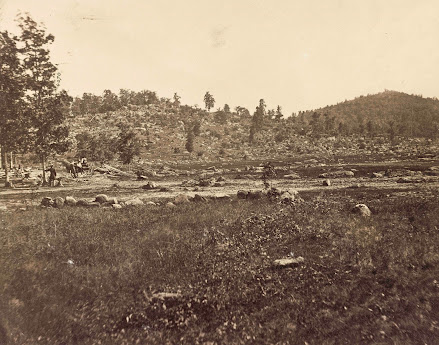
Little Round Top seen from Plum Run Valley (Library of Congress)
Little Round Top and Sykes Avenue will be closed Feb. 9-11 and Feb. 14-16 for the cutting of up to 63 trees along both sides of the road. The park says the removal is necessary for the project.

The work is happening now so as not to interfere with the nesting and breeding of northern long-eared and Indiana bats that may roost in the area. “Both species of bat are on the federal endangered species list and the select tree cutting project must be completed before their anticipated arrival in early spring when nesting activities typically begin.”

Little Round Top is the location of some of the most famous fighting of the battle

Rising 164 feet above the Plum Run Valley to the west, the boulder-strewn hill became the anchor of the Union’s left flank and a focal point of Confederate attacks on the afternoon of July 2, 1863.  The 4th,15th and 47th Alabama regiments made a series of legendary assaults against the 20th Maine, led by Col. Joshua Chamberlain (right).    

“The (Maine) regiment’s sudden, desperate bayonet charge blunted the Confederate assault on Little Round Top and has been credited with saving Major General George Gordon Meade’s Army of the Potomac, winning the Battle of Gettysburg and setting the South on a long, irreversible path to defeat,” according to the American BattlefieldTrust. 

Thursday, November 12, 2015

Work at Petersburg's Poplar Grove cemetery will return headstones to upright position

Gravestones lie flat on the ground at Poplar Grove (NPS photos)

Ann Blumenschine recalls the day a group of Vietnam veterans stopped at the visitor station of the Five Forks unit of Petersburg National Battlefield. They had made a stop at Poplar Grove National Cemetery – resting place for 6,000 Union soldiers – and were disappointed by its condition.

Perhaps they weren’t expecting to see gravestones placed on the ground rather than standing upright. Occasional flooding from poor drainage had eaten away some of the writing on the stones. The flagpole was in rough shape, as were historical buildings on the property.

“I did not know what to say,” said Blumenschine, a Petersburg park ranger and public information officer.

Now the park has an answer. A dozen years after the push for a multimillion-dollar rehabilitation project began, proper and lasting honor will be restored to those who made the ultimate sacrifice for their country at this Virginia battlefield in 1864 and 1865.

Typical Poplar Grove grave (NPS)
This Sunday (Nov. 15) is the last day for people to visit Poplar Grove National Cemetery before it closes for an anticipated 18 months. 

Maintenance employees and contractors will repair drainage issues, put in new – and upright – marble gravestones, and repair a brick boundary wall and the buildings, including a lodge that one day may serve as a visitor stop. (The cemetery currently is not staffed.)

Officials said they are unaware of any other cemetery maintained by the National Park Service that contains flat gravestones.

Betsy Dinger, a park ranger who maintains a database of soldiers buried at Poplar Grove, told the Picket earlier this year that her heart sank when she first saw the peculiar arrangement of stones, which are of different sizes. “I thought this doesn’t look right.”

The park superintendent in the early 1930s believed that cutting off the bases of the gravestones and placing the remaining marble on the ground was a good way to save on maintenance money. 

Tombstone House off of I-85 (NPS)

Hundreds of the bottoms from the sawed-off monuments found a new, inappropriate purpose. They were sold to a man who used them on the exterior of his Petersburg house and sidewalk.

While park employees don’t second-guess the superintendent’s maintenance decision, they are well aware that the action needs to be remedied.

Dinger said that the new, familiar military gravestones with a rounded top will “make it easy for elements to roll off and protect the inscription.” Because of poor drainage, some of the current stones have become hosts to lichen.

Blumenschine said a storm once brought down trees, including one that brought up a gravestone in its exposed roots. Rumors that coffins were exposed were unfounded, she said.

Lodge at Poplar Grove National Cemetery
1932 photo shows cemetery with upright markers (NPS)

In accordance with protocol, the old gravestones will be ground up and disposed of in order to prevent their use in a dishonorable way.

Poplar Grove National Cemetery, about in the center of the sprawling battlefield, was surveyed in 1866. The Rev. Thomas Flower’s farm was chose. The War Department administered the site until turning it over to the NPS in 1933.

About 6,200 soldiers are buried there, with about 4,000 of them unknown. In some instances, multiple soldiers are buried together. A few Confederates rest at Poplar Grove.

1869 burial register
Many of them fell along the battlefield’s western front. Some died at hospitals, including at City Point. The last burial at Poplar Grove came in 2003.

Rangers said the rehabilitated cemetery will benefit from a maintenance crew up to the task.

“This project is not just important to Civil War soldiers who sacrificed and died,” said Blumenschine. “It will show the respect we have” for fallen sevicemembers today.

Visitation to Poplar Grove during the project will be very limited. Officials said requests for tours will need to be made at least 30 days in advance. Updates on the project will be posted on the park's website and on Facebook.

Monday, January 26, 2015

Beginning of Savannah harbor project to be marked near soon-to-be-removed ironclad

Panamerican diver James Duff prepares to go down to the CSS Georgia off Old Fort Jackson in Savannah (U.S. Army Corps of Engineers)

A staggering 24 million cubic yards of material will be dredged during the much-anticipated $706 million deepening of the harbor in Savannah, Ga.

But the first things to be taken from the Savannah River’s sandy bottom will be surviving pieces of the Civil War ironclad CSS Georgia.

The U.S. Army Corps of Engineers’ office in Savannah on Monday announced that the harbor project construction will officially begin Thursday morning with a media event not far from where the vessel is submerged.

Corps spokesman Russell Wicke said the removal of the CSS Georgia, necessary for the deepening, will occur in several phases and cost about $15 million.

“This is very exciting for us, for not only the historical significance on the CSS Georgia, but we are now moving forward with getting this harbor deepened -- which will have huge national benefits.”

Lacking much power, the locally built CSS Georgia was destined to become a stationary floating battery and part of the city’s defensive system during the Civil War.

It was scuttled on Dec. 21, 1864, by its Confederate crew in order to keep it out of the hands of Federal forces that took Savannah. 

Section of ironclad was removed in 2013 (USACE)

The ironclad, resting on a slope about 40 feet deep below the surface, must be removed so that an additional 5 feet of river bottom can be dredged. With the expansion of the Panama Canal, even larger ships will be able to travel to U.S. cities. That requires consistently deeper channels.

Debris includes four of the CSS Georgia’s original 10 cannons, parts of the propeller and propulsion system, a boiler and two casemates, which housed the artillery pieces. The wooden hull is believed to have largely disintegrated over the years.

The Savannah Army Corps of Engineers office, which has “soft launched” a website about the CSS Georgia recovery, said contract divers have been out at the site and are first mapping, tagging and putting a recovery grid in place. A network of ropes connects wreck site artifacts and assists divers to navigate through the mucky river floor.

They will be recovering small artifacts, such as fasteners or small personal items. “Anything you might be able to pull up by hand,” said Wicke.

The second phase, sometime this summer, will be the recovery of the large pieces. Divers, under direction of the U.S. Navy, will take special care because of the possibility of live ammunition and powder.

The third phase is mechanized recovery, “basically clearing up what is left over once the large pieces are pulled out.” The final phase is an archaeological clearance, to ensure everything has been properly removed.

Conservation will be done at Texas A&M University and will take about two years to complete. But that’s only for pieces that likely will be displayed some point at a museum. That will include the casemates, artillery pieces and other “signature” items.

Photo is believed to be of CSS Georgia (USACE)

Much of the CSS Georgia was constructed of railroad item. The majority of that will be resubmerged in another location for safekeeping, Wicke told the Picket.

Georgia Ports Authority Executive Director Curtis Foltz told Savannah TV station WTOC: “We were shared some pictures yesterday of the first segment that was brought up as kind of a test, and they've identified the various particles that are still in existence on the floor of the river, and so they are well prepared to start recovering immediately.”

The initial contract for recovery of the CSS Georgia went to Dial Cordy and Associates of Jacksonville, Fla., the Corps said. Panamerican Consultants of Memphis, Tenn., will conduct field work.

Officials soon will award other contracts in the project, which is being funded by the federal government and Georgia.

Besides deepening the channel of the Savannah River from 42 feet to 47 feet, the Corps will extend the shipping lane an additional seven miles into the Atlantic Ocean off Tybee Island.

On the river-based portion, the Corps will be installing a dissolved oxygen injection system to protect marine life. That’s important because the deepening will allow more salt water to go upstream, throwing off the current equilibrium. Two plants will be installed: One on Hutchinson Island, the farther upstream near a Georgia Power facility.

Billy Birdwell, senior public affairs specialist with the Corps, said the large ships now entering the port will be less restricted once the deepening is completed: They won’t be so dependent on high tides to clear the channel bottom.

“We’re expanding the window for them,” he said. “They are getting more bang for their buck.”

One of the previously recovered guns (Courtesy of Old Fort Jackson)