Showing posts with label Meade. Show all posts

Saturday, December 28, 2024

2024's Top 12 Picket posts: Fort Fisher earthworks, Meade's cool hat, replica gun at Walmart, USS Monitor mystery, Burning of Darien survivor -- and much more

Clockwise: Enfield rifles conserved in Georgia; Herb Peck collection auction, Adam Strain building in Darien, Ga., deadline at Andersonville prison, George Meade's slouch hat and Fort Fisher's new replica traverses
Posts about a rescued tabby warehouse that has an interesting Civil War connection, Fort Fisher's rebuilt earthworks and new visitor center, George Meade’s cool slouch hat and rusted Enfield rifles being kept in an aquarium tank were big reader draws in 2024.

The top 12 Civil War Picket posts – by Blogger page views – covered a wide array of topics (two pertain to North Carolina's Fort Fisher).

Chad Jefferds, assistant site manager at Fort Fisher State Historic Site, recently told the Picket: “The reconstructed earthworks are already a major hit, and we hope to be adding more interpretation to them in the coming months. Visitors have also been very pleased with the exhibits, along with the views from the second-floor windows and balcony. We have seen a dramatic increase in visitation – this November’s total was 56% higher than November of 2023.”

We’ve got a few items in the works (including an update on Enfield rifles under conservation and Georgia troop markers at Manassas) and we look forward to rolling them out in early 2025. Thanks so much for your continued interest. Please tell a friend or two about us. And Happy New Year!

Drum roll, please ....

12. PRECIOUS PORTRAITS AUCTIONED: The family of the late Herb Peck Jr. enlisted the help of law enforcement, other collectors and Military Images magazine in their hunt for 117 photographs taken during a 1978 burglary at their Nashville home. Forty-eight recovered images sold for $292,000 in a March sale. – Read more

11. CROSSING “DEADLINE” MEANT DEATH: The light railing at Andersonville in Georgia was made from posts 3 to 4 feet long and driven into the ground. Horizontal pieces of wood topped the design, which was roughly 18-19 feet inside the stockade wall. Confederate guards in sentry boxes kept a sharp eye for POWs who extended any part of their body past the deadline. – Read more

10. LITTLE ROUND TOP BACK IN BUSINESS: A two-year rehabilitation of the Gettysburg landmark tackled erosion, overwhelmed parking areas, poor accessibility and related safety hazards, and degraded vegetation. This January post ahead of the reopening summarized the major project. – Read more

9. HOW THEY CLEAN ENFIELDS KEPT IN WATER: A team with the Georgia Department of Natural Resources uses a garden hose, small pump, spray nozzle and a wet-dry vacuum to periodically clean and refill a 300-gallon aquarium tank that holds -- of all things -- 18 Pattern 1853 Enfield riflesThe artifacts are awaiting long-term conservation. – Read more

8. VANDALS TRASH KENNESAW MOUNTAIN: Vandals destroyed or damaged six signs, several sections of split-rail fencing and caused minor damage to Civil War earthworks at Kennesaw Mountain National Battlefield Park in late January. As of this month, no arrests have been made. – Read more

7. Q&A WITH GETTYSBURG SUPERINTENDENT: The Picket asked Kristina Heister (right) about her priorities and initiatives, current and future projects and her ancestors. Many fought in the Civil War and two were at Gettysburg. – Read more

6. GEORGE MEADE’S COOL HEADGEAR: If I ever get around to writing “Cool Hats of the Civil War,” my top choice (spoiler alert!) will go to Union Maj. Gen. George Meade’s slouch hat, followed closely by those of Ambrose E. Burnside and J.E.B. StuartThere are great images of him with that headgear: In front if his tent; seated among a throng of soldiers, or perched on a bench at the famous Grant "Council of War" at Massaponax Church in Virginia. – Read more

5. FORT FISHER, PART ONE: The staff at the Civil War site near Kure Beach, North Carolina, and contractors engaged in an extraordinary effort this year to recreate three traverses, bombproofs, a magazine and a sally port that were vital parts of the Confederate fort, which fell in furious hand-to-hand combat in January 1865.. – Read more

4. FORT FISHER, PART TWO: This piece previewed the earthworks project mentioned above and the building of a new visitor center, which is just north of the east-west line mounds of earth known as traverses that were part of the defenses. Much of the eastern part of the fort has been claimed by the Atlantic Ocean. – Read more

3. REPLICA GUN FOUND AT WALMART: A Civil War replica revolver (not the real thing, as some news reports claimed) was found in January by a Walmart employee in Gettysburg, Pa., while emptying an outside trash can. It was a real firearm, however. State troopers recently said they still don’t know who left it. – Read more

2. LINGERING MYSTERY OF USS MONITOR: I continue to marvel at the design and engineering skills of those who made the vessel that changed naval warfare in a single battle with the CSS Virginia in March 1862. My recent foray into learning a bit more about the vessel’s circular, ingenious turret – and its supporting braces -- put me back in touch with experts on Monitor about a distinctive maker’s mark found on a brace. Project director Will Hoffman says they still don't know who stamped an "ULSTER" mark on one brace.  – Read more

1. THEY SAVED A CIVIL WAR SURVIVOR: One of just a few tabby structures remaining on the Georgia coast, this weathered warehouse had survived a controversial fire during the Civil War, hurricanes, economic downturns, Father Time and decades of emptiness. Entrepreneurs Milan and Marion Savic, working with a team of specialists, completed the painstaking restoration of the Adam Strain Building in Darien and turned it into a brewery and event space. They are now working on a museum about the area's history and culture. – Read more

Honorable mentions: This researcher helped obtain Medals of Honor for two soldiers; Wisconsin twins are legendary in reproduction artillery; monument will honor Black hero Robert Smalls

Thursday, February 8, 2024

I've always thought George Meade's slouch hat was awesome. We asked experts to weigh in on it and five other iconic Meade items kept at Gettysburg

Courtesy of Gettysburg Foundation, from the collection of the Civil War Museum of Philadelphia
CWMP 86.13.33, Slouch hat; Meade photos Library of Congress and National Archives
If I ever get around to writing “Cool Hats of the Civil War,” my top choice (spoiler alert!) will go to Union Maj. Gen. George Meade’s slouch hat, followed closely by those of Ambrose E. Burnside and J.E.B. Stuart.

While the hero of Gettysburg and commander of the Army of Potomac is sadly overshadowed by many in the pantheon of Civil War commanders, Meade and his hat will always stand tall to me.

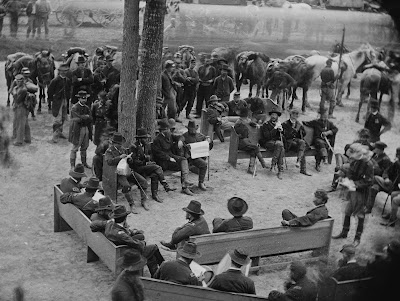
There are great images of him with that headgear: In front of his tent, seated among a throng of soldiers, or perched on a bench at the famous Grant “Council of War” at Massaponax Church in Virginia.

The Gettysburg Foundation operates Gettysburg National Military Park’s visitor center and museum. It also owns and curates thousands of items, including those of Meade from the collection of the Civil War Museum of Philadelphia: The slouch hat, a kepi, frock coat, flags, field glasses, sash and swords, among other fascinating items. Meade wore the hat and frock coat at Gettysburg in July 1863.

Kepi-topped Gen. Meade (center) with members of his staff (National Archives)
Meade’s slouch hat certainly was attention-getting.

“I am not sure if Meade had a preferred style of hat but, maybe his preference was more utilitarian; e.g., wearing the slouch hat on active campaign because it kept the sun and rain off of him; whereas wearing the kepi in static locations such as a winter quarters and formal occasions,” says Mike Kwolek, museum exhibition specialist for the foundation.

The general’s hometown was Philadelphia. For more than 70 years after his grandchildren donated them in 1937, Meade’s belongings were housed at the Civil War Museum of Philadelphia. Other items at the museum were donated by former Union officers, members of the Military Order of the Loyal Legion of the United States (MOLLUS). Meade died in 1872 at age 56.

Museum officials had hoped to erect a new building after it closed in 2008, but funding never came through and hundreds of artifacts went to the Gettysburg Foundation. (Paper documents relating to the officers are kept by the Union League of Philadelphia)

Gettysburg’s collection has many sources, including what was at the Philadelphia museum. (Photo at left, Courtesy of Gettysburg Foundation, from the collection of the Civil War Museum of Philadelphia; CWMP 86.13.32, Frock Coat)

I spoke with Kwolek – whose duties include designing and executing museum exhibits, collections management and registration – about a half dozen items in the Meade inventory. (I am grateful for his help and patience when I peppered him with myriad follow-up questions)

Here’s a close look at the six artifacts:

MEADE'S FELT SLOUCH HAT

Courtesy of Gettysburg Foundation, from the collection of the Civil War Museum of Philadelphia
CWMP 86.13.33, Slouch Hat
Talk about a close call. The general came to Gettysburg with two bullet holes in the hat, from fighting several months before at Fredericksburg, Va.

Army regulations allowed for officers to wear black felt hats. The height of the crown could be a little over 6 inches. The bindings were made of black ribbed silk. It features a bullion hat cord and insignia.

“These examples were similar, yet more elegant than the 1858 Hardee hat; however, many officers went to the private market and purchased black felt hats in a variety of shapes and sizes. The one that Maj. Gen. Meade wore, and housed at the Museum and Visitor Center, is one of those privately purchased hats,” says the foundation.

Meade, seated at far left, at Massaponax Church (Library of Congress)
His slouch hat has a pinched crown (click to enlarge)
The park doesn’t know when Meade got the hat, which he wore with the brim down. Kwolek said this headgear may have been produced in Philadelphia by the hatter William F. Warburton; who, in 1862, held three patents for military caps and hats.

Conservation was performed on the hat in 2012. The bullet holes, above his major general’s insignia, were stabilized during that work, said Kwolek.  

C. Paul Loane, co-author of “US Army Military Headgear, 1812-1872,”.recalls seeing the hat when it was at the museum in Philadelphia.

“It appeared to be the standard black felt headgear with black silk edging around the brim worn by most officers, he said. "His hat cords were all gold as called for in regulations for a general officer."

The hat and coat have been off-exhibit since 2016, following the park’s Treasures of the Civil War” exhibit.

CHASSEUR-STYLE KEPI

Courtesy of Gettysburg Foundation, from the collection of the Civil War Museum of Philadelphia
CWMP 86.13.34, Kepi
Of the Meade-associated items described here, only the wool kepi is currently (February 2024) on display. The exhibit has the words “Old Snapping Turtle,” a nickname given to the commander because of his famous ill temper.

Text below the kepi reads:

“Although often seen in contemporary photographs wearing his favored slouch hat in the field, Meade wore this regulation officer's cap (with gold trim for general officers) for dress and ceremonial occasions." 

National Archives, Library of Congress photos of Meade wearing a kepi; click to enlarge
This is the French style of cap that Maj. Gen. George B. McClellan advocated that officers use after his observations during the Crimean War, says Kwolek. Meade’s kepi was made by Wanamaker’s of Philadelphia, his hometown. The company was founded in 1861 and operated at Market and Sixth streets. Meade purchased it in 1862 or 1863.

Loane told the Picket the cap is “a slightly brighter blue than most examples (which flirt with being a midnight/almost black shade) and had a subtle ‘bagginess’ about it we collectors like. Two silver stars of a major general were affixed to the front within a gold embroidered wreath backed with black velvet. Staff officer buttons secured the chin strap and narrow black tape trimmed the sides and top.”

The classic-period kepi went through restoration in 2012, which included cleaning and stabilization.

MAJOR GENERAL FROCK COAT

Courtesy of Gettysburg Foundation, from the collection of the Civil War Museum of Philadelphia
CWMP 86.13.32, Frock coat; Meade photo Library of Congress
The maker of this dark blue frock is not known, but Meade is known to have worn it from at least Gettysburg onward. Kwolek wondered whether it was made by Brooks Brothers, which made uniforms for Federal officers. Brooks Brothers. told the Picket in an email it has no existing record of Meade.

The coat conforms to 1861 regulations and bears the rank of major general on its epaulets. For that rank, the coat had two rows of buttons on the breast, nine in each row, extending to the waist. Four buttons were on the back and skirt of the coat, according to the Gettysburg Foundation. The interior chest/torso region of the jacket exhibits quilting with patriotic motifs.

The coat went through extensive cleaning and stabilization 2012. Its condition before treatment exhibited extensive use, according to Kwolek.

ARMY OF THE POTOMAC HEADQUARTERS FLAG

Courtesy of Gettysburg Foundation, from the collection of the Civil War Museum of Philadelphia
CWMP 86.2.4, 34‐star Headquarters Flag
This flag has the distinction of the one that flew at Meade’s headquarters at Gettysburg. His descendants provided the provenance for this 34-star silk flag.

Kwolek says Maj. Gen. Joseph Hooker may have flown it before Meade took command of the army in late June 1863, just days before Gettysburg.

ARMY OF THE POTOMAC HEADQUARTERS FLAG (May 1864)

Courtesy of Gettysburg Foundation, from the collection of the Civil War Museum of Philadelphia
CWMP 86.2.5, Army of the Potomac Headquarters Flag 
This short-lived flag was most likely made by Sisco Brothers of Baltimore, according to the Gettysburg Foundation. It was made of faded soprano silk with a dark blue laurel wreath surrounding a gold eagle with arrows and laurel in its talons.

It has a swallowtail design with silk ties. It was used only in May 1864, in Virginia, and was replaced by a small national flag. According to Kwolek, this reversal might be due to Gen. Grant’s reaction to it, which was recorded by artist Alfred R. Waud: “What’s this! Is Imperial Caesar anywhere about here?”

ARMY OF THE POTOMAC V CORPS FLAG

Courtesy of Gettysburg Foundation, from the collection of the Civil War Museum of Philadelphia
CWMP 86.23, 5th Corps flag
Meade commanded the corps for only a month, six months before Gettysburg. The flag conforms to the Army of the Potomac's general order No. 10 that specified flags to be used for corps headquarters as blue swallowtailed, with the number of the corps in red on a white botonee-style cross.

Kwolek believes Maj. Gen. George Sykes may have flown it at Gettysburg when he led V Corps. The flag was probably returned to Meade once the 1864 style of headquarters flags were issued. The flag was donated to what was then the War Library and Museum in 1937 by his grandchildren and great-grandchildren. 

Other Pennsylvania venues that highlight Meade

Meade’s legacy is covered at several institutions in Philadelphia, including the Grand Army of the Republic Civil War Museum & Library. It has an exhibit on the general, including many photos, and another unusual item – the head of Old Baldy, Meade’s war horse.

The National Constitution Center, while it has no Meade items in its permanent collection, does have several on loan from the Gettysburg Foundation for the exhibitCivil War & Reconstruction: The Battle for Freedom and Equality.” Those are the general’s sword and scabbard, dress spurs and field glasses with case (shown in photo below among other artifacts).

From the collection of the Civil War Museum of Philadelphia, on loan from Gettysburg Foundation
 and National Constitution Center, photo courtesy NCC
"The
sword is a M1839 Topographical Engineers sword used by Meade and supposedly the one where he broke the tip of the blade off while striking a soldier at Fredericksburg,” said Kwolek.

The Union League has multiple papers, orders, photographs and other items related to Meade. Click here and here for examples.

“Our archives and collections are available to the public through research appointments,” Keeley Tulio, archivist and collections manager with the group’s Heritage Center, said in an email.

Meade was awarded The Union League of Philadelphia Silver Medal in 1863 and The Union League of Philadelphia Gold Medal in 1866.

Friday, June 17, 2016

At Massaponax: A church that was the site of famous Grant council of war is ministering to 'changing and evolving' world

Ulysses Grant leans over George Meade's shoulder (Library of Congress)
Grant stood near shrubbery area in this modern view

I’ve long been fascinated by a rare series of Civil War photographs showing a council of war – outside a Virginia church on a late spring day in 1864. The images are simply remarkable.

On May 21, 1864, Timothy O’Sullivan, traveling with the Federal Army of the Potomac, set up his heavy camera at a window on the balcony of Massaponax Church and photographed Generals Ulysses Grant and George Meade and others as they relaxed on church pews, wrote orders and surveyed a map after the bloody fighting at Spotsylvania Court House.

In one candid view, Grant leans over Meade’s shoulder to study a map as they plot the next phase of the Overland Campaign -- a move toward the North Anna River. In another, Grant sits with a cigar clenched in his teeth. Also present is Assistant Secretary of War Charles Dana and staff officers. Wagons of the Federal V Corps rumble by in the background.

Grant (seated between two trees) enjoys a cigar (Library of Congress)
Best modern angle I could do without being on the balcony

My parents and I paid a quick visit to Massaponax Baptist Church a few weeks ago after visiting part of the Spotsylvania battlefield earlier in the afternoon. The church is at the corner of a very busy U.S. 1 (then called Telegraph Road) and Massaponax Church Road. Unfortunately, the sanctuary was closed. Still, it was interesting to walk around where these giants of the Union plotted strategy.

Today, the church has one foot in history and the other very much in the 21st century, meeting the needs of those near and far.

On a video posted on Facebook this week, incoming pastor Dusty Carson encouraged the congregation to pray for the Orlando massacre victims and their families. “We are called to love. The greatest act of love we can do is pray for them.” He said that Jesus Christ will help heal the battered community.

Shirley Wilson, a deacon at the church, answered the phone when I called to ask about the Baptist church’s ministries today.

The congregation’s diverse 100 members – many of whom commute to work in the Washington, D.C, metro area -- sponsor a food pantry that serves 150 to 200 families. They also provide school supplies for homeless and low-income children and take part in the Samaritan’s Purse ministry, an international relief effort.

“The world is changing and evolving,” Wilson told me.

Another Timothy O'Sullivan, before council of war (Library of Congress)
(Picket photo)

There are two Sunday services: 9:15 a.m. is traditional and the 10:30 a.m. service, which draws more worshippers, is considered contemporary.

Being in a heavy traffic zone can be a plus, Wilson said. “Lot of good things happen because of that.” People who drive by and see the food pantry operation sometimes send money.

I asked whether many people interested in the Civil War and the O’Sullivan photographs stop by. “All the time,” she said. “We think it is a fantastic thing.” Graffiti left by Federal troops is protected and visible on the balcony, although much of it has faded over time. “We tried to save most of it.”

The church was established in 1788. The current brick sanctuary was erected in 1859. Pastor Joseph Billingsley was famous for preaching long sermons of about two and a half hours.

“This did not sit well with the congregation,” the church website says. “On one occasion, it is said that they wedged the door to exclude him, but he preached his sermon in the church yard.”

Fuller views of Grant consulting and writing order (Library of Congress)

In 1863, during the middle of the conflict, Massaponax gave letters of dismissal to black members and they formed smaller churches. Confederate and Union forces alternately used the church as a stable, hospital and meeting place during various campaigns.

For a time, the graffiti was covered by whitewash that covered “unsightly marks and the sad stories were forgotten.”

Back to that day in 1864: Grant realized on May 21 that Confederates remained in strong positions at Spotsylvania and he decided to move to the southeast to try to get them out in the open.

John Cummings, in his Spotsylvania Civil War Blog, has written about the morning that Grant and his subordinates stopped by the church.

According to Cummings, Grant wrote one dispatch from Massaponax, to Gen. Ambrose Burnside. One of the O’Sullivan photographs shows Grant scribbling on a paper pad.

GENERAL: You may move as soon as practicable upon the receipt of this order, taking the direct ridge road to where it intersects the Telegraph road, thence by the latter road to Thornburg Cross-Roads. If the enemy occupy the crossing of the Po in such force as to prevent your using it, then you will hold the north side at Stanard's Mill until your column is passed, and move to Guiney's Bridge. General Wright will follow you and will cover the crossing of the Po for his own corps. At Guiney's Bridge you will receive further directions if you are forced to take that road. If successful in crossing at Stanard's your march will end at Thornburg.
U. S. Grant,
Lieutnant-General
.

The Metropolitan Museum in New York, which has a copy of one of the photographs (which are stored at the Library of Congress), says of that day:

“The chaotic study is one of the most daring made by any Union photographer. … Evidence suggests that it had been a disastrous day for the Union troops, as the losses were heavy and no strategic advantage had been gained. In the background are rows of horse-drawn baggage wagons and ambulances transporting supplies for the next day’s engagement and the wounded to field hospitals.

A soldier in one of the photographs went on to receive the Medal of Honor for postwar gallantry. You can read about that here.

View of busy U.S. 1 (Jefferson Davis Highway)