Showing posts with label revolver. Show all posts

Saturday, December 28, 2024

2024's Top 12 Picket posts: Fort Fisher earthworks, Meade's cool hat, replica gun at Walmart, USS Monitor mystery, Burning of Darien survivor -- and much more

Clockwise: Enfield rifles conserved in Georgia; Herb Peck collection auction, Adam Strain building in Darien, Ga., deadline at Andersonville prison, George Meade's slouch hat and Fort Fisher's new replica traverses
Posts about a rescued tabby warehouse that has an interesting Civil War connection, Fort Fisher's rebuilt earthworks and new visitor center, George Meade’s cool slouch hat and rusted Enfield rifles being kept in an aquarium tank were big reader draws in 2024.

The top 12 Civil War Picket posts – by Blogger page views – covered a wide array of topics (two pertain to North Carolina's Fort Fisher).

Chad Jefferds, assistant site manager at Fort Fisher State Historic Site, recently told the Picket: “The reconstructed earthworks are already a major hit, and we hope to be adding more interpretation to them in the coming months. Visitors have also been very pleased with the exhibits, along with the views from the second-floor windows and balcony. We have seen a dramatic increase in visitation – this November’s total was 56% higher than November of 2023.”

We’ve got a few items in the works (including an update on Enfield rifles under conservation and Georgia troop markers at Manassas) and we look forward to rolling them out in early 2025. Thanks so much for your continued interest. Please tell a friend or two about us. And Happy New Year!

Drum roll, please ....

12. PRECIOUS PORTRAITS AUCTIONED: The family of the late Herb Peck Jr. enlisted the help of law enforcement, other collectors and Military Images magazine in their hunt for 117 photographs taken during a 1978 burglary at their Nashville home. Forty-eight recovered images sold for $292,000 in a March sale. – Read more

11. CROSSING “DEADLINE” MEANT DEATH: The light railing at Andersonville in Georgia was made from posts 3 to 4 feet long and driven into the ground. Horizontal pieces of wood topped the design, which was roughly 18-19 feet inside the stockade wall. Confederate guards in sentry boxes kept a sharp eye for POWs who extended any part of their body past the deadline. – Read more

10. LITTLE ROUND TOP BACK IN BUSINESS: A two-year rehabilitation of the Gettysburg landmark tackled erosion, overwhelmed parking areas, poor accessibility and related safety hazards, and degraded vegetation. This January post ahead of the reopening summarized the major project. – Read more

9. HOW THEY CLEAN ENFIELDS KEPT IN WATER: A team with the Georgia Department of Natural Resources uses a garden hose, small pump, spray nozzle and a wet-dry vacuum to periodically clean and refill a 300-gallon aquarium tank that holds -- of all things -- 18 Pattern 1853 Enfield riflesThe artifacts are awaiting long-term conservation. – Read more

8. VANDALS TRASH KENNESAW MOUNTAIN: Vandals destroyed or damaged six signs, several sections of split-rail fencing and caused minor damage to Civil War earthworks at Kennesaw Mountain National Battlefield Park in late January. As of this month, no arrests have been made. – Read more

7. Q&A WITH GETTYSBURG SUPERINTENDENT: The Picket asked Kristina Heister (right) about her priorities and initiatives, current and future projects and her ancestors. Many fought in the Civil War and two were at Gettysburg. – Read more

6. GEORGE MEADE’S COOL HEADGEAR: If I ever get around to writing “Cool Hats of the Civil War,” my top choice (spoiler alert!) will go to Union Maj. Gen. George Meade’s slouch hat, followed closely by those of Ambrose E. Burnside and J.E.B. StuartThere are great images of him with that headgear: In front if his tent; seated among a throng of soldiers, or perched on a bench at the famous Grant "Council of War" at Massaponax Church in Virginia. – Read more

5. FORT FISHER, PART ONE: The staff at the Civil War site near Kure Beach, North Carolina, and contractors engaged in an extraordinary effort this year to recreate three traverses, bombproofs, a magazine and a sally port that were vital parts of the Confederate fort, which fell in furious hand-to-hand combat in January 1865.. – Read more

4. FORT FISHER, PART TWO: This piece previewed the earthworks project mentioned above and the building of a new visitor center, which is just north of the east-west line mounds of earth known as traverses that were part of the defenses. Much of the eastern part of the fort has been claimed by the Atlantic Ocean. – Read more

3. REPLICA GUN FOUND AT WALMART: A Civil War replica revolver (not the real thing, as some news reports claimed) was found in January by a Walmart employee in Gettysburg, Pa., while emptying an outside trash can. It was a real firearm, however. State troopers recently said they still don’t know who left it. – Read more

2. LINGERING MYSTERY OF USS MONITOR: I continue to marvel at the design and engineering skills of those who made the vessel that changed naval warfare in a single battle with the CSS Virginia in March 1862. My recent foray into learning a bit more about the vessel’s circular, ingenious turret – and its supporting braces -- put me back in touch with experts on Monitor about a distinctive maker’s mark found on a brace. Project director Will Hoffman says they still don't know who stamped an "ULSTER" mark on one brace.  – Read more

1. THEY SAVED A CIVIL WAR SURVIVOR: One of just a few tabby structures remaining on the Georgia coast, this weathered warehouse had survived a controversial fire during the Civil War, hurricanes, economic downturns, Father Time and decades of emptiness. Entrepreneurs Milan and Marion Savic, working with a team of specialists, completed the painstaking restoration of the Adam Strain Building in Darien and turned it into a brewery and event space. They are now working on a museum about the area's history and culture. – Read more

Honorable mentions: This researcher helped obtain Medals of Honor for two soldiers; Wisconsin twins are legendary in reproduction artillery; monument will honor Black hero Robert Smalls

Saturday, January 27, 2024

Pennsylvania State Police want to know who dumped a replica Civil War revolver in the trash can at a Gettysburg Walmart. It's a 'legit firearm'

This weapon was found in a store trash can in Gettysburg (Photo: Pennsylvania State Police)
Some news outlets in Pennsylvania this week wrote that a Civil War revolver was found Tuesday by a Walmart employee in Gettysburg while emptying a trash can in the parking lot.

All of that is true – except for the fact that the weapon does not date to the war. It’s a replica made by an Italian company.

An incident report filed by a Pennsylvania State Police trooper described the gun as a Pietta 1851 Confederate Navy Revolver (the short report does not include the words Civil War).

Trooper Megan E. Frazer, a public information officer for the Harrisburg station, told the Picket in an email Friday that the unloaded firearm is believed to be a black powder-style .44-caliber revolver with a brass frame. She said the investigating officer did not believe the weapon to be authentic “based on machined markings and 2020 marked on the underside of the barrel," but called it a "legit firearm."

"It appeared to have been used," Frazer said.

Frazer said there were no leads in the investigation into how it came to be in a trash can in the city famous for the July 1863 Battle of Gettysburg, and whether it is tied to any Civil War venues or sites.

Jason Martz, spokesman for Gettysburg National Military Park, said nothing has been reported missing or stolen from its collections.

On its website, Pietta says the firm is “synonymous with the most faithful and refined reproductions of historical weapons and high quality hunting rifles.”

F.LII Pietta makes several versions of the Colt 1851 Navy revolver, one of the most famous firearms from the Civil War. They are listed as either Yank or Confederate, with .36-caliber and .44-caliber variations.

More Picket coverage

-- Gettysburg hopes Little Top will reopen in early July
-- Virginia's Henrico County buys farm that was scene of several Civil War events

Thursday, April 13, 2023

Treasure trove: Capt. James Lile Lemon kept spoils of war and all his belongings. Descendants got to see them at the Atlanta History Center

Gordon Jones with drum, a revolver and James L. Lemon's prize watch (Picket photos)
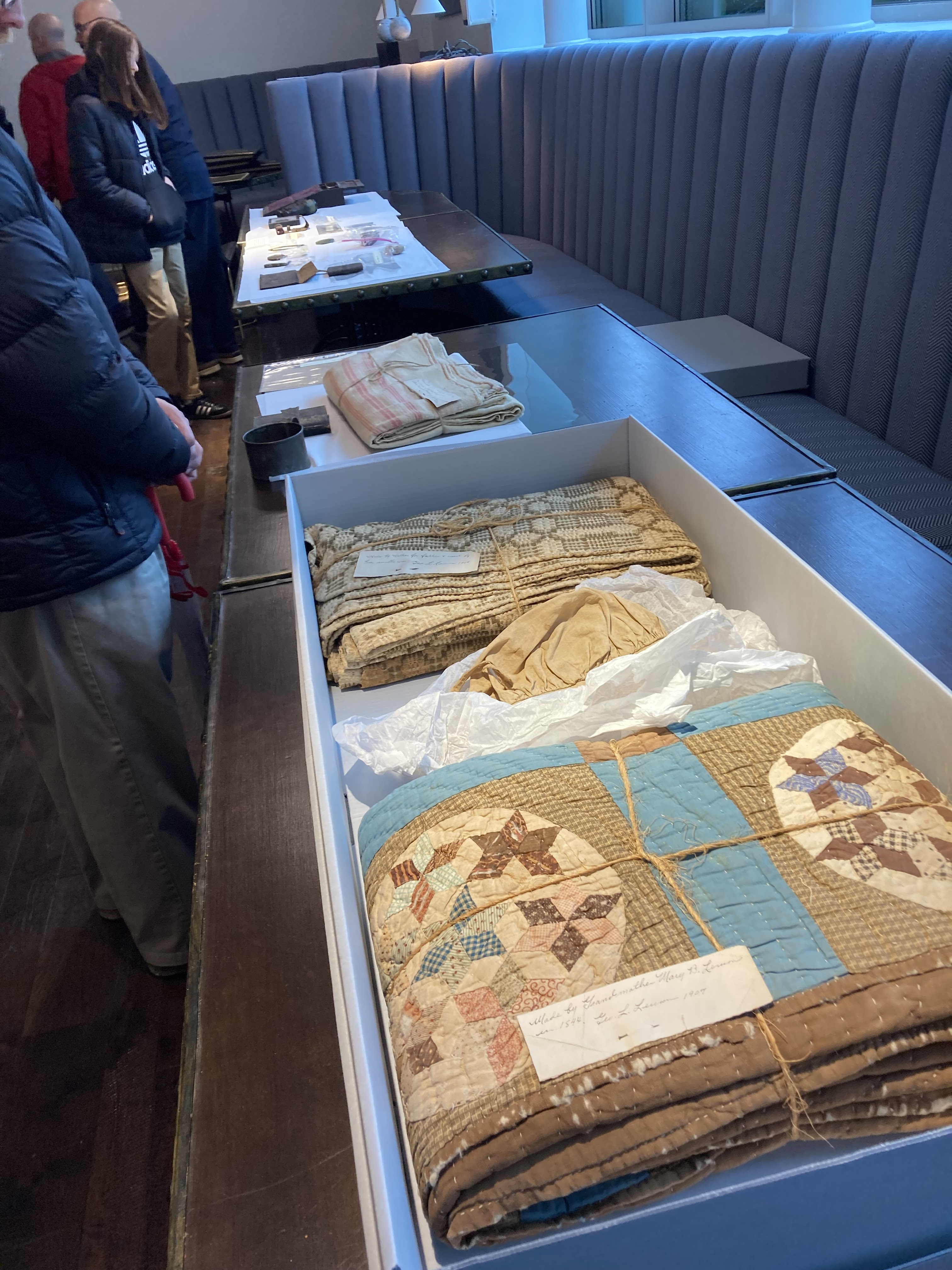
Last weekend, dozens of Civil War-period items were laid out on tables in the Atlanta History Center’s Cox Room. Almost all related to a single soldier -- a curator's dream.

There were personal items, a captured drum, revolver, letters, canteen, photographs and much more. Many artifacts were labeled with handwritten notes by Capt. James Lile Lemon of Company A, 18th Georgia Infantry, who fought in the Virginia theater and survived a year and a half in Union prison camps.

“I am speechless at this entire collection, to see it all together, said Heather Spann, of Kennesaw, Ga., a third great-granddaughter of Lemon (left).

“It is amazing how meticulous he was in keeping records,” said Fred Aiken, a member of the Atlanta Civil War Round Table.

Aiken, along with about 20 members of the Lemon family, most living in northern Georgia, were invited to the AHC to see the impressive collection the institution purchased from the widow of a Macon, Ga., collector in 2020. The set includes three wartime diaries.

“He literally saved everything,” said host Gordon Jones, senior military historian and curator at the AHC. Lemon was “an individual who was thinking ahead about his own legacy.”

Jones told the Lemon family that their ancestor is a quintessential example of the human experience in the Civil War. “This is storytelling stuff. People love it.” It is the history center’s fortune to have such a complete collection, he added.
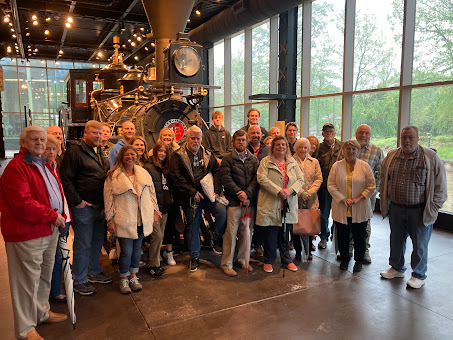
Lemon descendants and others before seeing collection (Picket photo)
Before the Atlanta Cyclorama painting was moved to the AHC a few years ago, visitors filed through the exhibit “Turning Point: The American Civil War.” Many of the artifacts were collected by an Atlanta father and son team decades ago.

While “Turning Point” still attracts visitors, the AHC believes it is a dinosaur, and it is raising money for a new exhibit that will offer newer, fresher and more inclusive perspectives of the conflict. The Lemon collection, Jones said, will be shown to the public as part of that effort.

When the war broke out, Lemon was living in Acworth, about 30 miles northwest of Atlanta. His family had seven enslaved persons, and Lemon wrote in his memoirs that he freed them. There is some dispute over the claim, according to the AHC.

Descendant Mark Lemon lives in the Acworth home 
Early in the war, the 18th Georgia was part of John Bell Hood’s Texas Brigade. Lemon enlisted as a second lieutenant in 1861 for a three-year term in the Confederate army. 

The regiment fought in numerous Eastern battles – including Antietam, Fredericksburg, Second Manassas and Chancellorsville. The farmer and merchant had a close call at Gettysburg, when a Yankee bullet struck his canteencausing it to strike his head.

His combat days came to a close in November 1863, when Lemon was severely wounded by a Minie ball in the pharynx and taken prison after an assault on Fort Sanders in Knoxville, Tenn. 

Mark Lemon (left) brought sword given by Union NCO to J.L. Lemon (Picket photo)
By the time he arrived at Fort Pulaski near Savannah, in October 1864, Lemon had already been at three Federal prisons: One in Louisville, Ky; Camp Chase in Ohio and Fort Delaware, Delaware. 

The captain’s brief time at Pulaski is part of the story of the "Immortal 600", a fascinating footnote to the conflict. The story is involved, but here’s a summary:

In summer 1864, Confederate Maj. Gen. Samuel Jones essentially used 600 captured Union officers as human shields, in a section of Charleston, S.C., in the line of fire. The North retaliated by transporting 600 POWs from Fort Delaware to Morris Island, S.C., in direct line of Rebel guns.

“For nearly three months, the stalemate continued. It wasn’t until yellow fever broke out in the city of Charleston that the Confederacy removed the Union prisoners to newly erected prison camps further inland,” the National Park Service says. “With the Union prisoners removed from Charleston and no longer under fire from Union artillery, there was no need to keep the Confederate prisoners on Morris Island. With this realization, the next phase of their journey began and the Immortal 600 began the journey south, to Cockspur Island and Fort Pulaski.”

While held at Fort Pulaski, Lemon etched his name into a wall. (At right, blanket near top of photo was given to Lemon while he was held there. Click to enlarge)

Lemon and other prisoners were returned to Fort Delaware toward the war’s end.

He earned the respect of one of the prison staff, who also had the name Lemon. Sgt. Lemon Kline of the 215th Pennsylvania Infantry gifted him an NCO sword when the Confederate was paroled. Lemon, who somehow managed to get the weapon back to Georgia, wrote a notation about it, as was his practice.

Mark Lemon, great-great grandson of Lemon and author of “Feed Them the Steel!”, a history of Lemon and his regiment, brought the sword to the AHC, eliciting much excitement from Jones. The book, written as a narrative, includes many battle and POW accounts written by James Lile Lemon.

Lemon lives in the home built by his ancestor in 1856.

At war’s end, James Lile Lemon refused to take an oath of allegiance to the United States, citing his treatment, but he eventually did take it in June 1865. Family today considers him a “diehard” Confederate.

In his journal, Lemon wrote: “I have done the unspeakable but I am now paroled & to day set out for home. My duty to my country is done, mine to my family remains.”

The officer returned to Acworth and had 11 children with his wife Eliza. He was a retail merchant and then a bank executive, serving as president of the bank when he died on June 12, 1907, at age 72. Lemon had published a compelling memoir in 1886, the same year the Cyclorama was painted.

For Jones, Lemon’s meticulous record-keeping has paid off. “The story was there. It was just matching it to the artifacts.”

Here are some highlights from the AHC’s Lemon collection that were shown to the family:-

(Picket photo of sketch)
-- Original pen and ink sketch by Harper's Weekly artist Theodore Davis of the Lemon home in Acworth when used by William T. Sherman as his headquarters in early June 1864. “This is the only original Davis wartime sketch I have ever seen,” says Jones

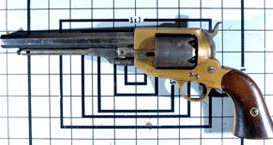
-- An Adams revolver with “JL” and “18th GEO” carved into the grips (see photo at top of this post). Jones believes the officer gave the gun to his brother Smith, who used it while serving in the Georgia State Line. It saw action at the Battle of Atlanta in July 1864. (Lemon’s gun that he lost at Knoxville is today in a private collection in Milwaukee.)

-- Lemon’s engraved gold watch, made in Liverpool, presented by his brother Smith Lemon on October 27, 1861. Lemon lost the watch when he was wounded at Knoxville, but later spotted it on a Union soldier and managed to retrieve it, according to his memoir. (See photo at top of this article)
(Picket photo)
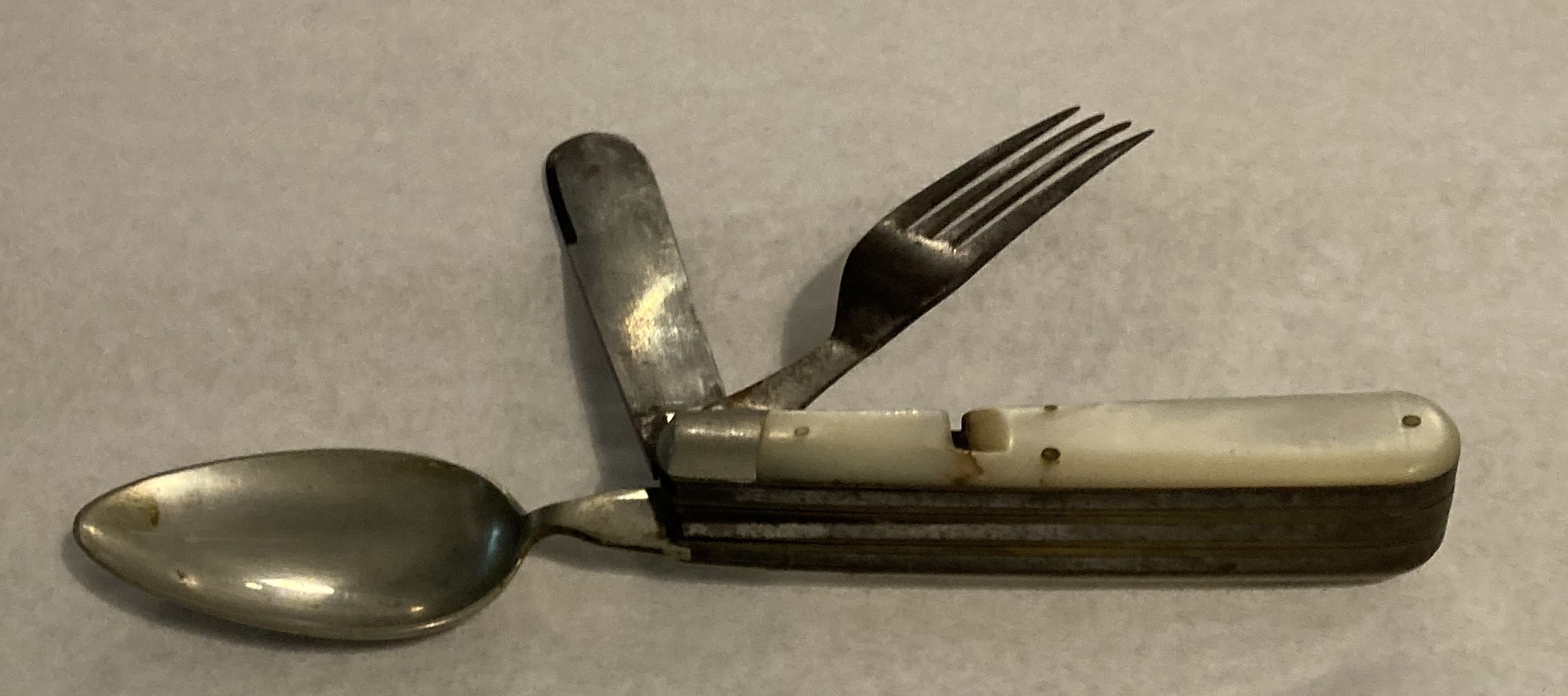
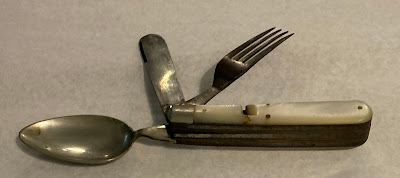
-- Knife/ fork/ spoon set Lemon took from a dead Federal soldier on the battlefield of Salem Church in Virginia, May 1863. He wrote in his memoir: “That evening, as we rested near the church, I had occasion to walk the field nearby. The ground was fairly strewn with every conceivable article of war, hundreds of Yankee dead and wounded lay everywhere, as well as scores of muskets, bayonets, accouterments of every type, haversacks and canteens ... As for myself, I allowed myself but one trophy, a nice little penknife with several blades and attachments, which an unfortunate Yankee corporal would no longer need. (It afterwards served me well and I have it still.”

-- Union canteen (below) Lemon picked up in the Wheatfield at Gettysburg after his own canteen had been ruined by a bullet (a Yankee bullet hit the canteen, and it struck the head of Lemon, who thought he had been shot). The strap bears Lemon's initials, date and initials of the dead 4th Michigan soldier from whom he got it.

(Picket photo)
-- Drum captured from two frightened young Pennsylvania drummer boys the day before the Battle of Sharpsburg (September 1862). Lemon tells the story of its capture by Pvt. Frank A. Boring in his memoir. The drumhead bears Boring's name in ink. This is James Lemon's handwriting, as indicated by pages in the diary and maps of battles shown in the memoir, according to Jones.  

Lemon wrote Pvt. Boring's name into drumhead (Picket photo)
Here is Lemon’s colorful account of the drummer boys, as written in his memoir:

“On the evening of the 16th our briggade was ordered to form line of battle & we advanced into a cornfield & into a piece of timber where we met almost by accident a force of the enemy. We drove them with style back through the woods, capturing some Yanks from the 1st & 3rd Penn'a Reserves. Among this bunch were a couple of drummer-boys, about 12 or 13 years old who were trying hard to "put on a brave face," but who were clearly terrified.

"Col. Ruff ordered their drums confiscated & then released as we were not equipped or inclined to care for children. Our drum had been damaged & thrown away at Groveton, so we took theirs as "spoils of war." Private Boring captured the boys. As he was driving them to the rear at point of bayonet they heaped so much abuse upon him -- out of their fear or nervousness -- that he had to be restrained from striking them with the clubbed musket.

"Of course, instantly the target of many wags among our company who joked with him about "scaring little boys" & etc. He replied that he would be d---d if he'd take such abuse from "d---d Yankee whelps." The boys were release(d) & "beat a hasty retreat" back to their lines, with Boring giving them a rite hard look as they went.”

One of James Lile Lemon's journals (Picket photo)

Monday, June 11, 2018

Lock of Custer's hair sells for $12,500; whoever wants his captured Civil War uniform, Tiffany sword will need to pony up a ton more

These Custer items are held by a gallery in Idaho (Courtesy of Cisco's Gallery)
Clump of Custer's hair sold on June 9 (Courtesy of Heritage Auctions)
The men of brevet Brig. Gen. George Armstrong Custer's Michigan cavalry brigade ran into a swarm of Confederate troopers at the June 1864 Battle of Trevilian Station in Virginia.

The slightly wounded Union legend barely avoided capture while his brigade suffered 416 casualties in an all-cavalry clash that lasted six hours. Among the casualties was a trove of personal items that the dashing Custer, who was only age 24, kept in his headquarters wagon.

Rebel Lt. Frank Blair -- a member of 36th Texas Cavalry briefly deployed to Virginia, where he fought under Thomas Rosser -- made off with the dress uniform Custer wore at his wedding, a Tiffany sword presented to Custer by the 5th Michigan Cavalry in late June 1863, letters, a fine rosewood case, a field writing desk and a valise.

Custer, circa 1865
Tucked inside the sword case was an envelope stuffed with locks of the Union hero’s blond hair. His wife, Elizabeth (Libbie), had wanted the hair to make a wig, but the envelope apparently wasn’t sent to her before it became the spoils of war.

On Saturday, more than 50 strands of that hair, each up to 3 inches long, sold at auction for $12,500, six times the preauction estimate. The hair was in the collection of retired filmmaker Glen Swanson. 

About 260 Swanson-owned items associated with Custer (Civil War and Indian Wars), the doomed 7th Cavalry Regiment and Native American warriors sold for $1.43 million in the Heritage Auctions sale. 

Custer's Tiffany sword (Cisco's Gallery)
How did Swanson come to get a slice of Custer's hair? 

About 15 years ago, he was asked by the current owner of the Custer uniform and sword to help verify their authenticity. 

When going through items, he opened a writer’s valise that had, among other things, a small envelope of hair that had not been previously noticed. Upon concluding that it had, in fact, come from Custer, the owner was so grateful to Swanson for the discovery and for his effort verifying items that he allowed Swanson to take the sample that was sold Saturday," said Heritage Auctions spokesman Steve Lansdale.

The businessman who contacted Swanson has the so-called "Trevilian Collection" up for sale at his gallery in Coeur d'Alene, Idaho. Sam Kennedy's website calls it "the most historic and important group of Civil War items to surface this century."

Collection kept under a bed

Kennedy, owner of Cisco Gallery, told the Picket he laid out an amount in "the seven figures" to a Dallas man for the collection in 2000. While there currently is no sales tag on the collection, "We are probably in the $10 million plus." He said advertising for the collection will begin later this summer.

"We had goose bumps when we first picked up the sword," said Kennedy, adding he worked with five experts over six months to authentic the Custer items. “The two most valuable (Civil War) swords would be General (Robert E.) Lee’s and Custer’s.”

Custer's dress coat and chapeau (Cisco's Gallery)
Kennedy has previously loaned out the collection, which includes a diary kept by a Civil War officer who helped retrieve love letters exchanged between the Custers. The correspondence had made its away across the South after they were taken at Trevilian Station. Many of the letters survive. (Military correspondence seized at Trevilian had been sent to Richmond.)

Libbie Custer routinely asked for George to send locks of hair from the front so that she could make a wig. She used it for theatrical productions, but it was destroyed at Fort Abraham Lincoln in North Dakota.

The Trevilian Collection has changed hands about five times, Kennedy said. He learned about it over dinner with someone who told him: "They are under a bed down in Texas. It will cost you a lot of money to find out."

More about the June 9 auction

Gen. Sherman's uniform
Ahead of the recent sale of Custer's hair through Heritage Auctions, Swanson spoke with Heritage’s Intelligent Collector magazine about his collecting passion, especially for items associated with Custer and Plains War Indians.

“We have Gen. [William Tecumseh] Sherman’s uniform – that really is a one-of-a-kind item. He and his son always were at it – they didn’t like each other at all,” Swanson told the magazine. “His son sold just about everything, so about 90 percent of it was lost. But I ran across his tunic, his hat, his sash and belt, his epaulets – which were totally unique.”

The dress uniform belonging to Sherman, a Civil War hero and general of the Army when Custer and more than 200 cavalry troopers were killed at Little Bighorn in June 1876, sold for $62,500, over a $50,000 pre-auction estimate, according to Heritage Auctions. It’s believed to be from the 1872-1883 period.

Courtesy of Heritage Auctions
Heritage Auctions spokesperson Steve Lansdale said a Sherman campaign hat that sold Saturday for $26,250 ($15,000-plus estimate) was worn probably right after the Civil War. At that time, the general was stationed in St. Louis, ensuring military protection for western expansion.

“The hat shows the effects of perspiration and dust, but otherwise it is in very good shape,” the catalog says.

The Smithsonian Institution’s National Museum of American History has the campaign hat that Sherman wore during the Civil War. It is worn and has some holes, and Heritage Auctions believes the one auctioned Saturday was a replacement.

Courtesy of Heritage Auctions
An inscribed .22-caliber revolver presented to Custer in 1863 by U.S. Volunteers, during the Civil War, sold for $35,000, well below the $50,000 estimate.

“It was undoubtedly presented by his men when he received a field commission as brigadier general from Gen. Alfred Pleasonton and given command of the Michigan Cavalry Brigade, 3rd Division, Army of the Potomac," the auction house said. "It comes with its original custom thermoplastic case with a patriotic motif on the lid.”

Photos courtesy of Heritage Auctions

Also sold at the auction (above) were a flintlock carbine belonging to Indian chief Sitting Bull and a statue depicting him ($162,500, with an estimate of $50,000-plus before the sale) and three Sioux arrows from the Battle of Little Bighorn ($93,750, with a $10,000-plus estimate).

2025 update: The "Trevilian Collection" is still up for sale. Kennedy says several people have expressed interest.

Wednesday, January 19, 2011

Museum to get stolen revolver back

A gun used in the Civil War, then stolen from the Museum of the Confederacy in Richmond, Va., has been recovered more than three decades after the theft. • Article

Wednesday, March 31, 2010

Man returns stolen revolver to museum

A Civil War buff from western Pennsylvania has returned a historic revolver to the Chicago museum from which it was stolen decades earlier. • Article