The cremains of Civil War Union soldier and Pawtucket, Rhode Island, native Byron R. Johnson were laid to rest on Wednesday, more than a century after his death. The burial marked one of the final Civil War soldier interments in the United States, offering a unique opportunity to honor the historic moment. “It’s special to begin with -- to have someone who served in this war and his cremains coming back. It’s very unique,” Pawtucket Mayor Donald Grebien said. -- Article
Showing posts with label soldier. Show all posts
Showing posts with label soldier. Show all posts
Friday, October 18, 2024


Thursday, November 2, 2023
John J. Upham fought in the Civil War and Indian Wars. He and his bride built a charming St. Augustine cottage that is now for sale
 |
| (Evan Ulsh photo, courtesy of ONE Sotheby's International Realty) |
So the bachelor, 54, married Caroline Hoppin Williams – 10 years his junior -- in Milwaukee on Sept. 23, 1891. Having soldiered through bouts of poor health over the years, the U.S. 8th Cavalry officer retired just four months later.

He and
Mrs. Upham decided to build a winter retreat on St. George Street in St.
Augustine, Fla. The striking cottage went up over the winter of 1892-1893 and
the couple happily wintered there and summered in Wisconsin until 1898, when
Upham died of kidney disease at a Milwaukee hotel where they were staying
before their return south. He was 61.
Today, the
house, which has had numerous additions and owners over the years, is for sale,
currently at $1.3 million. Upham Cottage, with eight bedrooms and 5,800 square
feet, is part of the St. Augustine historic district, which is listed on the
National Register of Historic Places; the National Park Service says the three-story
cottage is one of a few remaining of that style in the city.
 |
| (Evan Ulsh photos for ONE Sotheby's International Realty) |

“From its stunning original millwork and wood floors to its unique octagonal shape, this home will take you back to the splendor of the Gilded Age.” Photos of the property, which is just blocks from the water, show a welcoming home still steeped in the Victorian era.
The likes of
novelist Henry James and painter Martin Johnson Heade paid visits more than a
century ago. “Over time, the cottage evolved along with the ever-changing tides
of history. The original owners continuously added onto the property, building
a ballroom, rooftop garden and atrium,” the listing states.
The Upham
Cottage later became a multi-family property until it was converted back to a
single-family dwelling in the late 1980s, and it is a different cat than its neighbors. Its sales price has varied widely in
the past 15 or so years, according to Zillow. Like other houses of that age with
such features, upkeep is paramount.
 |
| (Evan Ulsh photo, courtesy of ONE Sotheby's International Realty) |
Upham battled health issues along with the enemy
John J. Upham
was born in Wilmington, Del., in 1837. His family moved to Milwaukee, where his
father, Don A.J. Upham, served as mayor in 1849 and 1850. The younger Upham
attended West Point, graduated in 1859 and joined the regular army.
First in the
infantry, the officer was stationed at Governor’s Island, N.Y., and California
before the Civil War broke out.
 |
| Arched entrance at the cottage in St. Augustine (Evan Ulsh photo) |

Upham was in
a few regiments in his time in Texas, Kansas and Indian Territory. He took
command of Oklahoma’s Fort Gibson in 1875 and was in the field in the summer of
1876 as part of the Yellowstone and Big Horn expeditions (George A. Armstrong
and much of his command were killed at Little Big Horn in June 1876).
Upham fought
at War Bonnet Creek and Slim Buttes and later was stationed at Fort D.A.
Russell, Fort Wahaskie and Fort Niobrara, according to his obituary.
 |
| Man holds rifle as two others ride off (Courtesy of Wisconsin Historical Society) |
'Distinguished son of a distinguished sire'
Upham’s later
service included time at Fort Leavenworth and brief deployments to Turkey and
France as a military observer. “He was at that time decorated with the cross of
the Legion of Honor, a distinction enjoyed by few Americans,” according to his
obituary.
Upham was
promoted to colonel on Jan. 14, 1892, and put on the retired list on Jan. 30,
1892.

The Uphams
shared seven years together and they returned to Milwaukee in spring 1898. But
John never saw Florida again. He died on Oct. 21 and was buried at Forest Home Cemetery. Caroline died in 1934. They had no children.
Upham’s
lengthy obituary, which called him one of Wisconsin’s best-known military men,
included these remarks made by a friend:
“Milwaukee
has lost the distinguished son of a distinguished sire. Large of frame and
equally large of heart; generous; genial; unassuming; unselfish; this endeared
him to all who had the privilege of his close friendship. On the pages of our
country’s military history one may read the record of the deeds that won for
him promotion and popularity, but from his own modest lips one never heard
mention of his gallant and meritorious conduct.”
Thursday, April 13, 2023
Treasure trove: Capt. James Lile Lemon kept spoils of war and all his belongings. Descendants got to see them at the Atlanta History Center
 |
| Gordon Jones with drum, a revolver and James L. Lemon's prize watch (Picket photos) |
There were
personal items, a captured drum, revolver, letters, canteen, photographs and
much more. Many artifacts were labeled with handwritten notes by Capt. James Lile Lemon of Company A, 18th Georgia Infantry, who fought in the
Virginia theater and survived a year and a half in Union prison camps.

“It is amazing how meticulous he was in
keeping records,” said Fred Aiken, a member of the Atlanta Civil War Round Table.
Aiken, along
with about 20 members of the Lemon family, most living in northern Georgia,
were invited to the AHC to see the impressive collection
the institution purchased from the widow of a Macon, Ga., collector in 2020.
The set includes three wartime diaries.
“He literally
saved everything,” said host Gordon Jones, senior military historian and curator
at the AHC. Lemon was “an individual who was thinking ahead about his own
legacy.”
Jones told
the Lemon family that their ancestor is a quintessential example of the human
experience in the Civil War. “This is storytelling stuff. People love it.” It
is the history center’s fortune to have such a complete collection, he added.
 |
| Lemon descendants and others before seeing collection (Picket photo) |
While
“Turning Point” still attracts visitors, the AHC believes it is a dinosaur, and
it is raising money for a new exhibit that will offer newer, fresher and more
inclusive perspectives of the conflict. The Lemon collection, Jones said, will
be shown to the public as part of that effort.
When the war
broke out, Lemon was living in Acworth, about 30 miles northwest of Atlanta. His
family had seven enslaved persons, and Lemon wrote in his memoirs that he freed them.
There is some dispute over the claim, according to the AHC.
 |
| Descendant Mark Lemon lives in the Acworth home |
The regiment
fought in numerous Eastern battles – including Antietam,
Fredericksburg, Second Manassas and Chancellorsville. The farmer and merchant
had a close call at Gettysburg, when a Yankee bullet struck his canteen, causing it to strike his head.
His combat
days came to a close in November 1863, when Lemon was severely wounded by a
Minie ball in the pharynx and taken prison after an assault on Fort Sanders in
Knoxville, Tenn.
 |
| Mark Lemon (left) brought sword given by Union NCO to J.L. Lemon (Picket photo) |
The captain’s
brief time at Pulaski is part of the story of the "Immortal 600", a
fascinating footnote to the conflict. The story is involved, but here’s a
summary:
In summer
1864, Confederate Maj. Gen. Samuel Jones essentially used 600 captured Union
officers as human shields, in a section of Charleston, S.C., in the line of
fire. The North retaliated by transporting 600 POWs from Fort Delaware to
Morris Island, S.C., in direct line of Rebel guns.
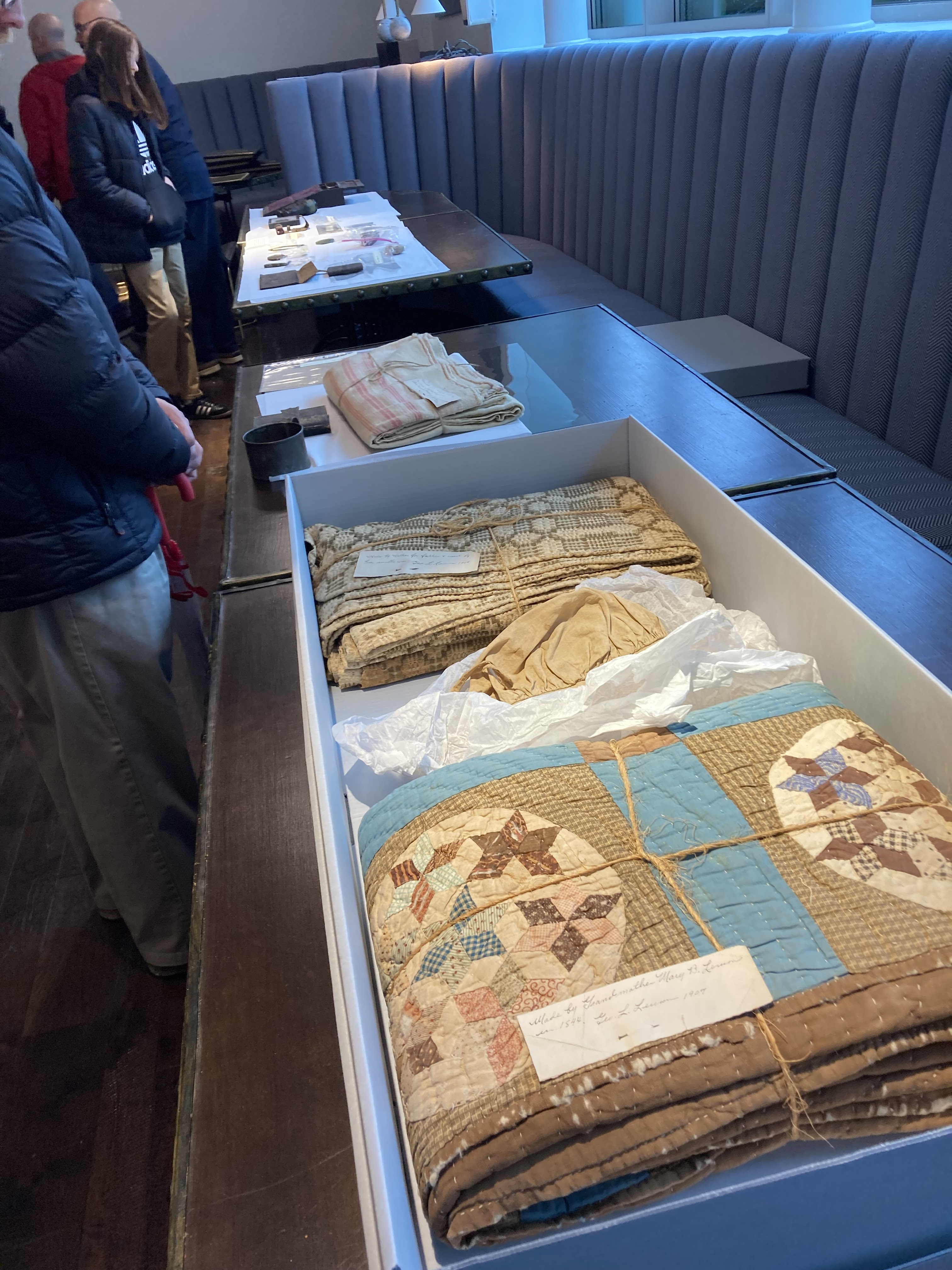
While held at Fort Pulaski, Lemon etched his name into a wall. (At right, blanket near top of photo was given to Lemon while he was held there. Click to enlarge)
Lemon and
other prisoners were returned to Fort Delaware toward the war’s end.
He earned the
respect of one of the prison staff, who also had the name Lemon. Sgt. Lemon
Kline of the 215th Pennsylvania Infantry gifted him an NCO sword when the Confederate was paroled.
Lemon, who somehow managed to get the weapon back to Georgia, wrote a notation
about it, as was his practice.
Mark Lemon,
great-great grandson of Lemon and author of “Feed Them the Steel!”, a history
of Lemon and his regiment, brought the sword to the AHC, eliciting much
excitement from Jones. The book, written as a narrative, includes many battle
and POW accounts written by James Lile Lemon.

At war’s end, James Lile Lemon refused to take
an oath of allegiance to the United States, citing his treatment, but he
eventually did take it in June 1865. Family today considers him a “diehard”
Confederate.
In his journal, Lemon wrote: “I have done the
unspeakable but I am now paroled & to day set out for home. My duty to my
country is done, mine to my family remains.”
The officer returned to Acworth and had 11
children with his wife Eliza. He was a retail merchant and then a bank
executive, serving as president of the bank when he died on June 12, 1907, at age 72. Lemon had published a compelling memoir in 1886, the same year the
Cyclorama was painted.
For Jones, Lemon’s meticulous record-keeping has
paid off. “The story was
there. It was just matching it to the artifacts.”
Here are some highlights from the AHC’s Lemon
collection that were shown to the family:-
 |
| (Picket photo of sketch) |
-- An Adams
revolver with “JL” and “18th GEO” carved into the grips (see photo at top of this post). Jones
believes the officer gave the gun to his brother Smith, who used it while
serving in the Georgia State Line. It saw action at the Battle of Atlanta in
July 1864. (Lemon’s gun that he lost at Knoxville is today in a private
collection in Milwaukee.)
-- Lemon’s
engraved gold watch, made in Liverpool, presented by his brother Smith Lemon on
October 27, 1861. Lemon lost the watch when he was wounded at Knoxville, but
later spotted it on a Union soldier and managed to retrieve it, according to
his memoir. (See photo at top of this article)
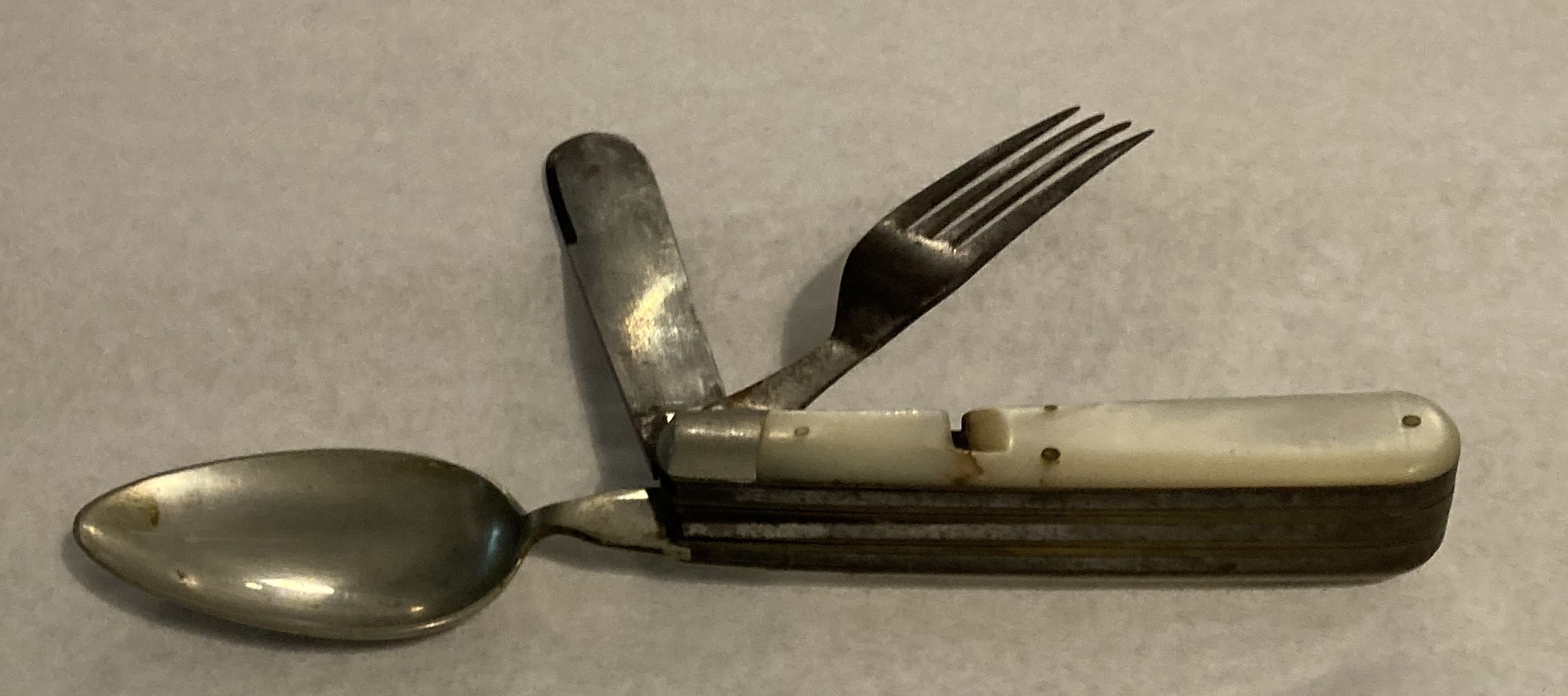 |
| (Picket photo) |
-- Union
canteen (below) Lemon picked up in the Wheatfield at Gettysburg after his own canteen
had been ruined by a bullet (a Yankee bullet hit the canteen, and it struck the
head of Lemon, who thought he had been shot). The strap bears Lemon's initials,
date and initials of the dead 4th Michigan soldier from whom he got it.
 |
| (Picket photo) |
 |
| Lemon wrote Pvt. Boring's name into drumhead (Picket photo) |
“On the evening of the 16th our briggade was ordered to form line of battle & we advanced into a cornfield & into a piece of timber where we met almost by accident a force of the enemy. We drove them with style back through the woods, capturing some Yanks from the 1st & 3rd Penn'a Reserves. Among this bunch were a couple of drummer-boys, about 12 or 13 years old who were trying hard to "put on a brave face," but who were clearly terrified.

"Of course,
instantly the target of many wags among our company who joked with him about
"scaring little boys" & etc. He replied that he would be d---d if
he'd take such abuse from "d---d Yankee whelps." The boys were
release(d) & "beat a hasty retreat" back to their lines, with
Boring giving them a rite hard look as they went.”
 |
| One of James Lile Lemon's journals (Picket photo) |
Monday, January 30, 2023
Cemetery manager secures headstone for Michigan soldier
The grave of a man who served in the Civil War has been formally marked at a northern Michigan cemetery. Claude Fields ensured that Ruel Boynton's service wouldn't be forgotten. Fields, manager of the Maple Grove cemetery in Empire Township, has performed research on many of the dead buried there, the Traverse City Record-Eagle reported. “We can’t have a vet in here with no headstone,” Fields said. “That isn’t right.”
Saturday, January 7, 2023
Colorado unit that fought Rebels and Indians during the Civil War put out a newspaper. The Library of Congress now has a rare complete set
 |
| A complete set of Soldier's Letter (Shawn Miller, Library of Congress) |
The bound copy of the full print run of Soldier’s Letter
was among only a few complete sets of 50 editions to survive the war, the library
said in a late December post about the acquisition. The
unofficial camp newspaper was produced 1864-1865 in Kansas City, Mo., and Fort
Riley, Kan.
Pvt. Oliver Wallace served as editor, working from
contributions by other enlisted men and wives. Soldier’s Letter included poems,
regiment history, rosters, letters to the editor and features about camp life,
according to the American Antiquarian Society. (Colorado, by the way, was a territory during the Civil War, but this unit fought in the Midwest).
“Though there is a
long-standing national obsession with the Civil War, regimental newspapers
never quite caught on as something to be preserved,” wrote Neely Tucker in the LOC blog post.
“More than 200 such papers in at least
32 states printed at least one edition, according to historian Earle Lutz, but
they had mostly vanished by the time he surveyed the nation’s libraries,
museums and major private collections in the early 1950s.”
 |
| (From left) Lt. Col. Theodore Dodd, Col. James H. Ford and Pvt. William Waggoner (WCNB) |
The editions of the newspaper -- which
each cost 10 cents -- are printed in pulp stock. Three pages in each edition
included news, rumors, jokes and histories of the regiment, which was formed in
1863. The fourth page was left blank for soldiers to write letters or notes to family
or friends. The troopers then mailed the pages home.
“Much of the war was over by the time
Wallace started his paper, but he and his unnamed correspondents did note
Lincoln’s assassination, accounts of skirmishes and the general tenor of the
last days of the Confederacy,” wrote Tucker, who manages the LOC blog.
“The rebels have taken to smuggling in bacon past the blockage,” a short item noted in one edition of the anti-slavery camp newspaper. “The evidences multiply that they are on their last legs.”
 |
| Final issue sums up unit's history and number of complete editions (Library of Congress) |
“Dear
Mother:
Nothing of
interest has transpired since I sent you the last two copies of the Soldiers
Letter. We are still staying in Mo and will probably remain here some time. My
health is good first rate. Plenty of fun Plenty to eat and nothing to do Capt
Moses was maried [sic] last Thursday He givs [sic] a party to night at his wives fathers you bet we will have
a good time.”
The Second Colorado Cavalry was deployed for some time in what was called the Trans-Mississippi Theater during the Civil War. Its actions included patrols, clashes and chasing Confederate Gen. Sterling Price in Missouri in 1864, engaging in multiple battles. Price's foray was a major defeat for the South.
Wilson's Creek National Battlefield in Missouri has a collection of Trans-Mississippi items in its museum, including 19 photos of Second Colorado Cavalry's soldiers (three above) and two documents, says curator Jeff Patrick.
Late in the war, the regiment was sent west to quell Indian
raiders on the Santa Fe Trail and other locations. Although the Second Colorado
Cavalry was not a participant in the infamous Sand Creek Massacre of Indians in
1864 that killed scores of women, children and the elderly, the Soldier’s
Letter editorialized the attack was not vicious enough.

He told the Picket in an email this week that accounts such as those by the regiment are "incredibly valuable for assessing the 'unit culture' of Civil War units. Letters, diaries, memoirs, etc. give an individual perspective, but newspapers were intended to appeal to a broader readership and therefore more accurately reflect collective views."
"The paper was
published during the most pivotal period of the unit’s service in the 'Burned
District' along the Kansas-Missouri border and therefore provides insight into
that 'counterinsurgency' campaign, as well as the flaring hostilities on the
Plains. It highlights how a regiment of staunch abolitionists could, at the
same time, be among the worst Indian-haters in the West," Rein told the Picket.
Chandra
Miller, in a 1999 article for the Kansas Historical Society, said the men of
the Second Colorado Cavalry, created the Soldier’s Letter to fight isolation,
boredom and vagueness of purpose.
“In each
issue the Soldier’s Letter covered topics from the history of the regiment to
civilian gossip, but the bulk of its pages was dedicated to reflections on the
righteousness of American governmental institutions, politics and the
eradication of slavery,” Miller wrote.
The
newspapers have not been transcribed and thus are not online. The only way to
see the full run is by visiting the LOC in Washington, D.C., or, according to Rein, the Denver Public Library, which he says also has a complete set.
Tuesday, October 9, 2018
Donation was music to their ears
Two sisters in search of information about a Civil War ancestor have
gifted the historical society in Adams, Mass., with an instrument he carried
through the Civil War. Judge Bullard enlisted as a private in H Company, 27th
Regiment of Massachusetts Volunteers, in August 1862. He re-enlisted in January
1864 and was later captured by Confederates and held as a prisoner in March and April 1865. • Article
Monday, June 25, 2018
Plaque honors soldier who died at age 99
It’s been
more than 78 years since Maryland soldier Jacob Andrew Snively died at age 99. Yet
about 20 people gathered Sunday at his grave site in Rose Hill Cemetery to
recognize the man who is believed to be the last surviving military member from
either side of the Civil War to live in Washington County. “If you stop
remembering, then they’ll forget them,” Union descendants group member George
Chapman said. • Article
Thursday, March 15, 2018
Divided over NC Confederate monuments: More than 4,000 submit comments on proposed relocation of 3 memorials
 |
| Confederate Soldiers Monument |
The North
Carolina Historical Commission has been tasked with talking with historians,
legal experts and hearing from the public before it makes a decision.
The next step
is a hearing on March 21 in Raleigh, at which speakers have one minute to make
their positions known to a five-member study committee.
A 2015 state
law makes it difficult to remove or relocate public monuments, according to the
News & Observer. Cooper made the recommendation following the
Charlottesville, Va., violence last summer.
The
commission is trying to determine whether it even has the authority to order
the state statues moved to the Bentonville battlefield about 45 miles away. A petition for relocation calls them “objects of remembrance.”
“This
commission has not had a contentious issue before them until now,” Michele
Walker, a public information officer for the state Department of Natural and
Cultural Resources, told the Picket this week.
The three
memorials on Union Square are the Confederate
Women's Monument (1914), the Confederate Soldiers Monument (1895) and the Henry
Lawson Wyatt Monument (1912). Wyatt was the first North Carolinian killed in
the Civil War.
The comment page, which launched on Jan. 29, is not
restricted to state residents, though most do come from them. As of the morning
of March 15, 4,031 people had weighed in.
 |
| Confederate Women's Monument (NCDCR) |
They reflect what commission member David Ruffin said during
a committee conference call this week that set ground rules for the hearing: “We understand
that opinions are strong and divided, and in many cases, passionately held.”
While some
comments reviewed by the Picket showed nuanced feelings on the matter, most are
solidly on either side of the contentious issue.
“The monuments were placed by the children and widows of these men on
the capitol grounds at a time when these veterans were getting old, and passing
on,” wrote a High Point resident. “They were placed to memorialize these
heroes, plain and simple, with no ulterior motives. I would feel we
would be doing ourselves and their memories a grave disservice to move these
monuments from their time-honored spots.”
A Chapel Hill resident countered.
“These statues told black citizens that they were not welcome in their
own country, and they continue to send that message today. As long as these
statue(s) stand in our state capitol, we are implicitly condoning the white
supremacists who put them up. North Carolina can do better. Please remove these
monuments to hate.”
Some commenters said if the three are moved, so should statues of the
Rev. Martin Luther King Jr. But James
Leloudis, a history professor at UNC-Chapel Hill, told the News & Observer
that equating the memorials ignores “fundamental moral distinctions.”
The
Confederacy was built on the rejection of the founding principle that "all
men are created equal," Leloudis said, while "King, by comparison,
called the nation back to its core defining democratic values."
The public hearing is set for 1:30-3:30 p.m. on March 21 at the Archives
and History/State Library Building in Raleigh. The chair has the option of
extending the session by an hour if needed.
 |
| Henry Lawson Wyatt Monument (NCDCR) |
During their conference call, committee members focused on ground rules
and ensuring that all views are heard. Speakers must sign in before they can
address the committee and they cannot mention other monuments, such as the
Silent Sam monument in Chapel Hill.
“We are
trying to be open and fair and respectful of all opinions,” said Ruffin.
Speakers get one minute, and a red warning card will be put up after 30
seconds.
“No applause
or other noises or clapping shall be allowed or tolerated before, during or
after any speaker. Individuals in attendance who violate this rule will first
be warned and then removed from the audience if a second violation occurs,” the
committee said.
Walker said no banners or flags will be allowed. While people generally
respect others and the rules, she said, security will be present.
The committee members agreed that the chairman can ask for comments
representing another view if they have not heard speakers with such views.
“Whatever our positions, we must be both fair to divergent opinions and
respectful of each other’s rights to utter those opinions,” Ruffin said.
The committee can vote to keep the monuments where they are, add
interpretive signage that may give historical context, move them or consider other
options. “They are not
limited to yes or no,” Walker told the Picket.
A Durham commenter spoke to one possible option: “If the monuments stay where they are, additional information needs to be posted on the same site to put them into the context in which they were erected. The date the monument was erected, who paid for it, who supported it, who did not support it. The fact that many were erected during Jim Crow as a way to put down efforts at equality by African-Americans should be front and center.”
A Holly Springs resident disagrees. “It is a very dangerous idea to remove statues which certain people do not agree with. History cannot be rewritten to satisfy disgruntled citizens.”
Walker said the committee is taking its duties very seriously.
A Durham commenter spoke to one possible option: “If the monuments stay where they are, additional information needs to be posted on the same site to put them into the context in which they were erected. The date the monument was erected, who paid for it, who supported it, who did not support it. The fact that many were erected during Jim Crow as a way to put down efforts at equality by African-Americans should be front and center.”
A Holly Springs resident disagrees. “It is a very dangerous idea to remove statues which certain people do not agree with. History cannot be rewritten to satisfy disgruntled citizens.”
Walker said the committee is taking its duties very seriously.
“They want to
know what the people of North Carolina think and how they want this issue to be
handled,” she said.
Saturday, May 30, 2015
'You never leave a fallen comrade'
A Civil
War-era soldier who received the Medal of Honor will be buried with full
military honors after his ashes were discovered in an unmarked, communal crypt.
Sgt. Charles Schroeter will be buried at Miramar National Center in July,
nearly a century after he died, the San Diego Union-Tribune reports. • Article
Sunday, August 3, 2014
Sign remembers Andrews Raid soldier
 William Pittenger took part with James Andrews nearly two dozen others in the April 1862 Union raid that was supposed to destroy portions of the Western & Atlantic Railroad between Atlanta and Chattanooga, Tenn. The event has been called the Great Locomotive Chase.
Pittenger's service has been remembered with a new historical marker in Knoxville, Ohio. The Medal of Honor recipient was exchanged during the war, later moved to Fallbrook, Calif., and lived until 1904. His descendants were on hand for the marker ceremony over the weekend. • Article
Saturday, July 6, 2013
Sword given to soldier back in Conn.
A Civil War sword that turned up at a New York tag sale is coming home to
western Connecticut. The sword belonged to John Betts, who enlisted in the Union Army in
1861. Betts was wounded in the First Battle of Winchester in Virginia, captured and
imprisoned. He was exchanged for a Confederate soldier and
returned to Danbury. His Masonic lodge honored him with a sword, which went missing for decades. • Article
Friday, September 21, 2012
Soldier's grave to be rededicated
The grave of a Minnesota Civil War soldier that became overgrown will be rededicated during a formal ceremony Saturday.
Pvt. Edmund Sampare, who died on Sept. 17, 1862, during the Battle of
Antietam, was a member of the Second Regiment, U.S. Sharpshooters, which saw action until nearly the end of the conflict. He was buried at Calvary
Cemetery in St. Paul, and his gravestone laid flat in 1940 to protect it from further
erosion.
The stone became overgrown, but was found by a member of the Minnesota
Historical Society. • Article
Saturday, October 22, 2011
Spoil of war returned to Va.
Nearly 150 years after a Union Army captain pilfered a book of court records from a county courthouse in Virginia during the Civil War, the Jersey City Free Public Library has returned the 220-year-old spoil of war to its rightful home. • Article
Wednesday, July 27, 2011
Veteran is finally laid to rest in Kansas
 Nearly 150 years after Pvt. George McCarthy served in the U.S. military, a detail of Civil War re-enactors carried his cremated remains slowly up the hill to his final resting place in Fort Leavenworth, Kan. McCarthy died at age 102 in Missouri, but for nearly seven decades years his ashes went unclaimed, resting on a shelf a funeral home storage facility in Kansas City. • Article
Thursday, June 30, 2011
Town makes pitch with bobblehead
 A Civil War officer known as "the hero of Hagerstown" is being immortalized as a bobblehead.
The Hagerstown, Md. convention and visitors' bureau said Wednesday it will present bobblehead dolls of Capt. Ulric Dahlgren to the first 1,000 fans at the Hagerstown Suns minor league baseball game July 9.
Dahlgren led an outnumbered Union cavalry unit against Confederate forces in the streets of Hagerstown on July 6, 1863. • Article
Thursday, January 27, 2011
Woman's research reunites family
After three trips to the public library, some online detective work and a little cold calling, a Goose Creek, S.C., homemaker reunited a long-lost heir with his great-grandfather's Civil War discharge papers, and in the process brought back together a family that had lost touch for about half of a century. • Article
Wednesday, December 15, 2010
Family ties 2: Your Civil War stories
The Picket is sharing readers' accounts of their ancestors who served or were affected by the Civil War. We encourage you to get involved by e-mailing us at  pgastjr@comcast.net. Jeff Hightower, a member of the SCV and a resident of McDonough, Ga., provided this story about his great-great-grandfather, George Washington Bright, who served in the 22nd Georgia Heavy Artillery, Co. A, the "Bartow Artillery" He enlisted at Griffin, Ga. and trained at Camp Stephens in Spalding County, Ga. Bright (left), who lived to 82, in 1913 wrote to the Alabama Pension Board in reference to their inquiry as to why he had appeared on a list of deserters. The board cleared his name and he received a pension until his death in 1927. The wording and spellings are as written.
State of Ala. Cleburne CO. Oct 9 1913
Dear friend, I have received your notice concerning our pension and I am glad that I can inform you that I never deserted my command. But me and a corporal and two others was placed on picket at the spindles at a [creek] four miles below Savannah our company was stasion at fort Jackson and when we come off picket the next morning and went back to fort Jackson our army had cross the Savannah river and left us on the other side of the river and no way left for us to get over and the enemy closed in on us and we had to give up or be shot down. This was at fort Jackson 3 miles below Savannah. We never deserted our company but they put us on picket duty and went a cross the river and left us. So while you good people have seen fit to give us old Soldiers a little pension to help us in our old age I appreciate it very much. But please dont call me a deserter now 50 years after it is all over. But I dont blame you for it for you was not there and dont no anything a bout it. So of course you will have to go accordin to the laws that is made I was in the Bartow artillery company that went from midle Georgia & I was in the company A 22 Battalion Georgia Artillery and served as a good soldier until I was captured and taken a prisoner. I went in service some time in March of 63 and was taken prisoner some time in December of 64 and carried to hilton head and put in the stock ade with the other prisoners and was kept there until the war ended and then they turned me loose and I went home to midle GA So now I am getting old and not able to defend my self. So give me justice and do the best for me you can.
Yours truly,
George Washington Bright
Fruithurst, Ala Rout 1
 pgastjr@comcast.net. Jeff Hightower, a member of the SCV and a resident of McDonough, Ga., provided this story about his great-great-grandfather, George Washington Bright, who served in the 22nd Georgia Heavy Artillery, Co. A, the "Bartow Artillery" He enlisted at Griffin, Ga. and trained at Camp Stephens in Spalding County, Ga. Bright (left), who lived to 82, in 1913 wrote to the Alabama Pension Board in reference to their inquiry as to why he had appeared on a list of deserters. The board cleared his name and he received a pension until his death in 1927. The wording and spellings are as written.
State of Ala. Cleburne CO. Oct 9 1913
Dear friend, I have received your notice concerning our pension and I am glad that I can inform you that I never deserted my command. But me and a corporal and two others was placed on picket at the spindles at a [creek] four miles below Savannah our company was stasion at fort Jackson and when we come off picket the next morning and went back to fort Jackson our army had cross the Savannah river and left us on the other side of the river and no way left for us to get over and the enemy closed in
 on us and we had to give up or be shot down. This was at fort Jackson 3 miles below Savannah. We never deserted our company but they put us on picket duty and went a cross the river and left us. So while you good people have seen fit to give us old Soldiers a little pension to help us in our old age I appreciate it very much. But please dont call me a deserter now 50 years after it is all over. But I dont blame you for it for you was not there and dont no anything a bout it. So of course you will have to go accordin to the laws that is made I was in the Bartow artillery company that went from midle Georgia & I was in the company A 22 Battalion Georgia Artillery and served as a good soldier until I was captured and taken a prisoner. I went in service some time in March of 63 and was taken prisoner some time in December of 64 and carried to hilton head and put in the stock ade with the other prisoners and was kept there until the war ended and then they turned me loose and I went home to midle GA So now I am getting old and not able to defend my self. So give me justice and do the best for me you can.
Yours truly,
George Washington Bright
Fruithurst, Ala Rout 1
Saturday, November 6, 2010
New York honors fallen soldier
A tombstone is being unveiled this weekend in an upstate New York cemetery for a Civil War soldier who survived some of the conflict's bloodiest battles only to be killed just before his enlistment was up in 1864. • Article
Wednesday, September 29, 2010
Black Union soldier remembered
A black Union soldier, Pvt. Alan Bobson, who died at a Civil War field hospital in Lynchburg, Va., is being remembered by the local Sons of Union Veterans. • Article
Thursday, July 15, 2010
Daughter of Civil War soldier dies at 103
 Edna Marie Hetrick, the daughter of a Union Civil War veteran, at age 103 in Findlay, Ohio. Hetrick was born Dec. 2, 1906, to David and Chloe (Helsel) Huffman. David Huffman served with Company F, 21st Ohio Volunteer Infantry. He fought in battles in Tennessee and Georgia and was wounded in the battle of Chickamauga. • Article
Subscribe to:
Posts (Atom)