Showing posts with label locomotive. Show all posts

Sunday, September 28, 2025

Medal of Honor recipients will take a special train ride in Georgia reenacting the 'Great Locomotive Chase.' They will take the same route used by Yankee saboteurs who were the first to receive the nation's top award for valor

Type of locomotive being used Tuesday (CSX); click to enlarge map showing route of the Andrews Raid in North Georgia; Ohio Pvt. Jacob Parrott received the first Medal of Honor; this is his second issue medal (Picket photo)
On Tuesday afternoon, about 15 Medal of Honor recipients will climb aboard a train in Kennesaw, Ga., to travel back in time while retracing the daring escapade of warriors first awarded the nation’s highest military award for valor.

The journey’s nexus to the Civil War episode will be somewhat remarkable, albeit no actual danger will be involved this time around.

The Medal of Honor recipients – who are meeting Sept. 29-Oct. 4 in Chattanooga, Tenn., for their annual convention – will be riding along the original route of the ambitious Andrews Raid, better known as the "Great Locomotive Chase."

The April 1862 romp began in Big Shanty (now Kennesaw) and ended near Ringgold, Ga., below Chattanooga when the Union men – most soldiers dressed in civilian clothes – jumped off the General, the train they commandeered, when it ran out of steam. Their brave mission was a strategic failure.

The Medal of Honor recipients will see both surviving engines Tuesday and start their two-and-a-half hour train journey near where the Union sabotage mission began.

The public is invited to wave at the CSX train and the honorees during the reenactment ride from Kennesaw to Ringgold. It starts around 1 p.m. ET and ends at 3:30 p.m.

As organizers note, the Great Locomotive Chase is more than a Civil War story. (At right the General inside the Southern Museum of Civil War and Locomotive History, Picket photo)

“It’s a defining moment in American military history and established Chattanooga as the birthplace of the Medal of Honor. The audacious raid, spanning roughly 87 miles over seven hours, evoked an epic chase," they said in a news release.

The very first recipients (in March 1863) of the Medal of Honor were men who took part in the Andrews Raid. Ultimately, 21 of 24 raiders received the award, while two were not eligible because they were civilians.

Eight Yankee raiders – including leader James Andrews – were tried as spies and executed in Atlanta. They are interred at Chattanooga National Cemetery. Last year, two hanged Ohio participants in the raid -- Pvt. George Wilson and Pvt. Philip G. Shadrach -- were posthumously awarded the Medal of Honor after a long campaign by descendants and a Georgia researcher to have them receive the honor.

Tuesday’s immersive reenactment is being principally sponsored by the Congressional Medal of Honor Society, the Coolidge National Medal of Honor Heritage Center in Chattanooga and CSX.

The Civil War Picket is planning to attend the events and post updates via Facebook.

Startled Southern conductor sprang into action

Andrews and his men traveled in groups to Marietta, below Kennesaw, where most spent the night at a hotel before the raid.

Their aim was to take a locomotive to Chattanooga while destroying sections of track and Rebel communications. The audacious raiders hoped to deliver a blow to the Southern war effort and morale.

The Texas can be seen from the front of the Atlanta History Center (Picket photo)
On that spring day in 1862, Western & Atlantic Railroad conductor William A. Fuller was shocked to see a group of men steal the General while passengers and crew were enjoying breakfast at the Lacy Hotel in Big Shanty.

Fuller and a couple of others ran north after his train. He didn’t yet know it had been taken by the Union commandos. The conductor ran across a handcar, jumped on three trains and traveled 86 miles -- along with Confederate horsemen who had been reached by telegraph -- after the raiders.

The Andrews Raid did not do much damage to the rail line, but it gained fame in the North, where the men were treated as heroes who struck a blow, however small, deep in enemy territory.

Officials at the Atlanta History Center, which showcases the Texas, have long stressed the engine tells a much larger story of the postwar growth of the city. For its restoration several years ago, they decided to paint the Texas in an 1886 scheme, rather than the bright colors it wore at its former home in the city’s Grant Park -- in part because its surviving parts date closer to that year than the Civil War.

Like the General, the object of the chase, the Texas was saved (in 1907) from the scrap heap.

Here's how the day's events will play out

The Medal of Honor recipients’ formal introduction to the chase will begin Tuesday morning with breakfast at the Atlanta History Center.

From there, participants will take a bus to Kennesaw, about 20 miles northwest. They will attend a lunch program at the Southern Museum of Civil War and Locomotive History, which is home to the General. The museum will be closed to the public Tuesday.

A rather fanciful depiction of the raid and a burning bridge (Wikipedia)
Around 1 p.m., the recipients, guests and others will board one or two modern executive rail cars positioned near where the Lacy Hotel once stood. CSX operates what once was the Western & Atlantic route.

A vintage engine cannot be used because the route was long ago modernized for faster and heavier commercial traffic.

The train will make no stops at it passes historic depots in Acworth, Adairsville, Resaca and Dalton. The retinue will arrive in Ringgold at 3:30 p.m.

Raid's legacy bigger than its accomplishments

During the trip, costumed living historians will tell the Medal of Honor recipients about those involved in the raid. Organizers note there will be no pursuing train, though the reenactors will discuss Fuller’s dogged pursuit, according to Task & Purpose website.

Charlie Crawford, president emeritus of the Georgia Battlefields Association, told the Picket last year the Andrews Raid made no difference in the war’s outcome. Still, he said, the raid “made Southerners behind the lines aware that they could be vulnerable.”

Richard Banz, executive director of the Southern Museum, said those on both sides of the Great Locomotive Chase should be considered heroes.

“These were men who were willing to sacrifice everything for their perspective countries to succeed. Amazingly, they seemed to hold each other in high esteem despite being enemies during this terrible war.”

Gordon Jones, senior military historian and curator at the Atlanta History Center, said the Andrews Raid, through books and a 1956 Disney movie, brought the Civil War to young people.

And, he added in 2024, the caper did result in something sacred that has been special to Americans for generations.

“It’s the origin story of the highest award for military valor the United States government can bestow. It’s about personal sacrifice to save others. That’s timeless.”

There are only 61 living Medal of Honor recipients.

Tuesday, October 2, 2018

Council wants more time to review depot bid

Saying they need more time to review the proposal, members of the Dalton (Ga.) City Council voted 4-0 Monday night to table a $300,000 bid for the Civil War railroad depot at 110 Depot St. "We only recently received the proposal and have been having some discussions," said City Council member Denise Wood. "We need to do some more due diligence, ask some more questions. We need a few more details about what Barrett Properties wants to do there." According to the company's proposal, the renovated depot would house two distinct businesses, a restaurant in the northern section and a bar in the southern section. The projected opening would be in December 2020. • Article

Tuesday, September 25, 2018

Patrons at Atlanta museum will get engineer's view of restored locomotive Texas when exhibit opens in November

A view of the locomotive during an August tour

The steam locomotive Texas, a star of the Great Locomotive Chase and an emblem of Atlanta’s meteoric rebound after the Civil War, will be back on public display Nov. 17 for the first time in more than three years.


Patrons at the engine’s new home at the Atlanta History Center will enjoy a hands-on experience: They will be invited to step up to the cab and get the engineer’s view of the 1856 locomotive.

(All photographs by the Civil War Picket)

For the past 16 months, the Texas has been preening before motorists who glide past the history center on West Paces Ferry Road. The fastidiously restored engine, built for the Western & Atlantic Railroad, is lit up at night and rests in a new glass-fronted gallery that will lead patrons to the Battle of Atlanta cyclorama painting when it opens in February 2019.

Both artifacts were housed for more than 85 years in Grant Park, just south of downtown Atlanta. That building closed in summer 2015 after the city and the AHC announced the move of the treasures to the Buckhead neighborhood. The Texas arrived in May 2017 after getting a $500,000 makeover in Spencer, N.C.

The accompanying 1886 circular painting is undergoing a significant restoration in a new AHC wing that has a gallery connecting the Texas to cyclorama exhibits.

AHC officials announced last week that the Texas will be the cornerstone of “Locomotion: Railroads and the Making of Atlanta,” a permanent exhibition opening in November. They want to tell more than the story of its role in the Civil War, a switch from interpretation at Grant Park.

(Civil War Picket photos)

“The detailed exhibition accompanying the Texas will interpret the major role railroads played in transforming Atlanta into the transportation hub and commercial center it is today,” the AHC said in a press release. “The exhibition captures Atlanta's beginning, in 1837, when a surveyor drove a stake into the ground in a North Georgia forest previously inhabited by Native Americans. The stake marked the end point for the Western & Atlantic Railroad designed to run north to the Tennessee River near present-day Chattanooga.”

Texas will lead to cyclorama gallery
The new Rollins Gallery has the look of a railroad repair shop, with exposed steel girder columns and a brick wall.

While the Texas is most famous for running down a load of Union raiders and spies in April 1862, AHC officials have long stressed the engine tells a much larger story of the postwar growth of the city, and they decided to paint it in an 1886 scheme, rather than the bright colors it wore at Grant Park -- in part because its surviving parts date closer to that year than the Civil War.

Jim Wilke, a railroad historian in California who has done extensive research on locomotive and tender paint schemes, lauded the restoration of the Texas and the decision to interpret it two decades after the Civil War. "The parts of the engine that were original and running around in Georgia in the 1860s you could put in the back of a pickup truck."

Like the locomotive General, the object of the chase, the Texas was saved (in 1907) from the scrap heap. The General presides at the Southern Museum of Civil War and Locomotive History in Marietta, Ga. The Texas and General are the sole surviving locomotives of the Western & Atlantic, which played a large part in Atlanta’s early development.


“The Texas locomotive symbolizes Atlanta’s longtime relationship with railroads and the city’s importance as a hub for people, commerce, and ideas. No artifact can be more important for telling Atlanta’s origin story than this Western & Atlantic locomotive,” AHC CEO Sheffield Hale said in a statement.

New Jersey locomotive maker Danforth, Cooke & Co. manufactured the Texas in the 4-4-0 design (4 leading wheels, 4 driving wheels and 0 trailing wheels).

Wilke told the Picket that the engine is one of a few remaining from the 1850s and helps tell the evolution of American railroads. By the time the Texas was retired, it was dwarfed by larger and more powerful locomotives, he said. "This change was happening all over the nation."

(Civil War Picket photos)

The exhibit will include a circa 1900 waiting room bench, signage from a 1949 Pullman sleeping car, a 1940s operating signal from Atlanta’s Terminal Station, gate signs and Western Union telegraph signage and clocks.

Patrons also will learn about the experience of working on the railroad, segregation on the rails and the science and mechanics of a steam locomotive, the AHC said.

Thursday, May 4, 2017

Cheers, applause greet restored Civil War locomotive Texas at its new Atlanta home

Gordon Jones guides the caravan. (Civil War Picket)

A 53,000-pound iron horse made famous in the Civil War turned heads as it made its way Thursday to a new home at the Atlanta History Center.

The restored locomotive Texas and its tender were greeted by cheers and applause as tractor trailers carried them up a driveway in front of the Buckhead museum.

From there, they were plucked by cranes and placed on railroad tracks in a specially built gallery that will be enclosed. Hillary Hardwick, AHC vice president of marketing communications, said that part of the move was completed about 7 p.m. "They complement each other quite well," she said.

The pair will be an important companion piece to the Atlanta Cyclorama painting, which is currently being restored in a new circular building on the campus ahead of its opening in 2018.

“I am happy to have delivered this baby” to work crews, said Gordon Jones, the AHC’s senior military historian.

(Civil War Picket)

He and other AHC officials took part in a weekend event in Spencer, N.C., where the Texas was restored over 16 months. The caravan to Atlanta took two days. The smokestack, cowcatcher and headlamp were removed to keep them safe during the journey.

The timing of the arrival early in the afternoon appeared providential. The rain had cleared and AHC officials, guests and the curious snapped photographs and video. The Texas' bell softly clanged as it entered the driveway.

Among those on hand was Harper Evans (left, with his niece), 95, of Griffin, Ga. He grew up in the city’s Grant Park neighborhood, where the Texas and painting were housed for decades before the building was closed ahead of the move of the large artifacts.

Evans was about 5 when he was able to scramble into the Texas’ cab in 1927, the year it was moved inside the building at Grant Park.

The locomotive was famous for being in the 1862 “Great Locomotive Chase” from Big Shanty toward Chattanooga, Tenn. It successfully pursued Union raiders who were trying to destroy track of the Western & Atlantic Railroad.

The tender was carried on a a separate trailer.

AHC officials chose to paint the Texas in colors from its postwar operation in 1886. The engine, built in 1856 and most famous for its Civil War glory, became a workhorse as the city became a prominent railroad hub.

Some critics on Civil War and railroad forums have questioned why the refurbished Texas does not have a Civil War appearance. They also wonder whether it should have retained the name Cincinnati, which it gained several years after the war and apparently carried to the end of its service.

Tender is set onto tracks (Georgia Battlefields Association)

Jackson McQuigg, vice president of properties for the AHC, said the locomotive “is still the Texas.”

It’s true that only the frame and a few other parts survive from the Civil War, but that’s almost always the case for engines that served for decades, McQuigg said. “A locomotive is a collection of spare parts” and they wore out and were interchangeable.

“We know what the name Texas means to Atlanta,” said McQuigg. The Texas, officials say, is “true to its parts” and will tell many stories of 19th century Atlanta.

Locomotive merchandising arrived at the AHC before the engine and tender. Sheffield Hale, the center's president and chief executive officer, sported a Western & Atlantic ballcap for Thursday's welcome.

Monday, May 1, 2017

Texas two-step: Specialist who helped restore famed locomotive does a walk-through before it returns to Atlanta

(Photos courtesy of Atlanta History Center)
The restored Civil War locomotive Texas returns to Atlanta this week and Steam Operations Corp.’s Max Sigler and Nathaniel Watts, who spent 16 months at the North Carolina Transportation Museum on the project, will move on to other tasks. The pair got to show off their work this past weekend at a major event at the museum in Spencer. The Picket spoke by phone with Sigler about the 1856 locomotive, which was restored to an 1886 appearance and will be showcased at the Atlanta History Center.

Texas (No. 49) before its restoration. (Picket photo)
BACKGROUND: Danforth, Cooke & Co. manufactured the locomotive (53,000 pounds). Except for the frame and some aspects of its power system, most of the locomotive was replaced over the years because of wear and tear and technology gains. The tender (20,000 pounds) was not the original used with the Texas.

SMOKESTACK: The stack is new. Historian and artist Wilbur Kurtz first, who saved the locomotive from potential salvage, restored the Texas in the mid-1930s while it was housed in Atlanta’s Grant Park.

“We found some drawings that Kurtz had made of some of what new he put on and what he took off,” Sigler said. Basically, Kurtz had returned the Texas to a Civil War appearance.

The Atlanta History Center has aimed to show the engine in its modified, postwar career. The new stack was built in three sections and is lighter than the original one (the locomotive doesn’t operate).

(Courtesy of Atlanta History Center)
BOILER JACKET (replaced, above): This part of the restoration also took extensive research by the AHC. The boiler produced the power necessary to move the train and is the longest part of the locomotive. The new blue color on the boiler was painted to resemble the finish on Russian iron, historically pressed in the Ural mountains. “It was cheaper and easier to maintain as an alternative for their jackets. It would not oxidize as quickly as a regular piece of pressed iron,” Sigler said.

BOILER BANDS: They are four inches wide, fastened with copper rivets. A patina effect dulled the color.

BELL: Besides the warning whistle, the Texas carries this picturesque bell. While likely not the original, it’s been on the Texas since at least the Kurtz restoration.

The metal component or bracket that holds it is believed to go back to the Great Locomotive Chase in 1862, Sigler said. “Of the original pieces, that is one that made it on with all the changes.”

HEADLAMP:  The main purpose was to warn people ahead to clear the track. By the Civil War they had been standardized in the form of a box with a glass front. Sigler said the one on the Texas is probably from its last few years in service, around 1903-1907.

The history center, he says, is still looking for one that would have been in use in 1886. “If an old and better thing comes along, it can be swapped out.”

 No. 212 at the end of its life (Courtesy of AHC)
NO. 12: The numeric designation is a bit complicated. The Texas carried the number 49 immediately after the Civil War as it continued service in Georgia for the Western & Atlantic Railroad. In 1870, it was renamed the Cincinnati and given the 12 number. It was converted from wood to coal power. In 1890, the Nashville, Chattanooga and St. Louis Railway leased the locomotive, and it was renumbered to 212, which it kept until retirement. Kurtz returned the number to 49 during his restoration and the new effort picked No. 12, to meet the 1886 history of the engine. Follow that?

(Courtesy of AHC)
COWCATCHER: The one put on by Kurtz is being retained for exhibit at the Atlanta History Center. The new one is hand-built. “We had a basic degree of angle we wanted off some Baldwin research on pilots.” It attaches to a horizontal pilot beam. The purpose is to deflect items on the track that might derail the train.


(Courtesy of Bob Kassel)
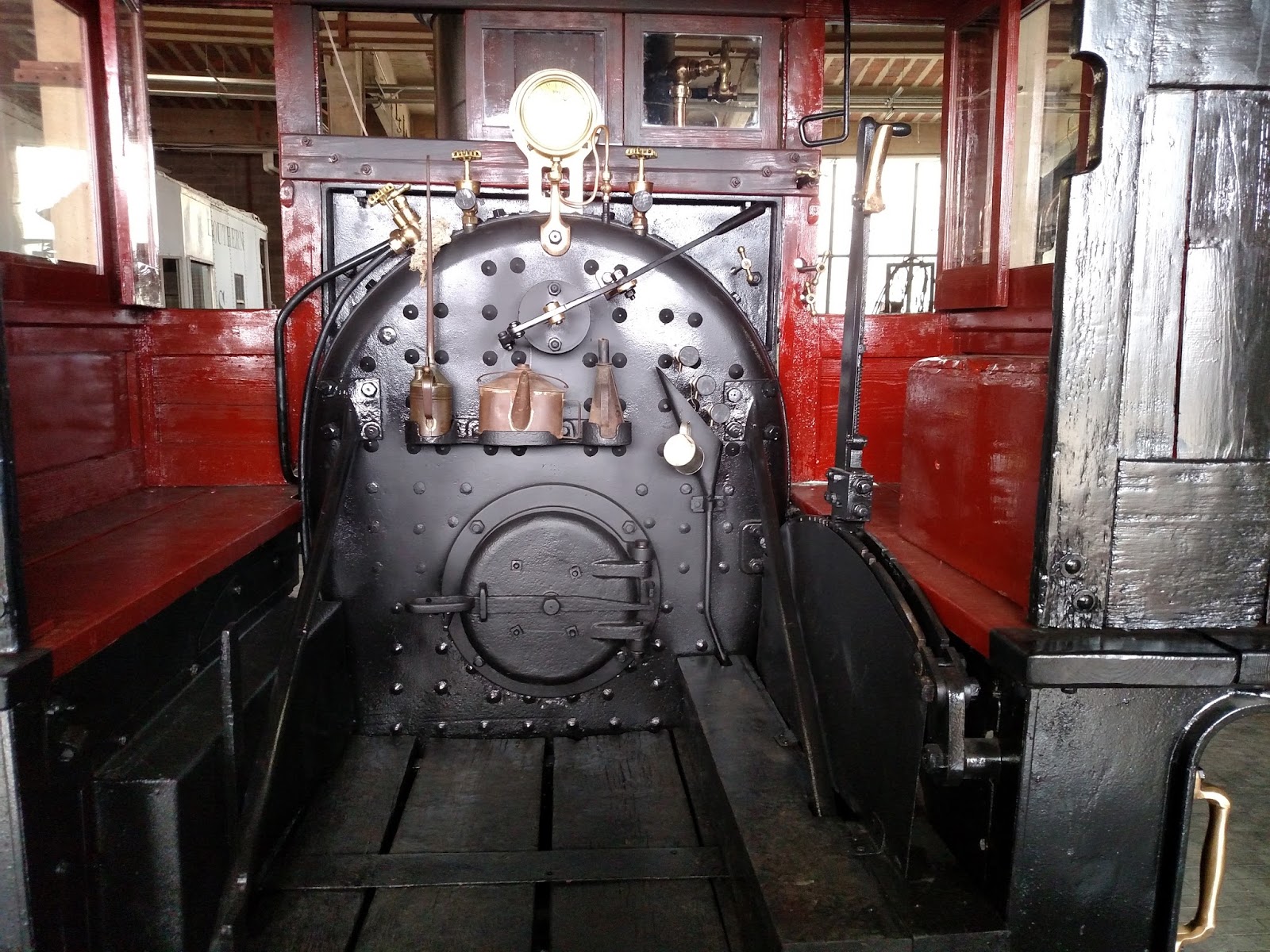
CAB: The roof and portions of the interior are painted in a deep red, which was found in paint samples. The back of the boiler that the crew would be facing is flat back.

SAND DOME/BOX: These carried sand that would be dropped on the track to gain traction to pull the engine forward. A cab lever was used to drop the sand from the dome and down tubes to the rail. Sand was delivered by gravity or a steam blast, depending on the engine design.

Smooth wheels on smooth rails are effective, but the sand helps during slippage.

(Courtesy of AHC)
LETTERING ON TENDER: The crew in Spencer turned to other specialists for some of the work. Sign painter Louis Brady of North Carolina did the lettering. “We based it on old photos of the Joseph E. Brown operated by the W&A,” said Sigler.


WHEELS:
The Texas was a 4-4-0, meaning it had four leading wheels and four powered, larger driving wheels, and no trailing wheels. These were common in the United States before the Civil War. The pilot/leading wheels helped with guiding the train.

Sigler said the Texas was “rode hard and put up wet” when it went out of service more than a century ago. While Kurtz did an extensive restoration, Sigler and Watts had to remove rot and worn parts, especially on the tender.

Jackson McQuigg, vice president of properties for the Atlanta History Center, has emphasized how much of the Texas had been modified or changed out during its half century of service. He notes the discovery of an 1871 stamp on the boiler. While some have wanted the restoration to go back to the presumed Civil War appearance, the AHC said the engine was also important in building Atlanta as a railroad center in the postwar, and they want to tell both stories.

Scott Lindsay, who heads up Steam Operations Corp., said it was a privilege for his team to restore the Texas. Meticulous AHC research and detailed craftsmanship combined for the final product. “Everything is a custom piece. Nothing is off the shelf.”

Thanks to Howard Pousner of the AHC for the photos taken at the North Carolina event.

Friday, April 28, 2017

With the shriek of a whistle, restored locomotive Texas makes its public debut

Jackson McQuigg and Gordon Jones of the AHC give a talk Friday (AHC)

Jackson McQuigg sounded very much like a proud papa as he described the public debut Friday morning of the restored Civil War locomotive Texas.

“It’s beautiful.” “It gives you goose bumps,” he said over the phone from the North Carolina Transportation Museum in Spencer.

The 1856 locomotive – which tooted its whistle -- and tender got the “runway” treatment as a three-day “The Texas Returns” festival began at the museum.

The Texas, which underwent a detailed $500,000 overhaul, makes the trip early next month to the Atlanta History Center, where it will greet visitors taking in the giant Atlanta Cyclorama painting, also being restored.

As reported by the Picket, the locomotive is in a black paint scheme from about 1886, coincidentally the year the Cyclorama debuted. But it does retain some bright coloring. Gold lettering has a raised effect, the Russian iron boiler jacket is blue and the engine has a new smokestack and cowcatcher.

“The engine is honest to is parts,” said McQuigg, vice president of properties for the history center. “The 1936 restoration was great. This was even better.”

AHC officials have stressed the Texas will be interpreted with its complete history, not just its moment in the sun during the April 1862 Great Locomotive Chase.

The Texas is rolled out to the public (AHC)

McQuigg said he is most touched by the restored cab, the boiler jacket and the number plate on front -- No. 12, from the engine's days with the Western & Atlantic Railroad.

He said the museum and restorers were most surprised by how much the engine had changed over time. Basically, the Texas is a collection of parts added over the decades before it went out of service in the early 1900s.

It was saved from the junk heap because of its role in the Great Locomotive Chase, in which Confederates ran down a trainload of Yankee saboteurs. Some were hanged as spies.

The Texas and the painting were housed in Grant Park for decades before the decision was made to restore them and have them displayed at the Atlanta History Center campus in the Buckhead neighborhood.

McQuigg and Gordon Jones, senior military historian and curator with the AHC, are giving talks all weekend in Spencer, detailing the Texas' history as a railroad workhorse and the extensive restoration.

Saturday, April 22, 2017

Just the ticket: Restored locomotive Texas arriving at Atlanta History Center on May 3

(N.C. Transportation Museum)

Fresh from an extensive restoration, a new paint job and some fine detailing, the Civil War locomotive Texas will be placed May 3 in its new home at the Atlanta History Center.

The locomotive famous for the “chase” end of 1862’s “Great Locomotive Chase” will be trucked from the North Carolina Transportation Museum. Craftsmen with Steam Operations Corp. spent more than a year and a half restoring the 1856 machine.

The Texas will be placed in a hallway-gallery that ushers patrons to the Atlanta Cyclorama painting, which is being restored.

The AHC announced the move date in a news release Friday. 

“After many years of limited view in the basement of the Cyclorama building in Grant Park, we are putting the Texas in a place where it is going to be front and center,” said AHC Vice President of Properties Jackson McQuigg. The AHC is in the city’s Buckhead neighborhood.

The Picket has written extensively about the Texas and its restoration, including the decision to put on a black scheme, representative of its importance in the development of Atlanta as a bustling railroad town.

The Western & Atlantic iron workhorse will go on display later this year as work on the massive painting depicting the July 1864 Battle of Atlanta continues.

Locomotive cab during restoration (Picket photo)

The $500,000 restoration included voluminous research as technicians removed extensive rust and blasted the engine with baking soda. A new pilot/cowcatcher, smokestack and boiler jacket were installed. The wooden cab was stripped and repainted.

Gone is the colorful appearance the Texas had since the 1930s.

“Atlanta History Center leaders, believing the Texas has even greater importance as an artifact that speaks eloquently and authentically of Atlanta’s beginnings, decided to return the locomotive to how it appeared in the late 1880s,” the news release said.

The Texas next weekend will get a rousing sendoff at the NC Transportation Museum in Spencer. The April 28-30 event will feature other locomotives. (The Texas is no longer an operating engine)

A few days later, Texas and its restored tender will be driven to Atlanta on separate tractor trailers. They will lifted and placed on the same tracks that held them since 1927 at Grant Park.

Wednesday, January 18, 2017

Paint it black: Restored locomotive Texas' color scheme will symbolize Atlanta's rise after war

(Photo: Max Sigler, Steam Operations Corp.)
The decision has been made: The restored locomotive Texas – made famous in the Great Locomotive Chase during the Civil War – will return to a black paint scheme when it goes on display at its new home in Atlanta.

As the Picket reported in September, officials at the Atlanta History Center have been conducting historical research and analysis on the Texas as it was deciding what era of its history the locomotive should depict. A committee was tasked with making a recommendation.

“How can this engine best educate folks? What story do we want to tell with this engine?” Jackson McQuigg, vice president of properties at the AHC, said at the time.

The AHC said Wednesday that the Texas, built in 1856, will appear as it did “when it was the workhorse of the Western & Atlantic Railroad” from the 1880s and beyond. The locomotive and its tender will be primarily black. Since the 1930s and before the current restoration, the displayed Texas was festooned in places with brighter colors.

Howard Pousner, manager of media relations for the AHC, said some final paint detail decisions will be made soon. The locomotive will include the Western & Atlantic lettering and the name Texas.

"This still is a work in progress. Right now, we’re trying to figure out how to replicate the look of Russian iron for the boiler jacket, for instance," Pousner said. "And historic photos, which of course are black and white, have us leaning toward white lettering. But that’s not a final decision, either. The driver tires are likely to be white as well."

During its Grant Park days
The locomotive, which sat in the former Atlanta Cyclorama building in the Grant Park neighborhood for nearly 90 years, will be moved (along with the painting of the Battle of Atlanta) to the AHC campus in the Buckhead neighborhood.

Officials said they will stress the Texas' role in Atlanta's rise as a transportation hub and its involvement in the Great Locomotive Chase.

Craftsmen with Steam Operations Corp. have been conducting the restoration since December 2015. They have worked out of a large building at the North Carolina Transportation Museum in Spencer.

The transportation museum announced Tuesday that the public will be able to see the restored locomotive during a celebration from April 28-30. The locomotive may be moved to Atlanta in May.

The story of the Texas, which was built in 1856, made the color scheme choice a bit complicated.

Should the restored locomotive have a Civil War appearance? The fact that much of the existing engine is not original, because of the replacement of nearly all of its working parts over time, would it made it extremely difficult to replicate such a look.

Companies such as the Western & Atlantic at that time had a livery of colors that might include bright red, blue, brown, gold and green wheels and accents. During the Civil War, the Texas likely featured many of those colors -- or others.

In April 1862, James Andrews and his band of Union raiders – having captured the locomotive General -- tried to destroy much of the Western & Atlantic Railroad and communications as they rushed northward from Marietta to Chattanooga, Tenn. They were chased by two locomotives, with the Texas running in reverse in the final stretch.

Texas with a different number in 1907 (Atlanta History Center photo)

The raiders achieved little success and eight of the nearly two dozen captured participants, disguised as civilians, were later hanged in Atlanta as spies. Andrews was among them.

The bright-color fad lasted only a few decades. Like thousands of other locomotives, the Texas was converted from burning wood to coal. They didn’t look so fancy when covered in black soot. The Texas was black by 1880, said railroad historian Jim Wilke, and it stayed that way until it ended service in 1907.

The locomotive was saved from the salvage yard and eventually was put on display with the famous painting in a building at Grant Park. The balloon stack and cab, which still has some of its original wood, were painted brown. The wheels and cowcatcher became a bright red. The bands, or belts, around the boiler, the sand dome, some pipes and the valve chests were a dull gold.

As it appeared last summer (Picket photo)

Wilke said he believes artist and historian Wilbur Kurtz did the best he could during the 1930s restoration. Kurtz spoke with people who had memories of the engine, Wilke said. But nuances and precise details may have become lost. Plus, historians have not been able to locate paint schemes for Danforth, Cooke and Company, which manufactured the Texas.

Pousner said officials have not decided what the cowcatcher, or pilot, will look like.

The paint scheme choice is not a total surprise, given AHC officials have touted the Texas’ importance to the commerce of the city after the war.

McQuigg said then that painting the Texas black would be keeping with its appearance for much of its life. “The Civil War is important … but there are other stories as well.”
The locomotive and tender earlier this month (NC Transportation Museum)