A nook overlooking rail line, the large boardroom and depot exterior work this week (Photos courtesy CFNW)
The old
Western & Atlantic train depot has reopened in Dalton, Georgia, as a
community gathering space where philanthropy aimed at solving 21st
century challenges can gain steam in a 170-year-old building integral to the
town’s identity.
The Community Foundation of Northwest Georgia earlier this month moved a mile to a building
that features 25-foot ceilings, charming brick and Civil War-era architectural
features. But make no mistake, this will a very up-to-date environment -- from
modern furniture to TV monitors that will prompt collaboration in today’s
world.
“It’s been
wonderful. It is beautiful office space,” foundation president David Aft told
the Picket in a phone call this week. “It is a really neat place to work, and I
have heard my whole life space has a huge impact on people’s creativity and the
ease to get things done.”
A kitchen will provide refreshments for meetings (Community Foundation of NW Georgia)
The oldest commercial
structure in the northwest Georgia city best known for its carpet industryisstudied by Civil War enthusiasts for its brief part in the“Great Locomotive Chase.”
Federal raiders commandeered a locomotive above Atlanta and raced north, bent
on destroying sections of the railroad. Confederates pursued them through
several cities, including Dalton
Locals tend to think more about the Dalton Depot, a longtime
restaurant and club which operated in the long brick building until about 10
years ago. Trains still roll by regularly.
Aft said visitors and those
attending foundation meetings in the depot appreciate its homage to the
station’s history (it last had passenger service in about 1971) and its
compelling design and architecture.
The foundation’s five
employees are working in an office nearly twice as big as its longtime more
traditional offices across town. They will facilitate meetings in a glass-lined
board room and smaller “collaboration zones.”
A large freight scale (above) and telegraph
window greet visitors in the open center of the depot. The foundation resides
in the south end of the structure.
The depot fell into hard times after the restaurant closed. The city contracted with the Georgia Trust for Historic
Preservation to market the vacant and deteriorated
building. Officials wanted $500,000, but eventually sold it to
local Barrett Properties in 2018 for $300,000.
The community foundation, which is leasing its space,
occupies the former nightclub area. Barrett Properties is still marketing the
other side, which still has remnants of dining booths.
Officials think a new
restaurant might be a good fit.
Working with charitable givers, the nonprofit provides grants
and funding for organizations in the area. Some of the endeavors involve mental
health programs, historic preservation, neighborhood revitalization and other
civic projects.
For now, the foundation is
settling in as improvements to the brick exterior continue. Wood trim is being
replaced and an old awning is coming down. (Above, the point of origin for surveys in Dalton)
He had to get a message through -- quickly
The Western and Atlantic
Railroad line from Atlanta to Chattanooga, Tenn.,
was completed in the early 1850s and the Dalton depot opened in 1852 to provide
passenger and freight service.
The depot was the hub for commercial growth in the Dalton
area and the point of origin for surveys and maps. The 12,100-square-foot brick
building is “a pretty high-style example of Georgia depot architecture” and has
Greek Revival features, with stone lintels, brick pilasters and door
entablatures.
Union raiders on the General set fire to a river crossing in North Georgia (Wikipedia)
The building had its moment of fame on April 12, 1862,
when Northern raiders (the
South labeled them spies) commandeered the locomotive General in Big Shanty.
They chugged toward Chattanooga, intent on destroying parts of the railroad.
Although not all his message got through, Edward Henderson’s
alarm sent troops toward the track. The Andrews Raiders were captured near
Ringgold when the General ran out of steam. They had accomplished little. Many
were hanged while others escaped. Several were the first to receive the Medal
of Honor.
The depot remained in use as a rail stop for more than a
century.
The setting: A comfortable place to convene, create
For Aft (left), the project mixes nostalgia, history and
preservation. Not everyone is interested in each of those aspects, he
acknowledged. But they are interested in community needs that include mental
health programs, food banks, education and other civic projects.
The area’s Latino population has grown considerably while
Whitfield County’s overall population growth has remained stagnant. Housing
affordability and supply are big issues.
The foundation contends it setting needs to be
comfortable, with a good flow that brings people together into the central room
and then into corners featuring some privacy. Large TV monitors are being built
into the space, and PowerPoints and other technology will provide visual
representations of projects.
The hope is for outside groups to eventually
utilize the convening spaces about four times a month. The foundation,
naturally, will hold meetings in the depot the rest of the time. “We understand it will take maybe 12
months to fully activate the space and to get the staff understanding how
others want to use the space,” said Aft.
The
nonprofit’s leader said he has already talked with groups who might choose to
hold meetings at the depot.
The
173-year-old building “has its own peculiarities to it,” said Aft, who quipped
no ghosts have thus far made their presence known.
What is
evident is the appreciation community members for the time and care into making
a charming gathering place.
Aft
summarizes their thoughts: “You made something important to me – you took care
of it.”
Common area (left) and work spaces at Community Foundation of Northwest Georgia
Barnard's fascinating photograph showing Union engineers (Library of Congress)
I’m a fan
of Garry Adelman’s Civil War Page on Facebook. The director
of history and education for the American Battlefield Trust regularly posts
photographs from the collection of the Library of Congress and other sources.
I
love his descriptions of Federal soldiers posing for the camera. Among them:
“Blue-eyed
dandy”
“Jaunty caps”
“Photobomber”
“A dude
checking his iPad”
You get the
idea. But an image he posted on January 4 of soldiers destroying Atlanta
railroad in November 1864 especially got my attention. George Barnard, a
contractor for the U.S. Army, took many photographs of the fallen city after he
arrived two months earlier, but I had never seen this one, for some reason. While
most of these fellas were just standing around, others were engaged in a flurry
of activity before the end of occupation and the commencement of the March to
the Sea.
Labeled “Gen.
Sherman’s men destroying the Railroad, before the evacuation of Atlanta, Ga.”,
the photograph was taken in downtown Atlanta not far from skyscrapers,
Underground Atlanta, Mercedes-Benz Stadium and the former CNN Center. (Detail from Georgia Battlefields Association walking tour map below)
It shows two
groups of men destroying railroad track and machinery, vital to Confederate
transportation in the Deep South. The larger contingent gazes at what appear
to be pipes or boilers. The freight depot for the Western & Atlantic
Railroad is in the background.
Barnard, a pioneer in the field, served as the official
photographer of the Military Division of the Mississippi, led by Maj. Gen.
William T. Sherman. He wasn’t primarily a photojournalist. A number
of his works were reproduced in the illustrated papers of the day, and some
stereographs were sold to a popular market.
On July 28, 1864, Capt. Orlando Poe, Sherman's talented chief
engineer, wired Barnard (right), who was in Tennessee: "Hold yourself in readiness
to take the field if telegraphed to that effect." A few days after Atlanta
fell, on September 4, Poe telegraphed Barnard to join him, shortly after Hood’s
Confederate troops, cut off from supplies, abandoned the city.
The Atlanta of the Civil War was a boom town, just beginning
to acquire the muscle and mettle that one day would make it the behemoth of the
South. In 1860, on the war’s eve, it had fewer than 10,000 residents, making it
the fourth-largest city in Georgia, behind Savannah, Augusta and Columbus.
With its nexus of four railroad lines, Atlanta quickly showed
its importance to the Confederacy and Federal forces who finally reached its
outer fortifications in July 1864. The city quickly descended into chaos as Rebel
troops were moved around and supply lines threatened.
Davis, author of several books on the Atlanta Campaign,
including “What the Yankees Did to Us: Sherman’s Bombardment and
Wrecking of Atlanta,” has written extensively about Barnard’s
documentation of the Union conquest of Atlanta, with scores of scenes showing
destruction, fortifications, a slave mart and Sherman himself.
In the volume “100 Significant Civil War Photographs: Atlanta Campaign,” Davis (left) said Sherman and Poe wanted their troops to destroy only
manufacturing and railroading capacity, which was concentrated in the downtown
business district. Federal soldiers, Davis wrote, started their own fires as
early as Nov. 11, 1864.
“We are fritened (sic) almost to death last night,” young Atlanta diarist Carrie Berry wrote. “Some mean soldiers set several houses on
fire in different parts of the town.”
Barnard ranks among the top echelon of Civil War photographers – Gardner, O’Sullivan, Cook, Rees, Reekie, Gibson and Brady.
The three photographs
I will be discussing here – showing destruction of the city’s railroad
infrastructure – were taken by Barnard in mid-November 1864. They likely were
taken within a short time of each other, and may include some of the same
troops.
What’s
going on in this picture?
It’s hard to
get a consensus because there were few detailed photo captions in those days and it’s
just plain difficult to know for sure, given several pieces of iron or steel
jammed together.
Poe, in his
set of images, wrote of this one: “View in Atlanta just before the ‘March
to the Sea’; showing manner of destroying Railroads and Machines.”
Jackson
McQuigg, vice president of properties for the Atlanta History Center, which
houses the giant Cyclorama painting and Civil War exhibits, said he thinks the largest
item in the foreground is a stationary steam engine (used for power
generation).
“The boiler is at right, while the stack is flopped over and laying on its side on top of
the engine itself,” he writes. “Even though the caption said that Sherman’s men
are destroying ‘the railroad’ I see rails at left … it sure looks like that’s
mostly pipe on the ground in the front. Maybe those were locomotive boiler
flues?”
Charlie
Crawford, president emeritus of the Georgia Battlefields Association, theorizes
the foreground may depict a boiler on the right and a detached exhaust chimney
(long tube) lying on a flat car.
“It could be
an exhaust chimney for any piece of machinery that creates heat by using
controlled flame,” he wrote. “The boiler is the item on the right of the flat
car. It still has an end cap, unlike the hollow tube. Could well be that
the exhaust chimney was paired with the boiler before the machinery was
disassembled.”
Commenters on
Adelman’s Facebook added these guesses:
The
‘toolbox’ looks to be a toolbox on top of a steam piston from a locomotive. A
boiler appears to be behind the smokestack and toolbox.....and there appears to
be steam pipe fittings on the platform as well.....possibly a disassembled
locomotive.
What
it is resting on to the right of the picture appears to be a steam engine
cylinder and valve box.
As for the
rest of the photo -- the men toward the back?
Michael Rose, curator of decorative arts and special
collections at the Atlanta History Center, said the smoke emanating from the
back half of the photo (above) are three fire pits built to heat the rails. The idea
was to warp and bend the rails and render them useless.
“I suspect the men are waiting for the
heat to do its job so they can do theirs before moving on to more,” Adelman wrote
in his Facebook post.
Later in this post, I examine two more destruction photos.
What exactly is that writing on the iron?
Zoom in on the flat car or platform and you will see a
horizontal piece of iron with writing. It’s tough to make out (and for me to brighten) but here are some posts from commenters on the Adelman Facebook post.
"Laimbeer
& Co. Atlantic Dock, Brooklyn, NY, 1855" which was one of the main
warehouse companies located at Atlantic Dock.
“ATLANTIC
DOCK BROOKLN NY 1855”
Rose said he can make out Brooklyn, N.Y.
“But not what
comes before it, undoubtedly the manufacturer’s name. It does look like it
includes “Atlantic” – but not in a way that look like Western & Atlantic
R.R.”
Who are these soldiers?
According to Steve Davis, Sherman initially assigned three
regiments of the provost guard to oversee the destruction: The 111th
Pennsylvania, 2nd Massachusetts and the 33rd
Massachusetts.
Their task to destroy track, the roundhouse, depots, the
railroad car shed and more, said Gordon Jones, senior military historian and curator at the Atlanta History Center.
The general changed his mind and brought in professionals --
Poe’s 1st Michigan Engineers and Mechanics and the 1st
Missouri Engineers – to carry out the work. The 58th Indiana also
pitched in, according to Crawford.
Poe (right), chief engineer of the Military Division of the
Mississippi, supervised demolition of the main passenger depot in downtown
Atlanta and many other buildings. He is remembered as a visionary engineer, for
both military and civilian service.
In his memoirs, Sherman wrote of “Poe’s special
task of destruction.”
Not only did Poe carry out the order to burn
Atlanta in 1864, he built the roads and bridges that made Sherman’s March to
the Sea possible, according to the National Park Service. “At the end of the
war, he was named brevet brigadier general. Since no system of medals existed
at the time, the brevet rank, meaningless in terms of real authority, served to
recognize gallant conduct or other meritorious service.”
Where
was the photograph taken?
Downtown
Atlanta was an extremely busy hub for railroads serving the city and much of
the South. The photograph was taken fairly close to the juncture of the Western &
Atlantic and Macon & Western railroads.
GBA map of downtown; W&A depot is shown at far left (Click to enlarge)
“In the background
is the W&A RR depot,” says Crawford. "Depot site would now be just west of
Ted Turner Drive and just northeast of “The Gulch.” Photo was taken from
WNW of the depot, about where CNN Center used to be.”
The W&A
roundhouse would be to the left, outside the image, said Rose.
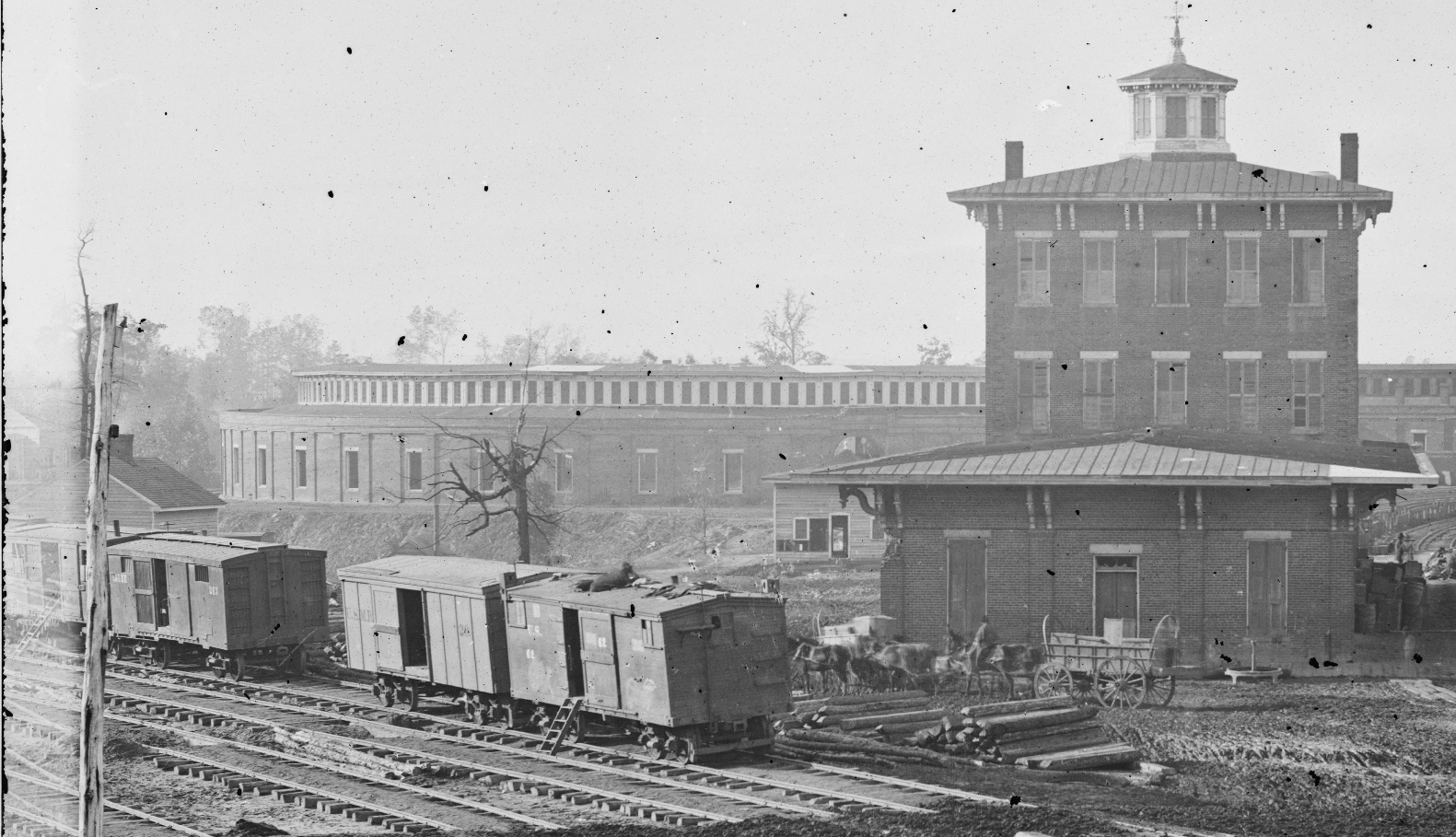
The Barnard
photo below -- taken before its destruction by Yankee troops -- shows a different angle of the depot, this time with a large roundhouse in the background. The facility was used for servicing locomotives. (Photo: Library of Congress)
Barnard, of
course, wanted to make money from his work. Anthony & Co. published several of his photos. A December 2014
article in the newsletter for the Center for Civil War Photography featured
the photo of the machinery among others depicting destruction in the city.
“As Yankee
engineers proceed with their destructive work, smoke drifts past the ruins of a
destroyed building in this original Anthony stereo view. Indeed, there was
plenty to dread as night fell on Nov. 15, wrote John Kelley and Bob Zeller. “It
was, (Maj. Henry) Hitchcock wrote, “the grandest and most awful scene.”
When
was the photograph taken?
Regarding the
shot of the men standing around the metal pieces, Steve Davis believes it was taken
around Nov. 10-11, days before much of the city was torched.
Keith Davis (left),
a leading expert on Barnard, told the Picket the photos of soldiers
destroying railroad were likely taken on both Nov. 14 and 15. Sherman’s troops
began leaving the city before noon on the 15th to begin the march to
Savannah, Ga.
“On the following morning, the general staff, Barnard, and the remainder of the Union
forces marched out of the shattered city,” Davis wrote in a book about Barnard.
“So, I have to think that Barnard was extremely active
on Nov. 15; thus, making
it correct to date these as Nov. 14-15,
rather than strictly the 14th,” he told the Picket.
Crawford doesn’t
believe the photographs could have been taken Nov. 15.
“We can date these photos because they depict activity,
and we know the car shed and rail lines were destroyed on 14November. Since the armies left town
on 15 November,
the photos must have been taken on the 14th. Barnard may have
taken images as the armies were leaving, but the destruction was completed on
the 14th."
The one major
gap in Barnard’s Atlanta photography is that no images exist showing the vast
panorama of destruction after the fires of Nov. 15 and 16, according Kelley and
Zeller in the “Battlefield Photography” newsletter.
What about the two other soldier photos?
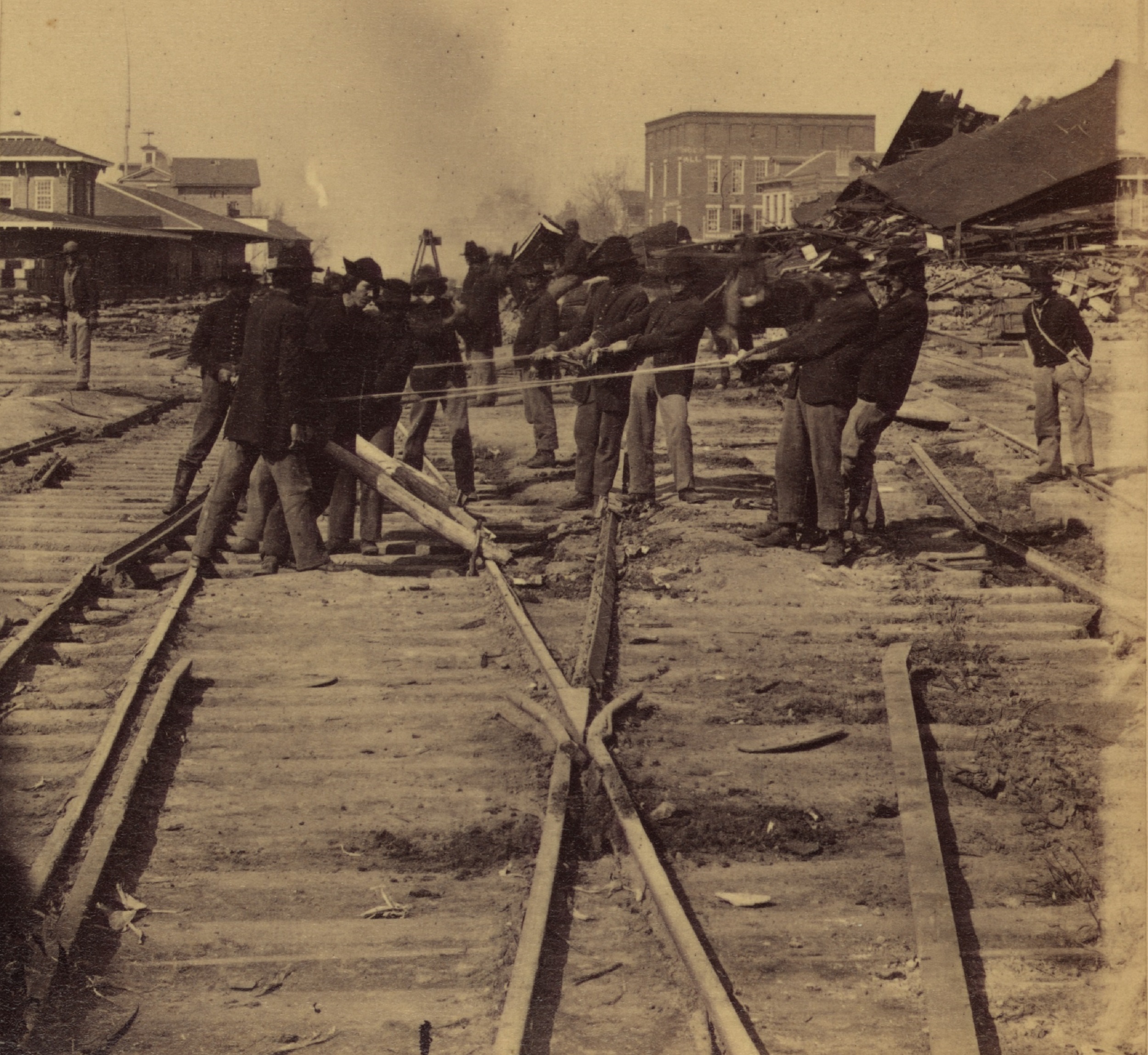
Union engineers destroying track; Western & Atlantic depot behind (Barnard, Library of Congress)
You probably are familiar with two more photographs
showing groups of men heating and damaging rail so that the South cannot
quickly get the trains running again after the Federal army ends its two-month
occupation of Atlanta.
The first photograph described here was taken very
close to the main image we have been discussing. Barnard must have moved his
camera forward. If you look closely, you can see the men working amid iron
rail, wooden ties and other infrastructure.
The photograph with all the machinery shows a
particularly tall soldier. I am trying to place him in this photo, and I
wonder if he is the man wearing a hat with a round crown, his face not visible to
the camera. But the hats don’t exactly match. I welcome guesses from anyone
reading this. These men are believed to be from the 1st Michigan and
1st Missouri engineers.
The second photograph, a vintage original stereo view, depicts men heating
track near the destroyed car shed, about 700 yards east-southeast from the
machinery shot.
Sherman's men do their work; behind right are remnants of car shed (Barnard, Library of Congress)
Union troops used large iron bolts and others items to knock down the arch supports before setting fire to the remains. This was a
devastating loss for Atlanta. The car shed was a cooperative venture of the
four railroads that served the Georgia city and the Confederacy. The
station had been a fixture for about 10 years.
This scene is mostly covered today by the Central Avenue overpass downtown. Smoke from burning
railroad ties rises in the background, according to Kelley and Zeller, who date
the photograph to Nov. 15. The view is to the west, said Crawford. (Below is a photo of the car shed before its destruction)
“This has
been a dreadful day,” Carrie Berry wrote on Nov. 15. “Things have been burning all
around us. We dread to night because we do not know what moment that they will
burn the last house before they stop.” (Her journal is at the Atlanta History Center)
Modern view (below) is above where car shed was built (Library of Congress and Georgia Battlefields Association)
Those who
visit downtown, especially around Underground Atlanta, will notice many street
levels have changed in the past century.
“Present day photos are difficult because construction of
the viaduct system in the 1920s put the roads 20 to 30 feet higher than the
terrain shown in the 1864 photos,” said Crawford. “You can still look down from
a few vantage points onto the existing freight line and the two MARTA tracks
that occupy some of the space that the multiple rail lines once traversed.”
You can get an idea of the modern landscape from the photo (above) of Lot R parking area that is above where the car shed was formerly.
Sharing blame for all that destruction
Let’s briefly step back for a little background on what’s been termed in folklore as the Burning of Atlanta. About 40 percent of the city was in ruins when Sherman began his March to the Sea. But don’t lay all the blame solely at his feet.
“It started when Confederate military planners stripped and leveled buildings and homes on the city’s outskirts to build the extensive fortifications that Sherman found impenetrable,” reads an online presentation, “War in Our Backyards,” produced by The Atlanta Journal-Constitution and the Atlanta History Center for the 2014 Civil War Atlanta centennial.
Hood's troops blew up ammunition train before leaving (Barnard, Fleischer's Auctions)
“During the summer siege, Union artillery fire hit many of the city’s major structures, setting many afire. Miles of trenches dug by both sides scarred fields and roads. When the Confederates made their retreat, they blew up their ammunition train, damaging scores of homes, and burned the massive Atlanta Machine Works factory,” the AJC said.
Looters, arsonists and the need for material for Union forts took their toll until November 1864, when Sherman “ordered the destruction and burning of all facilities with potential military value, including ripping up rail lines and destroying Atlanta’s transportation infrastructure.” He ordered out the remaining civil population, who were offered a one-way train ride either north or south.
Steve Davis has written about how the fires spread to residences, and some Union soldiers decided to start some residential blazes of their own.
You can see sites in March walking tours
Sadly, virtually nothing from wartime downtown Atlanta
remains today and only a guided tour and some imagination can provide an
adequate picture.
Crawford
has led the GBA walking tour for 18 years. I went on a version in 2014 with
former The Atlanta Journal-Constitution editor Scott Peacocke in July 2014. I
enjoyed it and wrote about the experience here. “It rained buckets,” Crawford reminded me.
Scott Peacocke, Charlie Crawford and Mary-Elizabeth Ellard in 2014 (Picket photo)
Crawford
works from a downtown then-and-now map and a PowerPoint presentation with
Barnard photos. The slides include pointers and basic information. He then
takes participants around the area to see the “now” view to correspond to the
old images.
“It’s always
fun to hear people say that they had seen some of Barnard’s photos and
always wondered where they were taken,” he said.
Particularly
popular are references to the book and movie “Gone With the Wind", including a
scene in which Scarlett O’Hara approaches the car shed, which
had been turned into a receiving hospital under care of Dr. Meade.
She walks
through the expanse created by multiple rail lines, and hundreds of injured Confederate soldiers,
some on stretchers, some on the red soil or tracks, writhe in agony or lie
motionless. It is a powerful scene, punctuated by a tattered Rebel battle flag.
Crawford said
he gets a variety of reactions and questions during his tours.
“Discovering
that not all of Atlanta was destroyed is difficult for some to accept. Seeing
that the state Capitol is now on the former City Hall site seems to give most
people something they can surprise their family with.”
----
Georgia
Battlefields Association will again lead free Phoenix Flies tours GBA of Civil
War downtown Atlanta. Participants must preregister for the March 8 and 22
walks, which take about 2 hours and 45 minutes. The tours are limited to 25
people. Click here for more information. Registration for Phoenix Flies begins
Feb. 21.
Rendering of changes to the exterior to better match original appearance (Montgomery & Peeples, Dalton)
A long-closed
Western & Atlantic railroad depot that played a part in the Civil War’s “Great Locomotive Chase” is
being reborn in a way that reaffirms its importance as a community gathering
place in Dalton, Ga.
A
philanthropic organization and developer are nearly midway through the restoration of the
oldest commercial structure in the northwest Georgia city best known for its
carpet industry. The goal is to have a unique setting where ideas and dreams
for the public good can gain steam.
David Aft,
foundation president, told the Picket the reopened 1852 depot also will
buttress revitalization in downtown Dalton. Officials want locals to spend
their dollars there rather than nearby Chattanooga, Tenn., and to enjoy the
Burr Performing Arts Park, among other venues.
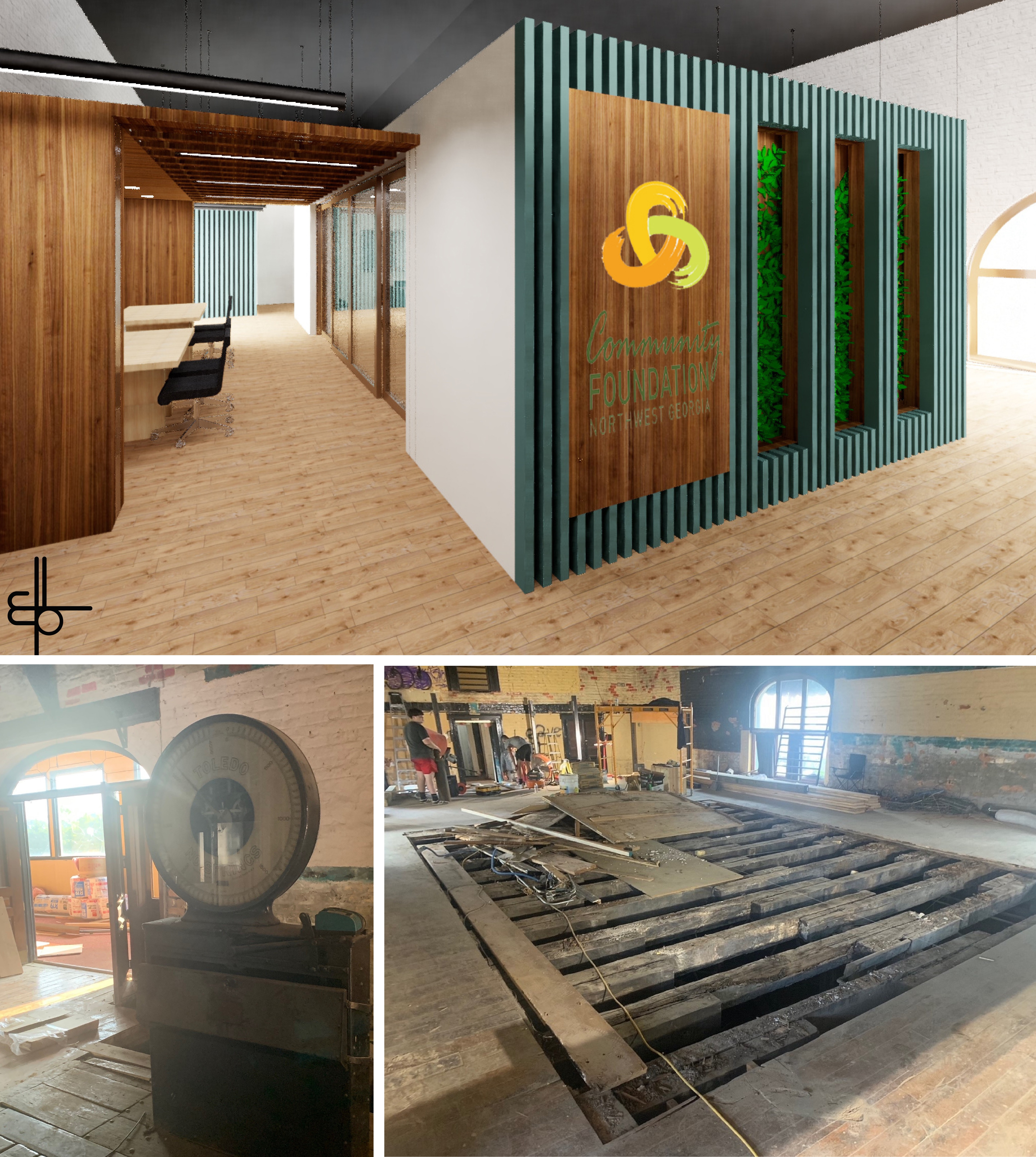
Glass-walled conference room, the old freight scale and floor work showing old timbers (Montgomery & Peeples rendering and David Aft photos)
“Working to renovate a building mothballed for 10 years is
part of that, to bring life into old facilities.” The depot, he said, was the
hub for commercial growth and the point of origination for surveys and maps in
the 19th century.
The
resilient depot has had some hard times since its heyday. A 1977 nomination form for the National
Register of Historic Places said Dalton citizens were aware of its value but “concerned
about the deterioration of the building.” At that time, it was being leased to
a railroad.
The
depot housed a tavern for about 25 years, but officials closed the building in
late 2015, citing conditions that “posed potential health hazards to the
public,” including mold, according to the Daily Citizen-News
newspaper.
The Western & Atlantic depot back when it was boarded up (Georgia Trust for Historic Preservation)
The brick building sat empty for nearly a decade. Now,
workers are on site, making repairs and modernizing the space to create an
open, welcoming environment.
“I’m excited
to see downtown Dalton continue to blossom, and to see the Dalton Depot once
again be a hub in downtown Dalton,” said Mayor Annalee Sams.
Andrews Raiders plowed through Dalton
The Western and Atlantic Railroad line from Atlanta to Chattanooga was completed in the
early 1850s and the Dalton depot opened in 1852 to provide passenger and
freight service.
The building had its moment of fame on April 12, 1862, when
Northern raiders who had commandeered the locomotive General in Big Shanty,
above Atlanta, were chugging toward Chattanooga, intent on destroying parts of
the railroad.
Union raiders on the General set a fire at a river crossing in Georgia (Wikipedia)
Although not all his message got through, Edward Henderson’s
alarm sent troops toward the track. The Andrews Raiders were captured near
Ringgold when the General ran out of steam. They had accomplished little.
According
to the National Registration nomination form, “the depot might have been
partially destroyed when Union troops entered Dalton and set fire to several
buildings in 1862. It appears that the essential structure of the depot was not
damaged and the restoration was confined to roof and interior repair. Since the
ornamental brackets are stylistically later than the date of the rest of the
building, it is likely that they replaced others lost in the destruction.”
The
12,100-square-foot brick building is “a pretty high-style example of Georgia
depot architecture” and has Greek Revival features. It features stone lintels,
brick pilasters and door entablatures.
The old ticket counter is among the surviving features (Georgia Trust for Historic Preservation)
Safeguarding depot's historic features a priority
A February
news release on the project said “Barrett Properties will be giving careful
consideration to the preservation of historical elements that pay homage to an
era’s character while innovative additions will infuse a modern and dynamic
flair.”
The
city years ago contracted with the Georgia Trust for Historic
Preservation to market the building. Officials wanted $500,000, but
eventually sold it to Barrett Properties in 2018 for $300,000. At that time, Barrett said the area would be suitable for another restaurant/bar and perhaps a small museum.
The city required bidders to submit a written preservation
plan and abide by a signed rehabilitation agreement.
Work crews have been on the site since spring (David Aft photo)
The trust's primary goal
was seeing that historic features in the building are saved. The depot’s
southern end retains features interior ticket windows, a freight scale and
other rail service features.
The
foundation has a 20-year lease with Barrett Properties, said Aft, who answered Picket questions on
behalf of his group and the developer.
What the foundation does with charitable gifts
The five
employees of the Community Foundation of Northwest Georgia, working with
charitable givers, provide grants and funding for organizations in the area.
Some of the endeavors involve mental health programs, historic preservation,
neighborhood revitalization and other civic projects.
Undated photo and another from 1922 (Courtesy of the Bandy Heritage Center for Northwest Georgia)
Some grants come
in the form of endowments, financial funds and scholarships to nonprofit groups
or individuals. The organization oversees more than $90 million in charitable
assets, said Aft.
The main
economic engine for Dalton and Whitfield County is the carpet industry, while
diversification has yielded a solar panel factory and supply chains for auto
manufacturing.
“We are one of the country’s last bastions of manufacturing,”
said Aft.
The area’s
Latino population has grown considerably. Housing affordability is a big issue,
compounded by the dearth of available land because of mountainous terrain, said
Aft, indicating nearby counties have made strides. The Greater Dalton Chamber of Commerce is working toward increasing residential units, including hundreds
of apartments, he added.
Depot and other downtown buildings in 1932 (Courtesy of the Bandy Heritage Center for Northwest Georgia)
The
foundation currently works from the top floor of a building about a mile from
the depot.
“We have kind of outgrown our space,” said Aft, indicating
the foundation needs a larger facility in which to meet with donors and working
groups and to conduct strategy sessions. “When you have 20 people in for a
workshop, we don’t have great bathrooms.”
New office will mix the old and the new
Aft touts the new space as ideal for meetings -- by mixing
the depot’s historic architectural features and modern office design.
“The most significant feature is a room built within that
space. It will have an ability to open its glass side walls into a bigger
convening space,” he said. The office includes other meeting areas and work
nooks. (Rendering at left by Montgomery & Peeples)
The foundation is moving into what once was a nightclub area
of the depot. “There was a lot of live music. People used it for event space.” The other half was a restaurant.
Photos from the current work show wear and tear, including
some graffiti on the walls.
“The entirety of the super structure and brick work is
original. Much of the underpinning foundation is original,” said Aft, adding the
current budget for the work is below $1 million.
(Barrett Properties is still marketing the other half of the
building, perhaps for offices, event space or a restaurant.)
While the interior is receiving an overhaul and plumbing and
heating and air are being modernized, work has not yet began on the exterior,
which will have a few modifications to provide its original look.
Barrett Properties sent out samples of the brick mortar to
use the right type while fixing damage created by wear and passing trains. Much
of the brick has been repointed.
Three cornices need to be rebuilt. “It will look more like
from the photographs of 50 years ago then now,” said Aft. (See collection of depot photos here)
The finished product will pay homage to the “Great Locomotive
Chase” in some form, perhaps through markers.
“We understand the valuable piece of real estate we are part
of,” said Aft.
(At right, David Aft photo of foundation, including old timber)