Showing posts with label burn. Show all posts

Sunday, August 16, 2026

History investigators: College class is focusing on the stories of the enslaved people at Dawkins House in Union, S.C. The home to where the state's Civil War governor fled is being preserved

Shored-up house (Annie Smith/USC Union), 1850 Dawkins slave schedule; interior door (Picket photo)
A course that debuted Aug. 18 at the University of South Carolina Union won’t be like the campus classes I attended back in the day. There will be no lecture hall, study sessions or a professor regurgitating set material.

Rather, “HIST 480-701 -- Internship in Public History” will turn students into investigators, digging up little-known facts about the Thomas and Mary Poulton Dawkins House in Union and the people – free and enslaved – who lived there before, during and after the Civil War.

The timing of the class is perfect. The once dilapidated home is slowly being rehabilitated into a new campus facility.

“Everything we are doing is bottom up,” said Andrew Kettler, assistant professor of history at the two-year campus (right). He will work with a small, but he believes mighty, group. So far, three students have signed up for the assignment, which includes building an archival history.

Kettler hopes a few students more will join the inaugural effort. He expects a bigger class in the spring once the work and documentation takes shape.

Union, which is south of Spartanburg, briefly served as the Civil War capital of the state after Columbia fell to Union forces in 1865 and Gov. Andrew Magrath fled to Union. From about Feb. 15, 1865, until early April, Magrath ran the state from the Dawkins House. He apparently worked in an informal library near the drawing room, which survives today.

According to histories and local legend, Magrath and his subordinates burned possibly incriminating documents and correspondence in the home’s fireplaces. (The building served as South Carolina's capitol while the city was briefly is capital.)

The 1850 federal slave schedule indicates Thomas Dawkins (left) enslaved about 20 persons, but there may have been more elsewhere. Some likely worked at other locations besides the home, which was called “The Shrubs.” (The project has not yet found an 1860 slave schedule)

Over the years, residents came and went from the Dawkins House, which is located on the small USC-Union campus. But there had been one constant: The deterioration of the building into near ruin.

Now the nonprofit Preservation South Carolina is working with the campus and local leaders to rehabilitate the house into an alumni and corporate center for the college. Raising money for the effort has taken time, but officials continue to make progress.

“This is the first time for PSC to have a class that is going on at the same time as one of its preservation projects,” said Kettler.

There’s a lot at stake. Supporters say it’s important the full history of the home and its occupants be told, warts and all. But they also want the building to be aimed at the future and bring new attention to USC Union, which has a growing enrollment. Currently, it has about 1,400 students; many are affiliated with the athletics programs.

Union County has a long segregation history and the area was known for Ku Klux Klan activity and postwar lynchings. There have been recent efforts, however, to acknowledge that history. Kettler said there is much more to learn.

2021 markers details part of the county's lynching history (Picket photo)
Annie Smith, director of development on the campus, said the course also will seek to identify those individuals who lived in the original structure between 1765 and the early 1800s, before Thomas Dawkins bought and expanded the residence.

The class research will include library, courthouse and genealogical records. Kettler previously told the Picket the aim is less about assigning blame for slavery than moving toward acknowledgement and reconciliation

“We don’t know what we are going to find. It just has to be an honest investigation,” said the professor, who showed the students the outside of the home after the class began.

So far, they have possible names for 2 enslaved

A large focus of the class is finding out about the enslaved persons, most of whose names are not know. Names were not included in old census records.

“Focusing searches on that specific population will also allow for uncovering connections to the later history of Black citizens in Union County,” says the class syllabus.

Kettler (right, Picket photo) and a couple students conducted some research over the summer, including at the South Caroliniana Library at the main University of South Carolina campus in Columbia. “We’re digging constantly,” he said.

Kettler, 42, said they have learned the possible names of two of the enslaved. He is not identifying them at this point until he can confirm accounts. One was mentioned in a postwar newspaper article saying the bride was a Dawkins servant (slave). The second may have been a lynching victim in the 1870s, said the professor.

He expects students will glean more names from county-by-county agricultural censuses.

“Tracing formerly enslaved people is very difficult because of name changes,” said Kettler. Others may have moved north decades later during the Great Migration.

The students, working like detectives, will dig up records from myriad sources, such as death schedules and wills. If they can find a Dawkins will, it may list enslaved persons and what they may have received upon Thomas’s death. That could help the effort to find out more about those individuals.

College hopes for an archives open to the public

The public history course outline includes this overview:

“Students will be engaging with archival documents to gain respect for the application and relevance of historical knowledge, as well as support the broader goals of the university and its environs. With the work in this course, USC Union students can begin to explore documents that are to be organized into a “Dawkins House Archive” that will be housed at the future Alumni and Corporate Sponsor Center in the Dawkins House. Our focus on the course will be on answering: What were the historical experiences of those who resided at the Dawkins House?”

Kettler envisions binders of documents at a location ”where people can see the actual letters.” (At left, part of 1867 correspondence by Thomas Dawkins)

Students will share extensive readings during the semester. Topics will include the Dawkins House, memory, the antebellum period, slavery, Reconstruction, “historic sites as powerful institutions,” contemporary Union and modern public history.

The class is half education on the topic and half working through the methods of public history. Students will analyze documents, said the professor. “They will do the work of the historian.”

Resources include census records, newspapers, the Union Country Museum, Rose Hill Plantation State Historic Site, diaries and other papers. Kettler wants to see if the county clerk has deeds to property owned Thomas Dawkins. That might help the researchers go back to those who lived in the house way back in 1765.

One goal of the endeavor is to get local folks involved in uncovering the area’s history and make the Dawkins House a destination of sorts. Kettler, who believes a book may result from the project, is available to speak to groups about the Dawkins House as part of South Carolina Humanities’ speaker’s bureau.

For white citizens, a world turned upside down

When it comes to the Civil War period, recorded experiences have almost exclusively been of white people.

Mary Poulton Dawkins was many things in her 86 years, the majority of which were ensconced in the home that was dubbed “The Shrubs” in honor of a family estate by the same name in her native England.

Dawkins (right), who in 1845 married Thomas, a prominent South Carolina judge 14 years her senior, was described by relatives as headstrong and proud of her imported furniture and Queen Victoria.

There was another side of the Englishwoman, however, that doesn’t project well these days.

While of the “highest culture,” Mary had a tendency toward bigotry, an observer wrote, and a paternalistic view of slavery.

Enslaved people had become a majority in Union County during the 1840s.

Following the South’s loss in the Civil War, and the Dawkins’ fortune largely gone, Mary lamented Reconstruction and the brief political power accorded to Black people.

“The negroes on the plantation had really no ill feeling, but poor ignorant creatures, they were intoxicated with the idea of power and always fond of idleness; began to steal and destroy property, scarcely a night without a burning,” Mary wrote in a memoir penned late in life. “There was no redress, no law, and the ‘Ku Klux’ was formed to frighten the negroes, so sensational, supersti­tious.”

Kettler said Thomas Dawkins lived in a world based on the idea the patriarch is nearly above the law on his own property, a theme popular on Southern plantations.

“Dawkins basically had one square mile that defined his life.There are four large Southern homes within a few blocks of the Dawkins House, one we date to 1850 and another to 1857. Those would have been his direct neighbors less than a mile away, he said. 

”A half mile up the road is the church he paid to build. And just up Main Street would have been the courthouse where he practiced as a lawyer and then a judge. (At left, Episcopal Church of the Nativity, Wikipedia).

“This was a figure who exemplified the Southern ideal of Pater Familias, and used Greco-Roman architecture to signify that in a Greek Revival-esque home,” the professor added.

Group is raising more money for work on house

Some 120 years after Mary’s death, Preservation South Carolina is raising money for the next phase of the restoration of the residence.

Bill Comer, a Union native who is heading up the DawkinsHouse rehab project for PSC, previously said the refurbished site will provide lessons from the past once it reopens.

Early rendering of what the house will look like when completed (PSC)
The $300,000 state-funded Phase 1 of the work, which concluded more than a year ago, shored up the building. Phase 2 will be much more extensive and expensive.

PSC said they need at least $845,000 for the next phase of work. About $284,000 has been raised or been committed, including a $100,000 award from the Timken Foundation and a $25,000 grant from the SC Department of Archives and History, said Comer.

Donations to the project can be made here.

“We hope to finalize other significant funding arrangements within the next several weeks. Fundraising efforts will be ongoing until the house is fully renovated and ready for use,” Comer said in an email.

It is anticipated Bennett Preservation Engineering of Charleston will begin updating and preparing design specifications for Phase 2 in early October and that construction will begin in January 2027. “Phase 2 will take the building well beyond stabilization to the point that it is ready to accommodate the Final Phase of mechanical, electrical and plumbing construction,” Comer said.

USC Union offers associate degrees in arts and science and a bachelor's in nursing
After that, the house will be owned by the Union Laurens Commission for Higher Education.

“PSC will continue to work collaboratively with USC Union and the commission via a memorandum of understanding to help secure funding and to provide historical preservation counsel until it is completely finished,” Comer added.

Juggling myths and the real stories

The Dawkins House rehabilitation and the university course are coming at a fortuitous time in South Carolina.

Gov. Henry McMaster has championed commemoration, including the state’s importance in the American Revolution. That awareness includes the complex history of slavery and its legacy, said Kettler.

“The base of the Freedmen’s Bureau was in Beaufort, South Carolina,” he said, arguing that’s where emancipation really began.

There are a lot of stories about the Dawkins House, he argued. “School kids know about the myth of McGrath’s silver.”

Upon learning of Rebel Gen. Robert E. Lee's surrender at Appomattox in early April 1865, Magrath and his staff raced away from Union as Maj. Gen. William Tecumseh Sherman's Federal troops moved in. 

Magrath apparently hid a silver tea set at the Dawkins' home while he was based there. Mary Dawkins wrote the couple took the set to Mills House in Charleston after Magrath was released and they gave it to him.

The silver tea set story is covered in the book "South Carolina's English Lady," compiled and edited by the late Sarah Porter Carroll in the 1980s. You can read the text on Family Search (right).

Letters and accounts written by relatives of Mary Dawkins -- and included in Carroll's book -- suggest slaves at “The Shrubs” and any other land owned by Thomas were treated more kindly than at other plantations. But that view belies the fact the institution was inherently cruel and violent.

For Kettler and students, this will be in intense exercise in public history, a movement that marries academic with engagement in the community.

Kettler hopes uncovering the history of the house and 19th century Union will better inform the community of its rich, complex history.

There is a  “mythic, shrouded history we are going to uncover.”

READ MORE:

https://civil-war-picket.blogspot.com/2026/04/as-fundraising-intensifies-to-fix-up.html

https://civil-war-picket.blogspot.com/2026/01/scs-civil-war-governor-slept-and-likely.html

https://civil-war-picket.blogspot.com/2025/09/craftsman-has-window-to-history-of-home.html

https://civil-war-picket.blogspot.com/2025/02/s-carolinas-governor-fled-to-this-house.html

https://civil-war-picket.blogspot.com/2024/07/south-carolina-community-gets-into-game.html

Friday, September 5, 2025

Craftsman has a window to the history of a home where South Carolina's governor fled to avoid Yankees. Robert Schmitt is working on its windows while the Dawkins House in Union awaits more funding for restoration, campus use

Robert Schmitt at work on windows and sashes (provided photo), McMillan Pazdan Smith Architecture rendering of completed alumni house; how the weathered Dawkins dwelling looks today (Preservation South Carolina)
Robert Schmitt appreciates the craftsmanship and materials that went into mid-19th century homes across the Piedmont region of South Carolina. For years, as a restoration expert, he’s rolled up his sleeves and touched the results of what workers created generations ago.

Schmitt, 74, sank a lot of money, passion and knowledge into restoring the stately Nathaniel Gist Jr. house outside of Union (Gist was first cousin of Confederate Brig. Gen. States Rights Gist).

Now Schmitt is helping repair windows at Union’s Dawkins House, a residence at the center of an interesting chapter in Civil War history. Union briefly served as the capital of the state after Columbia fell to Union forces in 1865.

The nonprofit Preservation South Carolina is working with partners to restore the dilapidated dwelling into an alumni and corporate events center for the University of South Carolina-Union.

Schmitt is removing old glazing and replacing any rot (Preservation South Carolina)
Schmitt is taking out old window glass, removing rot and replacing weathered glazing.

“These old windows were put together with mortise and pins and wooden pegs. That makes them reasonably easy to work on,” he said in a recent interview. “I like to preserve as much as the original as I can.”

Not surprisingly, the windows are much more substantial than modern ones.

“Part of that reason is the material they were made of. You can’t get that type of lumber anymore,” said Schmitt, adding the old yellow pine was heavy because of high rosin content.

Schmitt is working in the house’s yard in a “between” stage of the Judge Thomas Dawkins house restoration. The $300,000 state-funded Phase 1 shored up the building.

This fall, Preservation South Carolina (PSC) and the campus will launch a campaign to raise up to $1 million for the next phase. No state or federal funds are currently available, officials said. “Credible interest has already been expressed by potential corporate sponsors to participate in the funding,” said PSC.

Bill Comer, a Union native and head of the PSC’s Dawkins House rehab project, said Schmitt is taking good care of the windows, which have Roman numerals (right) that the original carpenters used to number each sash.

“He thinks about all the people who have looked through that pane,” Comer said of Schmitt.

'Putting the bones back in' deteriorated house

PSC just featured an update on the project in its September newsletter, sharing a rendering of what the property will look like after restoration is complete. Those stopping by the house -- purchased by PSC in 2023 -- will note there is a long way to go, with support beams in place and the roof sagging. Hurricane Helene in September 2024 caused further damage.

Phase 2 will be much more extensive and expensive, enabling PSC to hand over the house to the university for finishing and customization. Joanna Rothell, director of outreach and preservation for PSC, said Phase 2 will include:

-- Installation of new piers on concrete footings in the crawlspace;

-- Strengthening of porch, first and second floor framings, the roof system and all walls;

-- Installation of the required framing for a new interior staircase where the original historic, spiral staircase was located in the central hall. This will entail strengthening the floors and walls in this area, including any necessary new footings in the crawlspace.

“We are putting the bones back in it where the bones should be,” said Comer.

Interestingly, the Gist home (left) where Schmitt lives features a floating spiral staircase similar to what once was present in the Dawkins House. “I can’t help believe but the same craftsmen were involved,” Schmitt said.

PSC said It will measure the Gist staircase for creating construction drawings.

When Judge Dawkins built his residence in 1845, he expanded upon a pre-existing, two-story structure,” the organization said in its newsletter.

“Further examination has revealed that the materials used in the construction of the older portion of the house dates closer to 1760, rather than the previously estimated 1800s.”

Governor had to run to keep from hiding

The Dawkins House, on North Church Street, was nicknamed “The Shrubs” and was occupied by Judge Dawkins and his English-born wife Mary Poulton Dawkins. The 1850 Federal slave schedule indicates they owned about 30 enslaved persons before the war. 

The property is best known for several weeks in spring 1865.

Gov. Andrew Magrath, before fleeing Columbia as Federal troops closed in, got in touch with college chum Dawkins about using the home and others nearby to conduct business amid the chaos.

South Carolina already was the symbol of the South’s rebellion. Maj. Gen. William T. Sherman and his troops entered the state from Georgia with an eye on a full prosecution of the war. While they are behind some fires that ravaged Columbia, others were caused by other parties.

Union was a community with a small business district and nearby plantations.

From about Feb. 15, 1865, until sometime in March or early April, Magrath ran the state from the Dawkins House. He apparently worked in an informal library near the drawing room. Chaos ruled across South Carolina.

According to histories and local legend, Magrath and his subordinates burned possibly incriminating documents and correspondence in the fireplaces. (The building served as South Carolina's capitol while the city was briefly is capital.) Magrath and his staff raced away from Union as Federal troops moved in. He was eventually captured on May 25 and imprisoned at Fort Pulaski near Savannah, Ga., until release that December.

Comer said Magrath’s stint in Union is not well-known or covered in textbooks.

“Also, per a University of South Carolina Southern studies professor with whom I spoke recently, not many documents exist about that period … which I suspect is because most government documents were burned in the house’s eight fireplaces to avoid the identification of Confederate operatives who would be captured and tried for treason.”

Looking to Wofford for inspiration

Annie Smith, USC-Union marketing and development director, previously told the Picket an alumni association was being established to enhance recruiting efforts, develop a community between current, former and future students, and to provide outside funding and resources.

The small campus with about 1,400 students this year is celebrating its 60th anniversary.

Given the age of the Dawkins House and wear, any college or community events will need to occur on the main floor. The upstairs won’t be able to handle large crowds, so it likely will be office space, according to PSC.

Looking for ideas and inspiration, a team of campus officials in July toured the alumni house (left) at Wofford College in nearby Spartanburg. The Kilgo-Clinkscales House previously was a dwelling for campus leaders at Wofford.

“The Wofford Alumni house was stunning and (has a) very similar layout to Dawkins,” said Smith. “The visit gave us a helpful look at how another institution transformed a historic residence into a vibrant and usable location. We came away with great ideas about how our space can serve multiple purposes -- welcoming alumni, community events, space for corporations to meet and more.”

Thursday, February 20, 2025

Wrecking the railroads in Atlanta: What's going on this fascinating Barnard photo showing Sherman's men at work? Experts weigh in on this, other images

Barnard's fascinating photograph showing Union engineers (Library of Congress)
I’m a fan of Garry Adelman’s Civil War Page on Facebook. The director of history and education for the American Battlefield Trust regularly posts photographs from the collection of the Library of Congress and other sources.

I love his descriptions of Federal soldiers posing for the camera. Among them:

“Blue-eyed dandy”

“Jaunty caps”

“Photobomber”

“A dude checking his iPad”

You get the idea. But an image he posted on January 4 of soldiers destroying Atlanta railroad in November 1864 especially got my attention. George Barnard, a contractor for the U.S. Army, took many photographs of the fallen city after he arrived two months earlier, but I had never seen this one, for some reason. While most of these fellas were just standing around, others were engaged in a flurry of activity before the end of occupation and the commencement of the March to the Sea.

Labeled “Gen. Sherman’s men destroying the Railroad, before the evacuation of Atlanta, Ga.”, the photograph was taken in downtown Atlanta not far from skyscrapers, Underground Atlanta, Mercedes-Benz Stadium and the former CNN Center. (Detail from Georgia Battlefields Association walking tour map below)


It shows two groups of men destroying railroad track and machinery, vital to Confederate transportation in the Deep South. The larger contingent gazes at what appear to be pipes or boilers. The freight depot for the Western & Atlantic Railroad is in the background.

What exactly is shown here? I decided to reach out to Barnard authority Keith Davis and  Atlanta-area experts for their thoughts: The Atlanta History Center, Civil War author Steve Davis and The Atlanta Campaign History and Discussion Group and Uncle Billy’s Boys (Western Federals), both on Facebook.

Also consulted was the Georgia Battlefields Association, which will conduct two walking tours of Civil War Downtown Atlanta in March, using Barnard photos as reference points.

Why was Barnard in Atlanta in 1864?

Barnard, a pioneer in the field, served as the official photographer of the Military Division of the Mississippi, led by Maj. Gen. William T. Sherman. He wasn’t primarily a photojournalist. A number of his works were reproduced in the illustrated papers of the day, and some stereographs were sold to a popular market. 

On July 28, 1864, Capt. Orlando Poe, Sherman's talented chief engineer, wired Barnard (right), who was in Tennessee: "Hold yourself in readiness to take the field if telegraphed to that effect." A few days after Atlanta fell, on September 4, Poe telegraphed Barnard to join him, shortly after Hood’s Confederate troops, cut off from supplies, abandoned the city.

The Atlanta of the Civil War was a boom town, just beginning to acquire the muscle and mettle that one day would make it the behemoth of the South. In 1860, on the war’s eve, it had fewer than 10,000 residents, making it the fourth-largest city in Georgia, behind Savannah, Augusta and Columbus.

With its nexus of four railroad lines, Atlanta quickly showed its importance to the Confederacy and Federal forces who finally reached its outer fortifications in July 1864. The city quickly descended into chaos as Rebel troops were moved around and supply lines threatened.

Davis, author of several books on the Atlanta Campaign, including “What the Yankees Did to Us: Sherman’s Bombardment and Wrecking of Atlanta,” has written extensively about Barnard’s documentation of the Union conquest of Atlanta, with scores of scenes showing destruction, fortifications, a slave mart and Sherman himself.

In the volume “100 Significant Civil War Photographs: Atlanta Campaign,” Davis (left) said Sherman and Poe wanted their troops to destroy only manufacturing and railroading capacity, which was concentrated in the downtown business district. Federal soldiers, Davis wrote, started their own fires as early as Nov. 11, 1864.

“We are fritened (sic) almost to death last night,” young Atlanta diarist Carrie Berry wrote. “Some mean soldiers set several houses on fire in different parts of the town.”

Barnard ranks among the top echelon of Civil War photographers – Gardner, O’Sullivan, Cook, Rees, Reekie, Gibson and Brady.

The three photographs I will be discussing here – showing destruction of the city’s railroad infrastructure – were taken by Barnard in mid-November 1864. They likely were taken within a short time of each other, and may include some of the same troops.

What’s going on in this picture?

It’s hard to get a consensus because there were few detailed photo captions in those days and it’s just plain difficult to know for sure, given several pieces of iron or steel jammed together.

Poe, in his set of images, wrote of this one: “View in Atlanta just before the ‘March to the Sea’; showing manner of destroying Railroads and Machines.” 

Jackson McQuigg, vice president of properties for the Atlanta History Center, which houses the giant Cyclorama painting and Civil War exhibits, said he thinks the largest item in the foreground is a stationary steam engine (used for power generation).


“The boiler is at right, while the stack is flopped over and laying on its side on top of the engine itself,” he writes. “Even though the caption said that Sherman’s men are destroying ‘the railroad’ I see rails at left … it sure looks like that’s mostly pipe on the ground in the front. Maybe those were locomotive boiler flues?”

Charlie Crawford, president emeritus of the Georgia Battlefields Association, theorizes the foreground may depict a boiler on the right and a detached exhaust chimney (long tube) lying on a flat car. 

“It could be an exhaust chimney for any piece of machinery that creates heat by using controlled flame,” he wrote. “The boiler is the item on the right of the flat car. It still has an end cap, unlike the hollow tube. Could well be that the exhaust chimney was paired with the boiler before the machinery was disassembled.”

Commenters on Adelman’s Facebook added these guesses:

The ‘toolbox’ looks to be a toolbox on top of a steam piston from a locomotive. A boiler appears to be behind the smokestack and toolbox.....and there appears to be steam pipe fittings on the platform as well.....possibly a disassembled locomotive.

What it is resting on to the right of the picture appears to be a steam engine cylinder and valve box.


As for the rest of the photo -- the men toward the back?

Michael Rose, curator of decorative arts and special collections at the Atlanta History Center, said the smoke emanating from the back half of the photo (above) are three fire pits built to heat the rails. The idea was to warp and bend the rails and render them useless.

“I suspect the men are waiting for the heat to do its job so they can do theirs before moving on to more,” Adelman wrote in his Facebook post.

Later in this post, I examine two more destruction photos.

What exactly is that writing on the iron?

Zoom in on the flat car or platform and you will see a horizontal piece of iron with writing. It’s tough to make out (and for me to brighten) but here are some posts from commenters on the Adelman Facebook post.


"Laimbeer & Co. Atlantic Dock, Brooklyn, NY, 1855" which was one of the main warehouse companies located at Atlantic Dock.

“ATLANTIC DOCK BROOKLN NY 1855”

Rose said he can make out Brooklyn, N.Y.

“But not what comes before it, undoubtedly the manufacturer’s name. It does look like it includes “Atlantic” – but not in a way that look like Western & Atlantic R.R.”

Who are these soldiers?

According to Steve Davis, Sherman initially assigned three regiments of the provost guard to oversee the destruction: The 111th Pennsylvania, 2nd Massachusetts and the 33rd Massachusetts.

Their task to destroy track, the roundhouse, depots, the railroad car shed and more, said Gordon Jones, senior military historian and curator at the Atlanta History Center.

The general changed his mind and brought in professionals -- Poe’s 1st Michigan Engineers and Mechanics and the 1st Missouri Engineers – to carry out the work. The 58th Indiana also pitched in, according to Crawford.

Poe (right), chief engineer of the Military Division of the Mississippi, supervised demolition of the main passenger depot in downtown Atlanta and many other buildings. He is remembered as a visionary engineer, for both military and civilian service.

In his memoirs, Sherman wrote of “Poe’s special task of destruction.”

Not only did Poe carry out the order to burn Atlanta in 1864, he built the roads and bridges that made Sherman’s March to the Sea possible, according to the National Park Service. “At the end of the war, he was named brevet brigadier general. Since no system of medals existed at the time, the brevet rank, meaningless in terms of real authority, served to recognize gallant conduct or other meritorious service.”

Where was the photograph taken?

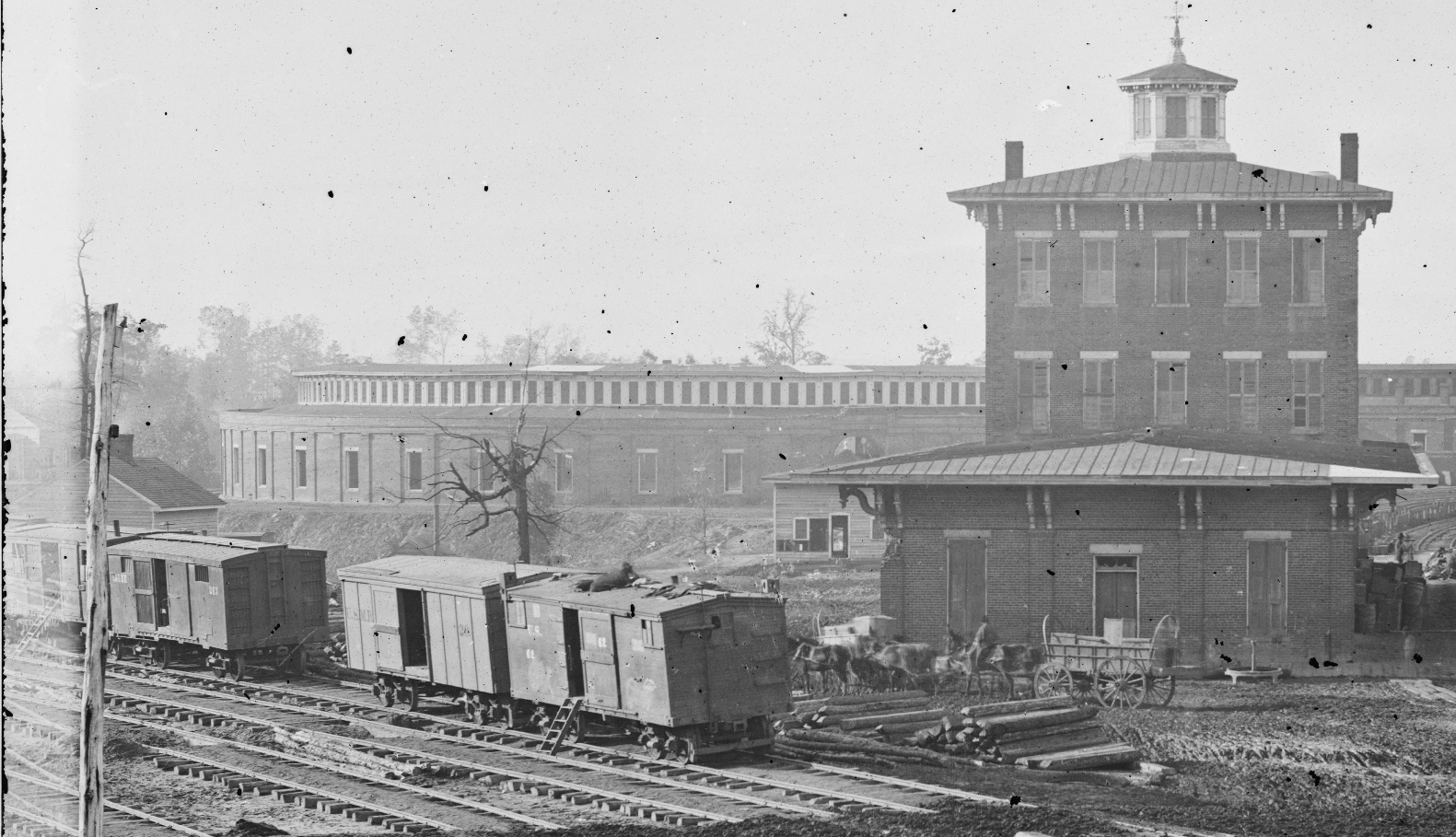
Downtown Atlanta was an extremely busy hub for railroads serving the city and much of the South. The photograph was taken fairly close to the juncture of the Western & Atlantic and Macon & Western railroads.

GBA map of downtown; W&A depot is shown at far left (Click to enlarge)
Local historian and tour guide Michael Hitt says the soldiers are on the Macon & Western railroad.

“In the background is the W&A RR depot,” says Crawford. "Depot site would now be just west of Ted Turner Drive and just northeast of “The Gulch.” Photo was taken from WNW of the depot, about where CNN Center used to be.”

The W&A roundhouse would be to the left, outside the image, said Rose.

The Barnard photo below -- taken before its destruction by Yankee troops -- shows a different angle of the depot, this time with a large roundhouse in the background. The facility was used for servicing locomotives. (Photo: Library of Congress)


Barnard, of course, wanted to make money from his work. Anthony & Co. published several of his photos. A December 2014 article in the newsletter for the Center for Civil War Photography featured the photo of the machinery among others depicting destruction in the city.

“As Yankee engineers proceed with their destructive work, smoke drifts past the ruins of a destroyed building in this original Anthony stereo view. Indeed, there was plenty to dread as night fell on Nov. 15, wrote John Kelley and Bob Zeller. “It was, (Maj. Henry) Hitchcock wrote, “the grandest and most awful scene.”

When was the photograph taken?

Regarding the shot of the men standing around the metal pieces, Steve Davis believes it was taken around Nov. 10-11, days before much of the city was torched.

Keith Davis (left), a leading expert on Barnard, told the Picket the photos of soldiers destroying railroad were likely taken on both Nov. 14 and 15. Sherman’s troops began leaving the city before noon on the 15th to begin the march to Savannah, Ga.

“On the following morning, the general staff, Barnard, and the remainder of the Union forces marched out of the shattered city,” Davis wrote in a book about Barnard.

“So, I have to think that Barnard was extremely active on Nov. 15; thus, making it correct to date these as Nov. 14-15, rather than strictly the 14th,” he told the Picket.

Crawford doesn’t believe the photographs could have been taken Nov. 15.

“We can date these photos because they depict activity, and we know the car shed and rail lines were destroyed on 14 November. Since the armies left town on 15 November, the photos must have been taken on the 14th. Barnard may have taken images as the armies were leaving, but the destruction was completed on the 14th."

The one major gap in Barnard’s Atlanta photography is that no images exist showing the vast panorama of destruction after the fires of Nov. 15 and 16, according Kelley and Zeller in the “Battlefield Photography” newsletter.

What about the two other soldier photos?

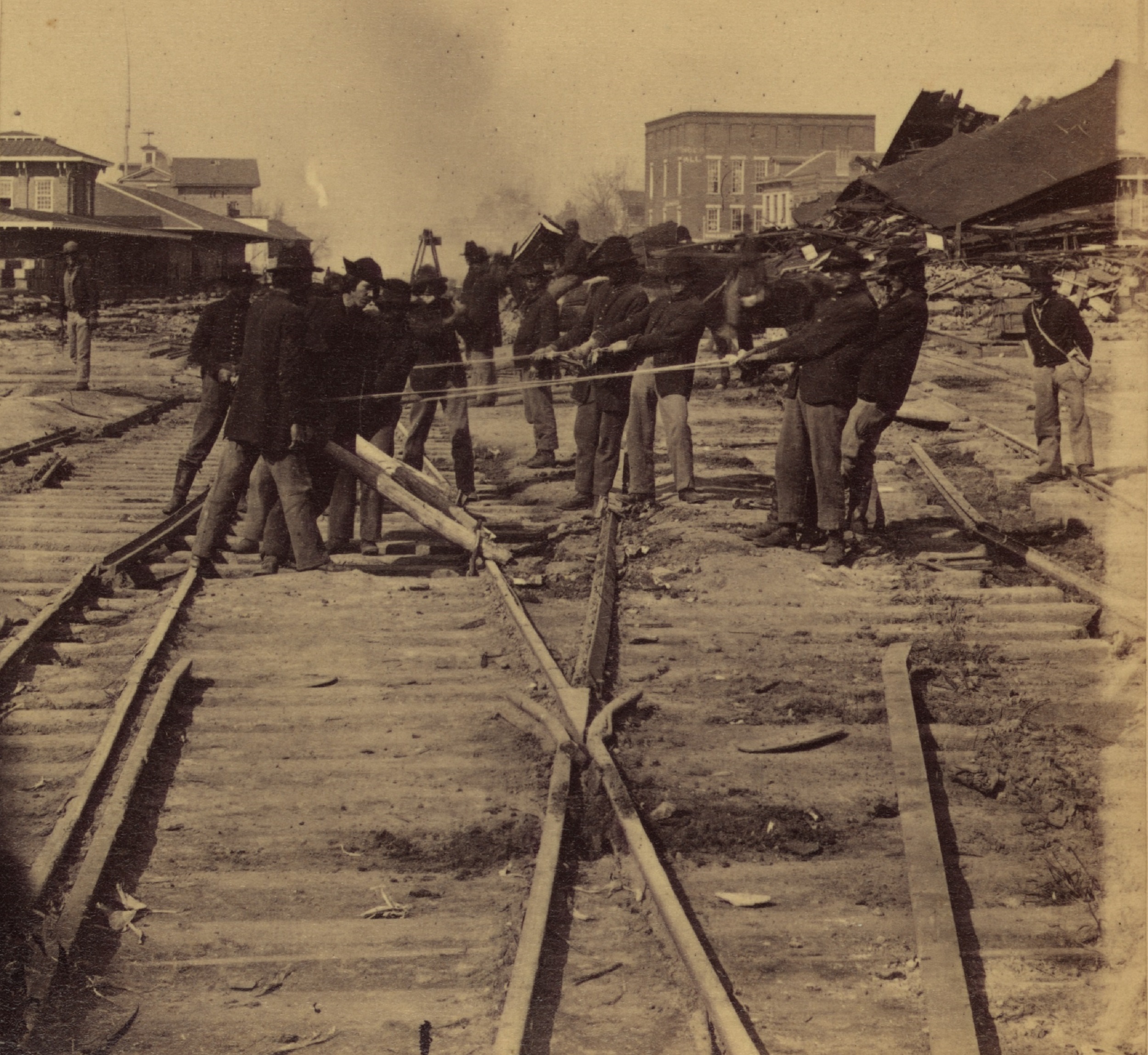
Union engineers destroying track; Western & Atlantic depot behind (Barnard, Library of Congress)
You probably are familiar with two more photographs showing groups of men heating and damaging rail so that the South cannot quickly get the trains running again after the Federal army ends its two-month occupation of Atlanta.

The first photograph described here was taken very close to the main image we have been discussing. Barnard must have moved his camera forward. If you look closely, you can see the men working amid iron rail, wooden ties and other infrastructure.

The photograph with all the machinery shows a particularly tall soldier. I am trying to place him in this photo, and I wonder if he is the man wearing a hat with a round crown, his face not visible to the camera. But the hats don’t exactly match. I welcome guesses from anyone reading this. These men are believed to be from the 1st Michigan and 1st Missouri engineers.

The second photograph, a vintage original stereo view, depicts men heating track near the destroyed car shed, about 700 yards east-southeast from the machinery shot.

Sherman's men do their work; behind right are remnants of car shed (Barnard, Library of Congress)
Union troops used large iron bolts and others items to knock down the arch supports before setting fire to the remains. This was a devastating loss for Atlanta. The car shed was a cooperative venture of the four railroads that served the Georgia city and the Confederacy. The station had been a fixture for about 10 years.

This scene is mostly covered today by the Central Avenue overpass downtown. Smoke from burning railroad ties rises in the background, according to Kelley and Zeller, who date the photograph to Nov. 15. The view is to the west, said Crawford. (Below is a photo of the car shed before its destruction)

“This has been a dreadful day,” Carrie Berry wrote on Nov. 15. “Things have been burning all around us. We dread to night because we do not know what moment that they will burn the last house before they stop.” (Her journal is at the Atlanta History Center)

Modern view (below) is above where car shed was built (Library of Congress and Georgia Battlefields Association)
Those who visit downtown, especially around Underground Atlanta, will notice many street levels have changed in the past century.

“Present day photos are difficult because construction of the viaduct system in the 1920s put the roads 20 to 30 feet higher than the terrain shown in the 1864 photos,” said Crawford. “You can still look down from a few vantage points onto the existing freight line and the two MARTA tracks that occupy some of the space that the multiple rail lines once traversed.”

You can get an idea of the modern landscape from the photo (above) of Lot R parking area that is above where the car shed was formerly.

Sharing blame for all that destruction 

Let’s briefly step back for a little background on what’s been termed in folklore as the Burning of Atlanta. About 40 percent of the city was in ruins when Sherman began his March to the Sea. But don’t lay all the blame solely at his feet.

“It started when Confederate military planners stripped and leveled buildings and homes on the city’s outskirts to build the extensive fortifications that Sherman found impenetrable,” reads an online presentation, “War in Our Backyards,” produced by The Atlanta Journal-Constitution and the Atlanta History Center for the 2014 Civil War Atlanta centennial.

Hood's troops blew up ammunition train before leaving (Barnard, Fleischer's Auctions)
“During the summer siege, Union artillery fire hit many of the city’s major structures, setting many afire. Miles of trenches dug by both sides scarred fields and roads. When the Confederates made their retreat, they blew up their ammunition train, damaging scores of homes, and burned the massive Atlanta Machine Works factory,” the AJC said.

Looters, arsonists and the need for material for Union forts took their toll until November 1864, when Sherman “ordered the destruction and burning of all facilities with potential military value, including ripping up rail lines and destroying Atlanta’s transportation infrastructure.” He ordered out the remaining civil population, who were offered a one-way train ride either north or south.

Steve Davis has written about how the fires spread to residences, and some Union soldiers decided to start some residential blazes of their own.

You can see sites in March walking tours

Sadly, virtually nothing from wartime downtown Atlanta remains today and only a guided tour and some imagination can provide an adequate picture.

Crawford has led the GBA walking tour for 18 years. I went on a version in 2014 with former The Atlanta Journal-Constitution editor Scott Peacocke in July 2014. I enjoyed it and wrote about the experience here. “It rained buckets,” Crawford reminded me.

Scott Peacocke, Charlie Crawford and Mary-Elizabeth Ellard in 2014 (Picket photo)
Free walks will be held on March 8 and March 22 as part of the Atlanta Preservation Center’s Phoenix Flies program of tours and other events.

Crawford works from a downtown then-and-now map and a PowerPoint presentation with Barnard photos. The slides include pointers and basic information. He then takes participants around the area to see the “now” view to correspond to the old images.

“It’s always fun to hear people say that they had seen some of Barnard’s photos and always wondered where they were taken,” he said.

Particularly popular are references to the book and movie “Gone With the Wind", including a scene in which Scarlett O’Hara approaches the car shed, which had been turned into a receiving hospital under care of Dr. Meade.


She walks through the expanse created by multiple rail lines, and hundreds of injured Confederate soldiers, some on stretchers, some on the red soil or tracks, writhe in agony or lie motionless. It is a powerful scene, punctuated by a tattered Rebel battle flag.

Crawford said he gets a variety of reactions and questions during his tours.

“Discovering that not all of Atlanta was destroyed is difficult for some to accept. Seeing that the state Capitol is now on the former City Hall site seems to give most people something they can surprise their family with.” 

----

Georgia Battlefields Association will again lead free Phoenix Flies tours GBA of Civil War downtown Atlanta. Participants must preregister for the March 8 and 22 walks, which take about 2 hours and 45 minutes. The tours are limited to 25 people. Click here for more information. Registration for Phoenix Flies begins Feb. 21.